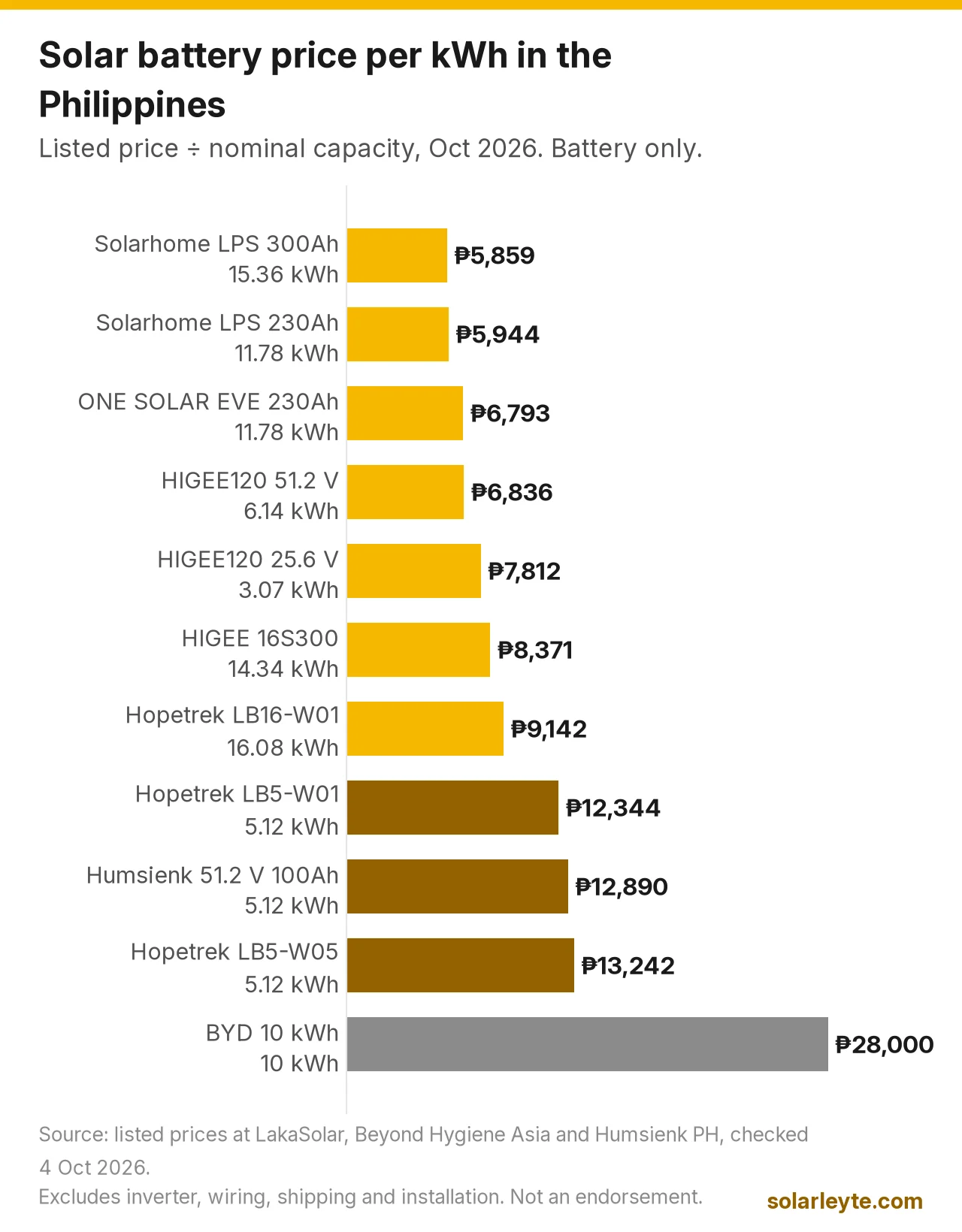
A 5–6 kWh LiFePO4 (lithium iron phosphate) home battery is listed at ₱42,000 to ₱67,800 by the Philippine sellers we checked. Bigger 11–16 kWh units run ₱70,000 to ₱147,000. For most models that works out to roughly ₱5,900 to ₱13,200 per kWh of nominal capacity. One premium brand costs about ₱28,000 per kWh. These are equipment prices only, before the hybrid inverter, wiring, delivery and installation.
Brownout na pud? Here's why Leyte and Biliran families are asking:
- On 8 August 2026, an NGCP maintenance shutdown cut power to BILECO's entire franchise area for 13 hours, from 5 am to 6 pm (Biliran Blogs, BILECO advisory).
- On 26 August, NGCP announced possible rotating brownouts from 5 pm to 9 pm for BILECO, LEYECO II to V, SOLECO, ESAMELCO, NORSAMELCO and SAMELCO I and II, because of limited generation (GMA News).
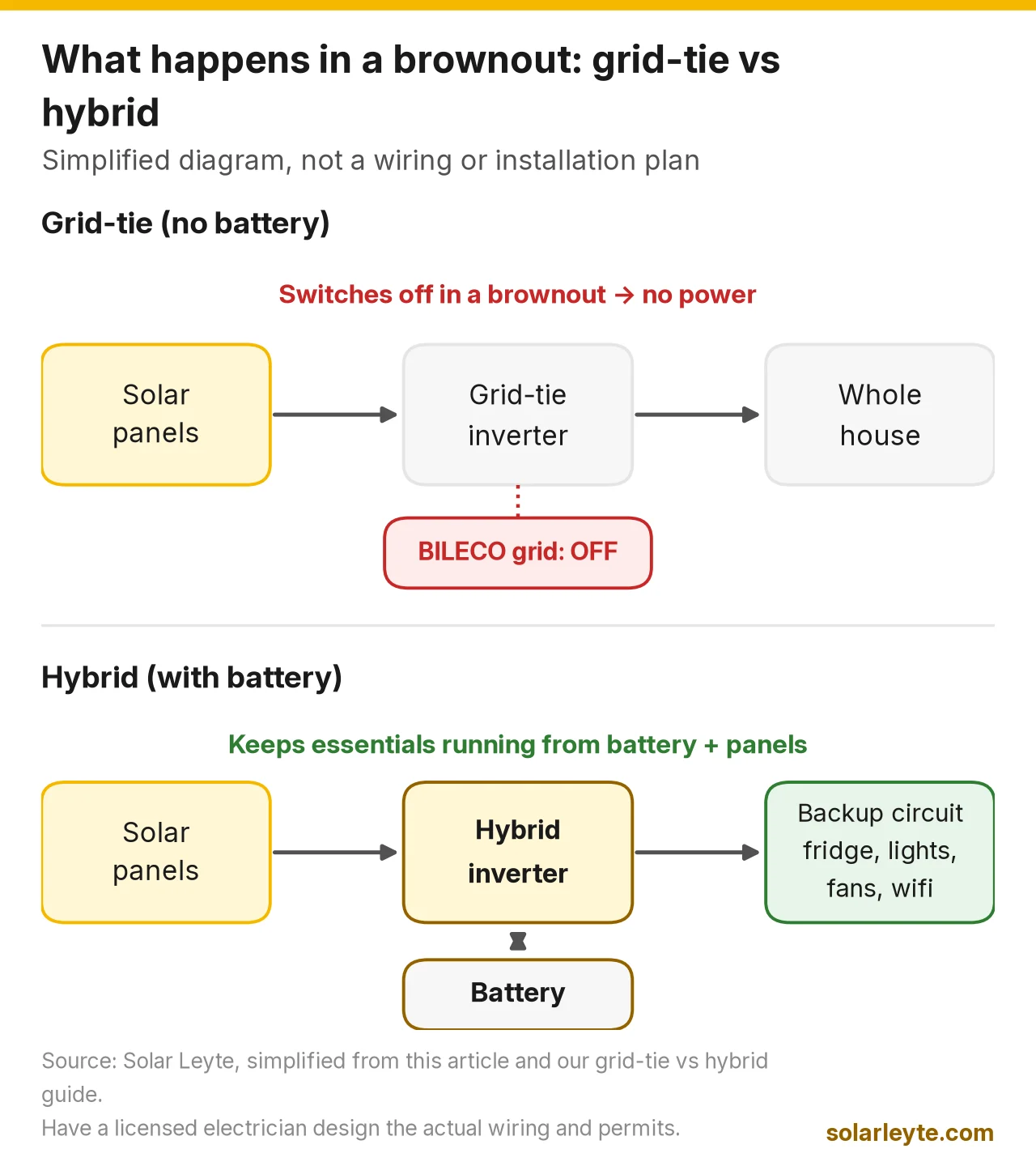
A standard grid-tie solar system switches off in a brownout. Only a battery on a hybrid or off-grid inverter keeps the lights on (grid-tie vs hybrid explained).
All prices and facts checked 4 October 2026. Prices change often. Click through to the seller before you budget.
Solar battery prices in the Philippines (October 2026)
These are listed prices from Philippine online sellers, for batteries sold for home solar storage. "₱ per kWh" is the listed price divided by the nominal capacity. We haven't added shipping or installation. Including a listing here isn't an endorsement.
Battery (as listed) | Nominal capacity | Seller | Listed price | ₱ per kWh | Warranty (per listing) |
|---|---|---|---|---|---|
ONE SOLAR HIGEE120, 25.6 V 120Ah | 3.07 kWh (24 V systems) | LakaSolar | ₱24,000 | ₱7,812 | 3 years |
ONE SOLAR HIGEE120, 51.2 V 120Ah | 6.14 kWh | LakaSolar | ₱42,000 | ₱6,836 | Not stated |
Hopetrek ESS-LB5-W01, 51.2 V 100Ah | 5.12 kWh (4.6 kWh usable) | Beyond Hygiene Asia | ₱63,200 (VAT incl.) | ₱12,344 | 5 years |
Hopetrek ESS-LB5-W05 | 5.12 kWh | Beyond Hygiene Asia | ₱67,800 (VAT incl.) | ₱13,242 | 10 years |
Humsienk 51.2 V 100Ah wall-mount | 5.12 kWh | Humsienk PH | ₱65,999 | ₱12,890 | 5 years |
Solarhome LPS 51.2 V 230Ah | 11.78 kWh | LakaSolar | ₱70,000 | ₱5,944 | Not stated |
ONE SOLAR EVE 51.2 V 230Ah | 11.78 kWh | LakaSolar | ₱80,000 | ₱6,793 | 3 years |
BYD 10 kWh energy storage battery | 10 kWh | LakaSolar | ₱280,000 | ₱28,000 | Not stated |
ONE SOLAR HIGEE 16S300, 51.2 V 280Ah | 14.34 kWh | LakaSolar | ₱120,000 | ₱8,371 | 5 years |
Solarhome LPS 51.2 V 300Ah | 15.36 kWh | LakaSolar | ₱90,000 | ₱5,859 | Not stated |
Hopetrek ESS-LB16-W01, 51.2 V 314Ah | 16.08 kWh (14.4 kWh usable) | Beyond Hygiene Asia | ₱147,000 (VAT incl.) | ₱9,142 | 5 years |
Small 12 V batteries (for DC lighting kits and small off-grid setups, not home hybrid systems):
- Humsienk 12 V 100Ah LiFePO4 (1.28 kWh): ₱12,999 on sale, ₱19,999 regular (Humsienk PH)
- Solar Homes 12 V 100Ah gel (lead-acid) (1.2 kWh): ₱6,500 (LakaSolar)
Listing links:
- LakaSolar: HIGEE120 25.6 V, HIGEE120 51.2 V, Solarhome 230Ah, EVE 230Ah, BYD 10 kWh, HIGEE 16S300, Solarhome 300Ah
- Beyond Hygiene Asia: Hopetrek LB5-W01, LB5-W05, LB16-W01
- Humsienk PH: 51.2 V 100Ah
Not listed: We couldn't find a Philippine listed price for the Deye SE-G5.1 Pro-B, a common 5.12 kWh battery for Deye hybrid inverters. Ask installers for a quote.
What makes one battery cost more than another
- Warranty length. The two Hopetrek 5.12 kWh models differ by ₱4,600. The seller says the confirmed difference is the warranty: 10 years versus 5 (Beyond Hygiene Asia). Deye says its SE-G5.1 Pro-B warranty is "5 Years / 10 Years" depending on where the battery is installed, so check the terms for the Philippines (Deye).
- Brand. The BYD 10 kWh listing works out to about ₱28,000 per kWh, against ₱5,859 to ₱13,242 for the other 51.2 V batteries in the table.
- Certifications. Some listings name safety and transport standards. Hopetrek lists IEC 62619 and UN38.3, and Humsienk lists IEC 62619. Others name none.
- BMS and current rating. The battery management system (BMS) limits how much power the battery can deliver. More on this below.
- Inverter communication. Listings mention CAN or RS485 communication and name compatible inverter brands. For example, LakaSolar's HIGEE120 lists Deye 5–16 kW hybrids, and Humsienk lists Victron, Deye and Growatt.
Nominal vs usable kWh: compare the right number
The label shows nominal capacity. You can't use all of it without shortening the battery's life:
- Hopetrek LB5-W01: 5.12 kWh nominal, 4.6 kWh usable, recommended depth of discharge 90%.
- Hopetrek LB16-W01: 16.08 kWh nominal, 14.4 kWh usable.
Divide by usable kWh, and the LB5-W01 costs about ₱13,739 per usable kWh. The LB16-W01 costs about ₱10,208. If a listing doesn't state usable capacity, ask for the datasheet.
The same applies to lead-acid. The gel battery above is cheaper per nominal kWh (₱5,417), but compare it on the usable capacity and cycle rating in its datasheet. Weight matters too: the Solar Homes 12 V 200Ah gel battery stores 2.4 kWh and weighs 58 kg (LakaSolar). The Hopetrek LB5-W01 stores 5.12 kWh at 45 kg.
How many kWh do you need for a brownout?
- List only what must keep running. For most homes that means the refrigerator, lights, fans, wifi and phone charging. Put these on a separate "backup" circuit.
- Find each appliance's energy use. Use the yellow DOE energy label (kWh per month) or the watts on the nameplate. Watts × hours ÷ 1,000 = kWh.
- Multiply by how long your brownouts last.
- Add a margin. We add 20% for inverter losses and battery ageing. That's our planning assumption, not a manufacturer figure.
The appliance figures we used:
- Refrigerator: a Condura 8 cu ft inverter model (CNF-223i) has a DOE label rating of 19.8 kWh per month, about 0.66 kWh a day (DOE energy label issuances, 2023).
- Lights: a 9 W LED bulb uses 0.009 kWh per use in Meralco's tested-appliance list (Meralco, lighting).
- Fans: a 16-inch Sharp stand fan uses 0.0584 kWh per use (Meralco, fans). We count one "use" as one hour.
- Wifi router: 10 W, our assumption. Check your adapter label.
Load | 4-hour evening brownout (5–9 pm) | 13-hour daytime outage (5 am–6 pm) |
|---|---|---|
Refrigerator (0.0275 kWh/hour) | 0.11 kWh | 0.36 kWh |
4 LED bulbs, 9 W | 0.14 kWh (4 hours) | 0.07 kWh (2 hours) |
2 stand fans | 0.47 kWh | 1.52 kWh |
Wifi router, 10 W | 0.04 kWh | 0.13 kWh |
Total | 0.76 kWh | 2.08 kWh |
With 20% margin | about 0.9 kWh | about 2.5 kWh |
What this means: for essentials only, one 5 kWh-class battery (about 4.6 kWh usable) covers either scenario with room to spare. A 3 kWh unit covers the evening brownout. During a daytime outage, the panels on a hybrid system also recharge the battery, weather permitting.
Aircon changes everything. A DOE-labelled 1.0 HP inverter split aircon (Boston Bay ABT1122-1HPS) has a power rating of 870 W (DOE energy label issuances, Jan–Jun 2024). At that rating, 8 hours overnight is up to about 7 kWh, more than a 5 kWh battery can deliver. If you want aircon through a night-time brownout, plan for a 10–16 kWh battery. Or accept fewer aircon hours.
Power (kW) matters as much as capacity (kWh)
Capacity (kWh) decides how long. Power (kW) decides how much at once. A battery's maximum power is roughly its current rating times its voltage:
- Humsienk 51.2 V 100Ah: 100 A BMS × 51.2 V ≈ 5.1 kW. Its listing gives 76.8 kW for 15 units, which is the same figure per unit.
- LakaSolar HIGEE120 25.6 V: 120 A discharge × 25.6 V ≈ 3.1 kW.
- Hopetrek LB5-W01: lists a 50 A pack current (about 2.6 kW) and "system 100 A". Ask the seller how much one unit can supply continuously.
Your hybrid inverter's rating is a second limit. Motors and compressors (fridge, pump, aircon) also draw a short surge when they start (our portable power guide explains why). If you want a fridge, a pump and an aircon on backup together, check both numbers.
Does a battery pay for itself in Biliran?
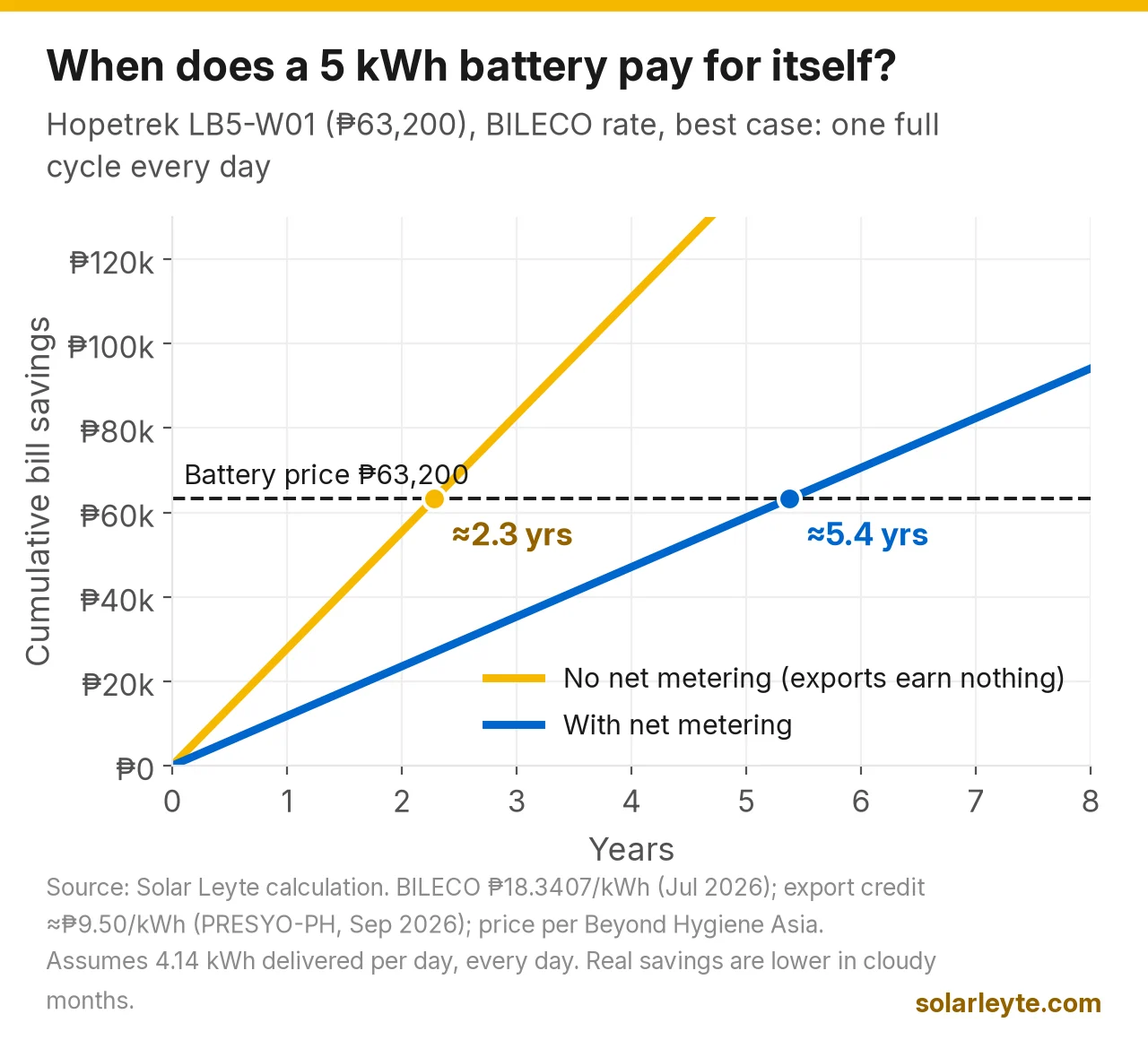
It depends on net metering. Solar power you use yourself saves BILECO's full rate, which was ₱18.3407/kWh in July 2026 (our BILECO rate tracker). Power you export under net metering earns only the blended generation rate, about ₱9.50/kWh for BILECO in September 2026 per ICSC's PRESYO-PH (how BILECO net metering works).
A battery's money value comes from storing midday surplus and using it at night, instead of exporting it.
Best-case example. These are assumptions, not a promise:
- Battery: Hopetrek LB5-W01, 4.6 kWh usable, ₱63,200.
- We assume 10% is lost charging and discharging, so 4.14 kWh comes back out.
- Assume a full cycle from surplus solar every day. That's optimistic, because cloudy days and the rainy season mean less surplus.
With net metering | Without net metering (exports earn nothing) | |
|---|---|---|
Value of 4.14 kWh used at night | 4.14 × ₱18.3407 = ₱75.93 | ₱75.93 |
Export credit given up | 4.6 × ₱9.50 = ₱43.70 | ₱0 |
Gain per day | ₱32.23 | ₱75.93 |
Gain per year (365 days) | about ₱11,764 | about ₱27,715 |
Simple payback on ₱63,200 | about 5.4 years | about 2.3 years |
What this means:
- With net metering, a battery is mainly brownout insurance. The bill savings are a bonus.
- Without net metering, it can pay back quickly. That applies if your co-op hasn't enrolled you yet, or if your system is set to zero export.
- The example leaves out the extra cost of a hybrid inverter compared with a grid-tie one.
Cycle life vs warranty. Hopetrek rates the LB5-W01 at 6,000+ cycles. At one cycle a day, that's over 16 years on paper. But the warranty you can actually claim is 5 years for this model, or 10 years for the W05. Count on the warranty, not the cycle rating.
Checklist before you buy a battery in Leyte or Biliran
- Voltage matches your inverter. Check which battery voltage your inverter takes. Most batteries in the table are 51.2 V ("48 V") units. The 25.6 V and 12 V ones are for 24 V and 12 V systems.
- Communication. Your battery and inverter should talk to each other over CAN or RS485. Check that your inverter brand is listed as compatible.
- Usable kWh and continuous kW are written on the datasheet.
- Certifications: ask for IEC 62619 and UN38.3 documents if they aren't listed.
- Warranty in writing, and who handles claims in Eastern Visayas.
- Delivery to the island. The 16 kWh Hopetrek weighs 120 kg. WattCycle PH, for example, sends large batteries by truck and requires a signature on delivery (WattCycle PH). Ask for the freight cost to Biliran or your town before you pay.
- Where it goes. The Hopetrek batteries are rated IP20, which means indoor use. Keep the battery dry, shaded and above flood level (typhoon guide).
- Compare full quotes, not battery prices alone (how to read a solar quote).
FAQ
How much is a 5 kWh solar battery in the Philippines? Between ₱42,000 and ₱67,800 in the listings we checked in October 2026, for 5.12–6.14 kWh LiFePO4 units. That's equipment only.
How long will a 5 kWh battery last in a brownout? For a fridge, 4 LED bulbs, 2 fans and wifi, our example uses about 0.9 kWh for a 4-hour evening brownout and 2.5 kWh for 13 hours, margin included. A battery with about 4.6 kWh usable covers both.
Can a solar battery run an aircon all night? A 1 HP inverter aircon rated at 870 W could use up to about 7 kWh in 8 hours. That needs a 10–16 kWh battery, not a 5 kWh one.
LiFePO4 or lead-acid? Lead-acid gel is cheaper per nominal kWh. Compare usable capacity, cycle rating and weight on the datasheets before you decide. For home hybrid systems, the listings in this guide are almost all 51.2 V LiFePO4.
Will a battery lower my BILECO bill? Only a little if you're on net metering, about ₱32 a day in our best case. It saves more if your exports earn nothing. Its main job is backup.
Solar Leyte is run by MACC Systems & Energy Solutions Inc., a solar installer in Naval, Biliran.
Get a free battery and backup quote from MACC
Tell us which appliances must keep running and how long your brownouts usually last. We'll size the battery and inverter for that list and show you the math, with no obligation.
- Call/Text: 0955 723 5093
- Email: official@macc-inc.com or benjie@macc-inc.com
- Website: www.macc-inc.com
- Office: Brgy. Talustusan, Naval, Biliran 6543
Sources (all checked 4 October 2026)
- LakaSolar Philippines, battery listings: HIGEE120 25.6 V, HIGEE120 51.2 V, Solarhome 230Ah, EVE 230Ah, BYD 10 kWh, HIGEE 16S300, Solarhome 300Ah, 12 V 100Ah gel, 12 V 200Ah gel
- Beyond Hygiene Asia, Hopetrek listings and specifications: LB5-W01, LB5-W05, LB16-W01
- Humsienk PH, 51.2 V 100Ah LiFePO4 battery (also lists the 12 V 100Ah unit)
- WattCycle PH, 48 V 100Ah battery page and shipping policy
- Deye, SE-G5.1 Pro-B datasheet page
- DOE Philippine Energy Labeling Program: refrigerating appliances, Jan–Jun 2023 (PDF), air conditioners, Jan–Jun 2024 (PDF)
- Meralco, tested-appliance tables: lighting (PDF), fans (PDF)
- GMA News, Rotating brownouts may hit Visayas consumers on Aug. 26, 2026
- Biliran Blogs, 13-hour power outage to affect entire BILECO coverage area (BILECO/NGCP advisory)
- ICSC, PRESYO-PH (BILECO blended generation rate)
- Solar Leyte, BILECO Rate per kWh 2026 and BILECO Net Metering guide