An isolation fault means your solar inverter measured too little insulation resistance between the solar panel wiring and earth (ground), so it refuses to connect to the grid until the leak goes away. A grid fault is different: the inverter is fine, but the co-op's power is missing, too high, too low or at the wrong frequency, so it disconnects to protect itself and the line. An isolation fault that shows only on wet mornings and clears by mid-morning is usually moisture. One that shows on a dry, sunny noon is a damaged cable, connector or panel, and that's a job for your installer. A grid fault during a brownout is normal. A grid fault that comes back every sunny afternoon with the lights still on is usually a voltage problem.
First move: photograph the code and the time, check whether your lights are on, and note the weather.
Last checked: 20 November 2026, against the Huawei SUN2000-L1, Solis S6-GR1P, Sungrow SG-RS, Growatt MIN TL-XH2 and Deye SUN-SG05LP1 user manuals, the Solis service alarm list, Fronius's DC insulation resistance white paper (June 2026) and the Philippine Distribution Code 2017. Codes differ by model and firmware, so always confirm with your own model's manual.
Isolation fault or grid fault? The 30-second check
What you see | Most likely | What it means |
|---|---|---|
Code shows at sunrise, after rain or on a foggy morning, then clears by itself | Isolation fault (moisture) | Damp wiring and panels let a little current leak to earth. Usually harmless if it always clears. |
Isolation code on a dry, sunny day, or it never clears | Isolation fault (real damage) | A cable, connector, junction box or panel is leaking to earth. Switch nothing back on repeatedly; call your installer. |
"No Grid", "Grid Lost", "Grid Failure" and your lights are off | Grid fault (brownout) | Normal. Grid-tie inverters must switch off when the grid goes down. |
"No Grid" but your lights are on | Grid fault (wiring) | The inverter can't see the grid: an AC breaker is off or a cable is loose. |
Grid overvoltage code around midday or afternoon, lights on | Grid fault (voltage) | The voltage at the inverter is above its limit, from the co-op line, a long thin AC cable, or both. |
Leakage current, residual current or GFCI code | Earth-leakage fault | Close cousin of the isolation fault, caught while the inverter is running. Same checks. |
Sources: each brand's fault table (see Sources). Solar Leyte summary.
What an isolation fault actually is
Every panel and cable has a very high but not infinite resistance to earth. Fronius calls the combined figure the system's insulation resistance, or Riso. Normally only a tiny, harmless current leaks away; damaged insulation can turn that into a fire or shock risk.
That's why the inverter checks Riso every morning before it connects to the grid, then keeps watching for leakage while it runs. Under IEC 62109-2, a non-isolated (transformerless) inverter, such as Growatt's MIN TL-XH2, must not connect to the mains while Riso is too low, because the grid's earthed neutral would give the leak a path.
The names differ by brand, but they mean the same thing:
Brand and model | Isolation code | Leakage code while running |
|---|---|---|
Huawei SUN2000-L1 | 2062 Low Insulation Resistance | 2051 Abnormal Residual Current |
Solis S6-GR1P | 1033 PV ISO-PRO 01/02 ("PV Isolation Protection") | 1034 Leakage Current Protection 01–04 |
Sungrow SG-RS | 39 Low System Insulation Resistance | 12 Excess Leakage Current |
Growatt MIN TL-XH2 | Error 203 PV Insulation Resistance Low ("PV ISO Low") | Error 201 Residual I High |
Deye SUN-SG05LP1 | F24 DC insulation impedance failure | F23 AC leakage current transient over current |
Sources: Huawei, Solis, Sungrow, Growatt and Deye user manuals; Solis service alarm list.
How low is "too low"?
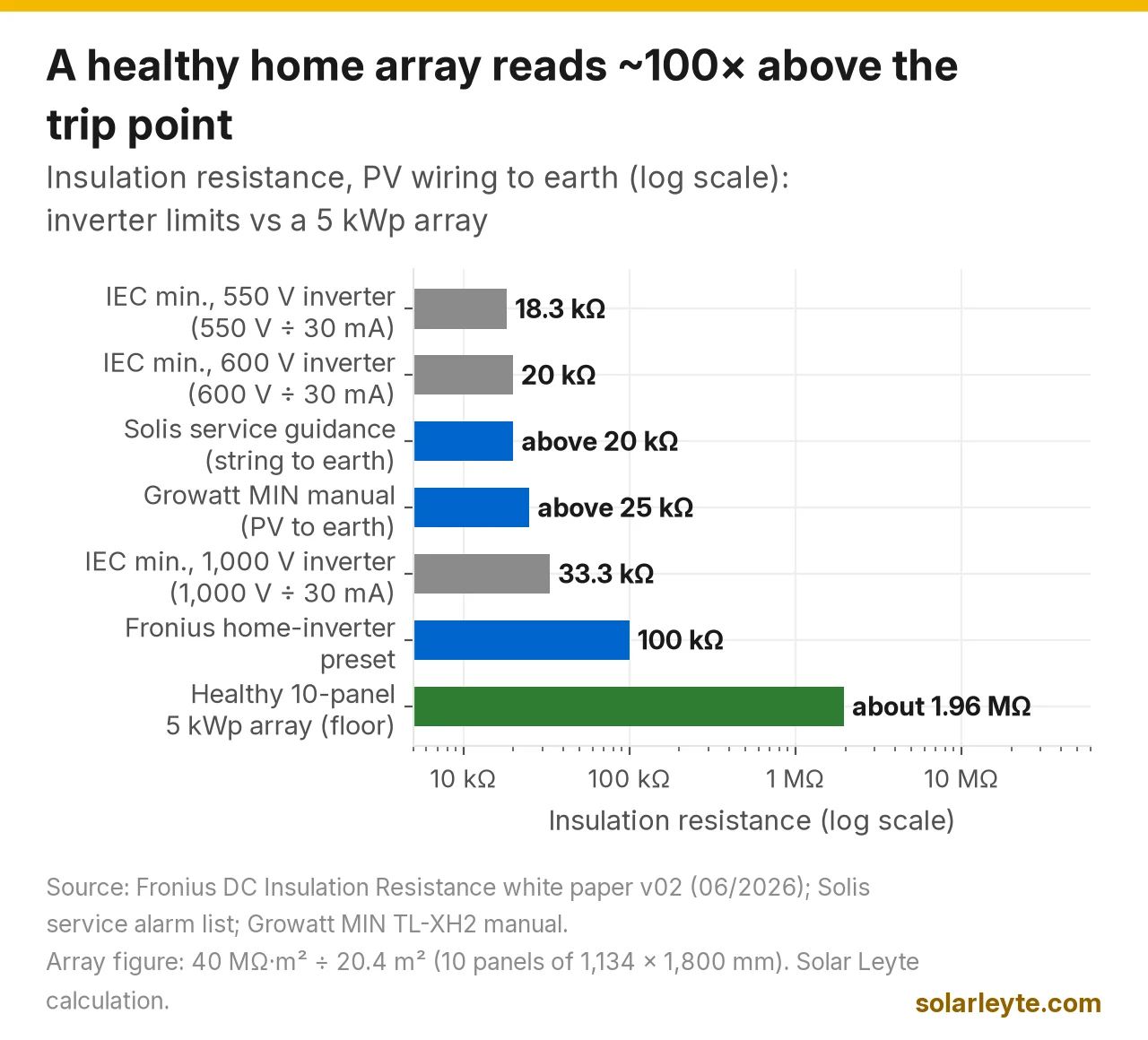
IEC 62109-2 sets the minimum as the inverter's maximum DC input voltage divided by 30 mA, the current most shock-protection standards treat as the limit. Fronius gives the example of a 1,000 V inverter: 1,000 V ÷ 30 mA = 33.3 kΩ. Some makers set their own threshold higher to leave a margin; Fronius uses 100 kΩ on its home inverters up to 15 kW.
Inverter (max DC input) | IEC 62109-2 minimum (max V ÷ 30 mA) | What the maker says |
|---|---|---|
Solis S6-GR1P (550 V) | about 18.3 kΩ | String-to-earth resistance "should be above 20 kΩ" (Solis service list) |
Growatt MIN TL-XH2 (550 V) | about 18.3 kΩ | "More than 25 KΩ or 550 KΩ (according to VDE 0126 standards)" |
Huawei SUN2000-L1 (600 V) | 20 kΩ | Shows the measured value in MΩ and a likely fault position in the app |
A 1,000 V inverter | 33.3 kΩ | Fronius presets 100 kΩ for its home models |
IEC minimums are Solar Leyte calculations from the IEC 62109-2 formula as quoted by Fronius. Maker figures from the Solis service list, the Growatt MIN manual and Fronius Appendix A.
Worked example A: what a healthy home array should read. The panel standard IEC 61215-2 requires at least 40 MΩ·m² of insulation per panel, so bigger arrays read lower. Fronius uses 500 W panels of 1,134 × 1,800 mm (about 2 m² each). Ten of those make a 5 kWp array of about 20.4 m²: 40 MΩ·m² ÷ 20.4 m² ≈ 1.96 MΩ, or about 1,960 kΩ, even at the panel standard's floor. That's roughly 100 times the 18–20 kΩ trip point of a 550–600 V home inverter (Solar Leyte calculation). So on a normal-size home system, a reading low enough to trip the inverter is very unlikely to be "just a big array". It's moisture or damage.
Why it shows up on wet mornings in Leyte and Biliran
Solis's own service list says it plainly: if the isolation alarm appears in the early morning, late afternoon or on a rainy day, it's a normal phenomenon, because moisture in the air lowers the resistance. Sungrow's manual says to recheck 39 when the weather turns fine, and Huawei lists "the ambient air of the PV array is damp" as one of the two causes of 2062. Solis adds that ageing panels can leak more on rainy days or mornings, and that this clears when the humidity drops.
What makes a wet-morning alarm a real problem is where the water gets in. Usual suspects:
- MC4 connectors lying in a gutter or on the roof sheet, where rain pools around them.
- Cable insulation cut by sharp roof edges, cable ties pulled too tight, or chewed by rats.
- A junction box on the back of a panel with a cracked lid or lifted seal.
- A cracked panel or backsheet. Broken glass means the insulation is no longer guaranteed when wet. See our cracked solar panel guide.
- A wet DC isolator or breaker box. Growatt's checklist includes "check if the DC breaker gets wet".
- Salt and grime on seaside roofs. See solar panels near the sea.
Rule of thumb: if it clears once the sun dries things out, log the dates and times. If it starts clearing later each week, or shows on dry days, the insulation is getting worse: call your installer.
What to do about an isolation fault
What you can safely do
- Photograph the code, the time and the weather. Huawei's FusionSolar app also shows the measured insulation resistance in MΩ; screenshot it.
- Look, don't touch. From the ground or a safe window, look for cables hanging loose, connectors in water, or a broken panel.
- Check the inverter's earth cable is in place, without opening anything. Huawei, Growatt and Deye all list a missing or loose PE (earth) cable as a cause.
- Wait for the sun. If it clears by mid-morning and never shows on dry days, log it and mention it at your next service.
- Don't keep switching the DC isolator on and off to "reset" it. The inverter will reconnect by itself when Riso recovers.
Never touch panel cables or connectors. Panels make DC voltage in daylight even with the inverter off, and a home string can be several hundred volts (Huawei's L1 allows up to 600 V).
What your installer will check
- Resistance from each string to earth, with the DC side isolated, one string at a time. Solis says to connect strings one by one: if the error stops when one string is out, that string has the problem.
- The N-to-earth wiring on the AC side. Solis says N-to-earth resistance should be close to zero. Growatt's Error 303 "PE abnormal" means more than 30 V between neutral and earth.
- Damaged cables, connectors and junction boxes, which get replaced, not taped.
- The inverter's insulation-resistance setting. Sungrow and Huawei both let an installer change it, but Sungrow says it must stay compliant with local rules, and Fronius says any change has to be cleared with everyone involved. It's not a fix for a real leak.
- Firmware. Solis notes that detection thresholds have changed with firmware updates over the years.
Worked example B: Huawei's fault locator. Huawei's app gives a "possible short-circuit position" as a percentage along the string, where 0% is the negative end and 100% the positive end. From Huawei's manual: a 14-panel string showing 34% points to 14 × 34% = 4.76, near panel 4, give or take one panel. That tells the installer which part of the roof to check first. It only works when there's one fault in one string.
What a grid fault means
A grid fault is the inverter telling you the co-op's side isn't right. The inverter itself is usually fine. The main types:
Fault | Huawei SUN2000-L1 | Solis S6-GR1P | Sungrow SG-RS | Growatt MIN | Deye SG05LP1 |
|---|---|---|---|---|---|
No grid / grid lost | 2032 Grid Failure | 1015 NO-Grid | 10 Grid Power Outage | Error 302 No AC connection | F35 No AC grid |
Grid overvoltage | 2034 Grid Overvoltage | 1010 OV-G-V 01–05 | 2, 3, 14, 15 | Error 300 AC V Outrange | Not in the F-code table |
Grid undervoltage | 2033 Grid Undervoltage | 1011 UN-G-V | 4, 5 | Error 300 AC V Outrange | F42 AC line low voltage |
Grid frequency | 2036 / 2037 | 1012 / 1013 | 8, 9 | Error 304 AC F Outrange | F47 / F48 |
Sources: the five user manuals and the Solis service alarm list (see Sources). Per-brand detail is in our Solis, Sungrow, Growatt and Deye error-code guides.
"No Grid" during a brownout is normal
When BILECO or LEYECO power goes off, a grid-tie inverter must stop exporting so it doesn't energise a dead line. The Distribution Code requires small home systems to detect this and disconnect within 2 seconds, and wait until utility power has been back for at least 10 minutes before reconnecting (sec 4.9.5.4). Meralco's net-metering FAQ says the same: a grid-connected system must stop energising the lines during an outage, and anti-islanding must never be bypassed. Huawei's manual says that with DC connected and AC off, the inverter reports a Grid Loss alarm and only starts again after the grid recovers. A hybrid inverter with a battery can keep selected loads running only through a separate backup (EPS) output isolated from the grid; it doesn't keep feeding the street (see our grid-tie vs hybrid guide). If the lights are back on and the inverter still says No Grid after several minutes, check the solar AC breaker. Sungrow, Deye and Growatt all list the AC breaker and AC wiring among their checks.
Grid overvoltage when the lights are on
The Philippine Distribution Code 2017 sets nominal frequency at 60 Hz and has the utility help keep it between 59.7 and 60.3 Hz in normal conditions (secs 3.2.2.1–3.2.2.2). It defines long-duration undervoltage and overvoltage as RMS voltage at or below 90%, or at or above 110%, of nominal for more than one minute (sec 3.2.3.3), and the utility must keep both away from the customer's connection point in normal operation (secs 3.2.3.4, 4.2.3.1). At the 230 V residential nominal (Meralco, citing the PEC) that window is 207–253 V (Solar Leyte calculation). If a licensed electrician measures a sustained voltage above 253 V on the meter side (at a nearby outlet, the service entrance or the inverter's AC terminals; never open the sealed meter or work live), file a dated written complaint with BILECO's or LEYECO's Consumer Welfare Desk with the readings, dates and times, and keep a copy. Inverters are set to trip near these limits. Every brand says the same thing: if it happens once in a while, it's the grid, and the inverter reconnects by itself. If it happens often, measure the voltage.
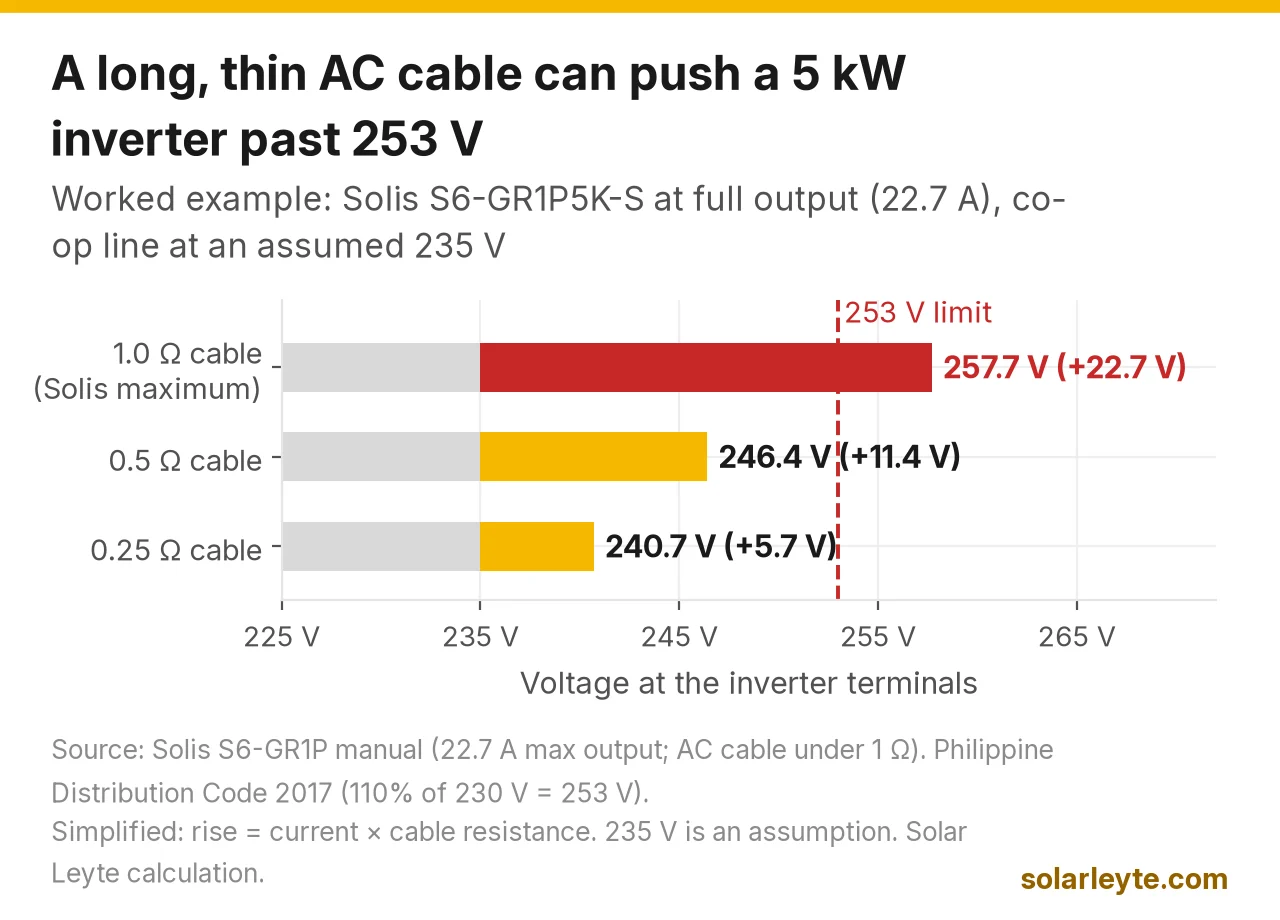
The catch is that a grid-tie inverter pushes the voltage up at its own terminals when it exports, by the current times the resistance of the AC cable back to the meter. That's why Solis requires an AC cable with under 1 ohm of resistance and recommends 6 mm² for runs longer than 20 m.
Worked example C: why the fault shows at noon, not at 8 a.m. A Solis S6-GR1P5K-S can push up to 22.7 A (its spec sheet). Say the co-op line at your meter reads 235 V (an assumed figure).
AC cable resistance | Voltage rise (22.7 A × R) | Voltage at the inverter | Inside 253 V? |
|---|---|---|---|
1.0 Ω (Solis's maximum) | 22.7 V | 257.7 V | No: likely OV-G-V trip at full output |
0.5 Ω | 11.4 V | 246.4 V | Yes |
0.25 Ω | 5.7 V | 240.7 V | Yes, with margin |
Solar Leyte calculation, simplified: real voltage rise also depends on power factor and the co-op transformer. 22.7 A and the 1 Ω limit are from the Solis S6-GR1P manual; 235 V is an assumption.
At 8 a.m. the inverter makes a fraction of 22.7 A, so the rise is small. At noon it trips. Solis's service notes describe this pattern: an inverter that ramps to about 2,000 W, then trips on OV-G-V 1, with AC cable length and size among the causes.
What to do: have your installer measure the voltage at the meter and at the inverter while it's exporting. If the inverter end is much higher, the AC cable is the fix. If the meter side reads above 253 V for long periods, that's a co-op issue: see the complaint steps above. Huawei, Sungrow and Solis all say that protection limits may only be widened with the consent of the local power operator, never just to make the alarm go away.
Worked example D: what a stubborn fault costs. A 5 kWp grid-tie system makes about 105 kWh per kWp a month, or about 17.5 kWh a day (5 × 10⁵ ÷ 30). At BILECO's November 2026 residential rate of ₱19.6949 per kWh, each full day the inverter stays off is about ₱344.66 of power you then buy from the co-op, if you'd have used it all at home (Solar Leyte calculation). Run your own numbers with the electricity calculator.
When to stop and call your installer
Call a qualified installer, and stop resetting, when:
- an isolation code shows on dry, sunny days, doesn't clear by midday, or the measured resistance keeps falling,
- you see a burnt connector, melted cable, a cracked panel or water in a breaker box,
- a grid overvoltage fault happens almost every sunny day, or
- "No Grid" stays on while your lights are on and the solar AC breaker is up.
If your inverter screen is blank instead, see inverter not turning on. If it's beeping, see our inverter beeping guide.
FAQ
Ano ang ibig sabihin ng isolation fault sa solar inverter?
Ibig sabihin, may "tagas" ng kuryente mula sa solar wiring papunta sa ground (earth), kaya ayaw kumonekta ng inverter sa grid. Kung tuwing umaga o pagkatapos ng ulan lang at nawawala pag maaraw na, kadalasan halumigmig lang. Kung lumalabas kahit tuyo at maaraw, may sirang kable, connector o panel: tawagan ang installer.
Is an isolation fault dangerous?
The inverter is doing its job by staying off the grid, so the alarm itself protects you. The danger is the leak: damaged insulation on a high-voltage DC string can cause a shock or fire. Don't touch the cables; have the installer find it.
Can I just lower the insulation threshold in the app?
Not as a fix. Sungrow says the setting must comply with local rules, Fronius says any change must be agreed with everyone involved, and a healthy home array should read far above the trip point anyway. Lowering it hides a real leak.
Why does my inverter say "No Grid" when there's no brownout?
The inverter can't see the co-op's voltage at its terminals. The usual causes are a tripped or switched-off solar AC breaker, a loose AC connector, or wiring at the meter. If the breaker is on and it persists, call your installer.
Solar Leyte is run by MACC Systems & Energy Solutions Inc., a solar installer in Naval, Biliran.
Get a free solar quote from MACC
Planning a new system, or wondering whether your current one was wired with the right cable? Send us a recent BILECO or LEYECO bill and a photo of your inverter's label, and we'll get back to you with a free, no-obligation written quote.
- Call/Text: 0955 723 5093
- Email: official@macc-inc.com
- Website: www.macc-inc.com
- Or use the site quote form: /quote
Related guides
- Grid-tie vs hybrid vs off-grid solar: which works in a brownout?
- Sungrow inverter error codes
- Solis inverter error codes
- FusionSolar app offline (Huawei)
- Brownout vs blackout in the Philippines
- Solar lightning and surge protection
Sources (all checked 20 November 2026)
- Fronius, DC Insulation Resistance of PV Systems, white paper version 02, June 2026 (PDF): what Riso is; the inverter measures it each morning before connecting and monitors with an RCMU after start-up; IEC 62109-2 minimum Riso = Vmax_PV ÷ 30 mA (1,000 V ÷ 30 mA = 33.3 kΩ); IEC 61215-2 module minimum 40 MΩ·m²; example 500 Wp modules of 1,134 × 1,800 mm; Fronius home inverters preset 100 kΩ (= 1,000 V ÷ 10 mA) up to 15 kW; threshold changes to be cleared with all parties.
- IEC 62109-2 clause 4.8.2.1 as published by the Bureau of Indian Standards, IS 16221 (Part 2):2015 (PDF): non-isolated inverters shall indicate a fault and not connect to the mains when array insulation resistance is below Vmax_PV/30 mA.
- Huawei, SUN2000-(2KTL-6KTL)-L1 User Manual, Issue 06 (2022-03-10) (PDF): alarms 2032 Grid Failure, 2033 Grid Undervoltage, 2051 Abnormal Residual Current, 2062 Low Insulation Resistance (causes: short circuit between PV array and ground, damp air; check PE cable; current insulation resistance in MΩ and possible short-circuit position); Appendix F, 14 modules × 34% = 4.76 example, ±1 module; Grid Loss alarm when DC is connected and AC disconnected; 600 V maximum.
- Solis, S6-GR1P(2.5-6)K-S user manual, V1.0 (PDF): AC cable 2.5–6 mm², resistance lower than 1 ohm, 6 mm² over 20 m (4.3.2); Table 8.1 incl. 1010–1015, 1033 PV Isolation Protection, 1034 Leakage Current Protection (rainy day or morning, ageing modules); S6-GR1P5K-S max output current 22.7 A, max DC input 550 V.
- Solis North America service centre, Solis Inverter Alarm Codes (Complete List): OV-G-V 01–05 definitions; 1015 NO-Grid; 1033 PV ISO-PRO steps (early morning, late afternoon or rainy day is normal; string-to-ground above 20 kΩ; N-to-ground close to zero; firmware thresholds); 1034 ILeak-PRO steps.
- Solis service centre, 1010 OV-G-V01 to 05: inverter ramps to about 2,000 W then trips on OV-G-V1; line impedance and AC cable length, size and type as causes.
- Sungrow, SG2.0–6.0RS grid-tie inverter user manual, Ver25-202509 (PDF): fault table 2/3/14/15 grid overvoltage, 4/5 undervoltage, 8/9 frequency, 10 grid power outage, 12 excess leakage current (poor sunlight or damp environment), 39 low system insulation resistance (ISO protection value compliant with local regulations; recheck when the weather turns fine); modify protection values only with the power operator's consent.
- Growatt, MIN 2.5–6K TL-XH2 user manual (PDF): Error 201 Residual I High, 203 PV Insulation Resistance Low (check panel and inverter grounding, wet DC breaker, impedance more than 25 kΩ or 550 kΩ per VDE 0126), 300 AC V Outrange, 302 No AC connection, 303 PE abnormal (N–PE above 30 V), 304 AC F Outrange; "PV ISO Low" with grounded PV modules.
- Deye, SUN-3.6–8K-SG05LP1-EU user manual, 19 March 2026 (PDF): F23 AC leakage current, F24 DC insulation impedance failure (check PV connections and PE cable), F35 No AC grid, F42 AC line low voltage, F47/F48 frequency.
- Energy Regulatory Commission, Philippine Distribution Code 2017 Edition (PDF copy): approved by ERC Resolution No. 2, Series of 2018. 60 Hz nominal, 59.7–60.3 Hz (3.2.2.1–3.2.2.2); undervoltage at or below 90% and overvoltage at or above 110% of nominal for more than 1 minute (3.2.3.3); the utility keeps both away from the customer's connection point (3.2.3.4, 4.2.3.1); small embedded generators disconnect within 2 seconds of islanding and reconnect only after 10 minutes of stable utility power (4.9.5.4).
- Meralco, Solar and Net-Metering FAQ: a grid-connected system must stop energising the lines during an outage; never bypass anti-islanding or isolation protection.
- Meralco, Service Application FAQ: residential nominal voltage is 230 V, per the Philippine Electrical Code (PEC).
- BILECO, November 2026 power rate post: residential ₱19.6949 per kWh, used in worked example D.
- Solar Leyte, How many solar panels do I need?: the 105 kWh per kWp a month planning figure.
- Solar Leyte calculations (labelled in the text): 550 ÷ 0.03 ≈ 18.3 kΩ; 600 ÷ 0.03 = 20 kΩ; 10 × 1.134 × 1.8 ≈ 20.4 m²; 40 ÷ 20.4 ≈ 1.96 MΩ; 230 × 0.9 = 207 V and 230 × 1.1 = 253 V; 22.7 × 1.0 = 22.7 V, × 0.5 ≈ 11.4 V, × 0.25 ≈ 5.7 V; 5 × 10⁵ ÷ 30 = 17.5 kWh; 17.5 × ₱19.6949 ≈ ₱344.66. The 235 V line voltage in example C is an assumption.