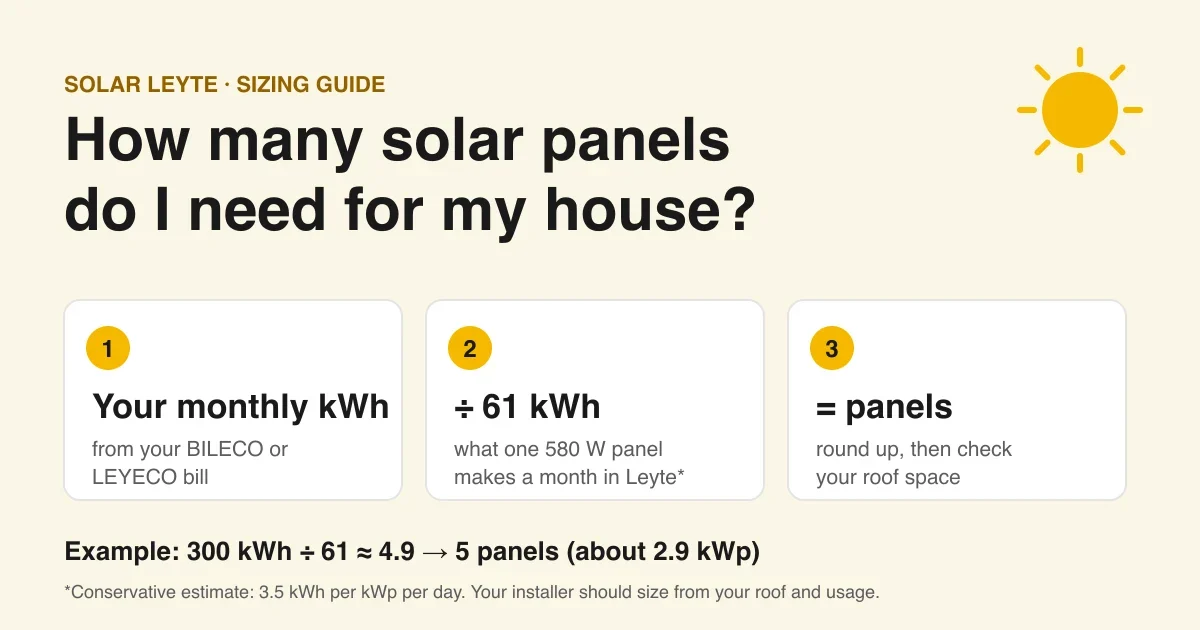
Short answer: take the kWh on your electric bill, divide by about 61, and round up. That's roughly how many 580 W solar panels it takes to cover your monthly use in Leyte and Biliran.
A home using 300 kWh a month needs about 5 panels (2.9 kWp). At BILECO's July 2026 rate, that's about ₱5,500 of electricity (BILECO rate tracker).
Below: where the 61 comes from, charts for 100–600 kWh homes and for aircons, how much roof you need, and why many homes are better off installing fewer panels than the formula says.
Figures checked 5 October 2026. This is an estimate to help you read quotes, not a quote.
Step 1: Find your monthly kWh
Your bill shows two numbers: pesos and kWh. Use kWh. The peso amount moves every month because the rate moves. BILECO went from ₱12.9458/kWh in May 2026 to ₱18.3407/kWh in July (BILECO rate tracker). Your kWh shows what your house actually uses.
- Look at the last 6–12 months if you have them. Take the average, or size to a typical hot-season month if aircon is your main load.
- No bill handy? Divide your peso bill by the rate. Our electricity bill calculator does this for BILECO and LEYECO.
Step 2: Divide by what one panel makes
One 580 W panel makes about 61 kWh a month here. That's our planning number. Here's how we get it:
- Global Solar Atlas estimates about 1,411 kWh per kWp per year for Naval, Biliran, or about 3.9 kWh per kWp per day (Global Solar Atlas).
- Real roofs lose some of that to shade, dust, heat, wiring and cloudy months. We plan with a lower 3.5 kWh per kWp per day.
- One 580 W panel is 0.58 kWp, so 0.58 × 3.5 × 30 days = 60.9 kWh a month.
- Put another way: each kWp of solar makes about 105 kWh a month.
Most new residential quotes use large panels in the 580–620 W range. If your quote uses a different size, the method is the same: panel watts ÷ 1,000 × 3.5 × 30 = kWh per panel per month.
Step 3: Round up, then check the chart
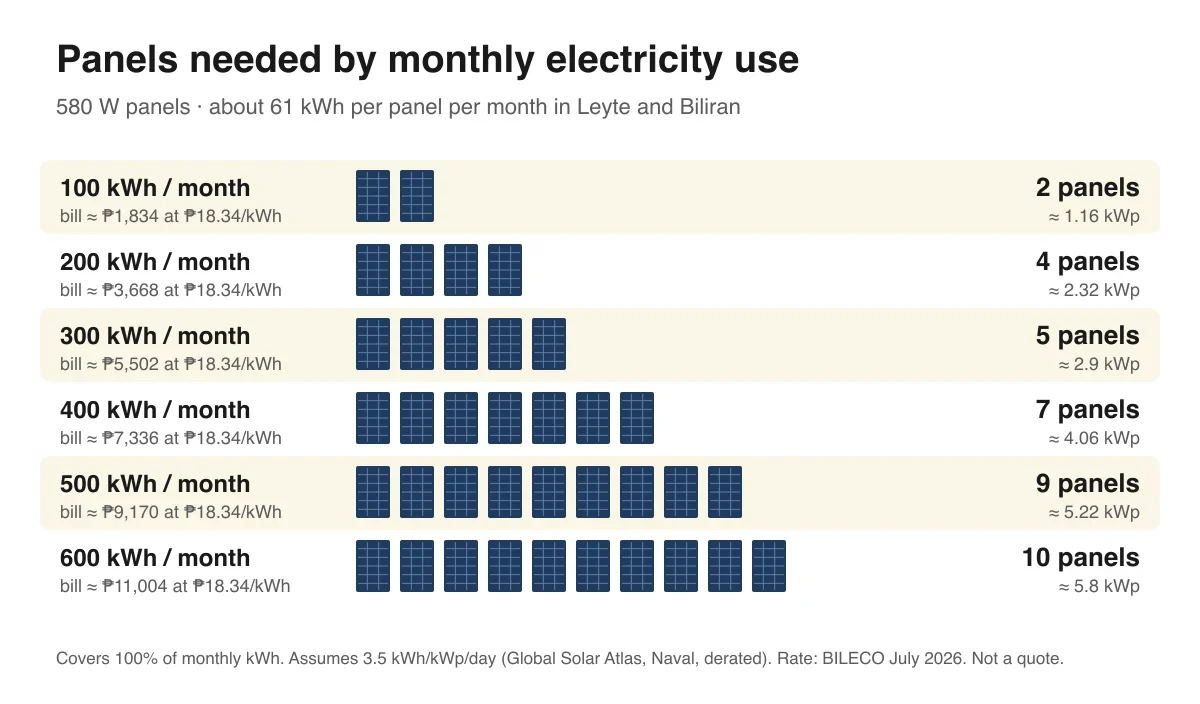
Monthly use | Bill at ₱18.3407/kWh | Panels (580 W) | System size |
|---|---|---|---|
100 kWh | ₱1,834 | 2 | 1.16 kWp |
200 kWh | ₱3,668 | 4 | 2.32 kWp |
300 kWh | ₱5,502 | 5 | 2.9 kWp |
400 kWh | ₱7,336 | 7 | 4.06 kWp |
500 kWh | ₱9,170 | 9 | 5.22 kWp |
600 kWh | ₱11,004 | 10 | 5.8 kWp |
Bills use BILECO's July 2026 residential rate, ₱18.3407/kWh (BILECO). LEYECO bills will differ.
Is a 3 kW system enough?
At 105 kWh per kWp a month, 3 kWp makes about 315 kWh a month. That covers a home using around 300 kWh. Homes running two or more aircons for long hours usually need more.
How many panels in a 5 kW system?
5,000 W ÷ 580 W = 8.6, so 8 or 9 panels, depending on the exact panel size and how the installer strings them. Using our estimate, 5 kWp makes about 525 kWh a month.
How many solar panels to run an aircon?
The aircon is usually the biggest load in the house. For costs, night-time use and battery runtimes, see our full guide to solar for aircon. Midea Philippines estimates these monthly figures for aircons running 8 hours a day (Midea PH, August 2026):
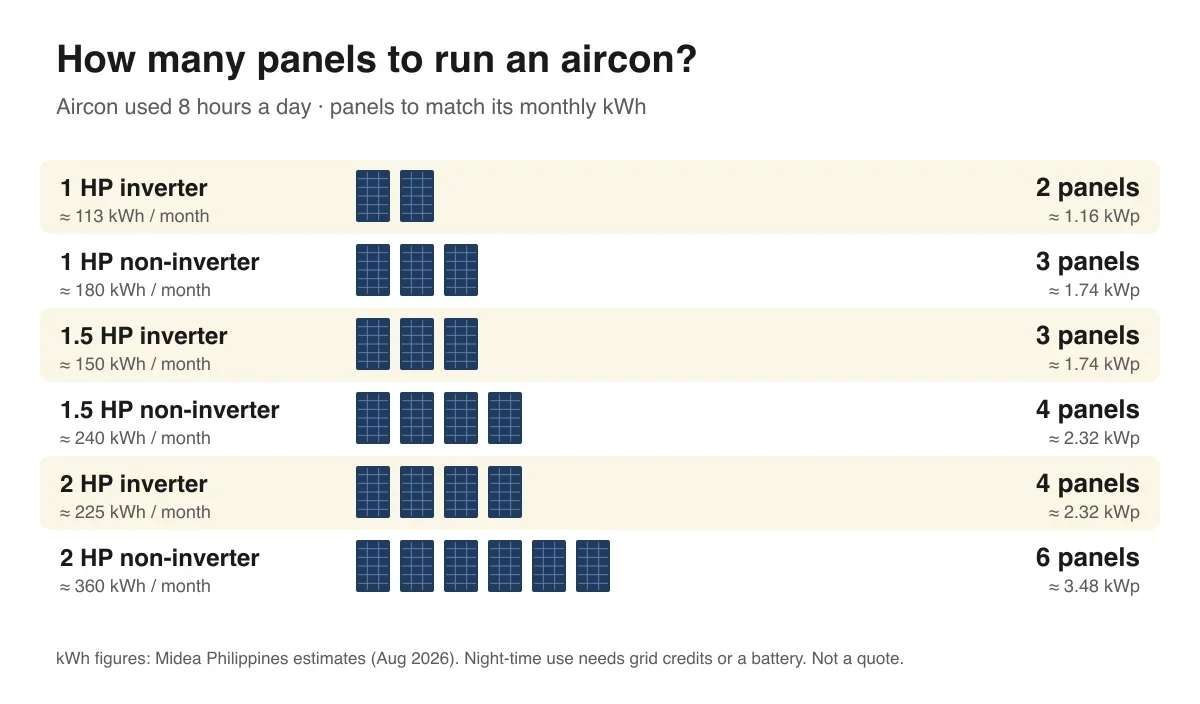
Aircon (8 h/day) | Standard inverter | Panels | Non-inverter | Panels |
|---|---|---|---|---|
1 HP | 113 kWh | 2 | 180 kWh | 3 |
1.5 HP | 150 kWh | 3 | 240 kWh | 4 |
2 HP | 225 kWh | 4 | 360 kWh | 6 |
Two things to know:
- Replacing an old non-inverter aircon can cut the panels you need. A 1.5 HP inverter uses about 90 kWh a month less than a non-inverter of the same size, using Midea's figures. That's 1–2 fewer panels, and about ₱1,650 a month off a BILECO bill (90 × ₱18.3407).
- Panels don't run your aircon at night. If you use the aircon mostly in the evening, a grid-tie system covers it with bill credits from daytime exports. Those credits are worth less than the full rate (see below). Running it through a brownout needs a battery. Our grid-tie vs hybrid guide explains the difference.
How much roof space you need
A typical 580 W panel measures about 2.28 m × 1.13 m, or about 2.6 m² (manufacturer datasheets for 580 W mono panels).
Panels | Panel area |
|---|---|
4 | about 10 m² |
5 | about 13 m² |
7 | about 18 m² |
10 | about 26 m² |
That's panel area only. Your installer also needs clearance at roof edges and room to walk for maintenance. In typhoon country, they should check the roof structure before adding weight. Our typhoon guide covers mounting and wind.
Should you cover 100% of your bill?
Not always. The chart above sizes solar to cover all of your monthly kWh. Whether that pays off depends on when you use power.
- Solar you use while the sun is up saves the full retail rate: ₱18.3407/kWh on BILECO in July 2026.
- Solar you export under net metering earns a credit at the utility's blended generation charge, not the full rate. For BILECO, PRESYO-PH's September 2026 figure was about ₱9.50/kWh (PRESYO-PH). Our BILECO net metering guide explains the rules.
So an exported kWh is worth roughly half a self-used kWh. If your house is empty during the day and most of your use is at night, a smaller system can pay back faster than one sized for 100%. If you run aircons or a business during the day, sizing close to 100% makes more sense.
Simple rule of thumb: size first for your daytime use, then add panels for night use only if the export credit still makes the math work. A good installer will ask when you use power, not just how much.
Quick sizing checklist
- ☐ Average monthly kWh from 6–12 bills
- ☐ Rough daytime vs night split (who's home, when the aircon runs)
- ☐ Any planned loads: new aircon, e-bike, water heater
- ☐ Usable roof area facing the sun, without shade from trees or neighbours
- ☐ Grid-tie, hybrid, or off-grid (which one?)
- ☐ Two or more quotes compared on the same system size (how to read a quote)
FAQ
How many solar panels do I need for my house? Monthly kWh ÷ 61, rounded up, for 580 W panels in Leyte and Biliran. A 300 kWh home needs about 5.
Is a 3 kW solar system enough? For a home using about 300 kWh a month, yes. 3 kWp makes about 315 kWh a month using our conservative estimate.
How many panels for a 1.5 HP aircon? About 3 panels for an inverter unit used 8 hours a day (around 150 kWh/month), and 4 for a non-inverter.
How much roof space does a solar panel need? About 2.6 m² per 580 W panel, plus edge and walkway clearance.
Can solar panels run my house during a brownout? Only with a battery (hybrid or off-grid). A plain grid-tie system shuts off during outages for lineworker safety.
Solar Leyte is an independent guide, sponsored by MACC Systems & Energy Solutions Inc., a solar installer in Naval, Biliran.
Get your system sized for free
Pila ka panels imong kinahanglan? Send MACC your last few BILECO or LEYECO bills. They'll size a system from your actual kWh and roof, with no obligation.
- Call/Text: 0955 723 5093
- Email: official@macc-inc.com
- Request a quote online: solarleyte.com/quote
Sources (checked 5 October 2026)
- Global Solar Atlas (Solargis/World Bank), Naval, Biliran point data
- BILECO, July 2026 Effective Rates, May 2026
- ICSC, PRESYO-PH: BILECO blended generation rate (DOE-sourced)
- Midea Philippines, Aircon electricity cost in the Philippines (6 Aug 2026)
- Manufacturer datasheets for 580 W monocrystalline panels (2279 × 1134 mm typical)
- Meralco, Net-Metering FAQ