A 1.5 HP inverter aircon used 8 hours a day needs about 3 solar panels. It uses about 150 kWh a month, which costs about ₱2,751 on BILECO at the July 2026 rate.
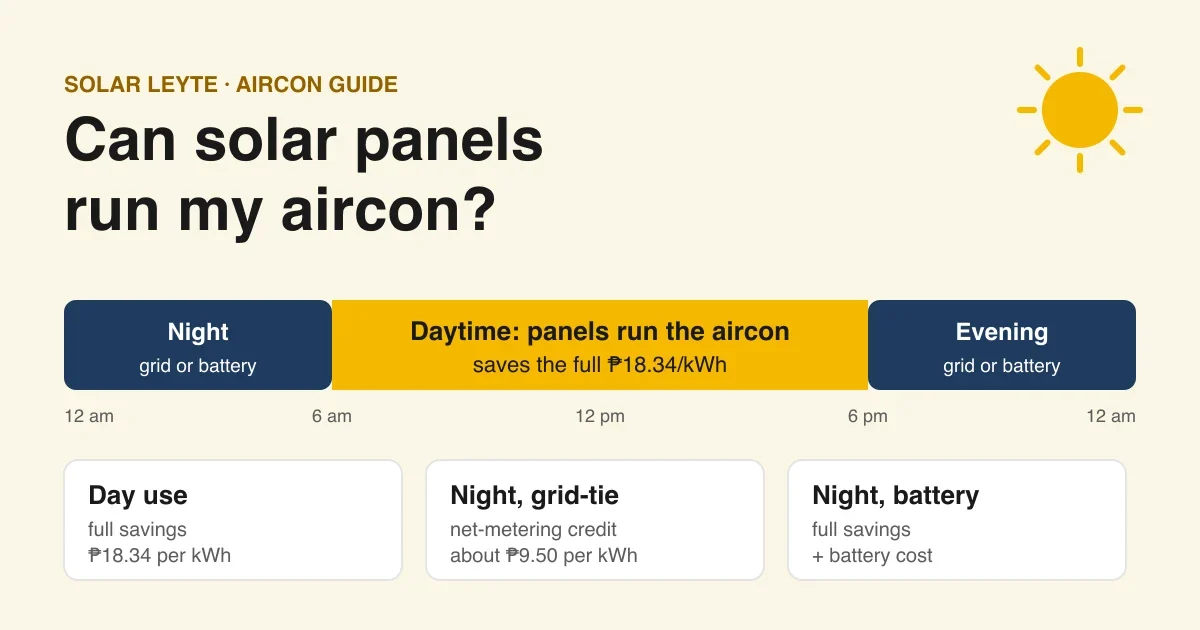
The catch is timing. Panels make power from about 6 am to 6 pm, but most families run the aircon in the evening. How much solar saves you depends on when the aircon runs:
- Daytime aircon runs straight off the panels and saves the full ₱18.34/kWh.
- Night-time aircon on a grid-tie system is paid partly by net-metering credits, worth about ₱9.50/kWh on BILECO.
- Night-time aircon on a battery saves the full rate and keeps running in a brownout, but the battery costs money.
Below: the cost of each aircon size, the panels each one needs, how long a battery runs each one, and the order we'd spend money in.
Figures checked 5 October 2026. Estimates to help you plan, not a quote.
What your aircon costs a month
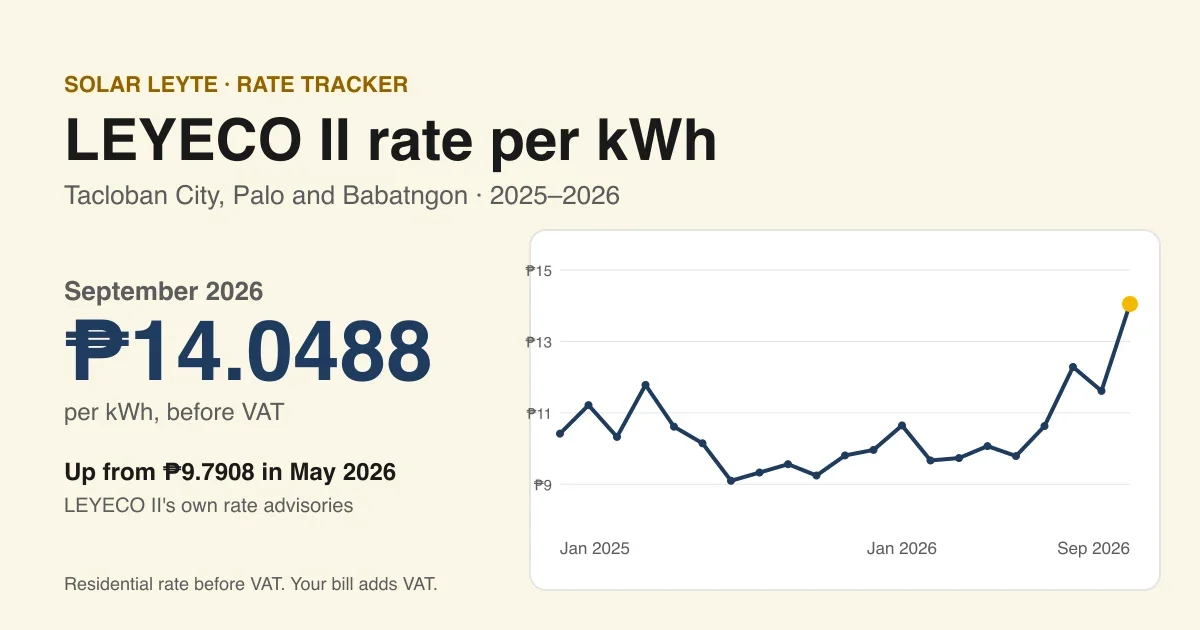
Midea Philippines estimates these monthly figures for aircons used 8 hours a day (Midea PH, August 2026). We multiplied them by BILECO's July 2026 residential rate, ₱18.3407/kWh (BILECO rate tracker).
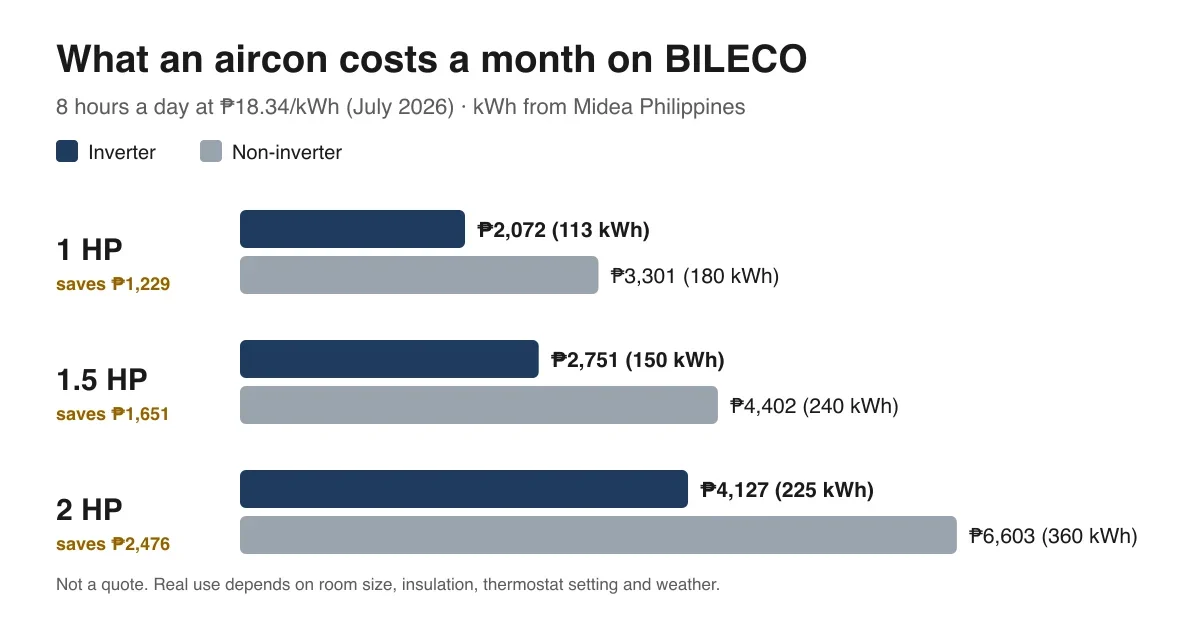
Aircon | Inverter | Cost a month | Non-inverter | Cost a month |
|---|---|---|---|---|
1 HP | 113 kWh | ₱2,072 | 180 kWh | ₱3,301 |
1.5 HP | 150 kWh | ₱2,751 | 240 kWh | ₱4,402 |
2 HP | 225 kWh | ₱4,127 | 360 kWh | ₱6,603 |
Your own numbers will differ with room size, insulation, thermostat setting and weather. Your bill's kWh is the best guide. Our electricity bill calculator converts pesos to kWh for BILECO and LEYECO.
Step one: switch to an inverter aircon
Before buying panels, look at the aircon itself. Using Midea's figures, a 1.5 HP inverter uses about 90 kWh a month less than a non-inverter of the same size. That's about ₱1,651 a month on BILECO (90 × ₱18.3407), with no solar at all.
It also shrinks the solar system you need. A 2 HP non-inverter needs about 6 panels to cover its monthly use. A 2 HP inverter needs about 4.
To work out the payback on a new aircon, divide the price difference between the two units by the monthly saving for your size: about ₱1,229 (1 HP), ₱1,651 (1.5 HP) or ₱2,476 (2 HP).
How many solar panels each aircon needs
Using our standard sizing method, one 580 W panel makes about 61 kWh a month in Leyte and Biliran (how we size systems). Divide the aircon's monthly kWh by 61 and round up:
Aircon (8 h/day) | Inverter | Non-inverter |
|---|---|---|
1 HP | 2 panels | 3 panels |
1.5 HP | 3 panels | 4 panels |
2 HP | 4 panels | 6 panels |
These panels are on top of what the rest of your house uses. They match the aircon's monthly kWh. They don't make it run at night. That's the next question.
Daytime vs night-time aircon
If the aircon runs while the sun is up, at home offices, stores, or with a family member home all day, the panels power it directly. Every kWh saves the full ₱18.34. This is where solar pays back fastest.
If the aircon runs mostly at night on a grid-tie system, the panels export power during the day and earn net-metering credit. That credit is valued at the utility's blended generation charge, not the full rate: about ₱9.50/kWh for BILECO in September 2026 (PRESYO-PH; how net metering works).
Example for a 1.5 HP inverter used only at night (150 kWh a month):
- Aircon power bought from BILECO: 150 × ₱18.3407 = ₱2,751
- Credit from 150 kWh exported during the day: 150 × ₱9.50 = ₱1,425
- Left to pay for the aircon: about ₱1,326 a month
So night-time aircon on grid-tie solar still roughly halves its cost. Daytime aircon on the same panels saves almost all of it.
A simple trick: pre-cool in the afternoon
If you're home in the afternoon, run the aircon in the late afternoon while the panels are still producing, then keep doors and curtains closed. Each kWh used before sunset is worth the full rate, not the export credit.
Running an aircon on a battery
A battery on a hybrid inverter stores daytime solar for the evening. It also keeps a backup circuit running when BILECO or LEYECO cuts power, which a grid-tie system can't do (grid-tie vs hybrid).
How long a battery lasts depends on the aircon. We took a 5.12 kWh LiFePO4 battery listed with 4.6 kWh usable (Hopetrek, from our battery price guide). For each aircon, average draw is Midea's monthly kWh ÷ 240 hours (8 hours × 30 days).
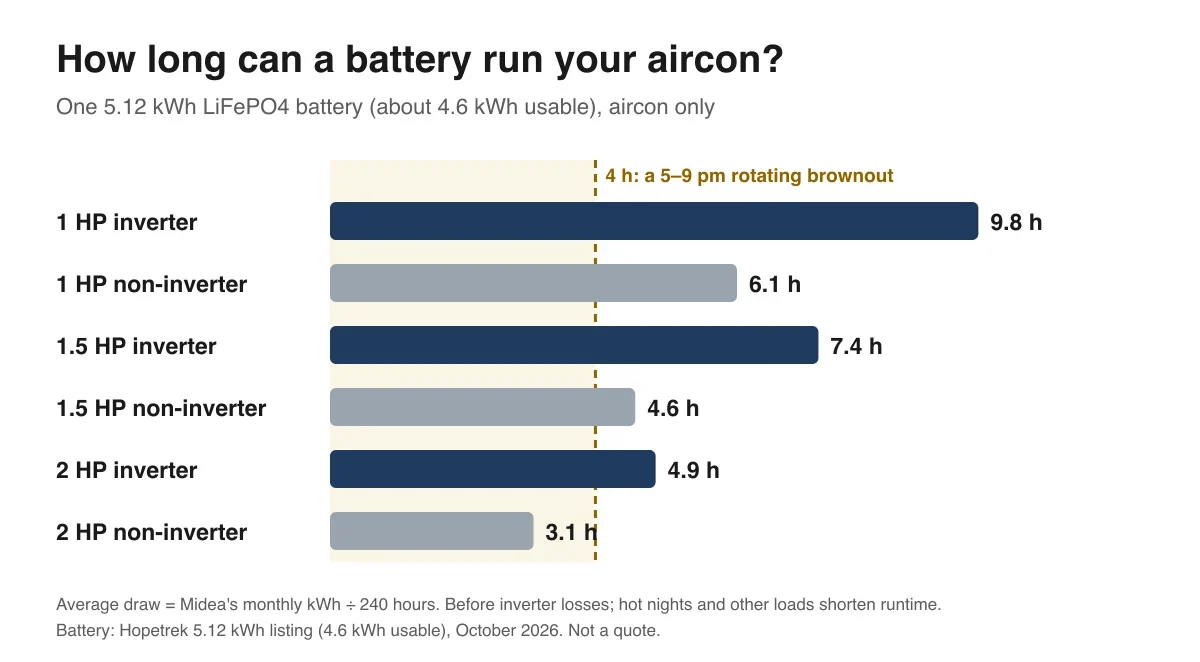
Aircon | Average draw | Hours on 4.6 kWh |
|---|---|---|
1 HP inverter | 0.47 kW | about 9.8 h |
1 HP non-inverter | 0.75 kW | about 6.1 h |
1.5 HP inverter | 0.63 kW | about 7.4 h |
1.5 HP non-inverter | 1.0 kW | about 4.6 h |
2 HP inverter | 0.94 kW | about 4.9 h |
2 HP non-inverter | 1.5 kW | about 3.1 h |
These are aircon-only estimates before inverter losses. Your fridge, lights and fans share the same battery.
What this means in a brownout
In August 2026, NGCP warned of possible rotating brownouts from 5 pm to 9 pm across BILECO and LEYECO II to V (GMA News). Four hours of a 1.5 HP inverter aircon uses about 2.5 kWh (0.63 × 4). A 5 kWh-class battery covers that and leaves room for the fridge, lights and wifi. A 2 HP non-inverter would use about 6 kWh in the same four hours, more than the battery holds.
Is a battery worth it just for aircon?
Here's the money math, using the same example: a battery that shifts about 4.6 kWh a night, or about 138 kWh a month (4.6 × 30).
- Without a battery, that solar power is exported for about ₱9.50/kWh.
- With a battery, it's used at night and saves ₱18.3407/kWh.
- The extra value is about ₱8.84/kWh × 138 kWh = about ₱1,220 a month.
5–6 kWh batteries were listed at ₱42,000 to ₱67,800 by the Philippine sellers we checked in October 2026 (battery prices). At about ₱1,220 a month, the battery alone pays back in roughly 34 to 56 months. That's before the extra cost of a hybrid inverter and installation, and assumes the battery fills from spare solar every day.
So a battery rarely pays for itself on bill savings alone. The stronger reason to buy one is keeping the aircon, fridge and lights on in a brownout. If outages are your main problem, a battery is worth it. If you just want a lower bill, use the aircon in the daytime and rely on net metering.
Practical checklist
- ☐ Replace old non-inverter aircons first. It's the cheapest kWh you'll ever save.
- ☐ Check your bill's kWh in hot months, when the aircon runs most.
- ☐ Note when the aircon runs: daytime, evening, or overnight.
- ☐ For brownout backup, list what must stay on (aircon, fridge, lights, wifi) and ask for a backup circuit sized for those loads.
- ☐ Ask the installer to check the aircon's starting current against the inverter's rating.
- ☐ Compare two or more quotes on the same system (how to read a quote).
FAQ
How many solar panels for a 1.5 HP aircon? About 3 panels (580 W) for an inverter unit used 8 hours a day, or 4 for a non-inverter.
Can solar panels run an aircon at night? Not directly. A grid-tie system covers night use with net-metering credits. For your own solar power at night or in a brownout, you need a battery on a hybrid inverter.
How long can a 5 kWh battery run an aircon? About 7 hours for a 1.5 HP inverter, 10 hours for a 1 HP inverter and 5 hours for a 2 HP inverter, on 4.6 kWh usable, aircon only.
Inverter or non-inverter aircon for solar? Inverter. It uses about 37% less power than a non-inverter of the same size using Midea's figures, so you need fewer panels and a smaller battery.
How much does a 1.5 HP aircon cost a month in Biliran? About ₱2,751 for an inverter and ₱4,402 for a non-inverter, used 8 hours a day at BILECO's July 2026 rate.
Solar Leyte is an independent guide, sponsored by MACC Systems & Energy Solutions Inc., a solar installer in Naval, Biliran.
Want your aircon on solar?
Init kaayo? Tell MACC which aircons you have and when you run them. They'll size panels, and a battery if you want brownout backup, with no obligation.
- Call/Text: 0955 723 5093
- Email: official@macc-inc.com
- Request a quote online: solarleyte.com/quote
Sources (checked 5 October 2026)
- Midea Philippines, Aircon electricity cost in the Philippines (6 Aug 2026)
- BILECO, July 2026 Effective Rates
- ICSC, PRESYO-PH: BILECO blended generation rate (DOE-sourced)
- GMA News, Rotating brownouts may hit Visayas consumers
- Solar Leyte, Solar battery price Philippines (seller listings, October 2026)
- Global Solar Atlas (Solargis/World Bank), Naval, Biliran point data