If your hybrid or off-grid inverter won't turn on at all (no screen, no lights, no beep), the problem is usually that no usable DC power is reaching it, not that the inverter is broken. The usual causes, in order: the inverter's own on/off switch is off, the battery breaker or the battery's own power button is off, a lithium battery's BMS has shut itself down, the battery is too flat to restart the inverter, or the panels aren't giving enough voltage. On 48 V MUST PV18 and Axpert VM III units the manuals set the cold-start voltage at 46.0 V. After a long brownout the inverter cuts off at around 42 V, so it can't start again on the battery alone until sun or grid power brings the battery back up.
If the screen is on and shows a code, this isn't your page. Go to our Deye error codes or MUST and Axpert error codes guides. If the inverter runs but the battery won't fill up, see solar battery not charging.
Last checked 9 November 2026, against the Deye SUN-3.6–8K-SG05LP1-EU manual (19 Mar 2026), MUST PV18 2–5.5 kW manual T1.7, Voltronic Axpert VM III and MKS II manuals, the Pylontech US5000 manual and the LuxPower GEN-LB-EU datasheet. Check the manual for your exact model; switch positions and voltages differ.
Safety first: what "check" means here
Deye's manual warns that a reverse-polarity battery connection will damage the inverter, and Pylontech says that if its breaker trips, find the cause (a current surge or a bad cable) before you switch it on again.
In this guide "you" means switches, buttons, the screen and the app only: the inverter's on/off switch, the breakers and isolators that are already mounted for you to use, and the battery's own switch and button. Opening covers, unbolting battery cables, measuring at terminals and changing battery settings are jobs for a licensed electrician or your installer.
Dead, or just showing OFF? Read the symptom first
What you see | What the manual says it usually means | Check |
|---|---|---|
Nothing at all: no screen, no LEDs, no beep | Battery far too low (below 1.4 V per cell), battery connected the wrong way round, or (Axpert VM III) internal fuse tripped | 2, 3, 4, then call |
Screen, LEDs and buzzer come on for about 3 seconds, then everything goes off | Battery too low to start (below 1.91 V per cell) | 4 |
Deye screen lights up and shows OFF | It has PV or grid but its on/off button is off | 1 |
Screen and LEDs flash, relay clicks on and off over and over | Battery disconnected | 2, 3 |
Screen on with a code | A fault or warning, not a dead unit | Error code guides |
Sources: MUST PV18 manual p. 27 and Axpert VM III manual p. 43 (troubleshooting tables), Deye SG05LP1 manual p. 26 (power on/off).
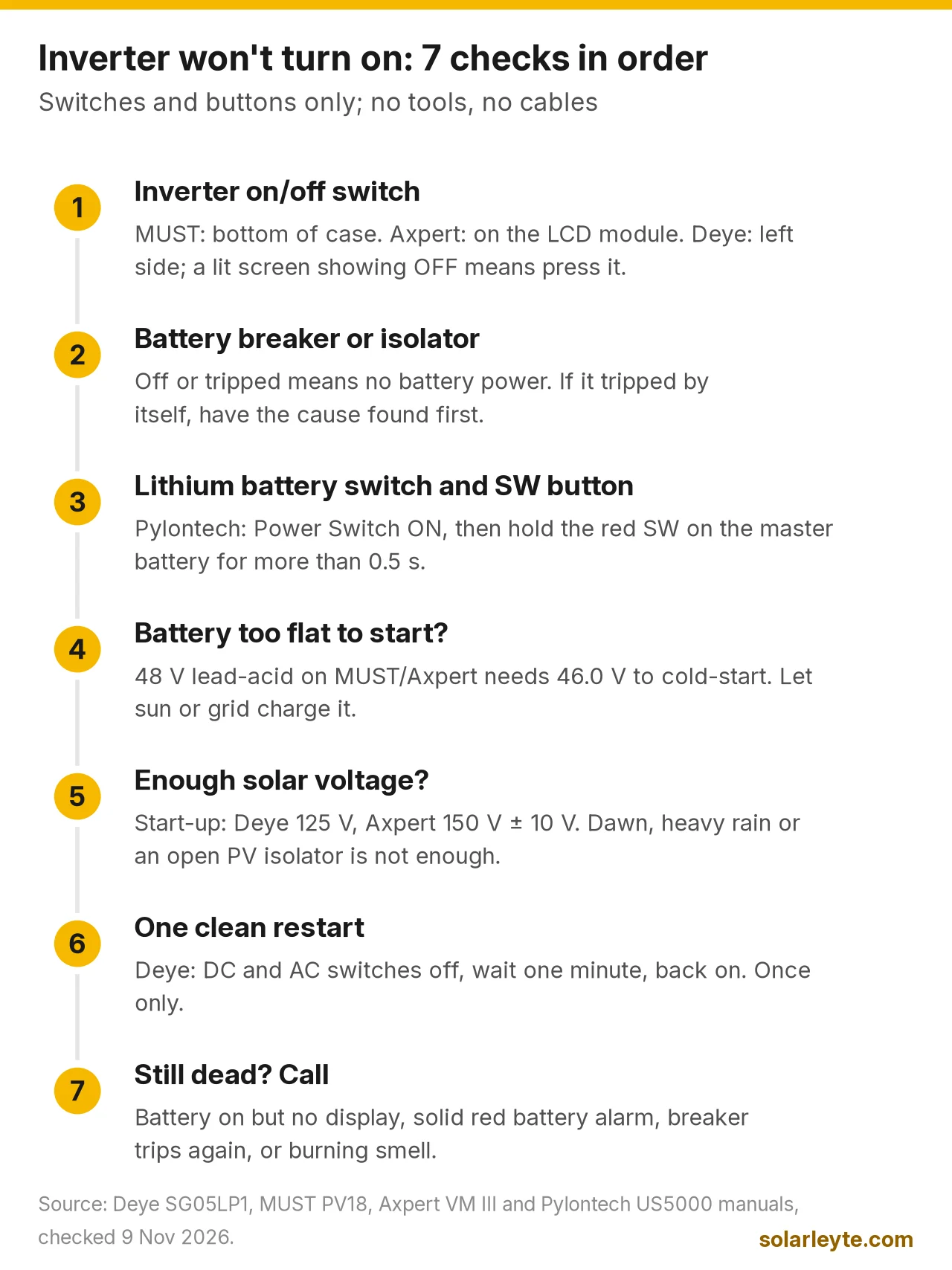
The 7 checks, in order
1. The inverter's own on/off switch
Easy to miss after a typhoon shutdown. It sits in a different place on each brand:
- MUST PV18: a rocker switch on the bottom of the case (manual p. 11).
- Axpert VM III: an on/off switch on the LCD module (p. 13).
- Deye SG05LP1: a button on the left side of the case (p. 26). With PV or grid connected and the button off, Deye's screen still lights up and shows OFF. If you can see "OFF", press the button.
2. The battery breaker or isolator between battery and inverter
Most installs have a DC breaker or isolator on the battery cable. Deye's wiring diagrams show a 150 A DC breaker for the 3.6–6 kW SG05LP1 models and 225 A for 7–8 kW. If it's off or tripped, the inverter gets no battery power. If it tripped by itself, don't keep flipping it back on. A trip means there was a short or a surge. Have the cause found first.
3. The lithium battery's own switch and start button
A lithium battery has its own BMS (battery management system), and it has to be switched on before it gives the inverter any power. On a Pylontech US5000 (manual p. 24) the order is:
- Switch on the isolator between battery and inverter, if there is one.
- US5000-B: switch on every module's breaker.
- Switch every module's Power Switch to ON.
- Press and hold the red SW button on the master battery (the one with the empty Link Port 0) for more than 0.5 seconds. The LEDs light up one module at a time, and the soft-start takes 3 seconds.
On Axpert units with a lithium battery, the battery comes on first and the inverter second. You select the battery type (PYL for Pylontech) in program 5, and Voltronic says the two can take more than a minute to start talking (Axpert VM III manual p. 46).
4. Is the battery too flat to start?
This is the most common one after a long brownout. The inverter runs the battery down to its cut-off, shuts off, and then needs a higher voltage than the cut-off to start again:
48 V model (lead-acid settings) | Cold-start voltage | Low DC cut-off | Source |
|---|---|---|---|
MUST PV18 3–5.5 kW | 46.0 V | 42.0 V (load under 20%), 40.8 V (20–50%), 38.4 V (50% and up) | MUST PV18 manual pp. 24–25 |
Axpert VM III 5 kW | 46.0 V | 43.0 V (load under 50%), 42.0 V (50% and up) | Axpert VM III manual p. 41 |
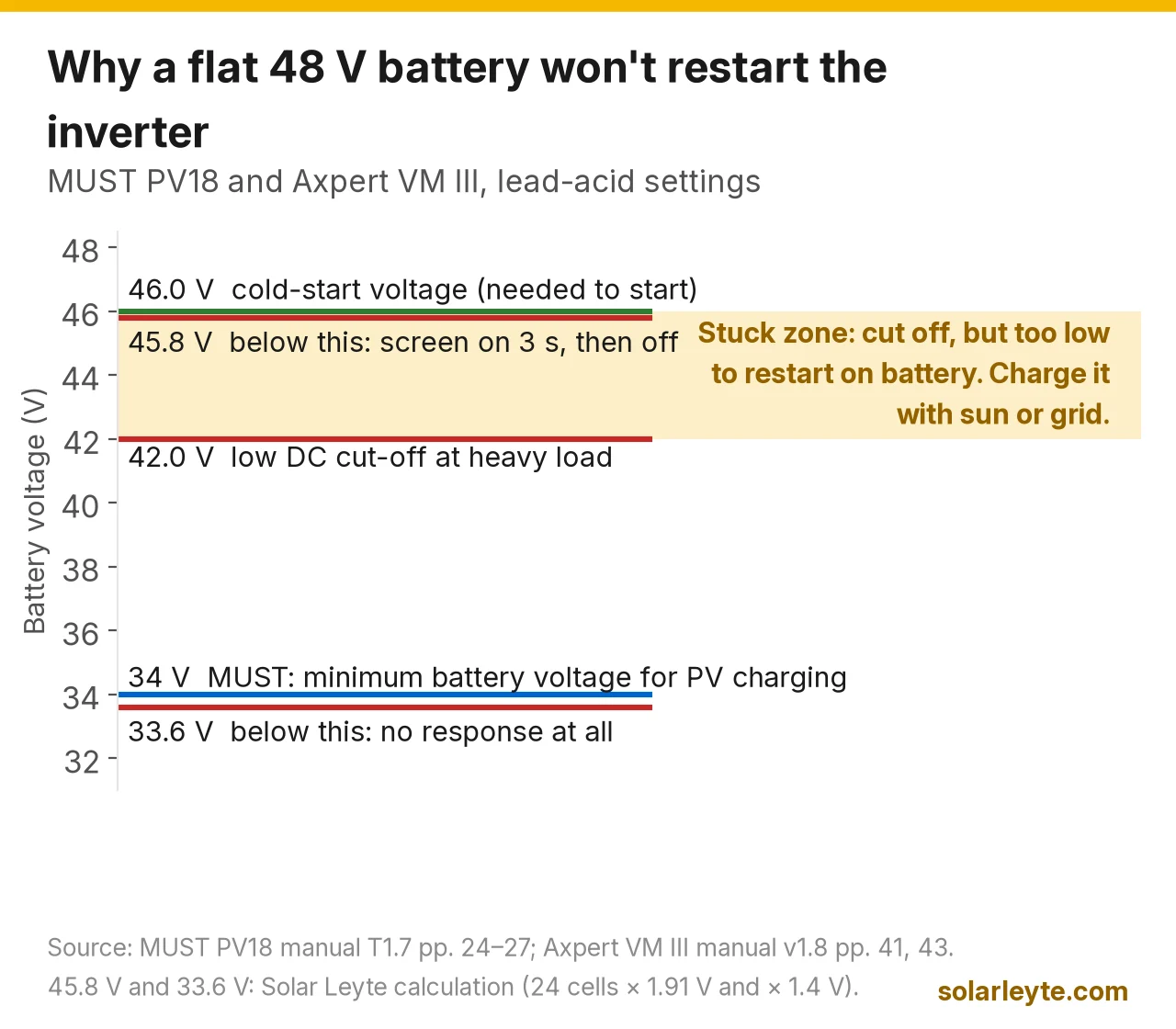
Worked example A (Solar Leyte calculation). A 48 V lead-acid bank is 24 cells of 2 V. Axpert's and MUST's "shuts down during start-up" limit of 1.91 V per cell works out to 24 × 1.91 = 45.8 V, and the "no response at all" limit of 1.4 V per cell is 24 × 1.4 = 33.6 V. So a bank that cut off at 42.0 V during an overnight brownout sits 4 V below the 46.0 V cold-start voltage. Pressing the switch again won't help: the screen flashes on for 3 seconds and goes dark.
What works is charging. The Axpert VM III manual says that when only the battery is available at cut-off, the inverter shuts down, but when PV and the battery are both available it charges the battery without giving AC output (program 29). MUST lists a minimum battery voltage for PV charging of 34 V on its 48 V MPPT models. In practice: wait for good sun or for the grid to come back, and give the battery a few hours. If the bank is below about 34 V, or still won't start after a full sunny day, call your installer; it may need a separate charger or a new battery.
Lithium is different. Pylontech's BMS shuts the battery off at 44.5 V. If none of its lights come on when you press SW, the manual says it needs a charger or inverter supplying 48–53.5 V to wake it, and below 45 V it should be charged slowly, at 0.05C or less. For a 4,800 Wh, 48 V US5000 that's about 100 Ah, so 5 A or less (our calculation). That's a job for your installer with the right charger. Some inverters can do it for you. Deye has an Activate Battery setting that "will help recover a battery that is over discharged by slowly charging from the solar array or grid" (manual p. 32), and LuxPower's GEN-LB-EU datasheet lists "force wake up battery from PV". Your installer should switch these on, not you.
5. Not enough solar voltage (PV-only start)
A hybrid inverter needs a minimum string voltage before it starts using the panels. Deye SG05LP1: 125 V start-up, 150–425 V MPPT range. Axpert VM III: 150 V ± 10 V start-up. MUST PV18 48 V MPPT models work on 60–130 V. At dawn, in heavy rain, or with the PV isolator off, a dark screen with flat batteries can be normal.
Worked example B (Solar Leyte calculation). A Jinko JKM575N-72HL4-BDV panel has a Voc of 52.30 V on its datasheet (lab conditions at 25 °C). Two in series give 2 × 52.30 = 104.6 V, below Deye's 125 V start-up even in perfect conditions, so that string can't start the inverter. Three in series give 156.9 V Voc, but their working voltage (Vmp 43.73 V × 3 = 131.2 V) is still under the 150 V MPPT range. Jinko lists a Voc temperature coefficient of −0.25%/°C, so a hot roof gives a bit less. That's for the installer to fix. See series vs parallel wiring and how to check panel voltage with a multimeter (have an electrician do it on high-voltage strings).
6. One clean restart, the way the maker says
If everything above is on and the screen is still blank or stuck, Deye's own restart instruction is: turn off the DC switch and AC switch, wait one minute, then turn them back on (manual p. 44). Do it once. Pylontech's shutdown order is the reverse of start-up: external power off, press SW on the master, Power Switch off, then breakers and isolator off (p. 25). Don't pull battery cables to "reset" anything.
7. Stop and call
Call your installer or a licensed electrician if:
- the battery is definitely on and charged but the inverter shows nothing (Axpert says an internal fuse needs the repair centre),
- the battery's alarm light stays solid red, or the buzzer sounds with all LEDs flashing (Pylontech, manual pp. 29–30),
- a breaker trips again after one reset, or
- you smell burning or see swelling, scorch marks or loose cables.
Send them a photo of the screen and the battery LEDs, the model labels, and what happened just before (brownout, typhoon, a new appliance). If the app says the inverter is offline but it's actually running, that's the Wi-Fi stick, not the inverter. See SOLARMAN offline fixes.
FAQ
Why won't my inverter turn back on after a long brownout?
Most likely the battery ran down to the low-voltage cut-off and is now below the cold-start voltage: 46.0 V on 48 V MUST PV18 and Axpert VM III units with lead-acid settings, against a cut-off of about 42 V. Let the panels or the grid charge it. If it still won't start after a full sunny day, call your installer.
Bakit walang display ang inverter ko kahit may araw?
Check the PV isolator first, then the on/off switch. Then check whether your string reaches the start-up voltage (125 V on a Deye SG05LP1, about 150 V on an Axpert VM III). Early morning or heavy rain can be below that. If the battery is also off or asleep, there's nothing to power the screen.
How do I wake up a sleeping lithium battery?
Switch its isolator and Power Switch on, then hold the start button (on Pylontech, the red SW for more than 0.5 seconds). If no lights come on at all, the battery is over-discharged and needs a 48–53.5 V charge, done slowly. That's an installer job, sometimes with the inverter's "activate battery" function.
Is it safe to reset the inverter by unplugging the battery?
No. Use the maker's restart order (Deye: DC and AC switches off, wait a minute, back on). Unbolting battery cables risks sparks, and reversing them damages the inverter, according to Deye's manual.
Solar Leyte is run by MACC Systems & Energy Solutions Inc., a solar installer in Naval, Biliran.
Get a free solar quote from MACC
Planning a hybrid or off-grid system that rides out long brownouts? Send us a recent BILECO or LEYECO bill and we'll get back to you with a free, no-obligation written quote.
- Call/Text: 0955 723 5093
- Email: official@macc-inc.com
- Website: www.macc-inc.com
- Or use the site quote form: /quote
Related guides
- Grid-tie vs hybrid vs off-grid solar: which works in a brownout?
- Inverter and battery backup for brownouts
- 12 V, 24 V or 48 V solar system?
Sources (all checked 9 November 2026)
- Deye, SUN-3.6/5/6/7/7.6/8K-SG05LP1-EU user manual, 19 March 2026 (PDF): reverse-polarity warning (p. 11), 150 A / 225 A battery DC breakers (wiring diagrams), power on/off and the "OFF" display (p. 26), Activate Battery (p. 32), DC/AC switch restart (fault table, p. 44), battery 40–60 V, PV start-up 125 V, MPPT 150–425 V (datasheet, p. 47).
- MUST, PV18 2–5.5 kW user manual, doc 4200-010356-07A1, T1.7 (PDF): on/off switch (p. 11); cold-start 46.0 V, low DC cut-off 42.0/40.8/38.4 V, 48 V MPPT 60–130 V, minimum battery voltage for PV charging 34 V (pp. 24–25); troubleshooting, including below 1.91 V/cell and below 1.4 V/cell (p. 27).
- Voltronic Power, Axpert VM III user manual, version 1.8 (PDF): power on/off (p. 13), program 29 low DC cut-off behaviour, PV start-up 150 V ± 10 V, cold-start 46.0 V and cut-off 43.0/42.0 V (p. 41), troubleshooting (p. 43), lithium battery start-up order and the "longer than 1 minute" communication note (p. 46).
- Voltronic Power, Axpert MKS II 5KVA user manual, version 1.4 (PDF): same start-up troubleshooting entries, with reversed battery polarity listed for "no response after power on".
- Pylontech, US5000 / US5000-B installation manual V1.0 (PDF): 48 V, 4,800 Wh (p. 8), breaker-trip note and Power Switch / SW button (p. 10), power on and off order (pp. 24–25), troubleshooting: 48–53.5 V wake-up charge, 0.05C below 45 V, 44.5 V low-voltage protection, alarm conditions (pp. 28–30).
- LuxPower, GEN-LB-EU 3–6K datasheet (PDF): "Force wake up battery from PV function: YES"; PV start-up voltage 100 V.
- Jinko Solar, JKM575-600N-72HL4-BDV datasheet (PDF): 575 W Voc 52.30 V, Vmp 43.73 V at STC; Voc temperature coefficient −0.25%/°C.
- Solar Leyte calculations: 24 × 1.91 V = 45.8 V and 24 × 1.4 V = 33.6 V for a 48 V lead-acid bank; 4,800 Wh ÷ 48 V = 100 Ah and 0.05C = 5 A; string Voc and Vmp sums for 2 and 3 Jinko 575 W panels.