Most of the time a solar panel is "not charging the battery," the kit is doing something normal — float stage, cloudy day, dirty glass, wrong battery type, or a tripped breaker — not a dead panel. On small off-grid and portable setups common in Leyte and Biliran (panel → charge controller → battery), you can clear a lot of false alarms before you call an installer. This is a fault-finding flow, not a DIY repair guide: stop at live DC if you are unsure, and leave BMS resets, open terminals and swollen lithium packs to a licensed person.
Last checked 7 Nov 2026 against the EPEver Tracer-AN manual, SRNE ML manual, Renogy's charge-controller troubleshooting guide and our related Solar Leyte posts. LED colours and menus differ by model — keep your unit's manual open.
This post is for separate charge-controller kits. If the battery sits behind a hybrid inverter app, start with generation vs house load in the app and our inverter battery backup post instead. Voltage presets live in solar charge controller settings; use this list when charging still looks wrong after the settings are right.
Safety first
- Cover or disconnect the panels before you pull PV plugs (Renogy). The array is live whenever the sun is up.
- Never meter current across battery or PV terminals. Use voltage first. Safe Voc / Isc steps: how to test a solar panel with a multimeter.
- Connect battery → load → panels (reverse to disconnect). EPEver needs about 8 V from the battery to wake up.
- Wire inverters to the battery, not the LOAD terminals. EPEver's low-voltage disconnect does not stop an inverter on the battery.
- SRNE: settings "must be done under the guidance of a professional person."
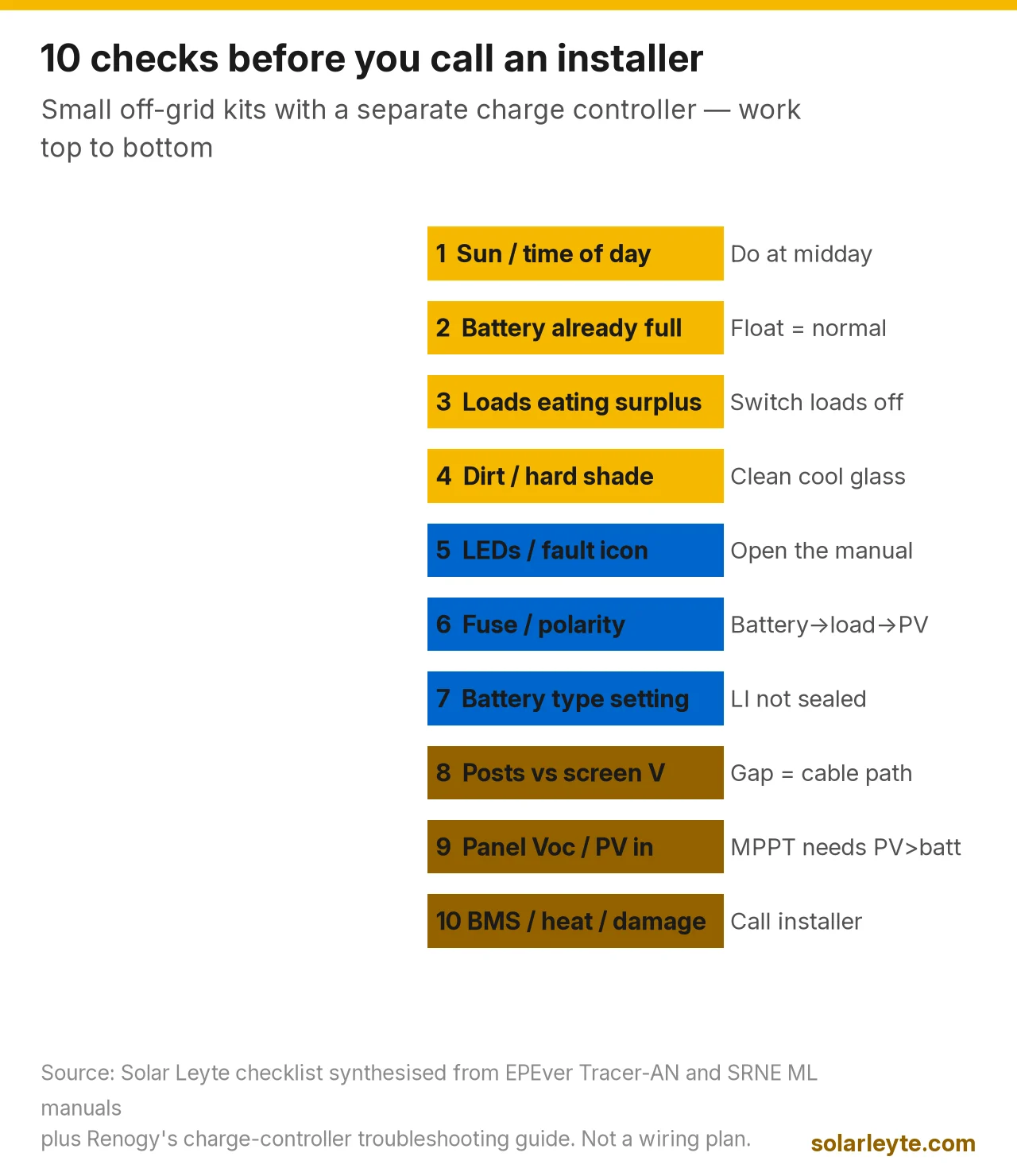
The 10 checks, in order
# | Check | What "OK" looks like | If it fails |
|---|---|---|---|
1 | Sun and time of day | Late morning–early afternoon, hard shadows | Expect slow charge; see rainy-day post |
2 | Battery already full / float | Float/absorb with near-zero amps | Normal — not a fault |
3 | Loads eating the surplus | Charge current rises when big loads go off | Turn loads off to test |
4 | Dirt, leaves, coconut shade | Clear glass; no hard shadow on cells | Clean / move; see shading post |
5 | Controller LEDs / fault icon | No blink fault; PV and battery icons sensible | Match code to the manual |
6 | Breakers, fuses, polarity | Tight, correct polarity, fuse intact | Fix only if you know DC safety |
7 | Battery type and voltages | Type + boost/float match the datasheet | USE / LI mode — settings post |
8 | Battery V at posts vs screen | Meter ≈ controller (within ~0.3–0.5 V) | Trace fuse, cable, corrosion |
9 | Panel Voc and PV at controller | Voc near datasheet; MPPT PV > battery | Multimeter test; check wiring |
10 | BMS / heat / damage | No swelling, no hot smell, BMS not locked | Stop; call the installer |
1–4. Sun, float, loads and dirt
A kit that charged in April can look "broken" on a grey December afternoon. Rain and thick cloud cut output a lot; night is zero — physics, not a warranty claim (do solar panels work on rainy days). Do the rest of the checks in good midday light.
Charge controllers drop to near-zero amps once the pack is full (float). That is normal. Rough rested hints: ~12.7 V for a full 12 V lead-acid; ~13.4–13.6 V rested for a near-full 12.8 V LiFePO4 on Renogy's chart (lithium voltage is still a poor fuel gauge — prefer the BMS app). Charts: charge controller settings.
On a small kit a rice cooker or inverter idle draw can eat every watt. Switch non-essentials off for ten minutes and watch charge current. Portable station sizing (not fault-finding) is in EcoFlow / solar generator prices.
Ash, salt film, leaves or a coconut frond flatten current; hard shade on one cell can pull a series string down (solar panel shading). Wipe cool glass with soft water; do not climb a wet tin roof to "test."
5–6. Read the screen, then the wiring
EPEver blinks a fault icon for over-voltage, over-discharge and overheating. Its table also lists PV open-circuit in good sun (check PV wiring) and battery below 8 V (controller will not start). Internal overheating stops above 85 °C and resumes below 75 °C; battery sensor overheating stops above 65 °C and resumes below 55 °C. SRNE's ERROR LED steady-on means a system fault — open the LED table before you reset anything.
Then check BAT+/BAT−, fuse or breaker, PV terminals and fully clicked MC4s (Renogy's order). A blown battery fuse can show voltage on the screen with zero charge current. Confirm connect order battery → load → PV. EPEver warns that reversed battery with lithium and a correctly wired PV array can destroy the controller — do not "try both ways."
7–8. Settings and the battery path
Many EPEver / SRNE units ship as sealed lead-acid. A LiFePO4 left on sealed mode can equalize, use temperature compensation and trip the BMS — it looks like "solar panel not charging lithium battery." Pick LFP / LI / USE and match the datasheet (settings guide). Still on a car starting battery? See car battery for solar.
Meter DC voltage on the battery posts, then on the controller BAT terminals. A big gap usually means a loose lug, undersized cable or corroded fuse holder — not a dead MPPT chip. Cover the panels and open the fuse before you touch lugs, or photograph it and call help.
9–10. Voc, MPPT vs PWM, and BMS
A healthy 12 V-class panel often shows roughly 20–23 V Voc in the sun (datasheet Voc at 25 °C; hot roofs run a bit lower). An MPPT needs PV voltage above battery voltage to start; a PWM pulls the panel near battery voltage by design. Undersized parallel strings on a 24 V bank fail both ways — MPPT vs PWM and the multimeter guide.
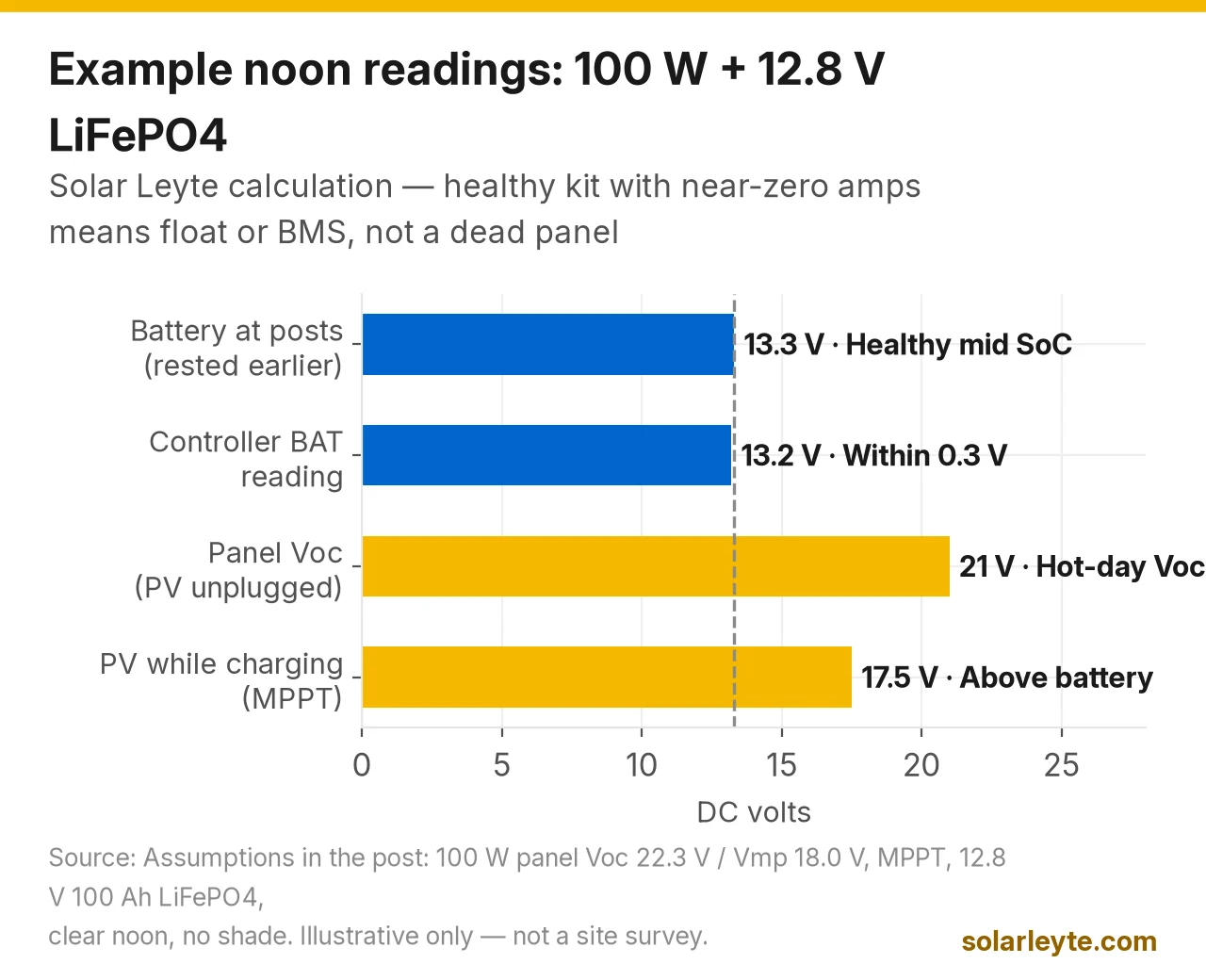
Worked example: 100 W panel, 12 V LiFePO4, "zero amps" at noon
Solar Leyte calculation — example only. Assumptions: one 100 W 12 V-class panel (Voc 22.3 V, Vmp 18.0 V), MPPT controller, 12.8 V 100 Ah LiFePO4, clear noon, no shade.
Reading | Example "healthy" | If far off |
|---|---|---|
Battery at posts (earlier rest) | ~13.3 V | ~11 V → deep discharge / BMS protect |
Controller battery voltage | Within ~0.3 V of posts | Big gap → cable / fuse path |
Panel Voc (PV unplugged) | ~21 V hot-day | ~0 V → open / reversed / broken |
PV voltage while "charging" | Above battery (often mid-teens–~18 V) | Stuck at Voc, 0 A → settings / BMS / full |
Charge current | A few amps in good sun | 0 A with PV > batt → float, BMS or fault |
If Voc is healthy but current stays 0 A and the pack is not full, jump to checks 7 and 10 before buying a new panel.
Lithium packs refuse charge when the BMS trips. EPEver's lithium low-temp lock (default 0 °C) rarely bites here; hot bodega corners do — see solar battery care. Swelling, hissing or burnt smell: disconnect what you can safely and call the supplier. Do not short BMS pins from a Facebook tip.
PWM vs MPPT cheat sheet
Symptom | More likely on PWM | More likely on MPPT |
|---|---|---|
Tiny current in soft sun | Normal efficiency hit | Check dirt / shade first |
PV voltage ≈ battery while charging | Normal PWM behaviour | Short or failed tracker |
PV never above battery | Array Voc too low for bank | Same — raise series count |
Controller very hot | Undersized / no airflow | Same; EPEver derates from ~81 °C |
Choosing hardware: MPPT vs PWM and solar generators and portable power.
When to call someone
Call your installer or a licensed electrician (electrical work under RA 7920) if a fault returns after you clear it, posts and screen voltages disagree and you cannot safely open the path, the lithium app shows protect, the case is swollen or hot, or you smell burnt plastic. Bring photos of the screen, battery label and meter readings.
FAQ
Bakit hindi nagcha-charge ang solar battery ko kahit may araw?
Often the battery is already full, loads are using the surplus, the glass is dirty, or the controller is still on the wrong battery type. Work checks 1–7 before assuming the panel is dead.
Solar panel not charging lithium battery — unsa may una?
Confirm LI / LFP / USE with the datasheet voltages, not sealed lead-acid. Then check the BMS app. See settings and battery care.
How do I know if the charge controller is broken?
Healthy battery and PV voltages, correct polarity, matching settings, no fault code, pack not full, good sun, and still 0 A — then the controller or its fuse is a suspect for a technician, not a guess-and-replace.
Can rain alone stop charging completely?
Heavy cloud cuts output sharply; night is zero. A bright sky with light rain can still make current. Myths vs data: rainy days.
Pwede ba akong mag-multimeter test mag-isa?
Voltage on accessible terminals is what many homeowners do; Isc needs a proper method. Follow the multimeter guide and stop if anything feels unsafe.
Solar Leyte is run by MACC Systems & Energy Solutions Inc., a solar installer in Naval, Biliran.
Get a free solar quote from MACC
Stuck after these checks, or planning a properly sized brownout kit for Leyte or Biliran? Send us a photo of your controller screen, battery label and latest BILECO or LEYECO bill, and we will get back to you with a free, no-obligation written quote.
- Call/Text: 0955 723 5093
- Email: official@macc-inc.com
- Website: www.macc-inc.com
- Or use the site quote form: /quote
Sources (all checked 7 November 2026)
- EPEver, Tracer-AN series (10–40 A) user manual V2.6 (PDF): connect battery → load → PV; ≥8 V to start; inverter on battery not LOAD; protections (PV reverse, battery reverse caution with lithium, OVD, LVD, battery OT 65/55 °C, device OT 85/75 °C, lithium LTPT default 0 °C, derating from 81 °C); troubleshooting table (PV open-circuit, battery <8 V, OVD, over-discharge, overheating, overload, short).
- SRNE, ML2420/ML2430/ML2440 user manual V1.06 (PDF): battery first then load then solar; ERROR LED; professional-person settings warning; inverter on battery.
- Renogy, Solar Charge Controller Troubleshooting Guide: cover panels before PV work; battery-then-array order; fuse/polarity/MC4 checks; measure battery at posts vs BAT terminals; measure PV vs Vmp; never meter current across terminals.
- Renogy, LiFePO4 voltage chart: rested SoC vs voltage (rough hint in check 2 only).
- Victron MPPT troubleshooting materials (maker support): zero charge current often means battery full, open fuse/wiring, wrong settings or reverse polarity — confirm against your model manual.
- Solar Leyte related: multimeter, MPPT vs PWM, settings, shading, rainy days, battery care, car battery, EcoFlow, inverter backup, portable guide.
- Solar Leyte calculation (worked example): illustrative 100 W / 12.8 V LiFePO4 noon readings; not a site survey.