Yes, a car battery will run a small solar setup, but it won't last long doing it. Car (starting) batteries are made to push a big burst of current for a few seconds, then get topped up right away by the alternator. Drain one every night and it wears out fast. Interstate Batteries says a starting battery handles only about 50 deep-discharge cycles in its whole life. A deep-cycle lead-acid battery like the Motolite Solar Master is rated in the hundreds to over a thousand cycles, and LiFePO4 in the thousands. Use the car battery you already have for an emergency. But if you're buying one para sa solar, skip the car battery.
The surprise: at Motolite's own online store, the Solar Master in the common 3SM/N70 size is ₱7,246, slightly less than the Enduro car battery in the same size at ₱7,370. So "car battery is cheaper" isn't even true here.
This post is for small 12 V setups: a panel, a charge controller, one battery, maybe a small inverter for a fan, lights, Wi-Fi or a piso wifi. For whole-house backup, see our solar battery price guide.
Last checked 28 October 2026. Prices are online list prices on that date and change often. Brands are named only because their prices and specs are public. This isn't an endorsement, and none of this is a MACC price or a quote.
Quick answer: car vs deep-cycle vs LiFePO4
Car (starting) battery | Deep-cycle lead-acid | LiFePO4 (lithium iron phosphate) | |
|---|---|---|---|
Built for | Short, big bursts to start an engine | Slow, deep discharge every day | Slow, deep discharge every day |
Deep cycles (maker or dealer figures) | About 50 (Interstate) | About 1,000 at 50% depth (Interstate table); "over 1,500" on some Solar Master models (dealer claim) | 5,000+ at 80% depth (Power Central, Wattcycle listings) |
How deep you can use it | Keep it shallow; it's not made for this | About half (Interstate: stay above 50%) | About 80% in the cycle ratings |
Example 12 V price, 28 Oct 2026 | Motolite Enduro 3SM/N70 (70 Ah): ₱7,370 | Motolite Solar Master 3SM/N70 (70 Ah): ₱7,246; 100 Ah: ₱8,464 | Wattcycle 12V 100Ah: ₱12,999 (sold out); Higee 12.8V 120Ah: ₱13,400 (in stock) |
Weight | Not listed on Motolite's store | Not listed on Motolite's store | 10.2–10.5 kg (100 Ah listings) |
Maintenance | Maintenance-free (Enduro listing) | Flooded types need distilled water; sealed AGM/gel don't | No water, but needs a lithium charge setting |
Why a car battery wears out so fast on solar
A car battery's job is to crank the engine for a few seconds and then get recharged by the alternator while you drive. To do that, it uses many thin plates for a big surface area. Exide's battery training module explains that deep-cycle batteries use thicker plates instead, which handle repeated deep discharges better. JRYG, a Motolite dealer, describes the Solar Master the same way: thick, high-density plates. VARTA puts it plainly: starter batteries "are not designed to withstand extensive discharge/charge cycles."
A brownout setup does the opposite of what a car does. It drains the battery for hours in the evening, then waits for the sun the next day. That's a deep cycle every day, and the thin plates don't like it. Interstate's marine and RV battery manual says a starting battery "will only handle about 50 deep-discharge cycles during its life."
Even in a car, where it's treated gently, Motolite's FAQ gives a car battery an average life of 2 to 3 years.
Two quick label tips:
- CCA (cold cranking amps) tells you starting power. It doesn't tell you how much energy you can store. For solar you want Ah (amp-hours).
- If a car battery only shows RC (reserve capacity, in minutes), Interstate's rule of thumb is Ah ≈ RC × 0.6. A Motolite Enduro N70 lists RC 123 minutes, so about 74 Ah, close to its 70 Ah rating.
Motolite car vs Solar Master: same size, same store
Here are Motolite's own online prices for its Enduro car battery and its Solar Master deep-cycle battery. Both pages say prices include tax.
Motolite battery | Size | Capacity | Price (motolite.com, 28 Oct 2026) |
|---|---|---|---|
Enduro (car) | NS40 / B20 | not listed on store | ₱4,740 |
Enduro (car) | NS60 / B24 | not listed on store | ₱5,410 |
Enduro (car) | 3SM / D31 / N70 | 70 Ah | ₱7,370 |
Solar Master (deep-cycle) | 3SM / D31 / N70 | 70 Ah | ₱7,246 |
Solar Master (deep-cycle) | 6SM / E41 / 100 | 100 Ah | ₱8,464 |
Solar Master (deep-cycle) | 2D / F51 / 120 | 120 Ah | ₱10,845 |
Solar Master (deep-cycle) | 4D / G51 / 150 | 150 Ah | ₱12,905 |
Solar Master (deep-cycle) | 8D / H52 / 200 | 200 Ah | ₱15,105 |
Capacities are from 1Stop Battery Shop's Motolite listings. The bigger Solar Masters cost less per amp-hour: about ₱104 per Ah for the 70 Ah, ₱85 for the 100 Ah and ₱76 for the 200 Ah.
Before you buy any lead-acid battery, ask whether it's flooded or sealed. Interstate explains the difference: flooded batteries have vent caps and need distilled water topped up now and then, while sealed AGM and gel batteries "don't expel gases such as hydrogen and oxygen during recharge." A flooded battery belongs somewhere ventilated, not in a closed cabinet in the bedroom. The Solar Master pages we read (Motolite's store and dealer JRYG) don't say which type it is, so ask the seller before you decide where it goes. For a sealed option, VARTA recommends AGM for solar and stationary use, or go LiFePO4.
How deep you drain it decides how long it lasts
Interstate publishes a cycle table for its deep-cycle batteries. The deeper you go each time, the fewer cycles you get:
Depth of discharge each cycle | Cycles (Interstate deep-cycle table) |
|---|---|
25% | 2,200 |
50% | 1,000 |
75% | 550 |
100% | 250 |
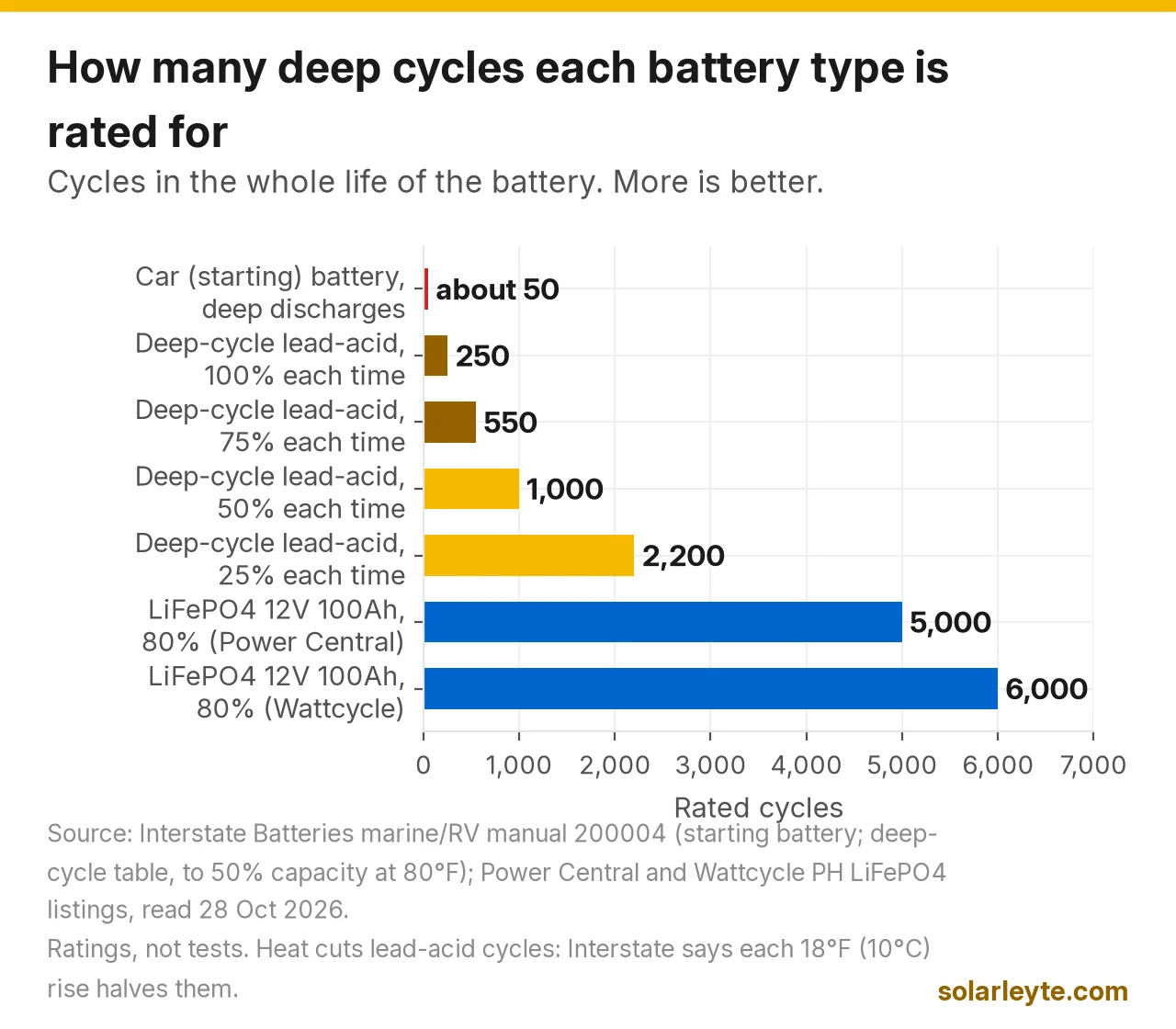
The manual's cycle counts run until the battery drops to 50% of its original capacity, at 80°F (about 27°C). It also says each 18°F (10°C) rise halves the cycles, and keeping batteries above 90°F (about 32°C) "drastically" cuts them. That matters here. Put the battery in shade with airflow, not in a hot tin box under the sun.
That's why most small setups plan to use only about half of a lead-acid battery's rated capacity.
Worked example: cost per kWh stored
Worked example (Solar Leyte estimate, not a test). Assume one full cycle a day. Usable energy is 12 V × Ah × depth: 50% for lead-acid, 80% for LiFePO4. Lifetime energy is usable energy × cycles. For LiFePO4 we cap the cycles at the 7-year warranty (365 × 7 = 2,555 days), because 6,000 days is over 16 years.
Battery | Price | Usable per cycle | Cycles used | Lifetime energy | Cost per kWh stored |
|---|---|---|---|---|---|
Motolite Enduro N70 car battery, 70 Ah | ₱7,370 | 0.42 kWh | 50 | 21 kWh | about ₱351 |
Motolite Solar Master N70, 70 Ah | ₱7,246 | 0.42 kWh | 1,000 | 420 kWh | about ₱17.25 |
Motolite Solar Master, 100 Ah | ₱8,464 | 0.60 kWh | 1,000 | 600 kWh | about ₱14.11 |
Wattcycle 12V 100Ah LiFePO4 (1.28 kWh) | ₱12,999 | 1.02 kWh | 2,555 | 2,616 kWh | about ₱4.97 |
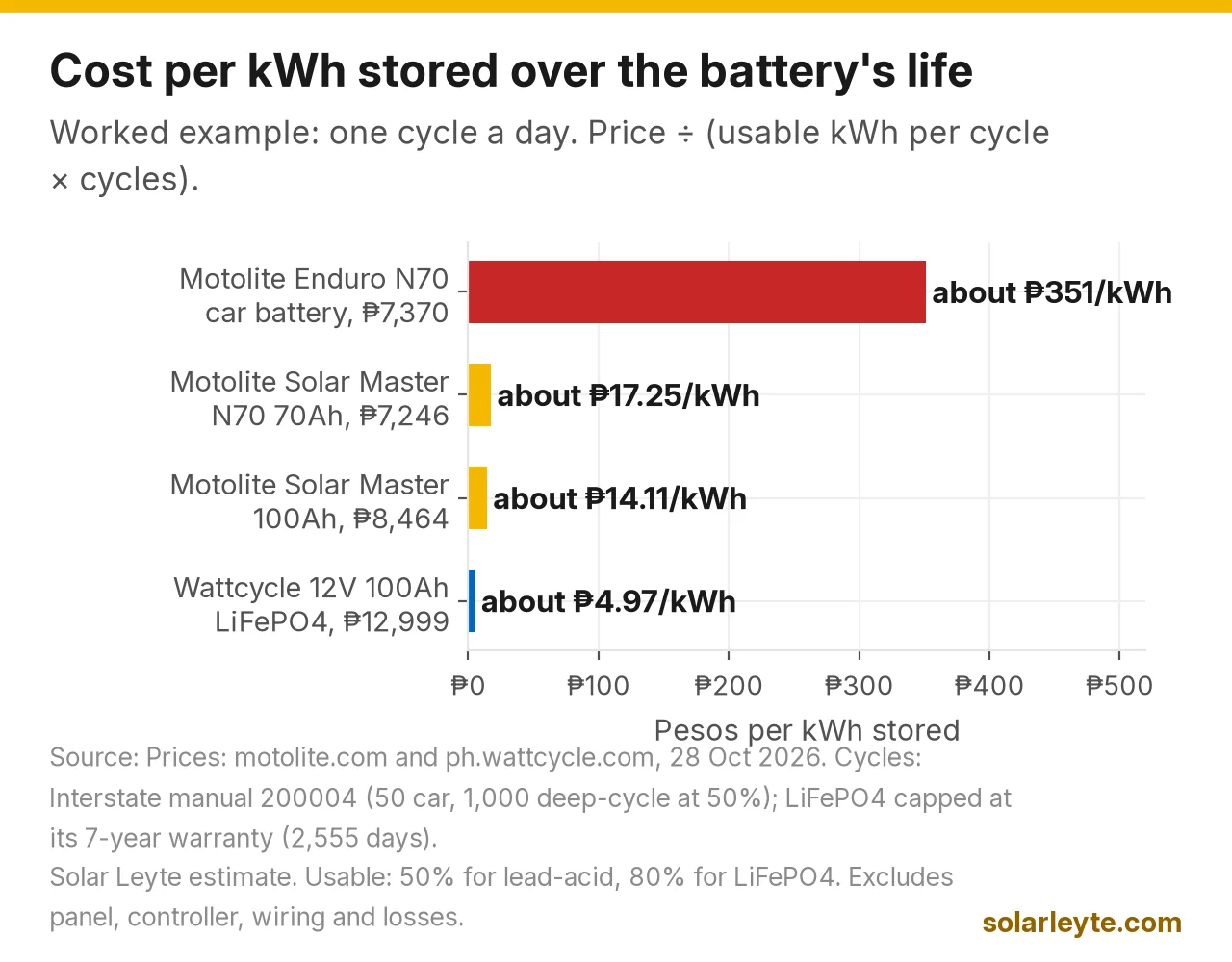
The car battery is cheap on day one and the most expensive per kWh by far. Even if it lasted four times longer than Interstate's figure (200 cycles), it would still cost about ₱88 per kWh stored. The Solar Master cycle count is Interstate's generic 50% figure, not a Motolite rating. Motolite doesn't publish one on its store page, and a dealer's "over 1,500 cycles" claim would make it cheaper still. These figures leave out the panel, charge controller, wiring and losses.
How long will it run? Say your brownout load is 60 W (a fan plus two LED bulbs, as an assumption). Before losses, 0.42 kWh runs it about 7 hours, 0.6 kWh about 10 hours and 1.02 kWh about 17 hours. Through an inverter you'll get less. Our inverter and battery backup post works through those losses.
If you only have a car battery: safe emergency use
Brownout na naman, and the car battery is all you have? You can use it. Treat it as a short-term fix:
- Don't drain it flat. For a lead-acid battery at rest (not right after charging, when Interstate says a surface charge inflates the reading), its table reads 12.75 V at 100%, 12.45 V at 75%, 12.25 V at 50%, 12.05 V at 25% and 11.90 V when empty. Stop at about 12.25 V. A cheap multimeter works (here's how to use one).
- Recharge it fully and soon. Interstate says to recharge as soon as possible after use, because leaving a battery sitting discharged for several days hurts its recharge acceptance and performance.
- Ventilate. Motolite's FAQ warns that charging gives off explosive gases. Charge in a well-ventilated spot, with no sparks or flames nearby.
- Use a charge controller and a fuse. Never wire a panel straight to the battery. Set the controller to the right battery type (see MPPT vs PWM controllers) and put a fuse close to the battery's positive terminal.
- Don't mix batteries. Bosch's leisure battery manual says not to combine batteries of different capacity, type, technology or brand. An old car battery paired with a new deep-cycle drags the new one down.
- Mind big inverters. A 1,000 W load on 12 V pulls close to 100 A. A small car battery can deliver that, but it'll be empty fast. For bigger loads, look at 12 V vs 24 V vs 48 V systems.
Old car batteries: a battery you've just replaced has already lost a good part of its capacity. Motolite's trade-in program gives a discount on a new battery and sends the old one to Evergreen Environmental Resources Inc. for recycling. That's a better place for it than your solar shelf. See our disposal post for other batteries.
Which battery should you buy for a small setup?
- Fan and lights for short brownouts, tight budget: a deep-cycle lead-acid such as a 100 Ah Solar Master, kept somewhere shaded and ventilated. Plan on using about half of it.
- Indoors, or you hate maintenance: sealed AGM or gel, or LiFePO4.
- Daily use, longest life, lighter to carry: LiFePO4. A 12 V 100 Ah lithium weighs about 10 kg in the listings we checked and gives about 1 kWh usable. Check stock: two of the three we looked at were sold out on 28 October.
- Don't buy: a new car battery for solar. Same price, a fraction of the cycles.
Pair the battery with the right panel. Our small solar panels guide covers 50 W to 200 W sizes and prices. For a ready-made option, see our portable power and solar generators guide.
FAQ
Can I use a car battery for a solar panel?
Yes, with a charge controller, and it will work. But a car battery is a starting battery. Interstate says it handles only about 50 deep discharges, so daily solar use wears it out in weeks to months. Use it only as a stopgap.
What's the difference between a car battery and a deep-cycle battery?
A car battery uses thin plates for a short, big burst of current. A deep-cycle battery uses thicker plates so it can be drained and recharged every day. Interstate rates its deep-cycle batteries at about 1,000 cycles at 50% depth, versus about 50 deep cycles for a starting battery.
How much is a Motolite Solar Master in the Philippines?
On Motolite's online store on 28 October 2026: ₱7,246 (70 Ah), ₱8,464 (100 Ah), ₱10,845 (120 Ah), ₱12,905 (150 Ah) and ₱15,105 (200 Ah), tax included. Dealer prices vary.
Is LiFePO4 worth it over lead-acid for a small setup?
If you cycle it daily, usually yes. In our worked example, a 12 V 100 Ah LiFePO4 at ₱12,999 cost about ₱5 per kWh stored, versus about ₱14 to ₱17 for a Solar Master. It's also lighter and needs no topping up. Upfront it costs more, and it needs a controller with a lithium setting.
Can I charge a car battery from a solar panel without a controller?
Don't. A panel's output isn't regulated for your battery. The charge controller is what stops overcharging, so always put one between the panel and the battery.
Solar Leyte is run by MACC Systems & Energy Solutions Inc., a solar installer in Naval, Biliran.
Get a free solar quote from MACC
Thinking of a small brownout setup or something bigger? Tell us what you want to keep running during brownouts and send a recent BILECO or LEYECO bill. We'll suggest a battery and system size, with no obligation.
- Call/Text: 0955 723 5093
- Email: official@macc-inc.com or benjie@macc-inc.com
- Website: www.macc-inc.com
- Request a quote online: solarleyte.com/quote
- Office: Brgy. Talustusan, Naval, Biliran 6543
Sources (all checked 28 October 2026)
- Motolite, Solar Master product page (prices by size, tax included) and Enduro product page (car battery prices)
- Motolite, FAQ (2–3 year average car battery life; reserve capacity definition; charge in a well-ventilated area, explosive gases) and car battery trade-in (recycling by Evergreen Environmental Resources Inc.)
- 1Stop Battery Shop, Motolite listings (Enduro N70 70 Ah, RC 123 min; Solar Master 70/100/120/200 Ah)
- JRYG Auto Parts (Motolite dealer), Solar Master page (thick plates, lead-antimony grids; "over 1,500 cycles at 50% discharge" on some models, a dealer claim)
- Interstate Batteries, Marine/RV battery maintenance manual 200004 (copy hosted by a dealer): about 50 deep cycles for starting batteries; deep-cycle table by depth of discharge; temperature effects; flooded vs sealed (AGM/gel); resting voltage vs state of charge; recharge soon after use; Ah ≈ RC × 0.6
- VARTA, Battery tips for the leisure season (starter batteries not built for repeated cycling; AGM for solar and stationary use)
- Exide, Training module 6: batteries (thin vs thick plates)
- Bosch, Leisure battery product manual (don't combine batteries of different capacity, type, technology or brand)
- Wattcycle PH, 12V 100Ah LiFePO4 listing (₱12,999, sold out on 28 Oct; 1,280 Wh; 6,000+ cycles at 80%; 10.5 kg; 7-year warranty)
- Power Central, 12V 100Ah LiFePO4 listing (from ₱10,218, sold out on 28 Oct; 5,000 cycles at 80%; 10.2 kg)
- Beyond Power, Higee 12.8V 120Ah LiFePO4 (₱13,400, in stock; about 1.54 kWh)
- Solar Leyte, inverter and battery backup post (about 100 A at 1,000 W on 12 V; inverter losses)