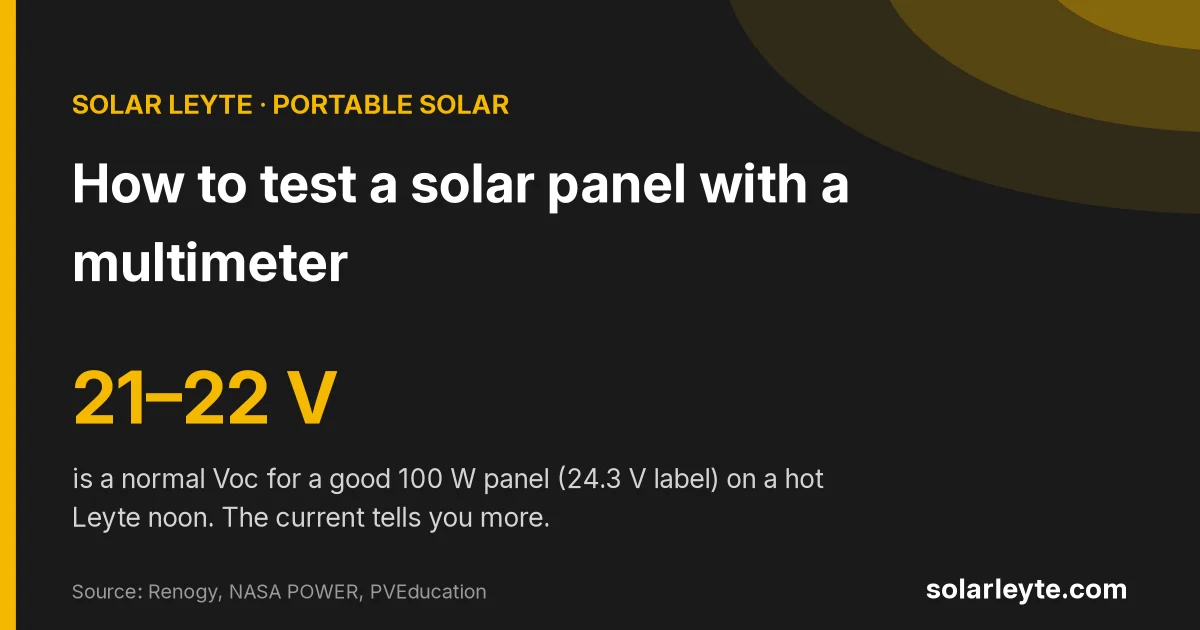
To test a small solar panel, unplug it from the charge controller, set your multimeter to DC volts and touch the probes to the panel's + and − connectors in full sun. That's the open-circuit voltage (Voc). A healthy panel reads close to the Voc on its label, but on a hot Leyte noon expect about 10% less, because heat lowers voltage. Then, only if the panel's short-circuit current (Isc) fits your meter's 10 A range with room to spare, measure Isc on the amps setting. On a clear noon it should be close to the label. On a cloudy day it can be a tenth of it, and the panel is still fine. A basic multimeter that can do both costs about ₱590 at a Philippine tool shop (27 October 2026).
This is for small 12 V and 24 V-class panels (50–200 W) for a boat, a store light, CCTV or a beginner kit. It is not for rooftop strings.
New to small panels? Start with our small solar panel price guide. Just bought one online? Our Lazada and Shopee buying guide has the five checks to do when the box arrives.
Last checked: 27 October 2026. Prices change often. This is general information, not an electrical service. The expected readings below are Solar Leyte estimates from public data, not measurements of your panel.
First: which panels you can test yourself
A single small panel is safe enough to test with care. Renogy's installation manual still warns that one panel in sunlight can put out more than 30 V DC, and that pulling a connector apart while current is flowing can cause an electric arc that burns.
Rooftop systems are a different story. Their panels are wired in series, so the voltages add up. In our 550–620 W panel guide, nine 580 W panels on one string reach about 470 V DC on a cool morning. That is dangerous. If your rooftop system is underperforming, call your installer. Electrical work on a house is a job for a licensed electrician or engineer under RA 7920.
Safety box (small panels only)
- Test one panel at a time, disconnected from the controller and the battery.
- Use a meter rated above the panel's Voc. Every meter in the table below is rated to at least 600 V DC.
- Take off rings and watches. Hold the probes by the insulated grips.
- Before you plug or unplug anything for a current test, cover the panel with something opaque (a sack, a folded tarp, cardboard). Renogy's manual recommends this to stop the panel making power.
- Wet hands, rain or a cracked, burnt-smelling panel? Stop.
What you need, and what it costs
Any digital multimeter with a DC volts setting can read Voc. For Isc you need a DC amps range, usually 10 A. Check the dial before you buy. A clamp meter is only useful for solar if it says AC/DC. An AC-only clamp can't read panel current at all.
Tool | Shop | Price (27 Oct 2026) | What it can do for solar |
|---|---|---|---|
Generic XL830L multimeter | Electx | ₱320 | DC volts. Specs not listed on the page, so check the current range on the box |
Pro'sKit MT-1220 multimeter | Powertool.ph | ₱590 | DC volts to 600 V, DC amps to 10 A, CAT II 600 V |
Total TMT460002 multimeter | Powertool.ph | ₱1,280 | DC volts to 600 V. No DC amps range listed |
Klein MM400 multimeter | Powertool.ph | ₱4,100 | 600 V AC/DC, 10 A AC/DC, CAT III 600 V |
Ingco DCM62002 clamp meter | Powertool.ph | ₱1,900 | "AC/DC" 400 A clamp. Can read current while the panel is charging |
Ingco DCM62001 clamp meter | Powertool.ph | ₱1,000 | AC only. Can't read panel current |
"MPPT solar panel tester" | Lazada (25 listings) | ₱1,343–₱3,599 (median ₱2,233) | Reads Voc, Isc and the panel's actual watts in one go |
UNI-T UT-196 Solar Pro | Electx | ₱18,988 | 1,700 V DC, CAT III 1000 V. A professional's tool for strings |
For a 50–200 W panel, the ₱590 class is enough. We haven't tested the MPPT testers' accuracy.
Read the label first
The sticker on the back of the panel gives Voc, Isc, Vmp and Imp measured at "standard test conditions" (STC): 1,000 W/m² of sunlight and a cell temperature of 25 °C. Renogy's manual says it plainly: outdoors, your numbers will differ from the label.
Write down Voc and Isc. Then multiply Isc by 1.25. Renogy says the ammeter's range should be more than 1.25 times the panel's rated Isc, so that's the number that has to fit under your meter's 10 A limit.
Panel (seller label) | Voc | Isc | Isc × 1.25 | Isc test on a 10 A meter? |
|---|---|---|---|---|
Renogy RNG-100D-SS 100 W | 24.3 V | 5.21 A | 6.5 A | Yes |
Sunworth SW100M 100 W (ABC Solar) | 22.5 V | 5.84 A | 7.3 A | Yes |
SolarHomes 200 W (Bolinao Solar) | 37.90 V | 6.41 A | 8.0 A | Yes |
Trina Vertex N 620 W (rooftop) | 49.6 V | 15.91 A | 19.9 A | No. Voc only, or ask your installer |
How to test Voc (open-circuit voltage)
- Pick a sunny time between about 10 a.m. and 2 p.m. Clean off dust and bird droppings. Make sure no part of the panel is shaded.
- Disconnect the panel from the charge controller. Renogy's checklist says to disconnect it from both the controller and the battery.
- Plug the black lead into COM and the red lead into V. Turn the dial to DC volts (V with a straight line), on the 200 V range if your meter isn't auto-ranging.
- Touch red to the panel's + connector and black to −. With MC4 connectors, push the probe tip gently inside the metal pin.
- Write down the reading, the time and the weather. A phone photo of the screen works.
A minus sign just means the probes are swapped.
How to test Isc (short-circuit current)
Only do this if Isc × 1.25 is under your meter's amp range.
- Cover the panel completely.
- Move the red lead to the 10 A jack (often marked 10A or A) and turn the dial to DC amps.
- Connect red to + and black to −. The meter is now shorting the panel through itself. That's safe for a small panel and is how Isc is measured.
- Uncover the panel, read the number, then cover it again right away.
- Disconnect with the panel still covered. Move the red lead back to V so you don't blow the meter's fuse on your next voltage test.
What the numbers should be on a Leyte day
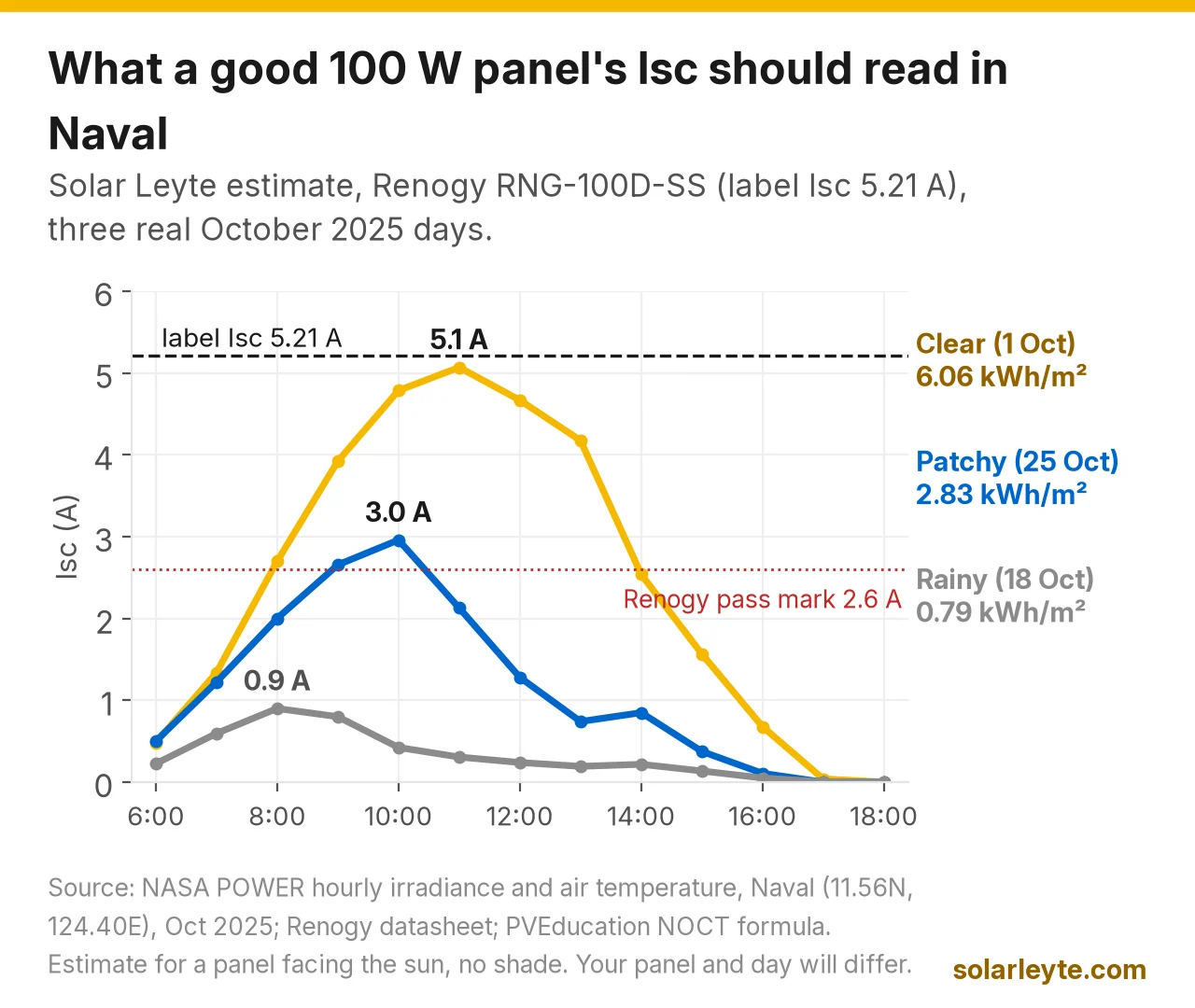
Labels assume 25 °C cells. A panel in the Biliran sun runs much hotter. PVEducation gives a simple estimate: cell temperature = air temperature + (NOCT − 20) ÷ 800 × sunlight in W/m². The Renogy 100 W's NOCT is 47 °C, and its Voc drops 0.28% for every degree above 25 °C. Current follows sunlight almost exactly: half the light, half the Isc.
Worked example 1: a clear October noon in Naval (Solar Leyte estimate)
Assumptions: Renogy RNG-100D-SS. NASA POWER's hourly data for Naval (11.56° N, 124.40° E) on 1 October 2025 shows 956 W/m² at 11 a.m. local time, with air at 29.0 °C. Panel facing the sun, light wind.
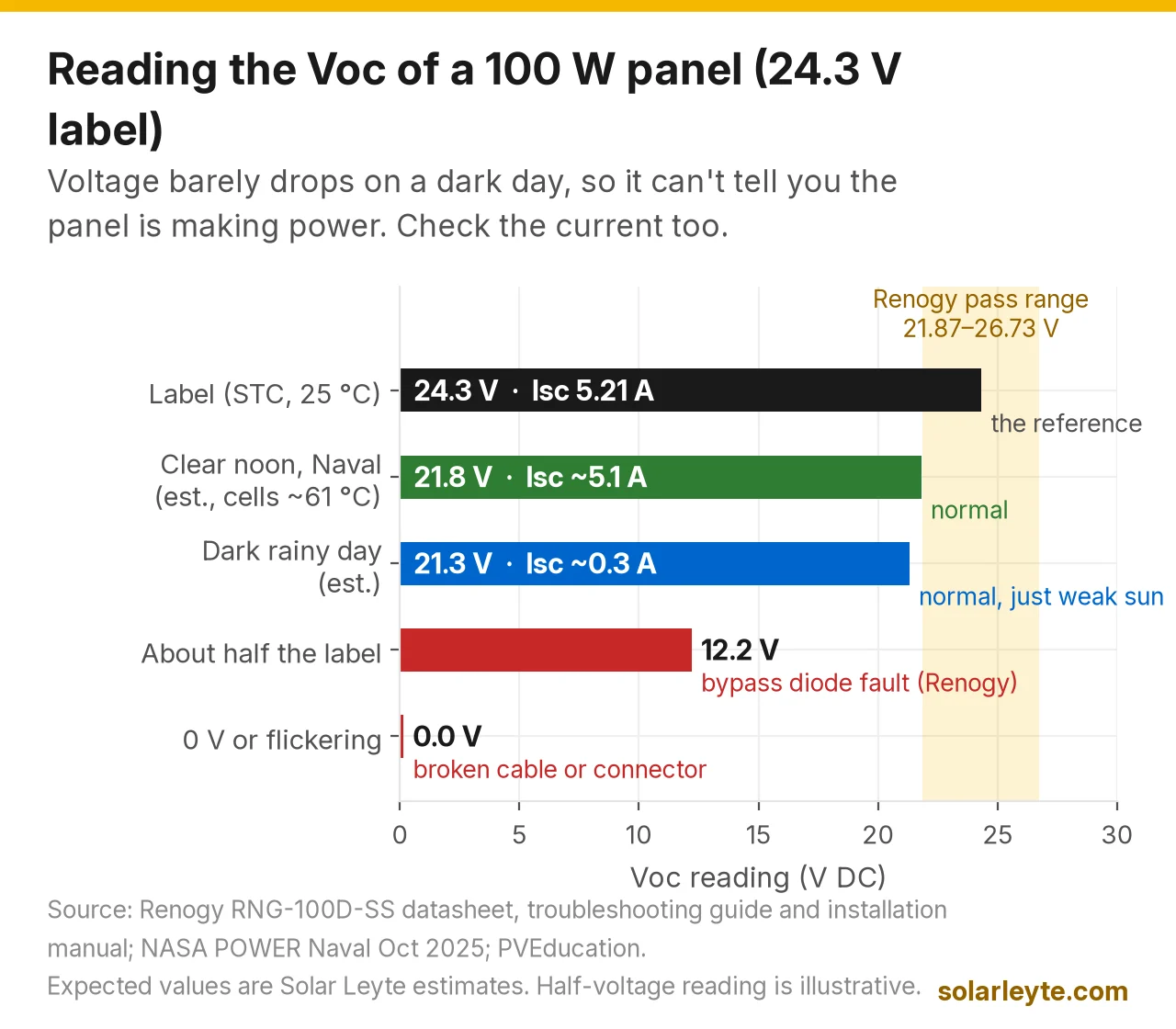
- Cell temperature ≈ 29.0 + (47 − 20) ÷ 800 × 956 ≈ 61 °C
- Voc ≈ 24.3 V × (1 − 0.0028 × 36) ≈ 21.8 V, about 10% under the label
- Isc ≈ 5.21 A × 0.956 ≈ 5.1 A (the small positive temperature coefficient adds a little)
So a healthy panel can read 21–22 V on a hot noon, right at the bottom of Renogy's "±10% of label" pass range (21.87–26.73 V). That's normal. A panel lying on a hot roof sheet can read a bit lower still.
Worked example 2: a dark, rainy day (Solar Leyte estimate)
Assumptions: same panel. NASA POWER shows only 59 W/m² at 11 a.m. on 18 October 2025, with air at 28.6 °C (0.79 kWh/m² for the whole day).
- Isc ≈ 5.21 A × 0.059 ≈ 0.3 A
- Voc stays around 21 V. Voltage barely depends on light. PVEducation's rule of thumb is about 18 mV less per cell for each halving of light, so roughly 2.6 V less for a 36-cell panel at one-seventeenth of full sun.
That's the trap: a panel can show 21 V on a gloomy day and still charge almost nothing. Voltage says the panel is alive; current says whether it's making power. That's why Renogy says to test on a sunny noon. Its pass mark for current is 50% of label Isc (2.6 A here), and on a day like 18 October a good panel would fail it. More on weather in our rainy-day solar guide.
What your reading means
What you see (sunny noon) | Likely meaning | What to do |
|---|---|---|
Voc about 85–100% of label | Normal. Heat pulls it down a bit | Check Isc, then look at the controller |
Voc about half of label | Renogy's manual: a defective bypass diode | Warranty claim, or a PV technician. Don't open the junction box yourself |
0 V or flickering | Broken cable, loose MC4 or a dead connection | Check the connectors and cable. Test right at the junction box leads if you can |
Good Voc, Isc well under half of label in full sun | Shading, heavy dirt, a cracked cell or an undersized panel | Clean it, remove the shade, test again. Then compare with another panel |
Good Voc and Isc, but the battery still won't charge | The panel is fine. Look at the controller, wiring or battery | See below |
When the panel passes but the battery doesn't charge, Renogy's checklist moves to the controller and battery. A nearly full battery gets less charge on purpose. Check the controller's battery type and charge voltages, and whether the panel's Voc is over the controller's limit (some cheap PWM controllers cap it at 21 V). Our MPPT vs PWM guide explains the mismatch, and our 12 V, 24 V or 48 V guide covers battery voltage.
Checking it while it charges
Isc is what the panel can do. To see what it actually sends to the battery, clamp an AC/DC clamp meter around one panel wire (+ or −, never both) while the system runs, or read PV volts and amps on the controller's screen (watts = volts × amps). Expect less than Isc: the controller works near Vmp, and charging slows as the battery fills.
A slow fall in output over the years is normal ageing; see our panel lifespan and warranty guide and cleaning guide. For portable setups in general, see our solar generators and portable power guide.
Frequently asked questions
Pwede bang i-test ang solar panel kahit maulap?
Pwede for voltage. Kahit maulap, Voc usually stays close to normal, so it tells you the panel isn't dead. For current, wait for a sunny noon. On a dark day a good panel can read under 1 A, and you can't tell it apart from a weak one.
My 100 W panel reads 22 V but my controller shows only 2 A. Is it broken?
Probably not. Check Isc on a sunny noon first. If Isc is close to the label (about 5 A for most 100 W 12 V-class panels), the panel is fine. Then check if the battery is nearly full, the controller settings, and the cable size and connections.
Unsaon pag-test sa rooftop solar namo sa balay?
Ayaw na i-test ninyo mismo. A rooftop string can be hundreds of volts DC. Look at the inverter app or screen for daily kWh and any error codes, then call your installer.
Can a cheap analog multimeter test a solar panel?
Yes for voltage, if its DC range is above the panel's Voc. Check it has a 10 A DC range before any current test.
Solar Leyte is run by MACC Systems & Energy Solutions Inc., a solar installer in Naval, Biliran.
Get a free solar quote from MACC
Thinking of going beyond a small panel? Send us a photo of your last BILECO or LEYECO bill and tell us what you want to run during brownouts. We'll size a system and give you every model number and datasheet, with no obligation.
- Call/Text: 0955 723 5093
- Email: official@macc-inc.com or benjie@macc-inc.com
- Website: www.macc-inc.com
- Request a quote online: solarleyte.com/quote
- Office: Brgy. Talustusan, Naval, Biliran 6543
Sources (all checked 27 October 2026)
- Renogy, How to troubleshoot solar panels (test on a sunny day around noon with no shade; COM/V and A ports; Voc within ±10% of spec; Isc at least 50% of spec; RNG-100D-SS example 21.87–26.73 V and 2.6 A)
- Renogy, Solar kits troubleshooting checklist (disconnect the panel from the controller and battery; "be careful when measuring current"; a nearly full battery cuts charging; check controller settings)
- Renogy, Solar module installation manual (PDF) (over 30 V DC from one module; arcs when disconnecting in sunlight; cover with opaque material; ammeter range over 1.25 × rated Isc; half of rated voltage indicates a defective bypass diode; low Voc from heat or low light is normal; data sheet values are at STC)
- Renogy, RNG-100D-SS 100 W datasheet (PDF) (Voc 24.3 V, Isc 5.21 A, Vmp 20.4 V, Imp 4.91 A, NOCT 47 ± 2 °C, Voc −0.28%/°C, Isc +0.05%/°C, 36 cells)
- PVEducation, Nominal operating cell temperature (NOCT conditions and the cell temperature formula); Effect of light intensity (Isc proportional to light; Voc changes logarithmically); Effect of temperature (Voc is the parameter most affected by temperature)
- NASA POWER, hourly data for Naval, Biliran, October 2025 (all-sky irradiance and 2 m air temperature, local solar time; 1 Oct 2025: 6.06 kWh/m², 956 W/m² at 11:00, 29.0 °C; 18 Oct 2025: 0.79 kWh/m², 59 W/m² at 11:00, 28.6 °C; 25 Oct 2025: 2.83 kWh/m²)
- Multimeter prices: Electx Electrical Supply, XL830L (₱320) and UNI-T UT-196 Solar Pro (₱18,988); Powertool.ph, Pro'sKit MT-1220 (₱590), Total TMT460002 (₱1,280), Klein MM400 (₱4,100), Ingco DCM62002 AC/DC clamp (₱1,900), Ingco DCM62001 AC clamp (₱1,000)
- Lazada Philippines, search results for "solar panel tester" (27 October 2026; 40 listings, 25 MPPT testers from ₱1,343 to ₱3,599, median ₱2,233; Solar Leyte tally, sellers not named)
- Panel labels: ABC Solar Sunworth SW100M and Bolinao SolarHomes 200 W as listed in our small solar panel guide; Trina Vertex N 620 W as listed in our 550–620 W panel guide
- Lawphil, RA 7920, Electrical Engineering Law