For a new rooftop system in Leyte or Biliran, an N-type TOPCon panel is the sensible default in 2026. It loses less power when it's hot, its warranty promises more output after 25 years, and in our 30 October check, Philippine sellers weren't charging more for TOPCon than for older PERC panels. HJT (heterojunction) panels handle heat a little better still, but they're hard to find with a peso price here. A good PERC panel at a clearly lower price still works fine; the difference is a few percent, not night and day.
How big is "a few percent"? Using five years of PVGIS weather for Naval, we worked out that the heat penalty costs a typical PERC panel about 7.4% of its energy over a year, TOPCon about 6.3% and HJT about 5.6%. So TOPCon makes roughly 1.2% more energy than the same-watt PERC panel, and HJT about 1.9% more, just from handling heat better.
Last checked 30 October 2026. Panel figures are from the makers' datasheets in the Sources. Peso prices are seller listings checked on 30 October 2026. Heat-loss and warranty numbers are Solar Leyte calculations, with the assumptions stated. Nothing here is a MACC price or a quote.
PERC, TOPCon and HJT in plain words
All three are monocrystalline silicon cells. The difference is in how the cell is built and what the wafer is doped with:
- PERC (Passivated Emitter and Rear Cell) adds a passivating layer to the back of a cell. It's usually made on a P-type wafer. PERC was the mainstream panel for most of the last decade, and a lot of the "mono PERC 550 W" stock in the Philippines is still this type.
- TOPCon (Tunnel Oxide Passivated Contact) puts an ultra-thin oxide layer and doped silicon on the back of an N-type wafer. Jinko's Tiger Neo, Trina's Vertex N and most new "N-type" panels are TOPCon.
- HJT (heterojunction) sandwiches an N-type wafer between thin layers of amorphous silicon. It's naturally two-sided and has the lowest heat loss of the three, but it needs different factory lines.
The market has already moved. The ITRPV roadmap, written with input from the big manufacturers, expected TOPCon to hold 68% of cell production in 2025 and PERC to fall to 18%. Its 2026 edition says about 82% of wafers made in 2025 were N-type and that PERC "is rapidly phasing out". So if a seller is pushing PERC hard, it's fair to ask whether you're buying older stock, and to ask for a lower price.
The datasheet numbers side by side
We picked one current, real datasheet for each type. These are examples, not recommendations, and other models in the same family differ slightly.
PERC: LONGi Hi-MO 5m LR5-72HPH-550M | TOPCon: Jinko Tiger Neo JKM580N-72HL4-BDV | HJT: HD Hyundai HiT-H710GH | |
|---|---|---|---|
Wafer type | P-type (gallium-doped) | N-type | N-type |
Rated power | 550 W | 580 W | 710 W |
Module efficiency | 21.3% | 22.45% | 22.86% |
Power temperature coefficient | −0.340%/°C | −0.29%/°C | −0.26%/°C |
First-year degradation (warranty) | under 2% | 1% | 1% |
Yearly degradation after that | 0.55% | 0.40% | 0.375% |
Linear power warranty | 25 years, 84.8% at year 25 | 30 years | 30 years, 88% at year 30 |
Product warranty | 12 years | 12 years | 15 years |
Back-side power (bifaciality) | none (single glass, one-sided) | 80 ± 5% | 85 ± 5% |
Size | 2,278 × 1,134 mm | 2,278 × 1,134 mm | 2,384 × 1,303 mm |
Figures from each maker's datasheet (see Sources). The HJT panel is a larger 132-cell format, so compare efficiency, not watts.
Three things stand out. The efficiency gap is small: about one percentage point from PERC to TOPCon, and less from TOPCon to this HJT panel. The real differences are the temperature coefficient and the degradation warranty. And the Jinko and LONGi panels are exactly the same size, so on the same roof, the TOPCon panel gives you 30 W more per panel.
Temperature coefficient: why heat matters more in Leyte
Panels are rated at a cell temperature of 25 °C. On a Leyte roof at midday, the cells run far hotter than that, and every degree above 25 °C costs a fixed share of power. That share is the temperature coefficient.
Here's a simple example. PAGASA's 1991–2020 normals put Tacloban's average daily high in May at 32.5 °C. Using the standard NOCT method from PVEducation, with a 45 °C NOCT (the LONGi datasheet's figure, used for all three so only the coefficient changes) and full sun of 1,000 W/m², the cells would sit at about 64 °C. At that temperature:
Cell type (coefficient) | Share of rated power left at a 64 °C cell | 550 W-class panel at that moment |
|---|---|---|
PERC (−0.340%/°C) | 86.8% | about 477 W from 550 W |
TOPCon (−0.29%/°C) | 88.8% | about 488 W from 550 W |
HJT (−0.26%/°C) | 89.9% | about 495 W from 550 W |
Worked example, Solar Leyte calculation: cell temperature = 32.5 + (45 − 20) ÷ 800 × 1,000 = 63.75 °C. Panels mounted close to a roof usually run hotter than the open-rack NOCT test assumes.
A hot noon is the worst case, though. For the whole year, we took PVGIS hourly sunshine and air temperature for Naval, Biliran (2019–2023, panels tilted 10° facing south) and applied the same cell-temperature model hour by hour. The energy-weighted average cell temperature came out at about 46.6 °C, and the heat loss over a year was:
Cell type | Energy lost to heat over a year (Naval) | Energy compared with PERC |
|---|---|---|
PERC | 7.36% | baseline |
TOPCon | 6.28% | +1.17% |
HJT | 5.63% | +1.87% |
Solar Leyte calculation from PVGIS-ERA5 hourly data for Naval (11.56° N, 124.40° E) and each datasheet's power temperature coefficient. Heat loss only; other losses (wiring, inverter, dirt) aren't included.
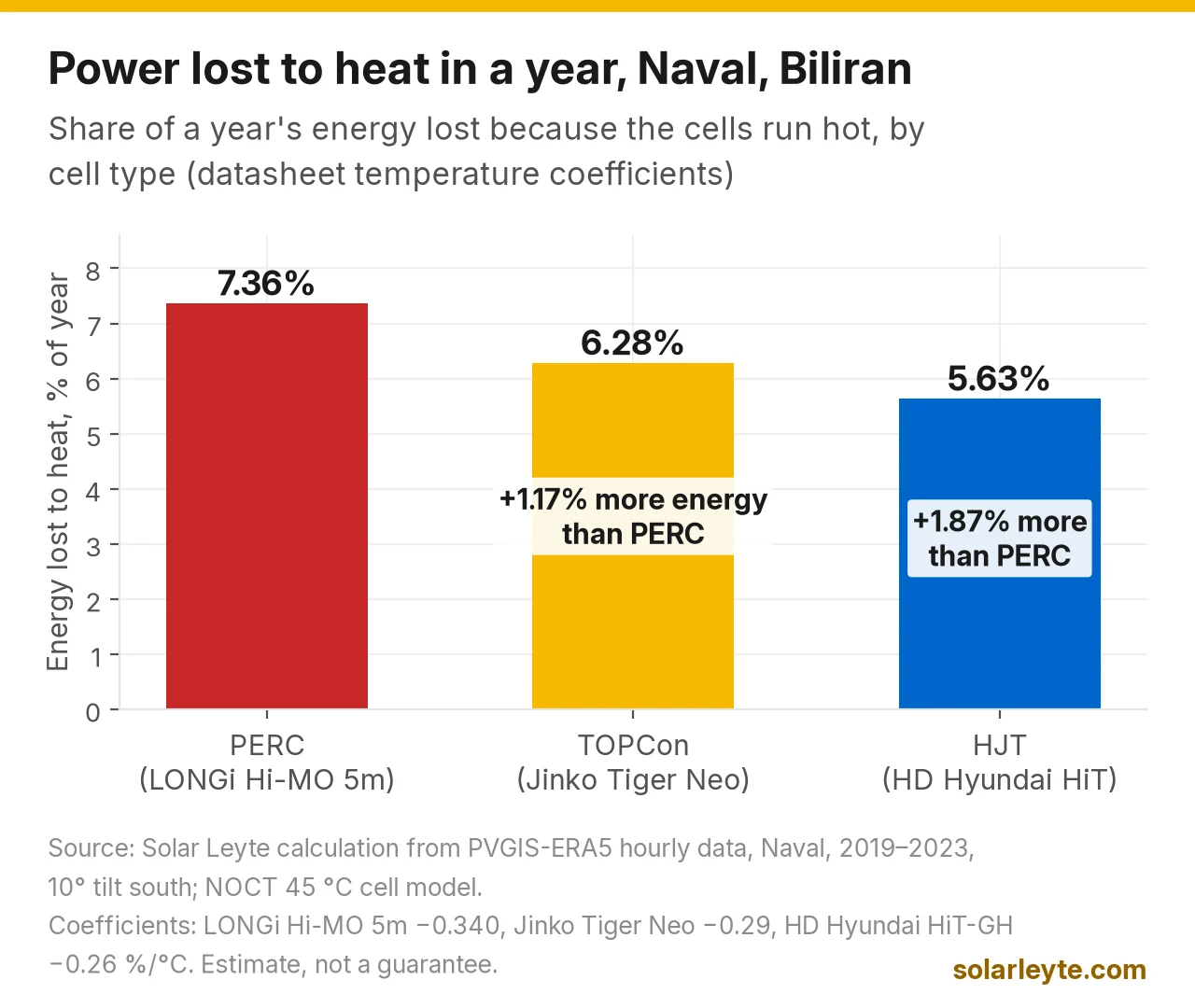
What that means on a real roof, as an example: PVGIS estimates a 5 kW system in Naval (10° tilt, facing south, 14% system losses) makes about 7,435 kWh a year. 1.17% extra is about 87 kWh a year from TOPCon. At an example rate of ₱12 per kWh (use the rate on your own bill), that's about ₱1,000 a year. It's real, but small. It shouldn't outweigh a big price gap or a weak warranty.
Degradation: what the warranty promises after 25 years
All panels lose a little output every year. The linear power warranty is the maker's promise of how much output will be left at minimum. These are floors, not forecasts, but they show the gap well.
Year | PERC (LONGi Hi-MO 5m) | TOPCon (Jinko Tiger Neo) | HJT (HD Hyundai) |
|---|---|---|---|
1 | 98.0% | 99.0% | 99.0% |
10 | 93.05% | 95.4% | 95.6% |
25 | 84.8% | 89.4% | 90.0% |
30 | no cover (25-year warranty) | 87.4% | 88.1% |
Year 1 and the end points are from the datasheets. The middle years are Solar Leyte calculations: first-year figure minus the yearly rate for each later year.
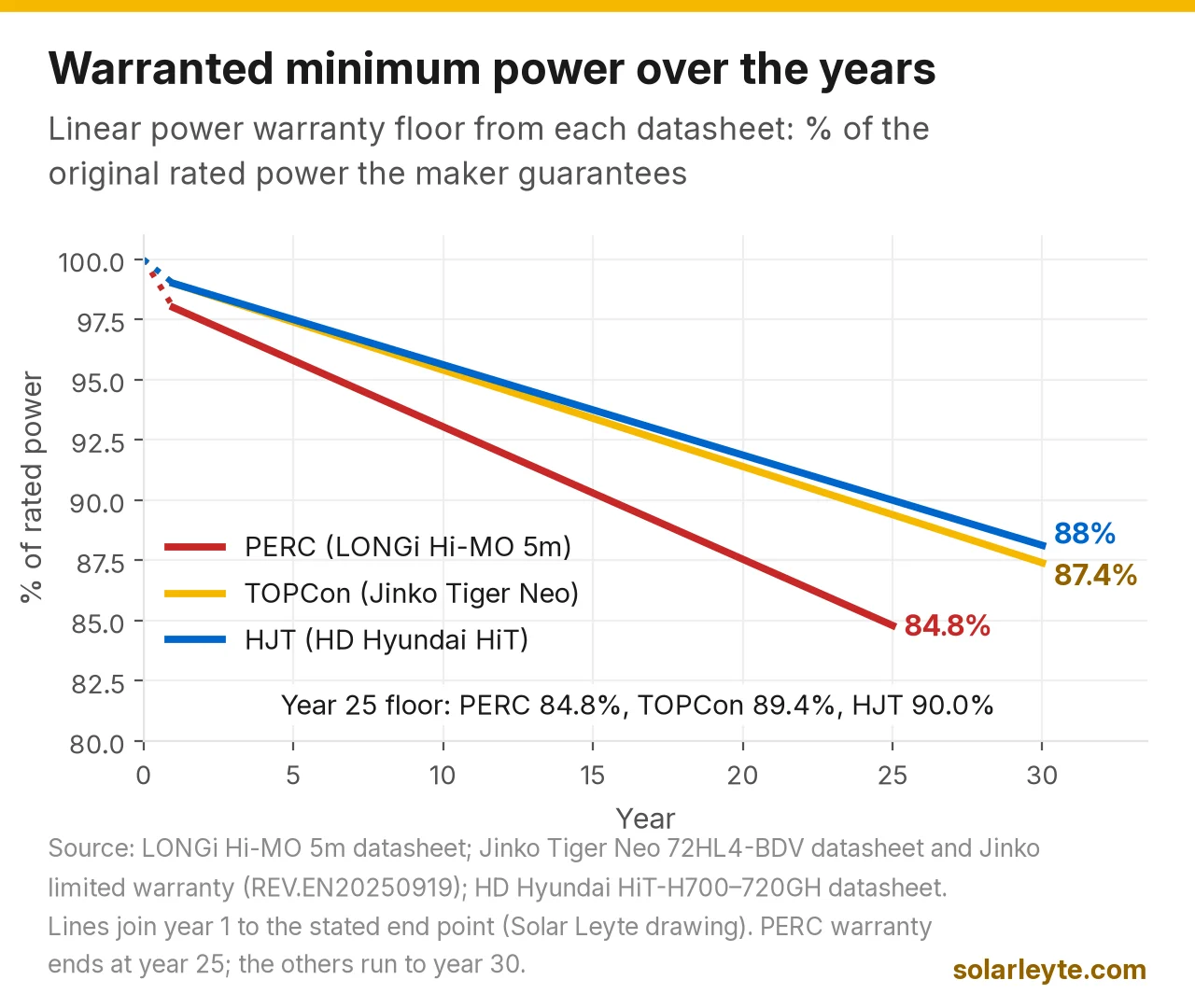
By year 25, the TOPCon warranty guarantees about 4.6 percentage points more of the original power than the PERC one, and it runs five years longer. On a 5 kW system, that's roughly 230 W of extra guaranteed capacity at year 25 (our calculation). For more on how these warranties are worded and claimed, see our solar panel lifespan and warranty guide.
LID and LeTID, briefly
Some of PERC's early loss comes from light-induced degradation (LID). NREL researchers describe it as mostly caused by boron-oxygen defects in boron-doped P-type wafers, with reported efficiency losses of 0.5% to 1.5% absolute in cells. Makers have worked around this: LONGi's Hi-MO 5m uses a gallium-doped wafer. N-type panels avoid the boron-oxygen problem: Jinko says its TOPCon panels have lower LID and LeTID (a heat-related cousin), and HD Hyundai says its N-type HJT wafer eliminates LID. Those are maker claims, and they show up in the smaller first-year numbers in the warranties.
Half-cut cells: what "half-cell" on a listing means
"Half-cell" or "half-cut" isn't a cell type. It's how the cells are cut and wired, and PERC, TOPCon and HJT panels all use it (every panel in the table above does). Each cell is cut in two, so each half carries half the current.
According to Fraunhofer CSP researchers writing in Photovoltaics International, resistive losses in the cell connections rise with the square of the current. Halving the current cuts those losses to a quarter: from up to about 3% of module power down to about 0.75%. Cutting the cells costs about 0.5% (relative) at the cell edge, but the module still comes out ahead. Half-cell modules are also more tolerant of partial shading, such as dust in a corner. In short, half-cut is a good thing, but it's normal now, not a premium feature.
Prices in the Philippines (30 October 2026)
Panel (as listed) | Cell type (as listed) | Seller | Listed price | ₱ per watt (our calculation) |
|---|---|---|---|---|
Sunova 550 W mono PERC | PERC | Phsolar | ₱6,700 | ₱12.18 |
AE 550 W mono PERC | PERC | Phsolar | ₱7,000 | ₱12.73 |
Seraphim 620 W TOPCon bifacial | TOPCon | Helios Optimum Development | ₱5,000 | ₱8.06 |
Trina Solar 600 W Vertex N-Type bifacial | N-type (as listed) | Helios Optimum Development | ₱5,000 | ₱8.33 |
Seller listings checked 30 October 2026, before delivery. Listing a product isn't an endorsement, and Solar Leyte earns nothing from these links.
The two TOPCon listings were cheaper per watt than the two PERC ones. That's four listings from two sellers, so it isn't a market survey. But it matches what we saw in our 550 W to 620 W panel price check: the seller and the freight matter more than the cell type. We didn't find an HJT panel with a peso price on a Philippine seller site in this check. If an installer offers HJT, ask for the exact model, datasheet and warranty PDF, and compare it on ₱ per watt delivered to Naval, Ormoc or Tacloban.
Which one should you buy?
- New rooftop system: TOPCon is the safe default. Same size and price range as PERC here, less heat loss, a longer power warranty. Check that the panel's current suits your inverter.
- Tight roof, hot GI sheet, or you want the most kWh per square metre: HJT is worth asking about, if you can get a real quote and local warranty support.
- PERC at a clear discount: fine for a budget system, a small off-grid setup or matching existing panels. Make sure it's a known maker with a datasheet, and price it below TOPCon.
- Adding panels to an old system: match the existing panels' electrical specs first. Cell type matters less than voltage and current.
Bisaya/Tagalog quick take: Kung bag-o ang imong sistema, TOPCon na lang. Gamay ra ang kalainan sa presyo, pero mas lig-on sa init ug mas taas ang warranty. (Kung bago ang system mo, TOPCon na. Halos pareho ang presyo, mas kaya ang init at mas mahaba ang warranty.)
Before you pay, ask for the exact model code, the datasheet and the maker's warranty PDF. Our guide to what "Tier 1" really means and our Jinko vs Trina vs LONGi comparison cover the brand side. If you're buying online, read our Lazada and Shopee checklist.
FAQ
Is TOPCon better than PERC?
On paper, yes. In the datasheets we compared, TOPCon lost less power per degree (−0.29% vs −0.34%/°C), degraded more slowly (0.40% vs 0.55% a year) and had a 30-year power warranty instead of 25. In Naval's climate, that heat difference alone is worth about 1.2% more energy a year (our calculation).
Is N-type the same as TOPCon?
Not exactly. N-type describes the wafer. TOPCon and HJT are both N-type cell designs. Most "N-type" panels sold in the Philippines in 2026 are TOPCon, but ask for the datasheet to be sure.
Are HJT panels worth it in the Philippines?
They have the lowest heat loss (about 1.9% more yearly energy than PERC in our Naval calculation) and long warranties. The catch is availability and price: we found no HJT peso listing on Philippine seller sites on 30 October 2026, so get a written quote and check local warranty support.
What does "half-cut" or "half-cell" mean?
Each cell is cut in two, which halves the current and cuts connection losses to about a quarter. It's a standard feature on PERC, TOPCon and HJT panels, not a separate cell type.
Related guides
- Solar panel prices: how to read a quote
- Bifacial solar panels: worth it on a roof?
- Solar panel sizes and how many fit on your roof
- Best tilt and direction for panels in Leyte and Biliran
Solar Leyte is run by MACC Systems & Energy Solutions Inc., a solar installer in Naval, Biliran.
Get a free solar quote from MACC
Comparing panel quotes? Send us the panel model codes (or photos of the labels) plus a recent BILECO or LEYECO bill. We'll check them and suggest a system, with no obligation.
- Call/Text: 0955 723 5093
- Email: official@macc-inc.com or benjie@macc-inc.com
- Website: www.macc-inc.com
- Request a quote online: solarleyte.com/quote
- Office: Brgy. Talustusan, Naval, Biliran 6543
Sources (all checked 30 October 2026)
- LONGi, Hi-MO 5m LR5-72HPH 540–560M datasheet (G2, 20220810V16): 550M efficiency 21.3%; under 2% first-year and 0.55% year 2–25 degradation; 84.80% at year 25; 12-year product, 25-year power warranty; TC Pmax −0.340%/°C; NOCT 45 ± 2 °C; gallium-doped M10 wafer, half-cell, single glass; 2,278 × 1,134 mm.
- JinkoSolar, Tiger Neo JKM575-600N-72HL4-BDV datasheet: N-type TOPCon; JKM580N efficiency 22.45%; TC Pmax −0.29%/°C; bifaciality 80 ± 5%; 12-year product, 30-year linear power warranty, 1% first year, 0.40% a year; lower LID/LeTID claim; 2,278 × 1,134 mm.
- JinkoSolar, Limited Warranty REV.EN20250919, linear bifacial module: 87.4% at year 30.
- HD Hyundai Energy Solutions, HeteroMax GH series HiT-H700–720GH datasheet: N-type HJT; H710GH efficiency 22.86%; TC Pmax −0.26%/°C; bifaciality 85 ± 5%; 15-year product, 30-year performance warranty, 1% first year, 0.375% a year, 88% at year 30; N-type wafer "eliminates LID"; 2,384 × 1,303 mm; NOCT 44 ± 2 °C.
- VDMA, ITRPV 17th edition press release: about 82% N-type wafers in 2025; PERC "rapidly phasing out". ITRPV 16th edition (March 2025) key findings, as reported by PV Tech: TOPCon 68% and PERC 18% market share expected in 2025.
- Sopori et al., NREL, Understanding Light-Induced Degradation of c-Si Solar Cells (preprint): LID attributed to boron-oxygen defects; reported losses 0.5–1.5% absolute.
- Schneider et al., Fraunhofer CSP, Half-cell solar modules: the new standard in PV production? (Photovoltaics International): connection losses reduced to a quarter, about 3% to 0.75% of module power; about 0.5% relative edge loss; better partial-shading tolerance.
- PAGASA, Climatological normals 1991–2020, Tacloban: May mean maximum 32.5 °C.
- PVEducation, Nominal operating cell temperature: cell temperature formula.
- European Commission JRC, PVGIS for Naval, Biliran (11.56° N, 124.40° E), 10° tilt facing south: hourly in-plane sunshine and air temperature (PVGIS-ERA5, 2019–2023), and the PV calculator estimate of 7,435 kWh a year for 5 kWp with 14% system losses (PVGIS-ERA5, 2005–2023).
- Seller listings: Phsolar, Sunova 550 W mono PERC and AE 550 W mono PERC; Helios Optimum Development, Seraphim 620 W TOPCon bifacial and Trina Solar 600 W Vertex N-Type bifacial.
- Hot-noon output, yearly heat loss, warranty middle years, per-watt prices and the 5 kW example are Solar Leyte calculations from the figures above.