Jinko, Trina and LONGi are the three panel brands that show up most often when a Leyte or Biliran homeowner asks for a Tier-1 quote. On paper they look almost the same: dual-glass N-type panels around 580 W to 620 W, about 22–23% efficiency, a 12-year product warranty and a 30-year linear power warranty that still guarantees 87.4% at year 30. The differences that matter on a BILECO or LEYECO roof are smaller than the marketing suggests: current (whether a 620 W panel fits your inverter), frame size, weight, and whether the seller can actually deliver that brand with a written datasheet and warranty.
Unsa may lahi gyud? Below we compare the makers' own datasheets and limited-warranty documents, list the Philippine peso prices we could verify on seller pages on 13 October 2026, and show how to read a quote without treating any brand as "best".
For watt-class shopping across all brands, see our 550W to 620W solar panel price list. For what bifacial backsides actually add on a GI roof, see our bifacial solar panel guide. For a whole system priced line by line, see the itemised 5kW solar system price.
Specs and warranty terms come from each maker's datasheet and limited-warranty PDF, checked 13 October 2026. Prices were checked the same day on each seller's own website. Makers revise documents, so match the exact model on your quote to the current sheet. Listing a product isn't an endorsement, and Solar Leyte earns nothing from these links. Nothing here is a MACC price or a quote.
Philippine prices for Jinko, Trina and LONGi (13 October 2026)
Big-brand panels are still harder to price online than no-name 550 W boards. On 13 October 2026 we found real peso prices for Trina and Jinko on seller pages. LONGi appeared as a listed product, but without a wattage on that page.
Panel (as listed) | Seller | Listed price | ₱ per watt (our calculation) |
|---|---|---|---|
Trina Solar 600 W Vertex N-Type bifacial | Helios Optimum Development | ₱5,000 | ₱8.33 |
Jinko Tiger Neo 625 W N-type bifacial | SolarPower Energy | ₱6,900 | ₱11.04 |
Jinko Tiger Neo 635 W N-type bifacial | SolarPower Energy | ₱7,015 | ₱11.05 |
Jinko Tiger Neo 640 W N-type bifacial | SolarPower Energy | ₱7,130 | ₱11.14 |
Jinko Tiger Neo 725 W N-type bifacial | SolarPower Energy | ₱8,624.98 | ₱11.90 |
LONGi Hi-MO X10 BC monofacial | SolarPower Energy | ₱6,500 | wattage not shown on the listing |
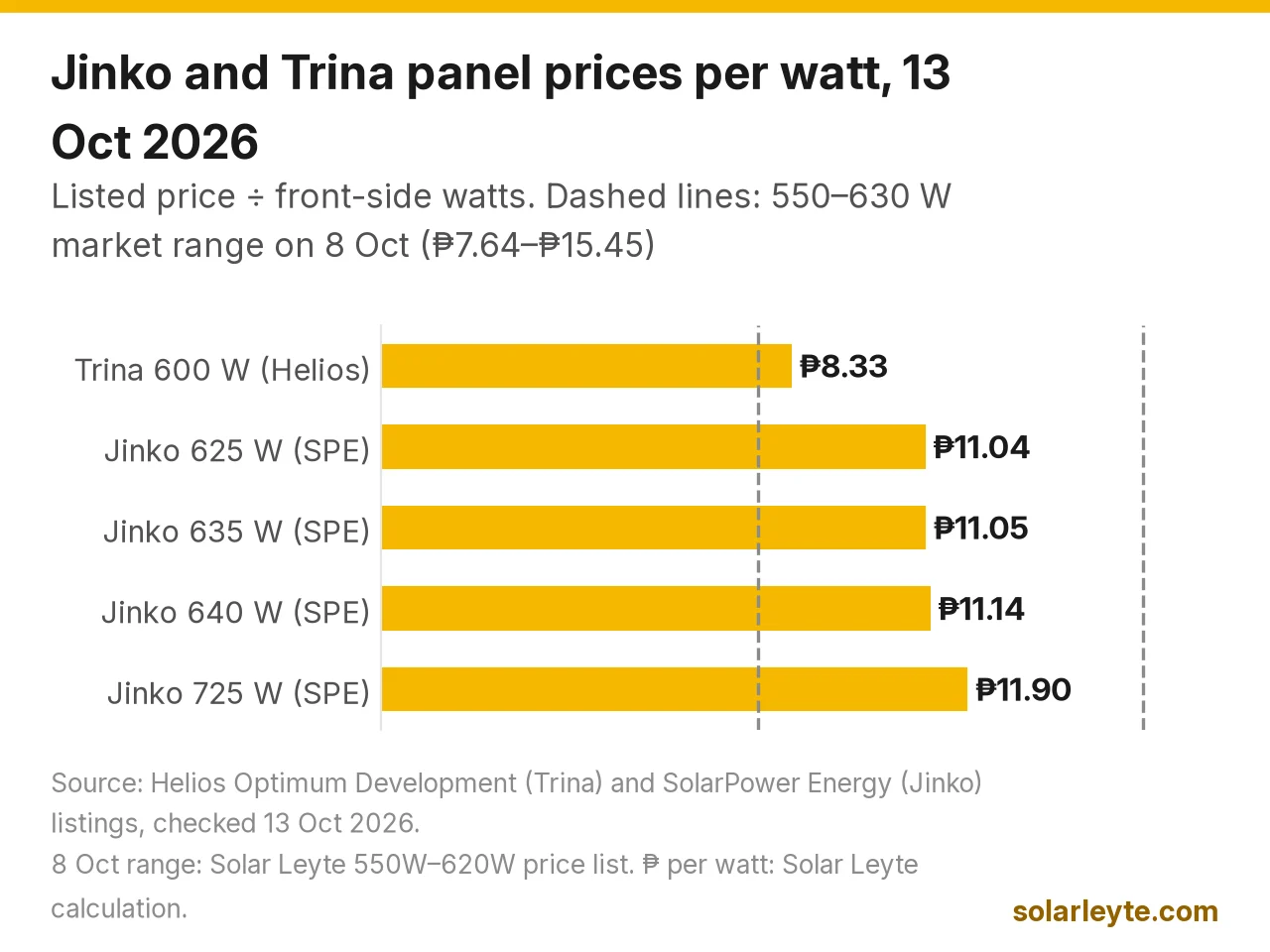
That's ₱8.33 to ₱11.90 per watt for the Trina and Jinko rows with a listed wattage. For context, the wider 550–630 W market we checked on 8 October 2026 ran from ₱7.64 to ₱15.45 per watt, and bifacial listings on 13 October sat at ₱8.06 to ₱13.07 per watt. So these Tier-1 listings sit inside the normal range, not above it.
What to watch in these listings:
- SolarPower Energy (Muntinlupa) has a minimum order of 5 panels. Delivery outside Metro Manila is quoted separately; VisMin freight "costs vary by weight/distance". Its LONGi page shows a seller badge of "5 years Product Warranty", which is not the same as LONGi's own 12-year product warranty on Hi-MO 7 datasheets. Always ask for the maker's warranty PDF for the exact model.
- Helios Optimum Development lists the Trina 600 W Vertex at the same ₱5,000 as its Seraphim 620 W. Ask for the exact Trina model number (for example TSM-xxxNEG19RC.20) and the datasheet; the shop title alone isn't a model code.
- LakaSolar still listed Trina Vertex panels as "Contact for Price" when we checked in early October. An installer quote is often the only way to get a LONGi, Jinko or Trina line item with freight to Naval, Ormoc or Tacloban.
Specs side by side: LONGi, Jinko and Trina
These four panels are the ones we read from manufacturer datasheets for the 550W–620W post and re-checked for this comparison. All four are bifacial dual-glass modules.
Spec | LONGi Hi-MO 7 LR5-72HGD-580M | Jinko Tiger Neo JKM580N-72HL4-BDV | Jinko Tiger Neo JKM600N-72HL4-BDV | Trina Vertex N TSM-620NEG19RC.20 |
|---|---|---|---|---|
Front-side watts (STC) | 580 W | 580 W | 600 W | 620 W |
Size (mm) | 2,278 × 1,134 × 30 | 2,278 × 1,134 × 30 | 2,278 × 1,134 × 30 | 2,382 × 1,134 × 30 |
Weight | 31.8 kg | 31.0 kg | 31.0 kg | 33.7 kg |
Efficiency | 22.5% | 22.45% | 23.23% | 23.0% |
Voc / Isc | 51.41 V / 14.22 A | 52.50 V / 13.95 A | 53.30 V / 14.19 A | 49.6 V / 15.91 A |
Vmp / Imp | 43.22 V / 13.42 A | 43.88 V / 13.22 A | 44.45 V / 13.50 A | 41.4 V / 14.99 A |
Temp. coeff. of power | −0.280%/°C | −0.29%/°C | −0.29%/°C | −0.29%/°C |
Bifaciality (power) | 80% ± 5% | 80% ± 5% | 80% ± 5% | 80% ± 5% |
Power tolerance | 0 to +3% | 0 to +3% | 0 to +3% | 0 to +5 W |
Front / rear test load | 5,400 / 2,400 Pa | 5,400 / 2,400 Pa | 5,400 / 2,400 Pa | 5,400 / 2,400 Pa |
Sources: each maker's datasheet (links in Sources). Figures at standard test conditions.
What the table actually shows:
- Efficiency is close. At the same 2,278 × 1,134 mm frame, LONGi 580 W and Jinko 580 W sit at about 22.5%, and Jinko's 600 W reaches 23.23%. Trina's 620 W is a longer panel (2,382 mm) at 23.0%. None of these three is a clear efficiency winner for a house roof; a few tenths of a percent won't decide your bill.
- Trina pushes more current. Its Imp of 14.99 A and Isc of 15.91 A are the ones that catch hybrid inverters with a 13 A per-input limit (for example the Deye SUN-5K we cover in the hybrid inverter price guide). LONGi and Jinko at 580–600 W stay closer to 13.2–13.5 A.
- Heat costs them all about the same. Around −0.28 to −0.29% per °C above 25 °C cell temperature. On a hot Leyte roof, none of them make their label watts at noon.
- Load ratings match. 5,400 Pa front and 2,400 Pa rear across all four. That is a test load for a panel clamped the way the install manual says, not a wind-speed rating. Our typhoon preparedness guide covers mounting, which matters more than the brand name on the glass.
Roof space for a ~5 kW array (our calculation from datasheet dimensions):
Build | Panels × watts | Array size | Panel area | Panel weight |
|---|---|---|---|---|
Nine LONGi or Jinko 580 W | 9 × 580 = 5.22 kWp | 9 panels | 23.2 m² | about 279–286 kg |
Eight Jinko 600 W (72HL4) | 8 × 600 = 4.80 kWp | 8 panels | 20.7 m² | 248 kg |
Eight Trina 620 W | 8 × 620 = 4.96 kWp | 8 panels | 21.6 m² | 269.6 kg |
Your installer still needs edge clearances and walkways. Dual-glass panels at about 12 kg/m², plus rails, need a roof-frame check, not just a look at the GI sheet.
Product warranty vs performance warranty
This is the part most quotes blur. Every serious panel warranty has two clocks:
- Product (materials and workmanship) warranty. Covers defects that stop the panel working properly: bad soldering, failed junction box, delamination that impairs generation, and (on these dual-glass sheets) glass breakage that wasn't caused by an outside hit. It does not cover normal wear, stains, or power fade by itself.
- Performance (linear power) warranty. Promises the panel won't lose power faster than a published curve. If measured output under standard test conditions falls below the curve, the maker owes a remedy (repair, replace, or compensate — each PDF spells this out).
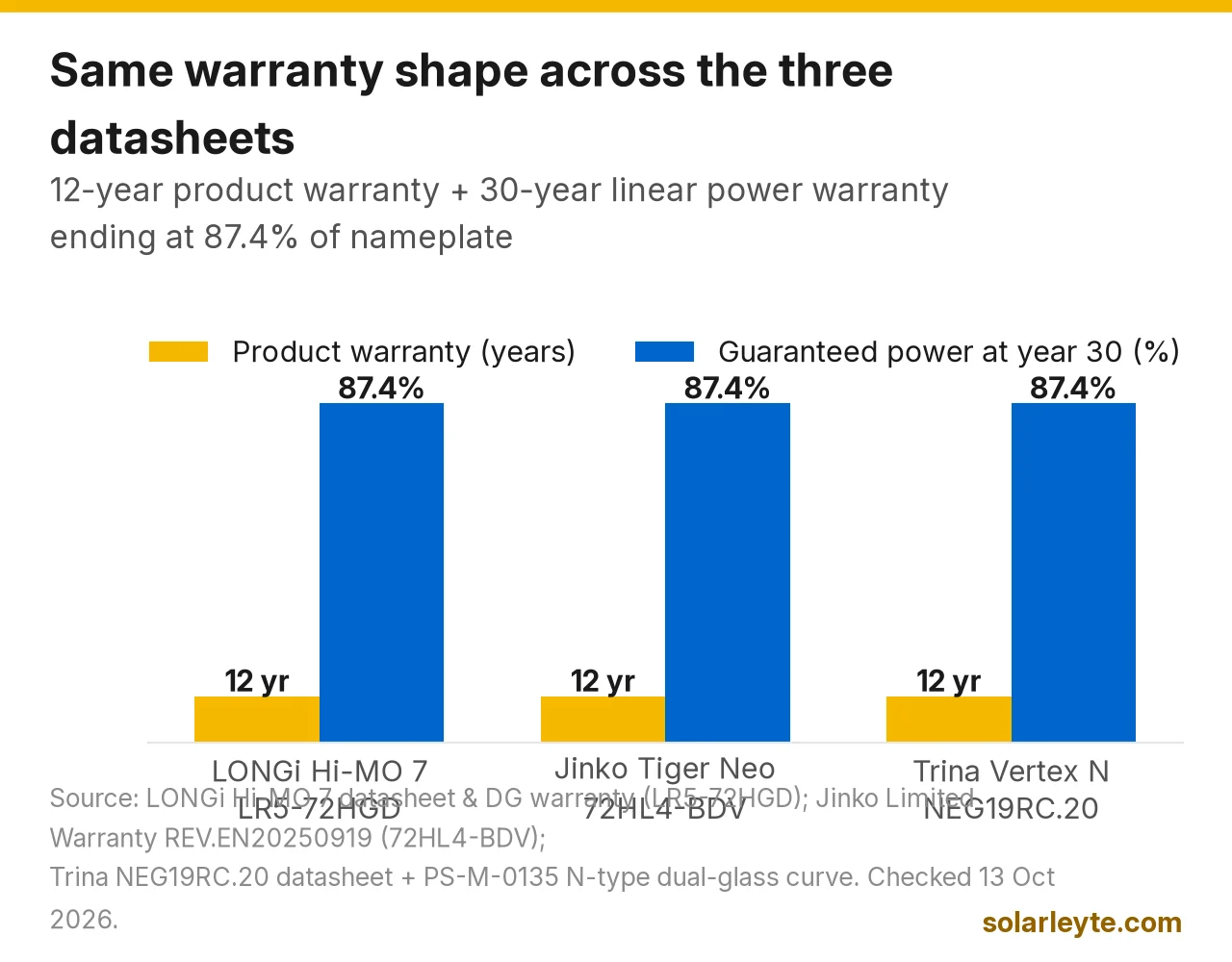
For the models above, the three makers' documents line up closely:
Brand / model family | Product warranty | Power warranty | First-year loss cap | Annual loss after year 1 | Guaranteed at year 30 |
|---|---|---|---|---|---|
LONGi Hi-MO 7 LR5-72HGD | 12 years (materials and processing) | 30 years linear | ≤1% | 0.4%/year | 87.4% |
Jinko Tiger Neo JKM…N-72HL4-BDV | 12 years | 30 years linear | 1.00% | 0.40%/year | 87.4% |
Trina Vertex N TSM-…NEG19RC.20 | 12 years (product workmanship, per datasheet) | 30 years power (per datasheet) | 1% | 0.40%/year | 87.4% |
Sources: LONGi Hi-MO 7 datasheet and LONGi limited warranty for Hi-MO 7 / Hi-MO 9 (distributed-generation market), section covering LR5-72HGD; Jinko Limited Warranty REV.EN20250919 for bifacial modules (JKMxxxN-72HL4-BDV row); Trina Vertex N NEG19RC.20 datasheet warranty block, with the matching 1% / 0.4% / 87.4% curve for N-type i-TOPCon dual-glass products in Trina's Global Limited Warranty PS-M-0135.
Three practical notes:
- Product warranty ends long before the power warranty. From year 13 to 30 you are covered for power fade under the linear curve, not for every materials defect. That is normal across these three brands, not a Trina- or Jinko-only quirk.
- The year-30 floor is the same number: 87.4%. The formula is essentially 100% − 1% − 0.4% × 29 = 87.4% (our arithmetic matching the PDFs). A seller who quotes "30-year warranty" without saying product vs power is skipping the part that matters.
- Model matters inside a brand. Jinko's own table gives some Tiger Neo residential formats 15 or 25 years of product warranty, while the 72HL4-BDV utility-style bifacial rows we compared are on 12 years. Trina's global PDF likewise assigns 10, 12 or 15 years of product warranty by exact type code. Always match the code on the nameplate to the warranty table, not the brand slogan.
What a warranty claim looks like from Leyte or Biliran
A warranty is only as useful as the path to use it. The maker PDFs put the formal claim on the buyer (or the installer who bought the panels), with serial numbers, proof of purchase, and often a third-party flash-test for power claims. None of the three warranty documents we read names a service centre in Eastern Visayas.
In practice:
- Your installer is the first call. A good local installer keeps the serial list, the datasheets and the purchase invoice in your handover folder. Our how to choose a solar installer guide covers what belongs in that folder.
- Shipping a failed panel from Naval or Tacloban to a Metro Manila importer is slow and expensive. Ask up front who pays freight on a warranty swap.
- Power claims need measurements. The linear warranty is tested at standard test conditions, not off your inverter app on a cloudy afternoon. Budget for a flash test or an accredited check if you ever need to prove fade.
- Typhoon damage is usually insurance, not panel warranty. Glass broken by flying debris is an external cause. Check your home policy before storm season; see our solar panel insurance guide.
Will these panels fit a common hybrid inverter?
The inverter, not the brand logo, often decides which panel you should buy. From the datasheets above and the Deye / SRNE / Sungrow limits in our hybrid inverter post:
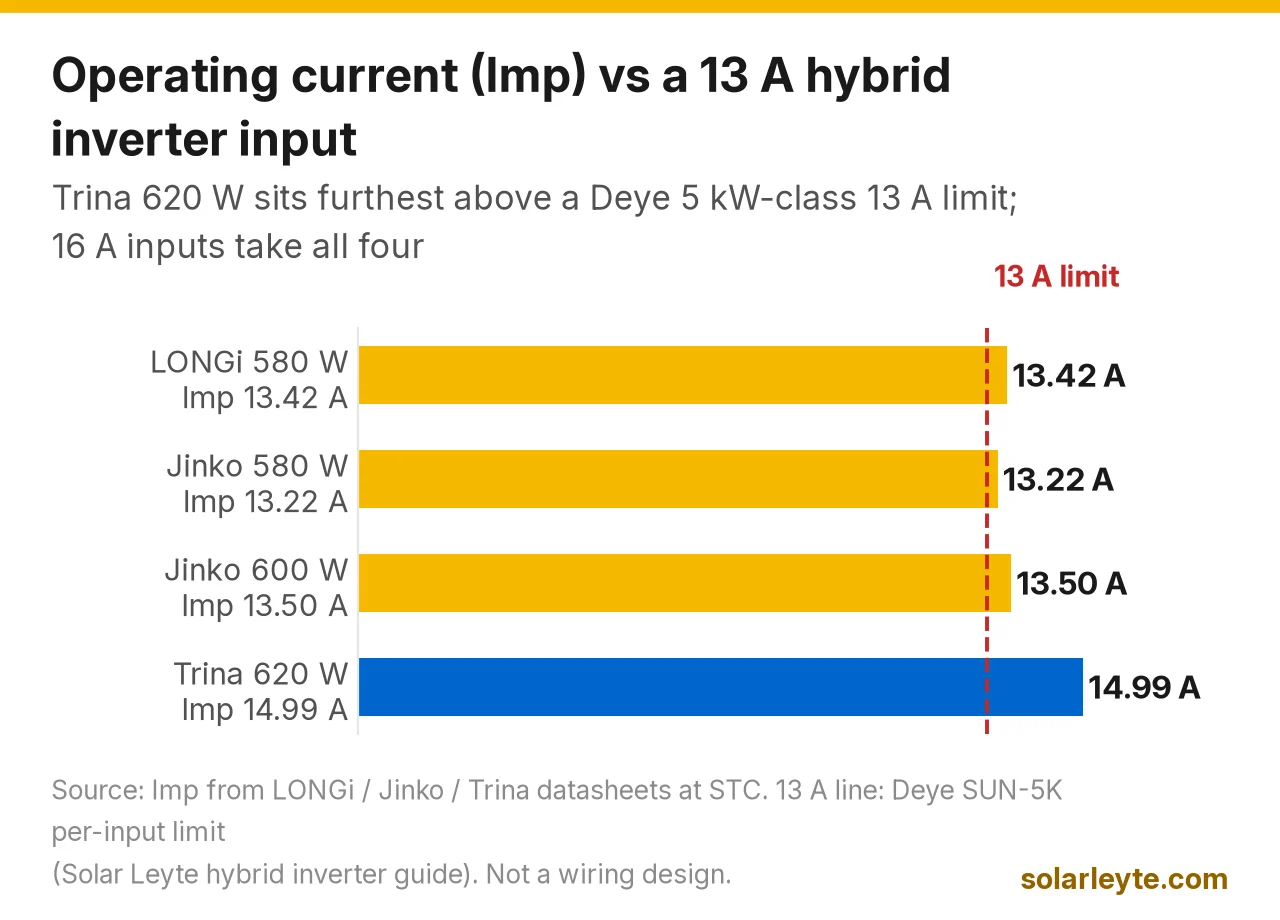
- Operating current. LONGi 580 W Imp 13.42 A and Jinko 580–600 W Imp 13.22–13.50 A sit just above a 13 A input (small midday clip on a Deye 5 kW). Trina 620 W Imp 14.99 A clips harder on that same input; a 16 A input (SRNE HESP, Sungrow SH5.0RS) takes it without clipping.
- Short-circuit current. Trina's 15.91 A Isc is under a 17 A limit at front-side test conditions, but Trina's own 10% rear-gain table lists 17.50 A. Bifacial gain on a bright surface can push past some inverter Isc ratings. Details are in the bifacial post.
- String voltage. At a cool 15 °C morning, Voc for these panels runs about 50.8 V (Trina 620 W) to 54.6 V (Jinko 600 W 72HL4). On a 500 V inverter, nine panels per string is usually the planning ceiling; eight for longer 78-cell Jinko formats. Full tables are in the 550W–620W price post.
So "Trina vs Jinko" on a Deye 5 kW quote is often really "14.99 A vs 13.5 A", not a brand loyalty test.
How to choose among Jinko, Trina and LONGi (without a "best" pick)
We are not ranking these brands. For a Biliran or Leyte house, use this checklist instead:
- Exact model number on the quote, with the PDF datasheet attached. "Jinko 600 W" or "Trina Vertex" is not enough.
- ₱ per watt on the panel line, freight to your sitio included. A cheap Metro Manila price can lose its edge once VisMin shipping and breakage cover are added.
- Imp and Isc vs your inverter's per-input limits, including bifacial rear-gain if the panels are raised over a light surface.
- Written product and performance warranty matching that model code, plus who files the claim and who pays return freight.
- Weight and roof frame check. Dual-glass 600 W-class panels are 31–34 kg each.
- Serial-number list and flash-test or factory report in the handover folder.
If two quotes use different brands but the same watts, same ₱ per watt after freight, and the same inverter fit, pick the installer you trust to still answer the phone in year eight. The panel brand is seldom the weakest link; installation and paperwork are.
Our solar panel price guide has the full quote-reading checklist.
FAQ
Which is better in the Philippines, Jinko, Trina or LONGi? None of the three wins on every row. Their 580–620 W dual-glass datasheets are close on efficiency, temperature coefficient, load rating and the 12/30-year warranty shape. Choose by exact model, ₱ per watt delivered, and inverter current limits — not by brand reputation alone.
How much do Jinko solar panels cost in the Philippines? On 13 October 2026, SolarPower Energy listed Jinko Tiger Neo bifacial panels at ₱6,900 (625 W), ₱7,015 (635 W), ₱7,130 (640 W) and ₱8,624.98 (725 W), or about ₱11.04 to ₱11.90 per watt, with a five-panel minimum order.
How much do Trina solar panels cost in the Philippines? Helios Optimum Development listed a Trina Solar 600 W Vertex N-Type bifacial panel at ₱5,000 (₱8.33 per watt) on 13 October 2026. Ask for the exact TSM model code and datasheet before you pay.
Do LONGi, Jinko and Trina all offer a 30-year warranty? They offer a 30-year linear power warranty on the dual-glass models we compared, with a separate 12-year product warranty. The power warranty guarantees about 87.4% of nameplate at year 30 (1% first-year cap, then 0.4% a year). Confirm the row for your exact model in the maker's limited-warranty PDF.
Are Tier-1 panels worth the extra money? They can be, when the alternative has no datasheet, no serial tracking and a vague "10-year warranty" with no product/power split. In the listings we checked, Trina and Jinko peso prices sat inside the normal ₱7.64–₱15.45 per watt band for 550–630 W panels, so "Tier-1" was not automatically a large premium online. On an installer quote, compare ₱ per watt and documents, not the Tier-1 label alone.
Can I mix Jinko and Trina panels on one inverter? Installers usually keep one model per string so current and voltage stay matched. Mixing brands on one MPPT is a design decision for your electrician, not something to improvise from a blog post.
Solar Leyte is run by MACC Systems & Energy Solutions Inc., a solar installer in Naval, Biliran.
Get a free solar quote from MACC
Comparing Jinko, Trina and LONGi on a quote? Send us a photo of your latest BILECO or LEYECO bill and your roof. We'll size the system, list every part by brand and exact model with its datasheet, and show you the savings math, with no obligation.
- Call/Text: 0955 723 5093
- Email: official@macc-inc.com or benjie@macc-inc.com
- Website: www.macc-inc.com
- Request a quote online: solarleyte.com/quote
- Office: Brgy. Talustusan, Naval, Biliran 6543
Sources (checked 13 October 2026 unless noted)
- PH seller prices: Helios Optimum Development, shop and Trina Solar 600 W Vertex N-Type bifacial; SolarPower Energy, Jinko Tiger Neo 625–725 W, panel category and LONGi Hi-MO X10 BC monofacial (wattage not shown on that page)
- Wider 550–630 W and bifacial ranges: Solar Leyte, 550W to 620W solar panel prices (8 Oct 2026) and bifacial solar panel guide (13 Oct 2026)
- Panel datasheets: LONGi, Hi-MO 7 LR5-72HGD 560–590M (distributor-hosted copy); Jinko Solar, Tiger Neo JKM575-600N-72HL4-BDV; Trina Solar, Vertex N TSM-NEG19RC.20 590–620 W (also 2025B revision used for warranty block)
- Warranty documents: Jinko Solar, Limited Warranty REV.EN20250919 — Linear Bifacial Module (JKMxxxN-72HL4-BDV: 12 / 30 / 1.00% / 0.40% / 87.40%); LONGi, Limited Warranty for Hi-MO 9, Hi-MO 7 and others (Distributed Generation Market), LR5-72HGD row under 12-year product and 30-year performance at 1% / 0.4% / 87.4%; Trina Solar, Global Limited Warranty PS-M-0135 (N-type i-TOPCon dual-glass power curve 1.0% / 0.4% / 87.4%) plus the NEG19RC.20 datasheet's 12-year product / 30-year power line
- Inverter current limits: as cited in Solar Leyte, hybrid inverter price guide and 550W–620W panel post