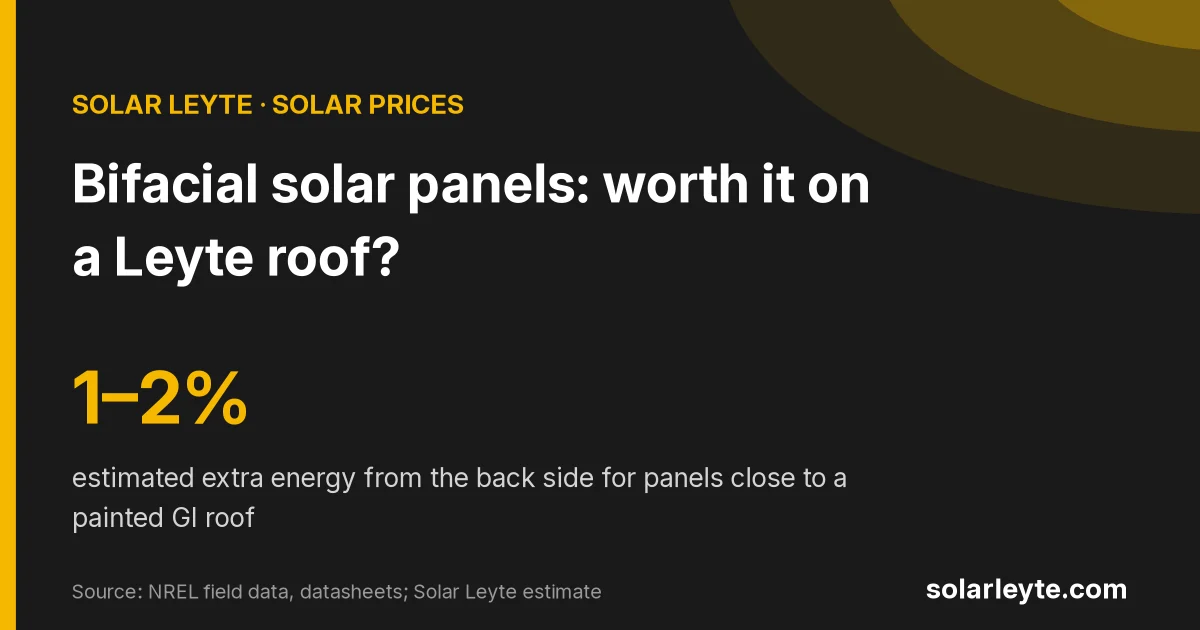
A bifacial panel makes power from light hitting its back as well as its front. On a typical Leyte or Biliran house, with panels on rails a few centimetres above a painted GI roof, our estimate is that the back side adds only about 1% to 2% a year. Lift the same panels a metre above a light surface and the gain can reach roughly 8% to 11%. The good news: in Philippine listings on 13 October 2026, bifacial panels weren't priced above ordinary panels per watt. The cheapest 600 W-class listing we found was a bifacial Seraphim at ₱8.06 per watt.
Sulit ba ang bifacial? Usually yes if it's the same price per watt, and no if a seller wants a premium for the back-side "bonus" on an ordinary roof. Below are the listings we checked, what the datasheets actually promise, how much back-side gain real installations get, and what that's worth in pesos at BILECO and LEYECO II rates.
For prices across all 550 W to 630 W panels, bifacial or not, see our 550W to 620W solar panel price list. For whole-system costs, see the itemised 5kW solar system price.
Prices checked 13 October 2026 (Philippine time) on each seller's own website, except where noted. They change often. Listing a product isn't an endorsement, and Solar Leyte earns nothing from these links. Nothing here is a MACC price or a quote.
What "bifacial" means
A normal (monofacial) panel has an opaque white or black backsheet. Only the front makes power. A bifacial panel uses cells that can collect light from both sides, usually with a second sheet of glass on the back ("dual glass" or "glass-glass"). Light that reflects off the roof or ground, and diffuse light from the sky, reaches the back of the cells and adds current.
Two numbers on a bifacial datasheet matter:
- Bifaciality. How well the back side works compared with the front. The LONGi Hi-MO 7, Jinko Tiger Neo and Trina Vertex N datasheets we read all list 80% ± 5% for power. So 100 W/m² of light on the back is worth about 80 W/m² on the front.
- Rear-side gain tables. Makers show what the panel would produce if the back gets extra light: 5%, 10%, 15% and so on. These are examples, not promises. Trina's sheet says "up to 30% additional power gain from back side depending on albedo". Albedo means how much light the surface under the panel reflects.
The front-side rating (for example 620 W) is the number that counts for sizing and price per watt. Treat anything from the back as a bonus that depends on your roof.
Bifacial panel prices in the Philippines (13 October 2026)
Panel (as listed) | Seller | Listed price | ₱ per watt (our calculation) |
|---|---|---|---|
Seraphim 620 W TOPCon bifacial | Helios Optimum Development | ₱5,000 | ₱8.06 |
Seraphim 630 W bifacial | SolarPower Energy | ₱5,800 | ₱9.21 |
JA Solar 630 W bifacial (DeepBlue 4.0 Pro) | SolarPower Energy | ₱6,350 | ₱10.08 |
Jinko Tiger Neo 625 W N-type bifacial | SolarPower Energy | ₱6,900 | ₱11.04 |
Jinko Tiger Neo 635 W N-type bifacial | SolarPower Energy | ₱7,015 | ₱11.05 |
Jinko Tiger Neo 640 W N-type bifacial | SolarPower Energy | ₱7,130 | ₱11.14 |
Aiko 650 W bifacial | SolarPower Energy | ₱7,590 | ₱11.68 |
Jinko Tiger Neo 725 W N-type bifacial | SolarPower Energy | ₱8,624.98 | ₱11.90 |
Aiko 660 W bifacial ABC | SolarPower Energy | ₱8,625 | ₱13.07 |
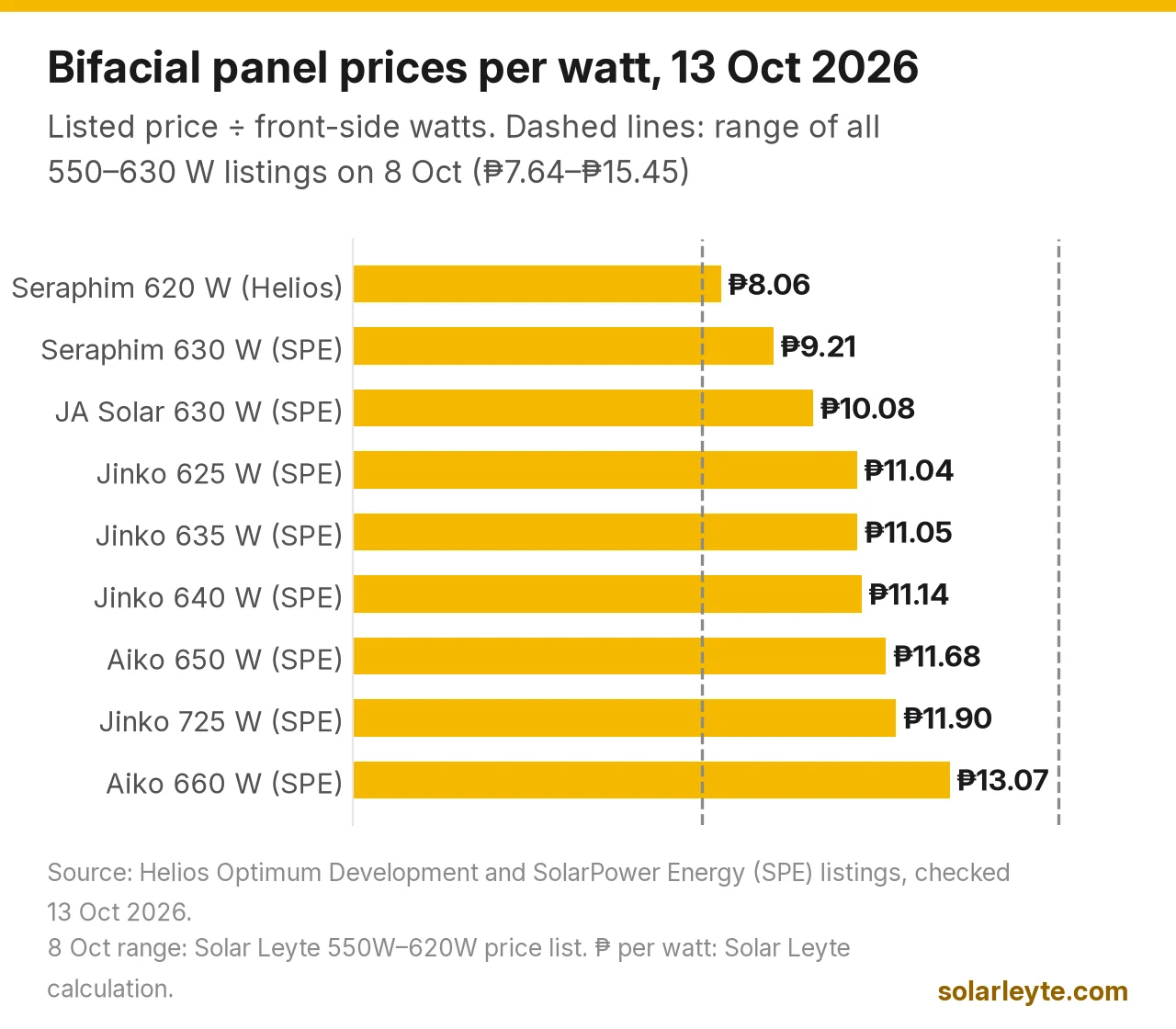
That's ₱8.06 to ₱13.07 per watt. For comparison, the 550 W to 630 W panels we checked on 8 October 2026, mostly monofacial, ran from ₱7.64 to ₱15.45 per watt. In other words, bifacial panels sit inside the normal price range. We didn't find a consistent bifacial premium in seller listings.
Some things to watch in these listings:
- SolarPower Energy (Muntinlupa) has a minimum order of 5 panels, and delivery outside Metro Manila and nearby provinces is quoted separately ("VisMin (Costs vary by weight/distance)"). Its 630 W page describes the panel as 620 W in the specifications, and shows a 5-year warranty badge but a "12-Year Product Warranty" in the text. Ask for the datasheet of the exact model and the warranty in writing.
- Helios Optimum Development's Seraphim 620 W listing title says "15 yrs warranty". Again, get the maker's datasheet and warranty document.
- One installer page claims bifacial panels in the Philippines cost 10% to 20% more than equivalent monofacial panels. The seller listings above don't show that. If your quote has a bifacial premium, ask what you're paying extra for.
How much extra power does the back side really give?
This is where datasheet tables and real roofs part ways. The back of a panel only gets light that bounces off what's underneath, plus some sky light from behind. Three things decide how much:
- How reflective the surface is. A white surface reflects much more than a dark one.
- How high the panel is above it. Close to the roof, the panel shades the very surface it needs light from, and only a thin wedge of reflected light gets in.
- How many rows there are. Panels in the middle of an array get less back light than the edges.
The US National Renewable Energy Laboratory (NREL) measured this directly. On a rooftop test array tilted 10° and mounted about 30 cm above a white roofing membrane (reflectance 0.8, which is very white), the back of the interior rows received only 4% to 7% as much light as the front. Its models had predicted 10% to 12%. On a test frame 1 m above light concrete (reflectance 0.28), the back got 10% to 14% of the front.
Multiply those by the 80% bifaciality on the datasheets and you get a rough gain:
Mounting | Surface under the panels | Back-side light vs front | Estimated bifacial gain |
|---|---|---|---|
Rails close to the roof (typical home) | Painted GI sheet, coloured (reflectance about 0.3) | About 1.5% to 2.6% (our scaling of NREL's 4–7%) | About 1% to 2% |
30 cm above the roof | Very white roof membrane (0.8) | 4% to 7% (NREL measured) | About 3% to 6% |
About 1 m up (carport, ground frame) | Light concrete (0.28) | 10% to 14% (NREL measured) | About 8% to 11% |
Estimated gain = back-side light ratio × 80% bifaciality. The first row scales NREL's white-roof measurement down in proportion to a coloured roof's reflectance; it's our estimate, not a measurement.
Why 0.3 for a coloured GI roof? Sherwin-Williams' published reflectance figures for its painted metal roofing range from 0.25 (blue) to 0.35 (dark green and rural red), and 0.31 for black. Its white coating measures 0.64. Bare, new galvanized metal reflects more (about 0.60 to 0.80 according to an Oak Ridge and Berkeley Lab summary), but it dulls as it weathers, and most Leyte and Biliran roofs are painted.
These numbers line up with NREL's other work: its modelling put typical bifacial gain at 4% to 8% for PERC panels on open ground, and three years of measurements on ground-mounted sun-tracking systems showed 6.1% to 7.3% a year. The "up to 25%" or "up to 30%" in listings and datasheets needs reflective ground, height and space that a house roof doesn't have.
What the extra kWh is worth in pesos
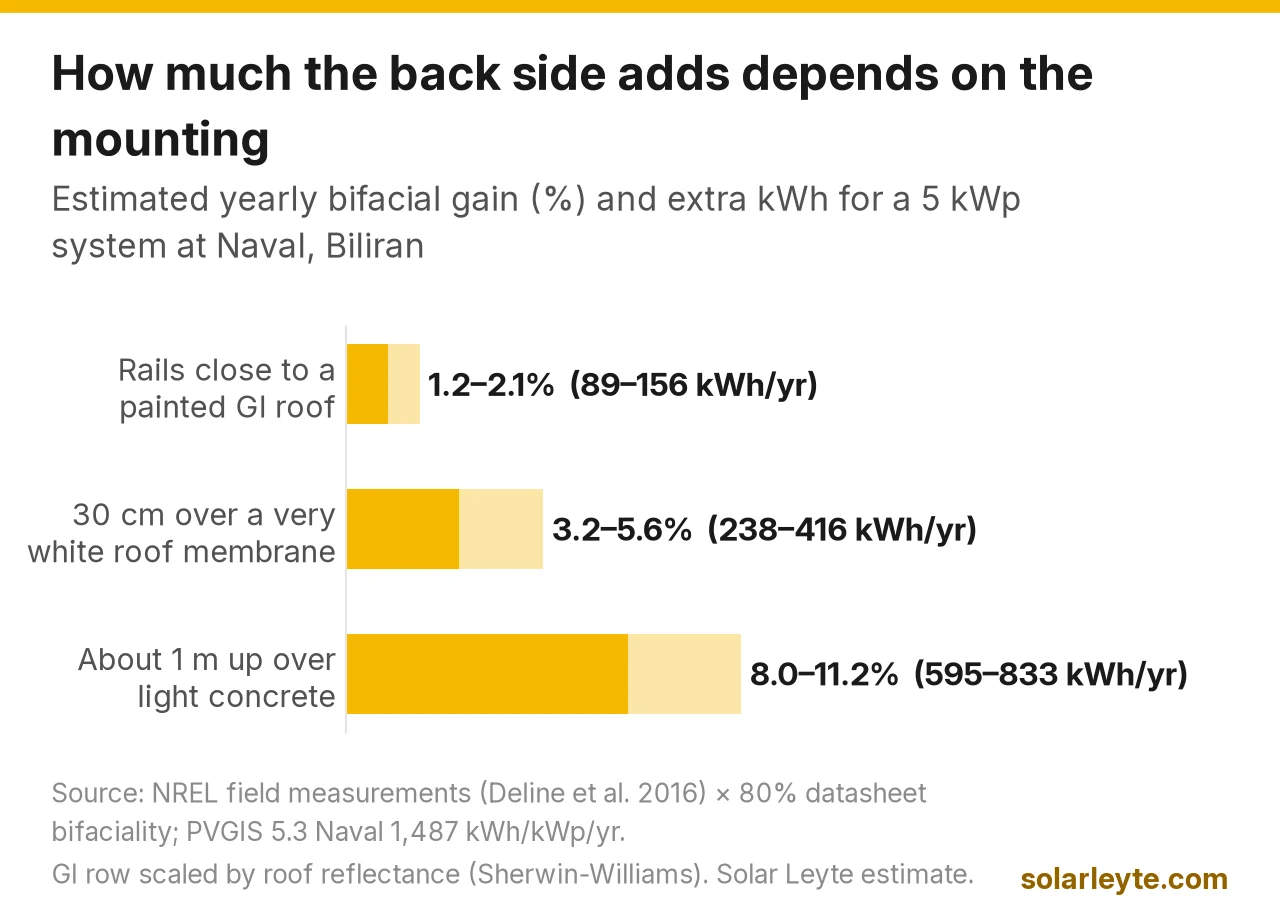
Take a 5 kWp system at Naval, Biliran. PVGIS (the European Commission's solar calculator) puts a 1 kWp system there at about 1,487 kWh a year, so 5 kWp makes about 7,437 kWh a year from the front alone.
Mounting (estimated gain) | Extra kWh a year (5 kWp, Naval) | Worth at BILECO ₱18.93/kWh | Worth at LEYECO II ₱14.05/kWh |
|---|---|---|---|
Close to a painted GI roof (1.2% to 2.1%) | 89 to 156 kWh | ₱1,689 to ₱2,956 | ₱1,254 to ₱2,194 |
30 cm over a white roof (3.2% to 5.6%) | 238 to 416 kWh | ₱4,505 to ₱7,883 | ₱3,343 to ₱5,851 |
About 1 m over light concrete (8.0% to 11.2%) | 595 to 833 kWh | ₱11,262 to ₱15,767 | ₱8,359 to ₱11,702 |
Solar Leyte calculation. Rates are September 2026 residential rates from PRESYO-PH (see our Samar and Southern Leyte rate tracker, which lists the Leyte and Biliran co-ops too). The peso values assume you use the extra kWh yourself, replacing power you would have bought. Fixed monthly charges stay the same.
So on an ordinary roof, the back side might be worth around ₱1,700 to ₱3,000 a year at BILECO rates. That's welcome if the panel costs the same. It's not worth paying several thousand pesos more for, and it shouldn't be counted in a payback promise.
On a raised frame over concrete or a light-coloured surface, the gain is big enough to matter. That's why bifacial panels are standard on ground-mounted solar farms.
When a bifacial panel makes sense in Leyte and Biliran
- It's the same price per watt, or cheaper. Many large 600 W+ panels are bifacial anyway. Buy on front-side ₱ per watt and treat the back as free.
- Carports, pergolas and garage roofs. Panels on an open steel frame with a concrete driveway or light gravel underneath get real back-side light.
- Ground mounts on farms and resorts. A frame about a metre up over light soil, gravel or crushed coral. Keep the area under it clear of tall weeds.
- Flat concrete roof decks (common on newer houses and commercial buildings). Tilted panels on a raised frame over a light-painted slab do better than panels flush on GI.
When to skip the premium:
- Panels on rails close to a dark or coloured GI roof, which is most houses.
- When the bifacial model is heavier or larger and your roof frame or installer can't handle it.
- When a seller uses the "up to 25%" figure to justify a higher price or a bigger savings estimate.
Weight, glass and typhoon ratings
Bifacial panels are usually dual-glass, which makes them heavy.
Panel | Type | Size (mm) | Weight | Front / rear test load |
|---|---|---|---|---|
LONGi Hi-MO 7 LR5-72HGD 580 W | Bifacial, 2.0 + 2.0 mm glass | 2,278 × 1,134 | 31.8 kg | 5,400 / 2,400 Pa |
Jinko Tiger Neo JKM600N-72HL4-BDV | Bifacial, 2.0 + 2.0 mm glass | 2,278 × 1,134 | 31.0 kg | 5,400 / 2,400 Pa |
Trina Vertex N TSM-620NEG19RC.20 | Bifacial, 2.0 + 2.0 mm glass | 2,382 × 1,134 | 33.7 kg | 5,400 / 2,400 Pa |
AE Solar MD-144 550 W (per seller listing) | Monofacial | not compared | 26.5 kg | see datasheet |
A bifacial 600 W-class panel weighs around 31 to 34 kg, about 12 kg per square metre. That's a two-person lift onto a roof. Ask your installer to confirm the roof frame and purlins can take it.
The test loads above are the panel's own rating, achieved only when it's clamped at the positions in the maker's installation manual. The rear-side (uplift) rating of 2,400 Pa is the one that matters in strong wind. Our typhoon guide covers mounting and checks before storm season.
Glass on both sides doesn't make a panel typhoon-proof. It does mean there's no plastic backsheet to age, which is one reason the makers give these panels a 30-year power warranty. The LONGi, Jinko and Trina datasheets list 12 years for the product and 30 years for power. Trina's lists 1% loss in the first year and 0.4% a year after.
Check the inverter: bifacial gain adds current
More light on the back means more current. That's fine for energy, but it matters for the inverter.
- Operating current. The Trina 620 W already runs at about 14.99 A at full sun from the front alone. A Deye 5 kW hybrid takes up to 13 A per input, so it holds the panel at 13 A and the extra is lost while it lasts. Back-side gain on such a panel mostly adds to the part the inverter can't use at midday. It still helps in the morning and afternoon.
- Short-circuit current (safety). Trina lists the 620 W at 15.91 A short-circuit current at test conditions, and 17.50 A with 10% back-side gain. The Deye's limit is 17 A per input. Your installer should check the bifacial short-circuit current (with margin) against the inverter's input rating, not just the front-side figure.
- LONGi's table shows the same effect: its 575 W panel's short-circuit current goes from 14.84 A at 5% back-side gain to 17.67 A at 25%.
Details on inverter limits are in our 550W to 620W panel post and the hybrid inverter price guide.
Questions to ask before you buy bifacial panels
- What's the front-side rating and the ₱ per watt? Compare that, not the "with rear gain" wattage.
- What back-side gain is in your yield estimate, and why? On a GI roof close-mounted, anything above a few percent needs an explanation.
- What's the exact model number, with its datasheet and warranty document?
- What's the panel's weight, and has the roof frame been checked?
- Is the short-circuit current with back-side gain within the inverter's input limit?
- How far above the roof will the panels sit, and what's underneath?
- For a Metro Manila seller: what's the freight and breakage cover to Leyte or Biliran? Glass-glass panels are heavy to ship.
Our solar panel price guide has the full list of questions for any quote.
FAQ
Are bifacial solar panels worth it in the Philippines? They're worth it when they cost the same per watt as a normal panel, or when the panels sit high above a light surface, such as a carport or ground frame. On a typical house with panels close to a painted GI roof, our estimate is only about 1% to 2% extra energy a year.
How much more do bifacial panels cost in the Philippines? In the listings we checked on 13 October 2026, bifacial panels cost ₱8.06 to ₱13.07 per watt. That's within the ₱7.64 to ₱15.45 per watt range we found for 550 W to 630 W panels in general on 8 October 2026, so we didn't see a consistent premium.
Do bifacial panels produce 25% or 30% more power? Only in ideal conditions. Datasheets show what the panel would make with that much back-side light, and Trina says "up to 30%... depending on albedo". NREL measured 6.1% to 7.3% a year on ground-mounted sun-tracking systems, and back-side light of only 4% to 7% of the front on a rooftop array 30 cm above a white membrane.
Should I paint my roof white to help bifacial panels? A white roof helps the back side and keeps the house cooler, but with panels close to the roof the gain stays modest. NREL measured only 4% to 7% back-side light on interior rows 30 cm above a very white membrane. That works out to about 3% to 6% extra energy.
Are bifacial panels stronger in a typhoon? Not automatically. The LONGi, Jinko and Trina bifacial panels we checked are rated 5,400 Pa front and 2,400 Pa rear, the same figures we see on many monofacial panels. Mounting and clamping decide most of the outcome.
Solar Leyte is run by MACC Systems & Energy Solutions Inc., a solar installer in Naval, Biliran.
Get a free solar quote from MACC
Wondering whether bifacial panels make sense for your roof, carport or farm? Send us a photo of your latest BILECO or LEYECO bill and of where the panels would go. We'll size the system, list every part by brand and model with its datasheet, and show you the savings math, with no obligation.
- Call/Text: 0955 723 5093
- Email: official@macc-inc.com or benjie@macc-inc.com
- Website: www.macc-inc.com
- Request a quote online: solarleyte.com/quote
- Office: Brgy. Talustusan, Naval, Biliran 6543
Sources (checked 13 October 2026 unless noted)
- Bifacial panel listings: Helios Optimum Development, Seraphim 620 W TOPCon bifacial; SolarPower Energy, solar panel list, 630 W bifacial (Seraphim / JA Solar), Jinko Tiger Neo 625–725 W and Aiko series
- General 550–630 W price range (8 October 2026): Solar Leyte, 550W to 620W solar panel prices
- Installer premium claim: SolarPro Install, Bifacial Solar Panels Philippines
- Panel datasheets: LONGi, Hi-MO 7 LR5-72HGD 560–590M (distributor-hosted copy); Jinko Solar, Tiger Neo JKM575-600N-72HL4-BDV; Trina Solar, Vertex N TSM-NEG19RC.20 590–620 W (checked 8 October 2026)
- Field measurements: C. Deline et al., NREL, Evaluation and Field Assessment of Bifacial Photovoltaic Module Power Rating Methodologies (2016); C. Deline et al., NREL, Bifacial PV System Performance: Separating Fact from Fiction (2019); NREL, Understanding the Bifacial Modeling & Field Research Space (2023)
- Roof reflectance: Sherwin-Williams via B&M Metal Roofing, Solar Reflectance, Thermal Emittance and SRI Values; S. Kriner, The Metal Initiative, Cool Metal Roofing (Table 1, ORNL and LBNL figures)
- Sun data: European Commission JRC, PVGIS 5.3 (PVcalc, Naval, 1 kWp, 14% loss, 11° tilt; run 8 October 2026)
- Rates: PRESYO-PH (ICSC), national residential rate table, September 2026, via our Samar and Southern Leyte rate tracker
- Inverter limits: Deye SUN-5K-SG03LP1 datasheet, as used in our hybrid inverter price guide