Shade costs a solar panel more than the light it blocks only when the system is badly laid out. With modern panels, a decent inverter and smart string design, the loss is mostly just the sunlight the tree takes away. And that depends a lot on where the tree is. In our model of a 15 m coconut palm next to a roof in Naval, a palm 6 m east, west or south of a panel takes about 13–15% of that panel's yearly sunlight. Move the palm to 15 m away and it's about 2%. A palm on the north side barely matters.
So the order of fixes is: keep panels out of the shadow first, trim second, design around what's left third. Optimisers and microinverters come last, for the stubborn cases.
Last checked 1 November 2026. The shading numbers are a Solar Leyte model built on PVGIS data, with the assumptions written out below. They're not a measurement of your roof. Legal points are quoted from RA 8048 as amended by RA 10593, linked in the Sources.
Why a small shadow can cause a big loss
A solar panel is a chain of cells wired in series, and a string of panels is a chain of panels. Current has to flow through every link. Shade one cell and it can choke the current for everything in series with it.
Panels deal with this with bypass diodes. A typical 60-cell panel is split into 3 groups of 20 cells, each with its own diode (Fronius's whitepaper uses exactly this example). When one group is shaded, its diode lets the current go around it. You lose that group, about a third of the panel, but the rest of the string keeps working. PVEducation explains that the diodes also stop a shaded cell from overheating into a hot spot (more in our cracked panels and hot spots guide).
The catch is that the diode only helps if the inverter reacts. Fronius worked through a string of 20 panels (30 V, 10 A each, 6,000 W total) where leaves cover one cell group on one panel:
What happens (Fronius example, 20 panels, 6,000 W string) | String output |
|---|---|
No shade | 6,000 W |
One cell group shaded, inverter lowers voltage so the diode kicks in | 5,894 W |
Half-cut panels, one panel shaded, inverter adjusts | 5,682 W |
Half-cut panels, bottom half of all 20 shaded (portrait) | 3,000 W |
One cell group shaded, inverter stays at 600 V (no diode action) | 1,800 W |
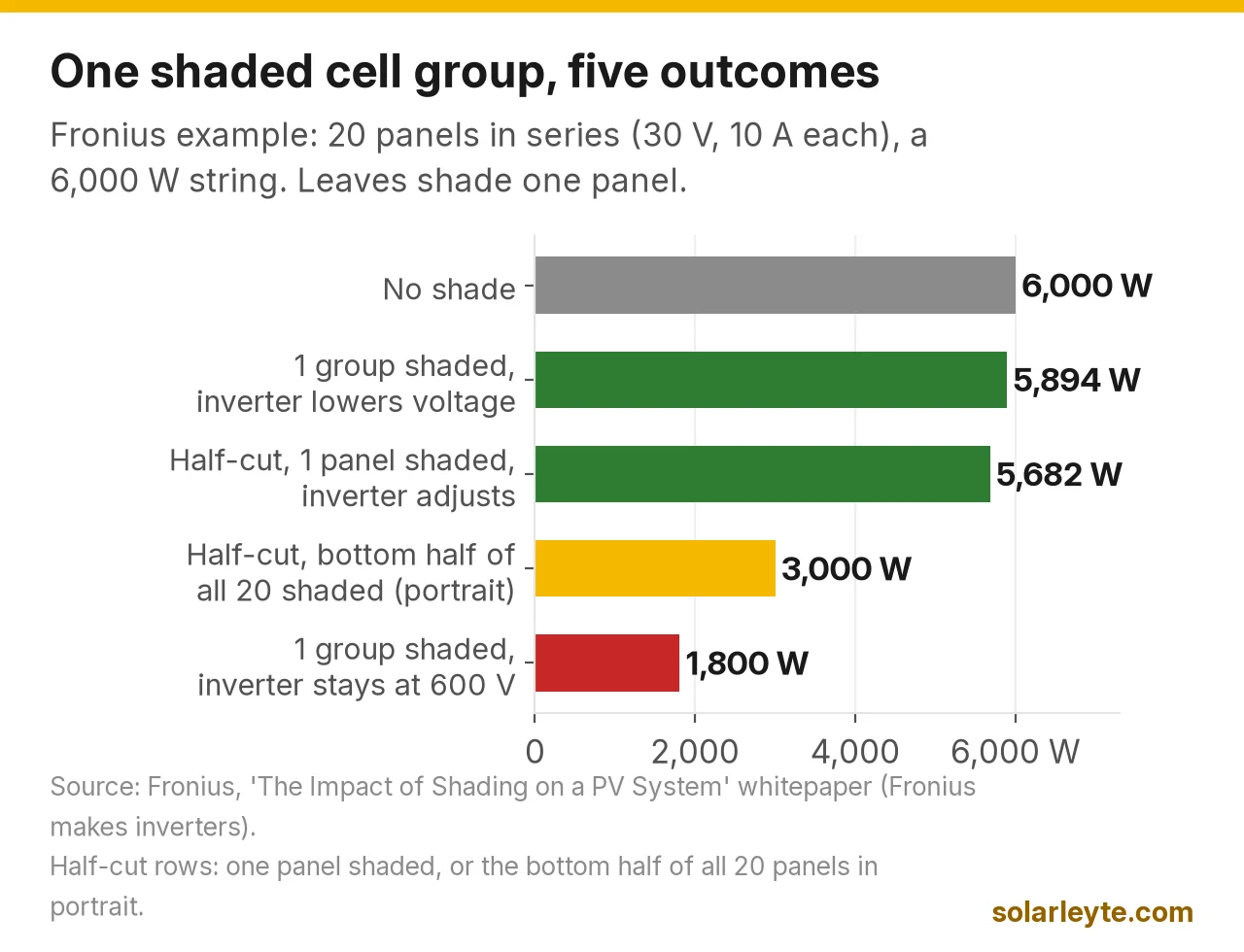
Source: Fronius, "The Impact of Shading on a PV System" whitepaper. Fronius sells inverters, so read its marketing points with that in mind. The arithmetic is straightforward physics.
That last row is the nightmare. One leaf-covered group drags the whole string down to the shaded cells' 3 A. Good inverters avoid it by sweeping the voltage now and then to find the true best point. Deye calls this "MPPT Multi-Point Scanning" in the SUN-5K-SG05LP1 manual. Many inverters have a similar feature, but ask your installer to confirm it for the exact model.
Half-cut panels: portrait beats landscape
Most panels sold now are "half-cut" (twin) panels: the cells are cut in half and wired as a top half and a bottom half in parallel. PVsyst's documentation explains that when the bottom half is shaded, the top half keeps producing at half current. REC's whitepaper puts it bluntly: a standard panel in portrait with its bottom row of cells shaded makes zero, while a twin panel keeps 50%.
The benefit only works when the panels are mounted in portrait (long side up the roof) and the shadow comes up from the bottom edge, like a shadow from a parapet or the row in front. In landscape, PVsyst says they behave like standard panels.
Worked example: a coconut palm next to a roof in Naval
How much does a real tree cost? We built a simple model using 10 years (2014–2023) of hourly PVGIS data for Naval, Biliran (11.56°N, 124.40°E). PVGIS gives the direct-sun and sky-light parts of each hour separately, so we could take away the direct sun in every hour the palm's crown or trunk sits between the sun and the panel. We also took away the slice of sky light the crown hides.
Assumptions (Solar Leyte model):
- The palm: 15 m tall. That's a modest coconut. Tall varieties reach 20–30 m (IPGRI/COGENT manual), so a mature palm can shade more than this.
- The crown: treated as a solid ball 3.5 m in radius, centred 13 m up. Mature coconut leaves are 3–4 m long. A trunk 0.4 m wide is included too.
- The panel: one panel on a 10° roof facing south, 4 m above the ground. The ground is level.
- Opaque fronds: we assumed no light gets through. Real fronds let some light through, so this leans pessimistic.
- Hourly steps: short flickers of shade inside an hour aren't modelled.
- The output: light lost by that one panel. For a small array sitting together, most panels will see similar shade.
Yearly sunlight lost by the panel, by where the palm stands:
Palm position | 6 m away | 10 m away | 15 m away |
|---|---|---|---|
East (morning shade) | 14.7% | 5.7% | 2.3% |
West (afternoon shade) | 12.6% | 6.3% | 2.2% |
South | 13.5% | 2.8% | 0.8% |
North | 2.4% | 1.1% | 0.5% |
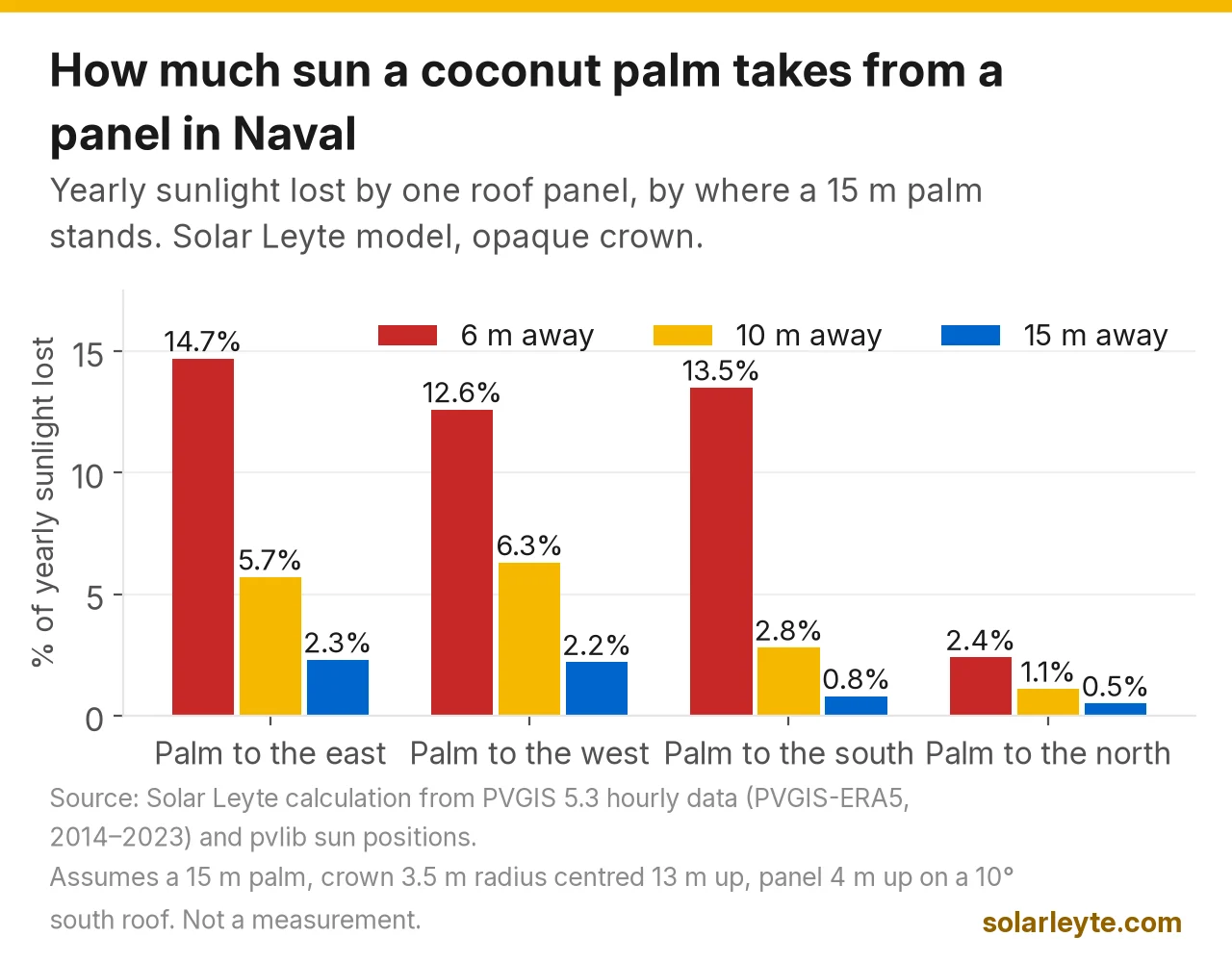
Source: Solar Leyte calculation from PVGIS 5.3 hourly data (PVGIS-ERA5, 2014–2023) and pvlib sun positions, assumptions as listed above.
Three things stand out:
- Distance matters most. Moving the palm from 6 m to 15 m away cuts the loss by roughly 80–95%, whichever side it's on.
- North is the safe side. At our latitude the sun is south of overhead for most of the year (from about late August to late April), so a north-side palm blocks almost no direct sun. What it still takes is a bit of sky light.
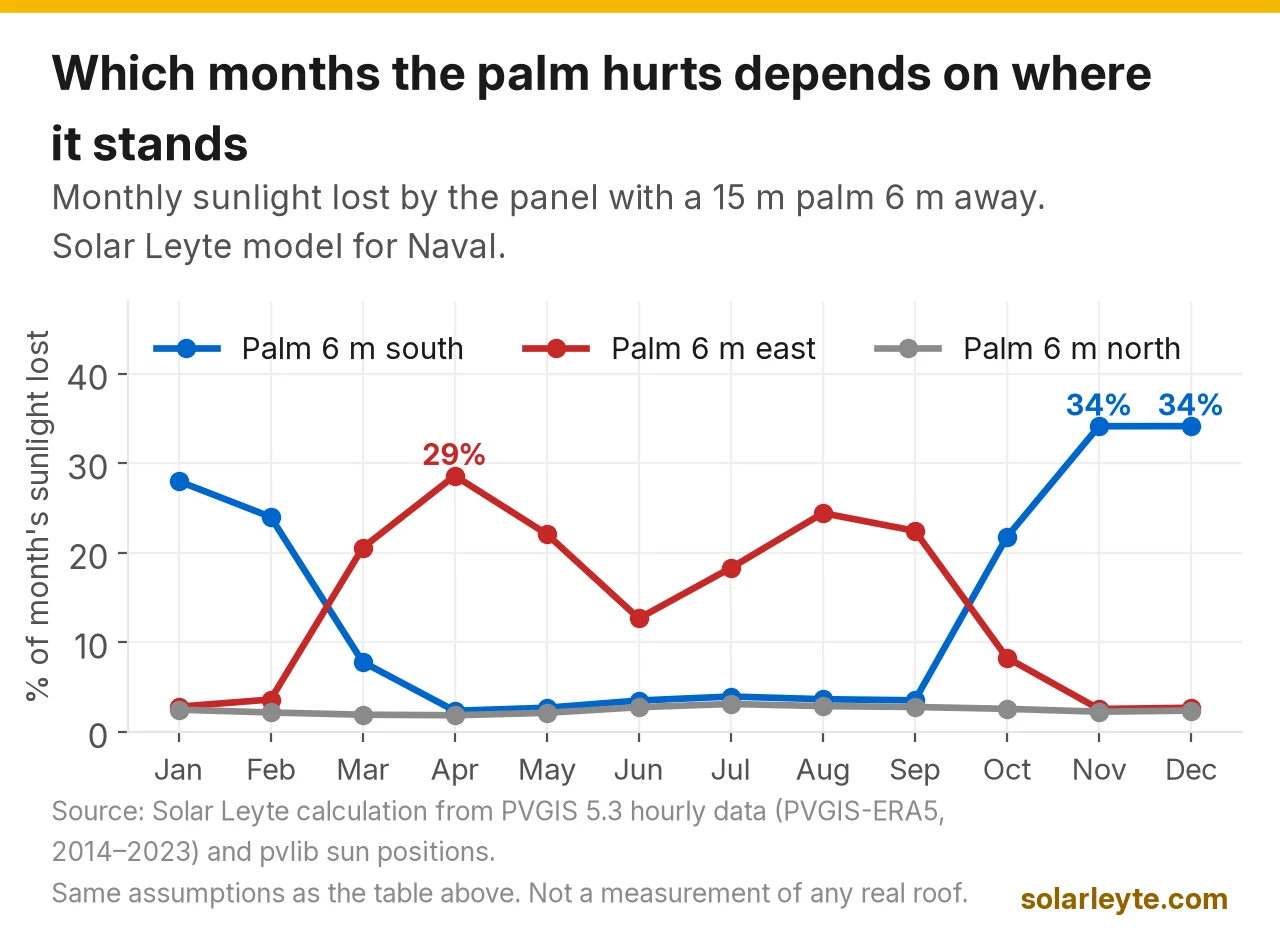
- The season depends on the side. A palm 6 m south costs 28–34% of the light from November to January but only 2–4% from April to September, when the sun is high or to the north. A palm 6 m east hurts most from March to September (up to 29% in April) and barely at all in December.
In pesos: an unshaded 600 W panel in Naval makes about 895 kWh a year in this PVGIS model (1,491 kWh per kWp, with 14% system losses). A palm 6 m to the east takes about 132 kWh of that. If you use all your solar at home instead of buying from BILECO at ₱18.3407/kWh, that's about ₱2,400 a year per shaded panel. If the shadow covers four panels, multiply by four. These are illustrations, not a quote.
How long are the shadows? For every metre a tree stands above your panels, its shadow is this long on flat ground in Naval:
Date | 8 AM | 9 AM | Noon | 3 PM | 4 PM |
|---|---|---|---|---|---|
21 December | 2.1 m | 1.3 m | 0.7 m | 1.7 m | 3.2 m |
20 March | 1.6 m | 1.0 m | 0.2 m | 1.1 m | 2.0 m |
21 June | 1.4 m | 0.9 m | 0.2 m | 1.1 m | 1.9 m |
Source: Solar Leyte calculation, sun elevation from pvlib for Naval (11.56°N, 124.40°E): shadow = 1 ÷ tan(elevation).
So a 15 m palm stands 11 m above a 4 m roof, and at 9 AM in December it throws a shadow about 14 m long. That's why "it's quite far from the house" isn't always far enough.
Fronius advises keeping panels shade-free whenever sunlight is strong (above 500 W/m²). In PVGIS's Naval data, about three-quarters of the yearly output comes between 9 AM and 3 PM. Shade before 8 AM or after 4 PM costs little. Shade at 10 AM costs a lot.
Fixes, in the order we'd try them
1. Put the panels where the shadow isn't
This costs nothing at design time. Use the roof face or the part of the roof farthest from the tree, and leave the shaded corner empty. Walk the roof at 9 AM and 3 PM, or take photos at those hours, before the installer finalises the layout. PVGIS's map tool lets you enter your own horizon if trees or hills block the low sun. Our tilt and direction guide shows how forgiving the angle is, so a slightly worse roof face with no shade often beats the "perfect" face under a palm.
2. Trim, don't fell
Cutting the fronds that hang over the roof is usually the cheapest fix, and it also cuts the risk of a falling frond or nut hitting the panels during a typhoon. Cutting down the whole tree is a different matter. Under RA 8048 as amended by RA 10593, a coconut tree may only be cut for the reasons listed in Sec. 4, for example: the tree is 60 years old (tall) or 40 (dwarf), no longer economically productive, severely diseased or typhoon-damaged, the land is being legally converted, or the tree is a hazard to life and property. The law says no other cause is valid, so "it shades my solar panels" isn't one. You need a PCA permit (₱100 per tree), and the penalty for cutting without one is 2–6 years in prison and/or a ₱100,000–₱500,000 fine. The law talks about cutting trees, not trimming fronds. If you're unsure about your case, ask the Philippine Coconut Authority office first.
3. Design the strings around the shade
If some shade can't be avoided, group the shaded panels on their own string and their own MPPT input. A common 5 kW hybrid like the Deye SUN-5K-SG05LP1 has two MPPT inputs, so a west-roof string under a palm doesn't drag down the clean east string. Mount half-cut panels in portrait when the shade comes up from the bottom edge. Our series vs parallel wiring guide shows what one bypassed cell group does to a string's voltage.
4. Add optimisers or microinverters where needed
Optimisers sit behind each panel and let it run at its own best point. Huawei's Philippine site lists its SUN2000-450W-P2 and SUN2000-600W-P optimisers. Microinverters go further and turn each panel into its own little AC system (see our microinverter guide). Both reduce the mismatch loss, but neither can bring back the sunlight the tree blocks. In Fronius's tree example from Germany, light blocked by the tree cost 0.89% of the year and mismatch only 0.29%. Fronius says mismatch is 10–20 times smaller than the light loss when the inverter tracks well.
Optimisers also add electronics on a hot roof and need to be compatible with your inverter. We couldn't find a public peso price for optimisers in the Philippines on 1 November 2026, so get a written quote and ask who handles warranty claims locally.
5. Keep the glass clean
Bird droppings and fallen leaves are shade too, and they sit right on the cells. See our cleaning and maintenance guide.
Bisaya quick take
Kung naay lubi duol sa imong atop, ang anino niini sa buntag ug hapon makapakunhod sa kuryente sa imong solar. Kung 6 metros ra ang layo sa east, west o south, mga 13–15% ang mawala sa panel nga duol. Sa north side, gamay ra kaayo. Unahon ang pagbutang sa panel sa dapit nga walay anino, dayon putla ang mga dahon sa lubi nga nag-abot sa atop. Pero ayaw putla ang tibuok lubi kung walay permit gikan sa PCA.
FAQ
How much does shading affect solar panels? It depends on where and when. In our Naval model, a 15 m palm 6 m east, west or south takes 13–15% of a nearby panel's yearly sunlight, and about 2% at 15 m. With a bad inverter response, a little shade on one panel can cut a whole string's output much more than that, as in Fronius's 1,800 W example.
Do solar panels work under trees? They work, but they make less. Shade during 9 AM–3 PM costs the most, because that's when about three-quarters of the yearly output comes in. Panels in deep shade all day aren't worth installing.
What does a bypass diode do? It lets current skip around a shaded group of cells, usually a third of the panel. The panel loses that group instead of the whole string slowing down, and the shaded cells don't overheat.
Do I need optimisers or microinverters for shade? Only if the shade can't be avoided, trimmed or isolated on its own MPPT input. They reduce mismatch losses but can't recover light the tree blocks.
Related reading
- Grid-tie vs hybrid solar guide
- Best tilt and direction for solar panels in Leyte and Biliran
- Series vs parallel solar panel wiring
- Microinverters in the Philippines
- Cracked solar panels and hot spots
- Deye vs Solis vs SRNE hybrid inverters
Solar Leyte is run by MACC Systems & Energy Solutions Inc., a solar installer in Naval, Biliran.
Get a free solar quote from MACC
Got a coconut tree or a neighbour's wall near your roof? Send us a photo of the roof and your latest BILECO or LEYECO bill, and we'll talk through where panels would get the most sun, with no obligation.
- Call/Text: 0955 723 5093
- Email: official@macc-inc.com
- Website: www.macc-inc.com
Sources (all checked 1 November 2026)
- Fronius, "The Impact of Shading on a PV System" (whitepaper, PDF): 60-cell panel with 3 substrings and bypass diodes; 20-panel 6,000 W string at 1,800 / 5,894 / 5,682 / 3,000 W; avoid shade above 500 W/m²; tree example −0.89% light loss vs −0.29% mismatch; mismatch 10–20 times smaller than light loss. Fronius is an inverter maker.
- PVEducation, Bypass diodes: how bypass diodes work and prevent hot-spot heating.
- PVsyst documentation, Twin half-cut cells and shadings: top half keeps working at half current when the bottom half is shaded; only in portrait.
- REC Group, TwinPeak shading properties (whitepaper, PDF): standard panel 0% vs twin panel 50% with the bottom row shaded.
- Deye SUN-3.6/5/6/7.6/8K-SG05LP1-EU user manual (PDF): two MPPT inputs; "MPPT Multi-Point Scanning".
- PVGIS 5.3 hourly data for Naval (European Commission JRC API): hourly direct, diffuse and reflected sunlight and output, 2014–2023, 1 kWp, 10° south, 14% losses (1,491 kWh/kWp a year). PVGIS tool for your own horizon.
- pvlib python: sun position calculations.
- IPGRI/COGENT, Manual on Standardized Research Techniques in Coconut Breeding (PDF, CIRAD archive): tall coconuts 20–30 m; mature leaf 3–4 m long.
- RA 10593, amending RA 8048, the Coconut Preservation Act (Lawphil): Sec. 4 valid grounds for cutting, "no other causes"; Sec. 5 PCA permit, ₱100 per tree; Sec. 9 penalties of 2–6 years and/or ₱100,000–₱500,000. Original RA 8048 (Lawphil).
- Huawei Smart PV Philippines, SUN2000-450W-P2 and SUN2000-600W-P optimisers.
- BILECO, July 2026 effective rates: residential ₱18.3407/kWh, VAT inclusive (still the latest on BILECO's power-rate page on 1 November 2026).
- Worked example: Solar Leyte calculation (PVGIS hourly data + pvlib), assumptions as listed in the post.