Deye, Solis and SRNE all sell 5 to 6 kW hybrid inverters for 48 V batteries, and on paper they're close. Each lists a standard 5-year warranty, each can start a motor at around twice its rated power, and each keeps working through a brownout once you add a battery. The differences are in the details: how many panels each will take, whether a 600 W panel fits its inputs, how it handles a generator, how low a co-op voltage it accepts, and where your warranty claim goes when you live in Leyte or Biliran instead of Metro Manila.
Unsa may lahi? We put the three makers' own datasheets and warranty documents side by side for the 5 kW-class models: the Deye SUN-5K-SG03LP1-EU, the Solis S6-EH1P5K-L-PLUS and the SRNE HESP4855S100-H (5.5 kW). For what each one costs at Philippine shops, see our hybrid inverter price guide. This post doesn't repeat those prices. It covers what you get for the money.
Specs and warranty terms come from the makers' own documents, checked 8 October 2026. Makers revise datasheets, so match the model number on your quote to the current sheet. This isn't an endorsement of any brand, and Solar Leyte earns nothing from these links. Nothing here is a MACC price or a quote.
Deye vs Solis vs SRNE: the specs side by side
All figures below are from each maker's datasheet for the 5 kW-class model, unless noted. The SRNE unit is the 5.5 kW HESP4855S100-H, the closest SRNE size.
Spec | Deye SUN-5K-SG03LP1-EU | Solis S6-EH1P5K-L-PLUS | SRNE HESP4855S100-H |
|---|---|---|---|
Rated output | 5,000 W | 5,000 W | 5,500 W |
Short-term peak (off-grid) | 2× rated for 10 s | 2× rated for 10 s | 11,000 VA max (no duration stated); motors up to 4 HP |
Switch time, grid to backup | Not stated in datasheet or manual | Under 10 ms | 10 ms (typical) |
Max grid-to-load passthrough | 35 A | 40 A | 40 A (bypass overload) |
Grid input voltage range | 0.85–1.1 × rated (about 196–253 V at 230 V) | 187–253 V | 170–280 V (UPS mode); 90–280 V (APL mode) |
Max PV input | 6,500 W | 8,000 W usable (up to 10 kW array recommended) | 4,000 W + 4,000 W |
Max PV current per input | 13 A | 16 A | 16 A |
MPPT voltage range | 150–425 V (start-up 125 V) | 90–435 V (start-up 90 V) | 120–450 V |
Battery voltage | 40–60 V | 40–60 V | 40–60 V |
Max battery charge | 120 A | 112 A (5 kW) | 100 A from solar; 60 A from grid or generator |
Generator connection | GEN port, shared with smart load or micro-inverter input | Generator input, plus dual backup ports | Separate generator port |
Max / European efficiency | 97.6% / 96.5% | 96.2% / 96.1% | 97.5% / 97% |
Enclosure rating | IP65 | IP66 | IP65 |
Operating temperature | −40 to +60 °C, derates above 45 °C | −25 to +60 °C | −25 to +60 °C, derates above 45 °C |
Parallel units | Up to 16 | Up to 6 | Up to 6 (3 or more can make three-phase) |
Battery communication | RS485, RS232, CAN | CAN, RS485 | RS485, CAN |
Monitoring | GPRS, Wi-Fi, Bluetooth, 4G or LAN (optional) | Bluetooth app on the unit; Wi-Fi, GPRS or LAN optional (SolisCloud) | Wi-Fi or GPRS module (optional) |
Weight | 25 kg | 23 kg | 20 kg |
Sources: Deye SUN-3.6/5/6K-SG03LP1-EU datasheet; Solis S6-EH1P(3-10)K Philippines datasheet, V2.0; SRNE HESP 4–6 kW datasheet, V1.0. The 6 kW versions (Deye SUN-6K, Solis 6K, SRNE HESP4860) follow the same pattern with higher limits.
What stands out:
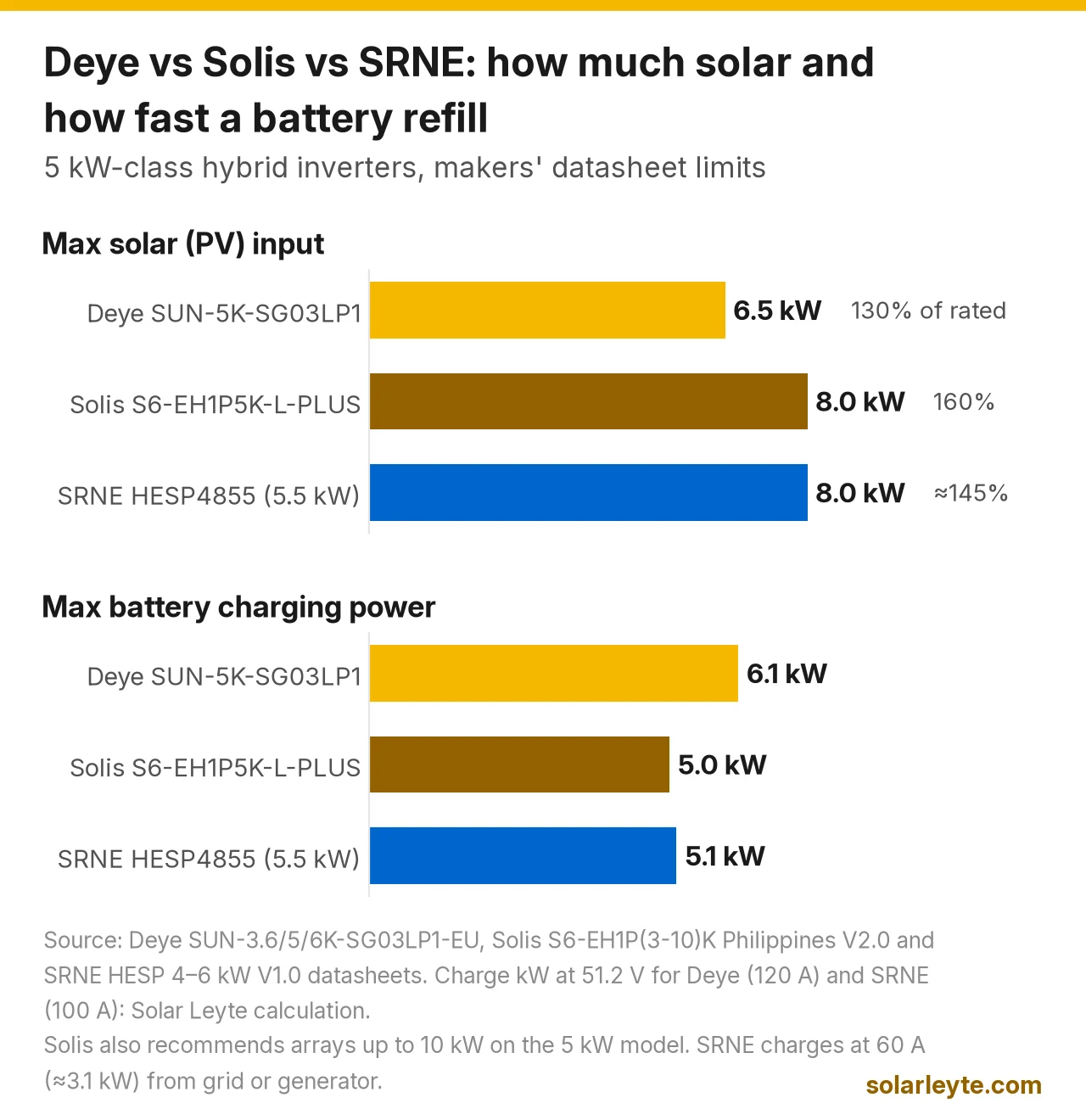
- Solis takes the most solar. Its 5 kW model accepts up to 8 kW of usable PV input, 160% of its rated output. Deye's 5 kW takes 6.5 kW (130%) and SRNE's 5.5 kW takes 8 kW across two inputs (about 145%). Those percentages are our calculation.
- Deye has the narrowest panel-current limit, 13 A per input against 16 A for Solis and SRNE. That matters with today's big panels (more below).
- SRNE accepts the widest grid voltage range on paper, down to 170 V in its UPS mode. On a long co-op line where the voltage sags in the evening, a narrower range means the inverter jumps to battery more often.
- Efficiency differences are small. Deye and SRNE list about 97.5%, Solis 96.2%. On European weighted efficiency the spread is under 1 percentage point.
Brownout behaviour: switchover, surge and passthrough
These three numbers decide what your family notices when BILECO or LEYECO power drops.
Switchover time. SRNE lists 10 ms (typical). Solis's current Philippine datasheet (V2.0) says under 10 ms, while its older Philippine datasheet (V2.3, December 2024) said under 4 ms, so check which sheet applies to your unit. Deye's SG03LP1 datasheet and user manual don't state a figure; ask the seller for it in writing. A few milliseconds is short enough that lights and most appliances carry on, but a desktop PC or a sensitive device can still reset. Put those on a small UPS if it matters.
Surge. Deye and Solis both rate their off-grid peak at twice rated power for 10 seconds, so about 10,000 W for a 5 kW model. SRNE lists a maximum output of 11,000 VA on the 5.5 kW unit and a "load motor capacity" of 4 HP, but no duration. If you'll start a deep-well pump, an aircon and a ref from the battery, that peak is what counts. Our solar water pump guide explains why motors need the extra.
Passthrough. When the grid is up, your backup circuit is fed through the inverter, up to a limit: 35 A on the Deye 5 kW, 40 A on the Solis and SRNE. At 230 V, 35 A is about 8 kW and 40 A about 9.2 kW (our calculation). Most homes put only their brownout circuits behind the inverter, so this rarely bites. If you plan to run the whole house through it, ask the installer to check your peak load against this number.
The grid alerts that cause most brownouts here are explained in our Visayas grid yellow and red alert guide.
Solar input: bigger panels and bigger arrays
Most new quotes in Leyte and Biliran now use 550 W to 620 W panels (what those panels cost). Those big panels push more current, and each inverter input has a limit.
- Deye SUN-5K-SG03LP1: 13 A per input. A Trina 620 W panel runs at 14.99 A at full sun by its datasheet, so the Deye would hold it back at midday. The 580 to 600 W panels we checked run 13.2 to 13.5 A, slightly over.
- Solis S6-EH1P5K-L-PLUS and SRNE HESP: 16 A per input. Both take any of the 580 to 620 W panels we checked without limiting current.
How many 600 W panels fit? Dividing the maximum PV input by 600 W gives about 10 panels on the Deye 5 kW (6 kW of panels), 12 on the SRNE 5.5 kW (6 per input, 7.2 kW) and 13 on the Solis 5 kW (7.8 kW). That's our calculation, before the installer checks string voltage, which also limits the count. Extra panels on a 5 kW inverter help most in the cloudy months and when you're charging a battery after an evening brownout. Our off-grid sizing post shows why December sun is the one to plan for.
Start-up voltage. Solis starts at 90 V and tracks from 90 V, Deye starts at 125 V and tracks from 150 V, and SRNE tracks from 120 V. A lower start-up lets short strings begin producing earlier in the morning and on dark days.
Battery: charge power and the compatibility list
All three take the common 48 V (51.2 V) LiFePO4 wall or rack battery listed in our solar battery price guide.
Charge power at 51.2 V (our calculation from the datasheet currents): Deye 120 A is about 6.1 kW, SRNE's 100 A from solar is about 5.1 kW, and Solis lists 5 kW of charge power directly. SRNE caps charging from the grid or a generator at 60 A, about 3.1 kW. All three can refill a 5 kWh battery in roughly an hour of strong sun, if the panels and the battery's own limit allow it.
The compatibility list is a warranty issue, not just a setup step. Solis's warranty excludes "use of battery types not certified and listed on Solis approved list." SRNE's published HESP warranty excludes installs with batteries that aren't SRNE-certified. Before you buy, ask the seller for the inverter maker's current battery compatibility list and check that your exact battery model is on it, and ask the installer to confirm the CAN or RS485 link works at commissioning. Solis publishes its list as a battery matching pamphlet.
Generator and smart-load ports
Plenty of families in Eastern Visayas already own a generator, and some sitios rely on one. All three can work with it, but differently.
- Deye: one GEN port that you set to one job at a time: generator input, smart-load output (a circuit that switches on only when the battery and solar have power to spare), or input for an existing micro-inverter. That's from Deye's SG03LP1 user manual. If you want both a generator and a smart load, ask the installer how they'll wire it.
- Solis: a generator input with automatic control, plus "dual backup ports for intelligent control of critical and non-critical loads," per its December 2024 Philippine datasheet.
- SRNE: a separate generator port, with generator charging up to 60 A.
Low or unstable co-op voltage
A hybrid only uses grid power when the voltage is inside its accepted range. Outside it, it switches to battery, even if the lights would have stayed on without it.
- Deye: 0.85 to 1.1 times rated voltage, about 196 to 253 V at 230 V (our calculation).
- Solis: 187 to 253 V.
- SRNE: 170 to 280 V in UPS mode, and 90 to 280 V in its wider "APL" mode, per its datasheet.
If your barangay sees low voltage in the evening, tell the installer. The grid standard chosen at commissioning can also change these limits, so ask what setting they'll use and why.
Warranty: what each maker actually promises
Warranty point | Deye | Solis | SRNE |
|---|---|---|---|
Standard term | 5 years from installation, and no more than 5.5 years from leaving the factory | 5 years for S6 hybrids | 5 years (datasheet) |
When the clock starts | Installation date, capped by factory delivery date | Commissioning, or 6 months after factory dispatch, whichever is first | 6 months after the production date on the serial number (SRNE's Australian HESP warranty) |
Longer cover | 10 years announced in August 2026 for Philippine hybrids with 2026 serials (Deye Philippines post) | Paid extension to 10, 15 or 20 years total, applied for within 12 months of installation | None found |
Accessories | 2 years (bracket, fan, CT or meter); data logger 5 years | 2 years (loggers, meters, CTs) | Not covered (Australian document) |
Battery condition | Use the maker's compatibility list | Battery must be on Solis's approved list | Battery must be SRNE-certified (Australian document) |
Sources: Deye warranty terms and conditions V1.7 and general warranty agreement V2.3; Solis limited warranty; SRNE PV storage hybrid inverter warranty description (Australia) and HESP datasheet.
Read the fine print:
- Deye's 10-year offer. The Deye Philippines Facebook page announced a 10-year warranty for hybrid inverters with serial numbers from 2026 onwards, as reposted on r/SolarPH on 12 August 2026. We couldn't open the original post, and Deye's own datasheet still says the term "depends on the final installation site." Get the term for your serial number in writing from the seller.
- Solis's extension has to be bought within 12 months of installation, through the SolisCloud app according to Solis's service centre. Ask Solis Philippines whether it's offered here and what it costs before you count on it.
- SRNE's only published HESP warranty document we found is for Australia. It applies to units bought from an authorised dealer and installed there. In the Philippines, the 5 years on the datasheet is backed by whoever sold it to you, so ask the seller who handles claims.
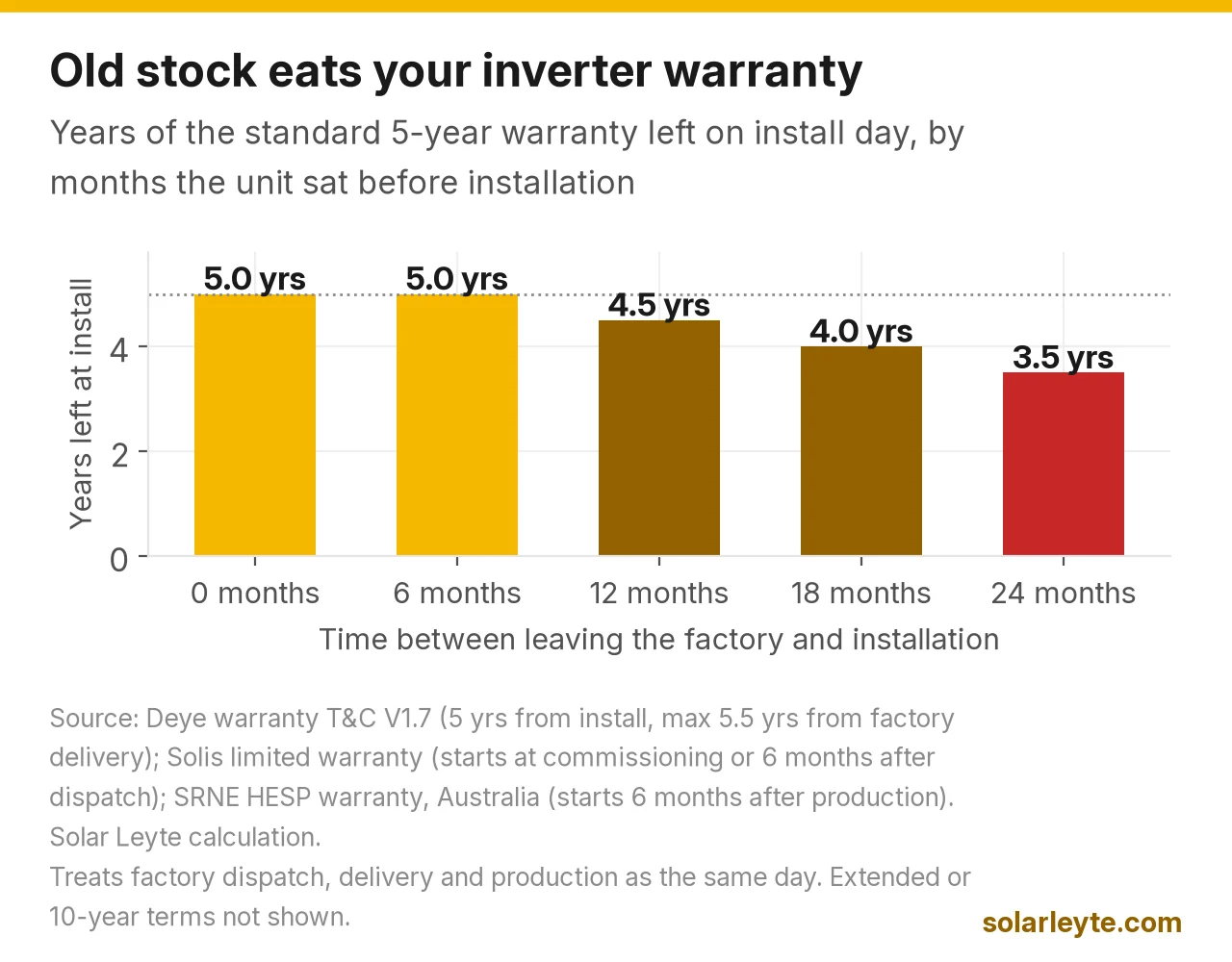
- Old stock eats your warranty. All three clocks can start before your install day. Under the terms above, an inverter that sat 12 months in a warehouse has about 4.5 years left the day it goes on your wall, and one that sat 24 months has about 3.5 (our calculation; it treats factory dispatch, delivery and production dates as the same day). Ask for the serial number before you pay and check the production date.
Service in Eastern Visayas: where a claim goes
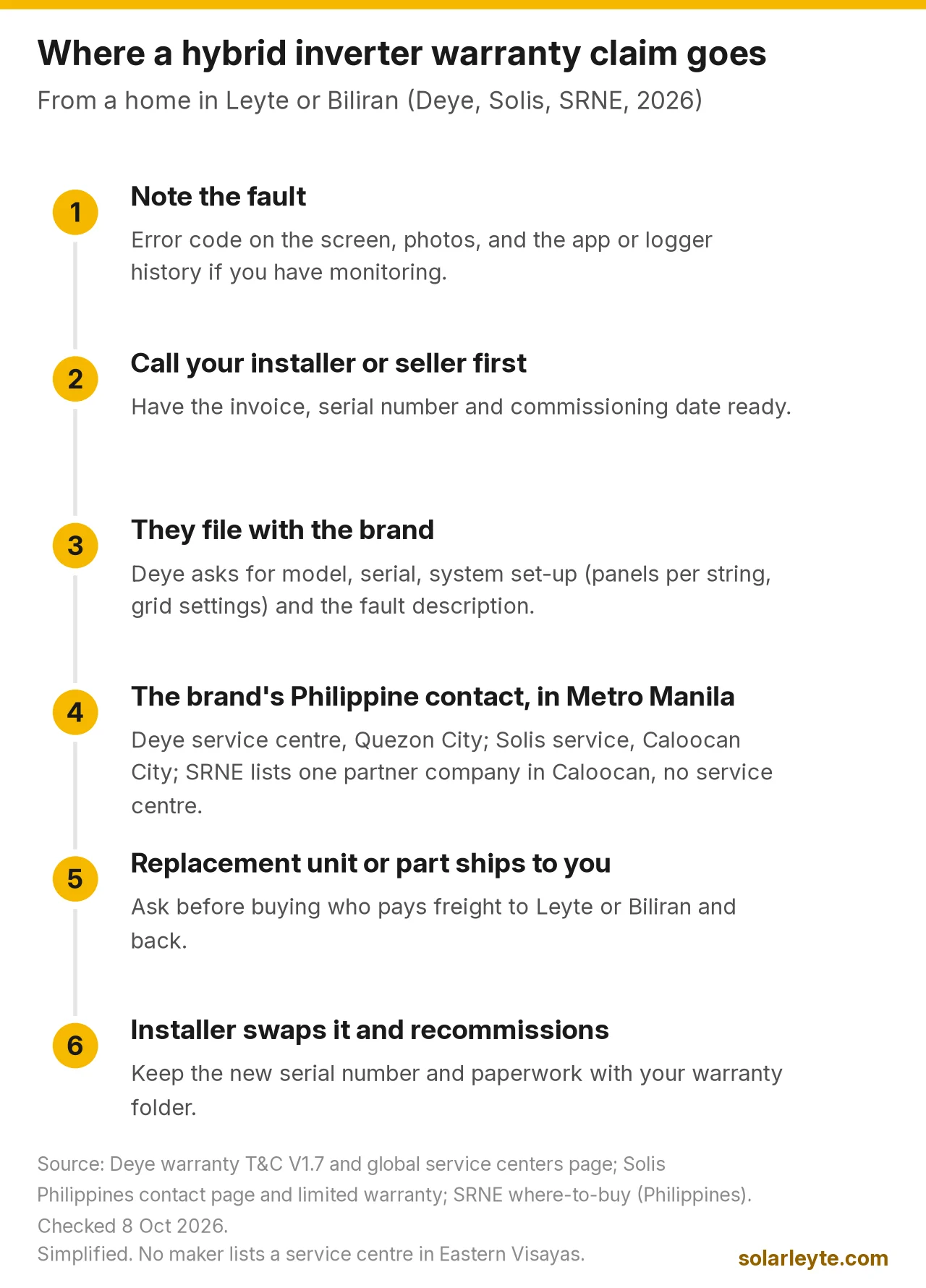
None of the three makers lists a service centre in Eastern Visayas. Their published Philippine contacts are all in Metro Manila:
- Deye: Philippines Service Center, MC Square Building, Tandang Sora Avenue, Quezon City; +63 920 927 2827; Monday to Saturday hours.
- Solis: Solis Philippines, Grace Park West, Caloocan City; service line +63 2 8372 7945; phservice@solisinverters.com.
- SRNE: its where-to-buy page lists one Philippine company, Greewatt Corporation in North Caloocan (posted August 2023). There's no SRNE service centre listed.
So in practice your installer and seller are the service network. Deye's terms say Deye "don't offer installation service," and its warranty table lists the service mode as "customer replace, faulty units return to Deye," with Deye arranging spare parts, or onsite service. Solis's warranty doesn't cover loss or damage in transit, or duties and import costs. Deye's terms also say a claim needs the model, serial number, system details (panels per string, grid settings) and a description of the fault with the error code. That's why a good handover folder matters (how to choose an installer).
Before you buy, ask the installer:
- Have you filed a warranty claim for this brand before, and how long did it take?
- Who pays freight for a replacement unit to Leyte or Biliran, and for sending the faulty one back?
- Is there a loan unit while mine is away?
- Will you register the warranty in my name and give me the serial number and commissioning date?
Heat, salt air and typhoons: the exclusions
The makers' warranties cover defects, not weather. Each one lists damage it won't pay for:
- Deye: force majeure "(e.g., lightning, overvoltage, storm, fire)", insufficient ventilation, incorrect installation, and opening the casing without permission.
- Solis: lightning, flood, power surge, fire, pest damage and corrosion. It also voids cover if the unit is moved after installation, unless a qualified installer reinstalls it at the same address and it's stored as the manual says in between. Keep that in mind if you take the inverter down before a typhoon.
- SRNE (Australian document): lightning, floods and fires; outdoor installs without protection from direct sunlight; water, conductive dust or corrosive gases.
For Leyte and Biliran, that means mounting the inverter in shade and under a roof, above flood level, away from direct sea spray, with proper surge protection. Solis's IP66 rating is one step tougher than the IP65 on Deye and SRNE, but the corrosion exclusion still applies. Weather damage is a job for insurance, not the inverter warranty (does home insurance cover solar?; typhoon guide).
Which one fits your home?
There isn't a best brand. There's a best fit for your panels, battery, generator and installer.
- You want the brand most local shops stock: In our 7 October price check, 10 of the 12 hybrid listings were Deye, including at ABC Solar Electronics in Cebu, the closest of the sellers to Eastern Visayas. More installers have wired one, and spare units are easier to find. Check the 13 A input limit against your panels.
- You're using 600 W+ panels or want a big array on a 5 kW unit: Solis (16 A, up to 8 kW usable) or SRNE (16 A, 4 kW per input) fit better. We found no Philippine shop price for the Solis hybrid online on 7 or 8 October, so you'll need a quote.
- You'll run a generator often, or your evening voltage sags: SRNE's separate generator port and its wide 170 to 280 V input range are worth a look. Ask the seller how SRNE warranty claims are handled, since there's no SRNE service centre listed in the country.
- You may add a second inverter later: Deye parallels up to 16 units, Solis and SRNE up to 6.
Whatever you choose, pick the battery and inverter together, and size them for what must keep running (grid-tie vs hybrid vs off-grid).
FAQ
Which is better, Deye, Solis or SRNE? None is better for every home. On the datasheets, Solis takes the most solar and the biggest panels, SRNE accepts the widest grid voltage and has a separate generator port, and Deye has the most parallel capacity and was by far the most listed brand in our price check. Service from your installer matters as much as the brand.
Do Deye, Solis and SRNE hybrid inverters have a 10-year warranty in the Philippines? Each lists 5 years as standard. Deye Philippines announced 10 years for hybrids with 2026 serial numbers, and Solis sells paid extensions to 10, 15 or 20 years within 12 months of installation. Get the term for your serial number in writing.
Does Deye, Solis or SRNE have a service centre in Leyte or Biliran? Not that we could find. Deye's Philippine service centre is in Quezon City and Solis's in Caloocan City, and SRNE lists a partner company in Caloocan. Claims usually go through your installer and seller.
Can I use a 600 W solar panel with a Deye 5 kW hybrid? Yes, but the Deye SUN-5K-SG03LP1 takes up to 13 A per input, and many 580 to 620 W panels run at 13.2 to 15 A at full sun. The inverter limits the current, so you lose a little power at midday. Solis and SRNE take 16 A.
Can these inverters run without a battery? Solis lists "PV-only off-grid operation." Deye sellers list their hybrids as working with or without a battery. Without a battery you get little or no brownout backup.
Solar Leyte is run by MACC Systems & Energy Solutions Inc., a solar installer in Naval, Biliran.
Get a free hybrid solar quote from MACC
Tell us what must keep running in a brownout, whether you have a generator, and send a photo of your last BILECO or LEYECO bill. We'll match the inverter, battery and panels to that list, give you every model number and datasheet, and show you the math, with no obligation.
- Call/Text: 0955 723 5093
- Email: official@macc-inc.com or benjie@macc-inc.com
- Website: www.macc-inc.com
- Request a quote online: solarleyte.com/quote
- Office: Brgy. Talustusan, Naval, Biliran 6543
Sources (all checked 8 October 2026)
- Datasheets: Deye, SUN-3.6/5/6K-SG03LP1-EU and SG03LP1-EU user manual (retailer-hosted copy; GEN port modes); Solis, S6-EH1P(3-10)K Philippines datasheet V2.0, S6-EH1P(3-8)K-L-PLUS Philippines datasheet V2.3, Dec 2024 and product page; SRNE, HESP 4–6 kW datasheet V1.0
- Warranty documents: Deye, warranty terms and conditions V1.7 and general warranty agreement V2.3; Solis, limited warranty (global) and warranty extension guide; SRNE, PV storage hybrid inverter warranty description (Australia, Aug 2025); Deye Philippines 10-year announcement as reposted on r/SolarPH, 12 Aug 2026
- Battery compatibility: Solis, battery matching pamphlet
- Philippine service contacts: Deye global service centers; Solis Philippines contact page; SRNE where to buy: Philippines
- Panel currents and listing counts: Solar Leyte, 550W to 620W solar panel prices (LONGi, Jinko and Trina datasheets) and hybrid inverter prices (seller listings, 7 Oct 2026)