A good solar installer puts a licensed person's name on your job, files the permits for you, and hands you warranty papers in writing. In practice that means a Professional Electrical Engineer (PEE) signs and seals the plans, a licensed electrical practitioner is in charge on the roof, the LGU issues an electrical permit before work starts and a Certificate of Final Electrical Inspection (CFEI) after, and every panel, inverter and battery is named by brand, model and serial number.
Kinsa man an maayo nga installer? Price matters, but it's the last thing to compare, not the first. This guide shows how to check the people, the paperwork and the warranties, so you can compare installers in Tacloban, Ormoc, Naval or anywhere in Eastern Visayas on equal terms.
Disclosure: Solar Leyte is run by MACC Systems & Energy Solutions Inc., a solar installer in Naval, Biliran. That's exactly why this post has no "top installers" list and no ranking. Use the checklist with any installer, including us.
Facts checked 7 October 2026 (Philippine time). This is a plain-language guide, not legal advice. Laws and LGU requirements can change, so confirm with your city or municipal engineering office.
The quick checklist
Our guide to reading a solar quote lists six questions to ask every installer. This post goes further: who is legally allowed to do the work, how to check them, and what papers you should end up holding.
What to check | How to check it | Why |
|---|---|---|
Name and PRC licence number of the PEE who will sign and seal your plans | Ask in writing, then look it up on PRC's online verification portal | RA 7920 gives PEEs the sole authority to seal electrical plans |
Who is in charge on site (PEE, registered electrical engineer or registered master electrician) | Ask for the name and licence number | RA 7920 requires installation under a licensed practitioner |
Technicians' PV Systems Installation NC II | Ask for the certificate, check TESDA's Registry of Certified Workers | Shows training in installing, testing and commissioning PV |
Business registration and invoices | DTI business name (sole proprietor) or SEC (corporation); a proper invoice or receipt | You need the receipt to claim warranties |
Electrical permit before work, CFEI after | The installer files them; you keep copies | Required by law, and needed for net metering |
Every component named, with datasheets | Brand, model and quantity on the quote | You can't compare or claim what isn't named |
Warranty papers in your name | Product, performance and workmanship warranties, in writing | The Consumer Act sets what a written warranty must say |
Typhoon-ready mounting | Ask how rails are fixed to the roof structure | See our typhoon installation guide |
Why this matters more than the brand of panel
Most solar problems start with how a system is put together, not with the panels. In the large German study we cover in our solar fire safety post, installation faults were the most common cause (37%) among the PV-caused fires where a cause was found, ahead of product defects (35%).
Philippine regulators are saying the same thing in 2026:
- The PRC Board of Electrical Engineering's chairman, Engr. Adelino V. Garcia Jr., said rooftop systems "are actually small power generation systems that require permits and associated design calculations that only licensed and qualified technical personnel can undertake" (Daily Tribune, 5 Jun 2026).
- The Institute of Integrated Electrical Engineers (IIEE) warned on 12 May 2026 that unregistered or "guerrilla" installations risk "electrical fires, electrocution hazards, equipment failure, unsafe back-feeding conditions" and grid problems (same source).
- Former PRC electrical engineering board chairman Engr. Francis Mapile pointed to the National Building Code, which requires permits, inspections and a CFEI before a system is energised (The Chronicle, 9 May 2026).
There's also a reason that's personal to you. The DOE's 2026 circular on zero-export and micro-solar systems puts the duty on the homeowner: "All end-users shall ensure that the installation, operation, and maintenance" of these systems comply with the Philippine Electrical Code, and end-users "shall secure and maintain all permits" (DOE DC2026-08-0017, Sections 5.1 and 5.2). If the installer cuts corners, the paperwork problem is yours.
Licences: who is allowed to do what
Solar is electrical work, so the main law is Republic Act No. 7920, the New Electrical Engineering Law (Lawphil). It sets out three licensed roles, all registered by the PRC's Board of Electrical Engineering:
Licence | What RA 7920 lets them do (Section 31) | Their role on a home solar job |
|---|---|---|
Professional Electrical Engineer (PEE) | "Sole authority to seal electrical plans" and practise electrical engineering in full | Designs or reviews, then signs and seals the plans and specifications |
Registered Electrical Engineer (REE) | Supervision of operation, maintenance, manufacture and repair, and sale of equipment needing engineering calculations | Can supervise the work; per JMC 001 summaries, can also sign and seal the single-line diagram for a net-metering permit |
Registered Master Electrician (RME) | Installation, wiring, operation, maintenance and repair of electrical equipment in buildings | Can be in charge of the installation; above 500 kVA or 600 V, the work must be supervised by a PEE or REE |
Three parts of the law matter most when you hire someone:
- Plans must be sealed by a PEE. Section 34 says no installation "shall be undertaken unless the plans, designs, valuations and specifications have been prepared by or under the responsible charge of, and signed and sealed by a professional electrical engineer," a construction permit is secured first, and the work follows the Philippine Electrical Code under a PEE, REE or RME.
- A company can't hold the licence. Section 35 says electrical engineering is a personal licence, and "no firm or corporation may be registered or licensed" for it. So "licensed company" isn't enough. Ask for the person's name and licence number.
- Nobody may sign for someone else. Section 32 bans using another person's licence or seal and signing design documents "on behalf of a professional electrical engineer."
How to check a licence: the PRC's online verification portal (verification.prc.gov.ph) lets you look up a licence by number. Ask the installer for the PEE's and the site supervisor's full names and PRC licence numbers in writing, then check that the names, professions and status match.
TESDA certificates for the crew
The people on your roof are usually technicians, not engineers. TESDA's PV Systems Installation NC II covers four core skills: site assessment, checking PV components and materials for compliance, installing the system, and testing and commissioning it (TESDA training regulations; e-TESDA course outline). TESDA also has PV Systems Design NC III and PV Systems Servicing NC III.
An NC II is a skills certificate, not a licence to design or seal plans. It's still a good sign. You can check a worker's certificate in TESDA's Registry of Certified Workers.
Business registration and receipts
A sole proprietorship should have a DTI business name registration (searchable on the DTI's Business Name Registration System); a corporation is registered with the SEC. Either way, insist on a proper sales invoice or official receipt in your name. Under the Consumer Act, the receipt or warranty card is what you present to claim a warranty (more below).
The DOE installer registry: what it is and isn't
The DOE publishes an Official Solar PV Installer Registry. The latest version we found is dated 13 July 2026 (DOE; PDF). We counted what's in it:
Region | Solar PV installers | ESCOs with solar PV installation |
|---|---|---|
NCR (Metro Manila) | 10 | 11 |
Central Visayas (VII) | 6 | 0 |
CALABARZON (IV-A) | 5 | 2 |
Western Visayas (VI) | 3 | 0 |
Davao (XI) | 3 | 1 |
SOCCSKSARGEN (XII) | 3 | 0 |
Central Luzon (III) | 2 | 0 |
MIMAROPA (IV-B) | 2 | 1 |
Eastern Visayas (VIII) | 1 | 0 |
Bicol (V) | 1 | 0 |
Total | 36 | 15 |
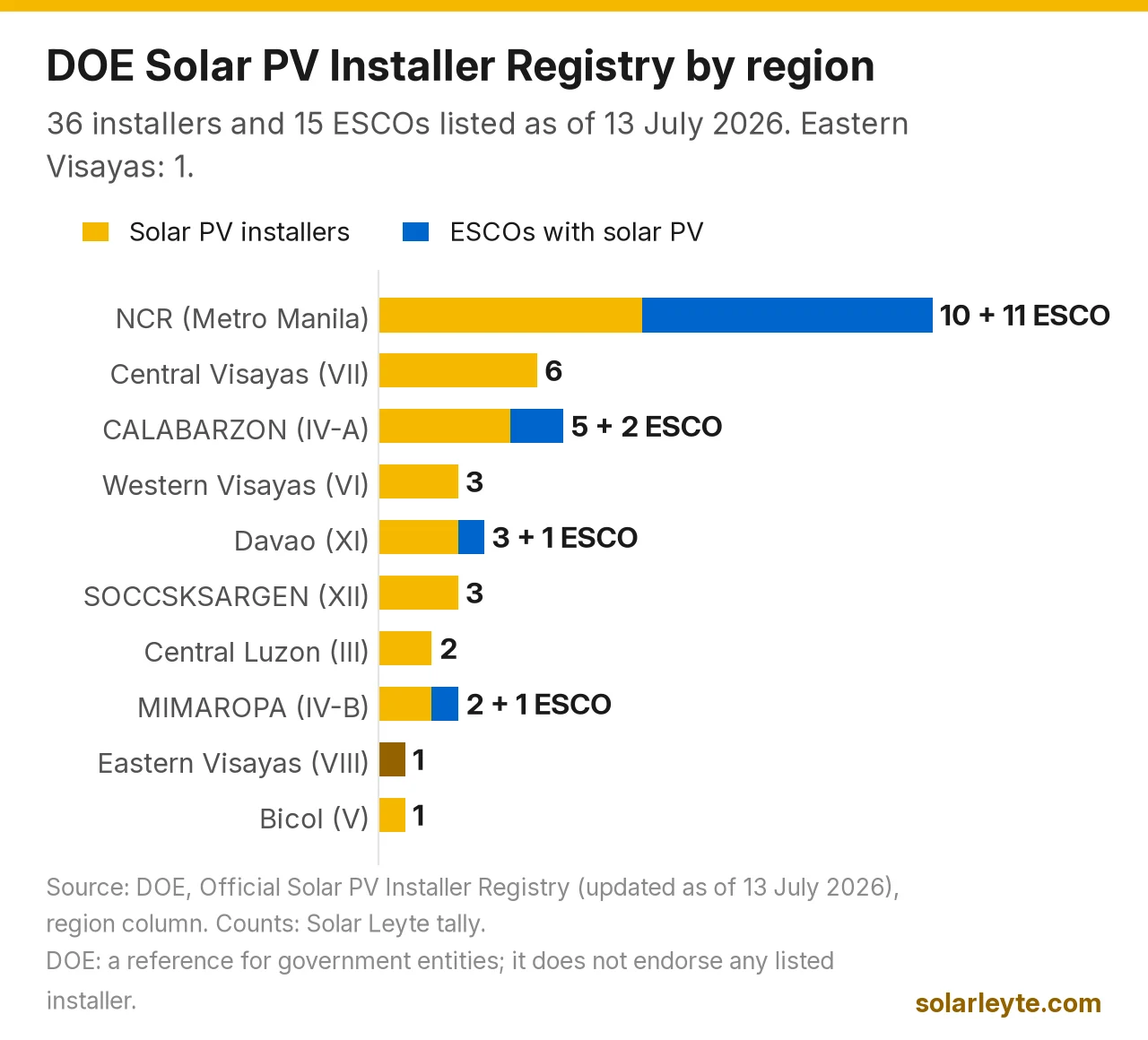
Counts are our tally of the region column in the DOE's 13 July 2026 PDF.
What that means for you:
- It's a reference for government buyers. The DOE says the registry "may serve as a reference and guide for interested Government Entities" and that it "does not endorse any listed Solar PV Installer."
- Only one listed installer gives an Eastern Visayas address (in Tacloban City). MACC, which publishes this site, is not on the 13 July 2026 list.
- Being listed isn't proof of good work, and not being listed isn't proof of bad work. We found no rule that requires a home installer to be on this registry. The licences above are what the law requires.
- If an installer says they're "DOE accredited" or "DOE registered," open the PDF and look for their exact business name.
Permits: what a proper installer files for you
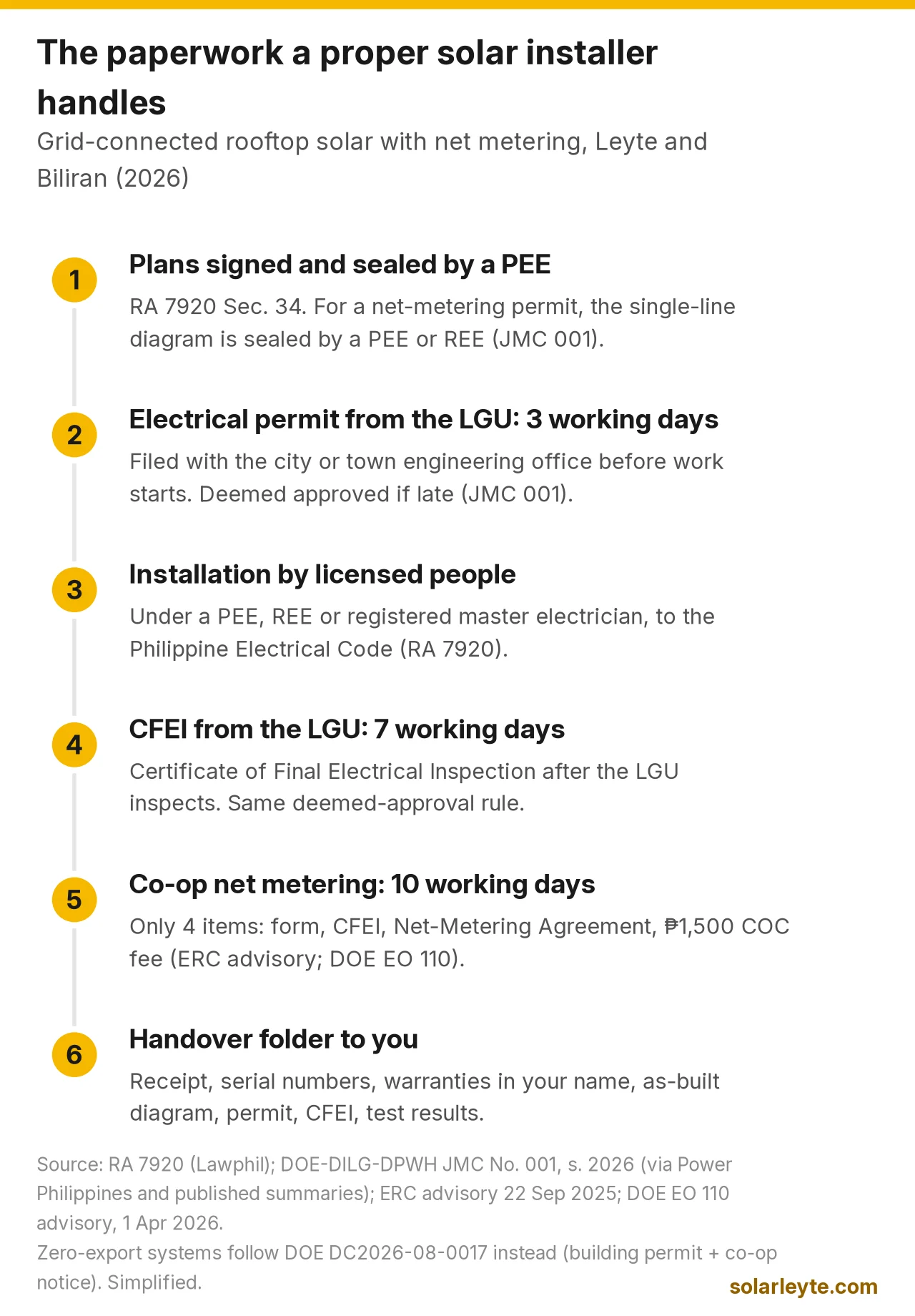
For a grid-connected system, the paperwork usually runs like this. A good installer handles most of it and gives you copies.
- Plans signed and sealed. A PEE prepares or reviews the electrical plan (RA 7920, Section 34). For a net-metering job, the LGU checklist under Joint Memorandum Circular (JMC) No. 001, s. 2026 asks for three copies of the net-metering application form and three sets of a single-line diagram, from the service entrance to the main breaker, showing the solar connection, signed and sealed by a professional or registered electrical engineer (summary of JMC 001; the same wording appears in the 2021 JMC checklist).
- Electrical permit before installation. Filed with your city or municipal engineering office (the Office of the Building Official). Under JMC 001, LGUs must act within 3 working days of a complete application, or it is "deemed approved" (Power Philippines).
- Installation under a PEE, REE or RME, following the Philippine Electrical Code.
- CFEI after installation. The LGU inspects and issues the Certificate of Final Electrical Inspection within 7 working days under JMC 001, with the same deemed-approval rule (same source).
- Co-op application, if you want net metering. BILECO or LEYECO can only ask for four documents under the ERC's 22 Sep 2025 advisory: the application form, the CFEI, the amended Net-Metering Agreement and the ₱1,500 COC fee. The DOE's EO 110 advisory sets 10 working days for the co-op. Our BILECO net metering guide and LEYECO II net metering guide walk through each step.
Zero-export and plug-and-play systems are different. Under DOE DC2026-08-0017, a zero-export system still needs a building permit (an existing permit may be accepted if the LGU confirms it) plus a notice to your co-op if it's connected to the grid; a micro-solar kit up to 1 kW of panels and an 800 W micro-inverter needs only a notice. Our plug-and-play and zero-export guide explains the details. Even then, the circular says the work must follow the Philippine Electrical Code.
Where to file in Leyte and Biliran:
- Tacloban City: electrical permits are under the City Engineer's Office, with the OBO Division approving them (Tacloban City Citizen's Charter 2024).
- Naval, Biliran: the municipal government's Naval Connect app lists building permit forms and links to OBO certifications (Philippine Information Agency). Ask the Municipal Engineering Office about electrical permits and the CFEI.
- Other towns: ask at the municipal hall for the municipal engineer or building official. LGU fees vary, so ask the installer whether permit fees are included in the quote.
Red flag to remember: an installer who says a full-size grid-tie system "doesn't need a permit." Only the small micro-solar category under DC2026-08-0017 is exempt from the building permit, and even that needs a notice to your co-op.
Warranty paperwork: get it in writing
A solar system comes with three different kinds of warranty, from different people:
Warranty | Who gives it | Typical terms (examples) | What to ask |
|---|---|---|---|
Product warranty (panels) | Panel manufacturer | LONGi LR5-72HTH (590–600 W): 15 years on materials and processing | Is the warranty valid in the Philippines, and who files the claim? |
Performance (power) warranty | Panel manufacturer | Same panel: at most 1.5% loss in year 1, then 0.40% a year: about 92.9% of rated power at year 15 (our calculation) and 88.9% at year 25 | Ask for the datasheet page with the power curve |
Inverter and battery warranty | Inverter and battery makers | Deye hybrid inverters and batteries: 5 or 10 years depending on install site; Hopetrek 5.12 kWh batteries: 5 years (LB5-W01) or 10 years (LB5-W05) | Which term applies here, and who handles claims in Eastern Visayas? |
Workmanship warranty | Your installer | No legal minimum we could find; set by each installer | How many years, and does it cover roof leaks, loose rails and connectors? |
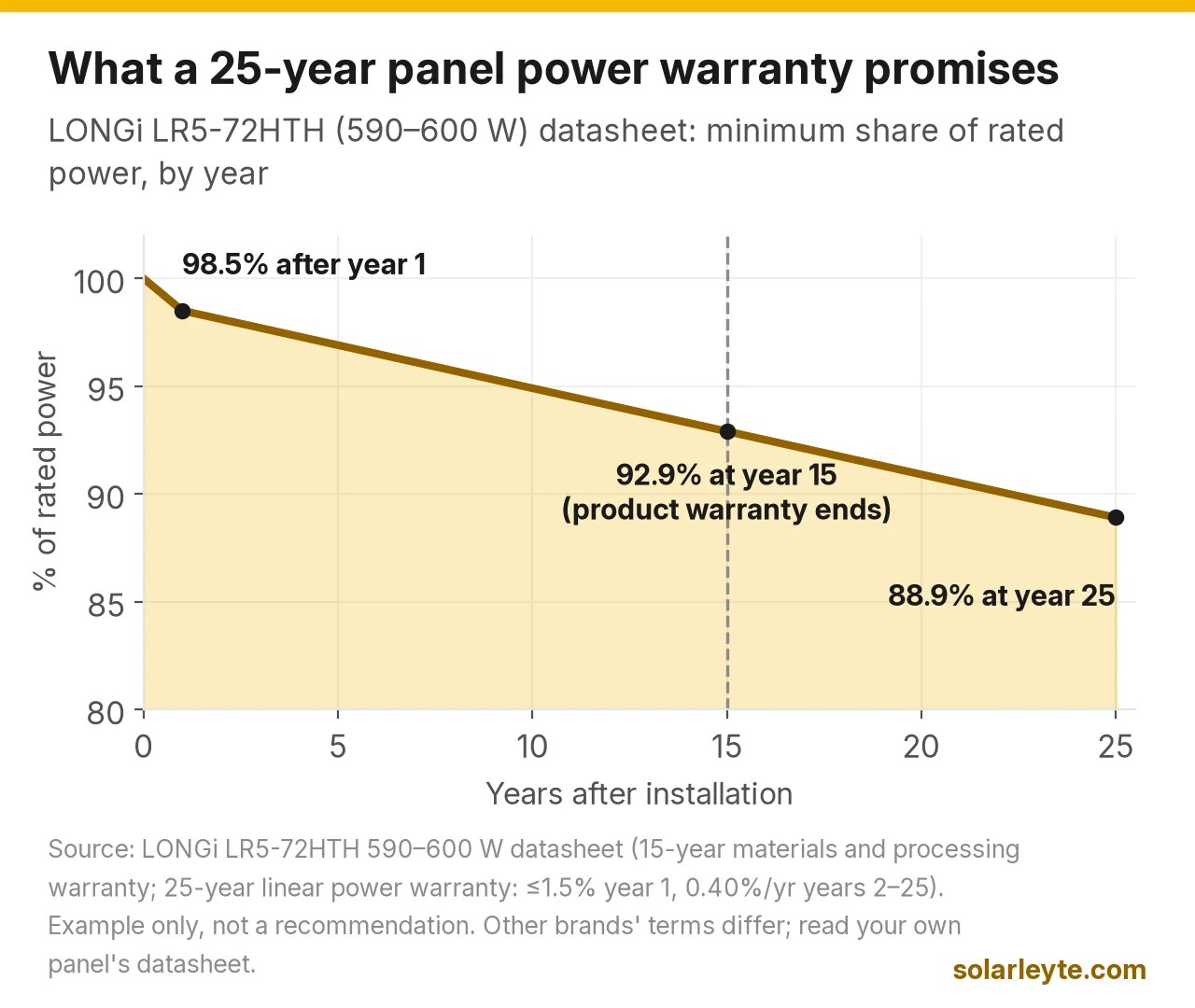
Sources: LONGi LR5-72HTH datasheet; Deye and Hopetrek terms as cited in our hybrid inverter price post and battery price post. These are examples, not recommendations.
What the Consumer Act says a written warranty must include
Article 68 of the Consumer Act (RA 7394) applies to consumer products sold with a warranty (Lawphil). Whoever gives an express warranty must:
- set out the terms "in clear and readily understandable language" and identify themselves as the warrantor;
- say who the warranty is for and which products or parts it covers;
- state what they'll do if there's a defect, "and at whose expense";
- state what you must do to claim; and
- give the period within which they'll act after you report a defect.
Other parts of Article 68 that help solar buyers:
- Warranty registration. Distributors must report each sale (date, model, serial number, buyer's name and address) to the manufacturer or importer within 30 days, and that report counts as warranty registration. Ask your installer to confirm this was done for your inverter and battery.
- Claims. To claim, you present the warranty card or the official receipt with the product to the seller. "No other documentary requirement shall be demanded."
- Repairs. If you choose repair under an express warranty, the work must be done within 30 days.
- Implied warranty. If an express warranty comes with the implied warranty of merchantability, both last the same period. Other implied warranties on new consumer products last at least 60 days and no more than one year.
Practical question to add: does the warranty cover the labour and freight to remove, ship and reinstall a faulty inverter or panel in Leyte or Biliran, or only the part? Get the answer in writing.
Your handover folder
When the job is done, you should be holding:
- the sales invoice or official receipt in your name;
- a list of every component with brand, model and serial number;
- datasheets and warranty certificates for panels, inverter and battery;
- the installer's written workmanship warranty;
- the as-built single-line diagram, signed and sealed;
- copies of the electrical permit and CFEI (and the Net-Metering Agreement, if any);
- the testing and commissioning results (TESDA's NC II includes documenting these);
- the shutdown and start-up procedure, which you'll need before a typhoon (our typhoon checklist).
Keep the folder in a waterproof bag with your house papers.
Comparing installers: questions beyond the basics
Start with the six questions in our quote guide. Then add these:
- Who is the PEE who will sign and seal my plans? Name and PRC licence number, please.
- Who will be in charge on the roof, and what licence or NC II do they hold?
- Will you file the electrical permit and CFEI? Are the LGU fees in your price?
- Will you handle my BILECO or LEYECO net-metering application, or the DC2026-08-0017 notice for zero-export?
- Can I see the single-line diagram before I sign, and will I get the as-built version after?
- How will the rails be fixed to my roof structure, and what hardware do you use near the sea? (See the typhoon guide.)
- What tests will you run at commissioning, and will you give me the results?
- How long is your workmanship warranty, what does it cover, and how fast do you respond to a fault?
- Do you inspect systems after a typhoon, and what does it cost?
- What's the payment schedule? Ask for payments tied to milestones (for example, delivery, installation, commissioning) rather than everything upfront.
- Can I talk to two or three past customers nearby whose systems are permitted, ideally ones that went through net metering?
If two quotes are for the same size, compare them line by line. Our itemised 5kW solar price post shows what the parts alone cost at Philippine sellers in October 2026. A complete installed package priced at or below the parts total is a reason to ask what's been left out.
Red flags
- No named PEE, or "our company is licensed" with no person's name or licence number.
- "No permit needed" for a normal-size grid-tie or hybrid system.
- Telling you to start exporting to the grid before net metering is approved. An old meter can record exports as consumption and raise your bill (see our BILECO net metering guide).
- A quote with no brand, model or quantity for panels, inverter, battery and mounting.
- A verbal "lifetime warranty" with nothing on paper, or warranty papers in the installer's name instead of yours.
- Full payment before anything is delivered.
- Claims of "DOE accredited" that you can't find in the DOE registry PDF.
- Refusing to show the single-line diagram or datasheets "because it's confidential."
- Savings promises with no electricity rate or production figure behind them (our payback post shows how to check).
- Pressure to sign the same day, or a "promo" that ends tonight.
For businesses, resorts and farms
The same checks apply, plus a few more:
- Your building may already need licensed electrical staff. RA 7920, Section 33, sets a minimum complement of PEEs, REEs or RMEs for commercial establishments and industrial plants, with exemptions for small, low-voltage installations (50 kVA or less and not more than 250 V). If you have an engineer or master electrician on staff or on retainer, have them review the installer's design.
- Zero-export COC. Under DC2026-08-0017, the exemption from the ERC Certificate of Compliance for zero-export systems covers households, clinics, hospitals and other medical facilities. Shops, resorts and farms should ask the installer to handle the COC (see our plug-and-play and zero-export guide).
- Bigger systems mean bigger paperwork. Ask for the full design calculations and a written commissioning report, not just a one-page diagram.
FAQ
Does a solar installer need a license in the Philippines? The electrical work does. Under RA 7920, plans must be signed and sealed by a Professional Electrical Engineer, and installation must be done under a PEE, a registered electrical engineer or a registered master electrician. The licence belongs to the person, not the company.
Is DOE accreditation required for solar installers? We found no rule requiring home installers to be on the DOE's Solar PV Installer Registry. The DOE describes it as a reference for government agencies and says it doesn't endorse any listed installer. As of 13 July 2026 it listed 36 installers and 15 ESCOs, one with an Eastern Visayas address.
How do I verify an electrical engineer's PRC licence? Ask for the full name and licence number, then use the PRC's online verification portal at verification.prc.gov.ph.
Do I need a permit for rooftop solar in Leyte or Biliran? For a grid-tie or hybrid system, yes: an electrical permit before installation and a CFEI after, from your city or municipal engineering office. Zero-export systems need a building permit under DC2026-08-0017. Only plug-and-play micro-solar kits (up to 1 kW of panels, 800 W micro-inverter) are exempt from the building permit under the circular, and they still need a notice to your co-op.
How long should a solar workmanship warranty be? There's no legal minimum we could find, so it varies by installer. Get it in writing, with the number of years and exactly what's covered.
What is the difference between product and performance warranty on solar panels? The product warranty covers defects in materials and manufacturing (15 years on the LONGi panel in our example). The performance warranty promises the panel will still make a set share of its rated power over time (88.9% at year 25 for the same panel).
Solar Leyte is run by MACC Systems & Energy Solutions Inc., a solar installer in Naval, Biliran.
Get a free, itemised solar quote from MACC
Want to put us through this checklist? Send a photo of your latest BILECO or LEYECO bill and tell us whether you need brownout backup. We'll name the engineer who'll seal your plans, list every part by brand and model, and explain the permits, with no obligation.
- Call/Text: 0955 723 5093
- Email: official@macc-inc.com or benjie@macc-inc.com
- Website: www.macc-inc.com
- Request a quote online: solarleyte.com/quote
- Office: Brgy. Talustusan, Naval, Biliran 6543
Sources (all checked 7 October 2026)
- Law: Lawphil, RA 7920, New Electrical Engineering Law (Sections 31–35); Lawphil, RA 7394, Consumer Act of the Philippines (Article 68)
- DOE: Official DOE Solar PV Installer Registry, 13 July 2026 (PDF); DC2026-08-0017 (zero-export and micro-solar, Sections 4 and 5)
- Permits: Power Philippines, DOE orders LGUs to clear net-metering permits in 3–7 days (JMC No. 001, s. 2026); AEDO Construction, net-metering application guide (JMC 001 document list); Cagayan de Oro City, net-metering checklist under JMC 2021-01; Tacloban City, Citizen's Charter 2024, 3rd edition; Philippine Information Agency, Naval goes digital, launches app for gov't services
- Licences and training: PRC, online licence verification; TESDA, training regulations downloads and Registry of Certified Workers; e-TESDA, PV Systems Installation NC II course; DTI, Business Name Registration System
- Safety statements: Daily Tribune, Industry experts push for stronger safety standards (5 Jun 2026); The Chronicle, Former PRC electrical engineering board chief warns vs unsafe DIY solar installations (9 May 2026); The Phil Biz News, Stricter safety standards for rooftop solar systems in PH sought (9 Jun 2026)
- Warranties: LONGi, LR5-72HTH 590–600 W datasheet; Deye, SE-G5.1 Pro-B; Hopetrek terms via Beyond Hygiene Asia, as cited in our battery price post