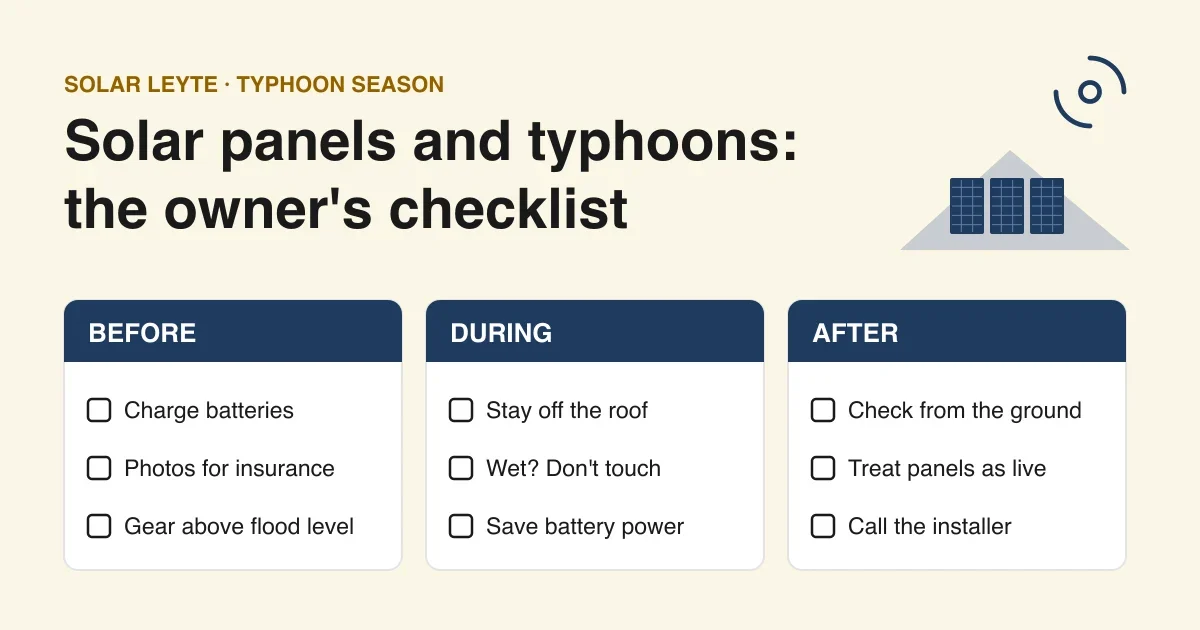
If you already have solar, typhoon season is mostly about what you do from the ground. Charge your batteries when PAGASA raises a signal. Take photos. Move portable gear above flood level. Stay off the roof. After the storm, check from the ground, treat panels as live, and call your installer before switching anything back on.
Andam ta, pero dili mahadlok. Be ready, not scared.
This is the owner's checklist. If you're still choosing a system or an installer, read our typhoon-ready installation guide first. That guide covers mounting, hardware and questions to ask. This post is what to do when a storm is actually coming.
Facts checked 5 October 2026. This is general guidance. Your installer's instructions for your system come first.
What PAGASA's signals mean for your solar
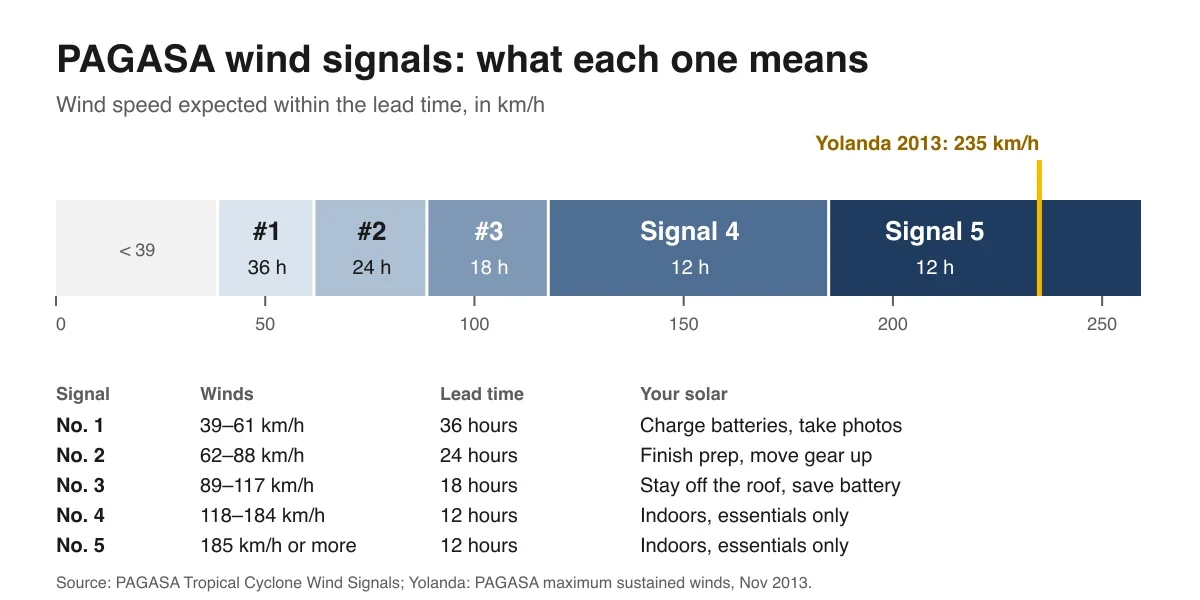
PAGASA raises a Tropical Cyclone Wind Signal (TCWS) for each area. Each level tells you how strong the winds may get and how much warning you have (PAGASA).
Signal | Winds expected | Lead time | What to do with your solar |
|---|---|---|---|
No. 1 | 39–61 km/h | 36 hours | Start the "before" list: charge, photograph, move gear |
No. 2 | 62–88 km/h | 24 hours | Finish prep. Portable panels and power stations indoors |
No. 3 | 89–117 km/h | 18 hours | Stay off the roof. Save battery for essentials |
No. 4 | 118–184 km/h | 12 hours | Stay indoors. Essentials only |
No. 5 | 185 km/h or more | 12 hours | Stay indoors. Essentials only |
PAGASA's own descriptions warn of possible power outages from Signal No. 2, and "near total loss of power supply" at Signal No. 4 (PAGASA). So the time to charge batteries is at Signal No. 1, while the grid is still up.
Why Leyte takes this seriously
Many families here remember Typhoon Yolanda (Haiyan), 6–9 November 2013. PAGASA records its maximum sustained winds at 235 km/h, and a storm surge of 5–6 m in Tacloban–Palo (PAGASA seminar slides, 2016). That's above the 185 km/h where today's Signal No. 5 starts.
The lesson for solar owners isn't fear. It's that wind and water both matter. Panels on the roof face the wind. Inverters, batteries and power stations on the ground floor face the flood.
Can solar panels withstand a typhoon?
Panels are tested to set loads, not to a wind speed. A typical example is the LONGi Hi-MO 6 (LR5-72HTH, 590–600 W). Its datasheet lists a front static load of 5,400 Pa and a rear static load of 2,400 Pa, and certification to IEC 61215 (LONGi datasheet).
In the IEC 61215 mechanical load test, the 2,400 Pa load represents wind on both faces of the panel, and the 5,400 Pa front load represents heavy snow (Sinovoltaics). Wind lifting a panel off the roof is the rear-side, or uplift, case.
Two things in the fine print matter:
- The rating depends on how the panel is mounted. LONGi's installation manual says the 5,400 Pa and 2,400 Pa figures are test loads that "can vary from different mounting methods" (LONGi installation manual).
- Design loads are lower than test loads. The same manual says to apply a 1.5 safety factor under IEC 61215 when working out the maximum design load. So 2,400 Pa of test uplift means about 1,600 Pa for design (2,400 ÷ 1.5).
We don't convert these into a km/h figure. Wind pressure on a roof depends on height, roof shape, panel position and gusts, and that's an engineering calculation. The practical point: the panel is rarely the only weak link. Rails, clamps, fasteners and the roof itself decide whether a panel stays put. That's why mounting is the focus of our installation guide, and why roof work belongs to your installer, before the season.
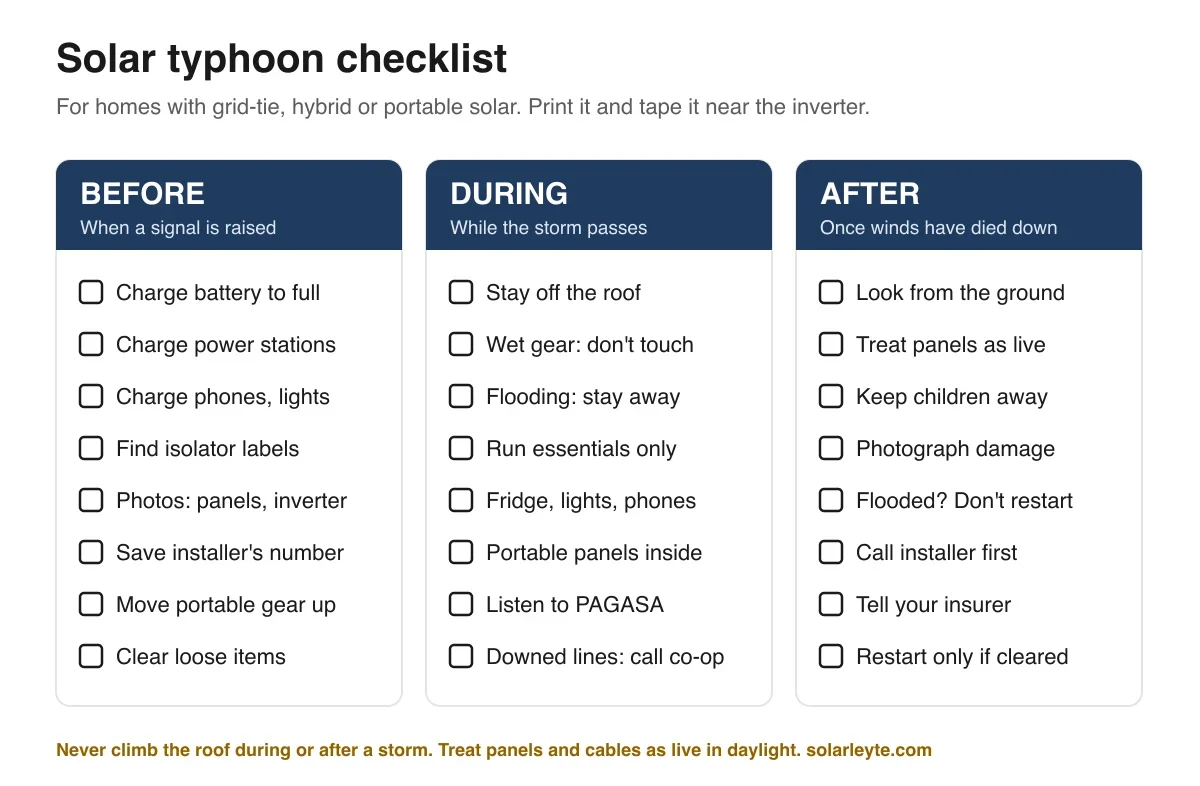
Before: when PAGASA raises a signal
Start at Signal No. 1. You have up to 36 hours.
Charge everything
- ☐ Hybrid system with batteries: let the battery charge to full while the grid and sun are still available. If your inverter has a backup reserve setting, ask your installer before the season what it should be set to for typhoons.
- ☐ Portable power stations: charge them to full from the wall or your panels. Our EcoFlow price guide covers which sizes run what.
- ☐ Charge phones, power banks and rechargeable lights.
- ☐ Plan what the battery must run: fridge, lights, fans, phones, wifi. Aircon drains a battery fast. Our battery price guide shows typical usable capacity by size.
Grid-tie with no battery? A grid-tie inverter switches off when the grid goes down, even in full sun. It won't power your house in a brownout. That's normal, not a fault (grid-tie vs hybrid).
Know your switches, don't experiment
- ☐ Find your installer's shutdown instructions and the labelled AC and DC isolators. Read the labels now, in daylight, while everything is dry.
- ☐ If your installer told you to switch off before a storm, do it in the order they gave you, while the equipment is dry. If you don't have instructions, call them and ask. Don't guess.
- ☐ Save your installer's number and your co-op's hotline (BILECO or LEYECO) in your phone and on paper.
Document the system
- ☐ Take clear photos of the panels from the ground, the inverter, the battery, the isolators and the meter. Include the date.
- ☐ Photograph serial-number labels you can reach safely.
- ☐ Keep your warranty papers, installer invoice and any insurance policy in a waterproof bag.
These "before" photos make warranty and insurance claims much easier if anything is damaged.
Get ready for water
- ☐ Move portable power stations, spare batteries and portable panels to an upper floor or high shelf.
- ☐ Bring folding or portable panels indoors. Don't leave them out to charge in rising wind.
- ☐ Clear loose items around the inverter and outdoor equipment that wind could throw into it.
- ☐ If your inverter or battery sits where floods have reached before, raise it with your installer after this storm. LONGi's own manual says not to install panels where flooding is possible (LONGi installation manual), and the same thinking applies to the electronics.
Never go up on the roof once the wind picks up. No tying down, covering or removing panels. Any roof job belongs to your installer, in calm weather, before the season.
During: while the storm passes
- Stay inside and off the roof. No exceptions.
- If equipment is wet, don't touch it. Queensland utility Ergon Energy warns not to switch off a solar system during a storm if its components are wet, because it "could result in a fatal electric shock" (Ergon Energy brochure).
- If floodwater reaches the inverter or battery, move away from it. Don't wade near submerged equipment.
- Don't assume a brownout makes the system safe. Panels make DC voltage whenever there's daylight, grid or no grid (Ergon Energy).
- Stretch the battery. Run essentials only: fridge, lights, fans, phones. Outages after a storm can last days. Our grid alert explainer covers why the Visayas grid is stretched even on normal days.
- Downed power lines or a damaged meter? Stay well away and report it to BILECO or LEYECO. Don't touch anything near a fallen line.
- Follow PAGASA bulletins on the radio or your phone.
After: checking your system safely
Wait until PAGASA lifts the signal for your area and the winds have died down.
Look, don't touch
- ☐ Check from the ground only. Don't climb the roof to inspect, clear debris or straighten panels.
- ☐ Treat panels and cables as live. Damaged panels still produce voltage in daylight (Ergon Energy).
- ☐ Keep children and pets away from fallen panels, loose cables and the inverter area.
- ☐ Look for: cracked or missing panels, panels at an odd angle, loose rails, dangling cables, roof damage around the mounts, and water or mud on or around the inverter and battery.
- ☐ Check the inverter display from a safe distance. Note any error codes, and photograph them.
Flooded equipment: don't restart
If water reached the inverter, battery, isolators or wiring, don't switch anything on or off. Ergon Energy's advice after floods is not to operate any switches, because residual moisture may have made the system live, and to have it tested by a qualified electrician before reconnecting. It also says an inverter that was submerged or partly submerged should be replaced (Ergon Energy).
The same goes for portable power stations and loose batteries that sat in floodwater. Don't charge or use them. Keep them away from the house and ask the seller or manufacturer what to do. Our fire safety guide covers battery warning signs.
Document and report
- ☐ Photograph all damage from the ground, with dates. Compare with your "before" photos.
- ☐ Tell your insurer before any repairs, if you have cover. Ask what they need.
- ☐ Call your installer to report damage and book an inspection.
When to call the installer, and when to call the co-op
Call your installer if... | Call BILECO or LEYECO if... |
|---|---|
Panels are cracked, loose or missing | Power lines are down near your house |
Rails, clamps or cables look damaged | Your meter or service drop is damaged |
Water reached the inverter, battery or isolators | You've lost grid power and need to report it |
The inverter shows an error or won't start | Your installer says the grid side needs checking |
You're unsure whether it's safe to switch on |
Only switch the system back on once your installer says it's safe, using the start-up order they give you. If you're net metered, your installer and co-op may also need to check the meter connection.
A quick note on portable solar
Portable power stations and folding panels are the easiest kit to protect, because you can carry them. Charge them at Signal No. 1. Keep them indoors on a high shelf. Don't use or charge them in the rain, and don't use one that's been in floodwater. If you're choosing one for typhoon season, see our EcoFlow price guide and how many panels you need.
FAQ
Can solar panels withstand a typhoon? Panels are tested, not storm-proof. A common LONGi panel lists 2,400 Pa rear and 5,400 Pa front static load, and LONGi says those vary with the mounting method. In practice, the roof, rails and fasteners decide whether panels stay on.
Should I remove or cover my panels before a typhoon? No. Don't go on the roof. Roof work is for your installer, before the season. Focus on what you can do from the ground.
Should I switch off my solar system before a typhoon? Follow your installer's instructions, using the labelled AC and DC isolators in their order, while everything is dry. Never operate wet switches.
What should I do with my solar panels after a typhoon? Check from the ground, treat panels as live, keep children away, photograph damage, and call your installer before switching back on.
Will my solar work in a brownout after the storm? Grid-tie only: no, it shuts down with the grid. Hybrid with batteries, or a portable power station: yes, for the essentials you planned for.
Solar Leyte is an independent guide, sponsored by MACC Systems & Energy Solutions Inc., a solar installer in Naval, Biliran.
Need your system checked before or after a storm?
Naunsa imong solar human sa bagyo? MACC can do a pre-season check of your mounting, isolator labels and battery settings, or a post-typhoon inspection before you switch back on. Send photos of your system and any damage, with no obligation.
- Call/Text: 0955 723 5093
- Email: official@macc-inc.com
- Request an inspection online: solarleyte.com/quote
Sources (checked 5 October 2026)
- PAGASA, Tropical Cyclone Wind Signals: wind ranges, lead times and impacts
- PAGASA, Extreme weather events, JPOW seminar slides (PDF) (2016): Yolanda dates, 235 km/h maximum sustained winds, Tacloban–Palo storm surge
- LONGi, LR5-72HTH 590–600M datasheet (PDF) (distributor-hosted copy): static load ratings, IEC 61215
- LONGi, Installation Manual for LONGi Solar PV Modules, V10 (PDF): test loads vary with mounting, 1.5 safety factor, flood siting
- Sinovoltaics, Mechanical load test: conduction and specification: what the IEC 61215 loads simulate
- Ergon Energy (Queensland), Solar PV safety during storms and floods (PDF): live panels, wet equipment, post-flood advice
- Solar Leyte, Solar battery price Philippines (October 2026)