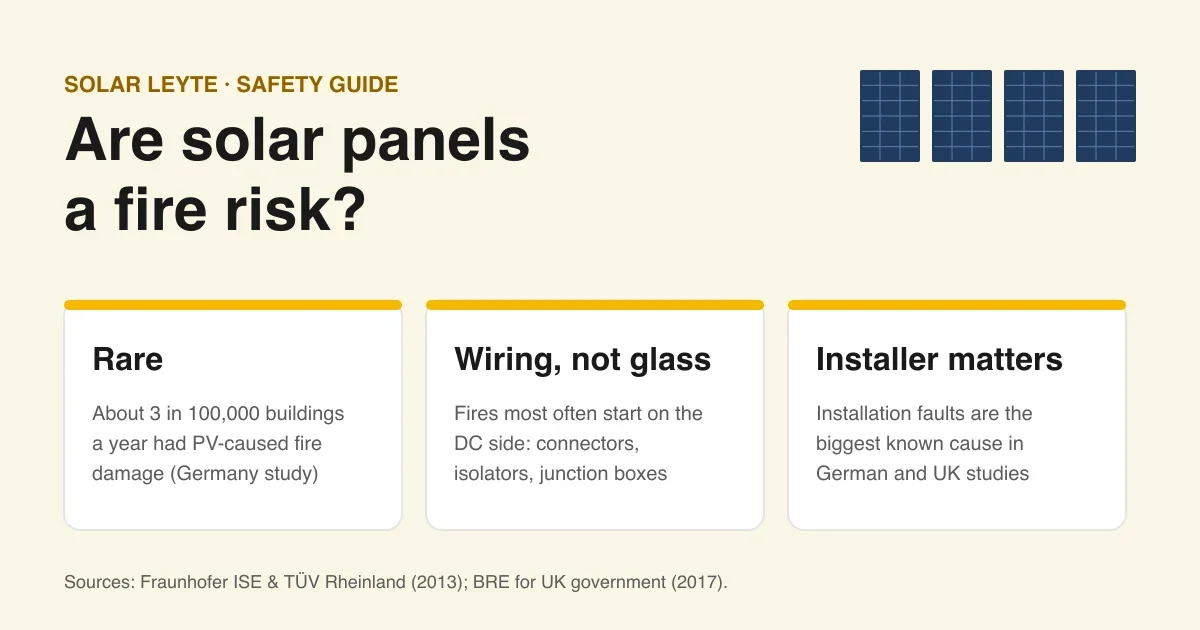
Short answer: yes, solar panels can cause fires, but it's rare. A study of Germany's 1.3 million PV systems by Fraunhofer ISE and TÜV Rheinland estimated the yearly risk of a building being damaged by a fire from its own solar system at about 30 in a million, or 3 in 100,000 (Fraunhofer ISE, 2013).
When solar fires do happen, they usually don't start in the panels' glass. They start in the wiring, connectors and switches, and poor installation is the biggest known cause.
Delikado ba? It doesn't have to be. Below: what the studies found, what Philippine regulators are saying, how batteries fit in, and a checklist for choosing an installer and spotting trouble.
Facts checked 5 October 2026.
How often do solar systems cause fires?
The largest study we found is from Germany, which installed rooftop solar early and at scale. Fraunhofer ISE, TÜV Rheinland and the Munich fire department collected fire and heat-damage reports from 1995 to 2012 (Fraunhofer ISE):
- About 400 incident reports involved PV systems.
- In about 180, the PV system itself caused the fire. In the rest, the fire came from elsewhere and reached the panels.
- 10 buildings were destroyed by a fire that started in the PV system.
- With about 1.3 million systems installed at the time, the researchers estimated the annual risk at about 30 in a million buildings.
A UK government study by BRE looked at more than 50 incidents. Responding to it, the UK's Solar Trade Association said about 99.995% of installations operate safely (Solar Power Portal, 2017).
These are European numbers, not Philippine ones. We couldn't find a published Philippine statistic on solar fires. But the causes below are physical, and they apply on any roof.
What actually causes solar fires
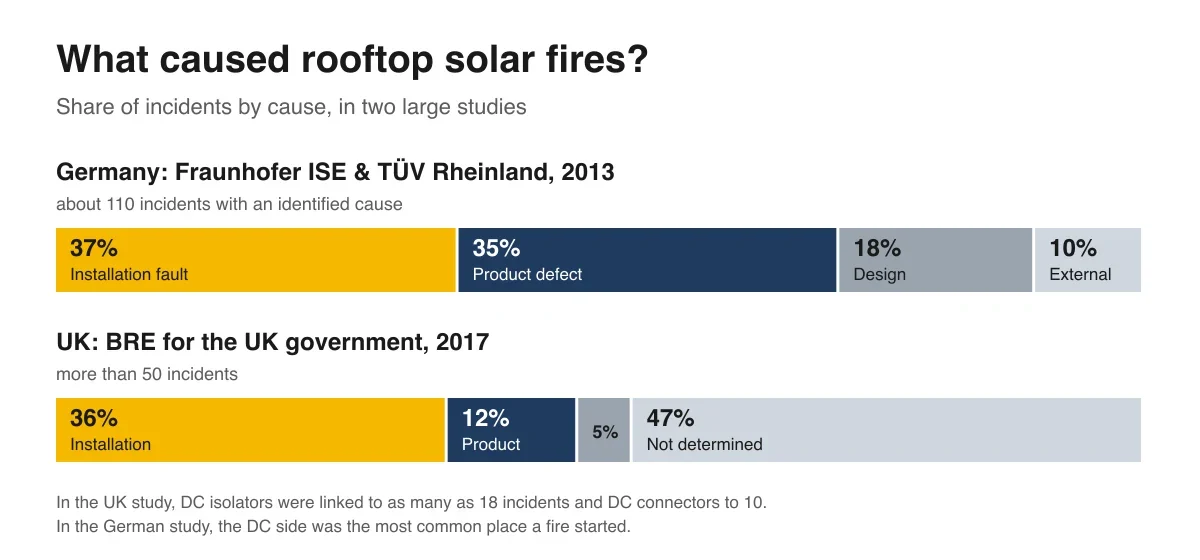
Cause | Germany (2013) | UK (2017) |
|---|---|---|
Installation fault | 37% | 36% |
Product defect | 35% | 12% |
Design | 18% | 5% |
External / not determined | 10% external | 47% not determined |
Germany's figures cover the roughly 110 incidents where a likely cause was found. The UK figures cover more than 50 incidents.
Where fires start: the German study found the DC side was the most common origin. That's the wiring between the panels and the inverter: string cables, connectors, DC switches and junction boxes. Inverters were the single most common component. In the UK study, DC isolators were linked to as many as 18 incidents and DC connectors to 10.
Why connectors matter: a connector that isn't fully clicked in, is badly crimped, or mixes two brands makes a poor contact. A poor contact heats up and can arc. The German researchers also flagged screw terminals that weren't tightened to the maker's torque, and pointed to installer training and the right tools.
In short: most of the risk is in how the system is put together, not in the panels themselves.
What Philippine regulators are saying
Fire safety came up in 2026 as rooftop solar took off:
- Meralco, May 2026: spokesman Joe Zaldarriaga warned that "one wrong installation may result in accidental fire," citing reports of fires from installations that didn't follow safety standards. He called unpermitted, uninspected systems "guerrilla installations" (GMA News).
- IIEE (the electrical engineers' professional body), with the PRC Board of Electrical Engineering, June 2026: warned that DIY and unregistered systems violate the Philippine Electrical Code and risk "electrical fires, electrocution, equipment failure, unsafe back-feeding conditions" (The Phil Biz News).
- DTI is drafting a rule requiring PV modules, inverters, batteries and cables to meet Philippine National Standards and be certified before they're sold (same source).
Not everyone agrees on new rules. A consumer coalition argued that existing building and electrical codes and Bureau of Fire Protection inspections already cover safety (GMA News). Either way, the message for homeowners is the same: a permitted, inspected installation by qualified people is the safe path.
If you plan to apply for net metering, you'll need a Certificate of Final Electrical Inspection (CFEI) from your LGU anyway. Our BILECO net metering guide covers the paperwork.
Where the risk sits in your system
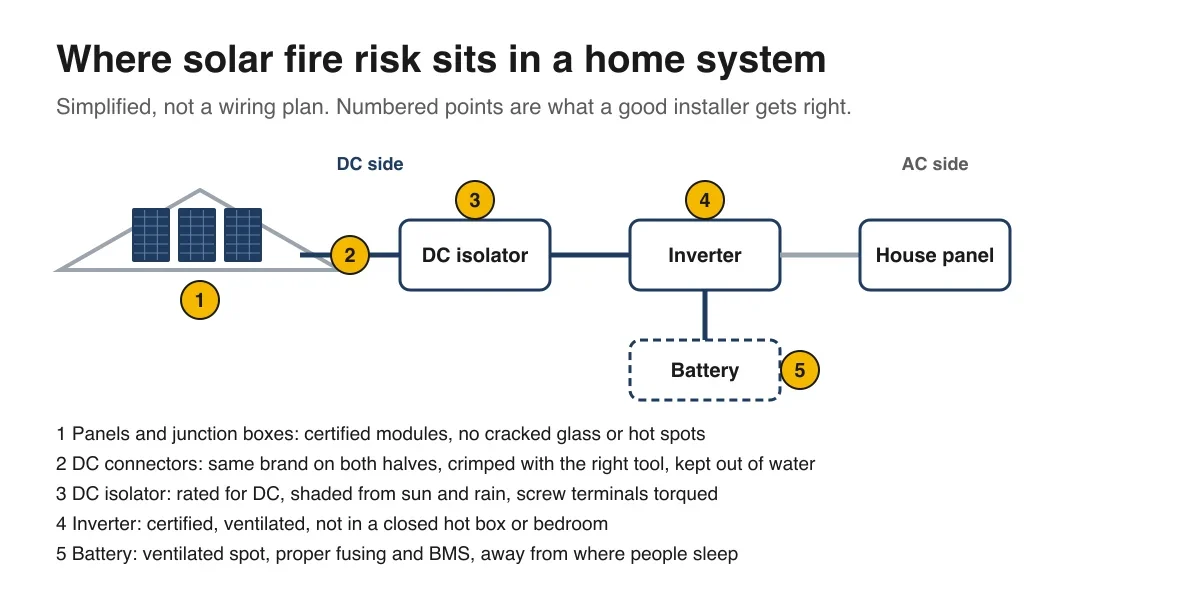
- Panels and junction boxes. Certified modules from a traceable supplier. Cracked glass or a scorched junction box needs checking.
- DC connectors. Same brand on both halves, crimped with the correct tool, fully clicked in, and kept off wet roofs and out of standing water.
- DC isolator. Rated for DC at the system's voltage, protected from direct sun and rain, with terminals tightened properly.
- Inverter. Certified, mounted with the clearance the manual asks for, ventilated, and not shut inside a hot cabinet.
- Battery. See below.
Some newer equipment adds rapid shutdown, which cuts roof wiring to a low voltage so firefighters can work safely. Equipment makers market it to meet the Philippine Electrical Code's PV rules (Tigo). Ask your installer whether your system has it.
What about solar batteries?
Most home solar batteries sold in the Philippines today are LiFePO4 (lithium iron phosphate) (our battery price guide). They're often described as the safer lithium chemistry.
The picture is more nuanced. A 2024 review by researchers at the University of Sheffield, Imperial College London and the University of St Andrews found that LiFePO4 cells show fewer flames in failure tests than NMC cells, but the gas they vent can still be flammable, and in some conditions more toxic (pv magazine, April 2024).
Practical takeaways:
- Put the battery in a ventilated spot, not a bedroom or a closed cabinet.
- Use a battery with a proper battery management system (BMS), and make sure the installer fits the fuses or breakers the battery's manual specifies.
- Keep it off the floor in flood-prone houses, and away from heat sources.
- Don't mix old and new batteries or different brands unless the maker says it's allowed.
How to choose a safe installer
- ☐ They pull an electrical permit and arrange the LGU inspection (CFEI).
- ☐ A licensed electrical engineer reviews or signs the plans. Ask who.
- ☐ They name the brands and certifications of the panels, inverter, connectors and battery in the quote.
- ☐ They use matching connectors and the right crimping tool. It's fair to ask.
- ☐ The system has clearly labelled shutdown switches, and they show you how to use them.
- ☐ They give you a single-line diagram and warranty papers at handover.
- ☐ They offer an inspection after typhoons or at least once a year.
Our guide to reading a solar quote covers how to compare offers.
Warning signs, and what to do
Warning signs:
- A burning or hot-plastic smell near the inverter, isolator or battery
- Scorch marks, melted plastic or discoloured cables
- Buzzing, crackling or popping from a switch or connector
- Repeated inverter error codes, especially arc-fault or isolation alarms
- A sudden drop in output with no cloudy weather to explain it
What to do:
- Keep people away. Don't touch the equipment or the cables.
- Only use the labelled shutdown switches if your installer showed you how, and only if you can reach them safely.
- Never climb onto the roof. Solar panels stay live whenever light hits them, even when switched off at the inverter.
- Call your installer.
- If there's smoke or fire, call 911 and tell responders the house has solar panels and, if you have one, a battery.
After a strong typhoon, have the system checked before assuming it's fine. Our typhoon guide covers what to look for from the ground.
FAQ
Can solar panels cause a fire? Yes, but rarely: about 3 in 100,000 buildings a year in the German study.
What causes most solar fires? Installation faults, then product defects. Fires most often start in DC connectors, DC isolators, junction boxes and inverters.
Are solar panels a fire risk during typhoons? Storm damage can crack panels or loosen wiring, which can create faults. Have the system inspected after a strong typhoon, from the ground and by your installer.
Are LiFePO4 batteries safe? They're widely used and show fewer flames in tests than some other lithium types, but their gas can still be flammable. Install them ventilated, fused and away from bedrooms.
Does solar affect my fire insurance? Ask your insurer before installing. Policies differ, and some ask for proof of a permitted installation.
Solar Leyte is an independent guide, sponsored by MACC Systems & Energy Solutions Inc., a solar installer in Naval, Biliran.
Want a safety check or a properly permitted install?
Naa nay solar pero wala ka sigurado? MACC can inspect an existing system or quote a permitted installation, with no obligation.
- Call/Text: 0955 723 5093
- Email: official@macc-inc.com
- Request a quote online: solarleyte.com/quote
Sources (checked 5 October 2026)
- Laukamp et al., Fraunhofer ISE and TÜV Rheinland, PV Fire Hazard: Analysis and Assessment of Fire Incidents (28th EU PVSEC, 2013)
- Solar Power Portal, Solar PV fires predominantly caused by installer error, government report concludes (BRE for BEIS, 20 Jul 2017)
- GMA News, Meralco advocates stricter implementation of rules against 'guerilla' solar installations (8 May 2026)
- The Phil Biz News, Stricter safety standards for rooftop solar systems in PH sought (9 Jun 2026)
- pv magazine, How safe are lithium iron phosphate batteries? (10 Apr 2024)
- Tigo Energy, Philippines: Meet rapid shutdown requirements