A yellow alert means the Visayas grid is running with thin reserves. It does not by itself mean a brownout. A red alert means supply can't cover demand plus the grid's required reserves, and that is when NGCP can order rotating brownouts (manual load dropping) through the electric cooperatives. In 2026, NGCP's rotating-brownout advisories for Leyte, Biliran and Samar co-ops mostly fell between about 4 pm and 10 pm, when demand peaks.
Yellow alert na pud? Here is why Leyte and Biliran families keep hearing about it:
- From 1 January to 25 August 2026, the Visayas grid logged 86 yellow alerts and 21 red alerts, according to an NGCP advisory reported by PowerPhilippines.
- The grid was on yellow alert again on 21, 25, 26, 27 and 28 September. On 27 September, NGCP also cited a deration in Leyte after several units tripped (GMA News).
- The Department of Energy (DOE) has warned of possible yellow and red alerts in the second and third weeks of October 2026, when several plants go down for planned maintenance (The Manila Times, 22 Sep 2026).
This article is not a live outage schedule. Alerts are declared day by day and can be cancelled. For today's status, check the official pages listed under "Where to check alerts" below.
All facts checked 5 October 2026 (Philippine time). Figures from news reports quote NGCP or DOE advisories.
Normal, yellow and red: what each alert level means
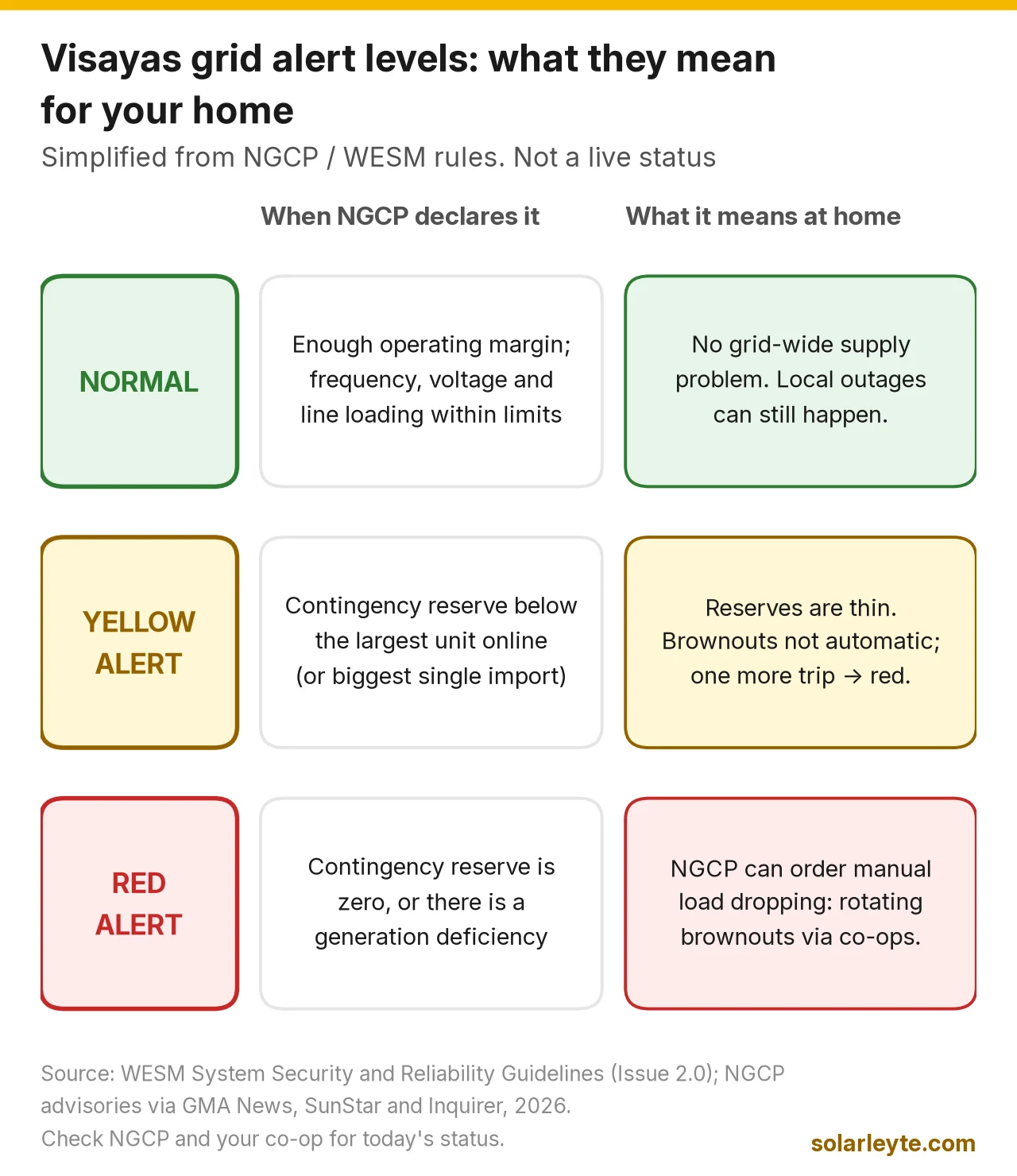
NGCP is the system operator for the Philippine grid. The rules for its alerts are written in the WESM System Security and Reliability Guidelines (WESM Manual, Issue 2.0, effective Dec 2022). Two terms matter:
- Operating margin: available generating capacity minus demand (plus losses).
- Contingency reserve: spare capacity kept ready in case a power plant or an interconnection suddenly drops out.
Grid status | When NGCP declares it (WESM guidelines) | What it usually means at home |
|---|---|---|
Normal | Operating margin is sufficient, and frequency, voltage and line loading are within limits | No grid-wide supply problem. Local brownouts from maintenance, faults or storms can still happen. |
Yellow alert | Contingency reserve is less than the largest generating unit online, or the biggest single power import, whichever is higher | Reserves are thin. Brownouts are not automatic, but one more plant trip can push the grid into red. |
Red alert | Contingency reserve is zero, there is a generation deficiency, or transmission lines are critically loaded | Supply is short. NGCP can order manual load dropping, which co-ops carry out as rotating brownouts by area. |
News reports use NGCP's shorter wording: "A yellow alert is issued when the operating margin is insufficient to meet the transmission grid's contingency requirement," and a red alert "when power supply is insufficient to meet consumer demand and the transmission grid's regulating requirement" (GMA News, 12 Sep 2026). Yellow alerts "do not necessarily lead to power outages" (Inquirer).
Why a yellow alert can happen with power to spare. On 27 September, NGCP reported 2,519 MW available against a projected peak of 2,342 MW (DZRH). That's about 177 MW more than demand (our calculation). But the grid must also hold back regulating reserve and enough spare capacity to cover the loss of its biggest unit or import. Under the guidelines, a yellow alert is issued when the margin left after regulating reserve is smaller than that. For scale, the coal units named most often in the 2026 advisories, PEDC Unit 3 and TVI Unit 1, are 150 MW and 169 MW (Daily Guardian). Losing one would wipe out most of a 177 MW cushion.
What manual load dropping means. LEYECO II describes it as "the intentional and manual interruption of electricity supply to selected areas by a distribution utility or electric cooperative to protect the stability of the power grid when there is insufficient power supply available" (Inquirer, 15 May 2026). NGCP has said its load-dropping schedules may be cancelled if demand comes in lower than forecast (SunStar).
How often the Visayas grid has been on alert in 2026
The two published tallies use different start dates, so don't add them together:
- NGCP (via PowerPhilippines): 86 yellow and 21 red alerts from the start of 2026 to 25 August (PowerPhilippines).
- Power for People Coalition: 107 yellow and 43 red alerts since May, as of late September (Cebu Spotlight, 30 Sep 2026). This is an advocacy group's count, not an official NGCP figure.
Here are the alert days we could confirm with NGCP's own capacity and demand figures. The margin column is our calculation (available capacity minus forecast peak). A negative number means a shortfall.
Date (2026) | Alert | Available capacity | Forecast peak demand | Margin (our calculation) | Reported by |
|---|---|---|---|---|---|
26 Aug | Red 3–9 pm, yellow before and after | 2,237 MW | 2,530 MW | −293 MW | GMA News, PowerPhilippines |
4 Sep | Red 1–10 pm, yellow before and after | 2,076 MW | 2,506 MW | −430 MW | The Freeman |
12 Sep | Red 5–9 pm, yellow 4–5 pm and 9–10 pm | 2,109 MW | 2,346 MW | −237 MW | GMA News |
21 Sep | Yellow 4–8 pm | 2,500 MW | 2,426 MW | +74 MW | Daily Guardian |
25 Sep | Yellow 4–8 pm | 2,565 MW | 2,456 MW | +109 MW | PNA |
26 Sep | Yellow 5–7 pm | 2,540 MW | 2,312 MW | +228 MW | GMA News |
27 Sep | Yellow 5–9 pm | 2,519 MW | 2,342 MW | +177 MW | DZRH, GMA News |
28 Sep | Yellow 5–7 pm | 2,572 MW | 2,374 MW | +198 MW | GMA News |
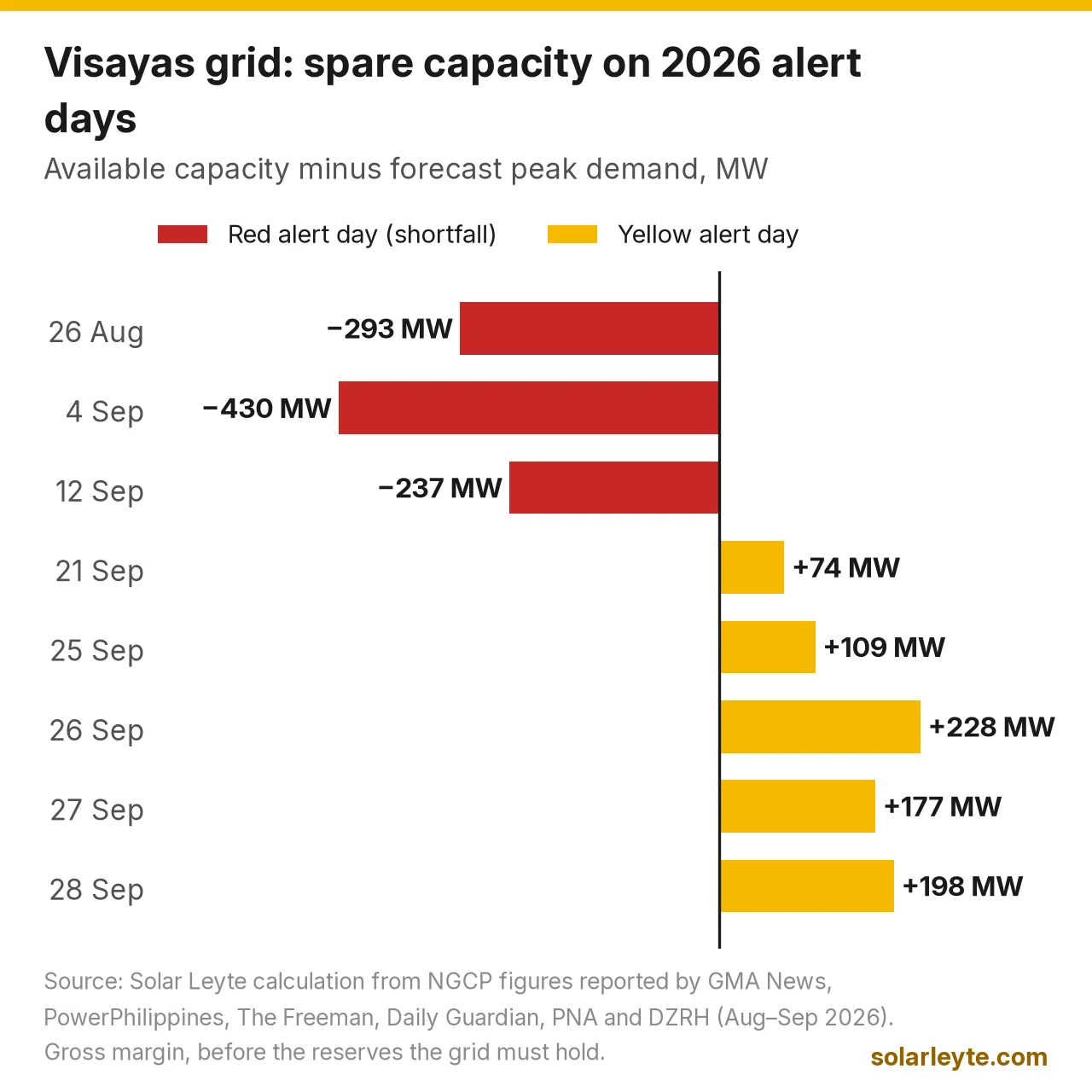
Two patterns stand out. Every red alert day in the table had less capacity than forecast demand. And nearly every alert window falls in the late afternoon and evening, when solar output fades and households switch on lights, fans and aircon. Energy Secretary Sharon Garin made the same point at the 3 October House hearing: excess daytime power in Negros comes mostly from solar, but demand peaks at night (Philstar, 5 Oct 2026).
What took the capacity out? In the September advisories, NGCP named the large coal units TVI Unit 1 (Toledo City, Cebu), PEDC Unit 3 (Iloilo City) and KSPC Unit 2. It also cited limited imports from Mindanao and, on most days, more than 850 MW of capacity unavailable from forced outages and derated plants (Daily Guardian; GMA News, 28 Sep). The DOE said only about 50 MW could be imported from Mindanao at the time (Cebu Spotlight).
Why Leyte and Biliran get rotating brownouts
Leyte has large geothermal plants, so people often ask why we share the Visayas' problems. Four reasons, all from the 2026 advisories:
- It's one grid. NGCP's Visayas grid connects Cebu, Negros, Panay, Leyte, Samar and Bohol, and carries about 14% of the country's power demand (DZRH). When the grid is short, load dropping is shared across co-ops. NGCP's advisories listed BILECO, LEYECO II, III, IV and V, SOLECO, DORELCO, ESAMELCO, NORSAMELCO and SAMELCO I and II. Their window was 5–9 pm on 26 August (GMA News) and 5–10 pm on 4 September (SunStar). Most Cebu, Negros, Panay and Bohol co-ops got longer windows on those days, starting at 1 pm.
- Local plants trip too. The 4 September red alert was partly blamed on the tripping of "Leyte-A Maha B" and other units (The Freeman). On 27 September, NGCP cited a deration in Leyte after several units tripped (GMA News).
- Transmission limits. The DOE said it is assessing transmission constraints across the Visayas, "including the Leyte-Samar corridor" (DOE, 7 Sep 2026).
- Leyte–Samar has enough generation on paper, but it's still connected. In its Visayas master plan, the DOE said Leyte–Samar needs the least new capacity of the three planned subregions, because local geothermal is "already more than sufficient". It also said the islands "will remain interconnected, so they will still be interdependent" (Daily Guardian, 22 Sep 2026).
Not every brownout is a grid alert
When the lights go out, it helps to know which kind of outage it is, because each one is announced differently and lasts differently.
Type of outage | Who announces it | Example from 2026 |
|---|---|---|
Rotating brownout (manual load dropping) during a red alert | NGCP advisory, relayed by your co-op | 26 Aug: possible MLD 5–9 pm for BILECO and LEYECO II–V areas |
NGCP scheduled maintenance on transmission lines | NGCP letter to the co-op, posted days ahead | 8 Aug: 13 hours (5 am–6 pm) for BILECO's entire franchise area, for work on the Ormoc–San Isidro 69 kV line |
Co-op maintenance or line faults | Your co-op (BILECO, LEYECO) | LEYECO V posts interruption notices on its advisories page |
Typhoon damage | Your co-op, after the storm | Restoration depends on the damage to lines |
Sources for the table: GMA News, 26 Aug 2026; Biliran Blogs, BILECO advisory; LEYECO V advisories. For storms, see our typhoon preparedness guide.
BILECO reminds consumers that it handles distribution while NGCP runs transmission. An NGCP-initiated interruption is not a BILECO decision, and power can come back earlier than announced, so treat all lines as live (Biliran Blogs, BILECO advisory).
What the DOE expects for October 2026 and beyond
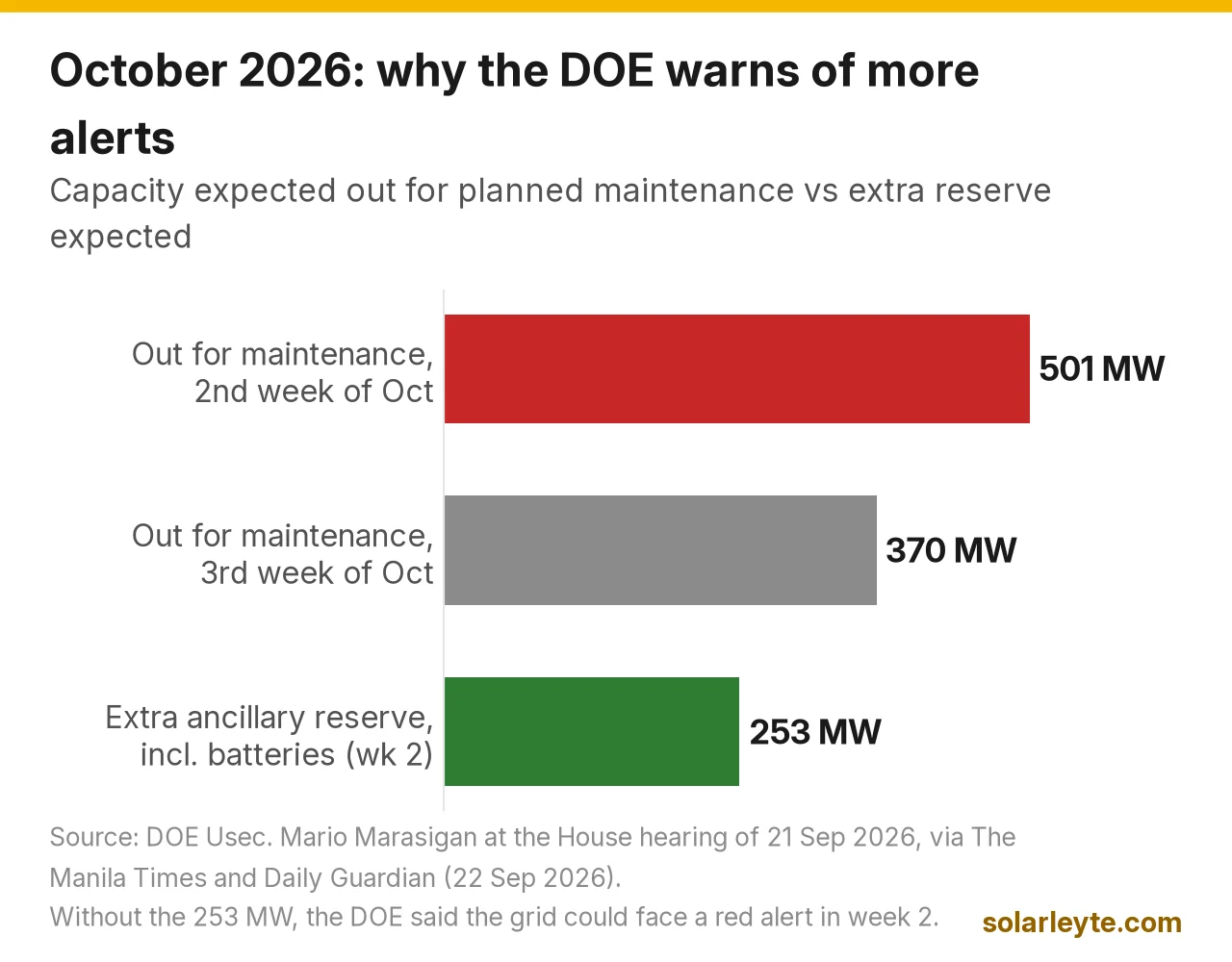
At the House Committee on Energy hearing on 21 September, DOE Undersecretary Mario Marasigan said the Visayas "could have potential red and yellow alerts" in the second and third weeks of October (The Manila Times; Daily Guardian):
- About 501 MW unavailable in the second week of October, with 18 plants scheduled for preventive maintenance.
- About 370 MW unavailable in the third week.
- The two coal units on the schedule are KSPC Unit 1 in Cebu (103 MW, 19 days of maintenance) and PCPC Unit 1 in Concepcion, Iloilo (135 MW, 30 days). Diesel, biomass and solar plants are also scheduled.
- 253 MW of extra ancillary capacity, including battery storage projects in Cebu, Leyte, Negros, Bohol and Panay, was expected in the second week. If it arrives, the DOE said the impact could be limited to a yellow alert. Without it, the grid could go red.
- PEDC Unit 3 (150 MW) was projected to return on 27 October.
Longer term, don't expect alerts to stop soon:
- Secretary Garin told the 3 October hearing that the supply gap could persist until 2028 (Philstar).
- In the DOE's best case, even with interventions completed by 2027, the grid would still see at least 1 red alert and 19 yellow alerts (GMA News, 4 Oct 2026).
- Short-term fixes are battery storage and 200–250 MW of power barges and diesel plants, which Garin said could be deployed by late 2026 or early 2027 (Cebu Spotlight; Daily Guardian, 5 Oct 2026).
- Lawmakers at the hearing also discussed retroactively decoupling the Luzon and Visayas grids. That would trigger the WESM secondary price cap during alert periods and "could lower bills for consumers who paid steep prices while enduring rotational brownouts" (Daily Guardian, 5 Oct 2026). It is a proposal, not a decision. To see what you're paying now, use our BILECO rate tracker.
Where to check alerts and brownout advisories
- NGCP: the Power Situation Outlook on ngcp.ph shows available capacity, peak demand and operating margin for Luzon, Visayas and Mindanao. Alert advisories are posted on NGCP's official Facebook page (NGCPph) through the day.
- BILECO (Biliran): the BILECO website links to its official Facebook page, "bilecoofficial". When we checked on 5 October 2026, the maintenance-schedule page on the website hadn't been updated since 2022, so check Facebook for current notices.
- LEYECO II (Tacloban, Palo, Tanauan): leyeco-2.com and its Facebook page.
- LEYECO V (Ormoc City and nearby towns): the advisories page.
- LEYECO IV: leyecoiv.com.
- News: GMA News, PNA and Philstar often report NGCP's alert advisories the same day, usually by late morning.
Treat any schedule you see shared in group chats as a guide only. NGCP updates its alerts during the day, and load dropping "will depend on real-time grid conditions" (SunStar).
How to prepare your home for alert season
On a yellow or red alert day:
- Charge before about 4 pm. Phones, power banks, rechargeable fans and lamps. The 2026 load-dropping windows for Leyte, Biliran and Samar co-ops that we found started at 4 pm or 5 pm.
- Use less during the peak. Co-ops in Eastern Visayas have asked consumers to switch off unused lights and appliances, avoid unnecessary high-power devices and unplug idle equipment, especially at peak hours (Inquirer).
- Keep the fridge closed during a brownout so it stays cold longer.
- Treat all lines as live, even during a brownout. Power can come back earlier than announced.
For the longer term, if brownouts are now part of your week:
- Know what your solar does in a brownout. A standard grid-tie system switches off when the grid goes down, even on a sunny afternoon. Only a hybrid system with a battery keeps your essentials running (grid-tie vs hybrid explained).
- Size a battery for the evening window, not the whole house. Most alert-day brownouts in this article fell in the evening, so a battery only needs to cover the hours you actually lose. Our solar battery price guide has current Philippine battery prices and worked examples for a 4-hour evening brownout and a 13-hour outage.
- Portable power stations can cover lights, fans and phone charging without any rooftop work. See when they make sense.
- Typhoon season adds a second risk. Batteries and inverters should be placed above flood level and protected from rain. Our typhoon preparedness guide covers what to do before and after a storm.
FAQ
Does a yellow alert mean there will be a brownout? Not by itself. A yellow alert means reserves are below what the grid needs to cover a sudden plant trip. Rotating brownouts come with red alerts, when supply is short. A yellow alert can turn red if another unit trips.
What time are red-alert brownouts in Leyte and Biliran? It varies by day. NGCP's 2026 advisories gave Leyte, Biliran and Samar co-ops windows such as 5–9 pm (26 Aug) and 5–10 pm (4 Sep). Your co-op rotates feeders within that window, so your area may not be off for the whole period.
Why does Leyte have brownouts if it has geothermal plants? Because Leyte and Biliran are on the same interconnected Visayas grid. When the grid as a whole is short, NGCP spreads load dropping across co-ops, including BILECO and the LEYECOs. Local units have also tripped during 2026 alerts.
Will the alerts stop after October 2026? The DOE expects improvement as plants return and batteries and power barges come in. But it says the supply gap could last until 2028. Even its best case for 2027 still has at least 1 red and 19 yellow alerts.
Where can I see if today is a red alert day? NGCP's website and official Facebook page, then your co-op's page for the areas and times affected. See the list above.
Solar Leyte is run by MACC Systems & Energy Solutions Inc., a solar installer in Naval, Biliran.
Get a free brownout backup quote from MACC
Tell us which appliances must keep running during evening brownouts and how many hours you usually lose. We'll size a hybrid system or battery for that list and show you the math, with no obligation.
- Call/Text: 0955 723 5093
- Email: official@macc-inc.com or benjie@macc-inc.com
- Website: www.macc-inc.com
- Office: Brgy. Talustusan, Naval, Biliran 6543
Sources (all checked 5 October 2026)
- WESM / NGCP, System Security and Reliability Guidelines, Issue 2.0 (PDF): alert definitions, operating margin, normal state
- DOE, DOE Intensifies Visayas Power Response (7 Sep 2026)
- The Manila Times, DOE eyes self-sufficient power subregions in Visayas (22 Sep 2026)
- Daily Guardian, Visayas power supply tightens again, and October looks worse (22 Sep 2026) and DOE pushes solar batteries, power barges to curb Visayas outages (5 Oct 2026)
- Philstar, DOE: Planning failure caused Visayas power shortfall (5 Oct 2026)
- GMA News, DOE admits planning failure over recurring Visayas grid outages (4 Oct 2026)
- GMA News, NGCP alert reports: 26 Aug, 12 Sep, 26 Sep, 27 Sep, 28 Sep
- PowerPhilippines, NGCP warns of possible manual load dropping across Visayas (26 Aug 2026)
- The Freeman (Philstar), Visayas power woes worsen (5 Sep 2026)
- SunStar, NGCP warns of rotational power outages across Visayas (4 Sep 2026)
- Philippine News Agency, Visayas grid on yellow alert anew (25 Sep 2026)
- DZRH, Visayas Grid placed under yellow alert Sunday evening (27 Sep 2026)
- Inquirer, Eastern Visayas co-ops warn of rotating outages amid grid alerts (15 May 2026) and Red alert raised in Luzon grid (yellow-alert explainer)
- Cebu Spotlight, Over Four Months in the Dark (30 Sep 2026)
- Biliran Blogs, 13-hour power outage to affect entire BILECO coverage area (BILECO/NGCP advisory)
- Co-op pages: BILECO, LEYECO II, LEYECO IV, LEYECO V advisories; NGCP ngcp.ph