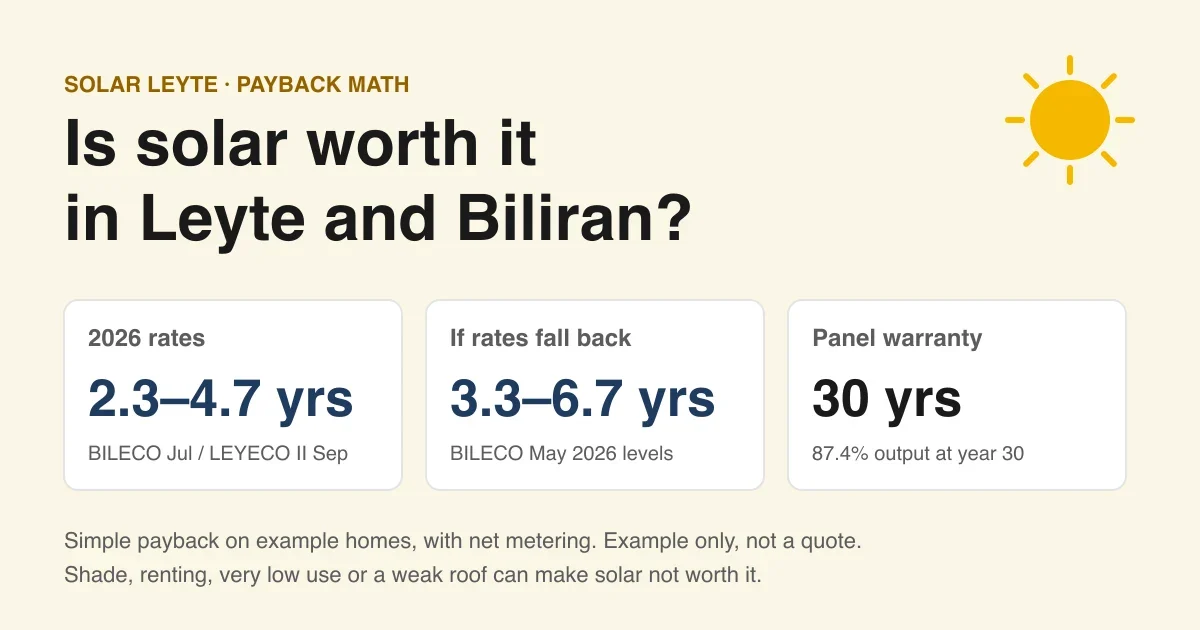
Short answer: for most homeowners in Leyte and Biliran with a sunny roof, yes. At 2026 rates, our example homes pay back a solar system in about 2.3 to 4.7 years. If rates fall back to BILECO's May 2026 level, that stretches to about 3.3 to 6.7 years. Panels are warranted for 30 years.
Sulit ba gyud? It depends on three things:
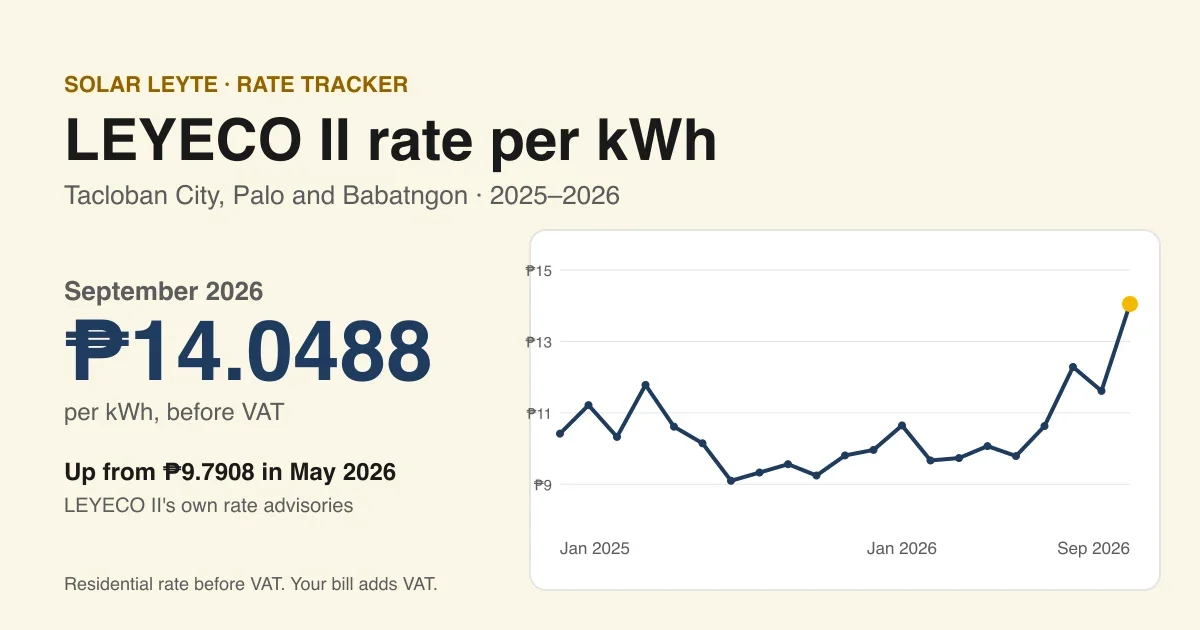
- Your rate. BILECO's July 2026 rate is ₱18.3407/kWh. LEYECO II was about ₱14.05 in September 2026. A higher rate means faster payback.
- When you use power. Solar you use yourself saves the full rate. Solar you export earns a smaller net-metering credit.
- The price you pay. We only use 2026 prices from published sources below. Get real quotes for your own roof.
Below: the method, three example households, grid-tie vs hybrid, what happens if rates drop, and when solar is not worth it.
Figures checked 5 October 2026. Every example here is an example only, not a quote.
The simple payback formula
Simple payback = installed price ÷ yearly savings.
Yearly savings come from two parts:
- Solar you use at home × your retail rate. This saves the full rate.
- Solar you export × the export credit. Under net metering, exports are credited at the utility's blended generation charge, not the full rate (Meralco FAQ; how net metering works).
Simple payback ignores panel ageing, repairs and loan interest. We cover those further down.
Our assumptions
Sun: Global Solar Atlas estimates about 1,411 kWh per kWp per year for Naval (Global Solar Atlas). We derate that to 3.5 kWh per kWp per day for shade, dust, heat and cloudy months. So each kWp makes about 105 kWh a month (3.5 × 30). Same method as our panel sizing guide.
Rates:
Co-op | Retail rate | Export credit (blended generation) |
|---|---|---|
BILECO | ₱18.3407/kWh (July 2026, BILECO) | ₱9.50/kWh (Sep 2026, PRESYO-PH) |
LEYECO II | ₱14.05/kWh (Sep 2026, PRESYO-PH) | ₱9.82/kWh (Sep 2026, PRESYO-PH) |
Note on VAT: BILECO's posted rate includes VAT. LEYECO II posts its rate before VAT (₱14.0488 for September 2026, LEYECO II), and VAT is added on the bill. Solar also saves you that VAT, so the LEYECO II paybacks below are slightly conservative.
PRESYO-PH is ICSC's tracker of DOE data. LEYECO II's rate moves a lot: PRESYO-PH shows about ₱12.29 in July, ₱11.61 in August and ₱14.05 in September 2026. See our BILECO rate tracker and LEYECO II rate tracker.
Installed prices (2026, published):
- Grid-tie: SurgePV gives "PHP 45,000–65,000 per kWp" for quality systems, and "PHP 225,000–325,000 fully installed" for 5 kWp (SurgePV, April 2026). Reslink puts a 5 kW on-grid system in Metro Manila at "approximately ₱220,000 to ₱260,000" (Reslink, May 2026).
- Hybrid with battery: unbox.ph says to "expect to invest between Php 300,000 and Php 350,000 for a 5kW hybrid system, inclusive of labor and high-quality materials" (unbox.ph, March 2026). The article doesn't state the battery size.
These are national and Metro Manila figures, not Leyte or Biliran quotes. Local prices can differ. Small systems often cost more per kWp than big ones. Our solar price guide explains how to compare quotes.
Self-use share (how much of your solar you use as it's made) is an assumption for each household below. It's the number that changes payback most, so be honest about yours.
Three example households
All three are examples only, not quotes.
Household A: 200 kWh a month, daytime-heavy
Someone is home all day, or there's a small store. 2 kWp grid-tie, priced ₱90,000 to ₱130,000 (2 × ₱45,000 to ₱65,000).
- Solar made: 2 × 105 = 210 kWh a month
- Assumed self-use: 70% = 147 kWh. Exported: 63 kWh.
- BILECO: 147 × ₱18.3407 = ₱2,696.08, plus 63 × ₱9.50 = ₱598.50. Total ₱3,294.58 a month, or ₱39,535 a year. Payback: ₱90,000 ÷ ₱39,535 = 2.3 years to ₱130,000 ÷ ₱39,535 = 3.3 years.
- LEYECO II: 147 × ₱14.05 = ₱2,065.35, plus 63 × ₱9.82 = ₱618.66. Total ₱2,684.01 a month, or ₱32,208 a year. Payback: 2.8 to 4.0 years.
Household B: 300 kWh a month, evening-heavy
Everyone is at work or school by day. The aircon runs at night. 3 kWp grid-tie, priced ₱135,000 to ₱195,000 (3 × ₱45,000 to ₱65,000).
- Solar made: 3 × 105 = 315 kWh a month
- Assumed self-use: 30% = 94.5 kWh. Exported: 220.5 kWh.
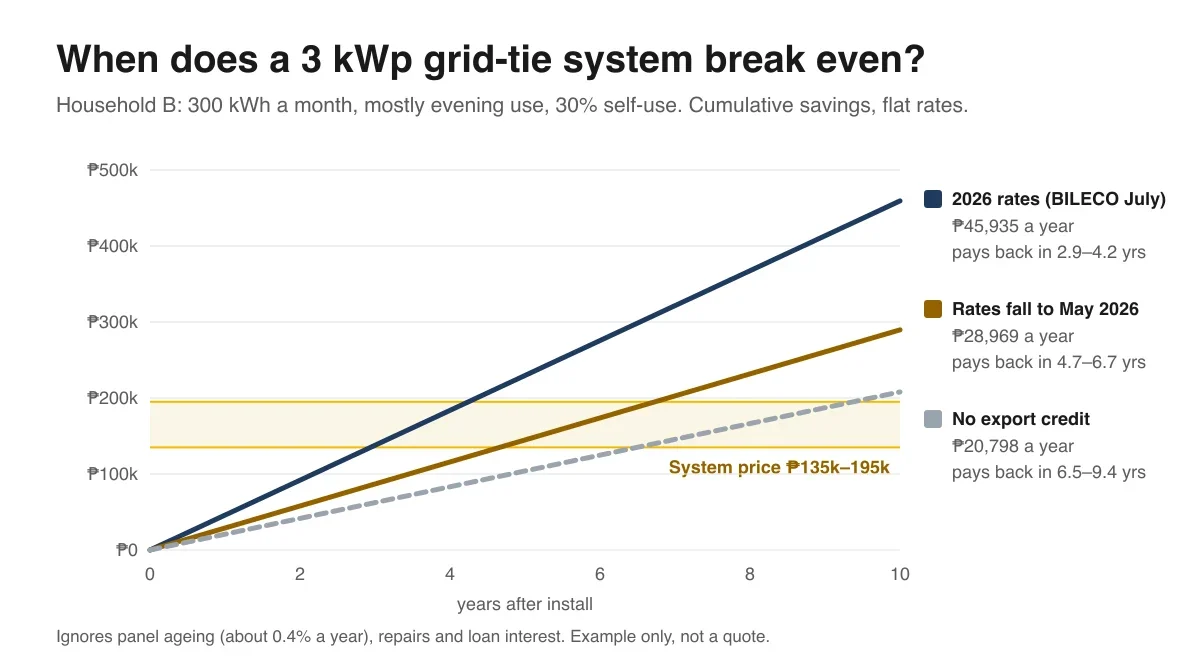
- BILECO: 94.5 × ₱18.3407 = ₱1,733.20, plus 220.5 × ₱9.50 = ₱2,094.75. Total ₱3,827.95 a month, or ₱45,935 a year. Payback: 2.9 to 4.2 years.
- LEYECO II: 94.5 × ₱14.05 = ₱1,327.73, plus 220.5 × ₱9.82 = ₱2,165.31. Total ₱3,493.04 a month, or ₱41,916 a year. Payback: 3.2 to 4.7 years.
Household B leans hard on net metering. More than half its savings (₱2,094.75 of ₱3,827.95) come from export credit. That makes it the most exposed if credits shrink (see below).
Household C: 500 kWh a month, grid-tie vs hybrid
A bigger home with two or more aircons, some daytime use, and brownout worries. Both options are 5 kW.
5 kWp grid-tie, ₱225,000 to ₱325,000 (SurgePV). Solar made: 5 × 105 = 525 kWh a month. Assumed self-use 50%: 262.5 kWh used, 262.5 kWh exported.
- BILECO: 262.5 × ₱18.3407 = ₱4,814.43, plus 262.5 × ₱9.50 = ₱2,493.75. Total ₱7,308.18 a month, or ₱87,698 a year. Payback: 2.6 to 3.7 years.
- LEYECO II: 262.5 × ₱14.05 = ₱3,688.13, plus 262.5 × ₱9.82 = ₱2,577.75. Total ₱6,265.88 a month, or ₱75,191 a year. Payback: 3.0 to 4.3 years.
5 kW hybrid with battery, ₱300,000 to ₱350,000 (unbox.ph). The battery stores daytime solar for the evening, so we assume self-use rises to 85%: 446.25 kWh used, 78.75 kWh exported. That assumes the battery is big enough to shift about 184 kWh a month (446.25 − 262.5), or about 6 kWh a night. Check this against the battery in your quote.
- BILECO: 446.25 × ₱18.3407 = ₱8,184.54, plus 78.75 × ₱9.50 = ₱748.13. Total ₱8,932.66 a month, or ₱107,192 a year. Payback: 2.8 to 3.3 years.
- LEYECO II: 446.25 × ₱14.05 = ₱6,269.81, plus 78.75 × ₱9.82 = ₱773.33. Total ₱7,043.14 a month, or ₱84,518 a year. Payback: 3.5 to 4.1 years.
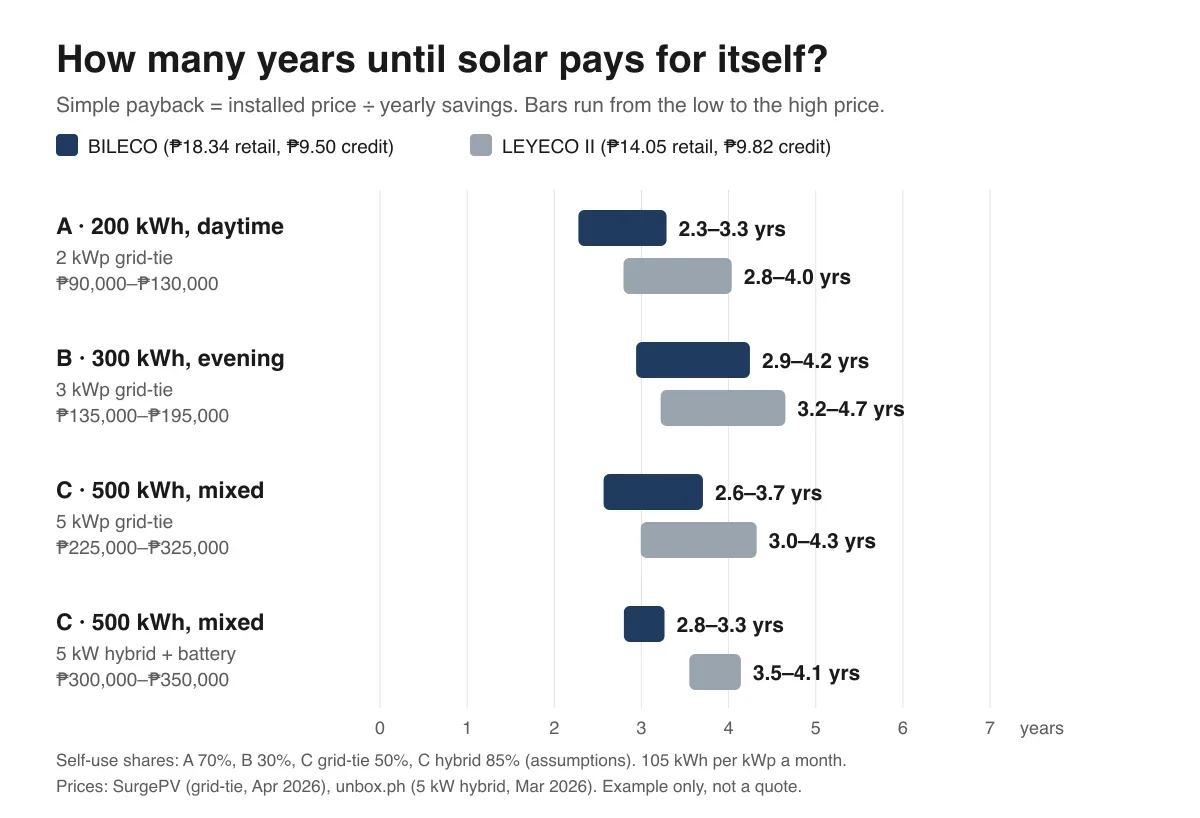
What the examples show
Household | System | Price (cited) | BILECO payback | LEYECO II payback |
|---|---|---|---|---|
A · 200 kWh, daytime | 2 kWp grid-tie | ₱90,000–₱130,000 | 2.3–3.3 yrs | 2.8–4.0 yrs |
B · 300 kWh, evening | 3 kWp grid-tie | ₱135,000–₱195,000 | 2.9–4.2 yrs | 3.2–4.7 yrs |
C · 500 kWh, mixed | 5 kWp grid-tie | ₱225,000–₱325,000 | 2.6–3.7 yrs | 3.0–4.3 yrs |
C · 500 kWh, mixed | 5 kW hybrid | ₱300,000–₱350,000 | 2.8–3.3 yrs | 3.5–4.1 yrs |
- Daytime users win. Household A gets the fastest payback because most of its solar saves the full rate.
- LEYECO II pays back slower because its retail rate is lower. Its export credit is closer to retail, though, so evening-heavy homes lose less.
- A hybrid can keep pace, but only on generous assumptions. Our example assumes the battery shifts about 6 kWh every night, and the cited hybrid price doesn't say how big its battery is. With a smaller battery, self-use drops and payback stretches. Our aircon guide works through the battery-only math. The surer reason to buy a hybrid is brownout backup (grid-tie vs hybrid).
What if rates fall?
Rates have been high in mid-2026. They can come down. BILECO's rate was ₱12.9458 in May 2026 (BILECO), and its blended generation rate that month was about ₱5.40 (PRESYO-PH). When rates fall, both your savings and your export credit fall.
Same households, re-run at BILECO's May 2026 rates:
Household | Savings a month | Savings a year | Payback |
|---|---|---|---|
A (147 kWh used, 63 exported) | ₱2,243.23 | ₱26,919 | 3.3–4.8 yrs |
B (94.5 used, 220.5 exported) | ₱2,414.08 | ₱28,969 | 4.7–6.7 yrs |
C grid-tie (262.5 / 262.5) | ₱4,815.77 | ₱57,789 | 3.9–5.6 yrs |
C hybrid (446.25 / 78.75) | ₱6,202.31 | ₱74,428 | 4.0–4.7 yrs |
Example for A: 147 × ₱12.9458 = ₱1,903.03, plus 63 × ₱5.40 = ₱340.20, total ₱2,243.23 a month.
Household B takes the biggest hit, because most of its value is export credit and May's credit was low.
What if you get no export credit?
If net metering isn't approved yet, or you install a zero-export system, exported solar earns nothing. At BILECO's July rate:
- Household B: 94.5 × ₱18.3407 = ₱1,733.20 a month, or ₱20,798 a year. Payback: 6.5 to 9.4 years.
- Household A: 147 × ₱18.3407 = ₱2,696.08 a month, or ₱32,353 a year. Payback: 2.8 to 4.0 years.
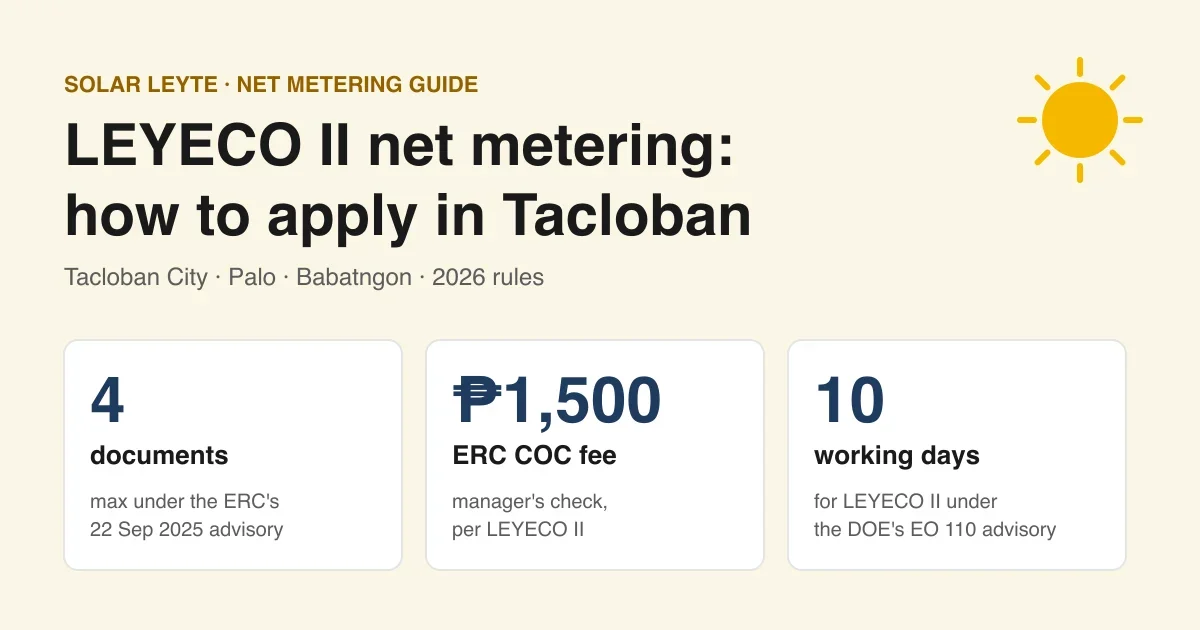
So evening-heavy homes should get net metering in place. Under a DOE advisory issued under EO 110, co-ops must process complete applications within 10 working days during the energy emergency (DOE).
A note for LEYECO II: PRESYO-PH also lists what LEYECO II paid for net-metered power in September 2026, about ₱7.56/kWh, below its ₱9.82 blended rate. At ₱7.56, Household B on LEYECO II saves ₱2,994.70 a month (94.5 × ₱14.05 + 220.5 × ₱7.56), and payback becomes 3.8 to 5.4 years. Ask LEYECO II what credit rate it applies.
Panel ageing over time
Panels lose a little output every year. One example: JinkoSolar's Tiger Neo 560–585 W datasheet guarantees 99% of rated power in year one, then 0.40% less each year, down to 87.4% at year 30, with a 12-year product warranty (JinkoSolar datasheet).
By year 10, that warranty floor is about 99% − (9 × 0.40%) = 95.4% of rated output. That's a small drag on a 3 to 5 year payback. Check the linear power warranty and product warranty on the exact panels in your quote. Inverters and batteries usually carry shorter warranties than panels, so ask about those too.
When solar is NOT worth it
Be honest with yourself here. Solar is a poor buy when:
- The roof is heavily shaded. Trees, a taller neighbour, or a water tank in the way can cut output well below our 105 kWh per kWp. Our numbers assume an unshaded roof.
- You rent, or may move soon. You need to stay long enough to collect several years of savings. The 2025 ERC rules let net-metering credits transfer to a new owner if the property is sold (GMA News), but that doesn't help a renter.
- Your use is very low. On a 60–100 kWh bill, the possible savings are small. Permits, the net-metering application and a minimum inverter size don't shrink with the system. Cut waste first; our electricity calculator helps.
- The roof is weak or due for replacement. Fix or replace it first. Removing and refitting panels later costs money, and in typhoon country the mounting matters.
- You'd pay mostly in interest. A loan with high interest stretches payback. Compare the loan cost against the savings before signing.
- You use almost nothing during the day and can't get net metering. See Household B with no export credit: 6.5 to 9.4 years.
Paying for it: cash, loan or Pag-IBIG
Cash gives the fastest payback. If you borrow, add the total interest to the installed price before dividing by yearly savings. That's your real payback.
- Pag-IBIG solar loan: who qualifies and how to apply
- Solar financing and Pag-IBIG guide
- If you want a battery too, see solar battery prices in the Philippines. For aircon-heavy homes, see solar for aircon.
Work out your own payback
- Get your monthly kWh from your last 6–12 bills.
- Estimate your daytime share honestly. Who's home, and when does the aircon run?
- Size the system: kWh ÷ 105 = kWp needed to cover 100% of use (sizing guide). Smaller is fine if you're out all day.
- Monthly savings = self-used kWh × retail rate + exported kWh × export credit.
- Payback = installed price from a real quote ÷ (monthly savings × 12).
- Re-run step 4 at a lower rate, such as BILECO's May 2026 ₱12.9458, to see the downside.
Checklist before you buy
- ☐ Roof gets full sun from mid-morning to mid-afternoon, no big shade
- ☐ You own the home and expect to stay
- ☐ Roof is sound and won't need replacing soon
- ☐ You know your monthly kWh and daytime share
- ☐ Net-metering application planned with BILECO or LEYECO II
- ☐ Two or more quotes for the same system size, with panel, inverter and battery warranties listed
- ☐ Loan interest added to the price if you're borrowing
FAQ
Is solar worth it in the Philippines in 2026? For most owner-occupied homes in Leyte and Biliran with an unshaded roof, yes. Our examples pay back in about 2.3 to 4.7 years at 2026 rates, and 3.3 to 6.7 years if rates fall back to BILECO's May 2026 level.
How long before solar pays for itself? Installed price ÷ yearly savings. A 3 kWp grid-tie system at ₱135,000 to ₱195,000 on an evening-heavy BILECO home saves about ₱45,935 a year in our example, so about 2.9 to 4.2 years.
Does solar pay back faster on BILECO or LEYECO II? BILECO, because its rate is higher (₱18.3407 vs about ₱14.05). In our examples, LEYECO II payback is about 0.3 to 0.8 years longer.
When is solar not worth it? Heavy shade, renting, very low use, a weak roof, or expensive financing.
Is a hybrid with a battery worth it? It can, if the battery is big enough and used every night: 2.8 to 3.3 years on BILECO in our 500 kWh example, assuming about 6 kWh shifted nightly. The surer reason to buy one is brownout backup.
Solar Leyte is an independent guide, sponsored by MACC Systems & Energy Solutions Inc., a solar installer in Naval, Biliran.
Want the payback math for your own home?
Pila ka tuig ang balik? Send MACC your last few BILECO or LEYECO bills and tell them when you use power. They'll size a system and show the payback for your actual usage, with no obligation.
- Call/Text: 0955 723 5093
- Email: official@macc-inc.com
- Request a quote online: solarleyte.com/quote
Sources (checked 5 October 2026)
- BILECO, July 2026 Effective Rates, May 2026 Effective Rates
- ICSC, PRESYO-PH: BILECO and LEYECO 2 pages, residential rates, blended generation rates and LEYECO 2 net-metering purchase rate, Jan–Sep 2026 (DOE-sourced)
- SurgePV, Philippines solar ROI calculator (25 Apr 2026)
- Reslink, Philippines Solar ROI 2026 (2 May 2026)
- unbox.ph, How to install a solar grid at home (31 Mar 2026)
- JinkoSolar, Tiger Neo JKM560–585N-72HL4R-V datasheet
- Global Solar Atlas (Solargis/World Bank), Naval, Biliran point data
- Meralco, Net-Metering FAQ
- DOE, Fast-tracks net metering under EO 110 (1 Apr 2026)
- GMA News, ERC amends net-metering program rules (2 Sep 2025)