Net metering lets your rooftop solar send unused power to LEYECO II's lines and earn a peso credit on your bill. It covers systems up to 100 kW (DOE). LEYECO II serves Tacloban City, Palo and Babatngon (GMA News).
Maupay nga adlaw, Tacloban. Good news first: unlike BILECO, LEYECO II has its net metering process online. It posts six phases, a request letter and a transformer hosting-capacity table on its net metering page. Below we walk through them, add the 2025–2026 national rules that override parts of them, and show what a net-metered LEYECO II bill looks like. For the nationwide picture, see our net metering guide.
Facts checked 5 October 2026.
The rules in 60 seconds
- The law: RA 9513, the Renewable Energy Act of 2008, requires utilities to offer net metering to qualified customers (Lawphil).
- ERC Resolution No. 15, s. 2025 rewrote the rules (Ocampo & Suralvo):
- Exports are credited at the utility's monthly generation charge, "excluding other adjustments".
- Unused credits are banked and rolled over to later bills.
- The REC meter, which measures your total solar output, is now optional.
- Utilities must finish interconnection within 20 working days.
- Utilities must post their process and hosting capacity online every quarter.
- ERC advisory, 22 September 2025 (Power Philippines):
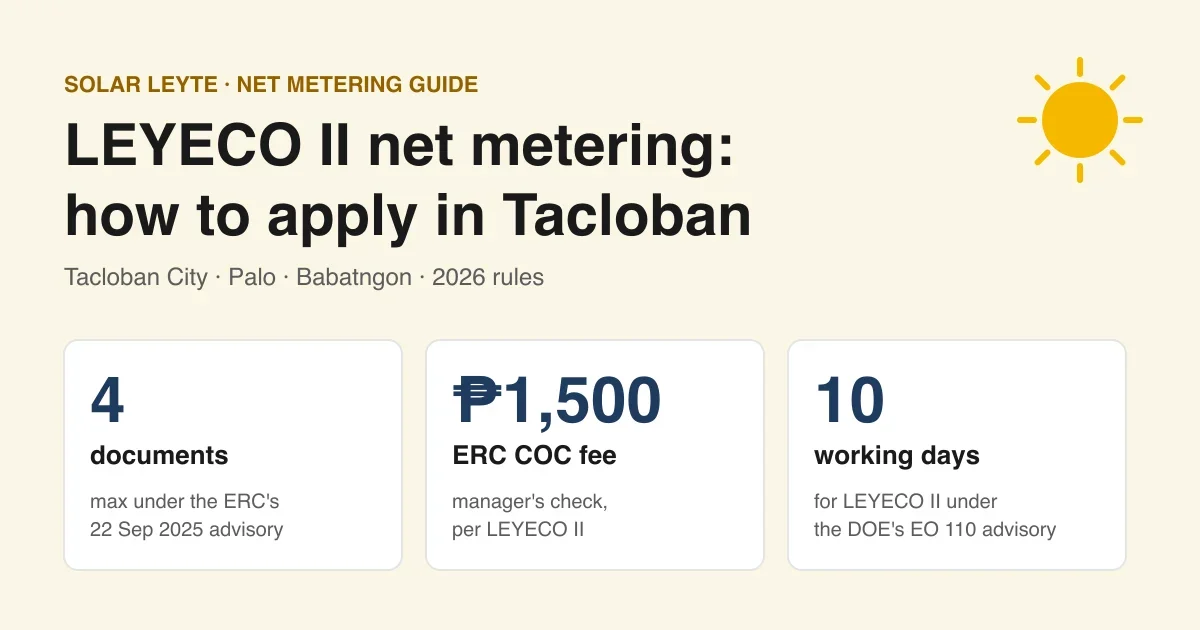
- Utilities may ask for four documents only.
- Notarization is not mandatory, and e-signatures are allowed.
- A home meter replacement costs ₱3,000 at most.
- Testing and commissioning are free.
- Credits start from the commissioning date.
- JMC No. 001, s. 2026 (DOE, DILG and DPWH): LGUs must issue the electrical permit within 3 working days and the CFEI within 7 working days of a complete application. If they don't act in time, the application is "deemed approved" (Power Philippines).
- DOE advisory, 1 April 2026, under EO 110: utilities and co-ops must process complete applications within 10 working days, down from 20. It lasts as long as the national energy emergency (DOE).
Is the emergency still on? EO 110 was issued on 24 March 2026. It runs for one year unless the President lifts or extends it (Lawphil). We found no order lifting it as of 5 October 2026. If it ends, the ERC's 20 working days apply again.
What LEYECO II publishes
On leyeco-2.com/net-metering-process (checked 5 October 2026):
- A six-phase process graphic: pre-qualification, documentary requirements, evaluation and inspection, approval and agreement, energization, and reporting and account update.
- A "Request for Application for Net Metering Service" letter, addressed to the General Manager. You fill in your account name, account number, address, contact number, and your panels, inverter and total capacity.
- A 1st Quarter 2026 hosting-capacity table for single-phase transformers (see below).
- A contact note: for questions about your application, LEYECO II says to contact its Engineering or Commercial Services Department.
What it doesn't publish: the amount of its "DU assessment fee", the meter cost, or any processing time of its own. We couldn't find a net metering advisory on LEYECO II's website news feed either. Its Facebook page may have one, so check there too.
Step by step: applying with LEYECO II
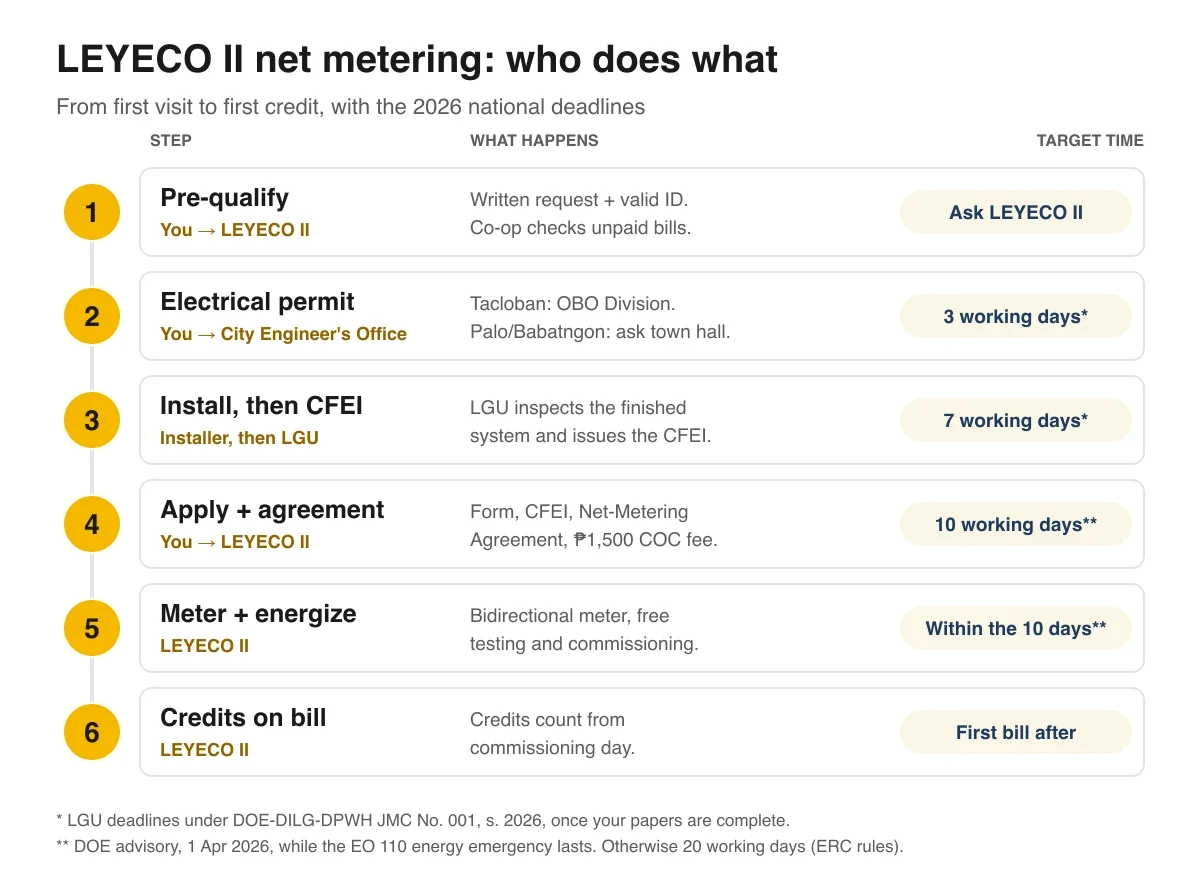
- Pre-qualify. Bring a written request and a valid government ID to the nearest LEYECO II office. You can use the request letter from its website. LEYECO II checks your account for unpaid balances or pilferage records (LEYECO II).
- Get your electrical permit. You need it before the system goes up. In Tacloban, electrical permits come from the City Engineer's Office, OBO Division (see the Tacloban section below).
- Install, then get the CFEI. The Certificate of Final Electrical Inspection is the LGU's sign-off that the finished system meets the Philippine Electrical Code. LEYECO II won't move forward without it.
- Submit your application. LEYECO II gives you the application form and its document checklist. It then evaluates your papers and inspects the system. If needed, it runs a Distribution Impact Study (DIS) or Distribution Asset Study (DAS) to check that the line and transformer can take your exports.
- Sign the agreement. You sign the Amended Net-Metering Agreement, plus an affidavit of waiver if it applies (for example, if you skip the REC meter). LEYECO II issues its certificate of acceptance and you pay the DU assessment fee, which includes postage. LEYECO II then sends your package to the ERC within 5 business days: the QE-COC Application Form No. 1, the agreement, its certificate of acceptance and a ₱1,500 manager's check payable to the ERC (LEYECO II).
- Energization. LEYECO II makes any line changes needed, installs the bidirectional meter (it measures power in both directions) and energizes your system. From here you are a "Qualified End-User".
- Account update. LEYECO II updates your account to net-metering status. Your monthly bill then shows credits for exported energy.
The document question
LEYECO II's phase 2 graphic lists seven items:
- Valid government-issued ID
- Barangay certificate for electric service
- CFEI from the LGU
- Approved electrical plan, signed and sealed by a Professional Electrical Engineer (PEE)
- RE facility general information and data sheet
- Application form for new or modified service
- The co-op's application for modification of service
The ERC's 22 September 2025 advisory says utilities may only require four: the application form, the CFEI, the amended Net-Metering Agreement and the COC fee (Power Philippines). Some of LEYECO II's extras, like the electrical plan, are things your LGU needs for the permit anyway.
Our practical advice: bring copies of everything you have. If one of the extra items holds up your application, ask politely whether it's still required under the ERC advisory. Keep it friendly. You'll be dealing with the same co-op for the life of your system.
Hosting capacity: check your transformer
Each transformer can only take so much solar. LEYECO II's 1st Quarter 2026 table gives the total solar allowed per single-phase transformer, shared by every net-metered home on it (LEYECO II):
Transformer size | Hosting capacity (all homes on it) |
|---|---|
10 kVA | 3.00 kWac |
15 kVA | 4.50 kWac |
25 kVA | 7.50 kWac |
37.5 kVA | 11.25 kWac |
50 kVA | 15.00 kWac |
75 kVA | 22.50 kWac |
100 kVA | 30.00 kWac |
That's 30% of the transformer's size in every row. Other transformer types need a loading study or field measurement. The ERC rules call for quarterly updates, but on 5 October 2026 the 1st Quarter table was still the only one posted. Before you buy, ask LEYECO II how much room is left on your transformer. If your neighbours already have solar, there may be less than the table suggests.
Tacloban, Palo and Babatngon permits
Tacloban City. The city's 2024 Citizen's Charter lists electrical permits under the City Engineer's Office, with the Office of the Building Official (OBO) Division approving them (Tacloban City Citizen's Charter, 3rd ed., pp. 729–733). Our notes on that charter:
- Fees are computed under PD 1096 and City Ordinance 2005-9-63. The charter doesn't print the amounts, so ask for an order of payment.
- It lists the electrical permit at about 4 days 3 hours in total. That predates JMC 001, which now sets 3 working days.
- Its checklist includes a barangay clearance, title or the lot owner's consent, tax declaration, tax receipt and electrical plan. JMC 001 adds a "no additional requirements" rule (DILG), so the 2026 list may be shorter. Ask.
- We didn't find a separate CFEI service in the charter. Ask the same office where to file for the CFEI.
Palo and Babatngon. We found no published permit steps online. Ask at the municipal hall which office issues electrical permits and CFEIs.
Keep your receipts. If the LGU misses its 3- or 7-day deadline, JMC 001 treats the application as approved. Your proof is the acknowledgment receipt and official receipt (Meralco checklist).
What you'll pay
- ERC Certificate of Compliance fee: ₱1,500, by manager's check payable to the ERC (LEYECO II).
- DU assessment fee, including postage: LEYECO II lists it but doesn't publish the amount. Ask.
- Meter cost difference: up to ₱3,000 for homes, if your meter isn't already bidirectional (ERC advisory).
- LGU fees: for the electrical permit and CFEI, set by your city or town.
- Possible extras: costs from a DAS if the line or transformer needs upgrades.
- Free by rule: testing and commissioning.
These are on top of the solar system itself. Our solar panel price guide shows how to read an installer's quote, and the Pag-IBIG solar loan guide covers one way to finance it.
What exports are worth on LEYECO II
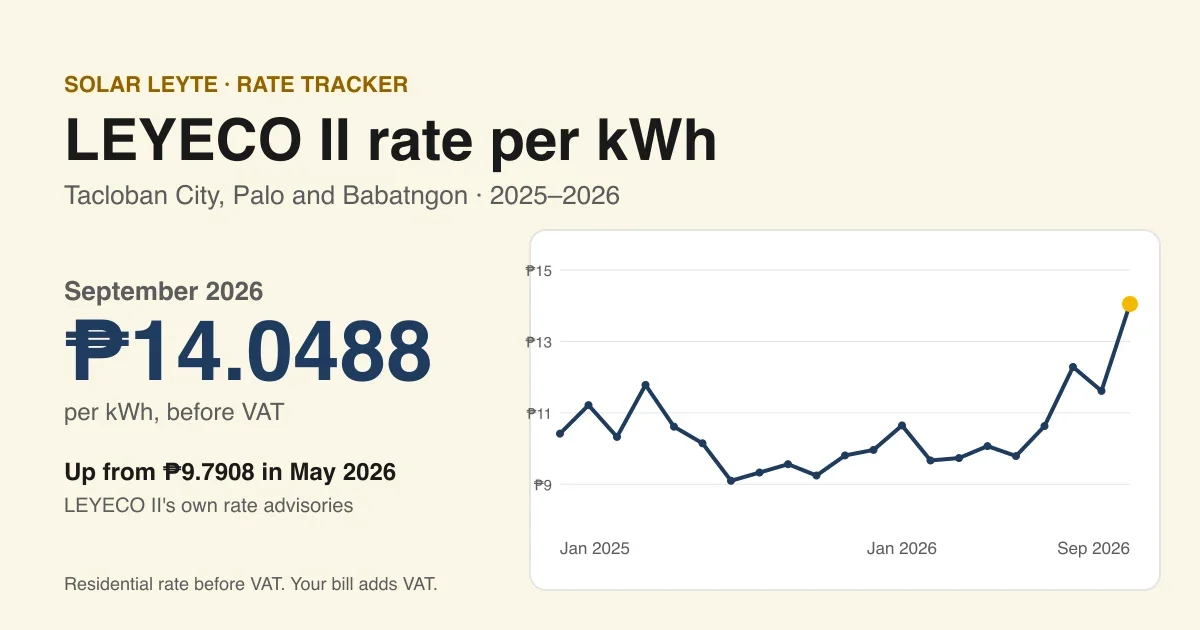
Solar you use at home saves the full rate. LEYECO II's September 2026 effective residential rate is ₱14.0488/kWh before VAT (LEYECO II rate advisory). For the month-by-month trend, see our LEYECO II rate tracker.
Solar you export earns much less. It's credited at the generation charge, not the full rate. LEYECO II publishes a monthly breakdown of its generation charge, and it includes a net-metering line: the energy it bought from net-metered customers and the average it paid (LEYECO II, 2026 breakdowns).
Rate schedule | Generation charge | Paid to net-metered customers |
|---|---|---|
April 2026 | ₱6.0088 | ₱5.9492 |
May 2026 | ₱5.9529 | ₱6.0088 |
June 2026 | ₱6.9777 | ₱5.9609 |
July 2026 | ₱8.5847 | ₱6.9777 |
August 2026 | ₱7.5401 | ₱8.3545 |
September 2026 | ₱9.8192 | ₱7.5609 |
Figures are per kWh. We pulled the table from PRESYO-PH, ICSC's rate tracker, and checked the June, August and September rows against LEYECO II's own breakdown sheets.
Two things stand out:
- The net-metering rate is often the previous month's generation charge. July's ₱6.9777 matches June's charge exactly, and May's ₱6.0088 matches April's. We think this is a billing lag, but LEYECO II hasn't said so. Ask.
- Net-metered homes supplied 54,794 kWh in the September 2026 breakdown. That's 0.16% of the 35,052,574 kWh LEYECO II bought that month. Net metering is already running in Tacloban.
Worked example: a net-metered LEYECO II bill
Example only. These are assumptions, not a quote.
- Rates: ₱14.0488/kWh retail, before VAT (September 2026). Export credit ₱7.5609/kWh, the latest rate LEYECO II paid net-metered customers.
- The home: uses 300 kWh a month. Its 3 kWp system makes about 315 kWh a month (how we size systems).
- The split: 189 kWh is used at home as it's made, and 126 kWh is exported. This is the same split as our BILECO example, so you can compare the two co-ops (BILECO rates).
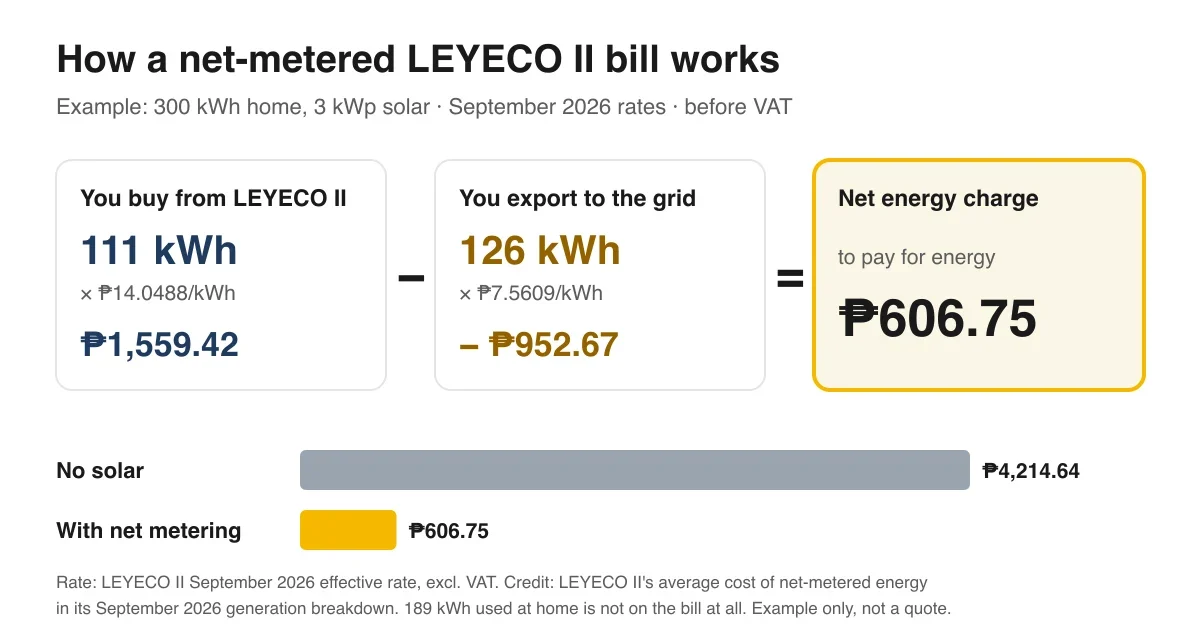
Line | Math | Amount |
|---|---|---|
Energy bought from LEYECO II | 111 kWh × ₱14.0488 | ₱1,559.42 |
Export credit | 126 kWh × ₱7.5609 | − ₱952.67 |
Net energy charge | ₱606.75 | |
Same home, no solar | 300 kWh × ₱14.0488 | ₱4,214.64 |
That's about ₱3,607.89 a month less on the energy charge (₱4,214.64 − ₱606.75), before VAT. If the export credit followed September's full ₱9.8192 generation charge instead, the 126 kWh would earn ₱1,237.22.
A rollover month. Say you buy 60 kWh (60 × ₱14.0488 = ₱842.93) and export 180 kWh (180 × ₱7.5609 = ₱1,360.96). The credit wipes out the energy charge, and ₱518.03 carries over to next month. Under the 2025 ERC rules, unused credits are banked and rolled over. Meralco puts it simply: "Unused bill credits can be carried over to the next billing cycle" (Meralco FAQ).
What this means for sizing. On LEYECO II, an exported kWh earns roughly half of what a self-used kWh saves. Size your system mainly for daytime use. Our electricity bill calculator turns your peso bill into kWh to start from. Our aircon guide shows how this plays out for the biggest load in most homes.
Common mistakes
- Turning on before the meter swap. Without a bidirectional meter, exports "may be recorded as imported energy", so your bill goes up (Meralco FAQ).
- Filing the CFEI last. LGU timing is usually the slowest step. Book the inspection as soon as the installer finishes.
- Unpaid balances, or the account in someone else's name. LEYECO II checks these first. Fix them before you start.
- Ignoring the transformer. On a shared 10 kVA transformer, all the homes together can connect only 3 kWac.
- Expecting power in a brownout. Grid-tie inverters shut off when the grid goes down, so lineworkers aren't hurt by power flowing back into the lines. Keeping lights on needs a battery on a hybrid inverter (grid-tie vs hybrid; battery prices).
- Adding panels later without telling LEYECO II. Your agreement covers the system you declared. Ask LEYECO II before you expand it.
What to ask LEYECO II
Main office: Real St., Sagkahan District, Tacloban City. Telephone (053) 321-2629. Mobile 0917-304-4316 (main office), 0917-306-5405 (Palo area office), 0917-802-4516 (Babatngon area office). Email leyeco2@yahoo.com (LEYECO II contact page; rate advisory). Ask for the Engineering or Commercial Services Department.
- Your current document checklist. Is it limited to the four items in the ERC's 22 September 2025 advisory?
- The amount of the DU assessment fee, and the meter cost difference for my account.
- The remaining hosting capacity on my transformer.
- Whether my system size needs a DIS or DAS.
- Your processing time under the DOE's 10-working-day advisory.
- How export credits will appear on my bill, and which month's generation charge sets the credit rate.
Printable checklist
- ☐ LEYECO II account in my name, with no unpaid balance
- ☐ Request letter and valid ID submitted to LEYECO II
- ☐ Transformer hosting capacity confirmed
- ☐ Electrical permit from the City Engineer's Office or town hall (target: 3 working days)
- ☐ System installed by a licensed installer
- ☐ CFEI from the LGU (target: 7 working days), or acknowledgment and official receipts if deemed approved
- ☐ LEYECO II application form submitted with the CFEI
- ☐ Amended Net-Metering Agreement signed (notarization optional)
- ☐ REC meter decision made, plus affidavit of waiver if skipped
- ☐ DU assessment fee paid (ask the amount)
- ☐ ₱1,500 manager's check payable to the ERC
- ☐ Meter cost difference paid, if any (₱3,000 cap for homes)
- ☐ Bidirectional meter installed and system energized (testing is free)
- ☐ First bill checked for export credits
FAQ
How do I start a LEYECO II net metering application? Bring a written request and a valid ID to a LEYECO II office. Its request letter is on its net metering page.
What documents are required? Under the ERC's 22 September 2025 advisory, four: the application form, the CFEI, the amended Net-Metering Agreement and the ₱1,500 COC fee. LEYECO II's graphic lists more, so bring copies.
How much is an exported kWh worth on LEYECO II? LEYECO II paid net-metered customers ₱5.95 to ₱8.35/kWh from April to September 2026. That's about half the ₱14.0488 retail rate.
How long does it take? LGU permits: 3 working days, then 7 for the CFEI. LEYECO II: 10 working days under the DOE's EO 110 advisory, or 20 under the ERC rules.
Where do I get the CFEI in Tacloban? Ask the City Engineer's Office, OBO Division, which handles electrical permits. In Palo and Babatngon, ask at the municipal hall.
Do I need a battery for net metering? No. Net metering works with a plain grid-tie system. A battery only matters if you want power during brownouts.
Solar Leyte is an independent guide, sponsored by MACC Systems & Energy Solutions Inc., a solar installer in Naval, Biliran.
Ready to apply for net metering?
Pira an imo bayaran ha kuryente? Send MACC your latest LEYECO II bill. They'll size a system for your daytime use and show you the net-metering math, with no obligation.
- Call/Text: 0955 723 5093
- Email: official@macc-inc.com
- Request a quote online: solarleyte.com/quote
Sources (checked 5 October 2026)
- LEYECO II, Net Metering Process: six-phase graphic, request letter, 1st Quarter 2026 hosting capacity
- LEYECO II, 2026 Break Down of Generation Charges (June, August and September 2026 sheets)
- LEYECO II, homepage (August and September 2026 residential rate advisories) and Contact Us
- ICSC, PRESYO-PH: LEYECO 2 generation and net-metering rates, April–September 2026
- Lawphil, RA 9513 and EO 110, s. 2026
- DOE, Fast-tracks net metering under EO 110 (1 Apr 2026)
- Ocampo & Suralvo Law Offices, ERC amends the net-metering rules (24 Oct 2025)
- Power Philippines, ERC orders DUs to streamline net-metering, cap meter costs at ₱3,000 (23 Sep 2025)
- Power Philippines, DOE orders LGUs to clear net-metering permits in 3–7 days (on JMC No. 001, s. 2026)
- DILG Calabarzon, Fast-track net-metering applications
- Tacloban City, Citizen's Charter 2024, 3rd edition (PDF), City Engineer's Office section
- GMA News, Marcos OKs franchise bid of LEYECO II
- Meralco, Net-Metering FAQ and documentary requirements (PDF)