To read your electric meter, write down the number on the display (or the dials), then subtract last month's reading. The difference is the kWh you used, and that's the number BILECO or LEYECO bills you for. Multiply it by your co-op's all-in rate for a rough peso figure. At BILECO's July 2026 residential rate of ₱18.3407 per kWh, 168 kWh comes to about ₱3,081.
If the number looks wrong, you have rights. Under the new Magna Carta for Electricity Consumers (ERC Resolution No. 25, Series of 2026), you can ask your co-op to test your meter free once every two years. A meter that runs more than 2% fast gets you a refund of up to six months.
Last checked 31 October 2026. Rules are quoted from ERC Resolution No. 25, Series of 2026 and the rate from BILECO's own page, both linked in the Sources. The worked examples are Solar Leyte illustrations with made-up readings, not a real bill.
Step 1: Find your meter and match the number
Your meter should be on an outside wall or a private pole. The Magna Carta says it must be mounted between 1.52 and 3 metres high, somewhere you and the co-op can both read it. Before you read anything, check that the meter number printed on the meter matches the one on your bill. If you share a post with neighbours, that's how you know you're reading yours, not theirs.
Step 2: Read it (digital vs dial meters)
Digital meters
Many homes now have a digital meter. Read the kWh number on the display. Some displays cycle through several screens (date, voltage, and so on), so wait for the one labelled kWh. Your bill shows the previous and present readings, so compare like with like.
Dial (electromechanical) meters
Older meters have four or five small clocks. Meralco's meter guide explains the method, and it works the same on any dial meter:
- Read the dials from left to right.
- Neighbouring dials turn in opposite directions. On a four-dial meter, the 1st and 3rd turn counter-clockwise and the 2nd and 4th clockwise. On a five-dial meter, the 1st, 3rd and 5th turn clockwise.
- If a pointer is between two numbers, write down the smaller number, the one it has just passed (after 9 comes 0).
Dial | Turns | Pointer is between | Write down |
|---|---|---|---|
1st (thousands) | counter-clockwise | 4 and 5 | 4 |
2nd (hundreds) | clockwise | 3 and 4 | 3 |
3rd (tens) | counter-clockwise | 8 and 9 | 8 |
4th (ones) | clockwise | 3 and 4 | 3 |
Reading | 4,383 |
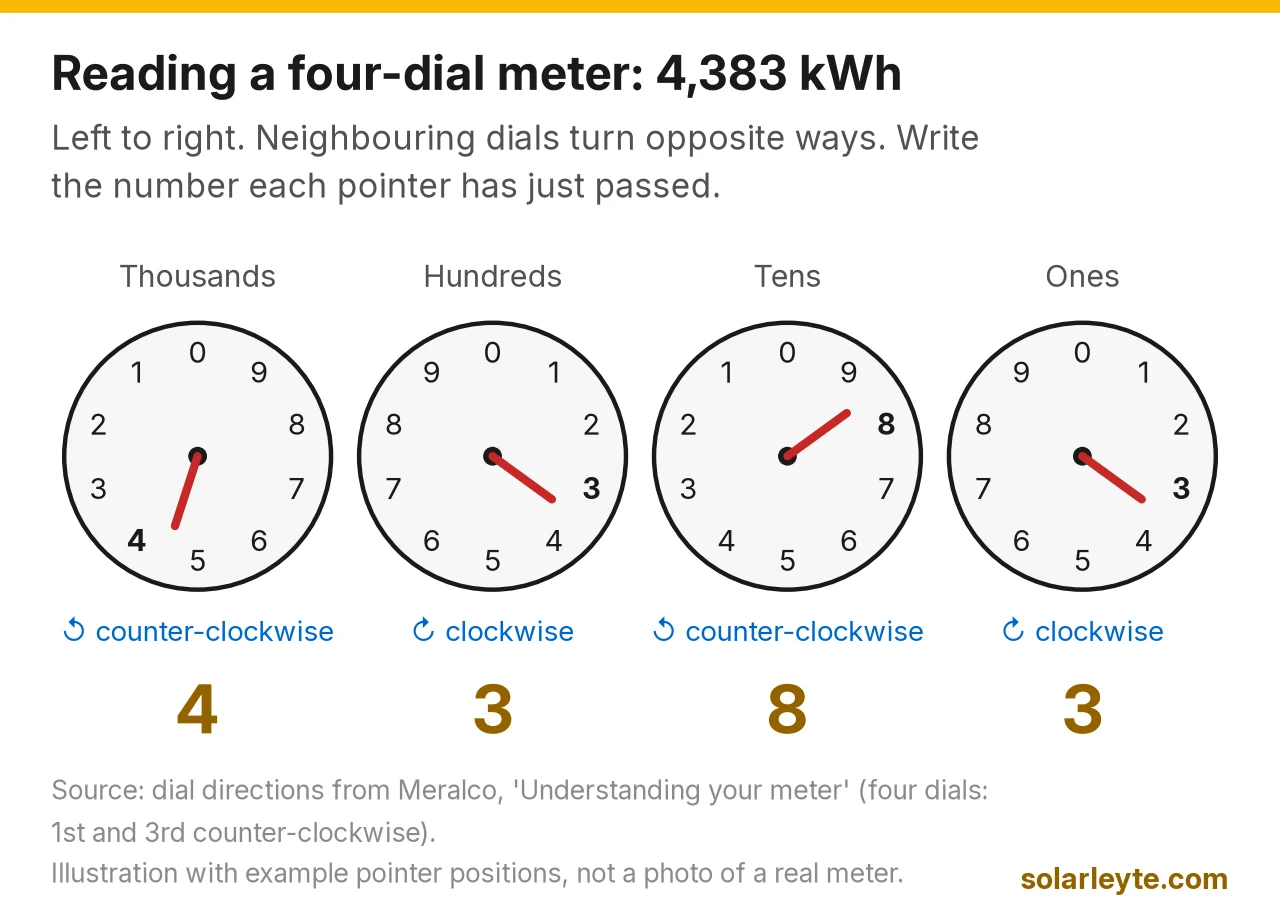
Example dial positions, not from a real meter.
Step 3: Turn kWh into pesos
Worked example (Solar Leyte illustration, made-up readings):
This month's reading | 4,383 |
Last month's reading (from your bill) | 4,215 |
kWh used | 4,383 − 4,215 = 168 kWh |
BILECO residential rate, July 2026 | ₱18.3407 per kWh (VAT inclusive) |
Rough bill | 168 × ₱18.3407 = ₱3,081.24 |
This is only a ballpark. Your real bill can differ because the rate changes every month, lifeline and senior discounts apply to some households, and a billing period isn't exactly one calendar month. The Magna Carta defines a billing month as 28 to 31 days between readings. For your co-op's latest figure, use our trackers: BILECO rate per kWh, LEYECO II rate per kWh and LEYECO IV and V rates. We don't repeat every month's rate here, so the trackers are where to look.
Splitting a bill with a boarder or a second house? See how to compute a submeter bill.
Step 4: Check your meter yourself (tonight)
You don't need tools for the first two checks.
1. The daily check. Read the meter at the same time on two days in a row. The difference is one day's use.
Worked example (illustration): 8 PM Monday shows 4,383.2, and 8 PM Tuesday shows 4,389.0. That's 5.8 kWh in one day. Times 30 days, that's about 174 kWh, or roughly ₱3,191 at BILECO's July rate. If a normal day for you comes out at 5 to 6 kWh but your bill implies 12, something changed: a new aircon, a ref with a bad gasket, or a problem you should report. Our list of how many kWh appliances use helps you find the culprit.
2. The "everything off" check. Switch off the main breaker inside the house, or unplug everything, and watch the meter for 10–15 minutes. The number shouldn't move. On a dial meter, the spinning disc should stop. If it keeps counting with your main breaker off, call your co-op. It could be a wiring fault or someone tapping your line.
3. The rough pulse check (optional). Digital meters have a small blinking light, and dial meters a turning disc. The meter's constant (for example "imp/kWh" or "rev/kWh") is printed on its face. With only one known appliance running, count the blinks for 60 seconds.
Worked example (illustration, assumes a meter constant of 1,600 imp/kWh and a 1,000 W heater-type appliance with nothing else on):
Expected blinks per minute | 1,600 × 1.0 kW ÷ 60 = 26.7 |
You count 27 | 3,600 × 27 ÷ (1,600 × 60) = 1.01 kW: looks fine |
You count 40 | 1.5 kW: way off, so report it |
Be honest with yourself about this one. Missing one blink is already a 3.8% error, and appliance stickers aren't exact either. So this only catches big problems. It can't prove your meter is 2% fast. That needs a proper meter test.
Step 5: If you think the meter is wrong
Here's what ERC Resolution No. 25, Series of 2026 says. It took effect in September 2026 and replaces the old 2004 Magna Carta.
Your right | What the rule says |
|---|---|
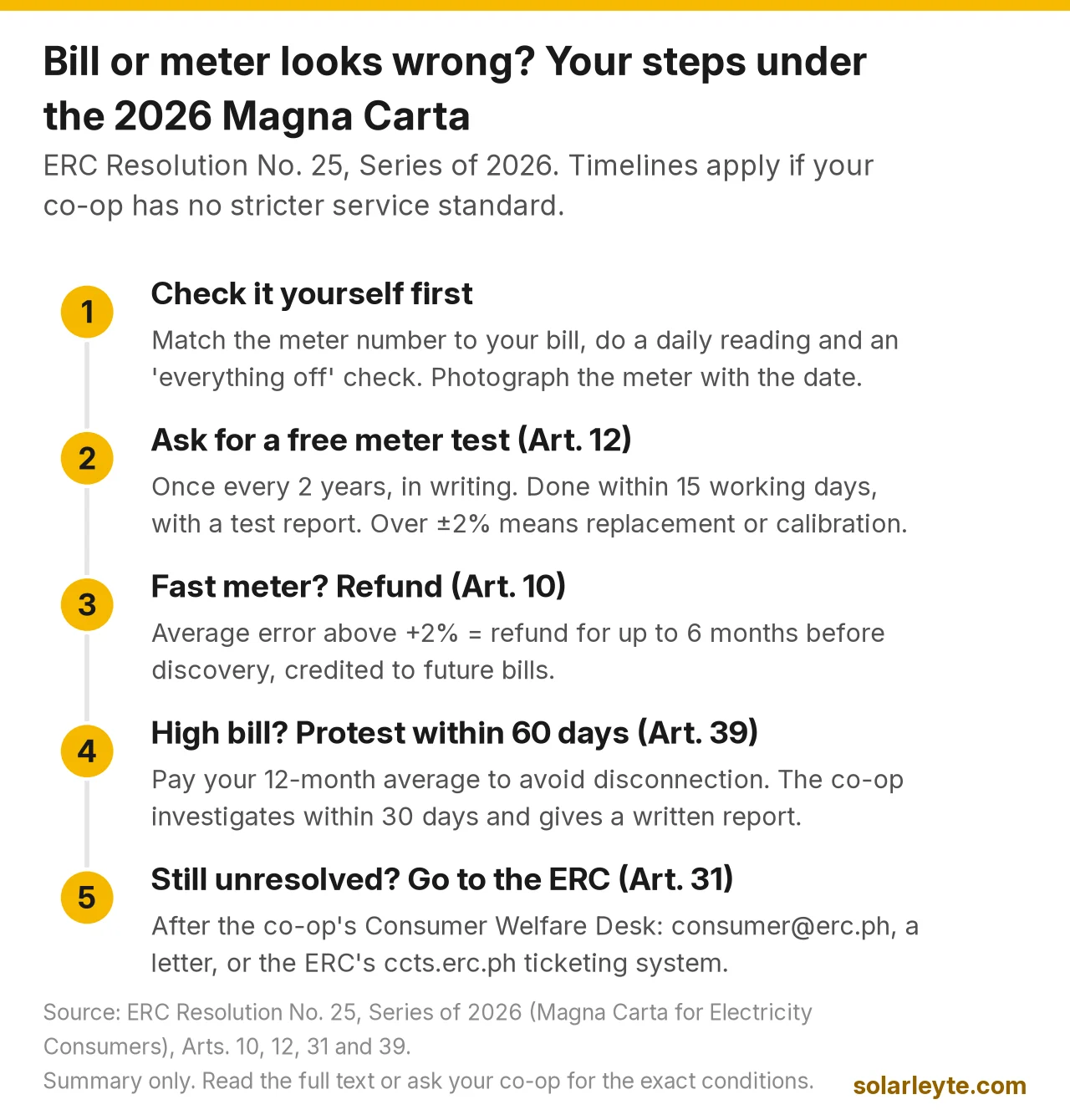
Free meter test | Once every 2 years, free, done by the co-op with an ERC-sealed meter standard (Art. 12). This doesn't apply if your meter was already tested within that period under the meter-testing rules. |
Test timeline | If the co-op has no service standard for it, within 15 working days of your written request, then a test report (Art. 12) |
Extra tests | If you ask more often and the meter is within ±2%, the co-op may charge the same fee the ERC charges (Art. 12) |
ERC test | You can ask the ERC to test it independently, for a fee on the ERC's schedule (Art. 12) |
Fast meter refund | Average error over +2% gets you a refund for up to 6 months before discovery, credited to future bills (Art. 10) |
Inaccurate meter | Replaced by the co-op, or calibrated by the ERC (Arts. 9 and 12). A defective meter is replaced at no cost (Art. 9). |
Test report | You can get a copy of the official meter test report (Art. 12 / 9(G)) |
Complaint answer | Written report from the co-op within 15 working days if it has no other standard (Art. 13) |
It cuts both ways. If the meter is found more than 2% slow, the co-op can bill the unregistered kWh. That's capped at 6 months for a defect you couldn't have noticed and 3 months for a stopped or obviously broken meter. It can go up to 2 years if the co-op kept up its required two-year meter testing (Art. 40).
The high-bill route
The Magna Carta defines high billing (Art. 2(o)) as one month's kWh that "exceeds one hundred percent (100%)" of your average over the previous 12 months. Ask your co-op how it applies that wording to your bill. Under Art. 39(C):
- File a formal protest with the co-op within 60 days of paying, with proof of why you shouldn't owe the whole bill.
- To avoid disconnection, you may pay an amount equal to your 12-month average while it's investigated.
- The co-op must finish its investigation within 30 days and give you a written report that includes the meter test result.
- You shoulder the inspection costs.
Worked example (illustration): your 12-month average is 150 kWh and the disputed bill says 420 kWh (280% of average). While the protest runs, you'd pay about 150 × ₱18.3407 = ₱2,751.11 instead of ₱7,703.09, then settle the difference once it's resolved.
Going to the ERC
Raise it with your co-op's Consumer Welfare Desk first. If it isn't settled, you can complain to the ERC by email at consumer@erc.ph, by letter, or through the ERC's online Consumer Complaints Ticketing System at ccts.erc.ph (Art. 31). Include the co-op's name, your name and address, your account number and what happened.
Don't touch the seal. Under RA 7832 Sec. 4, a broken or fake seal, a bored hole in the meter cover or a jumper wire is prima facie evidence of illegal use — but only when an officer of the law or an authorized ERC representative personally witnesses and attests to the discovery. If something looks tampered with and you didn't do it, report it to the co-op in writing right away.
FAQ
Can I read my own meter and pay based on that? You can read it to check your bill, but you pay the co-op's bill. If your reading and theirs don't match, take a dated photo of the meter and bring it to the co-op's Consumer Welfare Desk.
Is the meter test really free? Yes, once every two years, unless your meter was already tested within that period under the ERC's meter-testing rules (Art. 12). Extra tests that find the meter within ±2% may cost you the ERC's testing fee.
My bill doubled but nothing changed at home. What first? Do the daily check and the "everything off" check, then compare your meter number with the bill. If your daily use doesn't explain the bill, file a written protest within 60 days of paying. You can pay your 12-month average while the co-op investigates.
Will solar panels make my meter run backwards? No. Net metering is set up under RA 9513 Sec. 10. Eligible systems are generally capped at 100 kW under Sec. 4(j) and the ERC net-metering rules (ERC Res. 15 s.2025). The co-op installs a bidirectional meter that records what you import and export separately. See our BILECO net metering guide.
Related reading
- BILECO rate per kWh in 2026
- LEYECO II rate per kWh in 2026
- How to compute a submeter bill
- How many kWh your appliances use
- Paano makatipid sa kuryente
- BILECO and LEYECO electricity rates guide
Solar Leyte is run by MACC Systems & Energy Solutions Inc., a solar installer in Naval, Biliran.
Get a free solar quote from MACC
Tired of watching the meter spin? Send us your latest BILECO or LEYECO bill and we'll show you what solar could cut from it, with no obligation.
- Call/Text: 0955 723 5093
- Email: official@macc-inc.com
- Website: www.macc-inc.com
Sources (all checked 31 October 2026)
- ERC Resolution No. 25, Series of 2026, Magna Carta for Electricity Consumers (full text, PDF copy published by Visayan Electric): billing month 28–31 days (definitions); Art. 2(o) high billing "exceeds one hundred percent (100%)" of the 12-month average; Art. 9 (accurate meter, ERC seal); Art. 10 (+2% tolerance, refund up to 6 months); Art. 11 (meter 1.52–3 m high); Art. 12 / 9(G) (free test once every 2 years, 15 working days, ±2%, ERC test, meter-test report); Art. 13 (complaint written report within 15 working days); Art. 31 (ERC complaints, CCTS); Art. 39(C) (60-day protest, 12-month average, 30-day investigation); Art. 40 (6/3-month and 2-year recovery). Also on the ERC website.
- ISELCO II, reposting the ERC press release of 28 August 2026: complaints via consumer@erc.ph, by letter or ccts.erc.ph; 30-day high-bill investigation.
- Power Philippines, 30 August 2026: resolution published 26 August 2026, takes effect 15 days after publication.
- Meralco, About your meter: reading digital and dial meters, dial directions, record the smaller number.
- BILECO, July 2026 effective rates: residential ₱18.3407/kWh, VAT inclusive (latest posted on BILECO's power-rate page as of 31 October 2026).
- RA 7832, Anti-Electricity and Electric Transmission Lines/Materials Pilferage Act (Lawphil), Sec. 4: prima facie evidence of illegal use only when an officer of the law or an authorized ERC representative personally witnesses and attests to the discovery.
- RA 9513, Renewable Energy Act of 2008 (Lawphil), Sec. 10 (net metering); Sec. 4(j) and ERC Res. 15 s.2025 (generally up to 100 kW).
- Worked examples: Solar Leyte calculations from the figures above, with the assumed readings, meter constant and loads stated in each example.