To compute a submeter electric bill, take this month's submeter reading, subtract last month's reading, and multiply the kWh you used by the per-kWh rate on the landlord's own co-op bill for the same month. In Biliran, BILECO's residential rate was ₱18.93 per kWh in September 2026 (PRESYO-PH). So a boarding-house room that used 120 kWh owes 120 × ₱18.93 = ₱2,271.60 for its electricity. The Energy Regulatory Commission's (ERC) rules say the rate charged to a submetered unit "shall not be higher than" the rate the co-op charges the building owner, and that no profit may be made on it (ERC Resolution No. 02, Series of 2010, Article VI).
Sa madaling salita (the short version):
- Formula: (current reading − previous reading) × the co-op's ₱/kWh for that month.
- Use the same month's rate. BILECO's rate moved between ₱12.95 and ₱18.93 in 2026, so a fixed "₱20 per kWh" in a contract goes stale fast.
- Common areas are separate. Hallway lights and the shared water pump should be metered on their own and shown as their own line, not hidden inside a higher per-kWh rate.
- You can ask to see the main bill. The ERC rules say a copy of the co-op's bill to the landlord should be posted where tenants can see it.
- Unsure about the meter? Unit-users have the right to an ERC meter test, the same as direct co-op customers.
Last checked: 22 October 2026. October 2026 rates weren't out yet on PRESYO-PH or on the BILECO and LEYECO websites, so the examples use September 2026 rates. This is general information, not legal advice.
This post is for tenants, boarders and landlords who split one co-op meter. For what each line on a co-op bill means, see our BILECO and LEYECO rates guide. For this month's rate, check our BILECO rate tracker or the LEYECO IV and V tracker.
The submeter formula, step by step
A submeter is a small kWh meter that a landlord installs for each room or unit, behind the co-op's main meter. The ERC calls the landlord a "redistributor" and the room a "unit-user". Here's how to compute the bill:
- Read the submeter on the same day the co-op reads the main meter. The ERC rules ask for exactly that, so both meters cover the same days.
- Subtract: current reading − previous reading = kWh used this month.
- Check for a multiplier. Some meters show a multiplier (×10, ×40). Multiply the difference by it. The ERC rules say the multiplier must be printed on the face of the meter and agreed with the tenant.
- Find the rate. Use the ₱/kWh on the landlord's co-op bill for the same billing month.
- Multiply: kWh used × rate = your electricity charge.
Step | Example (Room 1, Naval) |
|---|---|
Current reading (22 Sep) | 3,482 kWh |
Previous reading (22 Aug) | 3,362 kWh |
kWh used | 3,482 − 3,362 = 120 kWh |
Rate on the landlord's BILECO bill | ₱18.93/kWh (Sep 2026, VAT included) |
Electricity charge | 120 × ₱18.93 = ₱2,271.60 |
Example only. The readings and dates are made up, and we use BILECO's September 2026 residential rate from PRESYO-PH. Your landlord's account may be on a different rate class, so use the rate printed on the actual bill.
What if there's no previous reading? For a brand-new submeter, the first reading is whatever the meter showed when it was installed, often 0. For a new tenant, read and photograph the meter together on move-in day. That number is your "previous reading" for the first bill. Kuhai dayon og litrato (take a photo right away).
Which rate to use: BILECO and LEYECO, September 2026
These were the latest posted residential rates when we checked on 22 October 2026:
Co-op | Area | Residential rate, Sep 2026 | VAT |
|---|---|---|---|
BILECO | Biliran | ₱18.93/kWh | Included |
LEYECO IV | Baybay, Hilongos and nearby towns | ₱16.9708/kWh, plus ₱5.00 a month fixed charge | Included |
LEYECO V | Ormoc and nearby towns | ₱16.3837/kWh | Distribution VAT not included |
LEYECO II | Tacloban, Palo, Babatngon | ₱14.0488/kWh | Before VAT |
Sources: PRESYO-PH national table, September 2026 (BILECO; LEYECO II); LEYECO IV, September 2026 rates; LEYECO V, September 2026 power rate. Links under Sources.
Two cautions. First, the rate changes every month, so always use the month that matches the reading. Second, the ERC rules say tenants should be billed "based on the same customer classification" as the landlord's account. If the building is on a commercial or low-voltage rate, that's the rate that applies, not the residential one. BILECO's July 2026 commercial rate, for example, was ₱16.8353/kWh against ₱18.3407 residential (BILECO).
Worked example 1: a four-room boarding house in Naval (BILECO)
Say a boarding house in Naval has one BILECO main meter and four room submeters. September looks like this:
kWh used | Electricity at ₱18.93/kWh | Common-area share (by kWh) | Total | |
|---|---|---|---|---|
Room 1 | 120 | ₱2,271.60 | ₱252.40 | ₱2,524.00 |
Room 2 | 95 | ₱1,798.35 | ₱199.82 | ₱1,998.17 |
Room 3 | 150 | ₱2,839.50 | ₱315.50 | ₱3,155.00 |
Room 4 | 175 | ₱3,312.75 | ₱368.08 | ₱3,680.83 |
Rooms total | 540 | ₱10,222.20 | ₱1,135.80 | ₱11,358.00 |
Main meter | 600 | ₱11,358.00 |
Example with assumptions: the BILECO bill is simply 600 kWh × ₱18.93 = ₱11,358.00 (no arrears, penalties or adjustments), and the 60 kWh gap between the main meter and the rooms is the hallway lights, the water pump and wiring losses. Solar Leyte calculation.
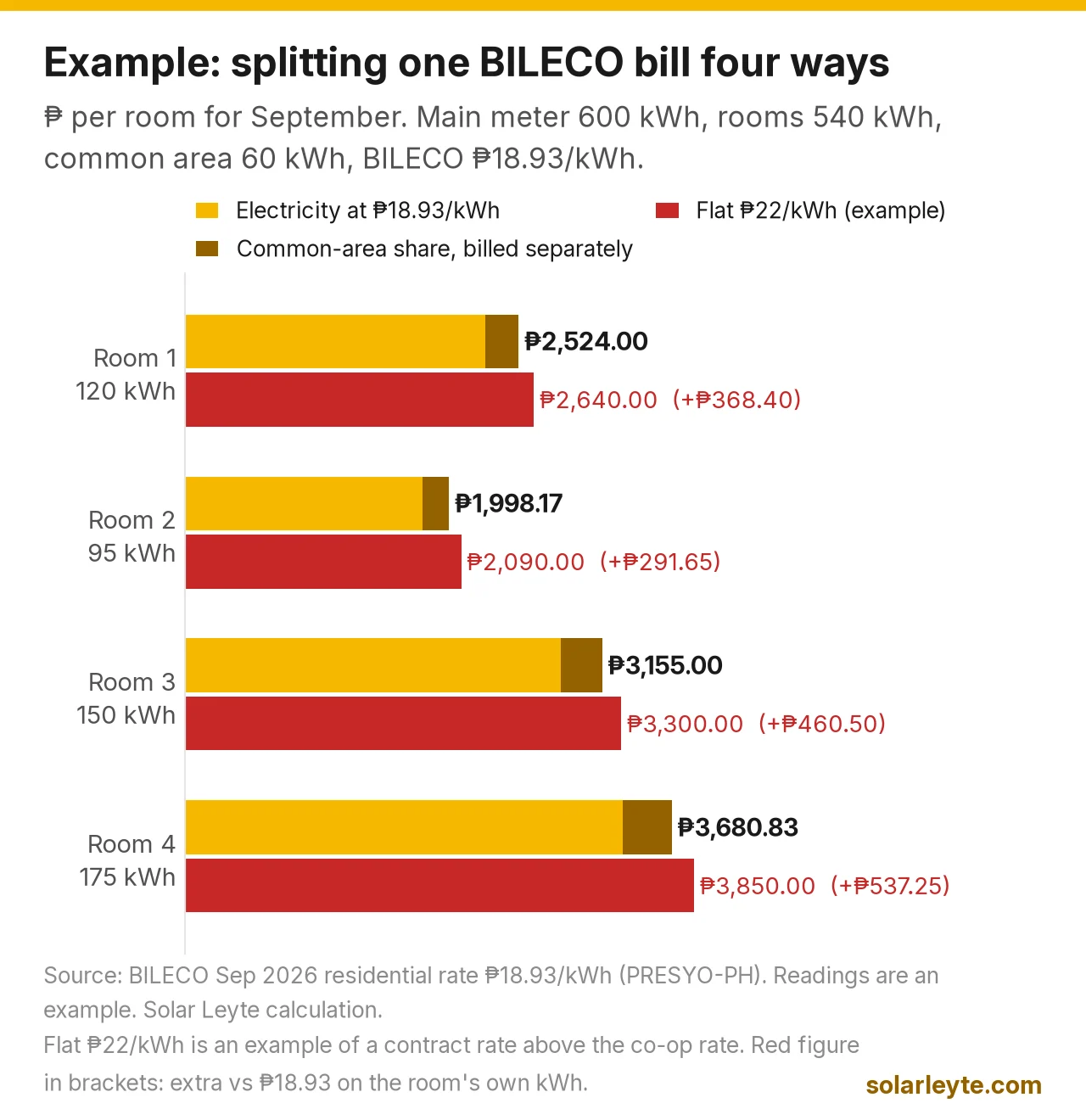
What the table shows. Each room pays for its own kWh at the co-op rate. The 60 kWh the rooms didn't use (₱1,135.80) is split by each room's share of the total, shown as its own column. Everyone can check every peso against the posted BILECO bill.
The shortcut many landlords use is to divide the whole bill by the rooms' kWh: ₱11,358 ÷ 540 kWh = ₱21.03 per kWh. Room 1 then pays 120 × ₱21.03 ≈ ₱2,524, the same total as above. But now the bill shows a rate of ₱21.03, higher than BILECO's ₱18.93. The ERC rules allow the landlord to recover the common-area power and technical losses, but through "monthly dues/rental" and "billed separately from the electric bill". So splitting the common area out, as in the table, is the transparent way to collect the same money.
Some contracts split the common area equally instead: ₱1,135.80 ÷ 4 = ₱283.95 a room. The rules say these recoveries follow the contract and should be "proportionate to utility allocation", so splitting by kWh, as in the table, is the safer reading.
Worked example 2: an apartment unit in Baybay (LEYECO IV)
LEYECO IV adds a small fixed charge on top of the per-kWh rate. Say Unit 2's submeter went from 2,345.6 to 2,478.9 in September:
- kWh used: 2,478.9 − 2,345.6 = 133.3 kWh
- Electricity: 133.3 × ₱16.9708 = ₱2,262.21
- LEYECO IV's ₱5.00 monthly fixed charge is charged once on the landlord's main account. Split across three units it's about ₱1.67 each, so it barely matters.
Example only: made-up readings, LEYECO IV's September 2026 residential rate and fixed charge.
For LEYECO V and LEYECO II, remember that the posted rate leaves out some or all VAT. Use the total ₱/kWh on the actual bill, not the posted rate, or the tenant will be undercharged.
Why a fixed "₱20 per kWh" in the contract doesn't work
A lot of boarding houses write one flat rate into the contract. But co-op rates move a lot. BILECO's residential rate went from ₱17.76 in January 2026 down to ₱12.9458 in May, then up to ₱18.93 by September (BILECO rate tracker).
Month (2026) | BILECO rate | 150 kWh at the BILECO rate | 150 kWh at a flat ₱18 | Tenant paid… |
|---|---|---|---|---|
January | ₱17.76 | ₱2,664.00 | ₱2,700.00 | ₱36.00 more |
February | ₱14.46 | ₱2,169.00 | ₱2,700.00 | ₱531.00 more |
May | ₱12.9458 | ₱1,941.87 | ₱2,700.00 | ₱758.13 more |
July | ₱18.3407 | ₱2,751.11 | ₱2,700.00 | ₱51.11 less |
September | ₱18.93 | ₱2,839.50 | ₱2,700.00 | ₱139.50 less |
Example: a room using 150 kWh every month on a contract rate of ₱18/kWh. BILECO rates from our tracker (BILECO website for April, May and July; PRESYO-PH for the other months). Solar Leyte calculation.
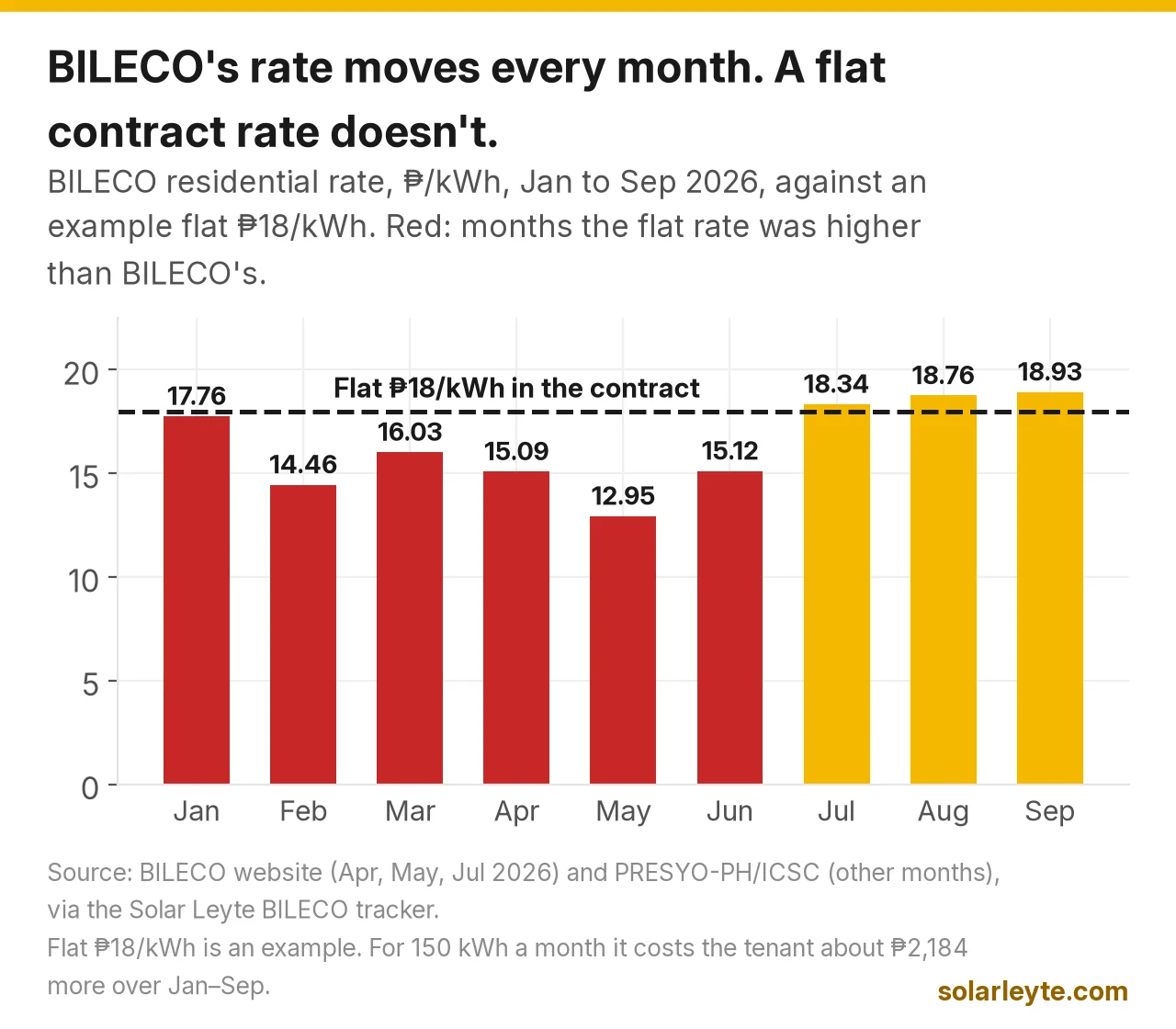
Over January to September, that tenant would have paid about ₱2,184 more than the BILECO rate. And in the months when the flat rate was above BILECO's, it was higher than the ERC rules allow. When rates jump, the landlord loses instead. Using each month's actual rate is fairer for both sides, and it's easier to defend.
A flat rate set well above the co-op's is worse. At ₱22/kWh, Room 3 in our Naval example (150 kWh) would pay ₱3,300 instead of ₱2,839.50, or ₱460.50 more a month.
What the ERC rules say landlords must do
The rules for submetered buildings are in Article VI ("Redistribution of Electricity") of the ERC's Distribution Services and Open Access Rules (DSOAR), as amended by ERC Resolution No. 02, Series of 2010. They cover buildings connected to the co-op through one meter (or a few), industrial or commercial complexes, and barangay power associations. In plain English:
The rule | What it means for you |
|---|---|
Rate "shall not be higher than" the co-op's rate to the redistributor, and "no profit shall be derived" (6.1 d) | No markup on the ₱/kWh |
Bill tenants "as if they are being billed directly by the DU" (6.1 g) | Same rate class, same month's rate |
Admin costs, equipment and network costs are recovered "separately from the electricity bills" (6.1 f) | Fees go on their own line |
Meters must be "tested, certified and sealed by ERC prior to installation" (6.3.1 b) | Ask whether your submeter was |
Common areas metered separately, or estimated by a method both sides agree (6.3.1 e) | The hallway and pump aren't your kWh |
Reader leaves a record of the date, previous and current reading (6.3.1 f) | You get your readings in writing |
Monthly bill, and a copy of the co-op's bill posted "in conspicuous places" (6.3.1 h) | You can check the main bill |
Allowed extra recoveries: common-area power, technical losses (not pilferage), billing, transformers, meters (6.3.1 j) | Through dues or rent, billed separately |
Rebates and refunds from the co-op are passed on (6.3.1 l) | If BILECO refunds, so should the landlord |
Unit-users get Magna Carta rights, including ERC meter testing, refund of overbilling, notice before disconnection and the right to complain to the ERC (6.4.1) | Same protections as a direct customer |
Source: ERC Resolution No. 02, Series of 2010 (amended DSOAR), Article VI, read in the full text on LegalDex; the resolution itself is on the Supreme Court E-Library. Last checked 22 October 2026. We didn't find a later ERC rule replacing Article VI, but check erc.gov.ph if you're in a dispute.
Two more points from the same article. The general rule is that occupants of a building should be served directly by the co-op, and co-ops "must install separate meters" for individual units if they meet the co-op's requirements (6.1 a and b). And for very short leases (temporary periods of six months or less, in spaces that aren't permanent divisions of the building), the rule says electricity is "deemed included in the rentals" (6.3.1 g).
Can a tenant get their own BILECO meter instead?
Often, yes. If the room or unit can be wired as its own connection, the tenant can apply to the co-op like any new customer. BILECO's checklist includes a pre-membership seminar (Tuesdays, 9:00 AM, main office), an approved electrical plan and permit, a certificate of final inspection, a fire safety inspection certificate, and the lot owner's written consent with a valid ID (BILECO). So you'll need your landlord on board. LEYECO co-ops have their own lists; ask at the nearest office.
With its own meter, the unit is billed directly by the co-op, and the household can apply for discounts on its own account. The lifeline rate and senior citizen discount both depend on the kWh registered on the co-op account (50 kWh and 100 kWh limits). A main meter shared by several rooms usually won't fall under them.
If you think your submeter bill is wrong
- Check the math. (Current − previous) × the rate on the main bill. Compare it with your bill.
- Ask to see the co-op bill. The rules say it should be posted, and unit-users may inspect it during reasonable business hours.
- Check the meter. Look for an ERC seal and the multiplier. Read it yourself on reading day and take a photo.
- Talk to the landlord with your numbers. Many problems are a wrong rate month or a forgotten common-area line.
- Ask for a meter test or file a complaint with the ERC (erc.gov.ph) if it can't be settled. Unit-users have both rights under the rules.
If you're a landlord: the common-area kWh (pump, lights, CCTV) is the part of the bill that's yours to reduce. Our appliance kWh guide shows what each load costs at BILECO and LEYECO rates, and why bills are so high explains what's behind the rate itself.
FAQ
What is the formula for a submeter electric bill? (Current reading − previous reading) × the per-kWh rate on the main co-op bill for the same month. At BILECO's September 2026 rate of ₱18.93, 100 kWh is ₱1,893.
Can my landlord charge more than BILECO's or LEYECO's rate per kWh? Not under the ERC's redistribution rules. The submeter rate "shall not be higher than" the co-op's rate to the building, and no profit is allowed. Common-area power, losses and admin costs may be recovered, but separately from the electricity charge.
How do I compute a submeter bill without a previous reading? Use the reading on the day the meter was installed (often 0) or the reading you agreed and photographed on move-in day. After that, every month's "previous" is last month's "current".
Is it fair to divide the whole bill by everyone's kWh? It collects the same total, but it hides the common area inside a higher per-kWh rate (₱21.03 instead of ₱18.93 in our Naval example). Showing the common area as its own line is clearer and matches how the ERC rules describe it.
Do lifeline and senior citizen discounts apply to a submeter? They're applied by the co-op to its own account, based on that meter's monthly kWh. A shared main meter rarely qualifies. A household that wants the discount usually needs its own co-op meter. See our lifeline and senior discount guide.
Solar Leyte is run by MACC Systems & Energy Solutions Inc., a solar installer in Naval, Biliran.
Own a boarding house or apartment? Get a free solar quote from MACC
If the common-area pump, lights and your own unit are a big part of the bill, solar on your roof can cut them. Send us a photo of your latest BILECO or LEYECO bill and we'll show you the sizing and savings math, with no obligation.
- Call/Text: 0955 723 5093
- Email: official@macc-inc.com or benjie@macc-inc.com
- Website: www.macc-inc.com
- Request a quote online: solarleyte.com/quote
- Office: Brgy. Talustusan, Naval, Biliran 6543
Sources (all checked 22 October 2026)
- ERC rules: ERC Resolution No. 02, Series of 2010, amended DSOAR, full text including Article VI "Redistribution of Electricity" (LegalDex); the resolution on the Supreme Court E-Library; Energy Regulatory Commission
- Rates: ICSC, PRESYO-PH national table (September 2026, latest available on 22 Oct: BILECO ₱18.93, LEYECO II ₱14.05); LEYECO IV, September 2026 rates (₱16.9708/kWh, ₱5.00 fixed charge, VAT included); LEYECO V, power rate (September 2026, ₱16.3837/kWh before distribution VAT); LEYECO II four-decimal rate and VAT basis from our LEYECO II tracker
- BILECO: July 2026 effective rates (residential ₱18.3407, printed on the page as "18.34.07"; commercial ₱16.8353; VAT included); May 2026 effective rates (₱12.9458); April 2026 effective rates (₱15.0929); other 2026 months from our BILECO rate tracker (PRESYO-PH); Apply for new connection
- Discounts: lifeline (50 kWh) and senior citizen (100 kWh) limits from our lifeline and senior discount guide (RA 11552, RA 9994, ERC 30 January 2026)
- All worked examples (readings, room kWh, flat-rate comparisons) are Solar Leyte calculations with the assumptions stated under each table.