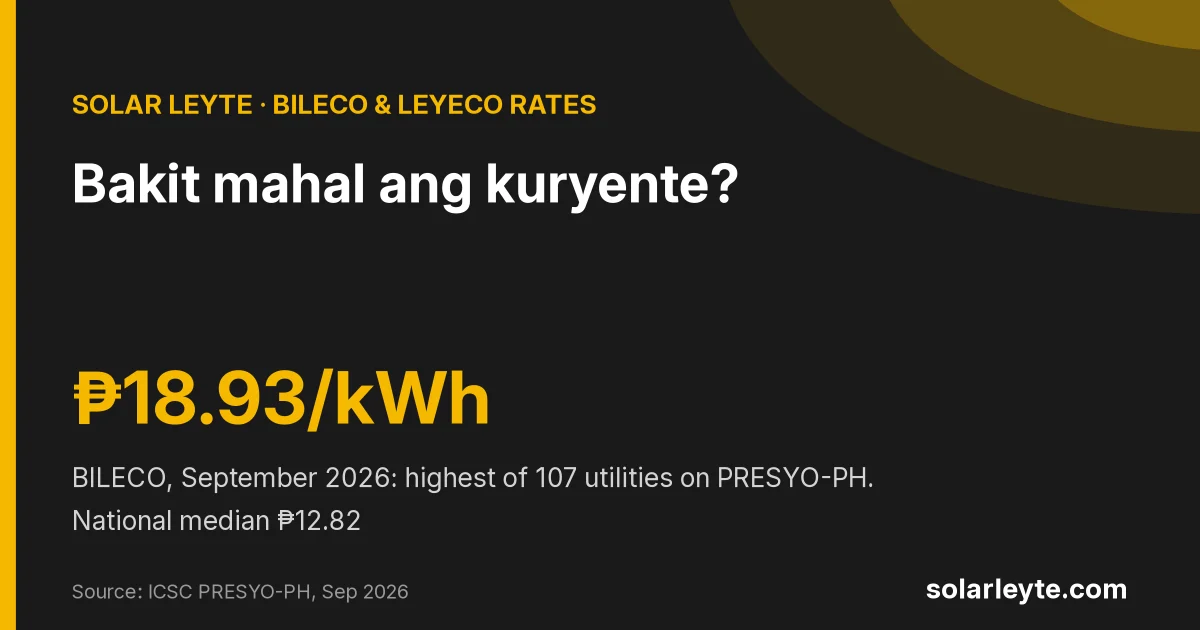
Mahal ang kuryente sa Pilipinas because almost every peso of the cost is passed straight to your bill: fuel (mostly imported coal), long-term power contracts, grid charges, system loss, taxes and the co-op's own costs. And the government doesn't subsidise household rates the way Malaysia or Indonesia do. In June 2026 the Department of Energy said the Philippines had the highest average residential rate in ASEAN, ₱12.43/kWh, slightly above Singapore (The Freeman/Philstar). Leyte and Biliran pay even more. In September 2026, BILECO's residential rate of ₱18.93/kWh was the highest of the 107 utilities tracked by ICSC's PRESYO-PH, against a national median of ₱12.82 (PRESYO-PH).
Sa madaling salita (the short version):
- Generation is the biggest part of your bill. About two-thirds of Philippine tariffs, says the World Bank. It follows coal, fuel and the peso.
- We import most of our fuel. Coal made 57% of the country's grid power in 2025, and nearly all imported coal comes from Indonesia.
- Halos walang subsidy (almost no subsidy). The power reform law (EPIRA) made rates recover their full cost. Neighbours keep household prices low with state money.
- The Visayas grid is short of power and congested. In 2026, plant outages and line congestion pushed spot prices, and Leyte–Biliran rates, way up.
- Taxes and charges add up. VAT alone was about 8.5% of a LEYECO IV bill in September 2026.
- What you control: how many kWh you use, whether you qualify for the lifeline discount, and whether some of your power comes from your own roof.
Last checked: 18 October 2026.
This post explains why rates are high. For the month-by-month rates and line-by-line breakdowns, use our trackers: BILECO rate per kWh, LEYECO II rate per kWh and LEYECO IV and V rates. Our rates guide explains each line on the bill.
How high are rates in Leyte and Biliran? (September 2026)
PRESYO-PH, run by the Institute for Climate and Sustainable Cities (ICSC), compiles the rates that utilities publish. For September 2026 it had residential rates for 107 of the country's 146 utilities. These were the highest:
Rank | Utility | Area | Residential rate (₱/kWh) |
|---|---|---|---|
1 | BILECO | Biliran | 18.93 |
2 | FICELCO (off-grid) | Catanduanes | 18.13 |
3 | LEYECO IV | Leyte | 16.97 |
4 | SOLECO | Southern Leyte | 16.60 |
5 | ILECO 3 | Iloilo | 16.48 |
6 | LEYECO V | Leyte (Ormoc) | 16.38 |
7 | GUIMELCO | Guimaras | 16.33 |
8 | DORELCO | Leyte | 16.23 |
9 | NOCECO | Negros Occidental | 16.01 |
10 | MECO | Cebu | 15.98 |
11 | CEBECO 2 | Cebu | 15.91 |
12 | NORSAMELCO | Northern Samar | 15.87 |
– | Meralco (for comparison) | Metro Manila | 14.74 |
– | LEYECO II | Tacloban, Palo, Babatngon | 14.05 |
– | National median | 107 utilities | 12.82 |
Source: PRESYO-PH, September 2026, read 18 October 2026.
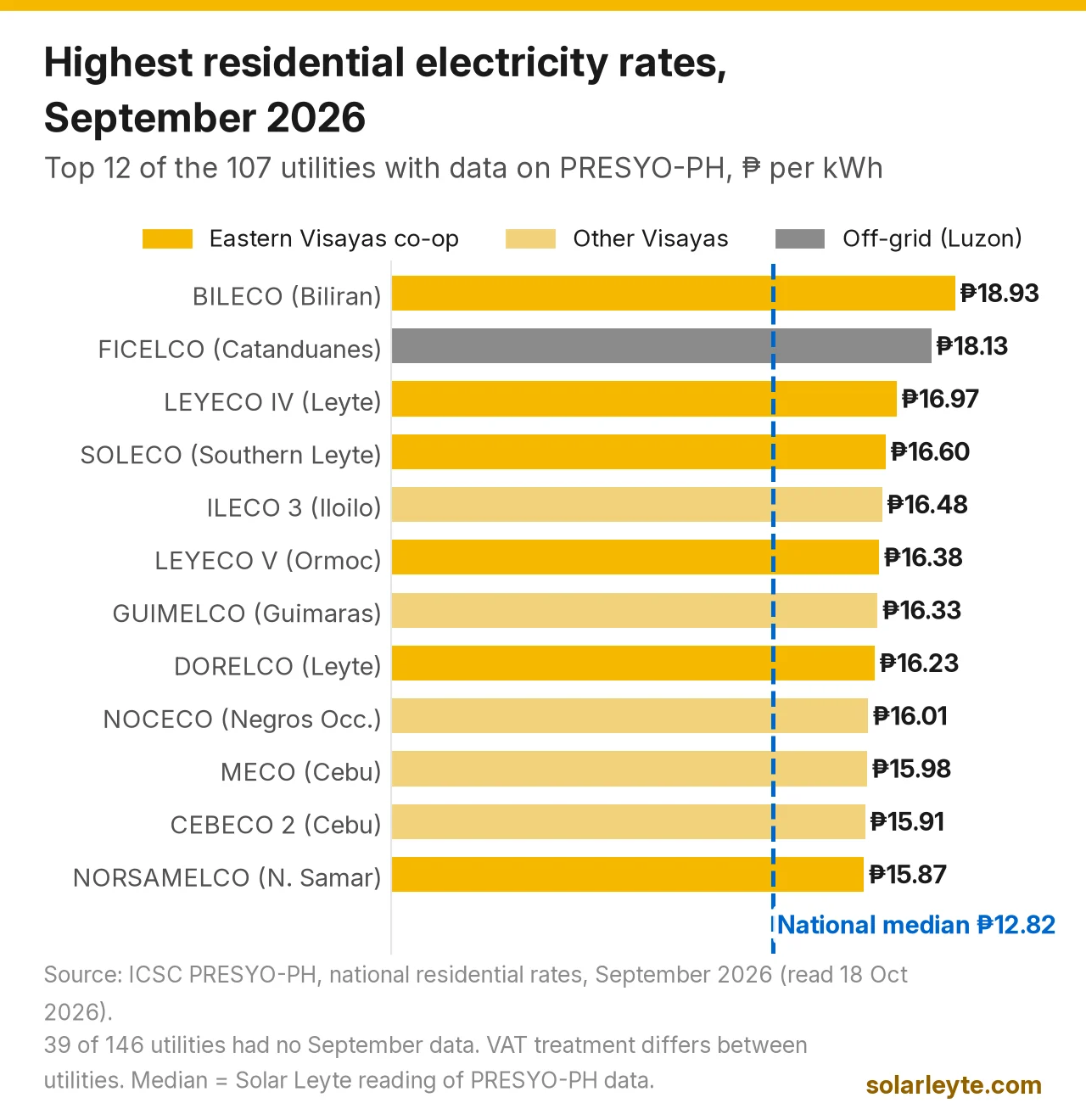
Eleven of the twelve are in the Visayas, and six are in Eastern Visayas. BILECO's rate was ₱6.11/kWh, or about 48%, above the national median (our calculation).
Two cautions. Utilities don't all present VAT the same way: LEYECO II posts its rate before VAT (see our LEYECO II tracker), while BILECO's posted rates include it (BILECO). And 39 utilities had no September figure on PRESYO-PH, so the ranking covers only those that reported. Meralco's own figure for a typical household in September was ₱14.7424/kWh (Meralco).
It also rose fast. ICSC listed BILECO at ₱15.12/kWh in June 2026 (ICSC). By September it was ₱18.93, up ₱3.81 or about 25% in three months (our calculation).
Reason 1: Generation is most of the bill, and it follows fuel prices
Your bill pays for three things: making the electricity (generation), moving it (transmission and distribution), and policy charges and taxes. The World Bank's Philippines Economic Update (midyear 2026) found that generation makes up about two-thirds of tariffs and is the main source of price swings (World Bank). ICSC's July 2026 analysis of 102 on-grid utilities put generation at an average of 57% of residential rates, or ₱7.28/kWh (ICSC).
Leyte and Biliran look similar. In September 2026, PRESYO-PH put LEYECO II's blended generation rate at 70% of its residential rate. BILECO's ₱9.50/kWh of generation was about half of its ₱18.93 (PRESYO-PH). BILECO itself describes generation as "roughly 45%" of its monthly rate (BILECO).
Co-ops don't make money on generation. BILECO says pass-through costs like generation and transmission are passed on "without any additions or reductions" (BILECO). When fuel costs or the peso move, your bill moves with them.
Reason 2: We burn a lot of imported coal and fuel
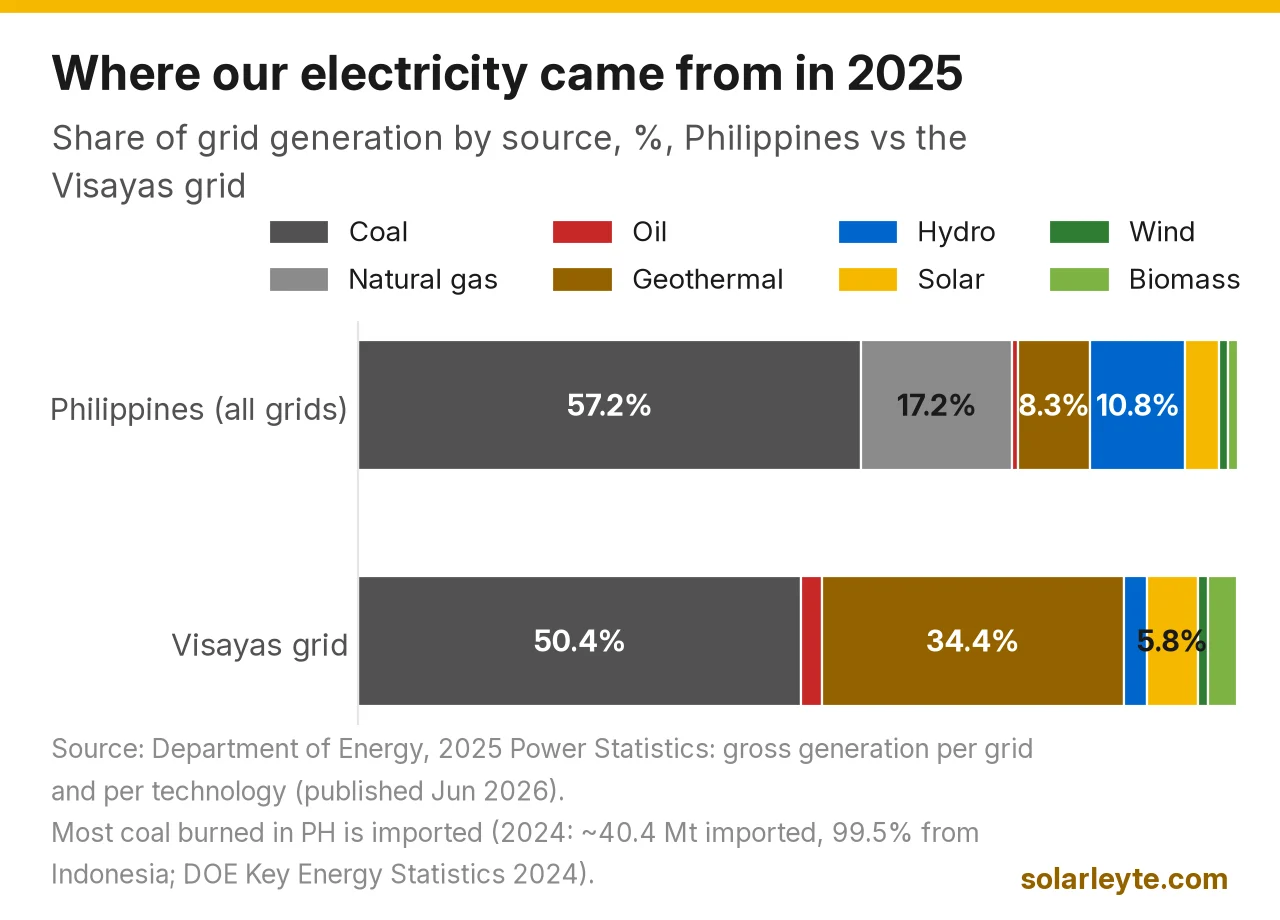
Coal produced 57.2% of the country's grid electricity in 2025, natural gas 17.2% and renewables 25.0%, according to the DOE (DOE 2025 Power Statistics). On the Visayas grid, coal was 50.4% and geothermal 34.4%.
Most of that coal is imported. In 2024 the Philippines imported about 40.4 million tonnes of coal, 99.5% of it from Indonesia, and produced about 15.9 million tonnes locally (DOE Key Energy Statistics 2024). The IEA counted 38 million tonnes of imports in 2025, 99% from Indonesia (IEA). By our rough count (ignoring stockpiles), about four of every five tonnes burned in 2024 were imported.
Imported fuel is priced in dollars, so a weaker peso raises your bill too. Meralco said its September 2026 generation charge rose mainly because of "the depreciation of the Peso and higher fuel costs amid the recent escalation of the Middle East conflict" (Meralco). That conflict also led the President to declare a national energy emergency on 24 March 2026 under Executive Order No. 110. It stays in force for one year unless the President extends or lifts it (EO 110, Lawphil).
Reason 3: Old power contracts lock in today's prices
Most power isn't bought on the spot. For a large representative utility in January–March 2026, the World Bank found that power supply agreements (PSAs) made up about 70% of purchases, independent power producers 22%, and the spot market (WESM) less than 8%. It found that realised PSA prices were above benchmark costs for every technology, solar included. If PSA prices matched those benchmark costs, the bank estimated residential tariffs could be roughly 26% lower (World Bank).
These contracts are why rates don't drop quickly even when cheaper plants get built. That part of the problem is for the ERC, the DOE and your co-op's board, not for households. It's still worth knowing, so you don't blame the meter reader.
Reason 4: The Visayas grid is short of supply and congested
This is the big one for Leyte and Biliran in 2026.
- Plant outages. In July 2026, DOE Undersecretary Rowena Cristina Guevara said about 21 Visayas power plants were on forced outage, making the region depend on imports from Luzon and Mindanao. She blamed the Visayas supply situation for the country's ASEAN-high June rate (The Freeman/Philstar).
- Expensive backup plants. When reserves are thin, the grid runs costlier plants instead of cutting power. "Instead of experiencing blackouts, we operate the more expensive power plants," Guevara said (same source). Our Visayas grid alert post explains yellow and red alerts.
- A congested link to Luzon. The World Bank says the Luzon–Visayas interconnection "is congested much of the time" and that spot prices spike most often in the Visayas and Mindanao in the late afternoon and early evening (World Bank).
- Line loss and congestion costs (LLCC). For July 2026 alone, the market operator IEMOP billed Eastern Visayas' 11 co-ops ₱572.9 million in LLCC, from ₱0.46/kWh for LEYECO II up to ₱5.99/kWh for LEYECO IV. Under the normal computation, Biliran's July rate would have reached ₱24.35/kWh. Co-ops staggered some of these pass-on costs to soften the hit (Daily Tribune).
Our LEYECO II tracker shows what this did to one co-op: in its September 2026 schedule, spot-market power cost five to six times as much as its contracted power.
Reason 5: Almost no subsidy, by design
The Electric Power Industry Reform Act of 2001 (EPIRA, RA 9136) required rates to be "unbundled" so that each charge reflects its own cost (Sec. 36). It also ordered cross-subsidies between grids and customer classes to be phased out (Sec. 74) (RA 9136, Lawphil).
That's the main reason our prices look so different from our neighbours'. The World Bank puts Philippine residential prices at about US$0.21/kWh, against Thailand's $0.13, Indonesia's $0.09 and Malaysia's $0.05. Only Singapore ($0.23) was higher. The bank notes that Indonesia and Malaysia "keep retail prices low through large subsidies." Even after adjusting for those subsidies, Philippine residential rates were still about 57% above Malaysia's and 17% above Indonesia's (World Bank).
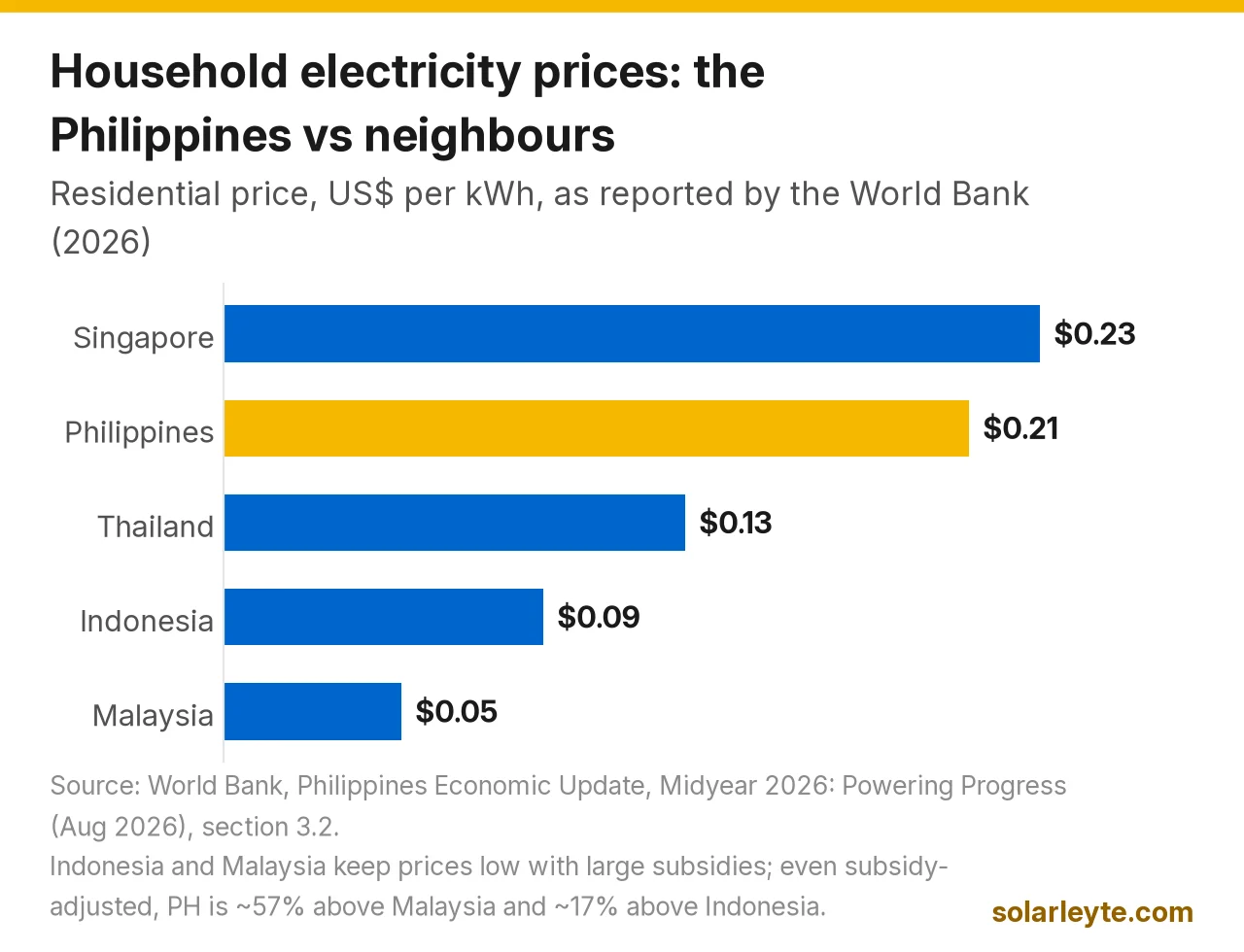
So it isn't only the lack of subsidy. A real cost gap remains, which is reasons 1 to 4. Reuters, reporting in June 2026, estimated that a median household using 200 kWh spends about 12% of its monthly income on electricity (Reuters via Rappler).
Reason 6: VAT and policy charges
Since RA 9337, sales of electricity by generation, transmission and distribution companies have been subject to VAT (RA 9337, Lawphil). Some power is VAT-free. Renewable energy sales are zero-rated under RA 9513 (Lawphil), and Meralco notes that indigenous natural gas is VAT-exempt (Meralco).
Policy charges are smaller than most people think. The universal charge, set under EPIRA Sec. 34, pays for things like missionary electrification (power for off-grid islands), stranded debts and an environmental charge. The feed-in tariff allowance (FIT-All) supports renewable plants. ICSC found FIT-All was only 1.10% to 1.42% of the rate among the 20 most expensive utilities in July 2026 (ICSC).
Reason 7: Small island co-ops and typhoon-proofing cost money
The World Bank lists the country's "archipelagic geography" and the many small islands on isolated systems among the reasons prices differ by region (World Bank). In plain terms, a co-op serving one island province spreads the cost of its poles, lines, meters and staff over fewer kWh than a big city utility, and typhoon repairs add to it. BILECO's rate includes a distribution charge and a Reinvestment Fund for Sustainable CAPEX for "rehabilitation, upgrading, expansion" of the network. Both stay fixed unless the ERC approves a change (BILECO).
BILECO doesn't publish a line-by-line table online, so we can't say which of its non-generation charges is biggest. PRESYO-PH only shows that ₱9.43 of BILECO's ₱18.93 was something other than generation in September 2026. Your printed bill lists every line, so check it.
Worked example 1: same usage at 150 and 200 kWh, different address
Example only. Assumptions: 150 kWh in a month, multiplied by each utility's September 2026 effective residential rate (PRESYO-PH; Meralco's own figure). It ignores fixed monthly charges, arrears and discounts. LEYECO II's rate is before VAT, so its real bill is higher.
Where you live | Rate (₱/kWh) | 150 kWh bill | 200 kWh bill |
|---|---|---|---|
Biliran (BILECO) | 18.93 | ₱2,839.50 | ₱3,786.00 |
Leyte, LEYECO IV area | 16.97 | ₱2,545.50 | ₱3,394.00 |
Ormoc, LEYECO V | 16.38 | ₱2,457.00 | ₱3,276.00 |
Metro Manila (Meralco) | 14.7424 | ₱2,211.36 | ₱2,948.48 |
Tacloban, LEYECO II (before VAT) | 14.05 | ₱2,107.50 | ₱2,810.00 |
National median | 12.82 | ₱1,923.00 | ₱2,564.00 |
At 150 kWh, a Biliran household paid about ₱916.50 more in September than one at the national median rate. Over a year at that gap, that's about ₱11,000 (our calculation).
Worked example 2: where ₱1 of a Leyte co-op bill went
Example only. LEYECO IV is one of the few Leyte co-ops that posts every line of its rate online. We grouped its September 2026 residential rate of ₱16.9708/kWh (LEYECO IV) into six buckets. The groupings and percentages are our calculation.
Bucket | ₱/kWh | Out of every ₱1 | Who decides it |
|---|---|---|---|
Generation | 9.5635 | ₱0.56 | Power suppliers, contracts, WESM |
Co-op distribution, supply, metering and RFSC | 2.4754 | ₱0.15 | ERC-approved co-op charges |
Transmission and ancillary services | 1.6734 | ₱0.10 | NGCP, ERC |
VAT | 1.4489 | ₱0.09 | National law (RA 9337) |
System loss | 1.1286 | ₱0.07 | Co-op network, within ERC caps |
Universal charges, FIT-All and small subsidies | 0.6810 | ₱0.04 | ERC and national policy |
For the full line list and how it changes month to month, see our LEYECO IV and V tracker.
What you can actually do about a high bill
You can't change the price of Indonesian coal. You can change how many kWh you buy at ₱14 to ₱19 each.
- Work out your real rate. Divide your total bill by the kWh used. Do it for three months. Our rates guide shows how.
- Check if you qualify for a discount. 4Ps households, low-income homes and seniors with the meter in their name may get the lifeline rate or senior discount. See our lifeline and senior discount guide.
- Go after the big loads first. An old ref, an aircon running all night or an electric water heater usually matter more than lights. Our appliance kWh post shows what each one costs at BILECO and LEYECO rates.
- Make some of your own power. Every kWh your panels make and you use yourself saves your full rate, ₱18.93 at BILECO in September. Under net metering (RA 9513 and the ERC's rules, for systems up to 100 kW), exported kWh are credited at the co-op's blended generation rate instead, which was ₱9.50 for BILECO in September 2026 (PRESYO-PH). So 100 kWh used at home saves about ₱1,893, and 100 kWh exported earns about ₱950 (our calculation). Size solar to your daytime use first. Our net metering guide, zero-export and plug-and-play solar post and honest payback maths go deeper.
- Follow the fights over your rate. Eastern Visayas co-ops, through FRECOR 8, asked the President and the ERC in July 2026 to review LLCC pricing and upgrade the Luzon–Visayas link (Daily Tribune).
Will rates go down?
Nobody can promise that. Rates follow fuel prices, the peso, plant outages and grid upgrades, and in July the DOE said next month's rates were hard to forecast because they depend on global fuel prices (The Freeman/Philstar). In the World Bank's slower-delivery scenario, wholesale prices stay high in the near term and fall by around 20–25% once new gas capacity comes in from the mid-2030s. The bank also says solar and onshore wind are now cheaper new-build options than new coal or gas (World Bank). For a household, that's a long time to wait. We track the monthly numbers in our BILECO tracker.
FAQ
Bakit mahal ang kuryente sa Pilipinas? Mainly because generation, about two-thirds of the bill, depends on imported coal and fuel, older power contracts and a tight Visayas grid, and the government doesn't subsidise household rates. VAT, grid charges and co-op costs add the rest.
What is "mahal ang kuryente" in English? "Electricity is expensive." People usually mean the bill is high. Your bill is the kWh you used multiplied by your co-op's rate per kWh, so both parts matter.
Is the Philippines the most expensive in Asia for electricity? In June 2026 the DOE said the Philippines had the highest average residential rate in ASEAN, slightly above Singapore. The World Bank's comparison puts it just below Singapore and well above Thailand, Indonesia and Malaysia.
Why is BILECO more expensive than LEYECO II? In September 2026 their generation costs were close (₱9.50 vs ₱9.82/kWh on PRESYO-PH). The gap is in the other charges: ₱9.43 for BILECO vs ₱4.23 for LEYECO II. Part of that is VAT, since LEYECO II posts its rate before VAT. BILECO doesn't publish its full line breakdown online, so check your printed bill.
Will solar panels fix a high electric bill? They cut the kWh you buy, not the co-op's rate. Solar pays best when you use the power yourself during the day. See our payback maths before you buy.
Solar Leyte is run by MACC Systems & Energy Solutions Inc., a solar installer in Naval, Biliran.
Get a free solar quote from MACC
Tired of a high BILECO or LEYECO bill? Send us a recent electric bill and a photo of your roof. We'll get back to you with a free, no-obligation written quote.
- Call/Text: 0955 723 5093
- Email: official@macc-inc.com or benjie@macc-inc.com
- Website: www.macc-inc.com
- Office: Brgy. Talustusan, Naval, Biliran 6543
- Or use the site quote form: /quote
Related guides
- BILECO and LEYECO electricity rates: how to read your bill
- BILECO rate per kWh 2026
- LEYECO II rate per kWh 2026
- Samar and Southern Leyte electricity rates 2026
- Visayas grid yellow and red alerts
Sources (all checked 18 October 2026)
- ICSC, PRESYO-PH national electricity rates, September 2026 (residential rate data for 107 of 146 utilities): BILECO ₱18.93/kWh (rank 1; blended generation ₱9.50, other costs ₱9.43), FICELCO ₱18.13, LEYECO 4 ₱16.97, SOLECO ₱16.60, ILECO 3 ₱16.48, LEYECO 5 ₱16.38, GUIMELCO ₱16.33, DORELCO ₱16.23, NOCECO ₱16.01, MECO ₱15.98, CEBECO 2 ₱15.91, NORSAMELCO ₱15.87, Meralco ₱14.74, LEYECO 2 ₱14.05 (generation ₱9.82, other ₱4.23); median ₱12.82
- ICSC, Nearly 50 distribution utilities charge residential electricity rates above already-high national average (22 July 2026): June 2026 national average ₱12.43/kWh; BILECO ₱15.12/kWh in June
- ICSC, Generation costs still dominate electricity prices despite FIT-ALL charges (6 August 2026): generation 57% of residential rates in July 2026 (₱7.28/kWh); average residential rate ₱12.88 across 102 on-grid utilities; FIT-All 1.10%–1.42% of the rate among the top 20
- The Freeman/Philstar, Philippines logs highest power rate in Southeast Asia (21 July 2026): DOE says June 2026 average residential rate ₱12.43/kWh, highest in ASEAN; about 21 Visayas plants on forced outage; yellow alerts since May; costlier plants run instead of blackouts
- World Bank, Philippines Economic Update, Midyear 2026: Powering Progress (released 3 August 2026): residential prices US$0.21/kWh vs Singapore $0.23, Thailand $0.13, Indonesia $0.09, Malaysia $0.05; subsidy-adjusted 57% above Malaysia, 17% above Indonesia; generation about two-thirds of tariffs; PSAs ~70%, IPPs ~22%, WESM <8% of a representative utility's purchases (Jan–Mar 2026); tariffs could be ~26% lower if PSA prices matched benchmark costs; Luzon–Visayas link often congested; wholesale prices fall ~20–25% from the mid-2030s in its constrained scenario
- Meralco, Lower Rates this September 2026 (11 September 2026): typical household rate ₱14.7424/kWh; generation charge up on peso depreciation and higher fuel costs; indigenous natural gas is VAT-exempt
- Department of Energy, 2025 Power Statistics, gross generation per grid and technology: Philippines 2025 coal 57.2%, natural gas 17.2%, renewables 25.0%; Visayas coal 50.4%, geothermal 34.4%, solar 5.8%
- Department of Energy, Key Energy Statistics 2024: 2024 coal imports 40,356 (thousand tonnes; Indonesia 40,139), local production 15,918, exports 7,877
- IEA, ASEAN Energy Security Review: coal: Philippines imported 38 Mt of coal in 2025, 99% from Indonesia
- Executive Order No. 110, s. 2026, Lawphil: national energy emergency declared 24 March 2026; in force for one year unless extended or lifted
- Daily Tribune, EV power consumers seek rate relief (26 July 2026): ₱572.9 million LLCC billed to 11 Eastern Visayas co-ops for July; ₱0.46 (LEYECO 2) to ₱5.99/kWh (LEYECO 4); Biliran's July rate would have reached ₱24.35/kWh under normal computation; FRECOR 8 resolution
- Reuters via Rappler, Philippines leads the world in rush to solar as power prices soar (29 June 2026): median household spends ~12% of income on 200 kWh; barely any power subsidies
- BILECO, Billing information: nine rate components; generation "roughly 45%"; pass-through "without any additions or reductions"; RFSC for rehabilitation and expansion. July 2026 effective rates: residential ₱18.3407/kWh, VAT inclusive (latest posted on bileco.net on 18 October 2026)
- LEYECO IV, September 2026 rates: residential ₱16.9708/kWh, line by line (generation ₱9.5635; VAT lines ₱1.4489 in total)
- RA 9136 (EPIRA), Lawphil: Sec. 34 universal charge, Sec. 36 unbundling, Sec. 74 cross-subsidy phase-out
- RA 9337, Lawphil: VAT on sales of electricity by generation, transmission and distribution companies
- RA 9513 (Renewable Energy Act), Lawphil: Sec. 10 net metering; Sec. 15(g) zero VAT on renewable power sales