An off-grid solar system for a small Leyte or Biliran home costs about ₱46,000 in parts for lights, fans, a TV and phone charging, about ₱97,000 once you add a refrigerator, and about ₱128,000 for a farm house that also runs a water pump and a rice cooker. Those are listed prices from Philippine sellers on 8 October 2026, before delivery and installation. The harder part isn't the price. It's sizing the system for December and January, when the sun in Naval is about a third weaker than in April and a run of grey days can drain a battery that looked big enough on paper.
Wala pay linya sa inyong lugar? This post is for homes and farms that aren't on BILECO or LEYECO lines, or that are and want to stop depending on them. We used 25 years of NASA satellite sun data for Naval and the European Commission's PVGIS off-grid simulator to test what actually keeps the lights on in the rainy months.
Prices and facts checked 8 October 2026 (Philippine time). Prices change often, so click through to the seller before you budget. Including a listing isn't an endorsement.
Who is still off-grid in Eastern Visayas
Fewer homes than ten years ago, but not zero:
- BILECO says it has energized 100% of barangays in its area, but 92% of potential sitios and 94% of potential house connections (BILECO). The rest are sitios and houses the lines haven't reached yet.
- Higatangan Island (Naval) got 24-hour power only on 22 December 2025, when BILECO energized a 4 km submarine cable from Calubian, Leyte. Before that, a diesel generator ran from 3 pm to 11 pm (Daily Tribune).
- Maripipi runs on a National Power Corporation (NPC) diesel plant, which went to 24 hours in November 2017 (BusinessWorld). NPC is now building a 150 kWp solar-diesel hybrid with battery storage for the island, with panels and the battery system being installed as of 31 March 2026 (NPC project status, Q1 2026, PDF).
- Nationally, the DOE's PV Mainstreaming dashboard counts 95,081 solar home systems, 3,667 of them in the Visayas (data updated 3 October 2026) (DOE PVM dashboard). NEA says it is aiming for full household electrification by 2028 (NEA).
Before you buy anything, ask your co-op first. If your sitio is on the list for a line extension under the Sitio Electrification Program, an off-grid system may only need to cover a year or two. In that case pick an inverter-charger that can also take the co-op line as an input later. The Axpert units in our builds below list "utility mains or generator input".
If your house already has a co-op connection and you mainly want brownout backup, a hybrid system is usually the better buy. Our grid-tie vs hybrid vs off-grid guide explains the difference.
Why December and January decide everything
A solar panel's output depends on "peak sun hours", the daily solar energy in kWh per square metre. Here is what NASA's POWER satellite dataset shows for Naval, Biliran, using daily data from 2001 to 2025:
Month | Average sun (kWh/m² a day) | Days below 2 kWh/m² |
|---|---|---|
January | 3.92 | 10.5% |
February | 4.75 | 4.4% |
March | 5.55 | 2.5% |
April | 6.09 | 1.2% |
May | 5.92 | 2.2% |
June | 5.28 | 1.7% |
July | 4.93 | 3.4% |
August | 5.07 | 1.7% |
September | 4.94 | 2.8% |
October | 4.77 | 4.1% |
November | 4.37 | 7.1% |
December | 3.86 | 10.5% |
Whole year | 4.95 |
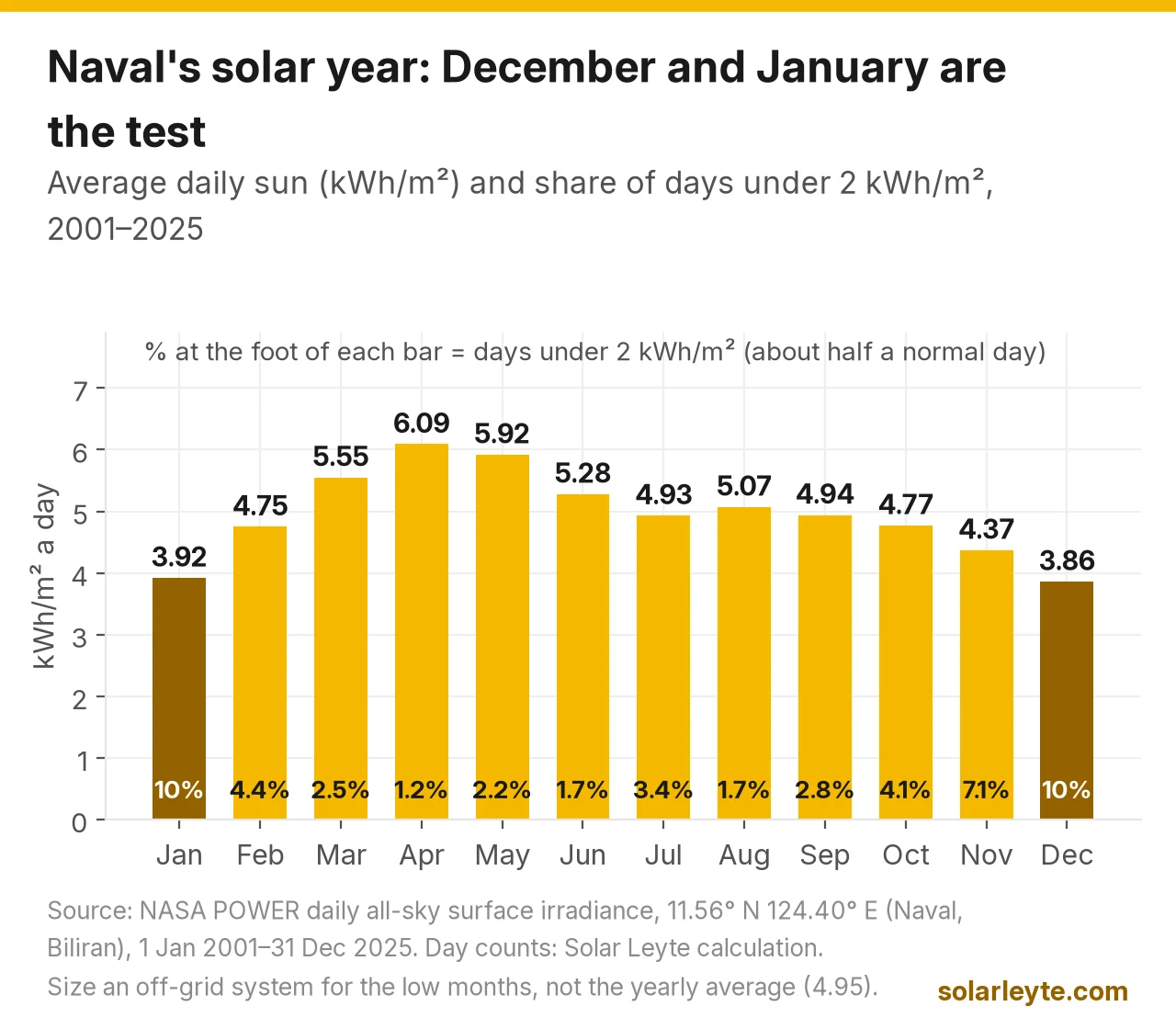
Source: NASA POWER daily all-sky surface irradiance for 11.56° N, 124.40° E (Naval), 1 January 2001 to 31 December 2025. Percentages are our count of days.
What this means:
- December is the weakest month, at 3.86 kWh/m² a day. April gives about 58% more.
- About 1 day in 10 in December and January gets under 2 kWh/m², roughly half a normal day's sun. Those are the days that empty batteries.
- Bad days come in runs. In a typical year (the median of 2001 to 2025), the worst 3 days in a row averaged just 1.58 kWh/m² a day. The worst run in the record was 14 to 16 December 2017, at 0.50 kWh/m² a day. That was when Tropical Storm Urduja crossed the region and caused deadly landslides in Biliran (Rappler).
PVGIS, which uses a different weather dataset (ERA5), puts Naval's annual average a bit higher, but it agrees that December and January are the low months. We size with the NASA December figure because it is the more cautious one.
How to size an off-grid system, step by step
Step 1: Add up your daily kWh
List only what you'll actually run, and how many hours. Our appliance kWh guide has DOE-label and Meralco-tested figures for the usual appliances. The three example homes below use these:
Load | Daily energy | Basis |
|---|---|---|
Four 9 W LED bulbs, 5 hours | 0.18 kWh | Meralco test, 0.009 kWh an hour per bulb |
16-inch stand fan, 8 hours | 0.38 kWh | Meralco test, 0.0476 kWh an hour |
32-inch LED TV, 4 hours | 0.15 kWh | DOE label median, 37 W |
Phone charging and a radio | 0.05 kWh | Our assumption |
Manual-defrost fridge, 4–7 cu ft | 0.65 kWh | DOE label median, 19.5 kWh a month |
Frost-free fridge, 7–10 cu ft | 0.90 kWh | DOE label median, 27 kWh a month |
Wi-Fi router, all day | 0.14 kWh | Meralco test, 0.006 kWh an hour |
Rice cooker 1.8 L, once a day | 0.34 kWh | Meralco test median, 0.3382 kWh per cooking |
1 HP surface water pump (750 W), 1 hour | 0.75 kWh | LakaSolar listing for a 750 W pump |
So the three homes come to:
- Home A, basic: 4 bulbs, 1 fan, TV, phones = 0.76 kWh a day
- Home B, with a fridge: Home A plus a second fan, a manual-defrost fridge and Wi-Fi = 1.93 kWh a day
- Home C, farm house: Home B with a bigger frost-free fridge, plus a rice cooker once a day and a 1 HP pump for an hour = 3.27 kWh a day
Leave out aircon, electric cooking and flat irons if you can. A single 1 HP inverter aircon can use more in one night than all of Home C uses in a day (see solar for aircon). Cook with LPG rather than electricity if you can.
Step 2: Size the panels for December
Panel kW ≈ daily kWh ÷ (December sun × 0.75)
The 0.75 is our allowance for heat, dust, wiring, charge-controller and battery losses. It's a planning assumption, not a manufacturer figure. With Naval's December average of about 3.9:
- Home A: 0.76 ÷ (3.9 × 0.75) = 0.26 kW
- Home B: 1.93 ÷ 2.925 = 0.66 kW
- Home C: 3.27 ÷ 2.925 = 1.12 kW
That's the minimum. As the next section shows, going over it is the cheapest reliability you can buy.
Step 3: Size the battery for 2 cloudy days
Battery kWh (nominal) ≈ daily kWh × 2 days ÷ 0.9 ÷ 0.9
- 2 days of storage covers the typical worst run of grey days in the NASA record, as long as the panels can refill the battery quickly afterwards.
- The first 0.9 is for inverter losses (our assumption).
- The second 0.9 keeps 10% in reserve. That matches the 90% recommended depth of discharge on the Hopetrek LiFePO4 datasheet in our battery price post.
That gives 1.9 kWh for Home A, 4.8 kWh for Home B and 8.1 kWh for Home C.
Extra panels beat extra battery
We ran Home B (1.93 kWh a day) through the PVGIS off-grid calculator for Naval with different panel and battery sizes. PVGIS simulates every day from 2005 to 2023 and counts how often the battery hits its cut-off, meaning the lights go out until the sun comes back.
Panels | Battery | January days the battery ran empty | Days it ran empty, whole year |
|---|---|---|---|
0.66 kW (sized to the December average) | 5.12 kWh | 12.8% (about 1 in 8) | 2.6% |
0.66 kW | 10.24 kWh | 5.7% (about 1 in 17) | 0.55% |
1.1 kW (two 550 W panels) | 2.56 kWh | 5.9% (about 1 in 17) | 2.2% |
1.1 kW (two 550 W panels) | 5.12 kWh | 1.9% (about 1 in 54) | 0.2% |
1.1 kW | 10.24 kWh | 0.8% (about 1 in 120) | 0.07% |
1.65 kW (three 550 W panels) | 5.12 kWh | 0.8% (about 1 in 120) | 0.1% |
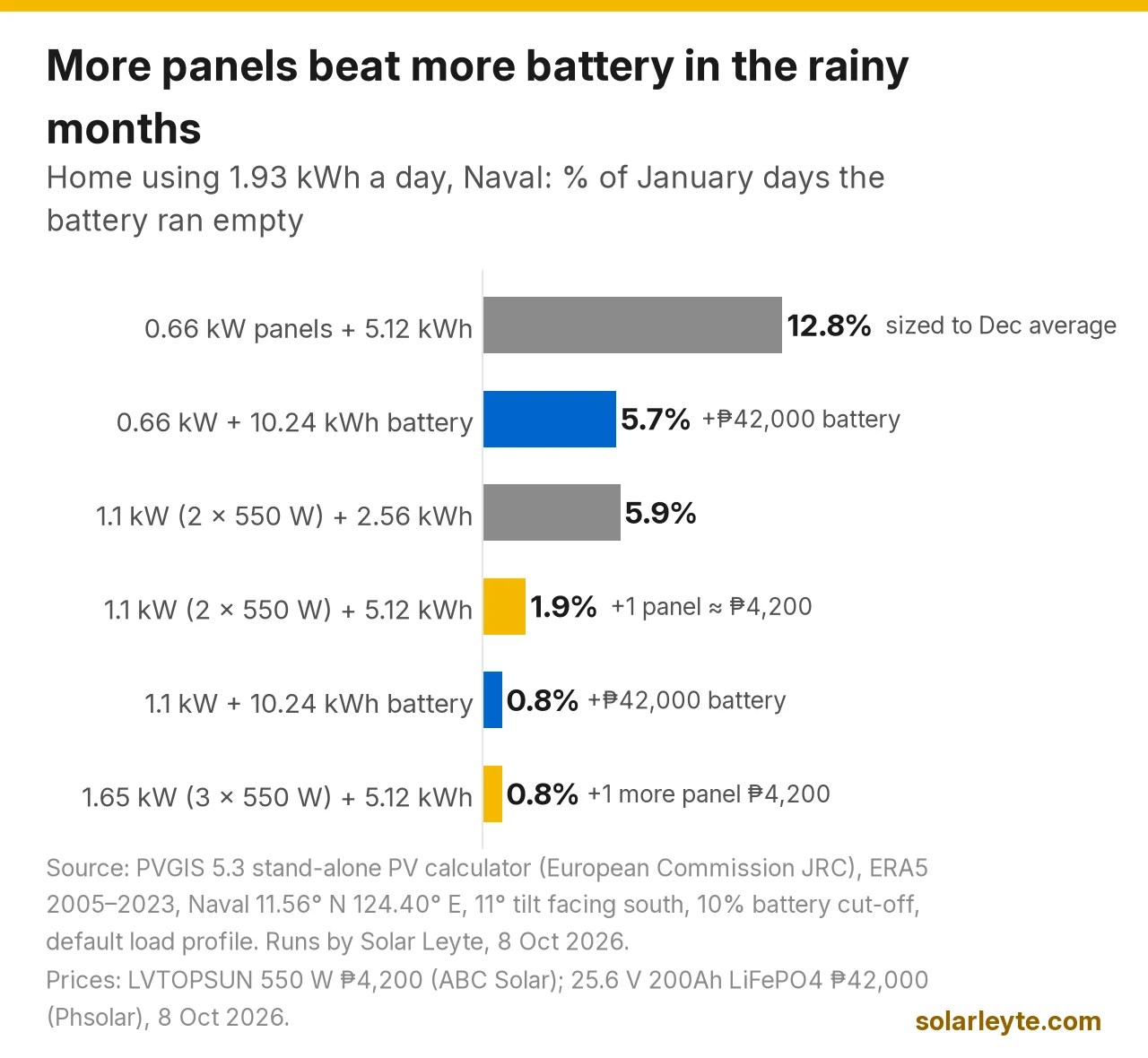
Source: PVGIS 5.3 stand-alone PV calculator (European Commission JRC), ERA5 weather 2005–2023, Naval (11.56° N, 124.40° E), panels at 11° facing south, 10% battery cut-off, PVGIS default daily load profile. Run by Solar Leyte on 8 October 2026.
What this means:
- Doubling the battery on the minimum panel array (₱42,000 more for a second 5.12 kWh battery at the price below) only cuts January blackouts from about 1 day in 8 to 1 in 17.
- Adding panels is far cheaper. A 550 W panel is listed at ₱4,200. Going from the bare minimum to two panels cuts January blackouts to about 1 day in 54, and a third panel gets you to about 1 in 120. That's the same result as doubling the battery on two panels, for a tenth of the extra cost.
- Panels do the refilling. A big battery doesn't help if the panels can't fill it again after a grey spell. That is why we size panels well above the December minimum.
Simulations aren't promises. Shade from coconut trees or a hill, dirty panels or a load you forgot to count will all make things worse. But the pattern is clear: in our climate, spend on panels first.
Three off-grid builds, priced (October 2026)
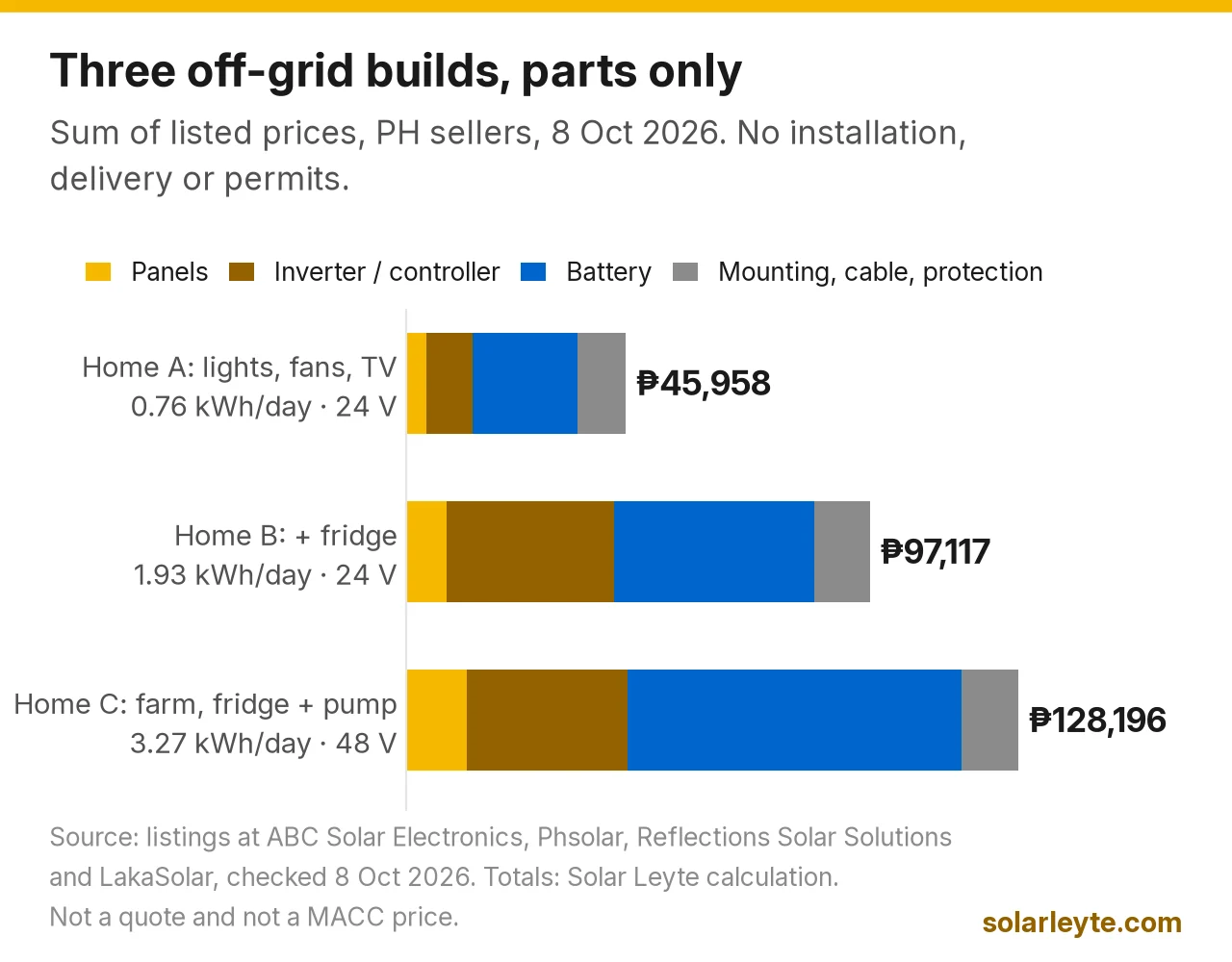
These are parts lists from Philippine online sellers, priced on 8 October 2026. They aren't packages and they aren't MACC prices. They show what the parts cost so you can judge a quote. Installation, delivery to your island or barangay, an electrical permit, earthing and a battery enclosure aren't included.
Home A: lights, fans, TV and phones (0.76 kWh a day, 24 V)
Part | Seller | Listed price |
|---|---|---|
1 × LVTOPSUN 550 W panel | ABC Solar Electronics | ₱4,200 |
SRNE SR-ML2430 MPPT charge controller, 30 A, 12/24 V | ABC Solar Electronics | ₱4,000 |
YCP 600 W 24 V pure sine wave inverter | ABC Solar Electronics | ₱5,600 |
LVFU 25.6 V 100Ah LiFePO4 battery (2.56 kWh) | Phsolar | ₱22,000 |
Mounting: 2 aluminium rails, 4 L feet, 4 end clamps | Reflections Solar Solutions | ₱1,858 |
DC solar cable, twin 4 mm², 50 m roll | Reflections Solar Solutions | ₱4,000 |
MC4 connector pair and IP66 DC isolator | LakaSolar | ₱2,300 |
DC battery breaker 125 A, DC surge protector, AC breaker, 2 m battery cable | Phsolar | ₱2,000 |
Total, parts only | ₱45,958 |
PVGIS check: 0.55 kW with 2.56 kWh ran empty on 0.8% of January days and 0.09% of all days. One panel is more than the 0.26 kW minimum, so this little system recovers quickly. The SR-ML2430 takes up to 100 V from the panels (per ABC's listing), so check the panel's open-circuit voltage (Voc) on its datasheet before you connect it.
Home B: add a fridge (1.93 kWh a day, 24 V)
Part | Seller | Listed price |
|---|---|---|
2 × LVTOPSUN 550 W panels | ABC Solar Electronics | ₱8,400 |
Axpert VM III 3 kVA 24 V inverter-charger with 80 A MPPT (ABC's page title says VM II) | ABC Solar Electronics | ₱35,000 |
LVFU 25.6 V 200Ah LiFePO4 battery (5.12 kWh) | Phsolar | ₱42,000 |
Mounting: 4 rails, 2 splice kits, 6 L feet, 4 end and 2 mid clamps | Reflections Solar Solutions | ₱3,417 |
DC solar cable, twin 4 mm², 50 m roll | Reflections Solar Solutions | ₱4,000 |
MC4 connector pair and IP66 DC isolator | LakaSolar | ₱2,300 |
Battery breaker, surge protector, AC breaker, battery cable | Phsolar | ₱2,000 |
Total, parts only | ₱97,117 |
Why an inverter-charger here, not a small inverter: a fridge compressor pulls a surge when it starts, and the Axpert also has a built-in solar charger and, per ABC's listing, can take "utility mains or generator input". That lets you plug in a small generator during a long grey spell now, and the co-op line later if it reaches you. PVGIS check: 1.1 kW with 5.12 kWh ran empty on 1.9% of January days.
Home C: farm house with fridge, pump and rice cooker (3.27 kWh a day, 48 V)
Part | Seller | Listed price |
|---|---|---|
3 × LVTOPSUN 550 W panels | ABC Solar Electronics | ₱12,600 |
SRNE HFP4850S80-H 5 kVA 48 V off-grid inverter-charger, 80 A solar charging, 10,000 VA peak | Reflections Solar Solutions ("last items in stock") | ₱33,600 |
Solarhome 51.2 V 230Ah LiFePO4 battery (11.78 kWh) | LakaSolar | ₱70,000 |
Mounting: 4 rails, 2 splice kits, 8 L feet, 4 end and 4 mid clamps | Reflections Solar Solutions | ₱3,696 |
DC solar cable, twin 4 mm², 50 m roll | Reflections Solar Solutions | ₱4,000 |
MC4 connector pair and IP66 DC isolator | LakaSolar | ₱2,300 |
Battery breaker, surge protector, AC breaker, battery cable | Phsolar | ₱2,000 |
Total, parts only | ₱128,196 |
If the SRNE unit is sold out, ABC lists an Axpert VM III 5 kVA 48 V with an 80 A MPPT at ₱45,000, which would bring the total to about ₱139,600. PVGIS check for Home C: 1.65 kW with 11.78 kWh ran empty on 1.35% of January days and 0.13% of all days. With only two panels (1.1 kW), the same battery ran empty on 10.6% of January days, another case where one more panel does more than a bigger battery.
Notes on the parts:
- Battery voltage must match the inverter. Homes A and B use 24 V (25.6 V LiFePO4) batteries; Home C uses a 48 V (51.2 V) battery. For bigger systems, 48 V keeps the currents and cables smaller.
- Prices are from sellers in Cebu (ABC Solar Electronics) and Luzon (Phsolar, LakaSolar, Reflections Solar Solutions in Biñan, Laguna). Ask for the freight cost to Biliran or your town before you pay. Batteries are heavy, so ask how they ship.
- The panel listing is the cheapest 550 W panel we found. Our 5kW price post lists 550 W panels from ₱4,200 to ₱8,500. A better-known brand may cost more but come with a clearer warranty.
- Check the PV input range on the inverter's datasheet before you decide how many panels to wire in series.
What usually goes wrong off-grid
- The load creeps up. A rice cooker, then a second fridge, then an aircon "for the kids". Every extra kWh a day needs about 0.34 kW more panels and 2.5 kWh more battery by our sizing rules. Re-check the numbers before you plug in anything big.
- Shade. A coconut tree that shades the panels for two hours in the afternoon can take out a big share of a December day. Put the array where it gets full sun from about 9 am to 3 pm, all year.
- The battery lives in the wrong place. Keep it indoors, dry, shaded and above flood level. Some home LiFePO4 batteries, like the Hopetrek units in our battery post, are rated IP20, which means indoor use only.
- Typhoons. Off-grid arrays are often on light roofs or simple ground frames. The fixings matter more than the panels. See our typhoon installation guide and the before, during and after checklist.
- Salt air. Near the shore, ask for aluminium rails and stainless fasteners, and check terminals and MC4 connectors for corrosion every few months.
- Nobody nearby can fix it. Ask who handles warranty claims in Eastern Visayas, and keep the datasheets and receipts in a dry folder (how to choose an installer).
Off-grid, hybrid or a portable power station?
- No co-op line, and you want a fridge or a pump: an off-grid system like Home B or C.
- No line, and you only need lights and phones: a small DC kit or a power station can be enough. Our solar generator price comparison compares cost per Wh.
- Pumping water only: a pump that runs straight from the panels in daytime, with no battery, is usually cheaper. See our solar water pump guide.
- You have a co-op connection but long brownouts: a hybrid system with a battery, sized for your brownout hours (battery sizing, hybrid inverter prices).
FAQ
How much does an off-grid solar system cost in the Philippines? Using listed prices on 8 October 2026, the parts for our three example homes came to about ₱46,000 (lights, fans, TV), ₱97,000 (plus a fridge) and ₱128,000 (farm house with a fridge, pump and rice cooker). Installation and delivery are extra.
How many solar panels do I need for an off-grid house? Divide your daily kWh by about 2.9 (Naval's December sun of 3.9 × 0.75) to get the minimum kW of panels, then go above it. For 1.93 kWh a day, the minimum is 0.66 kW, and two 550 W panels worked much better in the PVGIS simulation.
How big a battery do I need for cloudy days? About 2.5 times your daily kWh in nominal LiFePO4 capacity covers 2 days of storage with a 10% reserve. For 1.93 kWh a day, that's about 4.8 kWh, so a 5.12 kWh battery.
Can an off-grid system run an aircon? Not the systems in this post. A night of aircon can use more than Home C's whole day. Plan a much bigger battery and array, or skip the aircon.
Do I still need a generator? Not usually, if the panels are sized well above the December minimum. Some families keep a small one for the few worst days a year. An inverter-charger with a generator input, like the Axpert in Home B, makes that easy.
Solar Leyte is run by MACC Systems & Energy Solutions Inc., a solar installer in Naval, Biliran.
Get a free off-grid sizing from MACC
Tell us where the house or farm is, what you want to run and for how many hours. We'll size the panels and battery for December, not April, and show you the math, with no obligation.
- Call/Text: 0955 723 5093
- Email: official@macc-inc.com or benjie@macc-inc.com
- Website: www.macc-inc.com
- Office: Brgy. Talustusan, Naval, Biliran 6543
Sources (all checked 8 October 2026)
- NASA Langley Research Center, POWER Data Access: daily all-sky surface shortwave irradiance (ALLSKY_SFC_SW_DWN) for 11.56° N, 124.40° E, 2001–2025 (Solar Leyte download and counts)
- European Commission JRC, PVGIS 5.3: stand-alone (off-grid) PV calculator and monthly radiation for Naval, ERA5 data (Solar Leyte runs)
- BILECO, official website (barangay, sitio and house-connection energization)
- Daily Tribune, Higatangan Island welcomes illumination (2 January 2026)
- BusinessWorld, Capul and Maripipi islands now have 24/7 power supply (22 November 2017)
- National Power Corporation, Status of NPC projects as of 31 March 2026 (PDF) (Maripipi 150 kWp solar PV-diesel hybrid with ESS)
- DOE, PV Mainstreaming dashboard (data updated 3 October 2026)
- NEA, NEA pushes for 94% electrification rate in 2025
- Rappler, 26 dead in Biliran landslides after Urduja
- Seller listings: ABC Solar Electronics, LVTOPSUN 550 W panel, SRNE SR-ML 30A MPPT, YCP 600 W 24 V inverter, Axpert 3 kVA 24 V, Axpert 5 kVA 48 V; Phsolar, LVFU 12.8–25.6 V batteries, DC battery breaker, DC SPD, AC MCB, battery cable; Reflections Solar Solutions, SRNE HFP4850S80-H, mounting parts, DC solar cable; LakaSolar, Solarhome 51.2 V 230Ah, MC4 pair, IP66 DC isolator, 2" 1 HP surface pump (750 W)
- Appliance figures: DOE energy labels and Meralco tests, as cited in How Many kWh Do Your Appliances Use?