On 8 October 2026, Philippine sellers listed 550 W to 630 W solar panels at ₱4,200 to ₱8,500 each. Per watt, that's ₱7.64 to ₱15.45, a twofold spread for panels of almost the same size. The cheapest 600 W-class panel we found was a 620 W Seraphim at ₱5,000 (₱8.06 per watt). The cheapest 550 W was ₱4,200 (₱7.64 per watt).
Pila man ang usa ka panel? Below is every listing we could check on the seller's own page, with the date. Then we go through manufacturer datasheets from LONGi, Jinko and Trina to show what the watts on the label mean in practice: how much roof you need, how heavy the panels are, what the typhoon load ratings say, and the part most buyers miss, whether a 600 W+ panel actually suits your inverter.
This is a per-panel post. For a full system priced line by line, see our itemised 5kW solar system price. For how many panels your house needs, see how many solar panels do I need.
Prices checked 8 October 2026 (Philippine time) on each seller's own website. They change often. Listing a product isn't an endorsement, and Solar Leyte earns nothing from these links. Nothing here is a MACC price or a quote.
550W to 630W panel prices: the quick answer (8 October 2026)
Panel (as listed) | Seller | Listed price | ₱ per watt (our calculation) |
|---|---|---|---|
LVTOPSUN 550 W mono | ABC Solar Electronics, Cebu | ₱4,200 | ₱7.64 |
Seraphim 620 W TOPCon bifacial (15-year warranty per listing) | Helios Optimum Development | ₱5,000 | ₱8.06 |
Letovo 580 W half-cell | Letovo | ₱5,200 | ₱8.97 |
Letovo 630 W half-cell | Letovo | ₱6,100 | ₱9.68 |
Osda 610 W half-cell | Letovo | ₱6,950 | ₱11.39 |
Sunova 550 W mono PERC | Phsolar | ₱6,700 | ₱12.18 |
AE 550 W mono PERC | Phsolar | ₱7,000 | ₱12.73 |
Taifu 590 W | KHM Megatools | ₱7,750 | ₱13.14 |
Bravus BSPANEL 600 W | Powertool.ph and ToolsSavvy.ph | ₱8,140 | ₱13.57 |
AE Solar MD-144 550 W (15-year product, 30-year performance warranty per listing) | Reflections Solar Solutions | ₱8,500 | ₱15.45 |
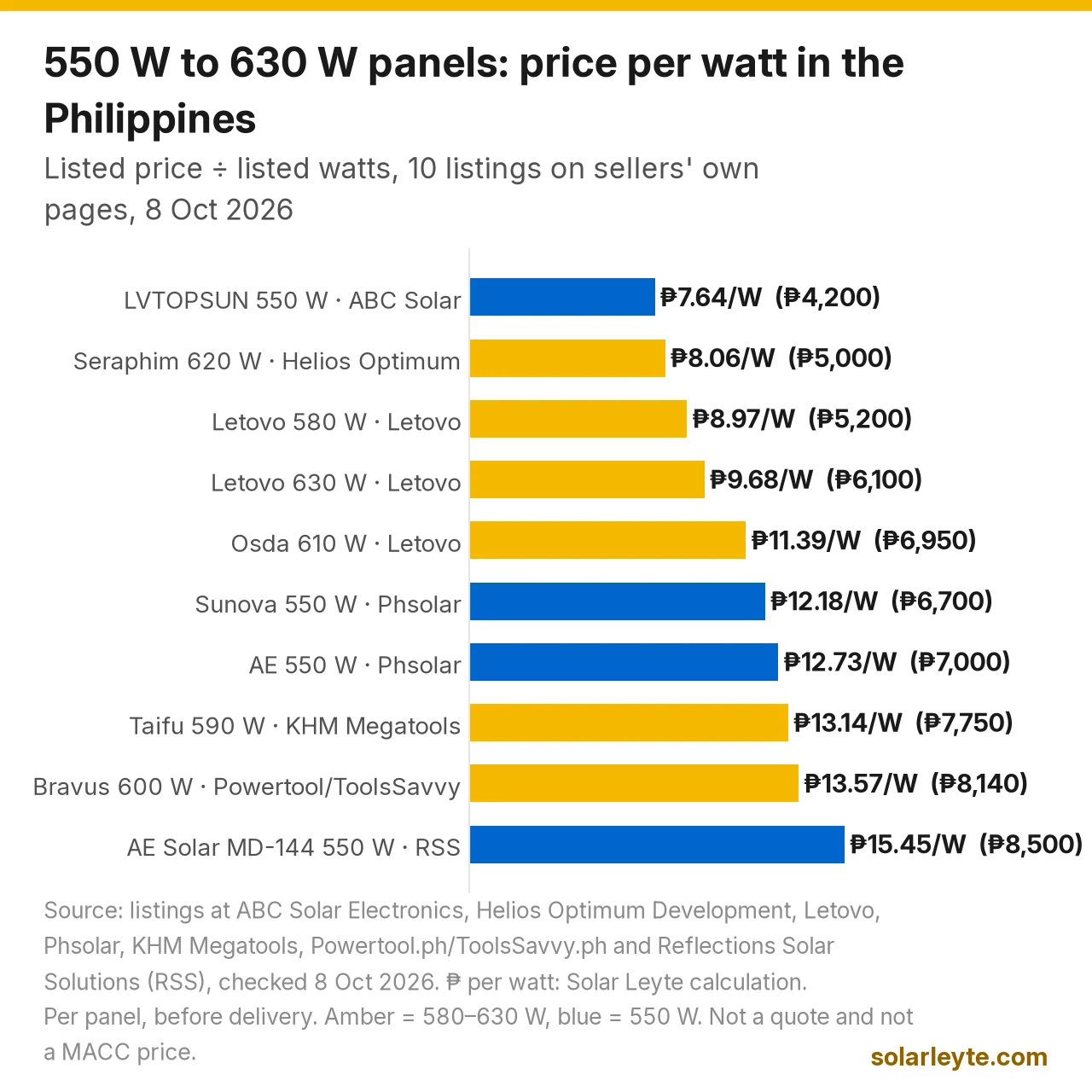
Prices are per panel, before delivery. ₱ per watt divides the price by the listed wattage. The middle of these ten listings is about ₱11.80 per watt (our calculation).
Also seen but not in the table:
- Out of stock at Letovo: 550 W at ₱4,800, 595 W (OSDA) at ₱5,680, 620 W at ₱5,700, and a 630 W "Otherbrand" panel at ₱6,200.
- Above this range: Reflections Solar Solutions lists a Blue Sun 700 W bifacial panel at ₱13,000 (₱18.57 per watt).
- No price shown: LakaSolar lists Trina Vertex panels (500, 550 and 610 W) as "Contact for Price". Sungrid Energy's Jinko 585 W page shows a ₱1.00 placeholder, not a real price.
- Big brands are hard to price online. We couldn't find a LONGi, Jinko, Trina, JA Solar or Canadian Solar panel in the 550–620 W range with a real peso price on a Philippine seller's own page. Installers quote those, so ask for the brand and exact model on any quote.
What stands out in the prices
- Per panel, a bigger panel isn't always dearer. The 620 W Seraphim (₱5,000) was cheaper than three of the four 550 W listings. Compare ₱ per watt, not the price tag.
- The same wattage varies a lot. Four 550 W listings ran from ₱4,200 to ₱8,500, ₱4,300 apart. The listings don't all show datasheets or warranty terms, which is part of the gap.
- Extra watts can cost more than they're worth. At Letovo, the 610 W Osda is ₱1,750 more than the 580 W Letovo panel for 30 W more. That's about ₱58 per extra watt. Those 30 W make about 3 kWh a month in Leyte or Biliran (our planning figure, below), worth about ₱60 a month at BILECO's September rate. Pay for extra watts only if roof space is tight.
- Check what the listing really says. On Letovo's 610 W and 630 W pages (and its out-of-stock 595 W and 620 W pages), the specification text below the title describes a 550 W panel (Voc 50.11 V, Isc 14.49 A, 27.7 kg). Ask any seller for the datasheet of the exact model before you buy, because you need the real voltage and current to wire it correctly (see the inverter section below).
- Weight is a clue. The Bravus 600 W is listed at 38.5 kg. The 580–620 W datasheet panels below weigh 31.0 to 34.6 kg. Ask why a panel is heavier before you put 10 of them on a roof.
What the watts mean: datasheets compared
The wattage on the label is the panel's power at standard test conditions: 1,000 W/m² of sunlight and a cell temperature of 25 °C. Two panels with the same wattage can be very different products. Here are five from manufacturer datasheets, plus the AE Solar 550 W from its seller listing:
Panel | Watts | Size (mm) | Weight | Efficiency | Voc / Isc | Temp. coeff. of power |
|---|---|---|---|---|---|---|
AE Solar MD-144 (seller listing, mono-facial) | 550 W | 2,278 × 1,133 × 30 | 26.5 kg | 21.31% | not listed | not listed |
LONGi Hi-MO 7 LR5-72HGD-580M | 580 W | 2,278 × 1,134 × 30 | 31.8 kg | 22.5% | 51.41 V / 14.22 A | −0.280%/°C |
Jinko Tiger Neo JKM580N-72HL4-BDV | 580 W | 2,278 × 1,134 × 30 | 31.0 kg | 22.45% | 52.50 V / 13.95 A | −0.29%/°C |
Jinko Tiger Neo JKM600N-72HL4-BDV | 600 W | 2,278 × 1,134 × 30 | 31.0 kg | 23.23% | 53.30 V / 14.19 A | −0.29%/°C |
Jinko Tiger Neo JKM600N-78HL4-BDV | 600 W | 2,465 × 1,134 × 35 | 34.6 kg | 21.46% | 55.03 V / 13.87 A | −0.30%/°C |
Trina Vertex N TSM-620NEG19RC.20 | 620 W | 2,382 × 1,134 × 30 | 33.7 kg | 23.0% | 49.6 V / 15.91 A | −0.29%/°C |
All figures at standard test conditions, from each maker's datasheet (sources at the end). The five LONGi, Jinko and Trina panels are bifacial, with glass on both sides.
Three things the table shows:
- More watts in the same frame means higher efficiency. The AE 550 W, the LONGi and Jinko 580 W and the Jinko 600 W all use a 2,278 × 1,134 mm frame. The extra watts come from better cells (21.31% up to 23.23%), not a bigger panel. That's what you pay for when roof space is tight.
- More watts in a bigger frame is just a bigger panel. Jinko sells a 600 W panel in two sizes. The 78-cell version is 187 mm longer and 3.6 kg heavier, and its efficiency is lower (21.46% against 23.23%). Same 600 W, more roof.
- Heat costs every panel some power. The temperature coefficients mean each panel loses about 0.28–0.30% of its power for every °C its cells run above 25 °C. On a hot roof with cells at 60 °C (an example, not a measurement), that's roughly 10% below the label (our calculation). None of them make their full label watts at noon in April.
Bifacial "rear gain" numbers need a bright surface behind the panel. Datasheets list extra watts from light hitting the back of the panel, but they say that gain depends on the surface behind it (Trina: "depending on albedo"). Flat on a metal or concrete roof, the back sees little light. Don't pay extra for rear-gain figures on a normal home roof.
Power tolerance should be positive only. LONGi and Jinko list 0 to +3%, and Trina 0 to +5 W, so a panel shouldn't test below its label. Ask for this on lesser-known brands.
How much roof, and how heavy
Panel | Panel area | Roof per kWp | Weight per m² |
|---|---|---|---|
AE Solar 550 W | 2.58 m² | 4.69 m² | 10.3 kg |
LONGi or Jinko 580 W | 2.58 m² | 4.45 m² | 12.0–12.3 kg |
Jinko 600 W (72HL4) | 2.58 m² | 4.31 m² | 12.0 kg |
Jinko 600 W (78HL4) | 2.80 m² | 4.66 m² | 12.4 kg |
Trina 620 W | 2.70 m² | 4.36 m² | 12.5 kg |
Panel area only, from datasheet dimensions (our calculation). Your installer also needs room at roof edges and walkways.
For a 5 kW system, the difference is a few square metres. Nine 550 W panels (4.95 kWp) take 23.2 m² and weigh 238.5 kg (AE Solar size). Eight 620 W Trina panels (4.96 kWp) take 21.6 m² and weigh 269.6 kg (our calculations). One fewer panel also means fewer clamps, roof fixings and connectors.
The dual-glass panels are heavier per square metre. At 12 kg/m² or so, plus rails, ask your installer to check the roof framing, not just the roof sheet. Each 600 W-class panel is over 2.2 m long and weighs 31 to 35 kg, so handling on a sloped roof, especially on a two-storey house, is a job for at least two people.
Typhoon load ratings are the same across these panels. The LONGi, Jinko and Trina datasheets all list 5,400 Pa on the front and 2,400 Pa on the back as test loads. A 2,400 Pa uplift is about 245 kg per square metre (our conversion). Those are test loads for a panel mounted the way the maker's manual says, not a wind speed rating. Our typhoon checklist explains what the numbers mean and why the rails and fixings matter more.
Will a 600W panel work with your inverter?
This is where bigger panels catch people out. Each inverter input has a voltage limit and a current limit. The newest 600 W+ panels push more current than many home inverters were designed for.
Here are three hybrid inverters from our hybrid inverter price guide, with their PV input limits from the makers' datasheets:
Inverter | Max PV voltage | MPPT range | Max operating current per input | Max short-circuit current per input |
|---|---|---|---|---|
Deye SUN-5K-SG03LP1 (5 kW) | 500 V | 150–425 V | 13 A | 17 A |
SRNE HESP 4–6 kW | 500 V | 120–450 V | 16 A | 27 A |
Sungrow SH5.0RS | 600 V | 40–560 V | 16 A | 20 A |
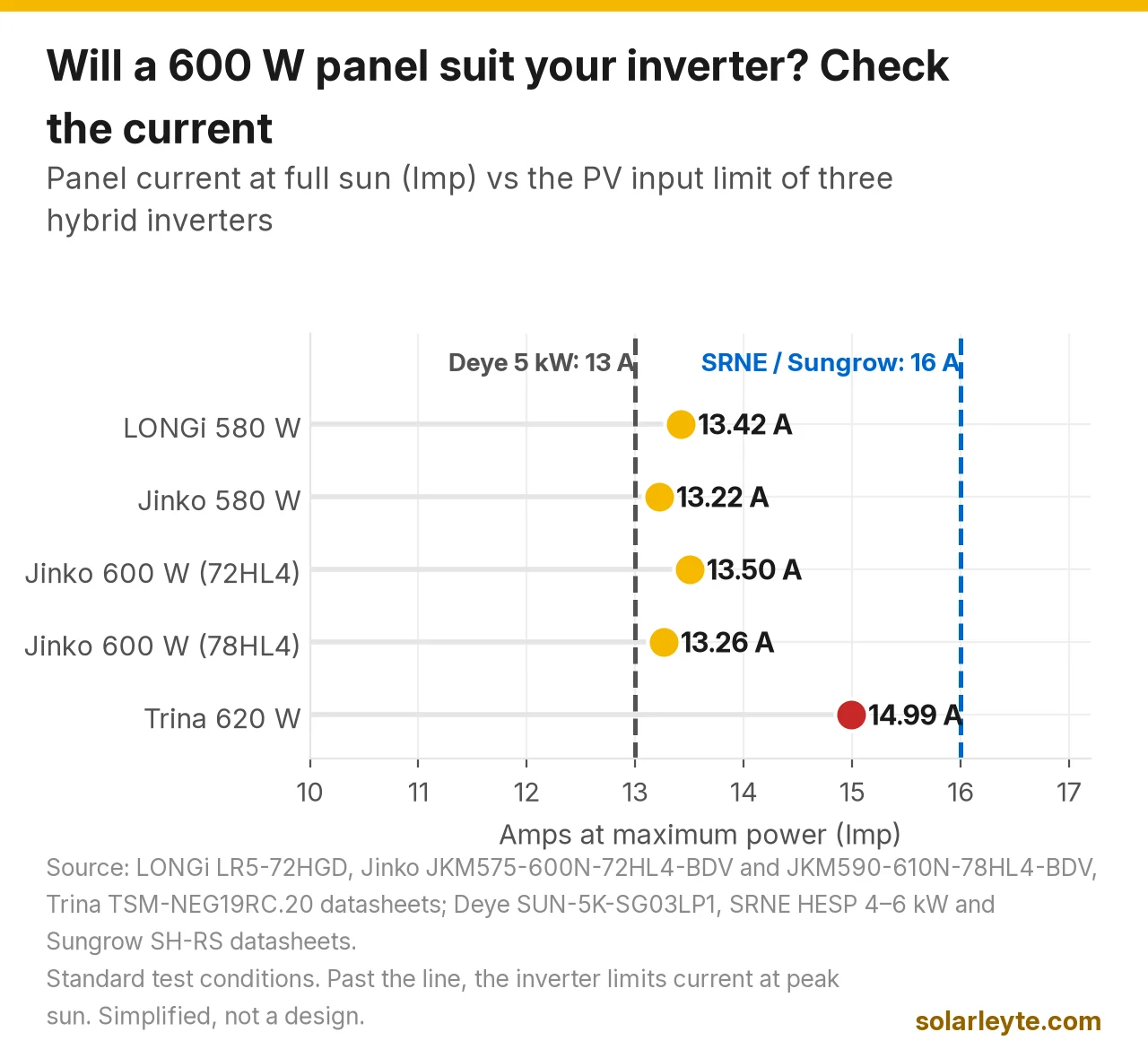
Current first. At full sun, a panel's operating current (Imp) is 13.22 A for the Jinko 580 W, 13.42 A for the LONGi 580 W, 13.50 A for the Jinko 600 W and 14.99 A for the Trina 620 W. The Deye 5 kW takes up to 13 A per input. If the panel pushes more, the inverter simply holds it at 13 A and the extra is lost while it lasts.
- With the 580–600 W panels, that's 2% to 4% over 13 A at peak sun. A small, short loss.
- With the Trina 620 W, it's 15% over. At that moment each panel would be held to about 538 W instead of 620 W (13 A × 41.4 V, our simplified calculation). Over a whole day the loss is smaller, because panels only reach full current around midday on clear days. We didn't model the yearly loss.
- The SRNE and Sungrow units (16 A per input) take all five panels' current without clipping.
- Short-circuit current matters for safety. The Trina 620 W's 15.91 A is under the Deye's 17 A limit at test conditions, but with 10% rear-side gain Trina lists 17.50 A, which is over it. Ask your installer to check the panel's Isc against the inverter's limit, with margin.
Then voltage. Panel voltage rises when it's cool, so the string has to stay under the inverter's maximum on the coldest morning. NASA POWER's daily records for Naval from 2001 to 2025 never went below 21.5 °C. We used 15 °C to leave a margin, because panels can cool below the air temperature before dawn.
Panel | Voc at 15 °C (our calculation) | Most in one string, 500 V inverter | Most in one string, 600 V inverter |
|---|---|---|---|
LONGi 580 W | 52.6 V | 9 | 11 |
Jinko 580 W (72HL4) | 53.8 V | 9 | 11 |
Jinko 600 W (72HL4) | 54.6 V | 9 | 10 |
Jinko 600 W (78HL4) | 56.4 V | 8 | 10 |
Trina 620 W | 50.8 V | 9 | 11 |
Voc at 15 °C = Voc × (1 + temperature coefficient of Voc × (15 − 25)), using each datasheet's coefficient. This is a planning check, not a design. Your installer should use the exact panel and inverter documents.
- So on a 500 V inverter like the Deye 5 kW, nine is usually the limit per string, and eight for the longer 78-cell Jinko 600 W. Nine 600 W-class panels on each of its two inputs is already well above its 6,500 W PV limit, so this rarely bites on a 5 kW home system.
- Short strings can fail too. The Deye's tracker works from 150 V. Four Trina 620 W panels make about 166 V at test conditions (4 × 41.4 V), and voltage drops further on a hot afternoon. Ask your installer to check both ends of the range.
- Small off-grid charge controllers are the bigger trap. A 100 V controller like the SRNE SR-ML2430 in our off-grid solar guide can take only one 600 W-class panel per string. Two LONGi 580 W panels in series reach about 105 V at 15 °C (our calculation).
How much one panel makes in Leyte and Biliran
Our planning figure, the same one used in our panel sizing guide, is about 105 kWh a month for each kWp of panels, after shade, heat, dust and wiring losses. The European Commission's PVGIS model (ERA5 weather 2005–2023, 14% system losses, 11° tilt facing south) gives a bit more:
Location (PVGIS) | Per kWp per year | Per kWp per month, average | Weakest month |
|---|---|---|---|
Naval, Biliran | 1,487 kWh | 124 kWh | January, 113 kWh |
Ormoc, Leyte | 1,481 kWh | 123 kWh | January, 111 kWh |
Tacloban, Leyte | 1,413 kWh | 118 kWh | January, 102 kWh |
Per panel, that works out to (our calculations):
Panel | Planning figure (105 kWh per kWp a month) | PVGIS Naval, average month | Value of the planning figure at BILECO ₱18.93/kWh |
|---|---|---|---|
550 W | 57.8 kWh | 68.2 kWh | about ₱1,093 a month |
580 W | 60.9 kWh | 71.9 kWh | about ₱1,153 a month |
600 W | 63.0 kWh | 74.4 kWh | about ₱1,193 a month |
620 W | 65.1 kWh | 76.8 kWh | about ₱1,232 a month |
BILECO's September 2026 residential rate is ₱18.93/kWh per PRESYO-PH (BILECO rate tracker). The peso value assumes every kWh is used at home. Exported kWh under net metering earn less, so treat this as the top end.
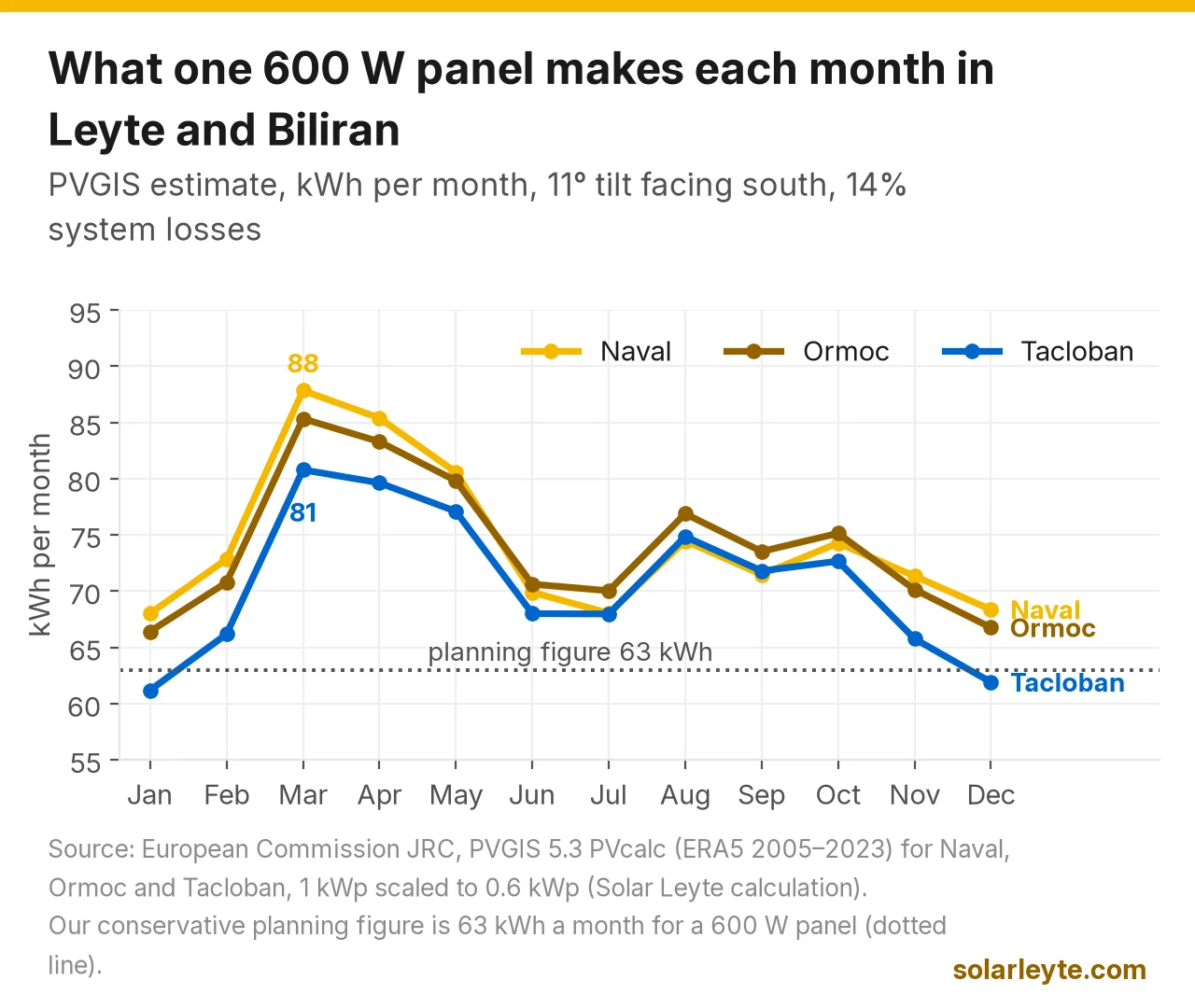
Month by month, one 600 W panel at Naval makes about 88 kWh in March and 68 kWh in January (PVGIS, our scaling from 1 kWp). Ormoc is close behind (66 kWh in January), and Tacloban runs lower, about 81 kWh in March and 61 kWh in January.
The step from 550 W to 620 W adds about 7 kWh a month per panel. That's real but small. On a roof with room to spare, the cheapest ₱ per watt usually wins. On a tight roof, higher-efficiency panels in the standard 2,278 × 1,134 mm frame let you fit more kWp.
How to compare panel quotes
- Brand and exact model number, with the datasheet. "600 W mono" isn't a model.
- ₱ per watt, not ₱ per panel. Divide the panel line by the total watts.
- Size and weight from the datasheet, so your installer can plan the roof and the lift.
- Voc, Isc and Imp, checked against your inverter's voltage and current limits per input.
- Warranty in writing: the LONGi, Jinko and Trina datasheets above list a 12-year product warranty and a 30-year power warranty. Ask who handles a claim in Eastern Visayas. Our installer guide covers warranty papers.
- Mounting: test loads of 5,400 Pa front and 2,400 Pa rear, mounted per the maker's manual. See our typhoon guide.
- Delivery: several of the sellers above are in Cebu, Cavite or Metro Manila. Ask about freight and breakage to Leyte or Biliran.
Our solar panel price guide has the full list of questions to ask on any quote.
FAQ
How much is a 550W solar panel in the Philippines? On 8 October 2026, 550 W panels were listed at ₱4,200 (LVTOPSUN, ABC Solar Electronics) to ₱8,500 (AE Solar MD-144, Reflections Solar Solutions), or ₱7.64 to ₱15.45 per watt.
How much is a 600W solar panel in the Philippines? 600 W-class listings ran from ₱5,000 for a 620 W Seraphim (Helios Optimum Development) to ₱8,140 for a Bravus 600 W (Powertool.ph and ToolsSavvy.ph). Letovo listed a 630 W panel at ₱6,100 and a 610 W Osda at ₱6,950.
Is a 620W panel better than a 550W panel? Not automatically. It's better if it has higher efficiency and you're short of roof space. Check the price per watt, the datasheet, and whether its current suits your inverter. The Trina 620 W pushes 14.99 A at full sun, more than the 13 A per input a Deye 5 kW hybrid takes.
How big is a 600W solar panel? The Jinko 600 W comes in 2,278 × 1,134 mm (31.0 kg) and 2,465 × 1,134 mm (34.6 kg) versions. The Trina 620 W is 2,382 × 1,134 mm and 33.7 kg.
How many kWh does a 600W solar panel produce in Leyte? About 63 kWh a month using our conservative planning figure, or about 74 kWh in an average month at Naval using PVGIS. January is the weakest month.
How many 600W panels for a 5kW system? Eight 620 W panels make 4.96 kWp, and nine 550 W panels make 4.95 kWp. See our 5kW solar system price for the rest of the parts.
Solar Leyte is run by MACC Systems & Energy Solutions Inc., a solar installer in Naval, Biliran.
Get a free solar quote from MACC
Not sure which panel fits your roof and inverter? Send us a photo of your latest BILECO or LEYECO bill and your roof. We'll size the system, list every part by brand and model with its datasheet, and show you the savings math, with no obligation.
- Call/Text: 0955 723 5093
- Email: official@macc-inc.com or benjie@macc-inc.com
- Website: www.macc-inc.com
- Request a quote online: solarleyte.com/quote
- Office: Brgy. Talustusan, Naval, Biliran 6543
Sources (all checked 8 October 2026)
- Panel listings: ABC Solar Electronics, LVTOPSUN 550 W; Helios Optimum Development, Seraphim 620 W TOPCon bifacial; Letovo, 580 W, 630 W, 610 W Osda, 620 W, 595 W OSDA, 550 W and 630 W Otherbrand; Phsolar, Sunova 550 W and AE 550 W; KHM Megatools, Taifu 590 W; Powertool.ph, Bravus BSPANEL 600 W and ToolsSavvy.ph, same panel; Reflections Solar Solutions, AE Solar MD-144 550 W and Blue Sun 700 W; LakaSolar, Trina Vertex 500/550/610 W; Sungrid Energy, Jinko 585 W
- Panel datasheets: LONGi, Hi-MO 7 LR5-72HGD 560–590M (V19.3, distributor-hosted copy); Jinko Solar, Tiger Neo JKM575-600N-72HL4-BDV and Tiger Neo JKM590-610N-78HL4-BDV; Trina Solar, Vertex N TSM-NEG19RC.20 590–620 W
- Inverter datasheets (as used in our hybrid inverter price guide): Deye SUN-5K-SG03LP1, SRNE HESP 4–6 kW, Sungrow SH-RS
- Sun and temperature: European Commission JRC, PVGIS 5.3 (PVcalc, ERA5 2005–2023, 1 kWp, 14% loss, 11° tilt, south) for Naval, Ormoc and Tacloban; NASA, POWER daily T2M_MIN for 11.56 N, 124.40 E, 2001–2025
- Rates and planning figure: Solar Leyte, BILECO rate tracker (PRESYO-PH, September 2026) and panel sizing guide (105 kWh per kWp a month)