Wiring panels in series adds their voltages and keeps the current of one panel. Wiring them in parallel adds the currents and keeps the voltage of one panel. Which one you need depends on your inverter or charge controller, not on the panels. A string has to stay under the inverter's maximum input voltage on the coolest morning, and stay above its MPPT minimum on the hottest noon. For a Deye 5 kW hybrid with Jinko 580 W panels, that works out to 5 to 9 panels per string. For four 100 W "12 V" panels on a 24 V battery, 2 in series × 2 in parallel is the setup that fits.
Below is the maths for both, with datasheet numbers and PAGASA temperature records, so you can check your own setup.
Last checked 30 October 2026. All panel, inverter and controller figures are from the makers' datasheets and manuals in the Sources. String voltages, temperatures used for design and the worked examples are Solar Leyte calculations with the assumptions stated. This is a guide for understanding and checking a design, not a wiring plan for your house.
Series, parallel and series-parallel in one table
Wiring | Voltage | Current | Example: four Renogy 100 W panels (Voc 24.3 V, Isc 5.21 A) | Typical use |
|---|---|---|---|---|
Series (positive of one to negative of the next) | Adds up | Same as one panel | 97.2 V, 5.21 A | Grid-tie and hybrid inverters with a high-voltage MPPT |
Parallel (all positives together, all negatives together) | Same as one panel | Adds up | 24.3 V, 20.84 A | Small 12 V systems, PWM controllers |
Series-parallel (2 strings of 2) | Adds within a string | Adds across strings | 48.6 V, 10.42 A | 24 V battery systems, MPPT controllers |
Voc and Isc are at standard test conditions (25 °C cell, 1,000 W/m²) from the Renogy RNG-100D-SS datasheet. Real voltage moves with temperature, which is the whole point of the next section.
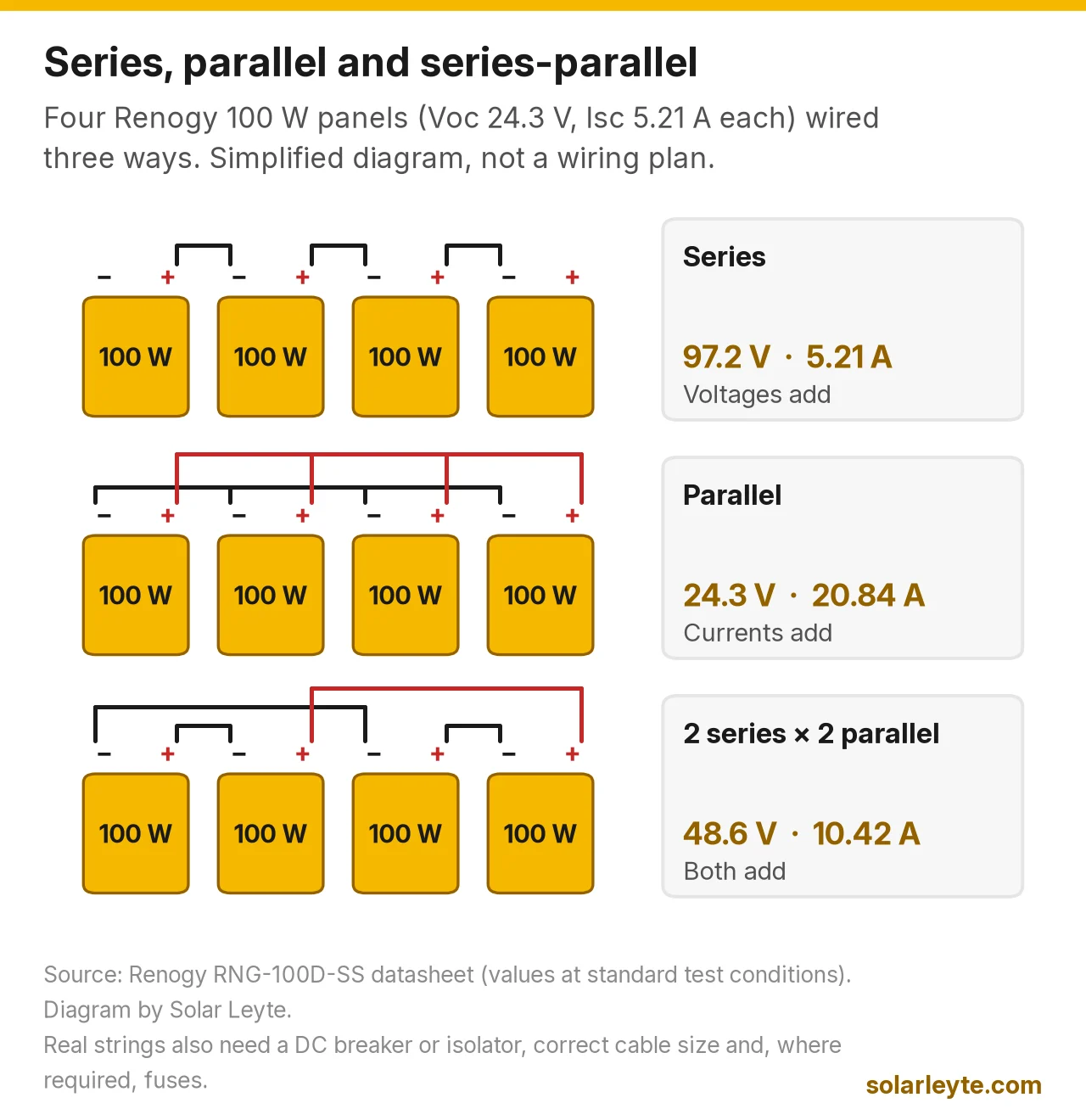
The power is the same either way. What changes is whether your inverter or controller can use it. If you know the MPPT vs PWM difference already, this is the next step.
Why temperature matters: cold mornings and hot noons
Panel voltage goes up when the panel is cold and down when it's hot. Datasheets give this as a temperature coefficient. The Jinko JKM580N-72HL4-BDV lists Voc at −0.25% per °C. Renogy's 100 W lists −0.28% per °C.
So check the string twice:
- Cold check (maximum voltage): Voc at the lowest temperature must stay below the inverter's maximum input voltage. Jinko's installation manual gives the formula: N × Voc × [1 + TCVoc × (Tmin − 25)]. The PEC (Article 6.90.2.1) also says the maximum PV voltage is the Voc sum corrected for the lowest expected ambient temperature. On one- and two-family homes, it caps PV DC circuits at 600 V.
- Hot check (minimum voltage): the operating voltage (Vmp) on a hot noon must stay above the MPPT minimum. If it drops below, the inverter loses power or stops tracking.
What "cold" and "hot" mean in Leyte and Biliran
PAGASA's record low at Tacloban is 17.5 °C (December 1904), and the record high is 38.0 °C (1924), over records from 1903 to 2025. The 1991–2020 normals are milder still: the lowest monthly average minimum is 23.7 °C in February. NASA POWER's daily data for Naval since 2001 never goes below 21.5 °C.
For design, we use:
- Cold: 15 °C. That's below the Tacloban record low, for some margin. In Baguio, Mindanao highlands or anywhere cooler, use your own local low.
- Hot cell: 70 °C. Cells run much hotter than the air. Renogy's NOCT of 47 °C, put into the standard NOCT formula at a 38 °C day and full sun, gives a cell temperature of about 72 °C. Jinko rates its panel for operation up to +70 °C. Panels flat on a roof can run hotter, so leave some margin.
Neither datasheet lists a Vmp coefficient, so we approximate it as the Pmax coefficient minus the Isc coefficient: −0.335% per °C for the Jinko and −0.42% per °C for the Renogy. That's our approximation, not a maker figure.
Worked example 1: Deye 5 kW hybrid + Jinko 580 W panels
The Deye SUN-5K-SG05LP1-EU manual lists: max PV input voltage 500 V, start-up 125 V, MPPT range 150–425 V, 2 MPPTs with one string each, 13 A max operating current and 17 A max short-circuit current per MPPT, and 6,500 W max PV input power. The Jinko 580 W: Voc 52.50 V, Vmp 43.88 V, Isc 13.95 A, Imp 13.22 A.
Panels in series | Voc at 15 °C | Vmp at 70 °C | Vmp at 15 °C | Fits the Deye? |
|---|---|---|---|---|
4 | 215 V | 149 V | 181 V | No: hot Vmp is under the 150 V MPPT minimum |
5 | 269 V | 186 V | 227 V | Yes |
7 | 377 V | 261 V | 317 V | Yes |
9 | 484 V | 335 V | 408 V | Yes: under 500 V, and Vmp stays inside 425 V |
10 | 538 V | 373 V | 453 V | No: Voc is over the 500 V maximum |
Solar Leyte calculation from the Jinko datasheet and Deye manual. Assumptions: 15 °C cold, 70 °C hot cell, Vmp coefficient −0.335%/°C as explained above.
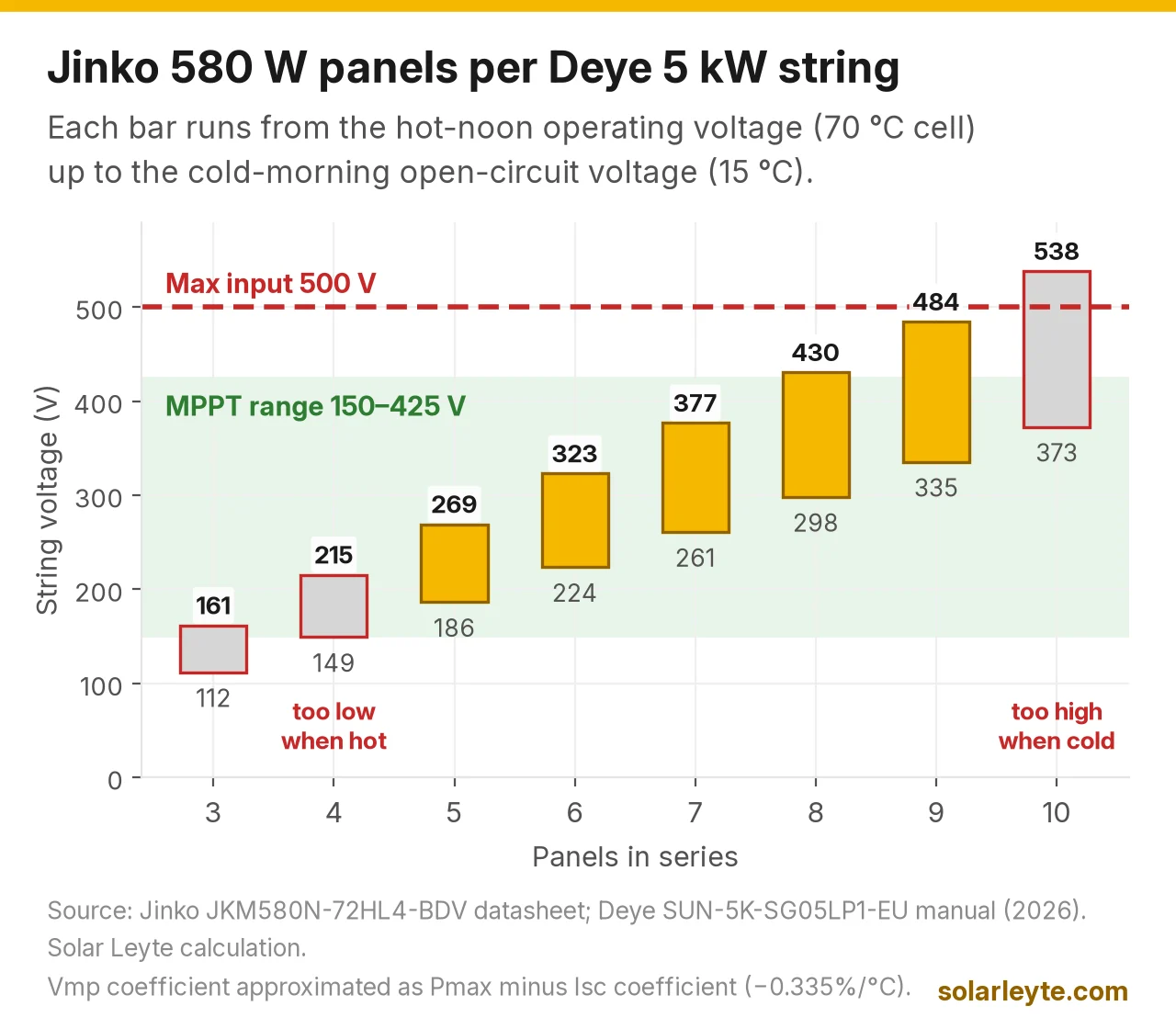
So each string can have 5 to 9 panels. Ten panels go in as two strings of 5, one per MPPT: 5.8 kWp, under the 6,500 W input limit. You can't put the two strings in parallel on one MPPT. The manual allows one string per MPPT, and 2 × 13.22 A would be double the 13 A limit.
One catch: the Jinko's Imp of 13.22 A is a hair over the Deye's 13 A, so you lose a little at peak sun. Its short-circuit current at 70 °C, about 14.2 A, is still under the 17 A limit. We covered this clipping and the bigger-panel picture in 550 W, 600 W and 620 W panels.
Worked example 2: four 100 W panels on a 24 V battery
Say you have four Renogy RNG-100D-SS panels and a 100 V MPPT controller. We'll use two from our MPPT post: the Victron SmartSolar 100/30 (880 W nominal at 24 V) and the EPEver Tracer4210AN (40 A, 1,040 W at 24 V).
The limits that matter:
- Victron: PV voltage must be over battery + 5 V to start, then over battery + 1 V to keep charging. Default absorption voltage is 28.8 V on 24 V.
- EPEver: max PV Voc is 100 V at the lowest operating temperature (92 V at 25 °C), and the MPP range is battery + 2 V up to 72 V.
Layout | Voc at 15 °C | Vmp at 70 °C | Current (Isc) | Verdict on 24 V |
|---|---|---|---|---|
4 in parallel | 25.0 V | 16.5 V | 20.84 A | No: the voltage is below the battery, so it can't charge. It also needs string fuses (see below) |
4 in series | 99.9 V | 66.2 V | 5.21 A | No: 97.2 V even at 25 °C, over EPEver's 92 V, and right at Victron's 100 V on a cool morning |
2 series × 2 parallel | 50.0 V | 33.1 V | 10.42 A | Yes: under 100 V cold, above 28.8 + 2 V hot, no string fuses needed |
Solar Leyte calculation from the Renogy datasheet and the Victron and EPEver datasheets. Assumptions: 15 °C cold, 70 °C hot cell, Vmp coefficient −0.42%/°C.
The hot-noon margin on 2S2P is real but not huge (33.1 V vs about 30–31 V needed at full charge, and the Victron wants battery + 5 V to start, which it gets in the cooler morning). Picking the battery voltage is its own question: see 12 V vs 24 V vs 48 V.
When parallel strings need fuses
In parallel, if one string shorts (a damaged cable, a cracked panel), the other strings can all push current backward into it. That's the "maximum series fuse rating" on the datasheet: 15 A for the Renogy, 30 A for the Jinko.
Jinko's manual gives the rule: you can parallel up to N strings without string fuses, where N ≤ fuse rating ÷ Isc + 1. The PEC (6.90.2.3) works the same way: no overcurrent device is needed where the short-circuit current from all sources stays within the conductors' ampacity and the module's maximum fuse rating. In its words, PV circuits "only need overcurrent protection when connected in parallel to higher current sources."
Panel | Max series fuse | Isc | Strings in parallel without fuses |
|---|---|---|---|
Renogy 100 W | 15 A | 5.21 A | Up to 3 (15 ÷ 5.21 + 1 = 3.9) |
Jinko 580 W, front side only | 30 A | 13.95 A | Up to 3 (30 ÷ 13.95 + 1 = 3.2) |
Jinko 580 W, with bifacial rear gain (BNPI Isc) | 30 A | 15.25 A | Up to 2 (30 ÷ 15.25 + 1 = 2.97) |
Solar Leyte calculation from the datasheets and Jinko's formula. BNPI is the bifacial test condition in Jinko's datasheet. We used it as a conservative case for panels over a bright roof or ground.
So four 100 W panels straight in parallel need a fuse on each string, in a combiner box. For grid-tie, check the inverter manual too. The Deye manual asks for a separate DC breaker and a PV junction box with surge protection. More on that in lightning and surge protection.
Mixing panels and shade
In series, current follows the weakest panel. PVEducation explains it simply: in a series string, the current is limited by the lowest-current cell. Jinko's manual says modules with different electrical parameters must not be connected in series. Put a 580 W panel (Imp 13.22 A) in a string with a 100 W panel (Imp 4.91 A), and the big panel is held near 4.91 A. That's roughly 215 W from a 580 W panel (a rough figure, ignoring what the bypass diodes might do).
In parallel, voltage is shared. Strings in parallel run at the same voltage, so they need the same number of the same panels. A 3-panel string and a 2-panel string can't go in parallel. Different panels with close voltages lose less, but you still lose some.
Shade and bypass diodes. Panels have bypass diodes in the junction box (the Renogy has 2), so a shaded section gets skipped instead of dragging the whole string down. Example with simple numbers: a string of 4 Renogy panels has a Vmp of 81.6 V at 25 °C. If shade on one panel makes its diode bypass half of it, the string loses about 10.2 V, or 12.5%, and keeps its current. Jinko notes that a bypass diode "is not an over-current protection", so it doesn't replace fuses.
If shade or mixed panels can't be avoided, see microinverters.
Paano magkabit ng solar panel: series o parallel?
Ang sagot ay nasa manual ng inverter o charge controller mo. Tingnan ang tatlong numero: max PV input voltage, MPPT range at max input current. Series kung kailangan mo ng mas mataas na boltahe (grid-tie at hybrid inverters). Parallel o series-parallel kung maliit ang controller at 12 V o 24 V ang baterya.
Sa Bisaya: ang series mopataas sa boltahe, ang parallel mopataas sa kuryente (current). Sukda una sa multimeter ang matag panel. Ang Voc dapat duol sa naa sa label sa likod. Our multimeter guide shows how.
A simple checklist before you connect anything
- Write down Voc, Vmp, Isc, Imp, the Voc temperature coefficient and the max series fuse from the panel label or datasheet.
- Write down the inverter or controller's max input voltage, MPPT range, max input current and max short-circuit current.
- Cold check: panels in series × Voc × [1 + coefficient × (15 − 25)] must be under the max input voltage (and 600 V on a house).
- Hot check: panels in series × hot Vmp must be above the MPPT minimum (or battery + margin for a controller).
- Current check: strings in parallel × Isc must be under the input's short-circuit limit. If you're over the fuse rule, add string fuses.
- Same panels, same number per string, and check polarity on every string before closing the DC breaker.
Safety: who should do the wiring
A 9-panel string is close to 500 V DC, and DC arcs don't stop by themselves like AC can. Republic Act 7920 (the Electrical Engineering Law), Sec. 34, says electrical wiring and equipment can't be installed without plans signed by a professional electrical engineer, a permit, and work done under the supervision of a professional, registered electrical engineer or registered master electrician. The PEC (6.90.1.4) says PV installation and wiring "shall be performed only by qualified persons." Jinko's manual also says string sizing should be done by qualified professionals.
Small 12 V or 24 V kits are common DIY territory; use the checks above and fuse them. Anything on a roof, tied to your house wiring or connected to the BILECO or LEYECO grid needs a licensed electrician and a permit. See electrical permits and CFEI and fire safety for solar.
FAQ
Is series or parallel better for solar panels?
Neither on its own. Series suits grid-tie and hybrid inverters that need 150 V or more. Parallel or series-parallel suits small 12 V and 24 V controllers.
How many solar panels can I connect in series?
Divide the inverter's max input voltage by the panel's cold Voc. For a Jinko 580 W (53.8 V at 15 °C) on a 500 V Deye, that's 9. Then check the hot Vmp still clears the MPPT minimum, which gives the lower limit: 5.
Can I connect two different solar panels together?
It's not recommended. In series, the string runs at the current of the weakest panel. In parallel, they run at a shared voltage. Jinko's manual says panels with different electrical parameters must not be connected in series.
Do I need a fuse for parallel solar panels?
For two strings, usually not. From three or four strings up, check the rule: max series fuse ÷ Isc + 1. Four 100 W panels (15 A fuse, 5.21 A Isc) in parallel need string fuses.
Related guides
- Grid-tie vs hybrid solar: the full guide
- MPPT vs PWM charge controllers
- Small solar panels (50 W to 200 W)
- Hybrid inverter prices in the Philippines
- How to choose a solar installer in Leyte and Biliran
Solar Leyte is run by MACC Systems & Energy Solutions Inc., a solar installer in Naval, Biliran.
Get a free solar quote from MACC
Not sure your strings fit your inverter? Send us the panel and inverter models (or a photo of the labels) plus a recent BILECO or LEYECO bill. We'll check the sizing and suggest a system, with no obligation.
- Call/Text: 0955 723 5093
- Email: official@macc-inc.com or benjie@macc-inc.com
- Website: www.macc-inc.com
- Request a quote online: solarleyte.com/quote
- Office: Brgy. Talustusan, Naval, Biliran 6543
Sources (all checked 30 October 2026)
- JinkoSolar, Tiger Neo JKM575-600N-72HL4-BDV datasheet: JKM580N Pmax 580 W, Vmp 43.88 V, Imp 13.22 A, Voc 52.50 V, Isc 13.95 A; BNPI Isc 15.25 A; TC Pmax −0.29%/°C, Voc −0.25%/°C, Isc +0.045%/°C; operating −40 to +70 °C; max series fuse 30 A; max system voltage 1500 V DC.
- JinkoSolar, Global Installation Manual (20240814_A1): max system voltage formula N × Voc × [1 + TCVoc × (Tmin − 25)]; parallel N ≤ fuse rating ÷ Isc + 1; different modules must not be connected in series; bypass diode is not over-current protection; sizing by qualified professionals.
- Renogy, RNG-100D-SS datasheet: 100 W, Voc 24.3 V, Vmp 20.4 V, Isc 5.21 A, Imp 4.91 A; NOCT 47 ± 2 °C; TC Pmax −0.37, Voc −0.28, Isc +0.05 %/°C; max series fuse 15 A; 2 bypass diodes.
- Deye, SUN-3.6/5/6/7.6/8K-SG05LP1-EU user manual (2026): SUN-5K max PV input power 6,500 W, max input voltage 500 V, start-up 125 V, MPPT 150–425 V, 13 + 13 A operating, 17 + 17 A short-circuit, 2 MPPTs with 1 + 1 strings; DC breaker and PV junction box with surge protection.
- Victron Energy, SmartSolar MPPT 100/30 and 100/50 datasheet: 100 V max PV Voc; 880 W nominal at 24 V (100/30); absorption 14.4/28.8 V; start at battery + 5 V, then battery + 1 V.
- EPEver, Tracer-AN 10–40 A datasheet: 100 V max PV Voc at minimum operating temperature, 92 V at 25 °C; MPP range battery + 2 V to 72 V; Tracer4210AN 40 A, 1,040 W at 24 V.
- PAGASA, Climatological extremes, Tacloban (as of 2025): lowest 17.5 °C (3 Dec 1904), highest 38.0 °C (1924), period 1903–2025.
- PAGASA, Climatological normals 1991–2020, Tacloban: lowest monthly mean minimum 23.7 °C (February).
- NASA, POWER daily data for Naval, Biliran (11.56° N, 124.40° E), 2001–2025: lowest daily minimum 21.5 °C.
- PVEducation, Mismatch for cells connected in series, in parallel, Bypass diodes and NOCT: NOCT cell temperature formula.
- Philippine Electrical Code 2017 Part 1, Article 6.90 Solar Photovoltaic Systems (article page, Filipino Engineer wiki): 6.90.1.4(C) qualified persons; 6.90.2.1 600 V on one- and two-family dwellings and Voc corrected for lowest expected ambient; 6.90.2.3 overcurrent exception. Clause wording checked against the PEC 2017 Part 1 text.
- Republic Act No. 7920, New Electrical Engineering Law, Sec. 34.
- All string voltages, hot and cold values, the Vmp coefficient approximation, fuse-rule results and shading figures are Solar Leyte calculations from the figures above.