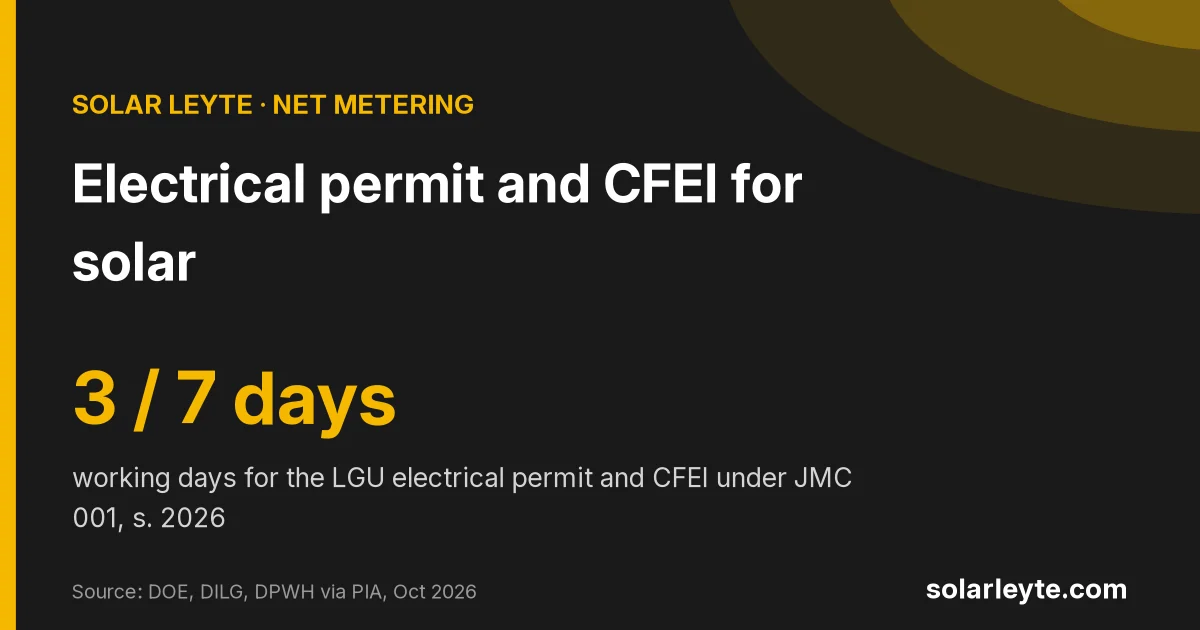
For rooftop solar you need two papers from your own municipality, not from the co-op: an electrical permit before the work starts, and a Certificate of Final Electrical Inspection (CFEI) after it's done. Under Joint Memorandum Circular No. 001, s. 2026, your LGU has 3 working days to act on the permit and 7 working days on the CFEI once your papers are complete. If it doesn't act in time, the application is deemed approved. The national fee for the electrical permit itself is small, ₱200 for a connected load of 5 kVA or less under the National Building Code schedule, but your LGU may add other charges, and the engineer's plans are a separate cost.
Daghan nag-aagi sa co-op dayon, tapos mabalik kay kulang ang CFEI. This post is the LGU side only. For the co-op side (application form, ₱1,500 ERC fee, bidirectional meter), see our BILECO net metering guide or, if you're in Tacloban, Palo or Babatngon, the LEYECO II net metering guide, which already covers Tacloban's permit office.
Sources: the DOE, DILG and PIA releases on JMC 001, s. 2026; the National Building Code (PD 1096) IRR schedule of fees as reproduced by LGUs; and published citizen's charters and permit forms from other LGUs, used to show what building officials typically ask for. We could not find an online citizen's charter or fee table for any Biliran municipality, so call your town's engineering office before you go. Fee examples are Solar Leyte calculations. Checked 9 October 2026. This is general information, not legal advice, and nothing here is a MACC price.
Electrical permit vs CFEI: what each one is
Paper | When you get it | Who issues it | Deadline under JMC 001 | Why the co-op cares |
|---|---|---|---|---|
Electrical permit | Before installation | Your city or municipal Building Official | 3 working days from complete filing | Proves the work was allowed and the plans were filed |
CFEI (Certificate of Final Electrical Inspection) | After installation and inspection | Same office | 7 working days from complete filing | One of the four documents the co-op may ask for in a net metering application |
The ERC's 22 September 2025 advisory limits what a utility may require for net metering to four items: the application form, the LGU-issued CFEI, the amended Net-Metering Agreement and the COC fee (Power Philippines). So the CFEI is the one LGU paper that BILECO and the LEYECOs actually need to see. You can't get a CFEI without the electrical permit first.
Permit forms from other LGUs spell out how the two connect. Batac City's electrical permit, for example, says a licensed electrical practitioner must be in charge of the installation, must submit a signed logbook, as-built plans and a Certificate of Completion when the work is done, and that "a Certificate of Final Electrical Inspection (CFEI) shall be secured prior to the actual occupancy of the building" (Batac City OBO form). For a solar job, read "occupancy" as "before you switch the system on for net metering".
The 3/7-day rule (JMC 001, s. 2026)
In January 2026 the DOE, DILG and DPWH signed Joint Memorandum Circular No. 001, s. 2026 on net metering permits. According to the DILG release carried by the Philippine Information Agency:
- it covers net metering installations in existing residential, commercial and industrial buildings;
- electrical permit applications must be processed within three working days;
- CFEIs must be issued within seven working days, in line with the Ease of Doing Business law (RA 11032);
- LGUs follow a "no additional requirements" policy; and
- deemed approval applies if the LGU doesn't act within the period (PIA; BusinessMirror).
The clock starts when your requirements are complete (Power Philippines). A missing signature or plan means the clock hasn't started, so most of the delay people blame on the LGU is really an incomplete file.
In April 2026 the DOE tightened this further in an advisory issued under the national energy emergency declared by Executive Order No. 110. While the emergency lasts, LGUs "are required to act on all net metering-related permits within three working days," and utilities and co-ops have 10 working days instead of 20 (DOE press release). Our BILECO guide has the EO 110 dates. If your LGU quotes you seven working days for the CFEI, it's fair to ask politely whether they've applied the DOE's April 2026 advisory under EO 110.
Deemed approved in practice: keep the acknowledgment receipt (with the date stamped) and the official receipt for your fees. Under JMC 001 those are what you show the co-op if the LGU didn't act in time (our BILECO guide cites Meralco's checklist on this).
Where to file in Biliran
Each of Biliran's eight municipalities issues its own permits: Almeria, Biliran, Cabucgayan, Caibiran, Culaba, Kawayan, Maripipi and Naval. You file where the house is, not where your installer is. The DPWH Biliran District Engineering Office in Naval is a national office and doesn't issue house permits (DPWH Biliran DEO).
In smaller towns the Office of the Building Official usually sits with the municipal engineer. The citizen's charters we checked from other LGUs run electrical permits through the engineering office (Naga City's City Engineer's Office; Pototan's Municipal Engineering Office) (Naga City charter; Pototan charter). So in Biliran, start at the municipal hall and ask for the engineering office or building official.
What to ask on the phone before you go:
- Do you have a separate checklist for adding solar to an existing house?
- How many copies of the electrical plans, and do they need to be signed and sealed by a Professional Electrical Engineer (PEE)?
- Which existing papers do you need: building permit number, tax declaration, lot title?
- How do you compute the fee for a solar addition, and are there other local charges (filing, zoning, fire)?
- Who does the CFEI inspection, and how do we book it?
- Are you processing net metering permits within 3 working days under JMC 001 and the DOE's April 2026 advisory under EO 110?
For Leyte: Tacloban, Palo and Babatngon are covered in the LEYECO II guide. For Ormoc, Baybay and the other LEYECO IV and LEYECO V towns, the same steps apply at your own city or municipal hall.
What the building official usually asks for
We couldn't find a Biliran checklist online, so here is what other LGUs' published charters list. Expect something close to this:
Item | Seen in | Notes for solar |
|---|---|---|
Electrical permit application form signed by a Professional Electrical Engineer | Naga City charter | Your installer's PEE fills in the technical part |
Electrical plans and specifications | Naga City charter; PD 1096 | PD 1096 requires electrical plans signed and sealed by a registered electrical engineer |
Bill of materials and cost estimate | Naga City charter | Panels, inverter, breakers, wiring |
Photocopy of the existing building permit | Naga City charter | For additions to an existing building. Batac's form says purely electrical work only needs the existing building permit number |
PRC ID and PTR of the professionals | Pototan charter | For the engineer who signs |
Notice of construction before work starts | Batac City form | Tell the OBO when installation begins |
Logbook, as-built plans and certificate of completion | Batac City form | Your installer's licensed practitioner submits these, then the CFEI inspection follows |
Naga's charter also says an electrical permit is needed for new or additional installations "involving at least 20 outlets or a capacity of 4 Kw" (Naga City charter). That threshold is Naga's. Don't assume your town uses the same one. For net metering you need the CFEI anyway, and you can't get a CFEI without a permit.
Under JMC 001's "no additional requirements" policy, the LGU shouldn't add items beyond its published list for net metering permits (PIA). If you get a surprise requirement, ask for it in writing and which rule it comes from.
Zero-export or off-grid instead of net metering? You skip the net metering application, but under DOE Circular DC2026-08-0017 a grid-connected zero-export system still needs a written notice to the co-op and a building permit (or LGU confirmation that your existing one is enough). Only plug-and-play kits (up to 1 kW of panels with a micro-inverter of 0.8 kW or less) skip the permit. Off-grid systems need no co-op notice but still need the permit. Details are in our plug-and-play and zero-export post.
How much the electrical permit costs
LGUs compute electrical fees from the National Building Code IRR schedule. The base fee is on the total connected load in kVA, as shown in the load schedule of your electrical plans (NBC schedule of fees, as published by Alaminos, Laguna):
Total connected load | Fee |
|---|---|
5 kVA or less | ₱200 |
Over 5 kVA to 50 kVA | ₱200 + ₱20 per kVA above 5 |
Over 50 kVA to 300 kVA | ₱1,100 + ₱10 per kVA above 50 |
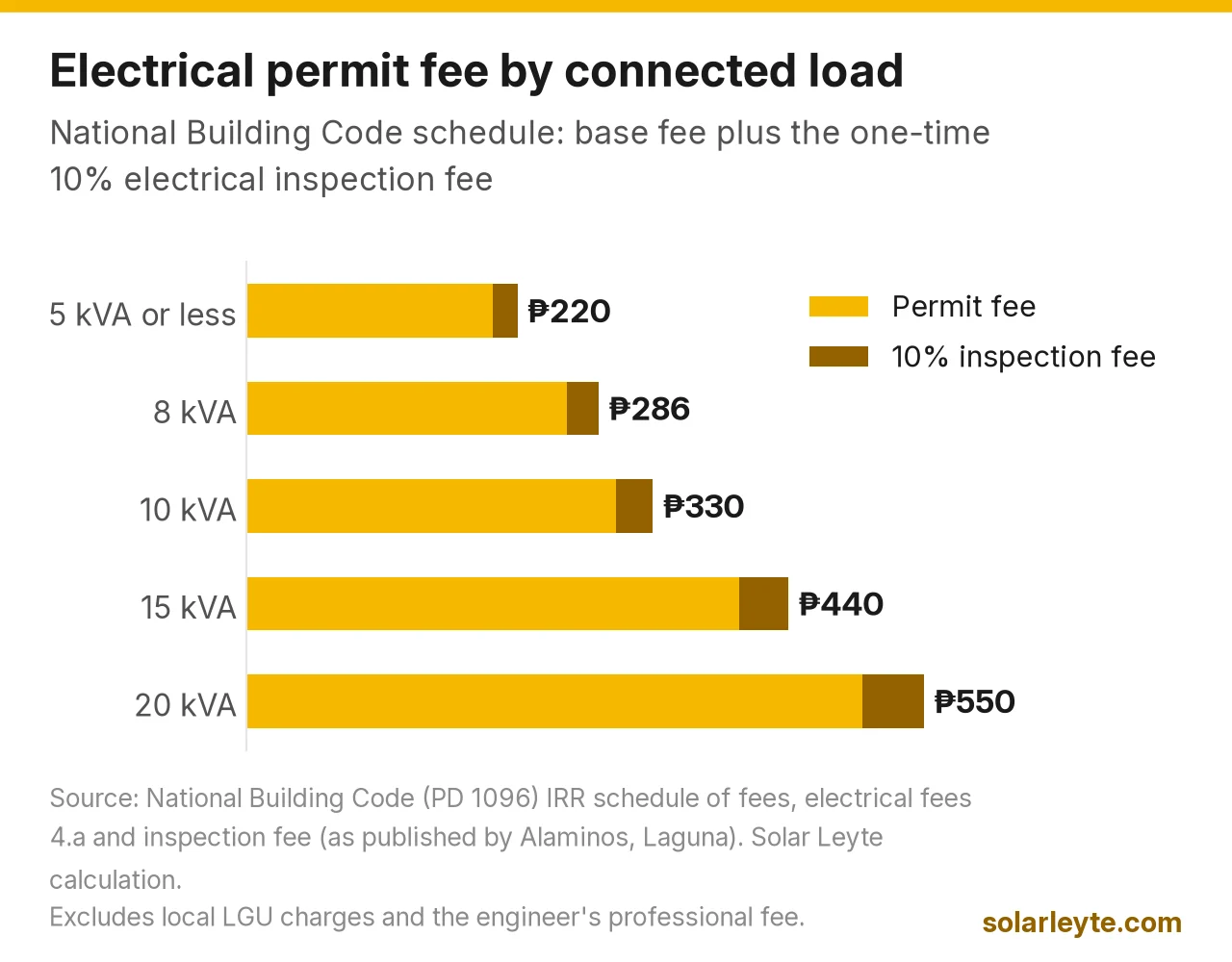
The same schedule adds a separate fee for transformer, UPS and generator capacity (₱40 for 5 kVA or less; ₱40 + ₱4 per kVA from over 5 to 50 kVA), ₱30 per pole for any power supply pole, and a one-time electrical inspection fee equal to 10% of the total electrical permit fees (same schedule). Puerto Princesa's worked example shows how the per-kVA part is counted: a 6 kVA load is ₱200 plus ₱20 for the one kVA above 5 (Puerto Princesa OCBO).
So, at the national schedule, the permit plus the 10% inspection fee looks like this (Solar Leyte calculation):
Connected load in the load schedule | Permit fee | + 10% inspection | Total |
|---|---|---|---|
5 kVA or less | ₱200 | ₱20 | ₱220 |
8 kVA | ₱260 | ₱26 | ₱286 |
10 kVA | ₱300 | ₱30 | ₱330 |
15 kVA | ₱400 | ₱40 | ₱440 |
20 kVA | ₱500 | ₱50 | ₱550 |
Three things this table does not include:
- Local charges. Filing fees, zoning or locational clearance, fire safety and other items depend on your LGU's revenue code. Ask for the full assessment.
- How the OBO counts solar. The schedule doesn't mention solar inverters. Some offices may count only the new solar circuits, others the whole house. Some may assess a hybrid inverter with a battery under the UPS/generator line. Ask how they'll compute it.
- The engineer's fee. Plans signed and sealed by a PEE are a private professional service, priced by the engineer or included by the installer. Ask your installer whether permit preparation is in the quote.
Even with local charges added, the LGU fees are small next to the price of a system. The real cost of a slow permit is time.
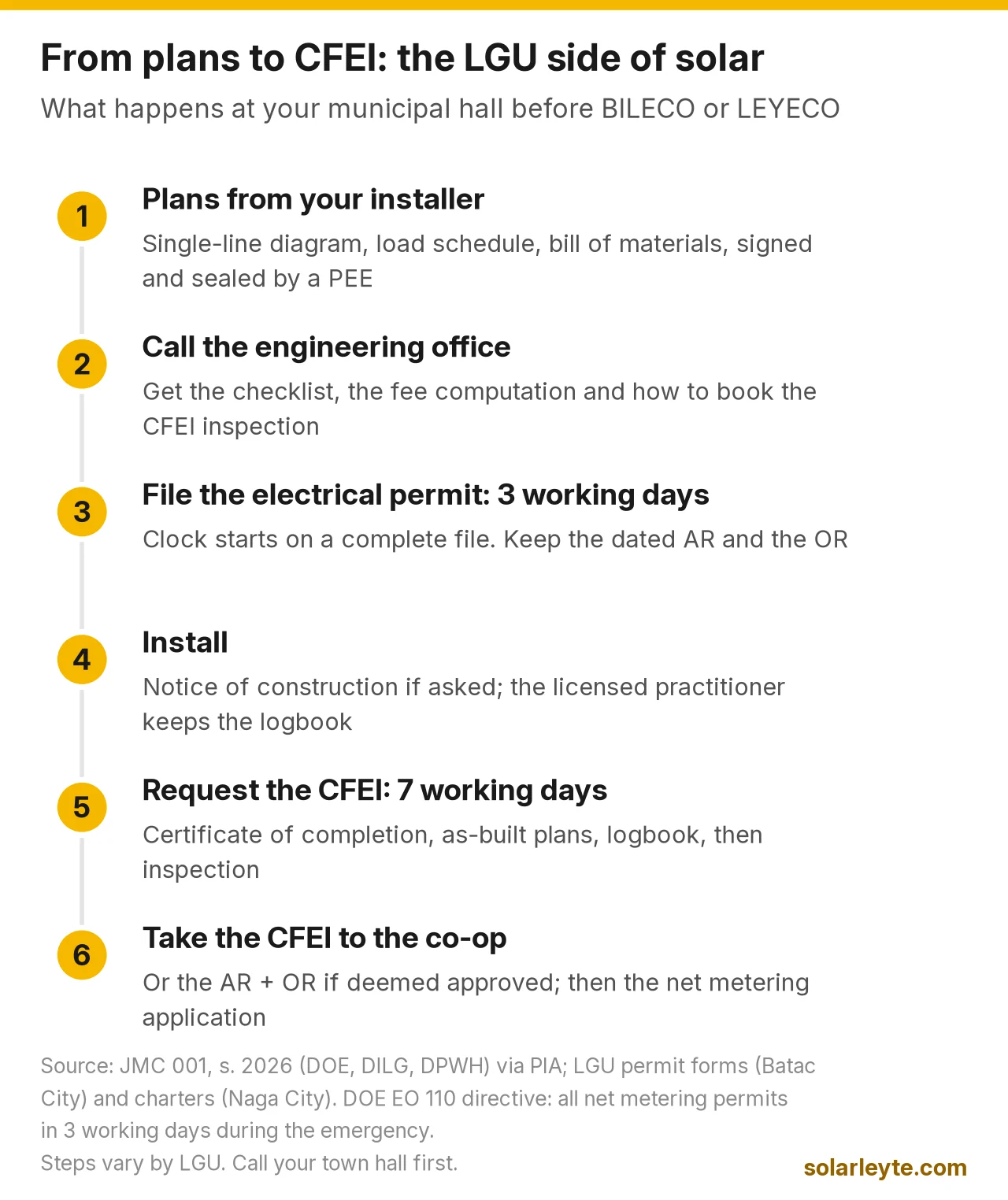
Step by step, from plans to CFEI
- Get the design and plans from your installer. Single-line diagram, load schedule, panel layout and bill of materials, signed and sealed by a PEE.
- Call your municipal engineering office. Ask the six questions above and get the checklist.
- File the electrical permit. Get a stamped acknowledgment receipt. Pay the assessment and keep the official receipt. The 3-working-day clock runs from a complete filing.
- Install. Submit the notice of construction if your OBO asks for one. The licensed practitioner in charge keeps the logbook.
- Request the CFEI. Submit the certificate of completion, as-built plans and logbook. The OBO inspects. The 7-working-day clock runs from a complete filing.
- Take the CFEI (or AR + OR if deemed approved) to the co-op. From here it's the co-op process in our BILECO or LEYECO II guide.
Common snags
- No building permit for the house. Many older homes in the province never had one. Batac's form says purely electrical work needs only the existing building permit number. If you have none, ask the OBO early what they'll accept, because this is the step that can take longest.
- Filing before the plans are signed. An unsigned plan means an incomplete file, and the 3-day clock doesn't start.
- Losing the receipts. No dated AR and OR means no way to prove deemed approval.
- Installing first, permitting later. The permit has to come before the work. An inspector who finds work that doesn't meet the Philippine Electrical Code can cancel the permit, and the fees are forfeited if it isn't corrected (NBC schedule). Most solar fires start in poor DC wiring, so the inspection is worth having. See our solar fire safety guide.
- Asking the co-op for the CFEI. BILECO and the LEYECOs don't issue it. Your LGU does.
FAQ
Do I need an electrical permit for rooftop solar in Biliran? For net metering, yes, because the co-op needs the CFEI and the CFEI follows the permit. For zero-export systems, DOE's 2026 circular requires a building permit. Plug-and-play kits up to 1 kW don't need one.
How long should it take? Under JMC 001, 3 working days for the electrical permit and 7 for the CFEI once your file is complete. Under the DOE's April 2026 advisory under EO 110, LGUs are told to act on all net metering-related permits within 3 working days while the energy emergency lasts.
How much is the electrical permit fee? At the National Building Code schedule, ₱200 for 5 kVA or less of connected load, plus ₱20 per kVA from over 5 up to 50 kVA, plus a 10% inspection fee. Local charges and the engineer's fee are extra.
What if the LGU doesn't act on time? JMC 001 provides for deemed approval. Keep your dated acknowledgment receipt and official receipt and present them to the co-op.
Does BILECO issue the CFEI? No. The CFEI comes from your municipality's building official. BILECO only receives it as part of your net metering application.
Solar Leyte is run by MACC Systems & Energy Solutions Inc., a solar installer in Naval, Biliran.
Get a free solar quote from MACC
Planning solar in Biliran or Leyte? Send us a photo of your last BILECO or LEYECO bill and tell us whether you want net metering, zero-export or a brownout backup. We'll size the system, give you every model number and datasheet, and show you the math, with no obligation. Ask us what the permit paperwork for your town involves.
- Call/Text: 0955 723 5093
- Email: official@macc-inc.com or benjie@macc-inc.com
- Website: www.macc-inc.com
- Request a quote online: solarleyte.com/quote
- Office: Brgy. Talustusan, Naval, Biliran 6543
Sources (all checked 9 October 2026)
- Philippine Information Agency, DILG to LGUs: Fast-track net metering applications (JMC 001, s. 2026)
- BusinessMirror, DILG to local governments: Expedite processing applications for net-metering (28 Jan 2026)
- Power Philippines, DOE orders LGUs to clear net-metering permits in 3–7 days (1 Feb 2026; ERC advisory of 22 Sep 2025)
- DOE, DOE fast-tracks net metering under EO 110
- National Building Code (PD 1096) IRR schedule of fees, electrical fees and inspection fees, as published by Alaminos, Laguna; worked example, Puerto Princesa OCBO
- Citizen's charters and forms: Naga City Engineer's Office; Pototan Municipal Engineering Office; Batac City electrical permit form
- DPWH, Biliran District Engineering Office
- Solar Leyte, BILECO net metering guide, LEYECO II net metering guide, plug-and-play and zero-export solar