Short answer: pick the system voltage from the size of your inverter. Use 12V for small setups up to about 1,000 W (lights, fans, TV, Wi-Fi, a piso wifi or CCTV). Use 24V for roughly 1,000 to 3,000 W. Go 48V once you want a fridge plus heavier loads, anything near 5 kW, or a grid-tie hybrid inverter. Victron, a big battery and inverter maker, puts the preferred limits at 12V up to 3,000 VA, 24V up to 5,000 VA and 48V from 5,000 VA (Victron, Wiring Unlimited). Our cut-offs are lower because the 12V hybrid inverters at the shop we priced stop at 1,200 W.
The reason: the same watts at a higher voltage need fewer amps, so you get thinner battery cable, smaller fuses and less energy lost as heat. Prices below were checked on 26 October 2026.
Why voltage matters: same watts, fewer amps
Current is watts divided by volts. Here's what an inverter pulls from the battery at full load (Solar Leyte calculation, I = P ÷ V, before inverter losses, which push the real figure a bit higher):
Inverter load | At 12V | At 24V | At 48V |
|---|---|---|---|
1,000 W (fans, TV, lights, Wi-Fi) | 83 A | 42 A | 21 A |
3,000 W (add a fridge, rice cooker, pump) | 250 A | 125 A | 63 A |
5,000 W (whole-house hybrid) | 417 A | 208 A | 104 A |
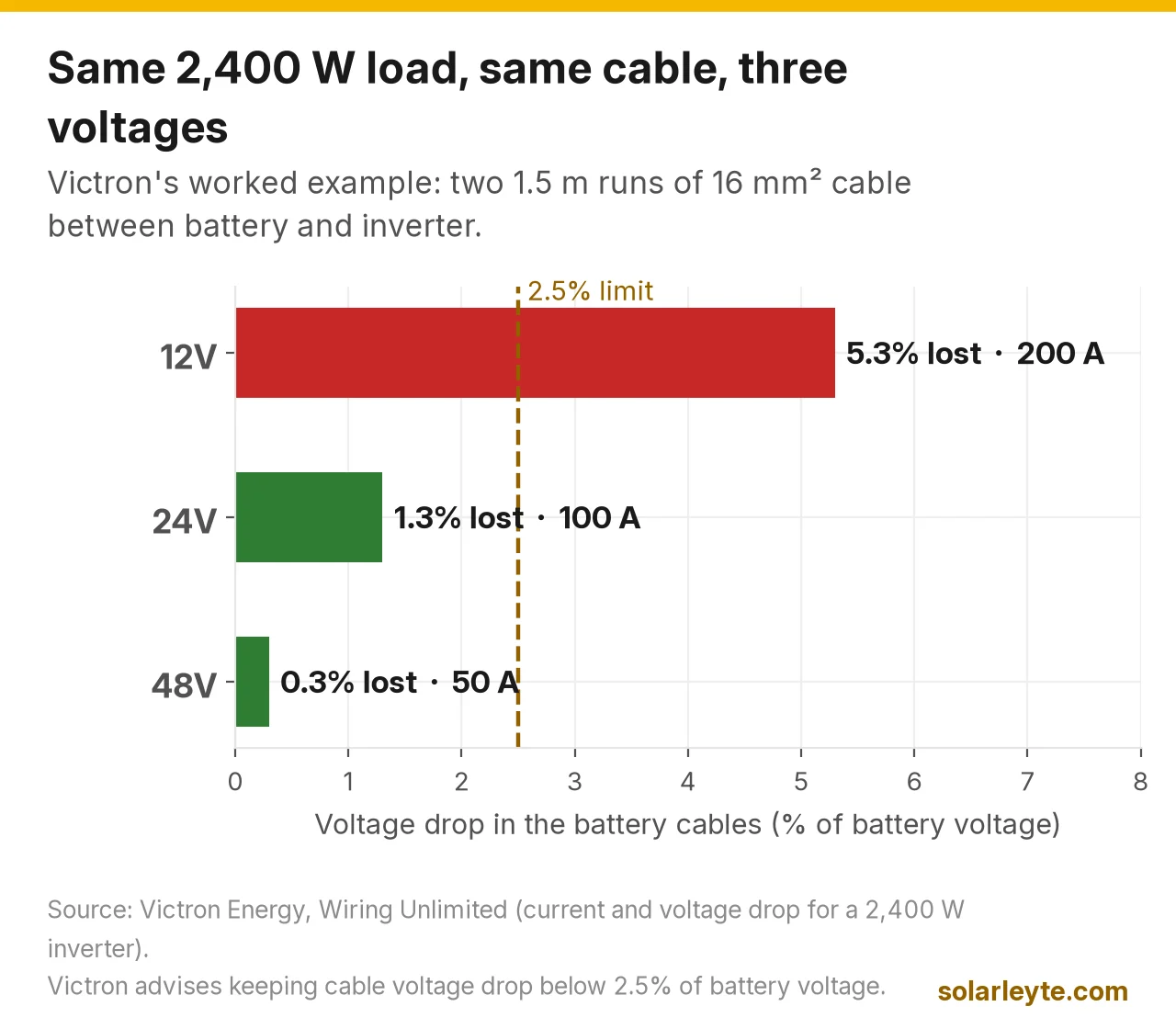
That matters because cable loss grows with current. Victron's own worked example: a 2,400 W inverter on 12V draws 200 A, and two 1.5 m runs of 16 mm² cable lose 0.64 V, about 5% of the battery voltage, as heat. The same load and cable lose 0.32 V (1.3%) at 24V and only 0.16 V (0.3%) at 48V (Victron, Wiring Unlimited PDF). Victron advises keeping the drop under 2.5%. That's 0.3 V on 12V, 0.6 V on 24V and 1.2 V on 48V. So the 12V version fails, and the 24V and 48V versions pass with the same cable.
The chart below shows Victron's example side by side.
Battery cable size: what the maker manuals say
Samlex lists minimum battery cable sizes for its SWI pure sine inverters, which come in 12V and 24V versions of the same model (Samlex SWI manual, Table 8.2). For a 48V comparison, Deye's 5 kW hybrid manual lists its battery cable (Deye SUN-3.6–8K-SG05LP1-EU manual).
Inverter | Battery | Max DC current (maker) | Min cable, short run | Min cable, longer run |
|---|---|---|---|---|
Samlex SWI 1100 (1,100 W) | 12V | 132 A | 35 mm² (under 1.5 m) | 50 mm² (1.6–3 m) |
Samlex SWI 1100 (1,100 W) | 24V | 66 A | 16 mm² | 25 mm² |
Samlex SWI 1600 (1,600 W) | 12V | 192 A | 50 mm² | 70 mm² |
Samlex SWI 1600 (1,600 W) | 24V | 96 A | 25 mm² | 35 mm² |
Samlex SWI 2100 (2,100 W) | 12V | 252 A | 70 mm² | 95 mm² |
Samlex SWI 2100 (2,100 W) | 24V | 126 A | 35 mm² | 50 mm² |
Deye SUN-5K-SG05LP1 (5,000 W hybrid) | 48V | 120 A | 35 mm² (1 AWG) | – |
A 5 kW Deye on 48V uses the same 35 mm² battery cable Samlex asks for on a 1,100 W inverter at 12V.
Two more things from those manuals:
- Fuse the battery cable. Samlex says its internal fuses "will NOT blow" if there's a short along the battery cables, and calls for a Class T or equivalent fuse within 10 cm of the battery's positive terminal. Deye says a separate DC over-current protector is required between battery and inverter. At 12V the fuse is bigger: Samlex's maximum external fuse is 300 A for the SWI 2100-12 and 150 A for the 2100-24.
- Higher voltage doesn't automatically mean lower idle draw. The Samlex SWI 1100-12 idles at under 1.1 A (about 13 W) and the 1100-24 at under 0.7 A (about 17 W). Check the idle figure on the datasheet. Don't assume it.
If you're worried about hot cables and loose lugs, our solar fire safety post covers what to check.
What 12V, 24V and 48V cost from one Philippine shop
To compare fairly, we used one seller. Beyond Power lists One Solar inverters and Higee LiFePO4 batteries at all three voltages (listed prices, 26 October 2026; links in Sources).
Item | 12V | 24V | 48V |
|---|---|---|---|
Hybrid off-grid inverter with MPPT | 1,200 W, 40 A MPPT: ₱10,100 | 3,000 W, 60 A MPPT: ₱21,800 | 6,000 W, 80 A MPPT: ₱33,000 |
Price per watt of inverter | ₱8.42 | ₱7.27 | ₱5.50 |
Inverter only (pure sine) | 1,000 W: ₱6,200 | 1,000 W: ₱6,200 / 3,000 W: ₱16,200 | 6,000 W: ₱29,100 |
LiFePO4 battery (Higee) | 12.8V 120Ah, 1.54 kWh: ₱13,400 | 25.6V 120Ah, 3.07 kWh: ₱33,600 / 25.6V 280Ah, 7.17 kWh: ₱62,700 | 51.2V 120Ah, 6.14 kWh: ₱50,400 |
Battery price per kWh | ₱8,724 | ₱10,938 (120Ah) / ₱8,747 (280Ah) | ₱8,203 |
Price per watt and per kWh are Solar Leyte calculations from the listed prices. kWh = volts × amp-hours ÷ 1,000.
What this tells you:
- Battery storage costs about the same per kWh at any voltage (₱8,203 to ₱10,938 here). A lower voltage doesn't make storage cheaper; you just buy less of it.
- Inverter watts get cheaper as you go up. The 48V unit costs about a third less per watt than the 12V unit.
- At 1,000 W, 12V and 24V cost the same (₱6,200 each). So if you think you might grow, 24V costs you nothing extra at the small end.
Three example builds (labelled examples)
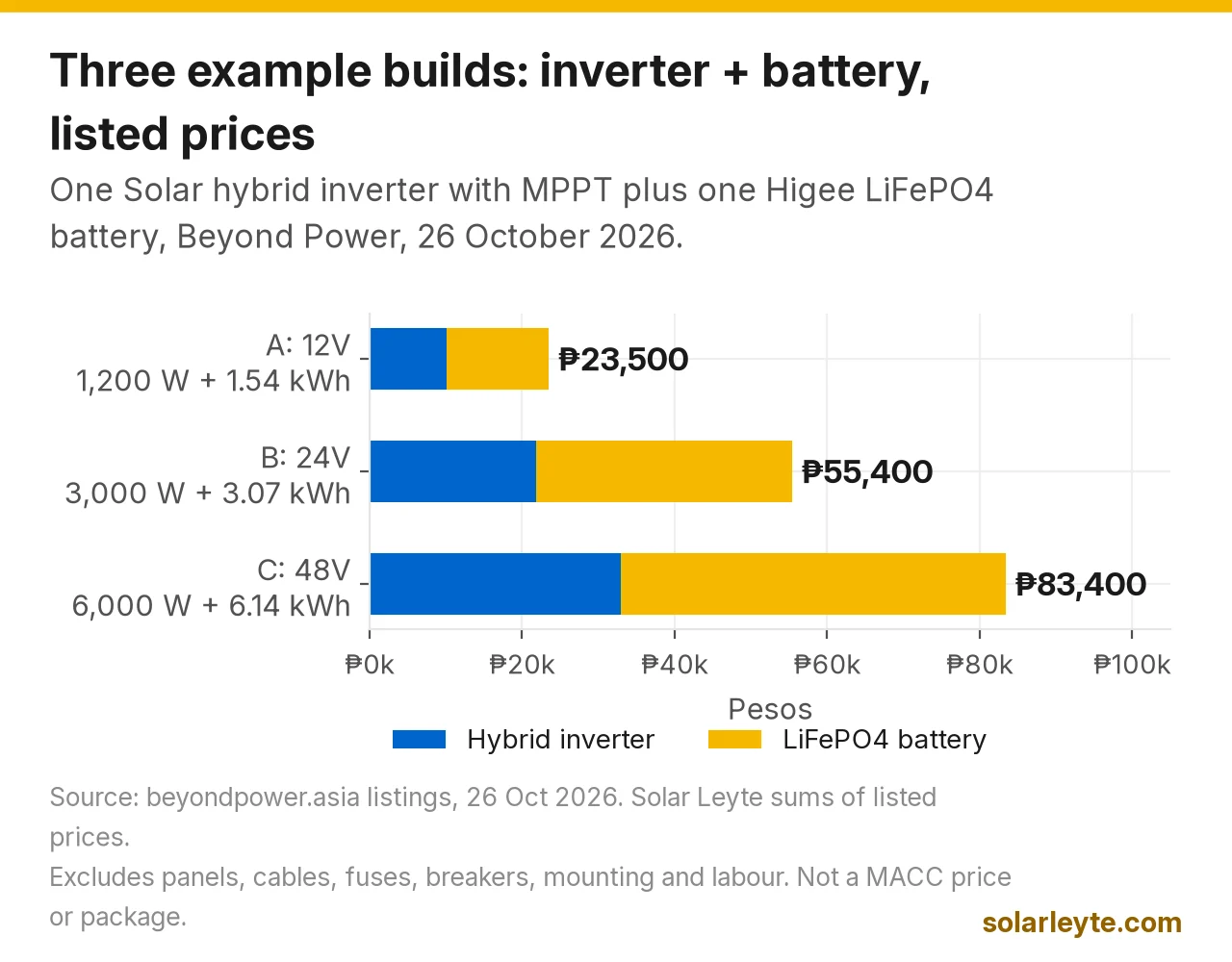
Our sums of listed prices for one inverter plus one battery. They leave out panels, cables, fuses, breakers, mounting and labour, and are not MACC prices or packages.
Example | Fits | Inverter + battery | Listed total | Storage |
|---|---|---|---|---|
A: 12V | Lights, fans, TV, Wi-Fi, phone charging | 12V 1,200 W hybrid + 12.8V 120Ah | ₱23,500 | 1.54 kWh |
B: 24V | A plus a fridge and short rice-cooker use | 24V 3,000 W hybrid + 25.6V 120Ah | ₱55,400 | 3.07 kWh |
C: 48V | B plus a pump, more fridges or a small aircon | 48V 6,000 W hybrid + 51.2V 120Ah | ₱83,400 | 6.14 kWh |
The chart below compares the three builds.
How long each battery actually lasts depends on your loads. Our inverter and battery backup guide works out hours for a fan-and-Wi-Fi load and a fridge load, and our off-grid sizing post uses 24V for its two smaller homes and 48V for the farm house with a pump.
Panels and the charge controller: more watts per amp at higher voltage
With an MPPT controller, battery voltage sets how many panel watts one controller can handle. LakaSolar lists a One Solar 40 A MPPT controller (₱4,500) with recommended PV power of 560 W at 12V, 1,120 W at 24V and 2,240 W at 48V (LakaSolar listing). Same box, same price, four times the solar.
Worked example (labelled): you want four 550 W panels (2,200 W). On 12V that needs about 180 A of charging (2,200 ÷ 12), which means several controllers. On 48V, one 40 A controller is right at its recommended limit. Always check the controller's maximum PV voltage (Voc) too. That's covered in our MPPT vs PWM post.
When each voltage makes sense
12V: small, simple and DC-friendly
- Loads under about 1,000 W: LED lights, electric fans, a TV, the modem, phone charging.
- Things that run on 12V DC directly: CCTV, piso wifi vendos, boat lights, car-style fridges. Running them straight from the battery skips the inverter's idle draw (see our piso wifi post).
- Small panels and kits: our small solar panels post covers 50–200 W panels and what they can run.
- The catch: past about 1,200 W you need very thick cable and big fuses (see the Samlex table), and the 12V hybrids we priced stop there.
24V: the middle ground
- About 1,000 to 3,000 W: a fridge plus fans, lights and TV through a brownout.
- Victron's battery datasheet says 24V systems are best built from 24V batteries, and that four 12V batteries in series for 48V will work but need more balancing time (Victron LiFePO4 Smart datasheet).
48V: the default for whole-house and hybrid systems
- About 3,000 W and up, or any home that wants room to grow.
- Grid-tie hybrid inverters: Deye's SG05LP1 hybrids take batteries in the 40–60 V range only, which is the 48V class (Deye manual). Most of the 5–8 kW hybrids in our hybrid inverter price post are 48V; Sungrow's SH-RS needs a high-voltage battery instead.
- These take 48V-class (51.2V) LiFePO4 batteries. Prices are in our solar battery price guide.
Changing voltage later costs you the inverter and battery
You can't move a system from 12V to 48V by changing a setting. An inverter only accepts its own battery range. The Samlex SWI 1100-24 takes 21.4–32 V, for example, and Deye's hybrids take 40–60 V. So upgrading usually means a new inverter and either new batteries or a rewired bank. Panels and a 12/24/48V MPPT controller can often stay.
If you think you'll add a fridge, an aircon or a second battery within a few years, start at 24V or 48V now. Example A plus Example C cost ₱106,900 together. Buying C first costs ₱83,400.
FAQ
Which is better, a 12V, 24V or 48V solar system?
None is better for everyone. 12V suits small setups up to about 1,000 W, 24V suits about 1–3 kW, and 48V suits anything bigger or any grid-tie hybrid. Victron's preferred limits are 12V up to 3,000 VA, 24V up to 5,000 VA, and 48V above that.
Can I use a 24V inverter on a 48V battery?
No. An inverter only works within its listed battery voltage range. The Samlex SWI 1100-24 accepts 21.4–32 V, and Deye's 48V hybrids accept 40–60 V. A 48V battery sits far outside a 24V inverter's range. Buy the inverter and battery as a matched pair.
Can I connect two 12V batteries to make 24V?
Yes, two identical 12V batteries in series give 24V. Victron says 24V systems are best built from 24V batteries, and that four 12V batteries in series for 48V "will work" but need more balancing. Use batteries of the same model, age and charge level, and check that the maker allows series connection.
Mas tipid ba ang 12V kaysa 24V o 48V?
Sa maliit na setup, oo, mas mura ang 12V. Pero sa listahan ng Beyond Power noong 26 October 2026, pareho ang presyo ng 12V at 24V na 1,000 W inverter (₱6,200 bawat isa). Halos pareho rin ang presyo kada kWh ng baterya sa lahat ng voltage. Kung lalaki pa ang gamit mo, mas tipid sa katagalan ang 24V o 48V.
Is a 48V system safer than a 12V system?
Not automatically. A 48V system carries a quarter of the current for the same load, so cables run cooler. But Victron warns that lithium batteries "can deliver very high short-circuit currents" at any voltage, so the fuse must be rated to interrupt them. That's why Samlex and Deye both require a fuse or breaker between battery and inverter, and why a licensed electrician should do the wiring.
Solar Leyte is run by MACC Systems & Energy Solutions Inc., a solar installer in Naval, Biliran.
Get a free quote from MACC
Not sure whether your home needs 12V, 24V or 48V? Send a list of what you want to run in a brownout, plus a photo of your latest BILECO or LEYECO bill, and MACC will reply with a suggested setup and a written quote. No obligation.
- Call/Text: 0955 723 5093
- Email: official@macc-inc.com or benjie@macc-inc.com
- Website: www.macc-inc.com
- Request a quote online: solarleyte.com/quote
- Office: Brgy. Talustusan, Naval, Biliran 6543
Sources (all checked 26 October 2026)
- Victron Energy, Wiring Unlimited, chapter 4: DC wiring (preferred upper inverter limits: 12V up to 3,000 VA, 24V up to 5,000 VA, 48V 5,000 VA and up; aim for voltage drop below 2.5%; lithium short-circuit currents and fuse interrupt rating, section 4.6.1)
- Victron Energy, Wiring Unlimited (PDF) (2,400 W example: 200 A at 12V, 0.64 V total drop on two 1.5 m 16 mm² cables; 0.32 V at 24V, 0.16 V at 48V; 2.5% = 0.3 V / 0.6 V / 1.2 V)
- Victron Energy, Lithium iron phosphate batteries 12.8V and 25.6V Smart datasheet (PDF) (24V systems best built with 24V batteries; four 12V in series for 48V will work but needs more balancing)
- Samlex, SWI 400/700/1100/1600/2100 owner's manual (PDF) (Table 8.2 cable and fuse sizes; Class T fuse within 10 cm of battery +; SWI 1100 input ranges 10.7–16 V and 21.4–32 V; idle current under 1.1 A and 0.7 A)
- Deye, SUN-3.6–8K-SG05LP1-EU user manual (PDF, 19 March 2026) (Chart 3-2: 5 kW battery cable 1 AWG / 35 mm²; battery voltage range 40–60 V; 5 kW max charge/discharge 120 A; separate DC over-current protector required)
- Beyond Power, One Solar inverters: 12V 1000W ₱6,200; 24V 1000W ₱6,200; 24V 3000W ₱16,200; 48V 6000W ₱29,100; 12V 1200W hybrid, 40A MPPT ₱10,100; 24V 3000W hybrid, 60A MPPT ₱21,800; 48V 6000W hybrid, 80A MPPT ₱33,000
- Beyond Power, Higee LiFePO4 batteries: 12.8V 120Ah ₱13,400; 25.6V 120Ah ₱33,600; 25.6V 280Ah ₱62,700; 51.2V 120Ah ₱50,400
- LakaSolar, One Solar LiFePO4 MPPT solar charger 40A (12/24/48V) (₱4,500; recommended PV power 560 W / 1,120 W / 2,240 W)