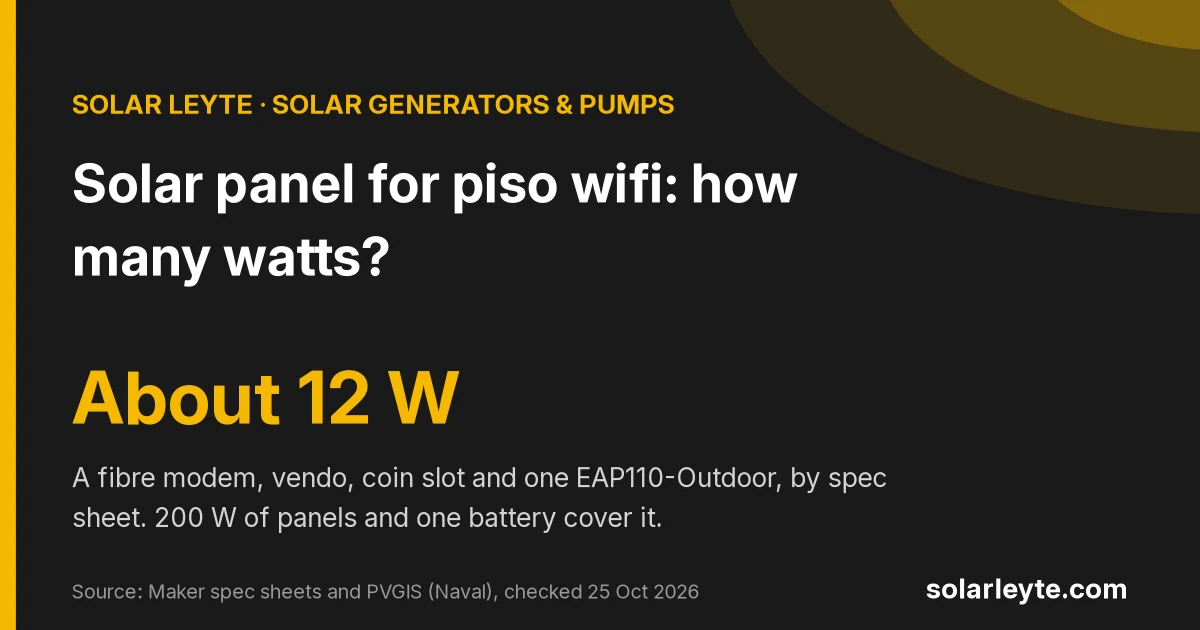
A basic piso wifi setup uses surprisingly little power. A fibre modem, an Orange Pi vendo board, a coin slot and one TP-Link EAP110-Outdoor access point add up to about 12 watts, or roughly 0.3 kWh a day. In Naval, two 100 W panels and one 12 V battery are enough to keep that running day and night, even in the cloudiest months. With listed parts, that's about ₱13,050 to ₱21,550 before wiring and installation.
The catch: on BILECO power that same setup only costs about ₱166 a month. So solar won't pay for itself through your electric bill. What it buys you is a vendo that keeps earning when the lights go out, or a vendo in a spot with no grid at all.
Prices were checked on 25 October 2026 on each seller's own website. Listing a product isn't an endorsement, and Solar Leyte earns nothing from these links. Nothing here is a MACC price or package.
How much power a piso wifi vendo really uses
Most piso wifi kits sold in the Visayas use the same parts. Cebuwebmart in Mandaue, for example, lists sets from ₱6,000 (vendo only, no access point) up to ₱10,899 (two access points). Every set includes an Orange Pi One board, licensed software, a universal coin slot, a 12V 3A or 5A adapter and a 5V buck converter (Cebuwebmart). Their V3 set at ₱8,299 uses a TP-Link EAP110-Outdoor.
Here's what each part draws, using the makers' own spec sheets:
Part | Power | Where the number comes from |
|---|---|---|
Fibre modem (Huawei EG8145V5) | 5.3 W static, 18 W max | |
Vendo board (Orange Pi One + buck converter) | about 3 W (our assumption) | No maker figure found. Measure yours. |
Coin slot (CH-926 type) | 0.78 W (12 V × 65 mA) | |
TP-Link EAP110-Outdoor | 3.1 W | |
COMFAST CF-EW71 | 8 W max | |
Starlink Mini (if no fibre) | 25–40 W average |
The adapter in the box says 12V 3A or 5A. That's the most it can supply, not what the vendo uses. We couldn't find a published figure for the Orange Pi One, so we used 3 W. Before you buy panels, run your vendo for 24 hours on a plug-in energy meter like the UNI-T UT230B (₱2,499 at LakaSolar) and use your real number.
Three common setups, worked out
These are Solar Leyte calculations. All three run 24 hours a day. We added 15% for converter and battery losses, the same allowance we used in our Wi-Fi and Starlink backup guide.
Setup | Total watts | Solar needs per day (with 15% losses) | Grid cost per month at ₱18.93/kWh |
|---|---|---|---|
A. Fibre + vendo + EAP110-Outdoor | 12.2 W | about 344 Wh | about ₱166 |
B. Fibre + vendo + COMFAST EW71 | 17.1 W | about 482 Wh | about ₱233 |
C. Starlink Mini + vendo + EAP110-Outdoor | 31.9–46.9 W | about 900–1,324 Wh | about ₱434–₱639 |
The grid cost uses BILECO's September 2026 residential rate of ₱18.93 per kWh, the latest month on PRESYO-PH on 25 October 2026, and a 30-day month without the loss allowance. Check the current figure for your town on our BILECO rate page.
How many solar panels you need
According to PVGIS, the EU's free solar calculator, a 100 W panel in Naval makes about 0.41 kWh a day averaged over the year. In the worst months, January and July, that drops to 0.36 kWh a day. We size for the worst month so the battery still fills up in the rainy season.
Setup | Daily need | Panel watts at the bare minimum | What we'd fit |
|---|---|---|---|
A | 344 Wh | 96 W | 200 W (2 × 100 W) |
B | 482 Wh | 134 W | 200 W |
C | 900–1,324 Wh | 250–368 W | 400 W or more |
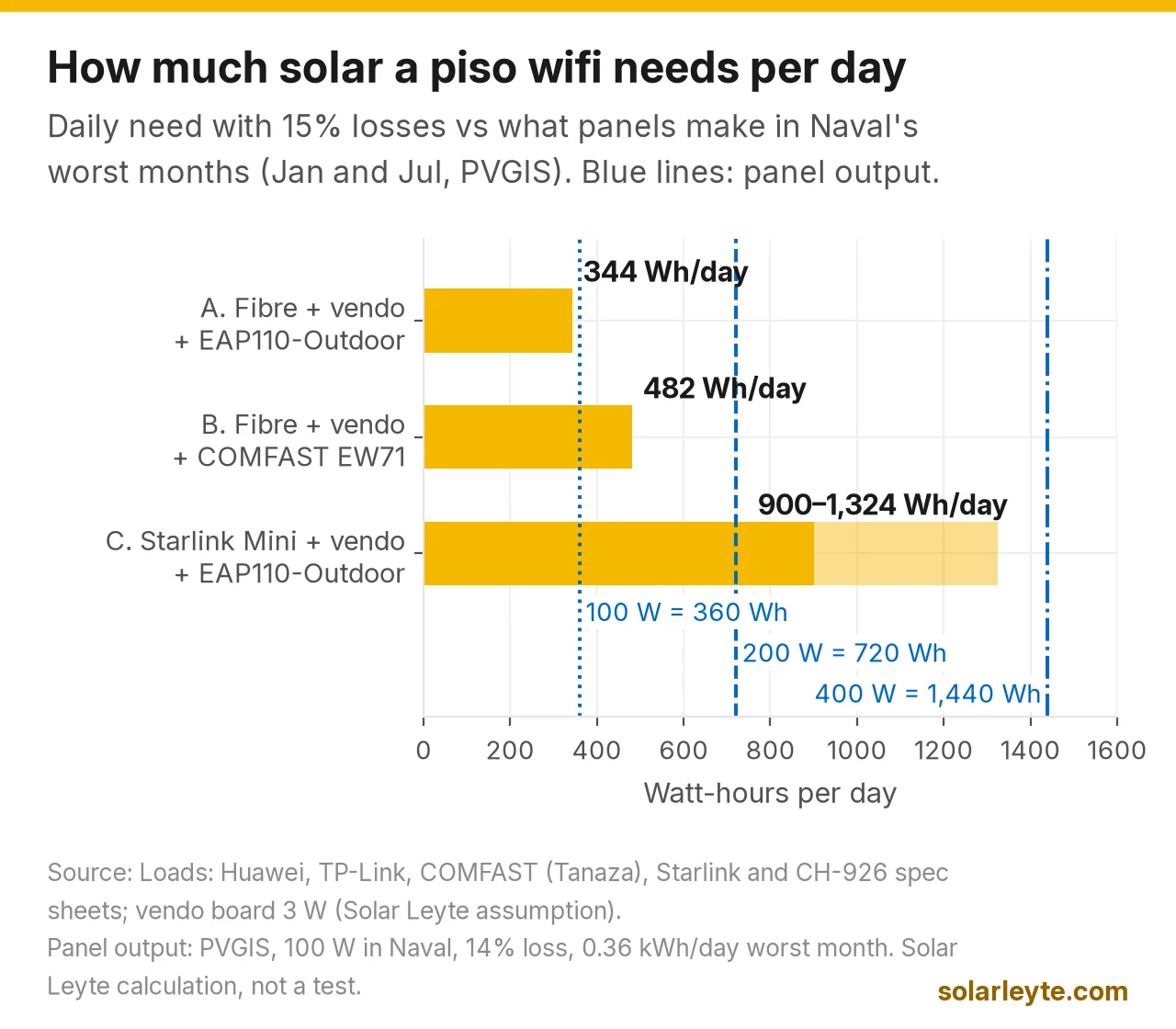
The "what we'd fit" column leaves headroom so the battery can catch up after a cloudy day. For small panels, LakaSolar lists a SolarHome 100 W mono at ₱1,800 and a 150 W at ₱2,300 (100 W, 150 W). Our small solar panels guide explains how to read the label before you buy.
How big a battery
The battery has to carry the vendo through the night, plus at least one rainy day. Assuming you use only 50% of a lead-acid battery and 80% of a LiFePO4 battery (Solar Leyte assumptions that protect battery life), here's how long each one lasts with no sun at all:
Battery (listed price) | Usable energy | Setup A | Setup B | Setup C |
|---|---|---|---|---|
Solar Home 12V 100Ah deep cycle (₱7,800) | 600 Wh | about 42 h | about 30 h | about 11–16 h |
Higee 12.8V 120Ah LiFePO4 (₱13,400) | 1,229 Wh | about 86 h | about 61 h | about 22–33 h |
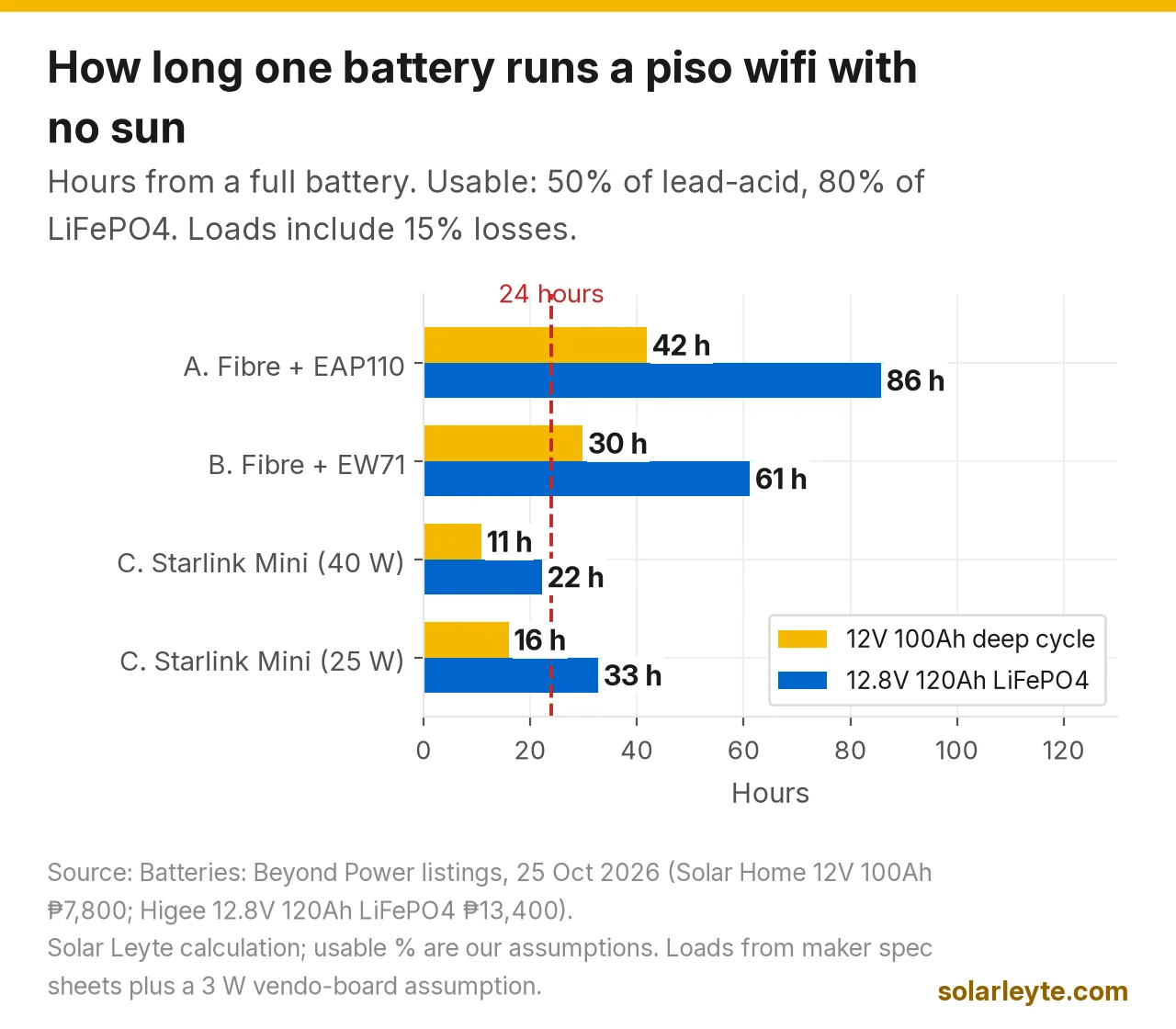
Prices are from Beyond Power (LiFePO4 listing). For setups A and B, a single 100Ah battery covers a night plus a cloudy day. A Starlink vendo is a different story: it needs the bigger battery, or two of them.
Keep it on 12 volts DC, not through an inverter
This is the mistake that doubles your system size. Many people plug the vendo's adapter into a small inverter. But Samlex's SWI-1100 manual lists the 12 V model's idle draw at up to 1.1 A, which is about 13 W just to keep the inverter switched on (Samlex SWI manual). That's more than all of Setup A put together.
Most of a piso wifi already runs on low-voltage DC:
- Vendo board and coin slot: these already run from a 12 V adapter, so they can run straight from the battery through a fuse.
- Fibre modem: the Huawei unit above takes 11–14 V DC at 1.5 A, per its datasheet. A battery's voltage moves around as it charges and drains, so feed the modem through a regulated 12 V DC-DC converter, not straight off the terminals.
- Access point: the EAP110-Outdoor uses 24 V passive PoE, and the EW71 uses 48 V PoE. You'll need a 12 V-input PoE booster rated for that voltage in place of the plug-in PoE adapter.
- Starlink Mini: its spec sheet lists a 12–48 V DC input rated 60 W, so it can run from DC with the right cable.
Put a DC fuse on the battery's positive lead. LakaSolar lists a Suntree SRD-30 fuse holder at ₱550. If your access point sits on a pole, read our lightning and surge protection guide too.
What the parts cost (example, before installation)
Here's Setup A with listed prices from 25 October 2026. These are Solar Leyte sums for illustration, not quotes:
Part | Budget build | Longer-life build |
|---|---|---|
Panels, 2 × 100 W (LakaSolar) | ₱3,600 | ₱3,600 |
Charge controller | ₱1,100 (KTF1220 20A PWM) | ₱4,000 (SRNE SR-ML 30A MPPT) |
Battery (Beyond Power) | ₱7,800 (12V 100Ah deep cycle) | ₱13,400 (12.8V 120Ah LiFePO4) |
DC fuse holder (LakaSolar) | ₱550 | ₱550 |
Total | ₱13,050 | ₱21,550 |
Controller prices are from ABC Solar (SRNE 30A). Not included: mounting, cables, the PoE booster, the DC-DC converter and labour. If you choose LiFePO4, make sure the controller has a lithium charging setting. Our MPPT vs PWM guide explains when the dearer controller is worth it. For a setup this small, PWM is fine.
So the solar kit can cost more than the vendo itself.
Is it worth it?
On grid power, Setup A costs about ₱166 a month. At that rate, the budget kit would take more than six years to pay for itself through bill savings alone. That's not a good reason to buy it.
The real reason is downtime. Example only, use your own numbers: say your vendo takes in ₱150 on a normal evening and four evenings a month are lost to brownouts. That's ₱600 a month in lost coins plus ₱166 of electricity, or ₱766 a month, and the budget kit would cover its cost in about 17 months. If your area rarely has brownouts, a small UPS for the modem and vendo is the cheaper fix. Our inverter and battery guide covers grid-charged backup.
Solar makes the most sense for:
- Sitios with no grid or weak grid, where the only internet is Starlink (Setup C).
- Stores that already lose sales to rotating brownouts, like the ones in our sari-sari store guide.
- Vendos far from an outlet, such as on a pole by the basketball court.
One limit: solar keeps your modem on, but it can't keep your ISP's equipment up. In a long outage, ask your provider whether their line in your area stays live.
Before you start charging for Wi-Fi (last checked 25 October 2026)
The Konektadong Pinoy Act (RA 12234) says all data transmission industry participants must register with the NTC (RA 12234). Its implementing rules, dated 5 November 2025, define a data transmission service as conveying data "offered on a commercial basis or to the public for a fee" (IRR). We couldn't find an NTC rule written specifically for piso wifi vendos, so:
- Ask the NTC regional office whether your setup needs registration.
- Read your ISP contract for any clause on reselling or sharing the connection.
- Get your barangay clearance and municipal business permit as you would for any small business.
Vendo software is a separate cost. LPB, for example, lists licences from ₱250 to ₱900 (LPB licence shop).
FAQ
How many watts does a piso wifi use? A basic setup with a fibre modem, Orange Pi vendo, coin slot and one EAP110-Outdoor access point is about 12 W by spec sheet, or about 0.3 kWh a day. A Starlink Mini adds 25 to 40 W.
Kaya ba ng 100W solar panel ang piso wifi? Barely. One 100 W panel in Naval makes about 0.36 kWh a day in the worst months, almost exactly what a basic setup needs once losses are counted. Two 100 W panels give you room for cloudy days.
Pwede bang walang battery? Not for a vendo that runs 24 hours. Without a battery it shuts off every evening and on cloudy afternoons.
Can I use a power bank or a small UPS instead? For short brownouts, yes. A UPS or a 12 V mini UPS charges from the grid and covers a few hours. Solar is for long outages or places with no grid.
Do I need an inverter? Usually not. An inverter's idle draw can be more than the whole vendo uses. Run everything on 12 V DC with the right converters.
Solar Leyte is run by MACC Systems & Energy Solutions Inc., a solar installer in Naval, Biliran.
Get a free quote from MACC
Send a photo of your last BILECO or LEYECO bill and tell us what you want to keep running. MACC will reply with options and a written quote. No obligation.
- Call/Text: 0955 723 5093
- Email: official@macc-inc.com or benjie@macc-inc.com
- Website: www.macc-inc.com
- Request a quote online: solarleyte.com/quote
- Office: Brgy. Talustusan, Naval, Biliran 6543
Sources (all checked 25 October 2026)
- Cebuwebmart, Piso WiFi complete sets (₱6,000 to ₱10,899; Orange Pi One board, 12V 3A or 5A adapter, 5V buck converter; V3 with TP-Link EAP110-Outdoor ₱8,299)
- Huawei, EchoLife EG8145V5 datasheet (PDF) (5.3 W static, 18 W maximum)
- CH-926 multi-coin acceptor, manual (PDF) (DC 12 V, working current 65 mA)
- TP-Link, EAP110-Outdoor v3 specifications (3.1 W, 24 V passive PoE)
- COMFAST, CF-EW71 product page (48 V 0.32 A PoE) and Tanaza CF-EW71 datasheet (PDF) (8 W maximum)
- Starlink, Starlink Mini specifications (PDF) (25–40 W average, 12–48 V 60 W input)
- European Commission JRC, PVGIS: 100 W, Naval (11.561, 124.395), 14% system loss: 0.41 kWh/day yearly average, 0.36 kWh/day in January and July
- ICSC, PRESYO-PH: BILECO's September 2026 residential rate, ₱18.93 per kWh (latest month available on 25 October 2026)
- Samlex, SWI series manual (PDF) (SWI 1100-12 idle current under 1.1 A)
- LakaSolar Philippines: SolarHome 100W (₱1,800), SolarHome 150W (₱2,300), UNI-T UT230B energy meter (₱2,499), Suntree SRD-30 DC fuse holder (₱550)
- ABC Solar Electronics: KTF1220 20A PWM (₱1,100), SRNE SR-ML 30A MPPT (₱4,000)
- Beyond Power: Solar Home 12V 100Ah (₱7,800), Higee 12.8V 120Ah LiFePO4 (₱13,400)
- LPB, licence shop (₱250 to ₱900)
- Republic Act No. 12234, Konektadong Pinoy Act, and its implementing rules (Lawphil)