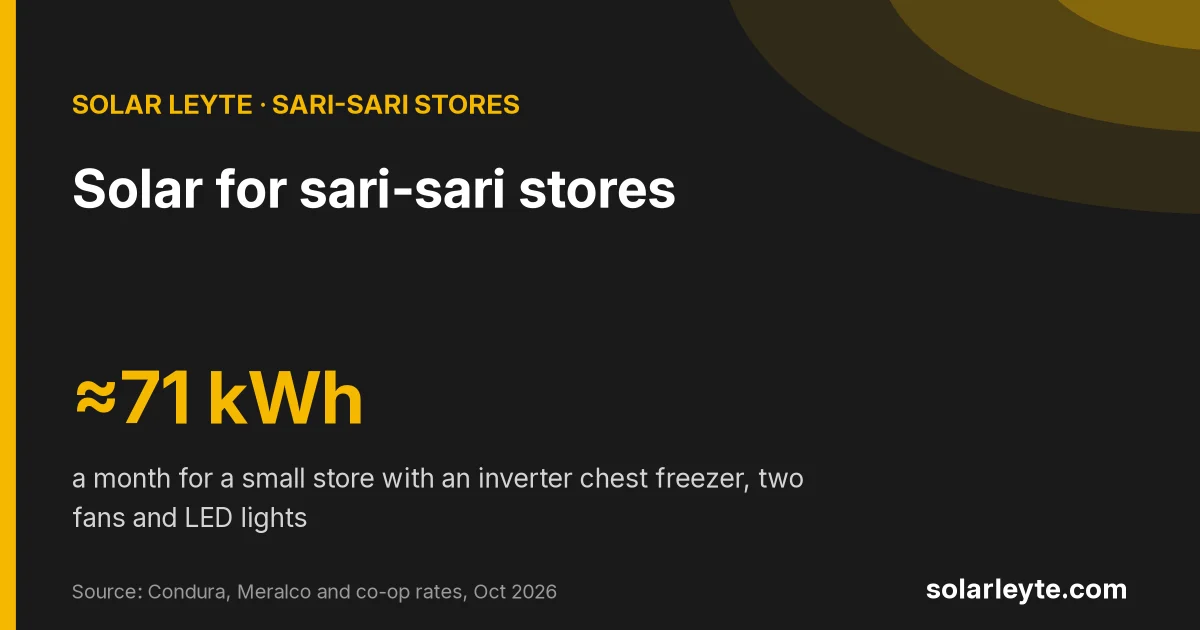
A sari-sari store's biggest load is usually the chest freezer. A 7 cu ft inverter model uses about 0.68 kWh a day on the maker's label, or roughly 21 kWh a month. Add two stand fans and LED lights and the store side of the bill is about 71 kWh a month — around ₱1,160 to ₱1,340 at BILECO and LEYECO IV/V residential rates. Put that freezer on a small hybrid system with a battery and it keeps ice cream and frozen goods cold through a four-hour evening brownout, which is the outage pattern NGCP has warned Visayas co-ops about.
Unsa may problema sa sari-sari? Unlike a water refilling station, you can't shift the biggest load to midday and sell from a tank later. The freezer runs all day and all night. Grid-tie solar still cuts the bill while the sun is up. Hybrid with a battery is what keeps the freezer alive when the lights go out.
Freezer kWh come from Meralco's Power Lab list and Condura's published Negosyo Pro specs; fridge medians from the DOE energy-label list; fan and bulb figures from Meralco tests (same basis as our appliance kWh post). Rates are the co-ops' own posts and PRESYO-PH, checked 9 October 2026. Store scenarios, bills, brownout kWh and payback are Solar Leyte calculations with the assumptions stated below. Your own freezer, hours and bill will differ — read the yellow label and your bill. Nothing here is a MACC price or quote.
What uses the power in a sari-sari store
A typical Leyte or Biliran sari-sari is a small front room with a chest freezer (ice candy, ice cream, frozen goods), a couple of fans, LED bulbs, a phone charger, and often the household fridge on the same meter. Some stores also run a glass-top cooler for soft drinks. The loads that matter:
Load | Typical size | Energy use | Basis |
|---|---|---|---|
Inverter chest freezer | 7 cu ft (about 198 L) | 0.68 kWh a day | Condura Negosyo Pro CCF70DCi label |
Inverter chest freezer (Meralco median) | solid-lid, various sizes | 0.61 kWh a day | Median of 14 inverter chest freezers in Meralco's Power Lab list |
Conventional chest freezer (Meralco median) | solid-lid, various sizes | 1.01 kWh a day | Median of 24 conventional solid-lid chest freezers |
Glass-top / flat-glass cooler | about 7–8 cu ft | 1.30 kWh a day | Sanden SNG-0225, Meralco test |
Frost-free household fridge | 7–10 cu ft | 27 kWh a month | DOE label median, 94 models |
16-inch stand fan, medium | one unit | 0.0476 kWh an hour | Meralco test / tips page |
9 W LED bulb | one unit | 0.009 kWh an hour | Meralco test |
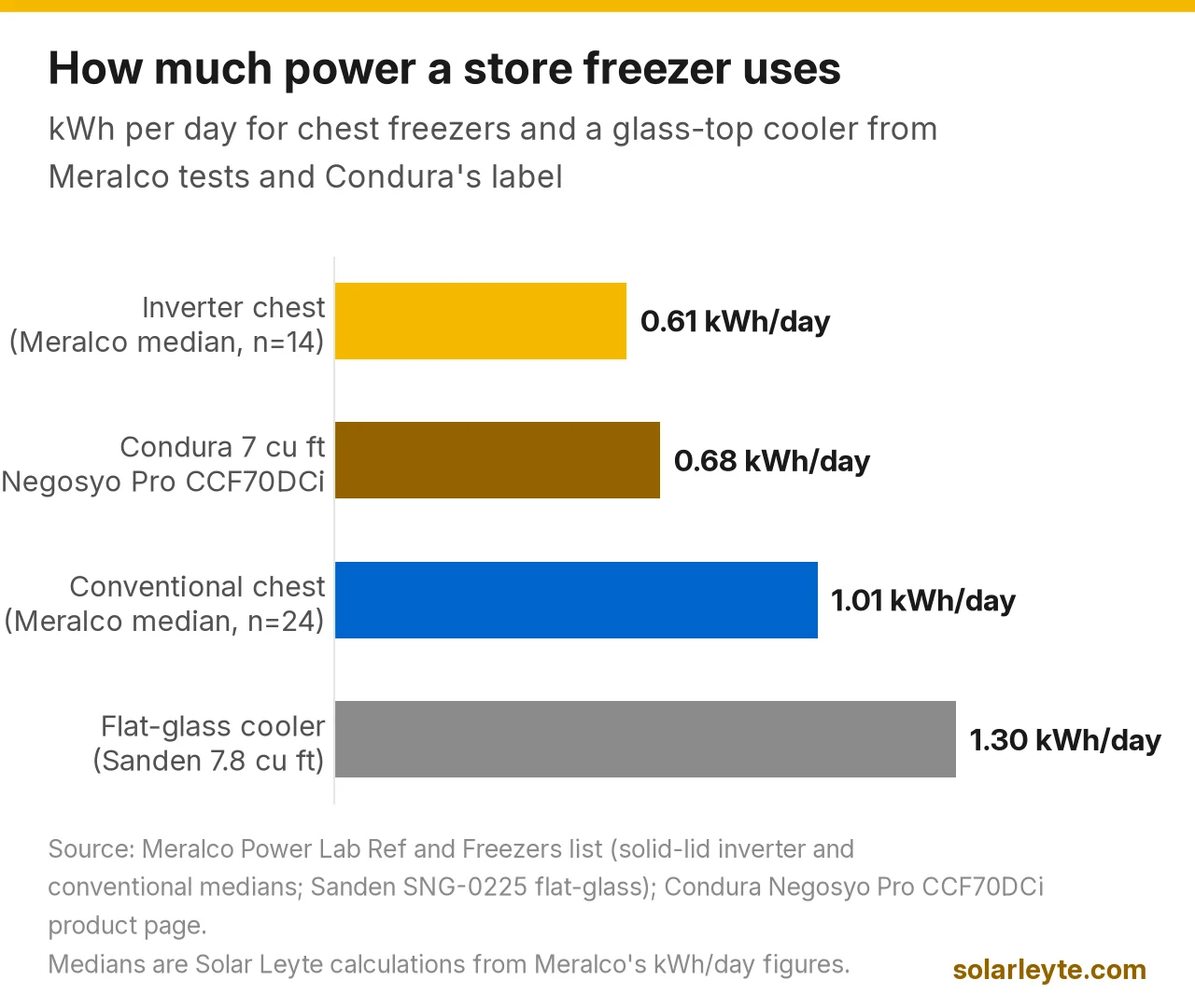
Sources: Condura Negosyo Pro Inverter Chest Freezer product pages (CCF35DCi to CCF180DCi); Meralco Power Lab "Ref and Freezers" appliance list (rate basis ₱10.45/kWh on that sheet); DOE Issuance of Energy Label for Refrigerating Appliances, 1 July to 31 December 2024; Meralco energy-efficiency tips and tested-appliance lists. Medians are Solar Leyte calculations from those lists.
A few things jump out:
- Inverter chests use about half what conventional ones do. Meralco's median inverter solid-lid chest is 0.61 kWh a day; the conventional median is 1.01. Over a month at BILECO's September rate (₱18.93/kWh via PRESYO-PH), that gap is about ₱230 (0.40 × 30.4 × ₱18.93, our calculation). If you're replacing a worn-out freezer, the inverter premium often pays for itself.
- Glass-top coolers are thirsty. A 7.8 cu ft flat-glass Sanden in Meralco's list uses 1.30 kWh a day — nearly two inverter chests. Soft-drink coolers with open lids or glass tops lose cold every time someone peeks in.
- The freezer is on 24 hours. Fans and lights only run while the store is open. That changes how solar fits (more on that below).
Condura's Negosyo Pro inverter line, aimed at stores, publishes these daily figures on its product pages:
Model | Size | Label kWh/day | About kWh/month | BILECO Sep (₱18.93) |
|---|---|---|---|---|
CCF35DCi | 3.5 cu ft | 0.58 | 18 | ₱334 |
CCF50DCi | 5.0 cu ft | 0.59 | 18 | ₱340 |
CCF70DCi | 7.0 cu ft | 0.68 | 21 | ₱392 |
CCF86DCi | 8.6 cu ft | 0.86 | 26 | ₱495 |
CCF102DCi | 10.2 cu ft | 0.98 | 30 | ₱564 |
CCF150DCi | 15.0 cu ft | 0.86 | 26 | ₱495 |
CCF180DCi | 18.0 cu ft | 0.96 | 29 | ₱553 |
Source: Condura product pages. Month = kWh/day × (365÷12). Pesos are Solar Leyte calculations at BILECO's September 2026 PRESYO-PH residential rate. Condura's own cost-per-day figures use older Meralco averages (₱11.44 or ₱11.50), so we re-priced at Eastern Visayas rates.
Three store scenarios and the monthly bill
These are scenarios, not industry averages. Hours are our assumptions for a store open about 12 hours a day.
Scenario | What's running | kWh a day | kWh a month |
|---|---|---|---|
A. Small store, inverter freezer | 7 cu ft inverter chest (0.68) + 2 fans × 12 h + 4 × 9 W LED × 14 h | 2.33 | about 71 |
B. Store + home fridge on one meter | A + frost-free 7–10 cu ft fridge (DOE median 27 kWh/mo) | 3.21 | about 98 |
C. Older freezer + glass cooler | Median conventional solid-lid chest (1.01) + flat-glass cooler (1.30) + fans + lights | 3.96 | about 120 |
Solar Leyte calculation. A month is 365÷12 days. Add a rice cooker, TV or Wi-Fi from the appliance kWh post if those sit on the same meter.
Residential or commercial rate?
Many sari-sari stores share the house meter and stay on the residential rate. A store with its own meter or service may be billed commercial or low-voltage instead; that depends on how your co-op has classified the account. Read the rate class printed on your bill. Don't assume.
BILECO posts both classes. Its latest website post (July 2026) has residential at ₱18.3407/kWh and commercial at ₱16.8353/kWh, VAT included. PRESYO-PH (ICSC's tracker, compiled from co-op rate disclosures) shows BILECO residential around ₱18.93 in September 2026; BILECO itself hadn't posted August or September on its site when we checked. LEYECO IV's September 2026 residential rate is ₱16.9708/kWh plus a ₱5.00/month fixed charge; its low-voltage (business) class is ₱15.6838/kWh plus ₱68.87 fixed. LEYECO V's September residential is ₱16.3837/kWh plus ₱5.00/month fixed; commercial is ₱15.4753/kWh plus ₱78.86 fixed. Both LEYECO V figures are before distribution VAT.
Scenario | kWh/mo | BILECO res Sep (₱18.93) | BILECO comm Jul (₱16.8353 + ₱71.94 fixed) | LEYECO IV res | LEYECO IV LV (+fixed) |
|---|---|---|---|---|---|
A. Small inverter store | 71 | ₱1,340 | ₱1,263 | ₱1,201 | ₱1,179 |
B. Store + home fridge | 98 | ₱1,851 | ₱1,718 | ₱1,659 | ₱1,602 |
C. Conv. chest + glass cooler | 120 | ₱2,278 | ₱2,098 | ₱2,042 | ₱1,956 |
Pesos are kWh × rate, plus the fixed charge where the column header shows one (Solar Leyte calculation). Residential columns are energy charges only; BILECO, LEYECO IV and LEYECO V each add a ₱5.00/month residential fixed charge. Sources: BILECO power-rate posts; PRESYO-PH; LEYECO IV September 2026 rates; LEYECO V unbundled sheet. Track the monthly moves on our BILECO, LEYECO II and LEYECO IV and V pages.
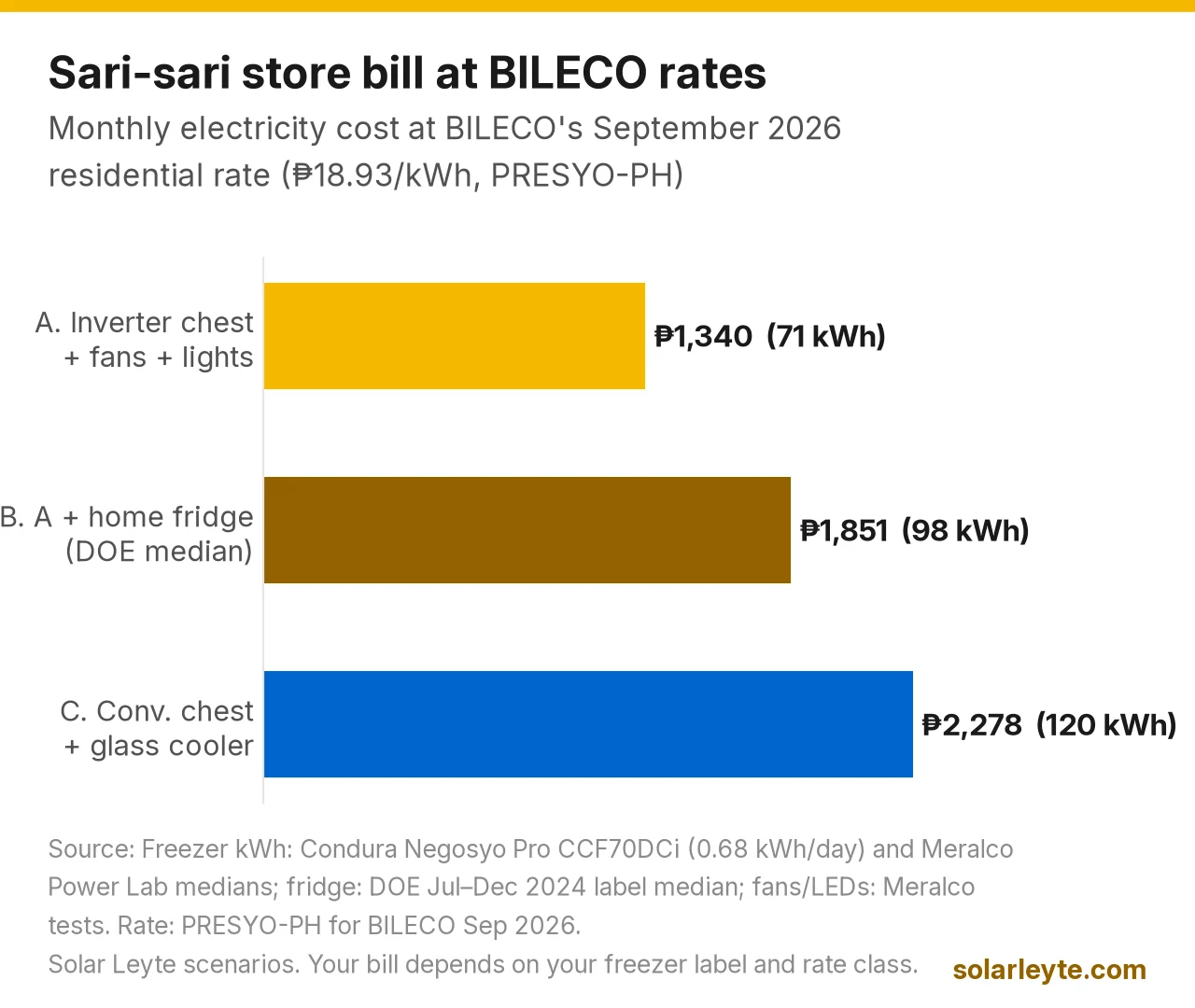
Commercial is a bit cheaper per kWh at these co-ops, and at BILECO and LEYECO IV it still comes out cheaper per month after the fixed charge. At LEYECO V, the ₱78.86 commercial fixed charge roughly cancels the per-kWh saving on a small store bill. Either way, it only applies if your account is actually on that class. A home-based store on residential still pays the residential rate.
Why brownouts hit sari-sari stores hard
A chest freezer can ride through a short blip on thermal mass alone — the food stays cold for a while with the lid shut. A four-hour evening outage is different. Soft ice cream melts, ice candy weeps, and you throw stock away. Eastern Visayas has seen that pattern: on 26 August 2026, NGCP flagged possible rotating brownouts from 5 pm to 9 pm across BILECO, LEYECO II to V and the Samar co-ops (GMA News, covered in our Visayas grid alert post).
Grid-tie solar switches off in a brownout. Anti-islanding rules shut the inverter so it can't back-feed a dead line. Only a hybrid (or off-grid) system with a battery keeps the freezer running. That's the whole point of the grid-tie vs hybrid choice for a store.
How much battery for a four-hour evening outage?
Using average power for the Scenario A store (freezer at 0.68 kWh/day ÷ 24, two fans, four LEDs) over four hours:
Load | kWh in 4 hours |
|---|---|
Chest freezer (average) | 0.11 |
Two 16-inch fans | 0.38 |
Four 9 W LEDs | 0.14 |
Total | 0.64 |
With 1.5× margin | about 1.0 |
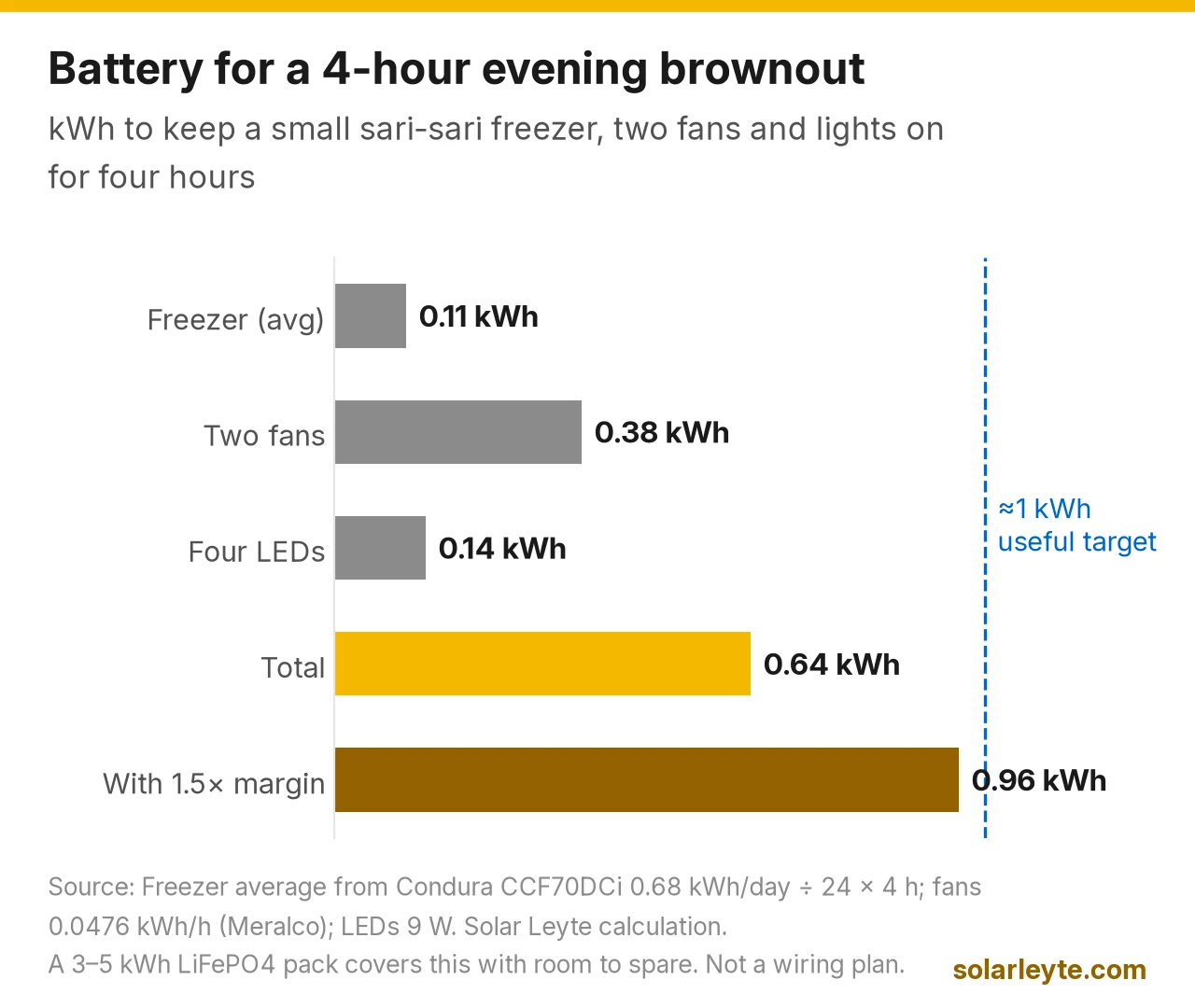
Solar Leyte calculation. Condura lists the 7 cu ft CCF70DCi at 75 W nameplate; running that watts figure flat for four hours is 0.30 kWh, which sits between our average and the margined total. A 3 to 5 kWh LiFePO4 battery (about 2.7 to 4.5 kWh usable at 90% depth of discharge) covers the store essentials through a four-hour evening outage with room to spare. Philippine sellers we checked in October 2026 listed 5–6 kWh LiFePO4 units at ₱42,000 to ₱67,800 (equipment only) — see our solar battery price guide.
If the household fridge is on the same backup circuit, add about 0.9 kWh for four hours of fridge-class load (from the battery post's essentials example) and size up.
Grid-tie vs hybrid for a sari-sari
Goal | Better fit | Why |
|---|---|---|
Cut the monthly bill only | Grid-tie (or zero-export) | Cheaper parts; daytime freezer and fan load overlaps the sun |
Keep the freezer cold in a brownout | Hybrid + battery | Grid-tie shuts off when the co-op does |
Both | Hybrid + battery, sized for the bill and the outage | Panels cover daytime kWh; battery covers evenings and alerts |
Daytime overlap helps. A freezer draws around the clock, so roughly a third to half of its kWh falls in solar hours on a clear day. Fans that run while the store is open (say 7 am to 7 pm) catch more sun than evening lights do. Lights after dark need the grid or a battery. So:
- Grid-tie alone still saves money on daytime freezer and fan use. It does nothing in a brownout.
- Hybrid with a small battery saves on the bill and keeps ice cream frozen when NGCP posts a yellow or red alert.
For systems that export nothing, DOE Department Circular DC2026-08-0017 (August 2026) simplifies the paperwork: you notify the co-op instead of waiting for clearances, and plug-and-play kits up to 1 kW skip the building permit and ERC certificate. A 1.5–3 kWp zero-export system still needs a building permit, and a store on a separate commercial account still needs an ERC Certificate of Compliance; only household and medical-facility systems are exempt. Details are in our plug-and-play and zero-export post. A home-based store on a residential meter is a different paperwork path from a separate commercial service. Your installer should confirm which track fits your account.
What size system fits
For Scenario A (about 71 kWh a month), you don't need a big roof. PVGIS 5.3 for Naval, Biliran, puts a 1 kWp array at about 124 kWh a month on average (1,487 kWh/year ÷ 12, ERA5, 11° tilt, south, 14% losses — same basis as our earlier posts). Even 1 to 2 kWp produces more than the store uses over a month. The limit is coincidence (when you use power vs when the sun shines) and, for hybrid, how much battery you want for brownouts.
A practical starting point for a small Leyte/Biliran sari-sari:
Piece | Rough size | Notes |
|---|---|---|
Panels | 1.5 to 3 kWp (three to six 550–600 W panels) | Covers daytime store load with margin; see 550–620 W panel prices |
Hybrid inverter | about 3 to 5 kW | Surge headroom for freezer compressor start; see hybrid inverter prices and Deye vs Solis vs SRNE |
Battery | 3 to 5 kWh LiFePO4 usable target | Four-hour evening brownout for freezer + fans + lights |
Critical-load panel | freezer, lights, one or two fans | Don't put the whole house on backup unless you size for it |
A full 5 kW hybrid is overkill for most pure sari-sari loads, but it makes sense if the same system also covers the house (Scenario B) or you want headroom for a second freezer later.
Rough payback (honest, not salesy)
Suppose Scenario A on BILECO residential at ₱18.93/kWh. If hybrid solar offsets about 70% of the 71 kWh (daytime self-use plus some evening from the battery), that's about 50 kWh a month, or roughly ₱940 a month saved (Solar Leyte estimate). At LEYECO IV residential (₱16.9708), about ₱840.
Parts for a small hybrid are harder to pin down than a 5 kW package. From our 7 October 2026 seller check, 5–5.5 kW grid-tie packages with installation listed at about ₱42 to ₱50 per watt, and hybrid packages higher. Smaller systems usually cost more per watt, and a 5 kWh battery alone was ₱42,000–₱67,800. A 2 kWp hybrid with a 5 kWh battery could land somewhere around the mid-₱100,000s in parts before labour and permits — get real quotes. At ₱940 a month saved, a ₱150,000 system is roughly a 13-year simple payback; at ₱200,000, about 18 years. That's before rate spikes (BILECO commercial jumped ₱5.39/kWh from May to July 2026) and before counting spoiled stock you no longer throw away after brownouts.
Payback is weaker than for a water refilling station, where the RO pump is big and can run at noon. For a sari-sari, the case is often: moderate bill savings + freezer insurance during Visayas alerts. If brownouts rarely hit your barangay, grid-tie alone may be enough. If they melt your stock twice a month, the battery is the product.
Before you ask for a quote
- Photograph the yellow DOE energy label on your freezer (and fridge, if any), or the nameplate watts.
- Note your bill's rate class (residential vs commercial / low voltage) and the rate per kWh.
- List what must stay on in a brownout (freezer only? lights and fan too?).
- Estimate how long your usual outages last (1 hour, 4 hours, overnight).
- Measure roof space and who owns it (especially if you rent the storefront).
- Decide whether the house shares the meter and the backup circuit.
Bring that list to any installer. Licence and paperwork checks are in how to choose a solar installer in Leyte and Biliran.
FAQ
How much electricity does a sari-sari store use? A small store with a 7 cu ft inverter chest freezer, two fans and LED lights uses about 71 kWh a month in our Scenario A (Solar Leyte estimate from Condura and Meralco figures). Add a household fridge on the same meter and you're around 98 kWh. An older conventional chest plus a glass-top cooler comes to about 120 kWh.
How much does a chest freezer cost to run at BILECO rates? Condura's 7 cu ft Negosyo Pro inverter (0.68 kWh/day) is about ₱392 a month at BILECO's September 2026 PRESYO-PH rate of ₱18.93/kWh. Meralco's median conventional solid-lid chest (1.01 kWh/day) is about ₱580 a month at the same rate (our calculations).
Can solar keep my freezer running during a brownout? Only if it's hybrid (or off-grid) with a battery. Plain grid-tie shuts off when the co-op line is dead. For a four-hour evening outage, about 1 kWh of usable battery covers freezer + two fans + lights with margin; a 3–5 kWh LiFePO4 pack is a common fit.
Is my sari-sari on residential or commercial rates? Check the bill. Many home-based stores stay residential. BILECO's July 2026 post shows residential ₱18.3407 and commercial ₱16.8353. LEYECO IV and V also publish separate residential and business/low-voltage classes. Use the class you're actually billed on.
Is solar worth it for a sari-sari store? For bill savings alone, a small daytime-heavy load at ₱16–₱19/kWh is a moderate case — weaker than a midday-heavy business like a refilling station. The stronger case in Eastern Visayas is protecting frozen stock during brownouts. Run the numbers on your bill and your spoilage losses.
Solar Leyte is run by MACC Systems & Energy Solutions Inc., a solar installer in Naval, Biliran.
Get a free solar quote for your sari-sari store from MACC
Send us a photo of your last BILECO or LEYECO bill, your freezer's energy label, and what must stay on in a brownout. We'll size the panels, hybrid inverter and battery around that list, give you every model number and datasheet, and show you the math, with no obligation.
- Call/Text: 0955 723 5093
- Email: official@macc-inc.com or benjie@macc-inc.com
- Website: www.macc-inc.com
- Request a quote online: solarleyte.com/quote
- Office: Brgy. Talustusan, Naval, Biliran 6543
Sources (all checked 9 October 2026)
- Chest freezer labels: Condura, Negosyo Pro Inverter Chest Freezer (CCF35DCi–CCF86DCi) and larger Negosyo Pro models (CCF102DCi–CCF180DCi)
- Meralco Power Lab, Ref and Freezers tested-appliance list (chest freezer, flat-glass and curved-glass cooler kWh/day)
- DOE, Issuance of Energy Label for Refrigerating Appliances, 1 July to 31 December 2024 (fridge medians)
- Fans and LEDs: Meralco, energy-efficiency tips and tested-appliance lists (same basis as our appliance kWh post)
- Rates: BILECO, power rate posts (July 2026 residential ₱18.3407, commercial ₱16.8353); PRESYO-PH / ICSC for BILECO September ~₱18.93; LEYECO IV, September 2026 rates; LEYECO V, power rates and September 2026 unbundled sheet
- Brownouts: GMA News, Rotating brownouts may hit Visayas consumers on Aug. 26, 2026; Solar Leyte, Visayas grid yellow and red alerts
- Solar output: European Commission JRC, PVGIS 5.3 yearly total for Naval (ERA5, 1 kWp, 11°, south, 14% loss) ≈ 1,487 kWh/year
- Prices: Solar Leyte, solar battery price, 5kW solar system price, hybrid inverter price (PH seller listings, October 2026)