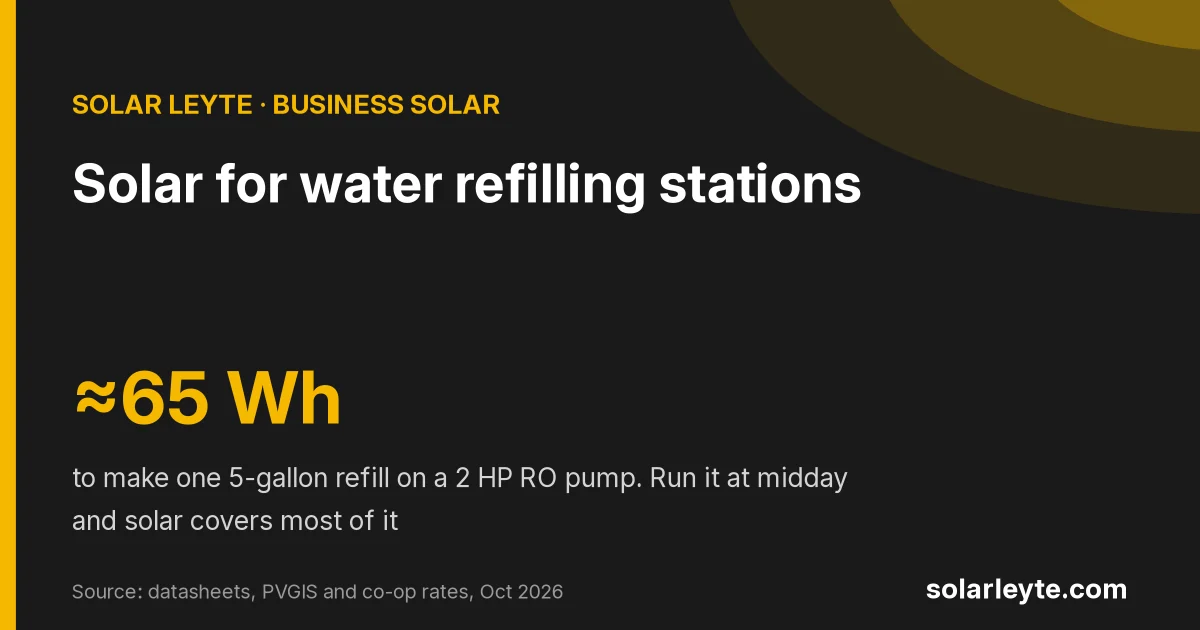
A typical refilling station runs a 2 HP reverse osmosis (RO) pump and a 1 HP booster pump while it makes water, about 2.8 kW together. On that equipment, each 5-gallon refill takes roughly 65 Wh to make, plus about 19 Wh to dispense. A station selling 200 refills a day uses about 550 kWh a month, which comes to around ₱8,600 to ₱9,300 at BILECO, LEYECO IV and LEYECO V commercial rates. Because the treated water waits in a tank, you can make it while the sun is up. In our Naval model, a 4 kWp zero-export system covers about 70% of that station's kWh.
Unsa may lahi sa refilling station? Most businesses have to use power at the moment customers walk in. A refilling station doesn't. Its biggest load, the RO plant, can run at midday and fill the product tank for the evening rush. That makes it one of the better solar fits on our grid-tie, hybrid and off-grid map.
Equipment specs come from Philippine package listings, government bid notices and makers' datasheets; rates are the co-ops' own posts, checked 8 October 2026. Loads, bills, solar output and payback are Solar Leyte calculations with the assumptions stated below. Your own pumps, hours and bill will differ, so measure before you buy. Nothing here is a MACC price or quote.
What uses the power in a refilling station
Philippine refilling-station packages are built around the same parts. Here are three published equipment lists:
Equipment list | RO pump | Other pumps | Membranes | UV sterilizer | Product tank |
|---|---|---|---|---|---|
Hydronex "6000 GPD" package, ₱295,000 (listed 8 Oct 2026) | 2 HP stainless vertical | 1.2 HP dispensing pump | 2 × Vontron ULP21-4040 | 12 GPM | 2 × 1,000 L stainless |
Bulacan Agricultural State College bid, budget ₱270,000 (Nov 2024) | Vertical multistage, stainless ("2-60") | 2 × 1 HP booster pumps | 2 × 4040 | 6 GPM | 1,000 L stainless |
Province of Catanduanes mobile unit bid (Sep 2023) | 2 HP horizontal | 1.5 HP raw-water pump, 1 HP product pump, 1 HP dispensing pump | 2 × 4040 | 6 GPM minimum | 2,000 L stainless |
Sources: Hydronex Water System product page; PhilGEPS bid notices 11448679 and 10144829. The Catanduanes unit also specifies a 5.5 kVA minimum backup generator.
So the core loads are an RO pump of about 2 HP, one or two 1 to 1.5 HP pumps to feed it or move water, a dispensing pump, a UV lamp of tens of watts, and the lights. Some stations add an ozone generator, a chiller or an aircon. Add those from their own labels; for aircon, see solar for aircon.
Horsepower is output, not what you pay for
A pump's HP rating is the motor's output. The meter counts what the motor draws, which is higher because motors lose some energy as heat. We used the IEC 60034-30-1 IE2 efficiency class to estimate input power. Many small single-phase motors do worse than IE2, so treat these as low-side figures.
Load | Rated output | IE2 efficiency (2-pole) | Estimated input |
|---|---|---|---|
RO pump, 2 HP | 1.5 kW | 81.3% | about 1.85 kW |
Booster/feed pump, 1 HP | 0.75 kW | 77.4% | about 0.96 kW |
Dispensing pump, 1.2 HP | about 0.9 kW | 79.6% (1.1 kW class) | about 1.12 kW |
UV sterilizer, 12–15 GPM class | – | – | 42 to 48 W |
LED lights (our assumption: four 18 W tubes) | – | – | 72 W |
Sources: ABB technical note on IEC 60034-30-1 (IE2 minimum efficiencies); Viqua Sterilight S12Q datasheet (42 W total, 39 W lamp) and S12Q-PA listing (48 W). Input = output ÷ efficiency, Solar Leyte calculation.
Does the RO pump really work that hard? Yes, close to it. The membranes are tested at 150 psi, which is about 105 m of head. A 2 HP stainless multistage pump such as the CNP CDLF2-15 (1.5 kW motor) delivers 2.4 m³/h at 100 m and 2.0 m³/h at 112 m on its published curve. That's close to its rated point, so the motor runs near full load the whole time it's on.
Measure yours. A clamp meter on each pump's supply, or the nameplate amps × 230 V as a rough upper bound, beats any estimate. Your electrician or installer can do this in a few minutes.
How many kWh per refill
The RO pump only runs while it's making water, so the hours depend on how much you sell.
- Production rate. Each Vontron ULP21-4040 membrane is rated at 2,600 gallons per day at 150 psi and 25 °C, with each element allowed ±20% (Vontron datasheet). Two of them make about 217 gallons an hour, or roughly 43 five-gallon containers an hour (Solar Leyte calculation). Older, fouled or colder membranes make less, so check your product flow meter.
- Making water: the RO pump plus booster draw about 2.81 kW, so each gallon takes about 13 Wh and each 5-gallon container about 65 Wh.
- Dispensing: at about 1.12 kW and an assumed 1 minute of pumping per container, about 19 Wh per refill. Time your own faucet.
- Always on while open: UV (48 W) and lights (72 W) for 12 hours is about 1.4 kWh a day.
Here's what that adds up to at three sales levels. These are scenarios, not industry averages.
Refills a day (5-gal) | Gallons | RO running time | kWh a day | kWh a month |
|---|---|---|---|---|
100 | 500 | 2.3 hours | 9.8 | about 298 |
200 | 1,000 | 4.6 hours | 18.2 | about 552 |
300 | 1,500 | 6.9 hours | 26.5 | about 806 |
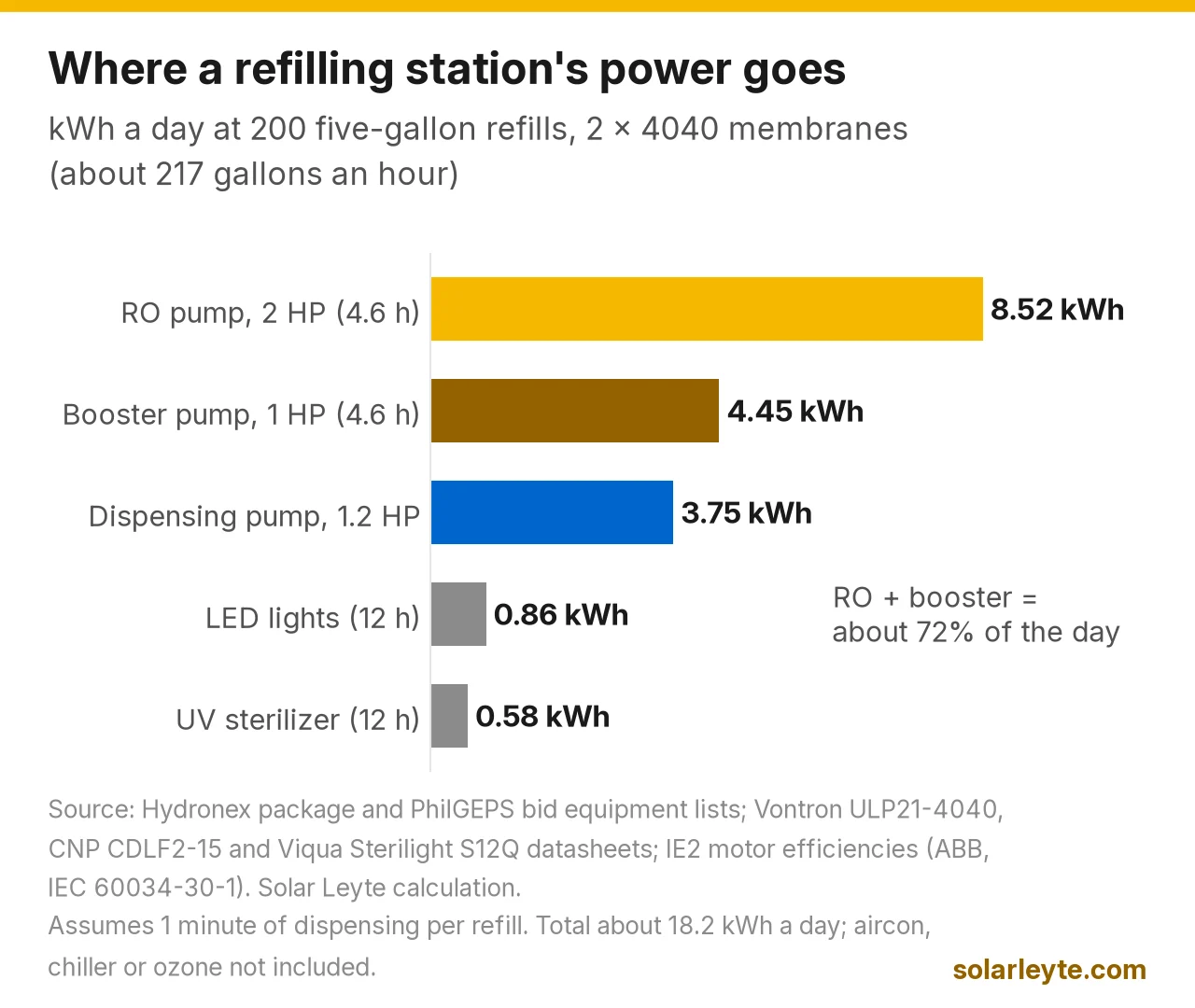
Solar Leyte calculation from the loads above. A month here is 365 ÷ 12 days. Add any aircon, chiller, ozone or delivery-vehicle charging separately.
At 200 refills a day, the RO pump alone is 8.5 of the 18.2 kWh, and the RO pump plus booster are about 72% of the total. That's the load to aim the solar at.
What it costs at BILECO and LEYECO commercial rates
A refilling station is a business, so its account may be on the co-op's commercial or low-voltage class instead of residential. Check the rate class printed on your bill. These are the latest commercial rates each co-op had posted when we checked:
Co-op (area) | Commercial rate | Fixed monthly charge | Residential rate, same month |
|---|---|---|---|
BILECO, Biliran (July 2026, VAT included) | ₱16.8353/kWh | none listed in the rate post | ₱18.3407/kWh |
LEYECO IV, southern Leyte incl. Baybay and Hilongos (September 2026, "low voltage", VAT included) | ₱15.6838/kWh | ₱68.87 | ₱16.9708/kWh |
LEYECO V, Ormoc and western Leyte (September 2026, "commercial", before distribution VAT) | ₱15.4753/kWh | ₱78.86 | ₱16.3837/kWh |
Sources: BILECO effective rate posts (latest on bileco.net when checked: July 2026); LEYECO IV September 2026 rates; LEYECO V unbundled rate sheet, September 2026. LEYECO V adds distribution VAT on top, roughly ₱0.09 to ₱0.13 per kWh by our estimate (12% of its vatable distribution-side charges).
Two things stand out:
- No demand charge on these classes. LEYECO IV's low-voltage column and LEYECO V's commercial column are billed per kWh plus a fixed monthly charge, with no ₱/kW demand line. Demand charges appear only on LEYECO IV's high-voltage class and on LEYECO V's industrial and "water system" classes (₱88.06/kW). If your LEYECO V bill shows class W or I instead of C, the math changes, and cutting your peak kW starts to matter.
- The rate moves a lot. BILECO's commercial rate was ₱11.4404 in May 2026 and ₱16.8353 in July, ₱5.39 more per kWh two months later. Our BILECO, LEYECO II and LEYECO IV and V trackers follow the monthly changes. LEYECO II's online rate inquiry returned an error when we tried it on 8 October, so Tacloban stations should read the rate off their bill.
Monthly bills for the three scenarios (kWh × rate, plus the fixed charge):
Refills a day | kWh a month | BILECO | LEYECO IV | LEYECO V (before distribution VAT) |
|---|---|---|---|---|
100 | 298 | ₱5,016 | ₱4,742 | ₱4,690 |
200 | 552 | ₱9,295 | ₱8,729 | ₱8,623 |
300 | 806 | ₱13,575 | ₱12,715 | ₱12,557 |
Solar Leyte calculation at the rates in the table above.
Make water while the sun is up
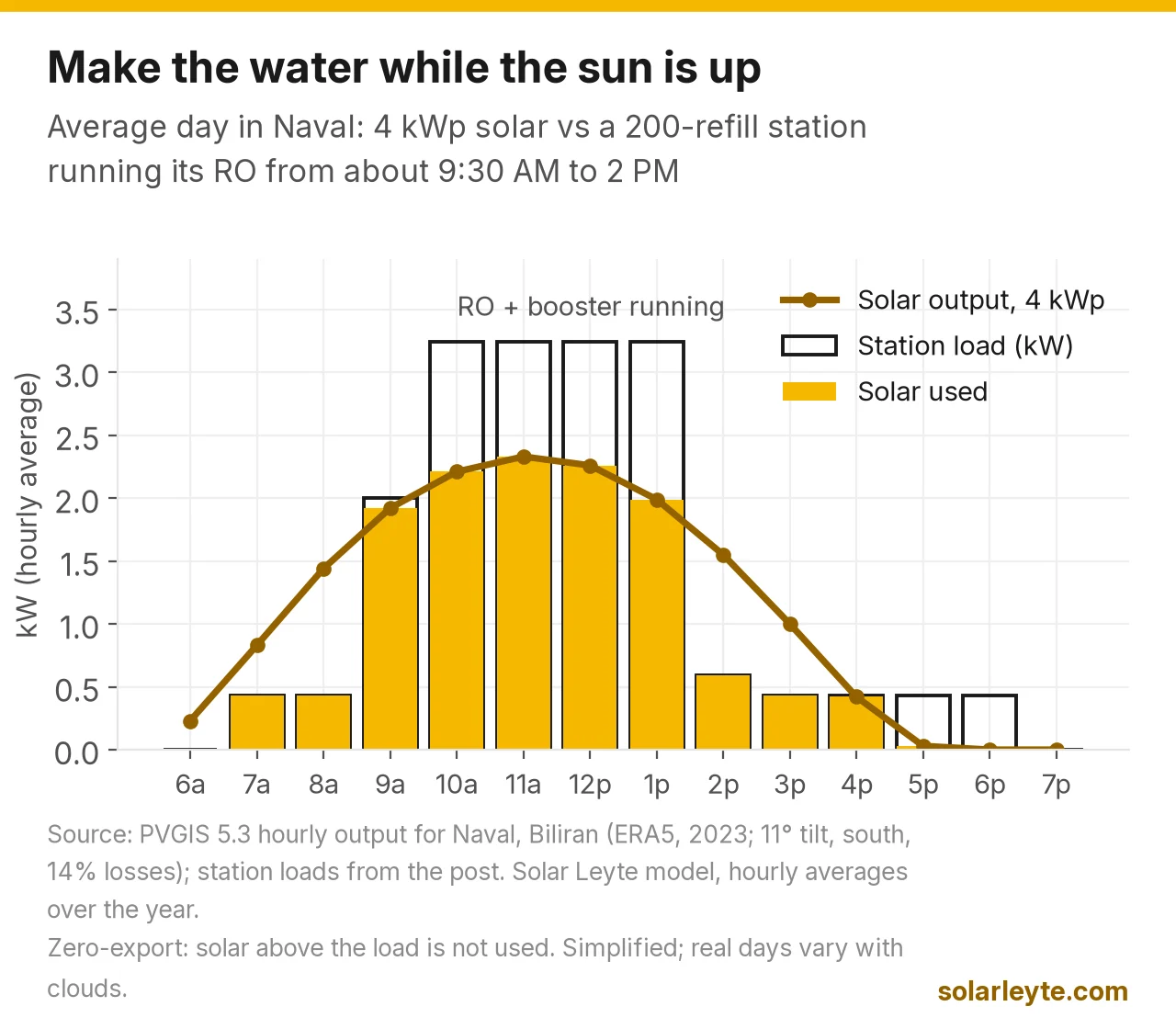
The product tank is your cheapest battery. In the Hydronex package, a 1,000 L product tank holds about 264 gallons, or about 52 five-gallon refills (Solar Leyte calculation). Running the RO plant from mid-morning to early afternoon and selling from the tank in the evening moves most of your kWh into solar hours, without buying a battery.
In practice:
- Set the RO to run in a midday block. In our model the 200-refill station runs the RO from about 9:30 AM to 2:00 PM. Packages like those above already include float switches, a solenoid valve and a low-pressure switch to start and stop the RO, so the change is mostly when you fill the tank.
- Keep the tank topped up before 3 PM. Panel output falls fast after 2 PM.
- Size the tank to your evening sales. If you sell more after sunset than one tank holds, a second product tank is usually much cheaper per kWh than battery storage (solar battery prices).
What size of solar system fits
We ran an hour-by-hour model with PVGIS hourly data for Naval, Biliran (2023 weather, panels tilted 11° facing south, 14% system losses). The system is zero-export: solar the station can't use at that moment is lost, not sold. The RO runs in one block centred on late morning, and the UV, lights and dispensing are spread across 7 AM to 7 PM.
Refills a day | Solar size | Solar used a month | Share of station kWh | Solar not used |
|---|---|---|---|---|
100 | 2 kWp | 159 kWh | 53% | 88 kWh |
100 | 3 kWp | 202 kWh | 68% | 168 kWh |
200 | 3 kWp | 309 kWh | 56% | 61 kWh |
200 | 4 kWp | 389 kWh | 70% | 105 kWh |
200 | 5 kWp | 454 kWh | 82% | 162 kWh |
300 | 4 kWp | 475 kWh | 59% | 18 kWh |
300 | 5 kWp | 582 kWh | 72% | 35 kWh |
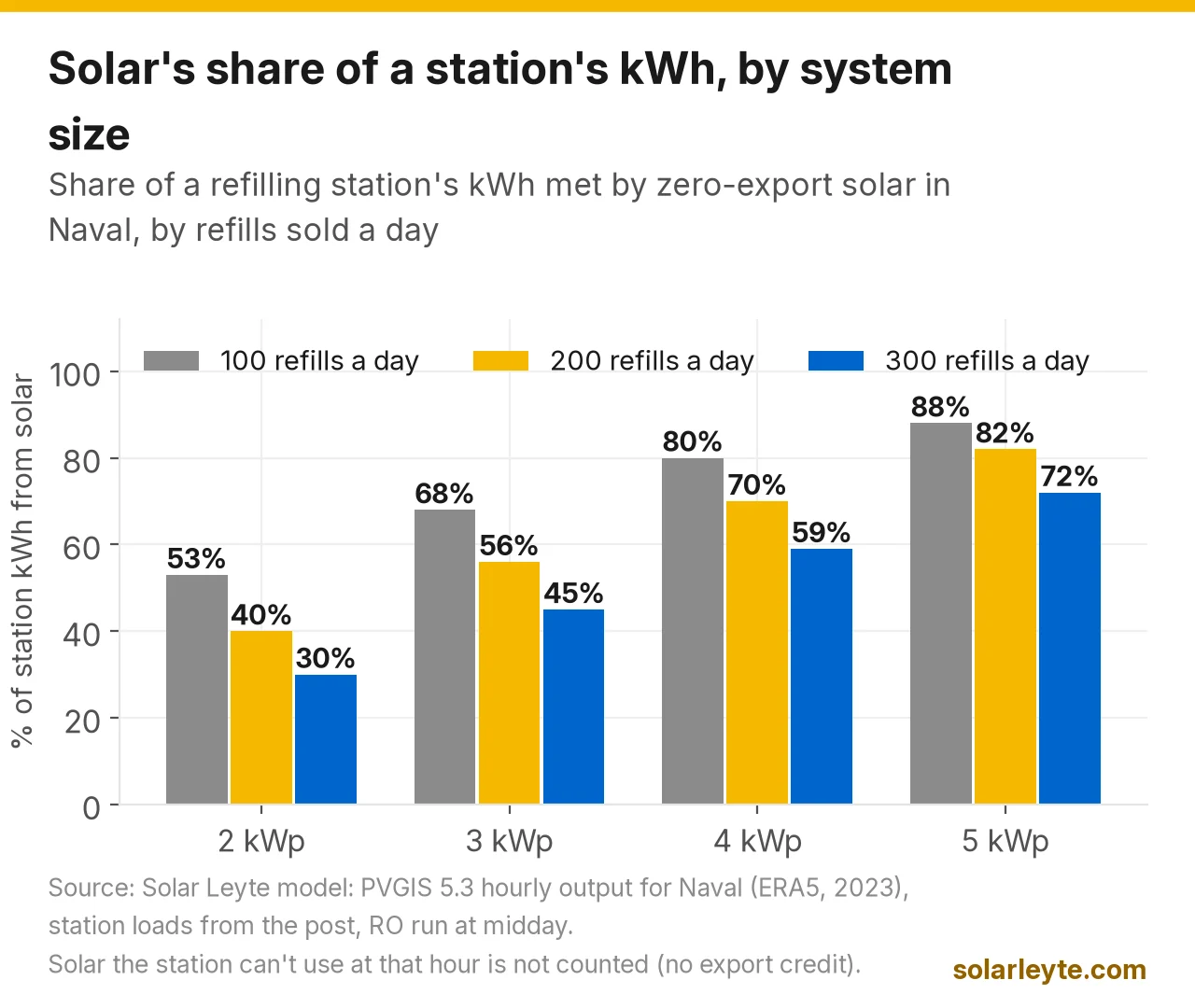
Solar Leyte model: PVGIS 5.3 hourly output for Naval (ERA5, 2023), our station loads above, hourly steps. January was the weakest month in every case. For 200 refills on 4 kWp, it was 292 kWh against a yearly average of 389.
A simple rule falls out of this: start with an array about the size of your RO pump and booster together (about 3 kW here), then go up a step if you sell more than about 200 refills a day. Past that, more of the extra solar comes at times the station can't use it, unless you run the RO longer or export it under net metering.
Leyte sites get a little less sun than Naval in PVGIS. In our 600 W panel post, 1 kWp made about 1,413 kWh a year in Tacloban and 1,481 in Ormoc, against 1,487 in Naval. Tacloban stations should expect about 5% less.
Roof space is often the real limit. A refilling station in a small rented unit may not have room for 4 kWp of panels. Ask the landlord before you get quotes.
Payback: rough numbers
Monthly savings are solar used × your rate. Here's the 200-refill station:
Solar size | Saved a month at BILECO | at LEYECO IV | at LEYECO V | Simple payback at LEYECO IV, if it costs ₱42.20–₱50.00 per watt installed |
|---|---|---|---|---|
3 kWp | ₱5,200 | ₱4,844 | ₱4,780 | about 2.2 to 2.6 years |
4 kWp | ₱6,542 | ₱6,094 | ₱6,013 | about 2.3 to 2.7 years |
5 kWp | ₱7,647 | ₱7,124 | ₱7,029 | about 2.5 to 2.9 years |
Solar Leyte calculation. The ₱42.20–₱50.00 per watt is the range of 5 to 5.5 kW grid-tie packages sellers listed with installation in our 5kW solar system price check (7 October 2026). Smaller systems usually cost more per watt, so get real quotes.
For the 100-refill station on 2 to 3 kWp, the saving is ₱2,489 to ₱3,173 a month at LEYECO IV, about 2.8 to 3.9 years to pay back on the same cost basis. At 300 refills on 5 kWp it's ₱9,125 a month, about 1.9 to 2.3 years.
Those paybacks look fast because commercial rates in Eastern Visayas are high and the load lines up with the sun. Be careful with them:
- Rates fall as well as rise. At BILECO's May 2026 commercial rate of ₱11.4404, the 200-refill, 4 kWp saving would be about ₱4,450 a month instead of ₱6,542.
- Our loads are estimates. If your RO pump draws less, or you sell fewer refills, the solar saves less.
- Simple payback leaves things out: permit and COC costs, an inverter replacement over the system's life, panel ageing, cleaning, and the cost of money if you borrow. Our is solar worth it post walks through those for homes, and the same logic applies.
Brownouts: keep selling
A brownout stops the RO plant and the dispensing pump. What you need depends on whether you only want to sell what's in the tank or keep making water. The Visayas grid has had repeated yellow and red alerts in 2026.
- Selling from a full tank: about 52 refills from a 1,000 L tank, at about 19 Wh each, plus UV and lights for 4 hours, is about 1.5 kWh (Solar Leyte calculation). A small battery on a hybrid inverter covers that.
- Making water too: about 2.9 kWh for every hour the RO plant runs (about 43 refills). A 5 kWh battery gives under 2 hours of production after allowing for the other loads, so for long outages a generator is the usual answer. The Catanduanes mobile unit above specifies 5.5 kVA.
- Motor starting. Pumps draw a surge when they start. The 5 kW Deye and Solis hybrids in our Deye vs Solis vs SRNE comparison are rated for 2× output for 10 seconds. Ask your installer to check your RO pump's starting current against the inverter's surge rating, and don't start the RO and dispensing pumps at the same moment.
A hybrid system costs much more than grid-tie. In our 5 kW check, parts for a hybrid with a 5–6 kWh battery came to ₱154,000–₱221,000, against ₱83,000–₱142,000 for grid-tie. Many stations start with grid-tie for the savings, keep the tank full, and use a generator for long brownouts. If you want backup, see hybrid inverter prices.
Permits for a business system
- Zero-export (own use only): under DOE Department Circular DC2026-08-0017 you need a building permit and, for a grid-connected system, a notice to your co-op after installation. The ERC Certificate of Compliance (COC) exemption covers households, clinics and hospitals, so a refilling station generally still needs a COC. Details are in our plug-and-play and zero-export rules post.
- Net metering (up to 100 kW): unused solar is exported and credited at roughly the generation charge (LEYECO IV's was ₱9.5635/kWh in September 2026), less than the ₱15–₱17 you save by using it yourself. That's why scheduling the RO matters more than exporting. Steps: BILECO and LEYECO II net metering guides.
- Electrical permit and sign-off apply either way. Our installer checklist covers licences and paperwork.
Before you ask for a quote
Bring these, and any installer can size the system properly:
- Your last 12 bills, or at least the last three, with the rate class.
- The nameplate HP and amps of each pump, and the UV, chiller and aircon wattages.
- How many refills you sell a day, and how many after 5 PM.
- Your product tank size, and whether there's room for a second tank.
- Roof size, material and who owns it.
- How often brownouts stop you, and whether you already have a generator.
FAQ
How many solar panels does a water refilling station need? For a station with a 2 HP RO pump, start at about 3 kWp, which is five or six 550–600 W panels. In our Naval model, 4 kWp covered about 70% of the kWh of a 200-refill-a-day station when the RO ran at midday.
How much electricity does a water refilling station use? On a 2 HP RO pump, 1 HP booster and 1.2 HP dispensing pump, about 300 kWh a month at 100 refills a day, 550 kWh at 200 and 800 kWh at 300 (Solar Leyte estimate). An aircon or chiller adds more.
Can a refilling station run on solar without a battery? Yes, while the sun is up. Run the RO plant at midday and sell from the product tank after dark. You'll still need the grid at night and in a brownout, unless you add a battery or a generator.
Does BILECO or LEYECO charge refilling stations a demand charge? Not on the classes we checked. BILECO's commercial rate, LEYECO IV's low-voltage class and LEYECO V's commercial class are per kWh plus a fixed charge. LEYECO V's "water system" and industrial classes do have a ₱88.06/kW demand charge, so check your bill's class.
Is solar worth it for a refilling station? Often, because commercial rates are ₱15 to ₱17 per kWh and the RO load fits solar hours. Our rough paybacks came to about 2 to 4 years. Real quotes, your measured loads and rate swings decide it.
Solar Leyte is run by MACC Systems & Energy Solutions Inc., a solar installer in Naval, Biliran.
Get a free solar quote for your refilling station from MACC
Send us a photo of your last BILECO or LEYECO bill, your pump nameplates and how many refills you sell a day. We'll size the panels and inverter around your RO schedule, give you every model number and datasheet, and show you the math, with no obligation.
- Call/Text: 0955 723 5093
- Email: official@macc-inc.com or benjie@macc-inc.com
- Website: www.macc-inc.com
- Request a quote online: solarleyte.com/quote
- Office: Brgy. Talustusan, Naval, Biliran 6543
Sources (all checked 8 October 2026)
- Equipment lists: Hydronex Water System, Water Refilling Station 6000 GPD / Two 4040 Membrane; PhilGEPS, Bulacan Agricultural State College water refilling station bid notice 11448679 (Nov 2024) and Province of Catanduanes mobile filtration unit bid notice 10144829 (Sep 2023)
- Datasheets: Vontron, ULP21-4040 membrane; CNP, CDLF2-15 vertical multistage pump, 1.5 kW (seller listing with performance table); Viqua, Sterilight S12Q specifications and S12Q-PA listing
- Motor efficiency: ABB, Technical note: IEC 60034-30-1 efficiency classes for low voltage AC motors
- Rates: BILECO, power rate posts (July, May and April 2026); LEYECO IV, September 2026 rates; LEYECO V, power rates and its September 2026 unbundled rate sheet
- Solar output: European Commission JRC, PVGIS 5.3 hourly series for Naval (ERA5, 2023) and yearly totals for Naval, Tacloban and Ormoc
- Rules: DOE, Department Circular DC2026-08-0017, as summarised in our plug-and-play post
- Prices and inverter surge ratings: Solar Leyte, 5kW solar system price (seller listings, 7 Oct 2026) and Deye vs Solis vs SRNE (makers' datasheets)