A good solar installation contract names every part by brand and model, ties each payment to something you can see (delivery, installation, permits), says who files the permits and the net-metering papers, lists each warranty and whose name it's in, and explains what happens if the job is late, hit by a typhoon, or cancelled. If it isn't written down, it's your word against the installer's.
Daghan nangutana kung naa bay "sample contract." We don't publish a fill-in template, because every job is different. Instead, here's what each clause should cover and the Philippine law behind it, so you can read any installer's contract, ours included, with a sharp eye. It goes one level deeper than our guide to choosing a solar installer, which covers licences, permits and red flags.
Last checked 1 November 2026. This is general information, not legal advice. For a large or commercial job, have a lawyer read the contract before you sign. Legal quotes are from the Civil Code (RA 386), the Consumer Act (RA 7394) and the Local Government Code (RA 7160), all on Lawphil and linked in the Sources.
Why the written contract matters
Under the Civil Code, a contract has "the force of law between the contracting parties" (Art. 1159). It's valid in whatever form it was made, written or not, as long as there's consent, a definite object and a cause (Arts. 1318 and 1356). So a chat thread plus a deposit can already be a contract. The hard part is proving what was agreed.
A solar job is mostly what the Civil Code calls a contract for a piece of work: the installer "binds himself to execute a piece of work" for a price and may supply the materials too (Art. 1713). That part of the Code has a few rules that help homeowners.
The clause-by-clause checklist
Clause | What it should say | Why (law or practice) |
|---|---|---|
1. Parties | Full names, the installer's registered business name and address, and the engineer's name and PRC licence number | You need to know who to hold to it. A company can't hold the engineering licence (RA 7920 Sec. 35) |
2. Scope and parts list | Every major part by brand, model and quantity: panels, inverter, battery, mounting, breakers, surge protection, cable sizes | Swapping in a different model than promised is a deceptive act under Consumer Act Art. 50(b) |
3. Price | One total, what it includes (labour, permits, delivery, scaffolding) and what it excludes, with VAT stated | Civil Code Art. 1724: no price increase on a fixed-price job unless a change is approved and priced in writing |
4. Payment schedule | Payments tied to milestones, with the last part due after the permits and papers | Keeps your money in step with the work (example below) |
5. Timeline | Target dates for delivery, installation and permits, plus what happens if they slip | Civil Code Arts. 1169 and 1170 on delay and damages |
6. Permits and net metering | Who prepares and files the electrical permit, the CFEI and the BILECO or LEYECO net-metering application, and who pays the fees | Plans must be signed and sealed by a PEE before installation (RA 7920 Sec. 34) |
7. Warranties | Each warranty, its length and whose name it's in: panel product and power, inverter, battery, and the installer's own workmanship | Consumer Act Art. 68 sets what a written warranty must state |
8. Testing and handover | Commissioning test, the as-built single-line diagram, manuals, warranty cards and app login handed over | You'll need these for every future claim |
9. Typhoons and force majeure | What counts, how long the delay can run, and who bears damage to parts stored on site | Civil Code Art. 1174 on unforeseen events |
10. Changes and cancellation | How changes are approved and priced, and what you owe if you withdraw | Civil Code Arts. 1724 and 1725 |
11. Disputes | A named contact for complaints and how disputes are settled | Barangay conciliation, DTI and small claims, explained below |
Sources: Civil Code (RA 386), Consumer Act (RA 7394) and RA 7920 on Lawphil. The "what it should say" column is our checklist, not wording required by law.
Clause 2: the parts list is the heart of the contract
"5kW hybrid system, Tier 1 panels" isn't a parts list. Ask for this instead: "10 × [brand] [model] 580 W panels; 1 × [brand] [model] 5 kW hybrid inverter; 1 × [brand] [model] 5.12 kWh LiFePO4 battery," plus the mounting system, AC and DC breakers, surge protection devices and cable sizes. If the installer has to substitute something because of stock, the contract should say a substitute needs your written OK and must be equal or better on the datasheet.
Why so strict? Under Consumer Act Art. 50, it's deceptive for a seller to say a product "is of a particular standard, quality, grade, style, or model when in fact it is not." A model number in writing makes that easy to prove. Our TOPCon vs PERC and Tier 1 explainer help you check what those model numbers mean.
Clause 3: price, extras and price increases
Watch for vague lines like "accessories" or "miscellaneous" with no quantities. Our 5kW system price breakdown shows what each part typically costs, so you can tell whether a quote is roughly in line.
On a fixed-price job, the Civil Code is on your side. Article 1724 says a contractor who agreed to build "for a stipulated price, in conformity with plans and specifications," can't demand more "on account of the higher cost of labor or materials." The only exception is a change in the plans that you authorised in writing, with the extra price "determined in writing by both parties." So if panel prices jump after you sign, that's the installer's risk unless the contract says otherwise.
Payment schedule: a worked example
How you pay matters as much as how much you pay. Here's how much money you'd have handed over at each stage of a job under three payment schedules.
Assumptions (example only): a ₱300,000 hybrid package, picked from inside the ₱280,000–₱330,000 range of listed 5.5 kW hybrid packages in our 5kW price post (prices checked 7 October 2026). Schedule C is our illustration of a milestone split, not a legal standard or a MACC payment term.
Stage | A: 100% upfront | B: 50% down, 50% on completion | C: 30 / 40 / 20 / 10 milestones |
|---|---|---|---|
On signing | ₱300,000 | ₱150,000 | ₱90,000 |
Parts delivered and checked against the parts list | ₱300,000 | ₱150,000 | ₱210,000 |
Installed and tested | ₱300,000 | ₱300,000 | ₱270,000 |
Permit, CFEI and handover papers done | ₱300,000 | ₱300,000 | ₱300,000 |
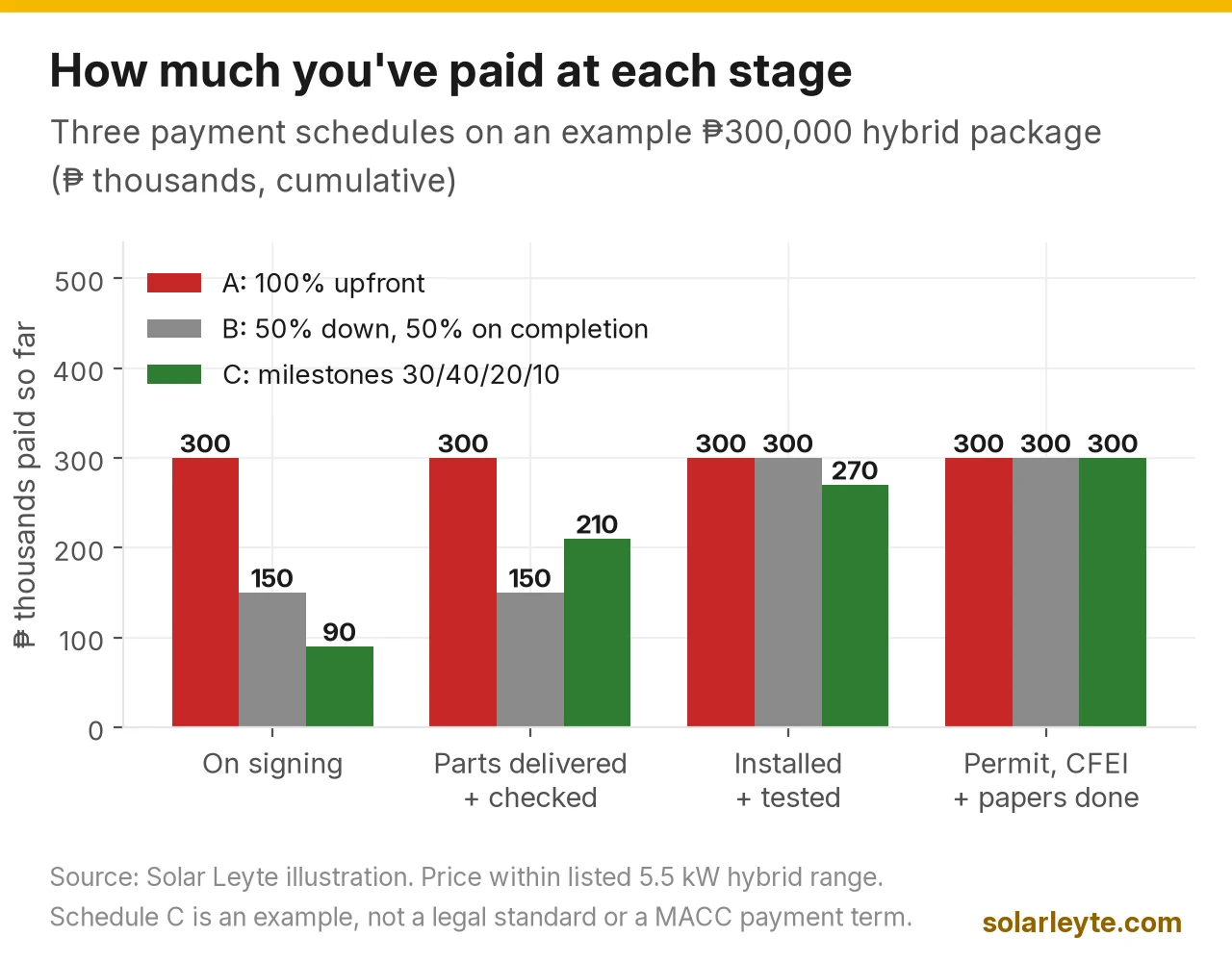
Cumulative amounts paid. Solar Leyte calculation; see the assumptions above.
Under schedule A, you've paid everything before a single panel reaches your house. Under C, you've paid ₱90,000 before delivery, and ₱30,000 is still unpaid until the permits and papers are done. That last 10% is what gets the paperwork finished. With a loan, the lender may release funds on its own schedule. Our Pag-IBIG solar loan and bank loan posts explain how.
Timeline, delays and typhoons
Put the target dates in writing: delivery, installation, and permit filing. Then add what happens if they slip. Under the Civil Code, a party is generally in delay only after you demand performance, judicially or extrajudicially. The exception is when the contract or the law says otherwise, or the date was a "controlling motive" for the deal (Art. 1169). In practice: send a written demand (a dated letter or message you can print) as soon as a deadline passes. Whoever is "guilty of fraud, negligence, or delay" is liable for damages (Art. 1170).
Some contracts add a delay penalty. For example, 0.1% of the price per day late, capped at 10%, would be ₱300 a day and at most ₱30,000 on our ₱300,000 example. Those figures are our illustration, not a norm. A penalty clause replaces the usual damages unless the contract says otherwise (Art. 1226), and a court can reduce a penalty that is "iniquitous or unconscionable" (Art. 1229).
Typhoons. Article 1174 says no one is responsible for events "which could not be foreseen, or which, though foreseen, were inevitable," unless the contract or the law says otherwise. A typhoon signal can fairly pause roof work. A good force-majeure clause still says:
- how long a delay it allows;
- that the installer must tell you in writing;
- who bears the loss if parts already delivered to your house are damaged.
Our typhoon preparedness guide covers what a typhoon-ready installation looks like.
Warranties: which clock is which
A solar system has several warranty clocks running at once, from different people. The contract should list each one and whose name it's in.
Warranty or deadline | How long | Source |
|---|---|---|
Panel power (example: Jinko Tiger Neo 72HL4-BDV) | 30 years | Jinko Limited Warranty REV.EN20250919 |
Panel product (same panel) | 12 years | Jinko Limited Warranty REV.EN20250919 |
Hybrid inverter (Deye) | 5 years from installation (10 years optional) | Deye Warranty Terms V1.7.1 |
Battery (Pylontech US-series, Europe terms) | 7 years, 10 if registered | Pylontech product warranty V1.2 (Europe) |
Installer's workmanship | Whatever the contract says | Negotiate this one |
Service firms' workmanship guarantee in the Consumer Act | At least 90 days, shown on the invoice | RA 7394 Art. 71 |
Implied warranties on new consumer products | 60 days to 1 year | RA 7394 Art. 68(e) |
Suing on a written contract | 10 years from when the right arises | Civil Code Art. 1144 |
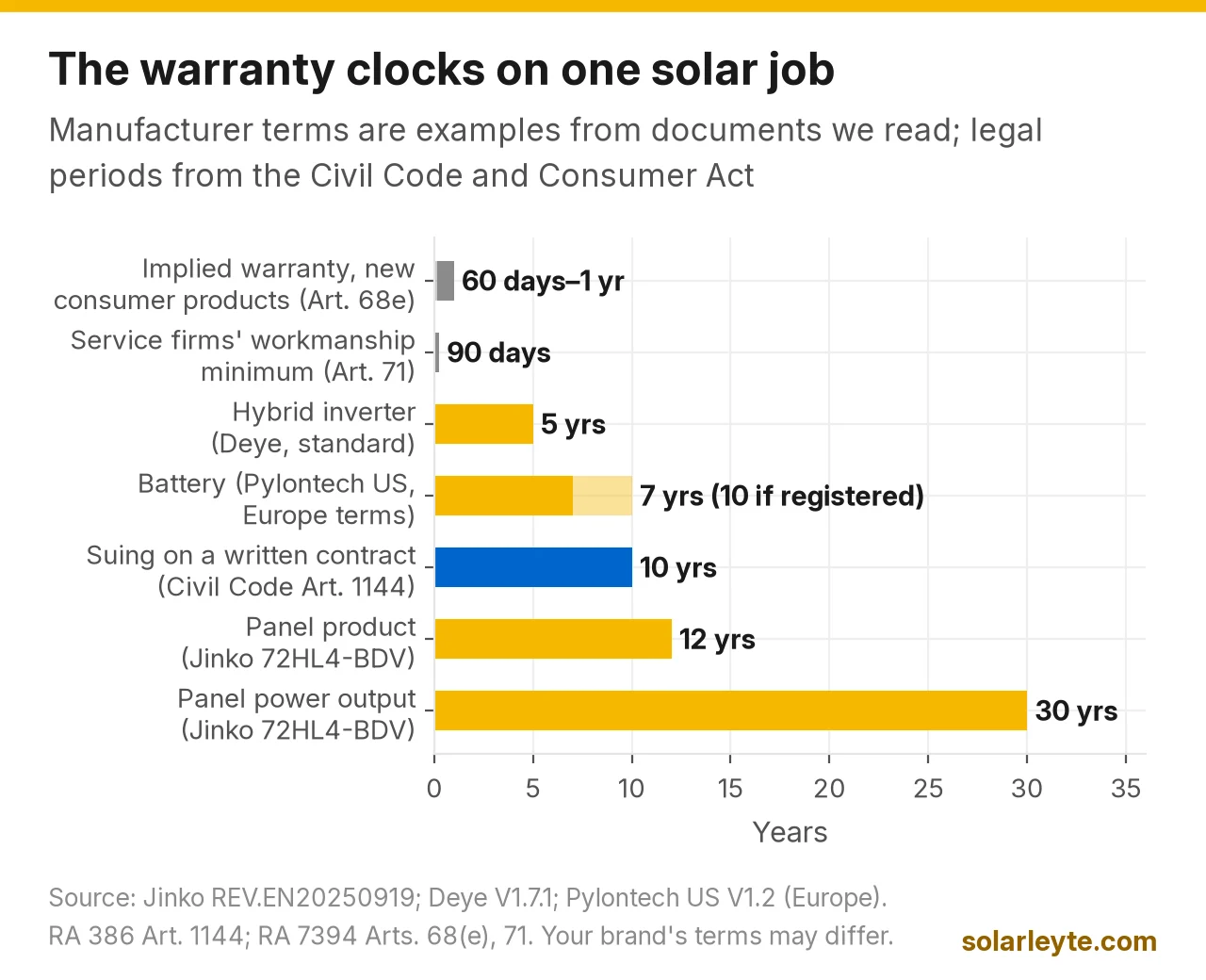
Manufacturer terms are examples from documents we've read; your brand's terms may differ, and makers' regional terms can differ from what applies in the Philippines. Ask for the document for your exact model.
Three things to get in writing:
- Who files a claim. If the inverter dies in year 3, does the installer pull it, ship it to the distributor and reinstall it? Our panel lifespan and warranty post goes through what each maker's warranty covers.
- A workmanship warranty of real length. The Consumer Act's 90-day minimum in Art. 71 is written for "service firms." Whether a solar installer counts as one isn't spelled out, and 90 days is short for leaks, loose connections or a badly fixed rail. Ask for the installer's own workmanship warranty, in years, in the contract.
- What a written warranty must say. Under Art. 68(a), whoever gives an express warranty must identify themselves as the warrantor and say what's covered. They must also say what they'll do and at whose expense, what you must do to claim, and how long they have to act. Under Art. 68(b)(4), the warranty card or official receipt is enough to claim.
At handover, don't sign away hidden defects. The Civil Code says accepting the work relieves the contractor of liability for defects. The exceptions are a hidden defect you couldn't be expected to spot, or rights you "expressly" reserve (Art. 1719). If something looks off at handover, write it on the acceptance form.
Cancelling: what the Civil Code allows
Under Civil Code Art. 1725, the owner "may withdraw at will from the construction of the work, although it may have been commenced." The catch is that you must pay the contractor's "expenses, work, and the usefulness" you get from it, plus damages. So cancelling is possible, but not free. A good contract spells out the cost at each stage, for example a refund of the deposit minus documented costs if you cancel before parts are ordered.
There's no general cooling-off period for solar sales that we could find in the Consumer Act. It does regulate home solicitation sales, where an agent knocks on your door: the business needs a DTI permit, and agents need identification and authority from their principal (Arts. 54–56). If a door-to-door agent pushes you to sign today, slow down.
If the installer fails to do the job at all, Civil Code Art. 1191 lets you choose between demanding that it be done and rescinding the contract, "with the payment of damages in either case."
If something goes wrong
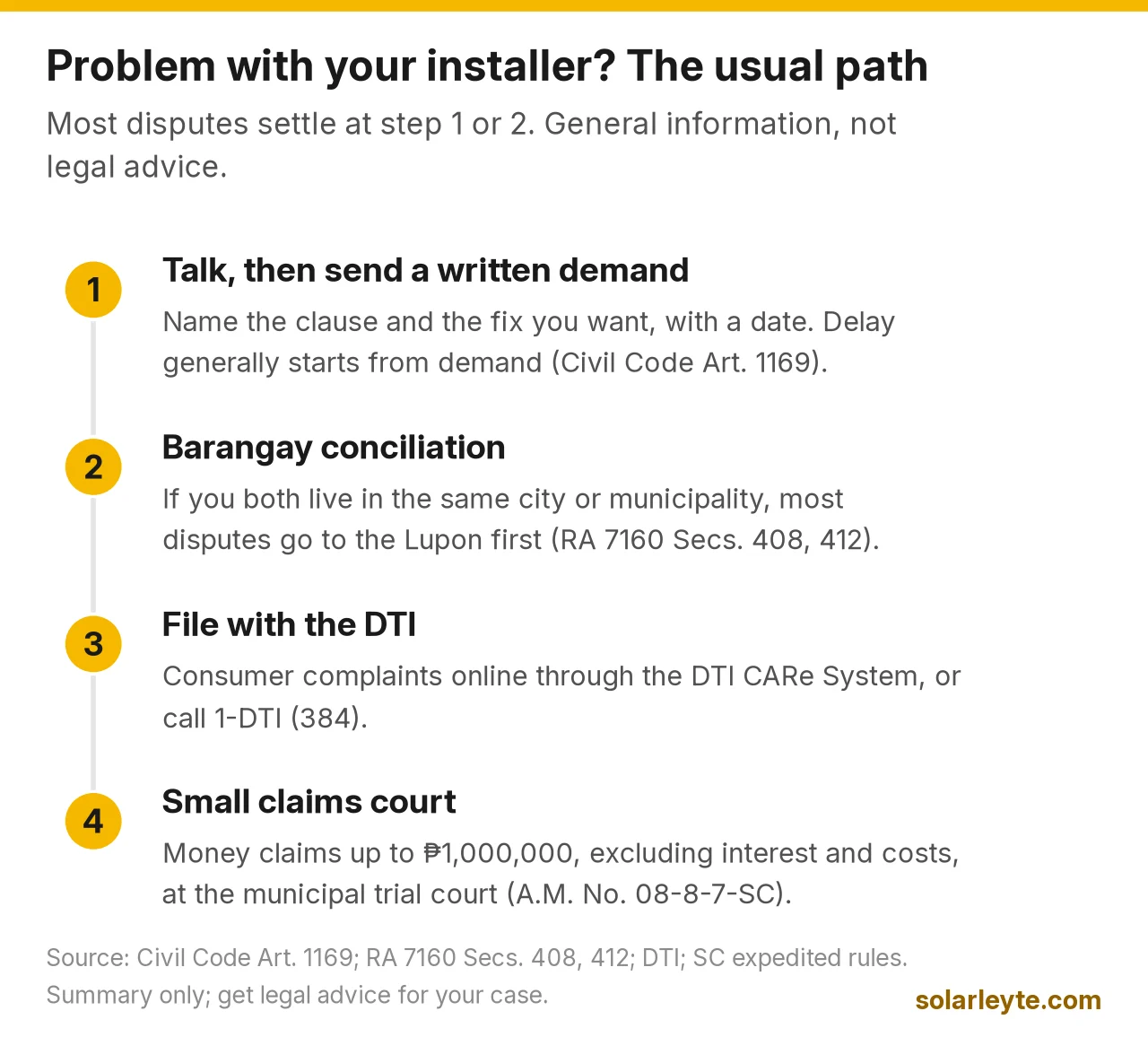
- Talk, then write. Send a dated written demand that names the clause and the fix you want.
- Barangay first, if you're neighbours. If you and the installer's owner actually live in the same city or municipality, most disputes must first go through the Lupon at the barangay before a court case (RA 7160 Secs. 408 and 412).
- DTI. Consumer complaints can be filed online through the DTI's CARe System. The DTI hotline is 1-DTI (384). For a complaint about your electric bill rather than the installer, go to your co-op and the ERC; see our meter-reading guide.
- Small claims. For a money claim of up to ₱1,000,000 (excluding interest and costs), the Supreme Court's small claims rules apply in the municipal trial court. They cover money owed under contracts for services and sale of personal property.
Sa Bisaya: mubo nga tambag
Ayaw pirma kung walay brand ug model sa matag parte. Bayad sunod sa trabaho: gamay sa pagpirma, dugang inig abot sa gamit, ug ang katapusan human sa permit ug papeles. Isulat kinsa ang mo-file sa permit ug net metering, ug kinsa ang mo-claim sa warranty kung madaot ang inverter.
FAQ
Is there a sample solar installation contract for the Philippines?
We haven't found an official government template; installers use their own forms. Use the 11-clause table above as a checklist against any contract you're offered, and have a lawyer read it for big jobs.
Is a verbal agreement or a chat message a binding contract?
It can be. Under Civil Code Art. 1356, contracts are binding "in whatever form they may have been entered into" if consent, object and cause are present. Proving the terms is the hard part, so insist on a signed contract with a parts list.
Can the installer raise the price after I sign?
On a fixed-price job, not because labour or materials got more expensive (Civil Code Art. 1724). An increase needs a change in the plans that you approved in writing and an extra price agreed in writing by both of you.
Can I cancel a solar contract?
Yes, the owner can withdraw from the work at will under Art. 1725. You must pay the installer's expenses and work done, plus damages, so the cost grows as the job progresses. Ask for a cancellation schedule in the contract.
Who should file the net metering application?
No law we found says it must be the installer, but most of the paperwork needs the installer's engineer. The contract should say who files and who pays. Our net metering guide and installation timeline post show each step for BILECO and LEYECO.
Solar Leyte is run by MACC Systems & Energy Solutions Inc., a solar installer in Naval, Biliran.
Get a free solar quote from MACC
Want a quote you can check against this list? Send us your latest BILECO or LEYECO bill and a photo of your roof, and we'll talk it through with you, with no obligation.
- Call/Text: 0955 723 5093
- Email: official@macc-inc.com
- Website: www.macc-inc.com
Sources (all checked 1 November 2026)
- Civil Code of the Philippines, RA 386 (Lawphil): Art. 1144 (10 years on a written contract), Art. 1159 (force of law), Art. 1169 (delay and demand), Art. 1170 (damages), Art. 1174 (unforeseen events), Art. 1191 (rescission), Arts. 1226 and 1229 (penalty clauses), Arts. 1318 and 1356 (requisites and form), Art. 1713 (contract for a piece of work), Art. 1715 (contractor must fix defects), Art. 1719 (acceptance and hidden defects), Art. 1724 (no price increase without written change), Art. 1725 (owner may withdraw).
- Consumer Act of the Philippines, RA 7394 (Lawphil): Art. 4 (consumer transaction includes "chattels that are intended to be affixed to land"), Art. 50 (deceptive sales acts), Arts. 54–58 (home solicitation sales), Art. 68 (express warranty terms, presentment, 60-day to 1-year implied warranty), Art. 69 (services rendered "with due care and skill"), Art. 71 (service firms' 90-day workmanship guarantee).
- Local Government Code, RA 7160 (Lawphil): Secs. 408 and 412 (Katarungang Pambarangay conciliation before going to court).
- RA 7920, New Electrical Engineering Law (Lawphil): Sec. 34 (plans signed and sealed by a PEE), Sec. 35 (no firm may hold the licence).
- Supreme Court, Rules on Expedited Procedures in the First Level Courts (A.M. No. 08-8-7-SC): small claims up to ₱1,000,000, nationwide, including money owed under contracts for services and sale of personal property.
- DTI, Complaints (links to the CARe System for filing online); DTI contact page (1-DTI (384)).
- Jinko Solar, Limited Warranty REV.EN20250919 (PDF): 72HL4-BDV row, 12-year product and 30-year power warranty.
- Deye, Warranty Terms and Conditions V1.7.1 (PDF): 5 years (10 years optional) from installation.
- Pylontech, product warranty US series V1.2, Europe (PDF): 7 years, extendable to 10 years free with registration.
- Package price range for the worked example: Solar Leyte, 5kW solar system price Philippines (listed 5.5 kW hybrid packages ₱280,000–₱330,000, checked 7 October 2026).
- Payment schedule and penalty figures: Solar Leyte illustration, assumptions as stated in the post.