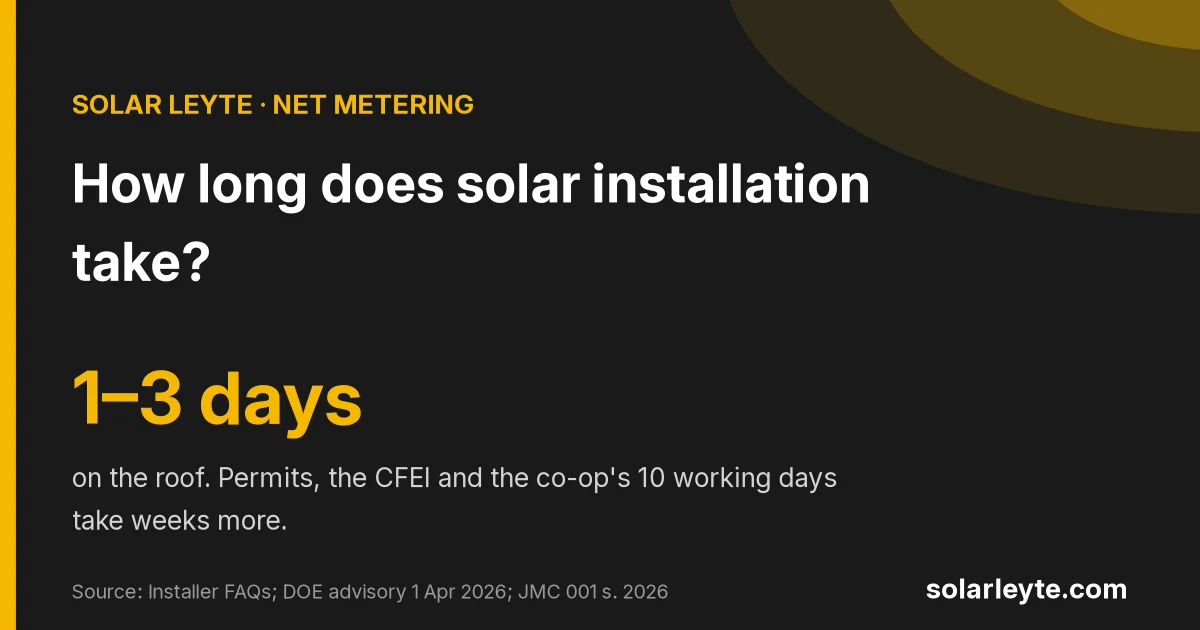
The installation itself is quick: Philippine installers publish one to three days on the roof for a typical home. The paperwork around it is what takes time. On the official clocks in force today, your town hall has 3 working days for the electrical permit, 3 working days for the CFEI (7 under the older rule), and BILECO or LEYECO has 10 working days to finish your net-metering application. On a real calendar, a smooth job takes about a month from permit filing to the co-op's deadline. Real jobs often take longer: incomplete files, equipment not in stock, or offices missing their deadlines.
Below is every step in order, who controls it and what the rules say. For detail, see our electrical permit and CFEI guide and the net metering guide.
Last checked: 26 October 2026. Deadlines are from the DOE, the ERC and JMC No. 001, s. 2026, as cited below. This is general information, not legal advice, and none of the times here are MACC promises.
The short version: every step and its clock
Step | Who controls it | Official deadline | What we found |
|---|---|---|---|
1. Site visit, design and quote | You and your installer | None | Depends on the installer. Ask for a date in writing |
2. Co-op pre-qualification | BILECO or LEYECO | None published | LEYECO II checks your account for unpaid balances or pilferage first |
3. Equipment delivery | Installer and supplier | None | Manila-to-Cebu shipping alone was a two-week lead time in April 2026 (CEAAPI, via Rappler) |
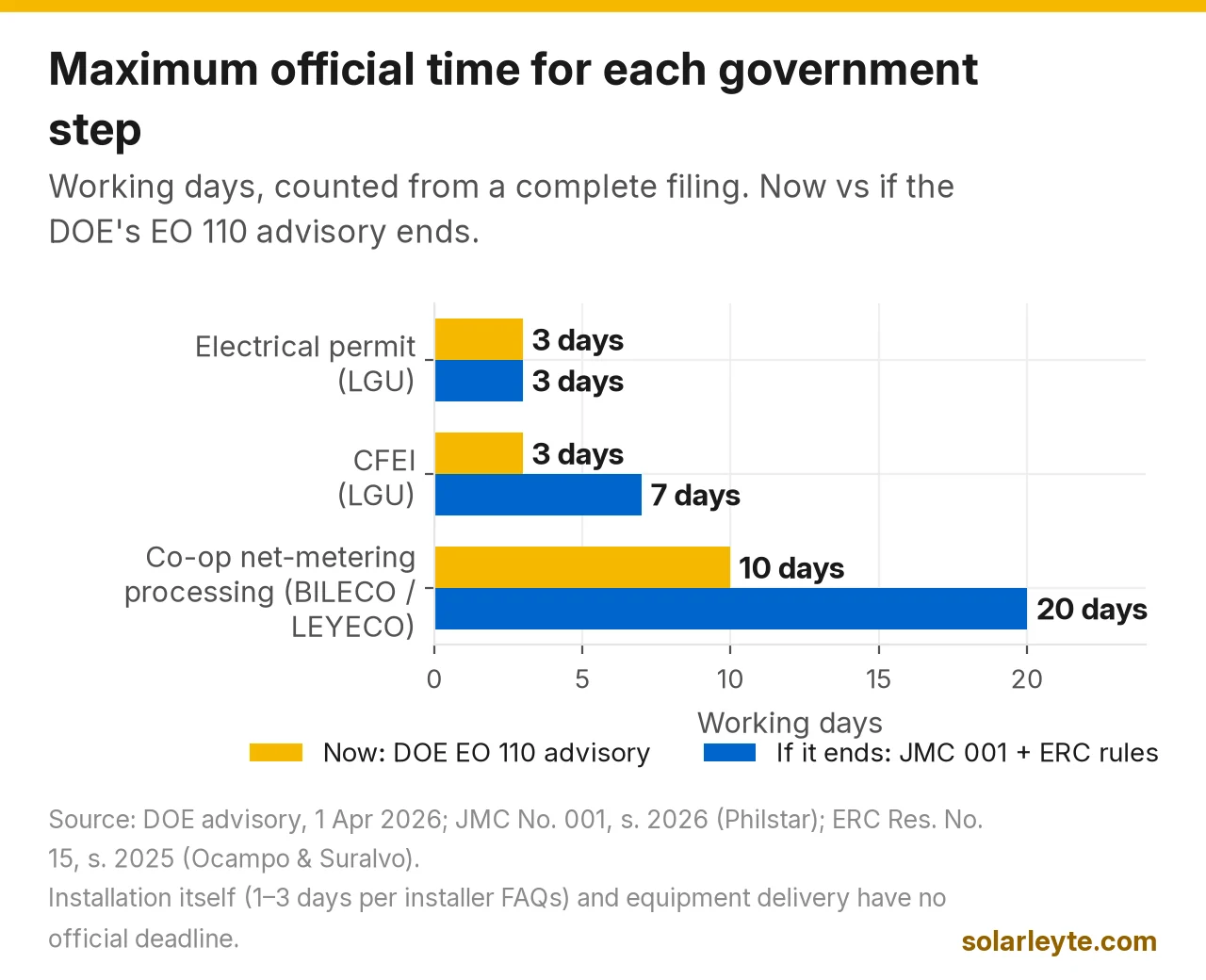
4. Electrical permit | Your municipal or city hall | 3 working days | From a complete filing (JMC 001) |
5. Installation on the roof | Installer | None | 1–3 days for a typical home (installer FAQs) |
6. CFEI | Your municipal or city hall | 3 working days now, 7 under JMC 001 | DOE advisory under EO 110 sets 3 for all net-metering permits |
7. Net-metering processing, meter swap, testing | BILECO or LEYECO | 10 working days now, 20 under the ERC rules | "Non-extendible" under the DOE advisory |
Steps 1 to 3 have no legal clock. Steps 4, 6 and 7 do, but each clock only starts when your file is complete.
The rules behind each clock
LGU permits: JMC 001, s. 2026
In January 2026 the DOE, DILG and DPWH signed Joint Memorandum Circular No. 001, s. 2026. It tells LGUs to issue electrical permits within three working days and Certificates of Final Electrical Inspection (CFEIs) within seven working days "upon submission of complete requirements". If the LGU fails to act in time, the application is treated as deemed approved (Philstar). JMC 001 also adopts a "no additional requirements" policy for the covered permits (DOE).
Deemed approval matters for your timeline. Meralco's checklist says that if the CFEI hasn't been issued but is deemed approved, you can submit the acknowledgment receipt (AR) and official receipt (OR) instead, citing Section 6.4.3 of JMC 001, and hand in the actual CFEI once the LGU issues it (Meralco checklist). Ask BILECO or your LEYECO whether they accept the same.
The DOE's EO 110 advisory: 10 and 3 working days
On 1 April 2026, under the national energy emergency declared in Executive Order No. 110, the DOE ordered utilities and electric cooperatives to finish net-metering applications, "including technical rectifications, within a non-extendible period of 10 working days", and LGUs "to act on all net metering-related permits within three working days". Before EO 110, utilities had 20 working days. The advisory lasts for the duration of the emergency, "unless sooner revoked by the DOE" (DOE).
EO 110 stays in force for one year from issuance unless the President extends or lifts it (Lawphil, EO 110). It was signed on 24 March 2026, so on its own terms it runs to 24 March 2027. In mid-October 2026 the ERC was still issuing bill-relief orders as part of the response to the EO 110 emergency (Daily Tribune), and we found no order lifting it as of 26 October 2026.
The ERC rules underneath: 20 working days
If the advisory ends, the ERC's 2025 Amended Net-Metering Rules (Resolution No. 15, s. 2025) are the fallback. They require the utility to complete interconnection within 20 working days from receiving your letter of interest, provided all permits are in place, and to send the signed Net-Metering Agreement to the ERC within five days for the Certificate of Compliance application (Ocampo & Suralvo).
The ERC is consulting on further amendments to Resolution No. 15 (ERC Case No. 2026-014 RM; consultation notice of 7 August 2026, as posted by ISELCO II). We found no final resolution as of 26 October 2026, so we don't know yet whether it changes any of these periods.
The chart below shows the maximum official time for each government step, now and after the advisory.
What these rules don't cover
The site visit and quote. No rule. Ask for dates in writing; our installer checklist lists what the quote should include.
Co-op pre-qualification. LEYECO II starts with a written request and a valid ID, then checks your account for unpaid balances or pilferage records (its six phases are in our LEYECO II net metering guide). BILECO hasn't published its process: bileco.net's homepage had no net-metering page or link on 26 October 2026. Our BILECO net metering guide lists what to ask the Naval office.
Equipment delivery. In April 2026, during the rooftop rush after EO 110, Lito Villar of the Clean Energy Advocates Association of the Philippines told Rappler that shipping components from Manila to Cebu needed a two-week lead time, and that busy installers were telling customers four weeks instead of two (Rappler). Leyte and Biliran sit further down that supply line, so ask whether the equipment in your quote is already in stock locally (more in our rooftop solar boom post).
The roof work itself. Published installer answers line up:
Installer (where) | What they publish |
|---|---|
PTG Solar (Quezon City) | "Most residential systems up to about 10kW are installed in one to two days", including mounting, panels, inverter and battery, wiring and commissioning (PTG Solar FAQ) |
Blueshift (Metro Manila) | "Most home installations take 2 to 3 days on the roof"; 100 kW and up, 2 to 4 weeks (Blueshift FAQ) |
NetSolar | "1–3 days after permits are approved" (NetSolar FAQ) |
That's crew time only, from Metro Manila installers. Roof repairs, tilt frames on a slab, or rain will stretch it (see our roof installation guide).
Grid upgrades. If your transformer is near its limit, the utility may need more studies. Meralco runs a Distribution Impact Study on every application and, if it shows an upgrade is needed, a Distribution Asset Study with its own fees (Meralco). BILECO and the LEYECOs don't publish how long an upgrade takes, so ask before you sign.
Worked example: a calendar for a Biliran or Leyte home
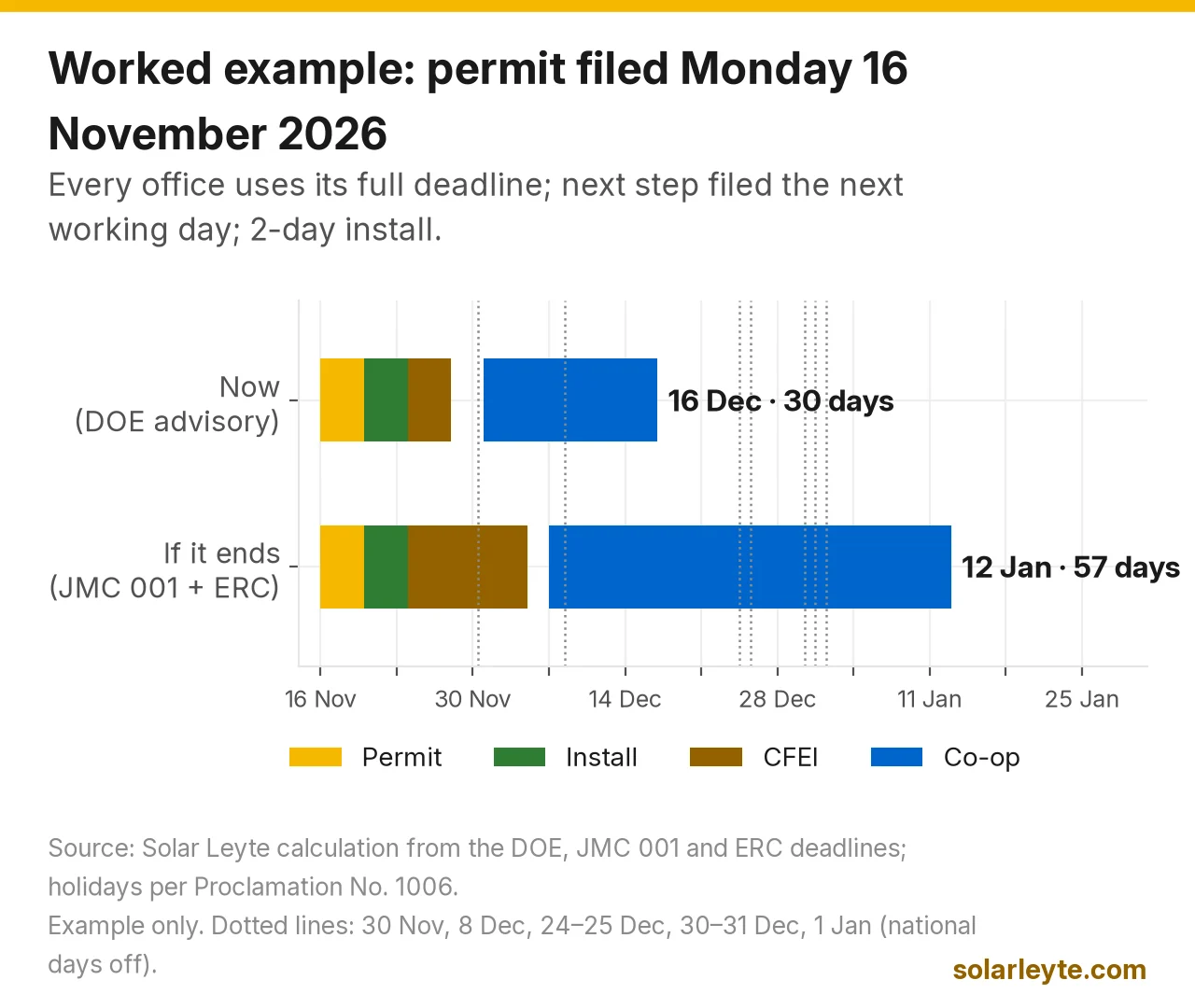
Example only, with these assumptions: a complete electrical permit filing on Monday 16 November 2026; every office acts on the last allowed day; you file the next step on the next working day; the crew needs two working days; and nothing is sent back as incomplete. Working days skip weekends and the national days off in Proclamation No. 1006: 30 November, 8 December, 24, 25, 30 and 31 December 2026 and 1 January 2027 (Lawphil, Proclamation No. 1006). Local holidays and town fiestas would add more.
Step | While the DOE advisory is in force | If only JMC 001 and the ERC rules apply |
|---|---|---|
Electrical permit filed (complete) | Mon 16 Nov | Mon 16 Nov |
Permit due (3 working days) | Thu 19 Nov | Thu 19 Nov |
Installation (2 working days) | Fri 20 – Mon 23 Nov | Fri 20 – Mon 23 Nov |
CFEI filed | Tue 24 Nov | Tue 24 Nov |
CFEI due | Fri 27 Nov (3 working days) | Fri 4 Dec (7 working days) |
Net-metering application filed with the co-op | Tue 1 Dec | Mon 7 Dec |
Co-op deadline | Wed 16 Dec (10 working days) | Tue 12 Jan 2027 (20 working days) |
Permit filing to co-op deadline | 30 calendar days | 57 calendar days |
(Solar Leyte calculation.) The December holidays alone push the slower case into January, and the fast case only works if every file is complete the first time.
The chart below shows the same example as a calendar.
Before the permit, add the quote, pre-qualification and equipment delivery. Blueshift, for its own Metro Manila jobs, tells customers net metering "usually" takes "3 to 8 months from contract to activation", and that the DOE's faster deadlines "aren't applied consistently yet" (Blueshift FAQ). That's one installer in a Meralco area, not a Leyte figure, but it's a fair warning: the official clocks are a ceiling on paper, not a promise.
How to keep your own timeline short
- Ask the co-op first. Pre-qualify and ask about your transformer's hosting capacity before you sign.
- File only with signed and sealed plans. An incomplete file doesn't start the 3-day clock.
- Keep every dated receipt. The stamped AR and the OR are your proof if the LGU misses its deadline.
- Book the CFEI inspection the day the crew finishes, with the as-built plans and logbook ready.
- Don't export before the meter swap. Meralco warns that without a bidirectional meter, the power your panels send out "may be recorded as imported energy", which raises your bill (Meralco FAQ).
- Pay the small fees early. Meralco says the meter cost difference (up to ₱3,000 for homes) must be settled before energization, testing and commissioning can proceed, and the ₱1,500 ERC Certificate of Compliance fee is paid once the ERC sends its statement of account (Meralco checklist).
Want savings while you wait? Zero-export is a separate route with its own rules; see our plug-and-play and zero-export guide.
FAQ
How long does solar panel installation take in the Philippines? On the roof, one to three days for a typical home (installer FAQs). From permit filing to the co-op's deadline, our worked example is about 30 calendar days under the DOE's EO 110 advisory, or 57 under JMC 001 and the ERC rules, if every office uses its full time.
How long does net metering approval take? 10 working days for the co-op under the DOE's 1 April 2026 advisory; 20 under the ERC rules if it ends. The clock starts once your file, including the CFEI, is complete.
What if the LGU doesn't act on time? Under JMC 001 it's deemed approved. Keep the dated AR and OR; Meralco accepts them in place of an unissued CFEI. Ask your co-op if it does.
Pila ka adlaw ang pag-install sa solar sa balay? Sa atop, kasagaran usa hangtod tulo ka adlaw. Ang taas nga hulat kay ang papeles: permit sa munisipyo, CFEI, ug ang net metering sa BILECO o LEYECO.
Can I use my solar before the co-op approves net metering? Not with a grid-tie system that exports: without the bidirectional meter, exports can be recorded as consumption. Zero-export and off-grid follow different rules.
Solar Leyte is run by MACC Systems & Energy Solutions Inc., a solar installer in Naval, Biliran.
Get a free solar quote from MACC
Planning solar in Biliran or Leyte and want to know what your own timeline looks like? Send us a photo of your last BILECO or LEYECO bill and tell us whether you want net metering, zero-export or a brownout backup. We'll size the system, give you every model number and datasheet, and walk you through the permit and co-op steps for your town, with no obligation.
- Call/Text: 0955 723 5093
- Email: official@macc-inc.com or benjie@macc-inc.com
- Website: www.macc-inc.com
- Request a quote online: solarleyte.com/quote
- Office: Brgy. Talustusan, Naval, Biliran 6543
Sources (all checked 26 October 2026)
- DOE, DOE fast-tracks net metering under EO 110 to lower power bills (1 April 2026; 10 working days for DUs and ECs, 3 for LGU permits, 20 before EO 110; JMC 001 "no additional requirements" and deemed approval)
- Lawphil, Executive Order No. 110, s. 2026 (Section 12: one year from issuance unless extended or lifted)
- Daily Tribune, ERC orders power firms to share bill relief burden (13 October 2026; measures under the EO 110 emergency)
- Philstar, Government speeds up LGUs' net metering permits (2 February 2026; JMC 001: 3 working days for electrical permits, 7 for CFEIs, deemed approval)
- Ocampo & Suralvo Law Offices, The ERC amends the net-metering rules (ERC Resolution No. 15, s. 2025: 20 working days; NMA to the ERC within 5 days)
- ISELCO II, ERC consultation notice, ERC Case No. 2026-014 RM (7 August 2026)
- Meralco, Net-metering documentary requirements checklist (PDF) (AR + OR under JMC 001 Section 6.4.3; meter cost difference up to ₱3,000; ₱1,500 COC fee)
- Meralco, Net-metering application process (DIS and DAS) and Net-metering FAQ (exports recorded as imports without a bidirectional meter; when credits start)
- Rappler, 'Solar rush': Surge in solar demand overwhelms local industry (11 April 2026; CEAAPI on two- and four-week lead times)
- Installer FAQs: PTG Solar, Blueshift, NetSolar
- LEYECO II, Net metering process; BILECO, bileco.net
- Lawphil, Proclamation No. 1006, s. 2025 (2026 regular holidays and special non-working days)
- Solar Leyte, electrical permit and CFEI guide, BILECO net metering guide, LEYECO II net metering guide, net metering guide