Rooftop solar in the Philippines has roughly doubled in a year, from about 721 MW in early 2025 to an estimated 1.3 GW (1,300 MW) by early 2026, according to the think tank Ember. Panel imports in 2026 suggest more is coming. For a home in Leyte or Biliran, the boom means three things: installers are busier, so expect longer waits; some parts cost more than last year; and the "3-year payback" headlines are based on Meralco prices, not yours. BILECO's September 2026 rate was about 28% higher than Meralco's, so solar you use yourself saves more here. LEYECO II's posted rate is close to Meralco's.
Below: the numbers behind the boom, why it happened, what it's doing to waits and prices, a worked payback check at BILECO rates, and a short checklist for buying solar while everyone else is buying too.
The rooftop solar boom in numbers
Nobody officially counts rooftop solar in the Philippines. The DOE tracks grid-connected solar, and we couldn't find a recent public ERC total for net metering, so the figures below are estimates from research groups and trade data (Ember).
Measure | Figure | Source |
|---|---|---|
Rooftop solar measured by satellite (images up to Jan 2025) | 721 MW (371 MW homes, 214 MW commercial and industrial, 136 MW rooftops over 1 MW) | ICSC, via Ember |
Rooftop solar added, April 2025 to April 2026 | About 600 MW | Ember, from IEMOP generation data |
Estimated rooftop solar, early 2026 | About 1,300 MW (1.3 GW) | Ember; APVIA (Oct 2026) |
Rooftop space that could take solar | 106,000 MW (so today's total is about 1%) | ICSC, via Ember |
Net solar panel imports | 3,130 MW (2024), 5,068 MW (2025), 4,133 MW (Jan–Apr 2026) | Ember, via pv magazine |
Panel imports from China, March to May 2026 | US$407 million | Al Jazeera, Reuters |
Cumulative net-metering capacity (last public figure, May 2025) | 157 MW | Ember |
All on-grid solar, end of July 2026 (mostly solar farms) | 4,230 MW | DOE data, via Context.ph |
The big gap between imports and recorded installations is the interesting part. In 2025 the country imported more than five times as much panel capacity as the 800 MW of solar farms it connected to the grid (Ember). Most of the rest ended up on roofs, or is sitting in warehouses waiting to.
The chart below shows how fast rooftop solar has grown, and how far Ember thinks it could go.
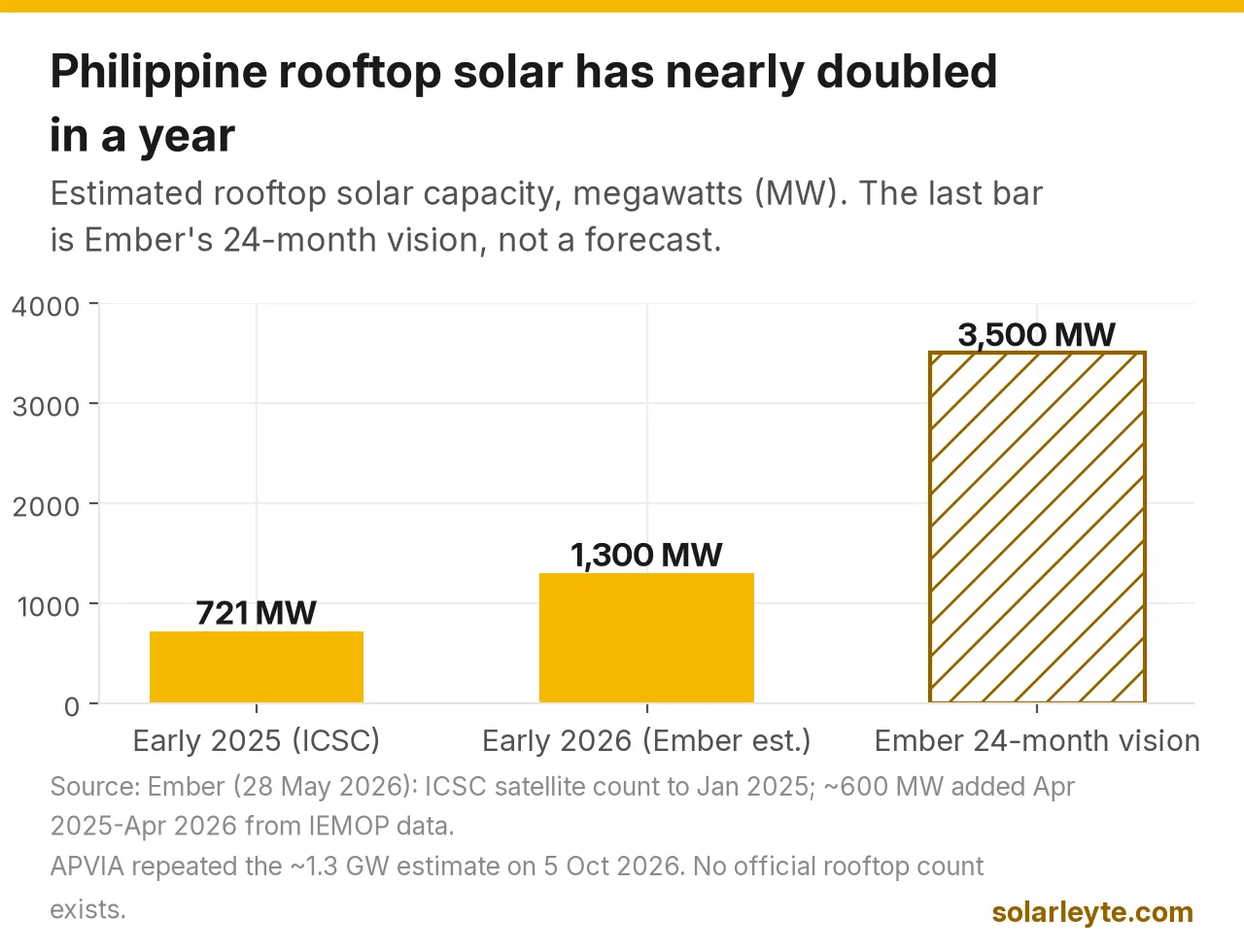
The 1.3 GW figure is an estimate built from how much less grid power was used at midday. APVIA, the regional solar industry group, repeated the same estimate at the ASEAN Energy Business Forum in Manila on 5 October 2026 (Power Philippines). The president of the Philippine Solar and Storage Energy Alliance (PSSEA) gives a wider range of 700 MW to 1.3 GW (Energy Tracker Asia). Treat it as a ballpark, not a census.
Why everyone is putting up panels now
- Power prices jumped. Ember says Meralco's residential prices in May 2026 were 17% higher than in May 2025 (Ember). Meralco raised prices by 10% after the Middle East conflict began in late February (Reuters via Rappler).
- The Philippines already had the region's priciest household power. A DOE comparison in March 2026 ranked its residential price the highest in Southeast Asia (via Ember).
- The energy emergency. President Marcos declared a national energy emergency in late March 2026 (Al Jazeera). More than 70% of the country's power comes from imported coal and gas (Al Jazeera).
- Cheap panels were already arriving. Bloomberg reported that China's panel exports to the Philippines more than doubled in the first five months of 2026, with March up 262% year on year (as published in The Business Times).
Here in Biliran it's sharper. PRESYO-PH, ICSC's rate tracker, lists BILECO at about ₱18.93 per kWh for September 2026, compared with about ₱14.74 for Meralco and ₱14.05 for LEYECO II (PRESYO-PH). LEYECO II posts its rate before VAT, so the LEYECO II bill is a bit higher than ₱14.05. Our guide to BILECO and LEYECO rates explains what makes up each peso.
The catch: demand is running ahead of installers
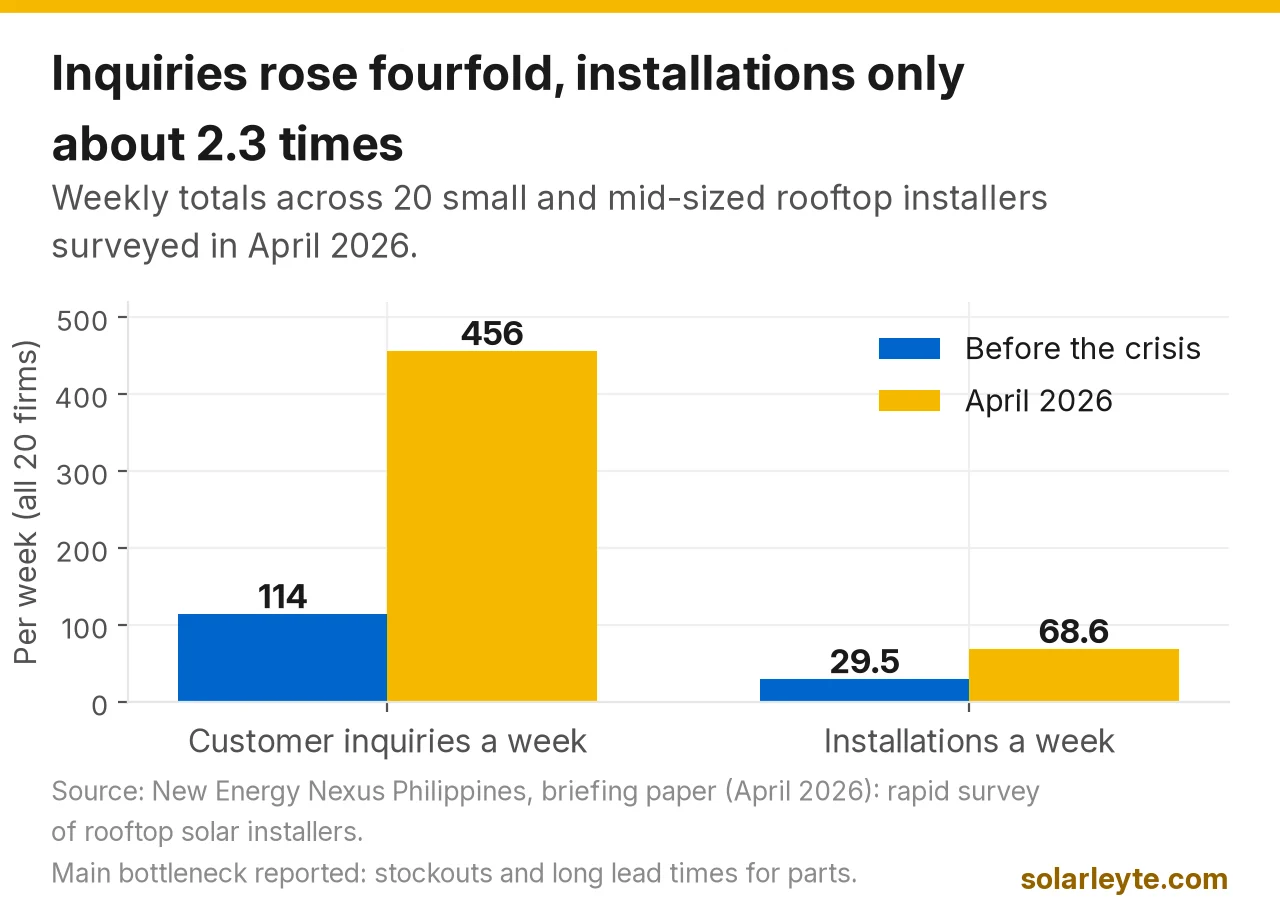
More interest doesn't mean faster installs. In April 2026, New Energy Nexus surveyed 20 small and mid-sized rooftop installers across Luzon, the Visayas and Mindanao. Their weekly inquiries rose from 114 before the crisis to 456, but weekly installations only went from 29.5 to 68.6 (New Energy Nexus). The main bottleneck was parts: every firm reported stockouts and long lead times. One Bohol installer had 22 confirmed jobs it couldn't start.
The chart below puts the two numbers side by side.
What installers told reporters:
- Prices: some Chinese panels rose by as much as 30%, aluminium rails tripled in price, and a good battery that was ₱85,000 now costs more than ₱100,000 (EcoSolutions PH, in Rappler, April 2026). Installers in the NEX survey said prices were changing week to week, sometimes while they were still writing a quote. "Pabago-bago presyo, mahirap mag quote confidently."
- Waits: one supplier told Al Jazeera there was a 30-day wait because panel shipments couldn't keep up (Al Jazeera, 17 October 2026). A Manila installer told Rappler its usual two-week lead time had become four weeks (Rappler).
- The Visayas wait longer: shipping parts from Manila to Cebu alone takes about two weeks, according to the Clean Energy Advocates Association of the Philippines (Rappler). Leyte and Biliran are one more boat ride away.
- Provincial installers are stretched: the PSSEA president says provincial installers are often short of capital, have unpredictable customer volumes, and face inter-island shipping costs and bad roads (Energy Tracker Asia).
Not every signal points the same way. Ember says solar costs fell about 10% in the year to May 2026 because of the flood of supply. Rappler's installers reported price jumps on specific parts. Both can be true at once. Panels are plentiful overall, while particular models, rails and batteries run short. That's why a quote with a validity date matters more than any average.
What "3-year payback" means for a BILECO home
The headline numbers come from Ember: residential rooftop solar payback fell from 4.0 years in May 2025 to 3.1 years in May 2026. That's based on Meralco prices and an installed price of about ₱60 per watt (Ember). APVIA and PSSEA quote about four years for homes (Daily Tribune). For solar plus a battery, the PSSEA president puts it at around five years (Energy Tracker Asia). These are their estimates, not ours.
Here's a quick check with local numbers.
Worked example (assumptions, not a quote): a 3 kW grid-tie system on a roof in Naval, Biliran. PVGIS estimates about 4,460 kWh a year for a 12° panel facing south (PVGIS). The price uses Ember's ₱60 per watt (₱180,000), plus a "boom price" of ₱70 per watt (₱210,000), which is our assumption for a quote that has risen. Solar you use yourself saves BILECO's ₱18.93 per kWh. To stay conservative, exported solar earns nothing, as on a zero-export system.
Share of solar you use yourself | kWh used a year | Saved a year at ₱18.93 | Payback at ₱60/W | Payback at ₱70/W |
|---|---|---|---|---|
70% (someone home in the day) | 3,123 | ₱59,119 | 3.0 years | 3.6 years |
50% (house empty most of the day) | 2,231 | ₱42,228 | 4.3 years | 5.0 years |
Same example on Meralco's ₱14.74: 3.9 years at 70% self-use and ₱60 per watt. On LEYECO II's pre-VAT ₱14.05: 4.1 years. These are simple paybacks. They ignore panel ageing, repairs and loan interest, and net-metering credits for exported power would shorten them. For the full method with three household types, see our honest payback math for Leyte and Biliran.
The lesson from the table: when you use your solar matters more than the boom. A 10-peso-per-watt jump in price adds about half a year. Being away all day adds more than a year.
Rules that changed with the boom
- Faster paperwork. Since early 2026, co-ops are supposed to approve net-metering applications within 10 days, and LGUs are supposed to issue electrical permits within 3 working days (Ember). Our electrical permit and CFEI guide and BILECO net metering guide cover the details.
- Zero-export option. Since August 2026, homes can install solar for their own use, with less paperwork, if it never exports to the grid. See our plug-and-play and zero-export solar explainer.
- Cheaper loans, for some. The GSIS solar loan (up to ₱500,000 at 5%) is for government workers only (Reuters via Rappler). Private-sector workers have Pag-IBIG and bank loans. See what government help actually exists.
- Proposed, not law yet. In July, the President made the Sariling Kuryente Act a legislative priority. It would let homes and businesses install solar and storage for their own use without meeting rules written for commercial power producers (Energy Tracker Asia).
How to buy solar in a boom without getting burned
Ayaw pagdali. A rush is when corners get cut. Before you sign:
- Get the quote in writing with a validity date and the exact panel, inverter and battery models. If prices move weekly, you want to know how long yours holds.
- Ask whether the parts are in stock in Leyte or Biliran or still need to ship from Manila or Cebu, and get an installation date in writing.
- Don't pay everything up front. Ask for staged payments tied to delivery, installation and commissioning.
- Check the installer, not just the price. Our guide to choosing a solar installer in Leyte and Biliran lists the licences, permits and red flags to look for.
- Compare the price per watt across quotes, then check panel prices against our 550 W to 620 W panel price check.
- Size it to your daytime use. As the table shows, solar you can't use (and can't export) doesn't pay you back.
FAQ
How much rooftop solar does the Philippines have in 2026?
About 1.3 GW, according to Ember and APVIA. That's an estimate: about 721 MW counted by satellite up to January 2025, plus about 600 MW added up to April 2026. There's no official count.
Are solar panel prices going up in the Philippines?
For some items, yes. In April 2026 installers told Rappler that some Chinese panels rose by up to 30% and aluminium rails tripled. Ember says overall solar costs fell about 10% in the year to May 2026. Get two or three dated quotes and compare them on price per watt.
Should I wait until the boom cools down?
Waiting has a cost too. In our worked example, a 3 kW system with 70% self-use saves about ₱4,900 a month at BILECO's September 2026 rate. Each month you wait is a month of that saving you don't get. What waiting can buy you is time to find a good installer and get a firm quote.
Is the 3-year payback true in Biliran and Leyte?
It can be. In our example at BILECO's rate it's about 3.0 years if you use 70% of your solar during the day, but 4.3 years at 50%. On LEYECO II's lower rate, expect it to take longer. Your own bills and daytime use decide it.
Last checked: 24 October 2026 (capacity estimates, rates, rules and news reports).
Solar Leyte is run by MACC Systems & Energy Solutions Inc., a solar installer in Naval, Biliran.
Thinking about joining the rooftop solar rush? Ask MACC first
Send us your last BILECO or LEYECO bill and tell us when your household uses the most power. We'll give you a free written quote with the exact model numbers and a validity date, with no obligation.
- Call/Text: 0955 723 5093
- Email: official@macc-inc.com or benjie@macc-inc.com
- Website: www.macc-inc.com
- Request a quote online: solarleyte.com/quote
- Office: Brgy. Talustusan, Naval, Biliran 6543
Sources (all checked 24 October 2026)
- Ember: How the Philippines' rooftop solar surge can flip the energy emergency script (28 May 2026; ICSC 721 MW split, ~600 MW added Apr 2025–Apr 2026, ~1,300 MW, 106,000 MW potential, 157 MW net metering May 2025, 5,068 MW imports vs 800 MW utility solar in 2025, Meralco +17% residential May 2026, payback 4.0 → 3.1 years at ₱60/W, ~10% cost fall, 3,500 MW + 4,500 MWh vision); press summary
- pv magazine: Philippines imported 4 GW of Chinese solar panels in January–April (net imports 3,130 / 5,068 / 4,133 MW)
- Power Philippines: PH rooftop solar capacity estimated at 1.3 GW — APVIA (5 October 2026)
- Context.ph: Group pushes urgent backing for rooftop project across ASEAN (DOE on-grid solar 4,230 MW, end-July 2026)
- Daily Tribune: High power costs shorten solar payback (APVIA/PSSEA payback, about 4 years residential)
- Energy Tracker Asia: Rooftop solar inquiries up tenfold in Philippines, industry says (21 October 2026; 700 MW–1.3 GW range, solar + battery ~5 years, provincial installers, Sariling Kuryente Act)
- New Energy Nexus Philippines: Surveying Philippines' rooftop solar installers (April 2026 briefing paper; 20 firms; inquiries 114 → 456 a week, installations 29.5 → 68.6 a week)
- Rappler: 'Solar rush': Surge in solar demand overwhelms local industry (11 April 2026; panels up to 30%, rails ×3, battery ₱85,000 → over ₱100,000, Manila–Cebu two-week lead time, two weeks → four weeks)
- Rappler (Reuters): Philippines leads the world in rush to solar as power prices soar (June 2026; Meralco +10% since late February; US$407 million imports March–May)
- Al Jazeera: Solar power booms in Philippines as war on Iran spikes energy costs (17 October 2026; 30-day wait; over 70% imported coal and gas); Philippine president declares energy emergency (25 March 2026)
- The Business Times (Bloomberg): China is supercharging a rooftop solar boom in the Philippines (exports more than doubled Jan–May 2026; March +262%)
- ICSC: PRESYO-PH national table (September 2026: BILECO ₱18.93, Meralco ₱14.74, LEYECO II ₱14.05 per kWh)
- European Commission JRC: PVGIS 5.3 (Naval, 11.56° N 124.40° E, 3 kWp, 12° tilt facing south, 14% system loss: 4,462 kWh a year)
- Worked example, payback table and charts: Solar Leyte calculations from the figures above