In Leyte and Biliran, the best fixed tilt for solar panels is only about 10° to 12°, facing south (slightly east of south is even a touch better). That's what the European Commission's PVGIS model gives for Naval, Tacloban and Ormoc, which sit around 11° north of the equator. The good news is that the angle is forgiving. A panel lying almost flat makes about 98% of the best yearly output, and an east-facing roof at 15° about 97%. The real loser is a steep roof facing north: at 30° it makes only about 80% of the best, and in December barely half of what the same roof facing south would make.
So for most homes here, put the panels on the roof face you have, at the pitch it already has, and skip the expensive tilt-up frames. The two exceptions are north-facing roofs steeper than about 15°, and dead-flat concrete decks, where you want a small tilt so rain can wash the glass. Here are the numbers, three worked examples and a checklist for your quote.
Last checked: 17 October 2026. All yields are PVGIS model averages for 2005–2023 weather, not a promise for your roof. Shade from trees, neighbours, water tanks and hills nearby isn't in the model.
How we got these numbers
We ran PVGIS 5.3 (the European Commission Joint Research Centre's free solar calculator) on 17 October 2026 for three towns:
- Naval, Biliran (11.56° N, 124.40° E)
- Tacloban City (11.24° N, 125.00° E)
- Ormoc City (11.01° N, 124.61° E)
Each run was for 1 kWp of ordinary crystalline-silicon panels, rack-mounted with air behind them, with 14% system losses (the PVGIS default, and the same basis as our earlier posts). Weather is PVGIS-ERA5, 2005 to 2023. We tried tilts of 0° (flat) to 35° in 5° steps, and eight directions: south, south-east, east, north-east, north, north-west, west and south-west. We also asked PVGIS for its own optimum. That's 174 runs in all.
In PVGIS, direction (azimuth) is measured from south: 0° is south, −90° is east, 90° is west, 180° is north.
The short answer: tilt and direction table for Naval
Each cell is the yearly output as a percentage of the best possible fixed angle for Naval. PVGIS put the optimum at 12° tilt, 16° east of south, about 1,489 kWh a year per kWp.
Tilt | South | South-east | East | West | North |
|---|---|---|---|---|---|
0° (flat) | 98.4% | 98.4% | 98.4% | 98.4% | 98.4% |
5° | 99.4% | 99.2% | 98.4% | 97.9% | 96.7% |
10° | 99.9% | 99.6% | 98.0% | 97.0% | 94.6% |
15° | 99.8% | 99.4% | 97.1% | 95.7% | 91.8% |
20° | 99.1% | 98.7% | 95.9% | 94.1% | 88.6% |
25° | 97.9% | 97.7% | 94.3% | 92.1% | 84.8% |
30° | 96.1% | 96.0% | 92.3% | 90.0% | 80.6% |
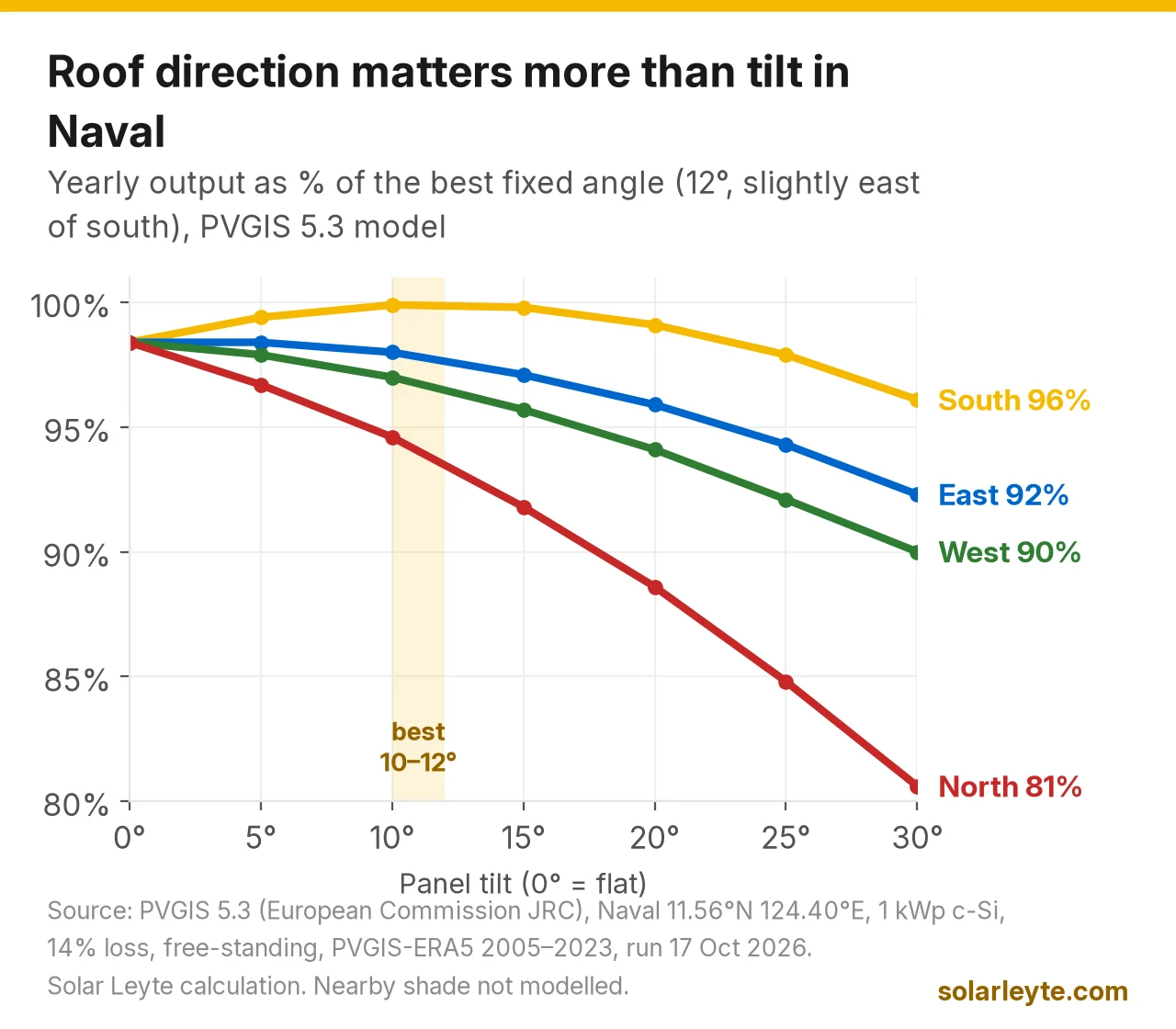
Source: PVGIS 5.3 (European Commission JRC), PVGIS-ERA5 2005–2023, 1 kWp crystalline silicon, 14% losses, free-standing. Solar Leyte calculation of % of optimum.
Three things jump out:
- Anything from flat to 20° facing south or south-east is within about 2% of the best. Don't pay extra to chase the perfect angle.
- East beats west, a little. At 15°, east makes 97.1% and west 95.7%. PVGIS also puts the optimum slightly east of south, so in its weather data for these towns, morning sun has a small edge over afternoon sun.
- North is the face to worry about, and steepness makes it worse. North at 10° still makes 94.6%. North at 30° drops to 80.6%.
Naval, Tacloban and Ormoc compared
The pattern is the same in all three towns. Tacloban's model output is a bit lower overall, but the losses from a poor direction are about the same.
Town | PVGIS best angle | Best yield (kWh/kWp/year) | Flat 0° | 20° east | 20° west | 20° north | 30° north | Peak sun hours at best angle |
|---|---|---|---|---|---|---|---|---|
Naval | 12°, 16° east of south | 1,489 | 98.4% | 95.9% | 94.1% | 88.6% | 80.6% | 5.33 |
Tacloban | 10°, 10° east of south | 1,413 | 98.8% | 95.8% | 94.8% | 89.9% | 82.3% | 5.15 |
Ormoc | 11°, 18° east of south | 1,483 | 98.7% | 96.2% | 94.6% | 89.7% | 82.1% | 5.40 |
Source: PVGIS 5.3 runs, 17 October 2026 (same settings as above). "Peak sun hours" is PVGIS's average daily sunlight on the panel, in kWh per m² per day.
What "peak sun hours" means here
People often ask for the "peak sun hours" in the Philippines. It's the day's total sunlight on the panel, written as if the sun shone at full strength (1,000 W per m²) for that many hours. PVGIS gives about 5.2 to 5.4 peak sun hours a day at the best angle in these three towns, and 5.09 to 5.33 on a flat surface. It isn't the number of hours the sun is up. It's an average, too: in PVGIS's monthly data, December and January are lowest and March to May highest.
Why north-facing roofs hurt most in December
At 11° north, the midday sun is south of overhead for most of the year, from about mid-August to late April. It's north of overhead for a few months around June. A north-facing roof tilts away from the sun in our cooler months, and the steeper it is, the worse it gets.
Here is the monthly output of 1 kWp in Naval on a 25° roof facing south, the same roof facing north, and a flat array:
Month | 25° south | 25° north | Flat |
|---|---|---|---|
December | 124.7 kWh | 63.2 kWh | 101.6 kWh |
January | 122.2 kWh | 67.4 kWh | 102.6 kWh |
April | 132.6 kWh | 137.2 kWh | 145.4 kWh |
June | 102.0 kWh | 130.3 kWh | 124.5 kWh |
Whole year | 1,458 kWh | 1,263 kWh | 1,465 kWh |
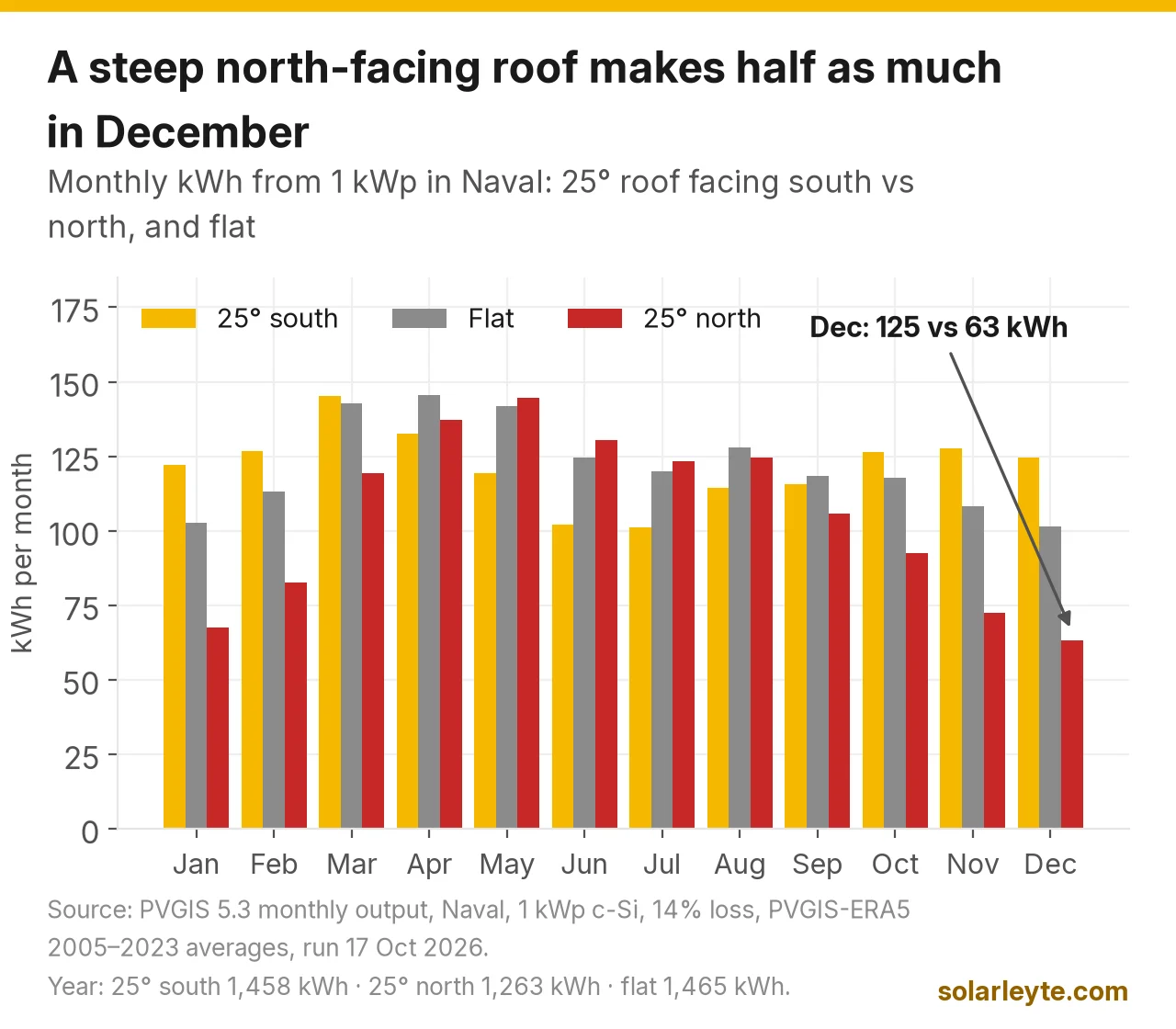
Source: PVGIS 5.3 monthly output, Naval, 2005–2023 averages.
In December, the north-facing roof makes only about 51% of what the south-facing roof makes. In June, it makes about 28% more. Over the year, the summer gain doesn't make up for the cool-season loss, and the north roof ends up about 13% behind.
That matters if your biggest bills come in December, or if you're off-grid and the battery has to last through the darkest weeks.
East-west roofs: a small loss, and more afternoon power
If your roof ridge runs north–south, one roof face looks east and the other west. Splitting the panels across both faces costs very little over a year, and it spreads production across the day.
We pulled the hour-by-hour PVGIS output for Naval in 2023 (1 kWp at 15°) and averaged it by hour of the day:
1 kWp at 15°, Naval, 2023 | Facing south | Facing east | Facing west |
|---|---|---|---|
Whole day, average | 4.06 kWh | 3.95 kWh | 3.91 kWh |
About 6 to 9 AM | 0.63 kWh | 0.84 kWh | 0.38 kWh |
About 3 to 6 PM | 0.36 kWh | 0.21 kWh | 0.54 kWh |
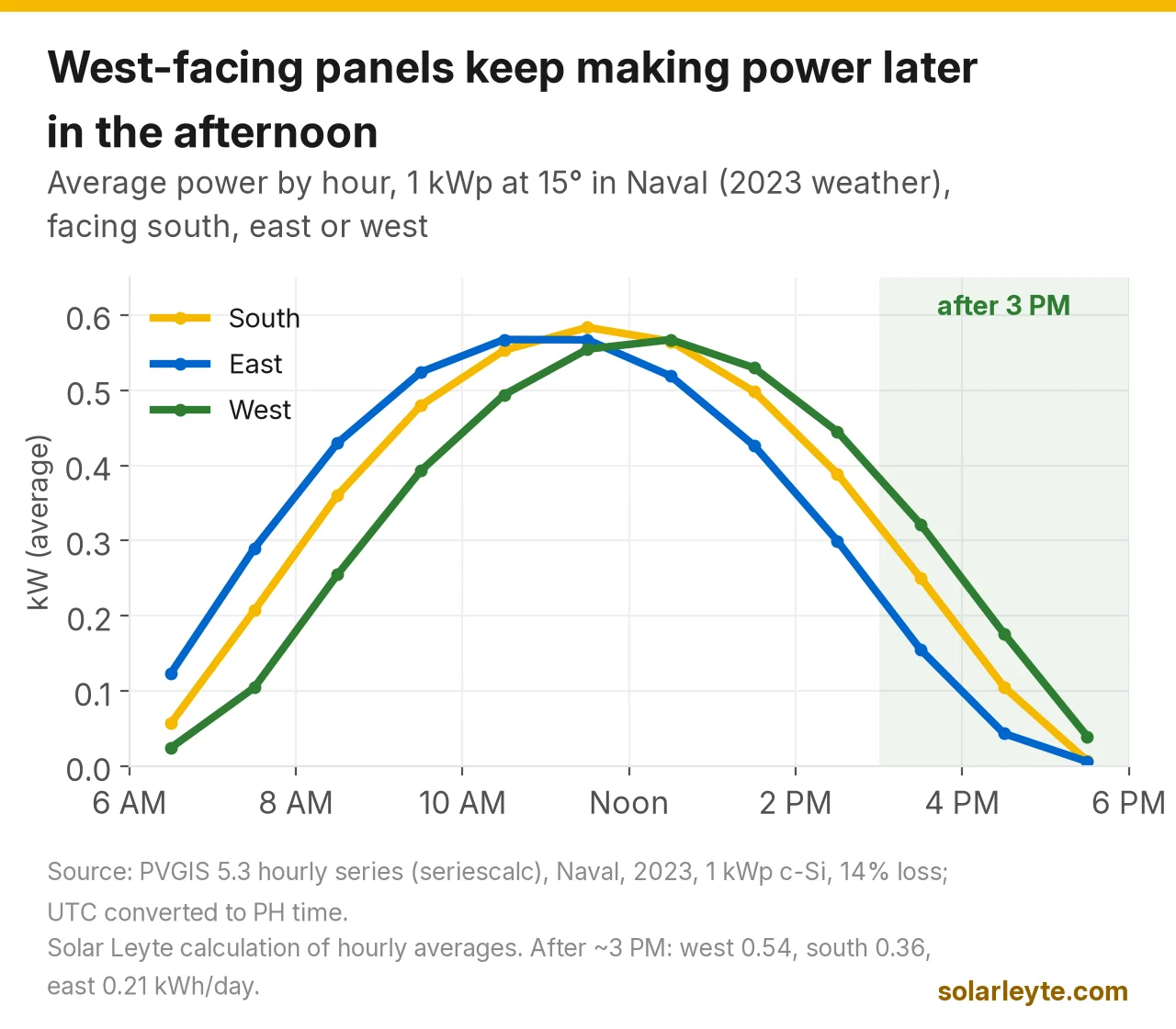
Source: PVGIS 5.3 hourly series (seriescalc), Naval, 2023 weather, converted to Philippine time. Solar Leyte calculation of hourly averages.
The west face makes about 50% more power after 3 PM than a south face (0.54 vs 0.36 kWh per kWp). That's when the house heats up and the aircon goes on. If you're on zero-export solar, the inverter throttles back when the house can't use all the power, so the extra simply isn't captured unless you add a battery. Small plug-and-play kits (panels up to 1 kW and a micro-inverter of 0.8 kW AC or less, under DOE DC2026-08-0017) earn nothing for power the house doesn't use, either. In both cases, a west or east-west layout can be worth the small loss in yearly kWh.
One string, one direction
LONGi's installation manual says modules in the same string should share the same orientation and tilt. Panels on different roof faces get different sunlight, and a mixed string drags down the whole string. So an east-west layout needs two strings on two separate MPPT inputs. Many home inverters have two. The Deye SUN-5K-SG03LP1 hybrid manual, for example, lists 2 MPP trackers with 1+1 strings. Check your inverter's datasheet before you agree to panels on two roof faces. Our MPPT vs PWM explainer covers what an MPPT does.
Shade and panel placement
Shade from trees, walls, a water tank or a neighbour's second floor often costs more than a poor angle, and PVGIS doesn't include it. On a string inverter, the panels in a string are wired in series, so one shaded panel can drag down the output of the whole string. Where you can, put panels on the part of the roof that stays clear from about 9 AM to 3 PM, and keep any panel that gets shade at some hours off the main string. If part of the array can't avoid shade, ask your installer about panel optimizers or microinverters, which let each panel work on its own so one shaded panel doesn't hold back the rest.
Worked examples
These are examples with stated assumptions, not quotes. The kWh figures come from the PVGIS tables above. The peso values use BILECO's September 2026 residential rate of ₱18.93/kWh and its blended generation rate of about ₱9.50/kWh, both from ICSC's PRESYO-PH tracker (see our BILECO rate tracker).
Example 1: a 5 kWp system on a 20° north-facing roof in Naval
- Best realistic layout, 10° south: 5 × 1,487 = about 7,435 kWh a year
- Same panels on a 20° roof facing north: 5 × 1,319 = about 6,596 kWh a year
- Difference: about 839 kWh a year, or 11.3% less
What that's worth depends on where the power goes:
If the lost kWh would have been… | Value per year (example) |
|---|---|
All used at home, at ₱18.93/kWh | about ₱15,900 |
Half used at home, half exported at about ₱9.50/kWh | about ₱11,900 |
All exported under net metering at about ₱9.50/kWh | about ₱8,000 |
Under net metering, the power you export is credited at roughly the co-op's blended generation rate, not the full retail rate. That's why the value drops as more of it is exported. Our net metering guide explains the details.
What to do with this: if you have a south, east or west face, use it. If the north face is all you have, the panels will still work. You'll just need about one extra panel for every eight to make the same yearly kWh, so price that into the quote. A tilt-up frame to point north-roof panels south is a structural job, and in typhoon country it brings wind risk (see below).
Example 2: 5 kWp split east and west at 15°
- 2.5 kWp east (2.5 × 1,446) + 2.5 kWp west (2.5 × 1,425) = about 7,177 kWh a year
- That's 96.5% of the 10° south layout in Example 1, or about 258 kWh less a year.
- In return, the west half makes more of its power in the late afternoon, which helps if nobody's home until 3 PM, or you're on zero-export.
Example 3: a flat concrete deck in Naval, flush (0°) or on a 10° frame
- Flat: 5 × 1,465 = about 7,323 kWh a year
- 10° south on a low frame: about 7,435 kWh a year
- Gain from tilting: about 111 kWh a year (1.5%), worth about ₱2,100 a year if all used at home.
The yield gain from a frame is small. The real reason to tilt on a flat deck is rain cleaning and drainage (next section). It's not about chasing a few extra kWh.
Don't go dead flat: the 10° rule for rain cleaning
PVGIS doesn't model dirt. Panel makers do warn about it:
- LONGi (installation manual V16) suggests a tilt of no less than 10°, so dust is washed off by rain, cleaning is needed less often, and water drains away instead of leaving marks on the glass.
- Canadian Solar (installation manual US v3.3, July 2026) says modules with a tilt of at least 15° generally may not need cleaning, because rain has a self-cleaning effect.
- JinkoSolar (global installation manual) says grid-connected systems should be tilted at the angle that gives the most energy over the year, and off-grid systems should be sized for the worst season.
A panel that's almost flat collects dust, bird droppings, leaves and salt. Water also pools along the bottom edge of the frame. Over a year, that can easily cost more than the 1.5% PVGIS says you'd gain or lose from the angle. Our solar panel cleaning guide covers how often to wash panels in Leyte and Biliran and what the makers allow.
A practical target: keep panels at 10° or more wherever the roof allows. If your roof is already pitched at 10° or more (use the table further down to check), flush mounting meets it.
Off-grid homes: tilt for December
For off-grid systems, LONGi and Jinko both say to choose the tilt for the worst season, not the best year. In Naval, going from 10° to 25° south raises December output by about 10% (112.9 → 124.7 kWh per kWp) and costs only about 2% over the year. See our off-grid solar guide for battery sizing through cloudy weeks.
Tilt frames and typhoons
Panels laid flush on a roof, parallel to it, sit low in the wind. A tilt-up frame lifts one edge into the wind and lets it get underneath, which adds load on the frame, the bolts and the roof. In Eastern Visayas, any frame steeper than the roof itself needs an engineer's check of the frame and its anchors. Our typhoon preparedness guide and typhoon checklist cover what to ask for.
How to check your roof's tilt and direction
You don't need special tools.
- Direction: stand in your yard, open a compass app on your phone and point it straight out from the roof face, down the slope. Note whether it points south, east, west or north. Google Maps' satellite view helps too, because north is at the top.
- Tilt: many phones have a level or measure app that shows angles. Or measure the roof's rise over a 1 m run (horizontal) and use the table below.
- Shade: watch the roof at 9 AM, noon and 3 PM. Trees, a neighbour's second floor, the water tank or a hill can cost more than any angle in this article. PVGIS only includes the far horizon (hills and mountains), not nearby objects.
Rise per 1 m of horizontal run | Roof tilt |
|---|---|
10 cm | 5.7° |
20 cm | 11.3° |
30 cm | 16.7° |
40 cm | 21.8° |
50 cm | 26.6° |
60 cm | 31.0° |
Solar Leyte calculation (tilt = arctan of rise ÷ run).
Safety: don't climb onto a roof to measure in wet or windy weather. Any wiring work, including splitting panels into separate strings, is a job for a licensed installer. Under RA 7920 (the Electrical Engineering Law), electrical installation work must be done under a licensed electrical practitioner. See our installer checklist.
Questions to ask on your solar quote
- Which roof face, what tilt and how many panels on each? The quote should name them.
- What yearly kWh did you model, and with what tool? Ask for a PVGIS or similar report for your actual roof faces, not a generic "4 peak sun hours × kW".
- If you're using two roof faces: is each face on its own MPPT input? Which inverter, and how many MPPTs does it have?
- If you're using a north face: how many extra panels does the quote add to make up for it?
- If you're using a tilt frame: who designed it for typhoon wind, and how is it anchored?
- Shade: what shading did you see at the site visit, and how is it handled?
For how panel counts and system sizes turn into a price, see our solar panel price guide and how many solar panels you need.
FAQ
What is the best solar panel angle in the Philippines? For Leyte and Biliran, PVGIS puts the best fixed tilt at about 10° to 12°, facing south or slightly east of south. We only ran these three towns, but the whole country sits roughly 5° to 21° north, so expect a low best tilt elsewhere too. Anything from 5° to 20° facing south loses less than 2%.
Which direction should solar panels face in the Philippines? South is best, and south-east is practically the same. At 10° to 20° in Naval, east loses about 2–4% and west about 3–6%. North loses about 5% at 10° and close to 20% at 30°.
Is a flat (0°) installation OK? For yield, yes. It's within about 2% of the best. For dirt and water, no. LONGi suggests at least 10° so rain can wash the glass and water can drain.
Should I pay for a tilt frame on my north-facing roof? Usually not. Adding about one panel for every eight makes up the lost kWh on a 20° north roof, without a frame that has to survive a typhoon. Ask your installer to price both options.
Do east-west panels make sense? Often, yes. In our Naval model, an east-west split at 15° made about 96.5% of the best south layout, and the west half gave about 50% more power after 3 PM than south-facing panels. You need an inverter with two MPPT inputs.
Solar Leyte is run by MACC Systems & Energy Solutions Inc., a solar installer in Naval, Biliran.
Get a free solar quote from MACC
Not sure which roof face to use? Send us a photo of your roof, which way it faces, and a recent electric bill. We'll give you a free written quote with the layout, system size and model numbers. No obligation, and this article doesn't include any MACC prices.
- Call/Text: 0955 723 5093
- Email: official@macc-inc.com or benjie@macc-inc.com
- Website: www.macc-inc.com
- Office: Brgy. Talustusan, Naval, Biliran 6543
- Or use the site quote form: /quote
Sources (all checked 17 October 2026)
- European Commission Joint Research Centre, PVGIS 5.3: PVcalc runs for Naval, Tacloban and Ormoc (1 kWp, crystalline silicon, 14% loss, free-standing, PVGIS-ERA5 2005–2023, tilt 0–35°, eight directions, plus optimal angles) and a seriescalc hourly run for Naval (2023, 15° south, east and west), all run 17 October 2026
- European Commission JRC, PVGIS non-interactive API reference: azimuth convention (0 = south, 90 = west, −90 = east)
- LONGi, Installation Manual for LONGi Solar PV Modules V16, §4.2 Selection of Tilt Angles (tilt no less than 10°; same orientation and tilt within a string; off-grid tilt for the worst season)
- Canadian Solar, Installation Manual PV Modules US v3.3 EN (July 2026): optimum orientation and tilt; modules with at least 15° tilt may not need cleaning
- JinkoSolar, Global Installation Manual 20240814_A1, §3.2 Tilt angle selection
- Deye, SUN-3.6/5/6K-SG03LP1-EU user manual: 2 MPP trackers, 1+1 strings per tracker
- ICSC, PRESYO-PH national overview (September 2026): BILECO residential rate ₱18.93/kWh, blended generation rate ₱9.50/kWh
- Republic Act No. 7920 (Lawphil), the New Electrical Engineering Law