Rain rinses a Leyte roof, but it does not replace cleaning. Dust, salt spray from Biliran and Leyte coasts, bird droppings and typhoon debris still sit on the glass and block light. Manufacturer manuals from LONGi, Jinko, Trina, JA Solar and Canadian Solar all say the same core things: soft tools, cool panels, gentle water, and never walk on the modules. Get those wrong and you can scratch the coating or void a warranty.
This post is for homeowners in Naval, Ormoc, Tacloban and nearby towns who want a clear, sourced answer to three questions: how often, how to clean safely, and what a service might cost in pesos. It sits with our typhoon installation guide, the before / during / after checklist and the home insurance post. Brownouts do not remove dirt from panels — a hybrid battery keeps the lights on, but dirty glass still wastes sun.
Facts and prices checked 13 October 2026 (Philippine time). Cleaning guidance is summarised from the manufacturers' own manuals linked in Sources. Service prices below are published Metro Manila starting rates, not MACC quotes and not Leyte fieldwork. This is not a warranty claim, electrical advice or a promise that cleaning will raise your bill by a fixed percent.
Why soiling matters on a Visayas roof
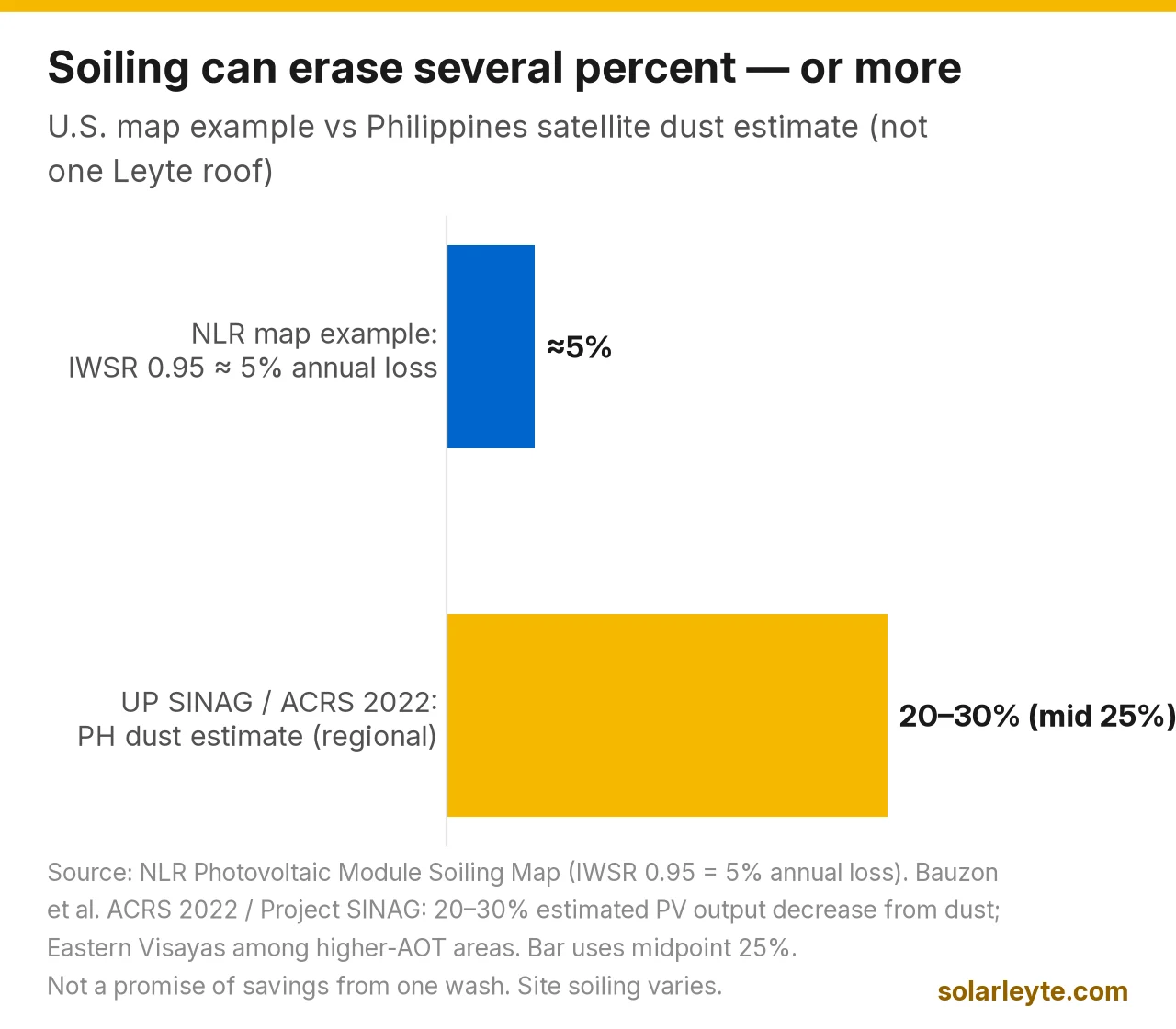
Soiling is the industry word for anything that sits on the glass: dust, pollen, soot, bird droppings, salt film, ash, leaves. The National Renewable Energy Laboratory (now NLR) soiling map for U.S. sites uses an insolation-weighted soiling ratio (IWSR). An IWSR of 0.95 means about 5% annual energy loss to soiling if you never clean between measured dirty spells. Losses on that map are site-specific; the page does not publish a single Philippines number.
For the Philippines, a 2022 University of the Philippines / Project SINAG paper (ACRS 2022) used Himawari satellite aerosol data for 2017–2021. It reported relatively high estimated dust deposition in Eastern Visayas, Eastern Mindanao and Western Luzon (AOT about 0.218–0.230), and estimated the decrease in solar PV power output due to dust deposition at 20–30%. That is a satellite-based regional estimate, not a measurement from one Naval rooftop. Treat it as a reason to look at your own inverter history, not as a guaranteed saving if you wash once.
Coastal Biliran and northern Leyte add salt spray. Typhoon season adds grit, leaves and sometimes broken roofing nearby. Volcanic ash is a Visayas risk when Kanlaon or other volcanoes erupt — in mid-October 2026, PHIVOLCS and news reports covered Kanlaon ash emissions and ashfall on Negros, not on Leyte or Biliran in the sources we checked. Ash is abrasive; treat it like any hard grit and follow the "do not scrape dry dirt" rule below.
What sits on the glass | Why it hurts | Local angle |
|---|---|---|
Fine dust / road dust | Cuts light evenly; humid air can cement it | UP SINAG flagged Eastern Visayas among higher-AOT areas |
Salt film (coast) | Hazy film; can leave deposits if rinsed with hard water | Biliran Strait, Leyte Gulf coastal roofs |
Bird droppings / sap | Hard shade on a few cells → hot-spot risk (LONGi) | Common on rural roofs with trees |
Typhoon debris | Leaves, grit, sometimes metal fragments | After every storm — see typhoon checklist |
Volcanic ash | Abrasive; do not rub dry | Visayas volcanoes; Oct 2026 Kanlaon ashfall reported on Negros, not Leyte/Biliran in our sources |
What the manufacturer manuals actually say
We read the cleaning sections of several Tier-1 style manuals commonly sold into the Philippine market. Rules below are from those PDFs, not from Solar Leyte inventing a method.
Water and chemistry
Brand / document | Water | Chemicals |
|---|---|---|
LONGi Maintenance Manual EN V3.0 | Municipal water OK; if other water: pH 6–8, TDS ≤1,000 mg/L, conductance ≤3,000 µS/cm | No abrasive powders, NaOH, benzene, acids/alkalis; glass cleaner / alcohol only if water fails |
LONGi Cleaning Work Instruction V02 | pH 6–8; water–module ΔT −5°C to +10°C; front hydraulic pressure <3,000 Pa (bifacial back <1,500 Pa) | Same ban on abrasives and harsh chemicals |
Jinko Global Installation Manual (14 Aug 2024) | Neutral water pH 6.5–8; high-mineral water not recommended; hose / backpack <675 kPa | "Never use chemicals … as this may affect the module warranty" |
Trina O&M white paper PS-M-0486 | Soft / non-alkaline water preferred; hardness 0–40 mg/L Ca+Mg; pressure on glass ≤0.7 MPa | No corrosive solvent; no organic-solution cleanser; neutral liquid only for greasy dirt |
JA Solar ARC-glass cleaning method (2014) | Municipal usually OK; pressure <690 kPa; high mineral not recommended | No abrasives, NaOH, benzene, nitro thinners, acids/alkalis |
Canadian Solar Installation Manual US v3.3 (Jul 2026) | Water + non-abrasive sponge; avoid hottest hours | No abrasive cleaners or unauthorised chemicals; "Damages induced by inappropriate cleaning procedures will void Canadian Solar warranty" |
Soft foam, non-woven cloth, soft sponge or nylon brush about 0.06–0.1 mm (LONGi) are the usual tools. Hard sponge faces, steel wool, blades and scouring pads are banned across these manuals. LONGi and JA say do not stand, walk or sit on modules while cleaning. Trina says the same (no treading) and: irradiance <200 W/m², wind not above Beaufort 4, no heavy rain, and ΔT water-to-module ≤10°C.
Canadian Solar adds a safety sequence many DIY guides skip: inspect for cracked glass and loose connections first; shock risk rises when modules are wet; disconnect the array from the inverter / combiner before cleaning; wear insulated gloves. Their maintenance note also says modules with tilt of at least 15° often self-clean enough in rain — and do not scrape or rub dry dirt, which can micro-scratch the glass.
How often
Frequency is site-specific. The manuals give planning ranges, not a Biliran ordinance:
- LONGi (Cleaning V02 and Maintenance V3.0): in rainy regions, about every 40–50 days; in dry regions with little rain, every 20–30 days — and they tell customers to adjust to local dirt.
- Jinko Global Installation Manual: "preferably once per annum, more frequently in dusty conditions." (Some Jinko regional O&M PDFs say monthly; follow the manual that shipped with your panels.)
- Canadian Solar: regular maintenance to keep modules clear of droppings, pollen, leaves and dust; rain may be enough at ≥15° tilt if the glass stays clear.
For Leyte and Biliran, a practical reading of those ranges is: glance at the array after the dry spells and after every typhoon, wash when you can see a film or when your inverter's sunny-day kWh has dropped versus a recent clean baseline, and do not wait a full year if you live on the coast or under trees. That schedule is a Solar Leyte reading of the manuals plus local weather — not a brand mandate.
Safe DIY method (from the manuals)
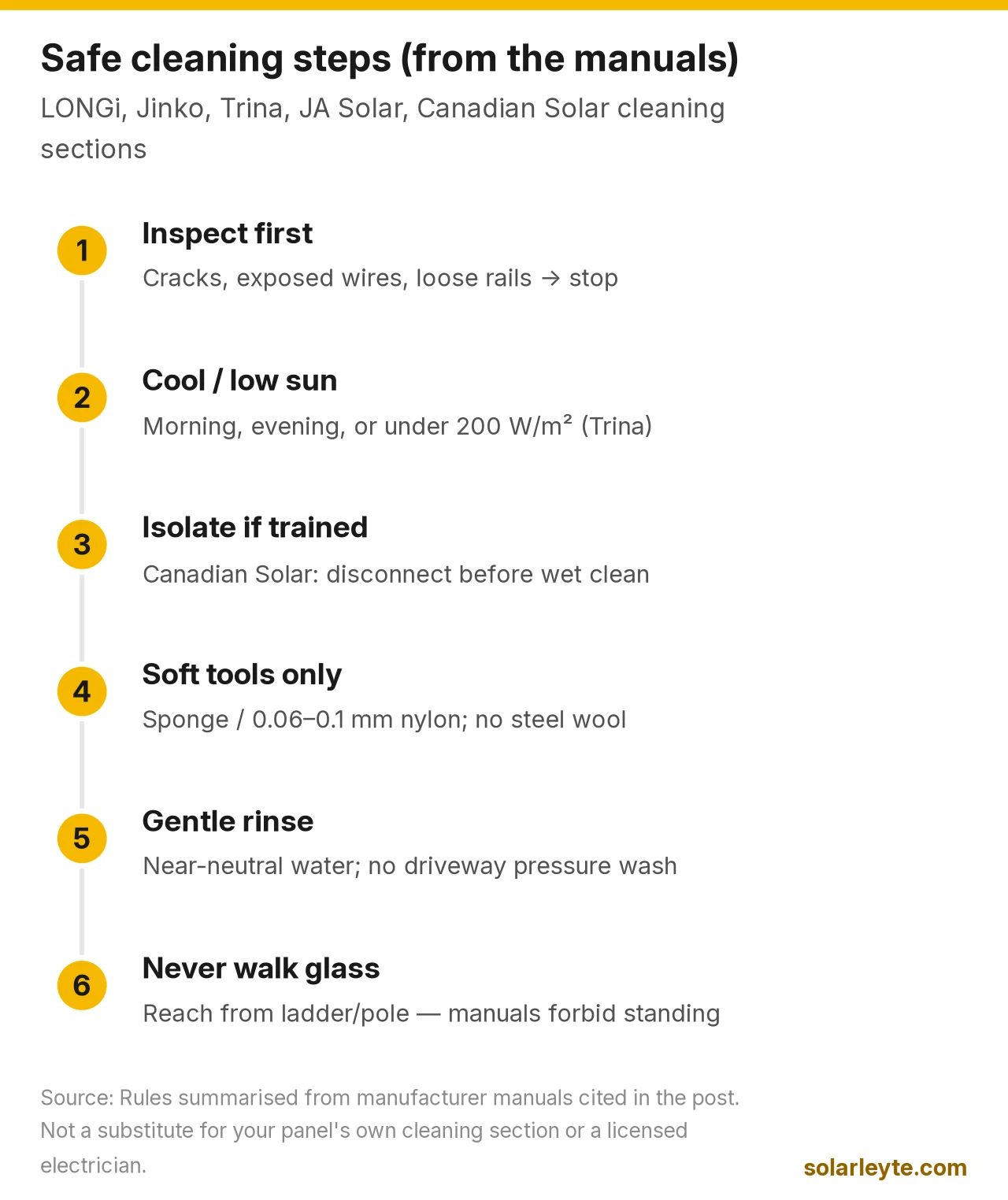
Only attempt DIY if you can reach the array without walking on panels, from a stable ladder or the ground with a soft brush on a pole, and you are comfortable with basic electrical safety. Steep or high roofs, cracked glass, or wet feet on a metal roof are reasons to hire someone.
- Look first. Cracked glass, exposed wires, loose rails or a humming inverter with fault lights → stop. Call your installer (how to choose one). Canadian Solar and LONGi both forbid cleaning broken glass or exposed cables.
- Pick a cool window. Early morning, late afternoon, overcast, or when irradiance is low (Trina: <200 W/m²). Hot glass + cold water risks thermal stress.
- Isolate if your installer taught you how. Canadian Solar wants the circuit disconnected from active components before wet cleaning. If you are not sure how to do that safely on your hybrid or grid-tie setup, hire a technician.
- Sweep loose dirt dry with a soft brush or cloth (LONGi / Trina "brush, scrape, wash" sequence). Do not grind dry grit into the coating.
- Rinse with low-pressure water in the pH / mineral ranges above. Garden-hose municipal water is what LONGi and JA generally allow; if your well water is very hard, mineral spots can bake on — deionized or RO water is what Metro Manila cleaning ads promote for that reason.
- Stubborn droppings: wet first, then soft brush. LONGi allows commercial glass cleaner / alcohol only when water fails. Jinko's global manual is stricter on chemicals — check your warranty booklet.
- Never pressure-wash like a driveway, never use kitchen scouring pads, and never climb onto the glass to "just reach the middle."
After a typhoon, debris removal and a structural check come before a beauty wash. Use the typhoon checklist, photograph damage for insurance (insurance post), and only clean intact panels once the array is declared safe.
What cleaning costs in the Philippines (published figures)
Leyte / Biliran: as of 13 October 2026 we could not find a publicly listed per-panel cleaning rate from a Naval, Ormoc or Tacloban service page we could archive. Do not treat any peso number below as a local quote. Ask your installer, or request a site assessment.
Metro Manila (indicative, published): Ophir Solar Panel Cleaning lists soft-brush + deionized-water residential starting rates for typical Metro Manila setups (checked 13 Oct 2026):
Package (Ophir page) | Indicative rate | What they say is included |
|---|---|---|
Starter, up to 10 panels | ₱150 / panel, minimum ₱1,800 | Soft-brush + deionized wash; visual inspection |
Standard, 11–20 panels | ₱130 / panel | Above + output performance report |
21+ / rooftop arrays | ₱100–120 / panel range (custom) | Volume pricing |
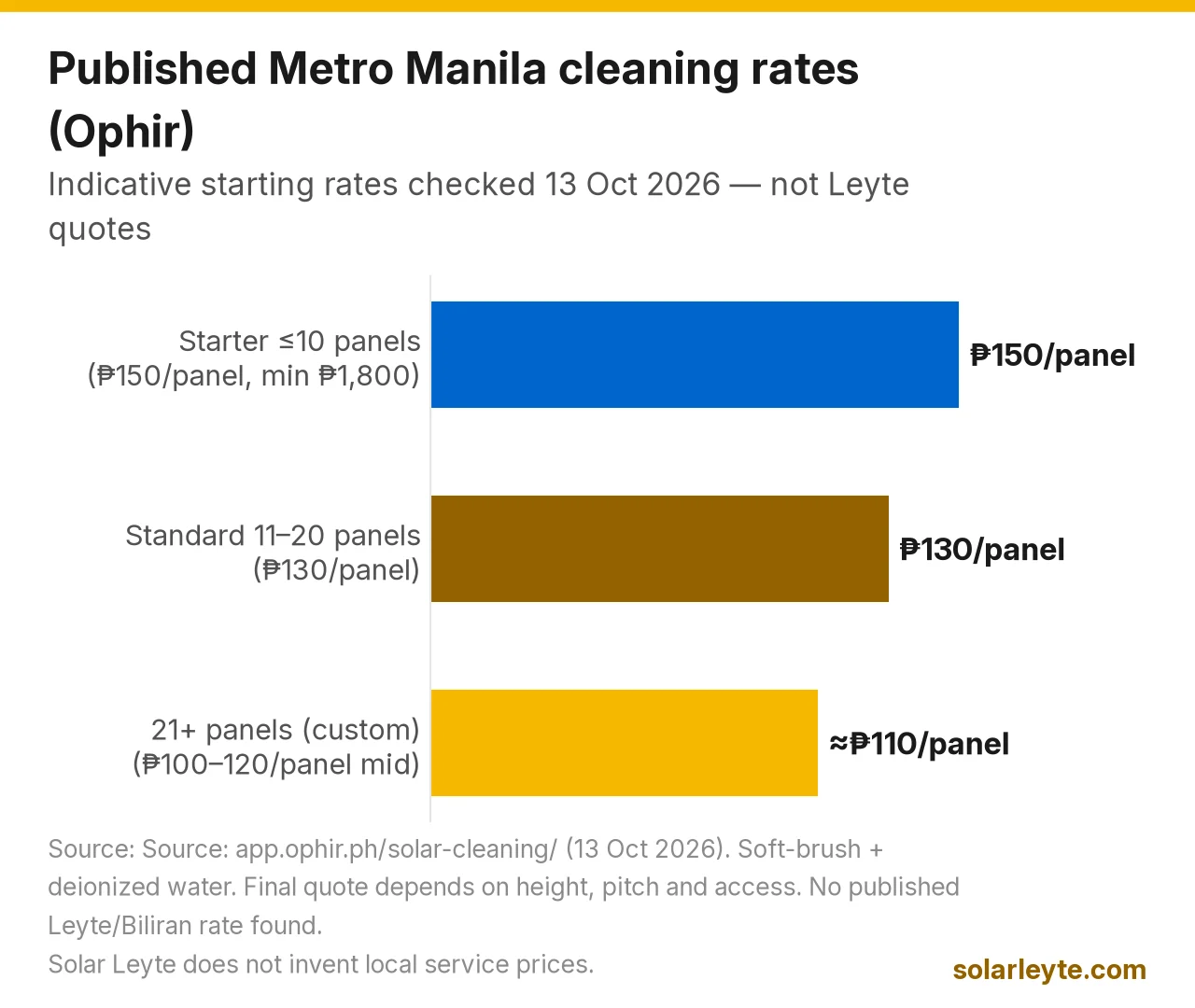
They label these as starting points; roof height, pitch, access and heavy soiling can add a surcharge. Other PH firms (e.g. Philvolt, TopMop) describe soft-brush / pure-water methods but do not publish a flat peso rate on the pages we saved — they quote after assessing panel count and access.
DIY supply cost: soft car-wash brushes and telescoping poles are sold in ordinary hardware and online shops; we did not lock a single Lazada/Shopee SKU price into this post because listings change by the hour. Budget for a soft head and low-pressure rinse, not a pressure washer. Solar Leyte does not sell cleaning kits.
Rough math for a 10-panel home (illustration only): at Ophir's Metro Manila starter minimum, one visit is about ₱1,800. Four visits a year ≈ ₱7,200 before travel. Whether that pays for itself depends on how dirty your roof gets and your co-op rate — we are not claiming a fixed kWh recovery. Compare any quote to your own sunny-day production before and after a wash.
Warranty and insurance: cleaning is not a claim
- Product / performance warranties cover manufacturing and output over time. Scratching the anti-reflective coating or cracking glass while cleaning is usually on you. Canadian Solar's manual states inappropriate cleaning can void the warranty. Jinko warns chemicals may affect warranty. Keep the cleaning section of the manual that came with your panels.
- Installer workmanship covers mounting and wiring mistakes, not dirt.
- Home insurance pays for named perils (typhoon, fire, etc.) under the endorsements you bought — not gradual soiling. See does home insurance cover solar panels.
Brownouts and Visayas yellow/red alerts (grid alert post) change how you use batteries; they do not clean glass. A dirty array simply makes less energy whenever the sun is out.
A simple maintenance calendar for Leyte and Biliran
When | What to do |
|---|---|
Monthly glance (from the ground) | Film, droppings, leaves, loose cables, inverter faults |
End of a dry stretch | Soft clean if glass looks dull or sunny-day kWh dropped |
After every typhoon / signal | Safety inspect first (checklist); clean intact panels only when safe |
Every 6 months (manuals vary) | Connector / cable visual check (Jinko recommends periodic connector inspection) |
Once a year minimum | Full wash if rain and monthly glances were not enough (Jinko annual baseline) |
Coastal salt and tree cover push you toward the more frequent end of LONGi's 20–50 day planning band. Inland roofs with good tilt and clean rain may sit nearer Jinko's annual baseline. Your inverter app history beats any calendar.
FAQ
How often should I clean solar panels in the Philippines? Follow your panel manual first. LONGi suggests about every 40–50 days in rainy areas and 20–30 days in dry ones; Jinko's global install manual says preferably once a year, more if dusty. In Leyte and Biliran, clean when you see film or after storms, and at least check monthly from the ground.
Can I use dishwashing soap or a pressure washer? Manuals favour plain water in a near-neutral pH range. Harsh detergents, abrasives and high-pressure jets are repeatedly forbidden. Trina caps water pressure on the glass at 0.7 MPa; JA at 690 kPa; LONGi's cleaning instruction uses a much lower Pa figure for hydraulic pressure — when in doubt, use a gentle rinse.
Is rain enough? Often helpful, especially at ≥15° tilt (Canadian Solar). Sticky droppings, salt film and cemented dust still need a wash.
How much does professional cleaning cost? Published Metro Manila starting rates we found on 13 Oct 2026: about ₱100–150 per panel (Ophir), with a ₱1,800 minimum for small jobs. We found no reliable published Leyte/Biliran rate.
Will cleaning void my warranty? Cleaning by the manual should not. Walking on panels, abrasives, harsh chemicals or cleaning broken glass can. Canadian Solar explicitly voids for inappropriate cleaning damage.
Do brownouts mean I can skip cleaning? No. Brownouts affect backup sizing (battery price post); dirt still cuts daytime yield.
Solar Leyte is run by MACC Systems & Energy Solutions Inc., a solar installer in Naval, Biliran. This article does not invent MACC cleaning prices, licences or service packages.
Get a free solar quote from MACC
Send a photo of your roof and your latest BILECO or LEYECO bill. If you already have panels, tell us the brand and whether you want a cleaning or inspection discussion — we will say honestly what we can and cannot do on site. No obligation.
- Call/Text: 0955 723 5093
- Email: official@macc-inc.com or benjie@macc-inc.com
- Website: www.macc-inc.com
- Office: Brgy. Talustusan, Naval, Biliran 6543
- Or use the form: solarleyte.com/quote
Sources (all checked 13 October 2026)
- LONGi, PV Modules Cleaning Work Instruction V02 (archived `raw/solar-panel-cleaning-2026-10-13/longi-cleaning-v02.pdf`)
- LONGi, Maintenance Manual EN V3.0 (cleaning water and tools; rainy 40–50 / dry 20–30 day guidance) (`longi-maintenance-v3.pdf`)
- LONGi, Installation Manual for LONGi Solar PV Modules V16 (§8.1 Cleaning)
- JinkoSolar, Global Installation Manual 20240814_A1 (§6.2 Cleaning)
- Trina Solar, White Paper for PV Modules Operation and Maintenance PS-M-0486
- JA Solar, Cleaning Method of ARC Glass of Photovoltaic Modules (Feb 2014) (`ja-cleaning.pdf`)
- Canadian Solar, Installation Manual PV Modules US v3.3 EN (§7 Maintenance, §8 Module Cleaning Guidelines)
- NLR / NREL, Photovoltaic Module Soiling Map (IWSR definition; U.S. sites)
- Bauzon et al., Spatial analysis … dust … Philippines (ACRS 2022; Project SINAG summary also at sinag.nec.upd.edu.ph)
- Ophir, Solar Panel Cleaning Services pricing (Metro Manila indicative rates, 13 Oct 2026; `ophir2.html`)
- Philvolt, Solar Panel Cleaning & Maintenance Philippines (method; no flat rate)
- TopMop, Solar Panel Cleaning Metro Manila (pure water / brushes; quote-based)
- GMA News / Inquirer Visayas / Daily Guardian reporting on Kanlaon ash emissions and Negros ashfall, 10–12 Oct 2026 (Alert Level 2; ashfall localities named on Negros Occidental — not used as Leyte ashfall evidence)
- Related Solar Leyte posts: typhoon preparedness guide, typhoon checklist, solar panel insurance, installer checklist, battery prices, Visayas grid alerts