Set the battery type first, then check three numbers: the charge (boost) voltage, the float voltage and the low-voltage disconnect. For a 12 V lead-acid battery, the factory presets on EPEver Tracer-AN and SRNE controllers are already sensible: 14.4 V boost and 13.8 V float for sealed, 14.2 V boost for gel, 14.6 V for flooded. For a 12.8 V LiFePO4, pick the lithium type, then check it against your battery's datasheet. EPEver's preset charges to 14.5 V and SRNE's to 14.4 V, while Victron recommends 14.2 V and a 13.5 V float for its own 12.8 V batteries. The battery maker's number wins. Double everything for 24 V and multiply by four for 48 V.
Last checked 4 Nov 2026 against the EPEver Tracer-AN, SRNE ML and MA manuals, Victron's lithium manual and datasheet, and Renogy's voltage chart. Menus differ by model and firmware, so keep your unit's manual handy.
Still choosing a controller? Start with our MPPT vs PWM guide. This post is about setting it up once it's on the wall.
Before you touch the buttons
- Know your battery. Read the label or datasheet: chemistry (sealed/AGM, gel, flooded, or LiFePO4), nominal voltage (12 V or 12.8 V, 24 V or 25.6 V, 48 V or 51.2 V) and the charge voltage it lists.
- Battery first, then panels. EPEver says connect the battery, then the load, then the panels (reverse to disconnect). It needs at least 8 V from the battery to start.
- Inverters go on the battery, not the LOAD terminal. EPEver says to wire an inverter "directly to the battery, not to the load side of the controller." So the controller's low-voltage disconnect only protects DC loads on its LOAD terminals. It does not stop an inverter draining the battery; the inverter's low-battery setting or the BMS does that.
- SRNE's own warning: settings "must be done under the guidance of a professional person." If someone else installed your system, ask them first.
The settings, in plain words
Setting (EPEver / SRNE name) | What it does |
|---|---|
Battery type (TYPE / n01) | Loads a preset group of voltages; edit them only in "User" (USE) mode |
Boost charging voltage (BCV / n03) | The voltage the controller charges up to, then holds. Victron calls it "absorption" |
Float charging voltage (FCV / n04) | Lower voltage that keeps a full battery topped up |
Equalize voltage | A periodic overcharge for flooded batteries only. Never for gel or lithium |
Boost reconnect voltage (n05) | Below this, a new full charge starts |
Low voltage disconnect (LVD / n07) | The LOAD terminals switch off below this |
Low voltage reconnect (LVR / n06) | The LOAD terminals switch back on above this |
Temperature compensation | Lowers lead-acid charge voltage when the battery is hot (needs a sensor) |
Lead-acid settings (sealed, gel, flooded)
Both makers use the same factory numbers, for 12 V at 25 °C. Double them for 24 V; SRNE multiplies by 3 and 4 for 36 and 48 V.
12 V setting | Sealed (AGM) | Gel | Flooded |
|---|---|---|---|
Equalize charging voltage | 14.6 V | none | 14.8 V |
Boost charging voltage | 14.4 V | 14.2 V | 14.6 V |
Float charging voltage | 13.8 V | 13.8 V | 13.8 V |
Boost reconnect voltage | 13.2 V | 13.2 V | 13.2 V |
Low voltage reconnect | 12.6 V | 12.6 V | 12.6 V |
Low voltage disconnect | 11.1 V | 11.1 V | 11.1 V |
Discharging limit | 10.6 V | 10.6 V | 10.6 V |
Boost / equalize duration | 120 min / 120 min | 120 min / none | 120 min / 120 min |
The older SRNE ML screen menu shows LVD as 11.0 V. SRNE equalizes flooded batteries every 30 days.
If your battery's label gives different charge voltages, select USE and enter the label's numbers. Using a car battery? Read our car vs deep-cycle vs LiFePO4 comparison first.
Hot battery boxes and temperature compensation
SRNE's default compensation is −3 mV per °C per 2 V cell. A 12 V lead-acid has six cells, so at 35 °C the controller lowers a 14.4 V boost to about 14.22 V (Solar Leyte calculation). EPEver says that without a temperature sensor it assumes 25 °C and doesn't compensate. In a hot Leyte or Biliran battery corner, plug the sensor in.
LiFePO4 settings: preset vs what the battery maker says
12.8 V setting | EPEver "LFP4S" preset | SRNE "LI" preset | Victron (battery maker) |
|---|---|---|---|
Charge / boost voltage | 14.5 V | 14.4 V | 14.2 V recommended (14.0–14.4 V allowed) |
Float voltage | 13.8 V | none (no float stage) | 13.5 V |
Boost reconnect | 13.2 V | 13.2 V | not given |
Low voltage reconnect | 12.8 V | 12.6 V | not given |
Under-voltage warning | 12.0 V | 12.0 V | BMS pre-alarm at 3.1 V per cell (12.4 V for 4 cells) |
Low voltage disconnect | 11.1 V | 11.1 V | end of discharge 11.2 V |
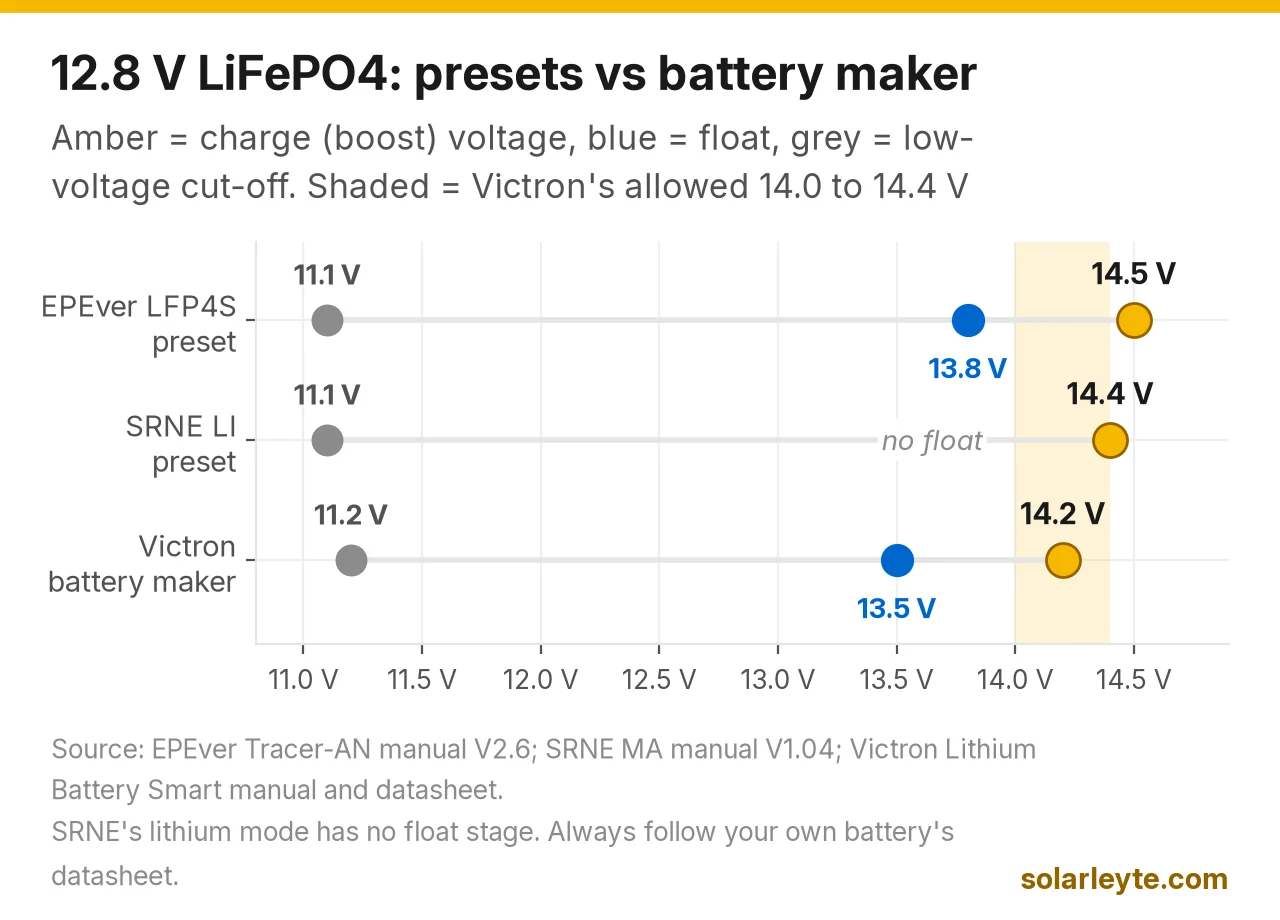
EPEver's 14.5 V preset is above Victron's 14.4 V maximum for Victron's own batteries. That doesn't make it wrong for every battery, but it shows why the datasheet comes first. SRNE's lithium mode has no float; it charges to boost voltage and holds it. Victron also suggests 2 hours of absorption so the balancer can even out the cells, and its BMS stops charging if any cell passes 3.75 V.
Heat matters more than cold here. Victron allows charging from +5 °C to +50 °C, so mind a battery sitting under a hot metal roof. EPEver and SRNE controllers only stop charging when a connected sensor reads above 65 °C.
Worked example: setting an EPEver for a 12.8 V LiFePO4
Example only. Assumptions: an EPEver Tracer-AN on a 12 V system, and a 12.8 V 100 Ah LiFePO4 whose datasheet asks for 14.2 V charge, 13.5 V float and 11.2 V end of discharge, like Victron's.
On its own screen, EPEver's USE mode takes four voltages (BCV, FCV, LVR, LVD) and works out the rest.
You enter | Controller calculates (EPEver's LiFePO4 User formulas) |
|---|---|
BCV 14.2 V | Over-voltage disconnect 14.5 V (BCV + 0.3); charging limit 14.3 V (BCV + 0.1) |
FCV 13.5 V | Boost reconnect 12.9 V (FCV − 0.6) |
LVR 12.8 V | (must stay below boost reconnect: 12.8 < 12.9, OK) |
LVD 11.2 V | Under-voltage warning 12.1 V (LVD + 0.9); discharging limit 11.1 V (LVD − 0.1) |
Calculated values are Solar Leyte's arithmetic from EPEver's formulas. Victron's 24 V figures are 28.4 V and 27.0 V; its 48 V figures are 56.8 V and 54 V.
Step by step: EPEver and SRNE menus
EPEver Tracer-AN (10–40 A):
- On the battery voltage screen, press and hold ENTER until the battery type flashes.
- Press SELECT to choose Sealed, Gel, Flooded, a lithium type, or USE. Press ENTER.
- For custom numbers: select USE, then ENTER steps through SYS (system voltage), BCV, FCV, LVR and LVD. SELECT changes a value (short press +0.1 V, long press −0.1 V); ENTER confirms.
- The full parameter list can be set through EPEver's PC software, phone app or MT50 remote meter.
SRNE MA series: long press > to enter settings. n01 is battery type (SLD, FLD, GEL, LI, USE, USE LI); n02–n07 (equalize, boost, float, reconnects, over-discharge) are editable in USE or USE LI; n08 is system voltage (12/24/36/48 V or AUTO).
Older SRNE ML2420/30/40: hold Set to enter, tap Set to move, Up/Down to change, hold Set to save. Its screen only offers User, Flooded, Sealed and Gel; the LI preset is in SRNE's monitor software. Restart after changing system voltage.
LiFePO4 voltage chart: 12V, 24V and 48V
This is Renogy's chart. The 12 V, 24 V and 48 V columns are 4, 8 and 16 cells (12.8, 25.6 and 51.2 V nominal). Use it only on a rested battery, nothing charging or discharging it.
State of charge | 1 cell | 12 V | 24 V | 48 V |
|---|---|---|---|---|
100% (while charging) | 3.65 V | 14.6 V | 29.2 V | 58.4 V |
100% (rested) | 3.40 V | 13.6 V | 27.2 V | 54.4 V |
90% | 3.35 V | 13.4 V | 26.8 V | 53.6 V |
80% | 3.32 V | 13.3 V | 26.6 V | 53.1 V |
70% | 3.30 V | 13.2 V | 26.4 V | 52.8 V |
60% | 3.27 V | 13.1 V | 26.1 V | 52.3 V |
50% | 3.26 V | 13.0 V | 26.1 V | 52.2 V |
40% | 3.25 V | 13.0 V | 26.0 V | 52.0 V |
30% | 3.22 V | 12.9 V | 25.8 V | 51.5 V |
20% | 3.20 V | 12.8 V | 25.6 V | 51.2 V |
10% | 3.00 V | 12.0 V | 24.0 V | 48.0 V |
0% | 2.50 V | 10.0 V | 20.0 V | 40.0 V |
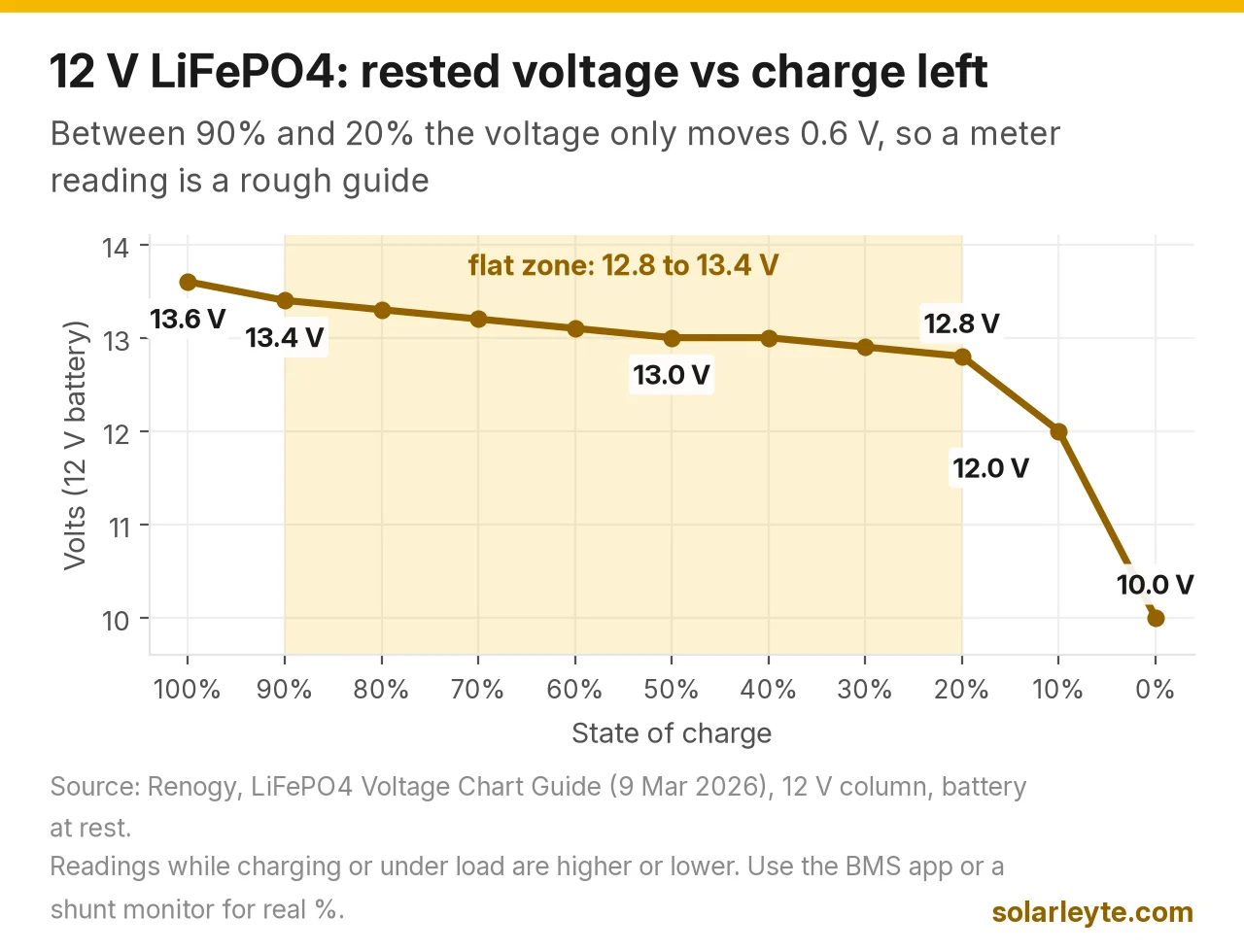
From 90% down to 20%, a 12 V LiFePO4 only moves from 13.4 V to 12.8 V. Ang liit ng difference. A meter off by 0.1 V, or a fan still running, can make 40% look like 60%.
Worked example: what 13.0 V means
Example only. A 12.8 V 100 Ah LiFePO4 (1,280 Wh nominal, per Victron's datasheet for its 100 Ah model) reads 13.0 V after resting.
Renogy's chart puts 13.0 V at about 40% to 50%: roughly 512 to 640 Wh, or 10 to 13 hours of a 50 W DC fan before losses (Solar Leyte calculation). Less through an inverter. For a real fuel gauge, use the BMS app or a shunt battery monitor. More on run-times in our solar electric fan guide.
Common mistakes
- Leaving a LiFePO4 on the "Sealed" default. Both brands ship set to sealed lead-acid, with equalize and temperature compensation on.
- Equalizing gel or lithium. Equalize is for flooded only. EPEver warns it gives off explosive gas, so ventilate.
- Wrong system voltage. Check the screen shows 12 or 24 V correctly after first power-up.
- Charging above the BMS limit. The BMS will keep tripping. Stay at or below the datasheet's charge voltage.
Battery still not filling? Check the panels with our multimeter test guide. Still choosing a system voltage? See 12V vs 24V vs 48V. Small brownout kits are in our solar generators and portable power guide.
FAQ
Paano mag-set ng solar charge controller for lithium?
Pick the lithium type (EPEver LFP4S/LFP8S, SRNE LI) and compare it with your battery's datasheet. If they differ, use USE / USE LI and enter the datasheet's charge, float and low-voltage numbers.
Pwede ba ang lead-acid setting sa LiFePO4?
Not as is. Sealed mode equalizes at 14.6 V and uses temperature compensation; Victron says to disable compensation for lithium.
What float voltage for a 12V LiFePO4?
Victron recommends 13.5 V for its 12.8 V batteries; EPEver's preset is 13.8 V; SRNE's lithium mode has no float. Follow your battery maker.
Solar Leyte is run by MACC Systems & Energy Solutions Inc., a solar installer in Naval, Biliran.
Get a free solar quote from MACC
Planning a battery system for brownouts and not sure about the settings? Send us a photo of your latest BILECO or LEYECO bill and your battery's label, and we'll get back to you with a free, no-obligation written quote.
- Call/Text: 0955 723 5093
- Email: official@macc-inc.com
- Website: www.macc-inc.com
- Or use the site quote form: /quote
Sources (all checked 4 November 2026)
- EPEver, Tracer-AN series (10–40 A) user manual V2.6 (PDF): supported battery types; local setting steps and USE-mode BCV/FCV/LVR/LVD (pp.14–17); lithium User formulas (BCV+0.3, BCV+0.1, FCV−0.6, LVD+0.9, LVD−0.1); lead-acid table (14.6/14.4/14.2/14.6/14.8/13.8/13.2/12.6/11.1/10.6 V, 120 min) and LFP4S/LFP8S table (14.5/13.8/13.2/12.8/12.0/11.1/11.0 V) (pp.18–19); battery first, inverter to battery, 8 V minimum; overheat stop 65 °C, low-temperature protection 0 °C default.
- SRNE, ML2420/ML2430/ML2440 user manual V1.06 (PDF): Set/Up/Down menu, screen settings (Sealed default; 14.6/14.4/13.8/12.6/11.0 V), "professional person" warning, LI preset (14.4/12.6/11.1 V), −3 mV/°C/2V.
- SRNE, MA series user manual V1.04 (PDF): n01–n09 settings, battery table incl. LI (14.4/13.2/12.6/12.0/11.1/10.6 V, no float) and USE LI, ×1/2/3/4 rule, no temperature compensation for lithium, battery charge stop above 65 °C, 30-day equalize for flooded.
- Victron Energy, Lithium Battery Smart manual (PDF): 14.2 V absorption, 2 h, 13.5 V float (28.4/27.0 V and 56.8/54 V); disable temperature compensation.
- Victron Energy, 12.8 & 25.6 V LiFePO4 Smart datasheet (PDF): charge voltage 14.0–14.4 V (14.2 V recommended), float 13.5 V, end of discharge 11.2 V, 1,280 Wh for 12.8/100, charge +5 °C to +50 °C, BMS 3.1 V / 2.8 V / 3.75 V per cell.
- Renogy, A Comprehensive LiFePO4 Voltage Chart Guide (9 Mar 2026): state of charge vs voltage for 1 cell, 12 V, 24 V and 48 V.
- PH availability: ABC Solar Electronics listings for SRNE ML MPPT and EPEver LandStar.
- Solar Leyte calculations (labelled in the text): 4-cell multiples of Victron's per-cell limits; temperature compensation at 35 °C; EPEver User example; 13.0 V energy and fan hours.