Looking after a LiFePO4 solar battery in Leyte or Biliran is mostly about heat, humidity, state of charge and listening to the BMS — not fancy gadgets. The packs common here (Pylontech, Dyness, Deye and similar 48 V modules) already have a Battery Management System that protects the cells. Your job is to put the battery where the maker says it can live, follow the storage and balancing rules in that brand's manual, and spot the warnings early.
This post is about care and maintenance. For peso prices see our solar battery price guide. For brand and warranty fine print see Pylontech vs Dyness vs Deye. Charge-controller voltage charts live in solar charge controller settings. Fire risk belongs to solar panel fire safety.
Why Leyte and Biliran are hard on batteries
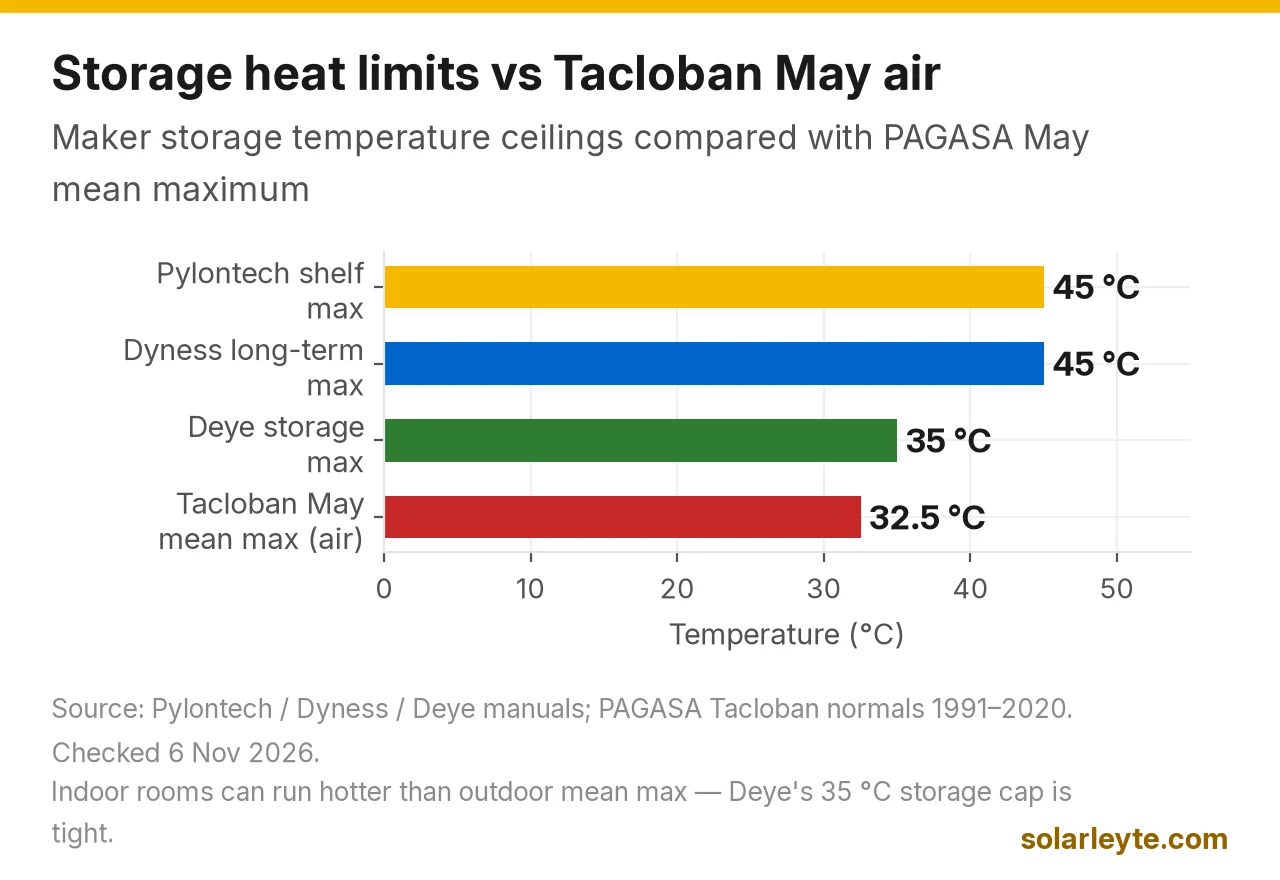
PAGASA's climatological normals for Tacloban (1991–2020) put the annual mean temperature at 28.1 °C and relative humidity at 84%. May's mean maximum is 32.5 °C; December humidity averages 88% (PAGASA Tacloban normals PDF).
That is outdoor air. A closed utility room, a tin bodega or a cupboard next to an inverter can run several degrees hotter. Compare that with what the makers allow for storage (not even full power use):
Maker / model | Working temperature | Storage temperature | Storage SOC | Humidity note |
|---|---|---|---|---|
Pylontech US5000 | Charge 0–50 °C; discharge −10–50 °C (optimal 10–40 °C) | Shelf −20–45 °C | Charge to ≥90% for long storage | 5–95% RH, no condensation; IP20 indoor |
Dyness Tower | 0–50 °C (optimal 18–30 °C) | Long-term 5–45 °C | 50–55% SOC | Long-term storage RH <65% |
Deye SE-G5.1 Pro-B | Charge 0–55 °C; discharge −20–55 °C | 0–35 °C | 40–70% SOC | 5–95% RH |
Sources: Pylontech US5000 installation manual; Dyness Tower user manual; Deye SE-G5.1 Pro-B user manual. Checked 6 November 2026.
Two takeaways for Eastern Visayas homes:
- Deye's storage ceiling of 35 °C is easy to breach in a hot room. Keep packs in a dry, shaded indoor space with airflow, not against a sunlit wall.
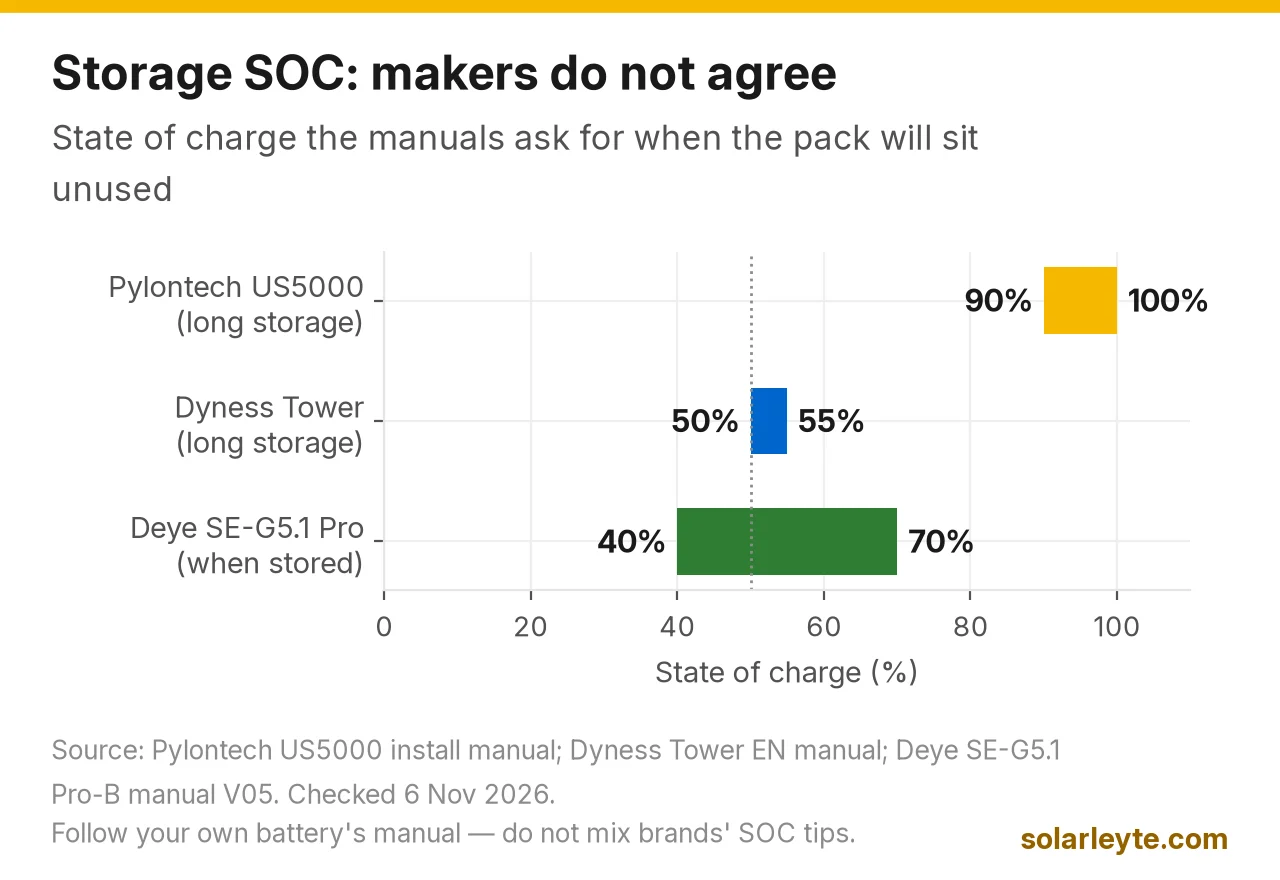
- Makers disagree on storage SOC. Pylontech wants the pack almost full for long storage; Dyness and Deye want mid-charge. Always follow your battery's manual, not a generic YouTube tip.
What "BMS" means on a solar battery
BMS means Battery Management System — the electronics board inside (or attached to) the pack that watches every cell. On Pylontech, Dyness and Deye home batteries the BMS typically:
- Stops over-charge and over-discharge
- Limits over-current (too many amps in or out)
- Cuts out on high or low cell temperature
- Balances cell voltages so one weak cell does not drag the pack down
Pylontech's US5000 manual puts it plainly: the BMS has protection for over-discharge, over-charge, over-current and high/low temperature, and "the system can automatically manage charge and discharge state and balance voltage of each cell." Dyness says the same for the Tower series. Deye lists BMS protection and SOC LEDs on the SE-G5.1 Pro front panel.
So for a home LiFePO4 pack, BMS means: the brain that keeps cells inside safe limits and tries to keep them equal. You do not "reset" it with a car BMS tool. If the red alarm LED stays on, use the maker's fault table or call the installer — Dyness says disassembly can void the warranty sticker.
IEC 62619 and UL 9540A appear on these makers' certification lists. They are product-test standards, not a homeowner checklist — they do not replace correct install and care. For fire behaviour, use our fire safety post.
Battery balancing: what it is, and how often
Balancing means bringing every cell in the pack to a similar voltage (and therefore a similar state of charge). LiFePO4 packs are strings of many cells in series. If one cell sits higher or lower than the others, usable capacity shrinks and the BMS may trip early.
- Passive balancing (common in these modules) bleeds a little energy from fuller cells through resistors until the others catch up. It usually happens near the top of charge.
- Dyness Tower manuals tell installers to do balancing maintenance (a full charge) every 3 months if the system has not been fully charged for a long time.
- Pylontech says the BMS can balance cells during normal cycling; if a cell-voltage-high alarm appears with the module still under about 54 V, keep charging at 53–54 V or keep the system cycling so the BMS can balance.
Worked example (labelled assumptions). A Dyness Tower system that mostly sits at 60–80% SOC (daytime solar use, rarely hits 100%) can drift out of balance, per Dyness's periodical-maintenance note. Fix from the manual: about once a quarter, allow a full-charge day (sunny morning, lighter loads, or a hybrid force-charge) so the BMS can finish balancing. Assumptions: compatible inverter on CAN/RS485, case stays closed, Dyness full-charge instruction followed.
Voltage setpoints for charge controllers belong in the charge controller settings post — this article does not repeat those charts.
How to store a lithium solar battery when it is not in use
People search "how to store lithium battery when not in use" for phones, e-bikes and golf carts. Home ESS rules are different and brand-specific. From the three manuals we checked:
If the battery will sit unused for months
Step | Pylontech US5000 | Dyness Tower | Deye SE-G5.1 Pro-B |
|---|---|---|---|
Target SOC before storage | ≥90% (reminders and annual maintenance charge) | 50–55% | 40–70% |
Revisit / recharge | At least every 6 months (reminders) / every 12 months (storage section, SOC >90%) | Activate (discharge + charge) every 3 months; do not leave without cycling more than 6 months | Room-temp storage max about 6 months; after that check voltage at least monthly; if pack voltage <51.2 V, recharge per the manual's 0.2C strategy |
Environment | Dry indoor; shelf −20–45 °C; no condensation | 5–45 °C, RH <65%, dry, clean, ventilated, no corrosive gas | Dry, cool; storage 0–35 °C; keep away from ignition and flammable areas |
Also common across the manuals:
- Recharge within 12 hours after a full discharge (Pylontech and Dyness).
- Do not leave a pack outdoors (Pylontech: indoor / within listed ranges; IP20 on these rack modules).
- Keep away from direct sun, heat sources and flammable vapours.
Day-to-day location while the system is running
Pylontech's install list is a solid IP20 checklist: waterproof area, flat floor, no flammables, ambient in range, stable temperature and humidity, little dust, >2 m from heat, >0.5 m from the inverter air outlet, no direct sun, and not a sealed salty or humid cupboard. Dyness adds regular dust/humidity checks in use, with an optimal 18–30 °C band.
If you are choosing between a car battery and a proper deep-cycle or LiFePO4 pack for a small system, that comparison is in car battery for solar. System voltage (12 / 24 / 48 V) is covered in 12V vs 24V vs 48V.
Warning signs — and what not to DIY
Call your installer (or the brand's PH distributor) if you see any of these, drawn from the makers' fault notes:
- Red alarm / ERROR LED that will not clear after a normal cool-down or reboot sequence in the manual
- Pack that will not charge or discharge while ambient is inside the working range
- Permanent protection in the manual (Pylontech: cell above ~4.2 V or below ~1.5 V, or temperature above ~80 °C — switch off and contact the distributor)
- Swelling, smoke, smell, or leaked electrolyte — emergency; avoid contact with leaked liquid
- Repeated high-temperature cutouts when the room feels fine — sensors may sit in a hot pocket by the inverter exhaust
Do not:
- Paint the case, hose it with solvents, or reverse the power terminals (Pylontech lists these as warranty exclusions; Deye says reverse polarity voids the warranty and can destroy the battery)
- Wire PV strings straight onto the battery terminals
- Mix random "any battery with any inverter" without a communication cable when the warranty requires it — see the brands post for Dyness's Asia warranty note on communication
Warranty process and cycle-life claims are owned by our lifespan and warranty post and the battery brands comparison. This post only flags care-related voids that appear in the install manuals.
A simple Leyte / Biliran care checklist
- Place: indoor, dry, shaded, airflow; keep clear of inverter exhaust and kitchen heat.
- Watch the app or LEDs: SOC, temperature alarms, and cell-imbalance warnings.
- Balance: if your maker asks for a periodic full charge (Dyness: every 3 months), schedule one.
- Store right: if the house will be empty for months, set SOC and revisit intervals from your manual — not a generic 50% tip if you own a Pylontech.
- After a deep brownout drain: recharge within 12 hours once power or sun returns.
- Annual look: terminals tight and corrosion-free, no insects or water near an IP20 pack (Pylontech annual check).
- Fire and insurance: linked posts cover those; keep clear space and working smoke alarms near the battery room.
For sodium-ion offers see sodium-ion batteries; for brownout kits without solar see inverter battery backup.
FAQ
What does BMS mean on a solar battery?
Battery Management System. It is the electronics that protect LiFePO4 cells from over-charge, over-discharge, over-current and unsafe temperatures, and that balances cell voltages. It is not something you normally "reset" with a car BMS tool.
How do I store a LiFePO4 solar battery when not in use?
Follow the maker. Pylontech US5000: high SOC (≥90%) and recharge on a 6–12 month schedule. Dyness Tower: about 50–55% SOC, cool and under 65% RH, cycle every 3 months. Deye SE-G5.1 Pro: 40–70% SOC, storage 0–35 °C, check within about 6 months.
How often should I balance a solar battery?
Many packs balance automatically near full charge. Dyness manuals ask for a full-charge balancing maintenance every 3 months if the system rarely hits 100%. Pylontech balances during cycling; stubborn cell-high alarms may need sustained top-of-charge time.
Is Leyte's humidity too high for these batteries?
Datasheets allow up to about 95% RH without condensation, but Dyness wants under 65% RH for long storage, and these modules are IP20 indoor products. Use a dry room with airflow — not a sealed damp bodega.
Will ignoring storage rules void the warranty?
Manuals list bad storage, heat, reverse polarity and outdoor use as warranty exclusions. Coverage years differ by brand — see battery brands and lifespan/warranty.
Solar Leyte is run by MACC Systems & Energy Solutions Inc., a solar installer in Naval, Biliran.
Get a free solar quote from MACC
Planning a hybrid or battery backup system for a Biliran or Leyte home? Send a photo of your latest BILECO or LEYECO bill and we will get back to you with a free, no-obligation written quote.
- Call/Text: 0955 723 5093
- Email: official@macc-inc.com
- Website: www.macc-inc.com
- Or use the site quote form: /quote
Sources (all checked 6 November 2026)
- Pylontech, US5000 / US5000-B installation manual (RESS, V1.0): storage SOC ≥90%, six-month / twelve-month charge, working and shelf temperatures, humidity, BMS functions, install location, warranty exclusions, IEC 62619 / UL 9540A references.
- Dyness, Tower series user manual (EN): long-term storage 5–45 °C, RH <65%, SOC 50–55%, activate every 3 months / max 6 months idle, optimal 18–30 °C, full-charge balancing every 3 months, BMS protections.
- Deye, SE-G5.1 Pro-B user manual (V05, 2026-03-14): storage 0–35 °C, SOC 40–70%, 6-month room-temp storage and voltage check, working temperatures, reverse-polarity warranty void, IEC 62619 / UL 9540A certifications.
- PAGASA, Climatological Normals 1991–2020, Tacloban City: annual mean 28.1 °C, RH 84%, May mean max 32.5 °C, December RH 88%.