There's no single "best" solar battery brand in the Philippines. The 5 kWh, 48 V LiFePO4 modules from Pylontech, Dyness and Deye are close on paper: about 4.5 to 4.6 kWh usable each, 100 A, and 6,000 or more cycles. What really separates them for a home in Leyte or Biliran is the warranty that applies here, which inverter each battery can talk to, and the fine print about heat, brownouts and lightning.
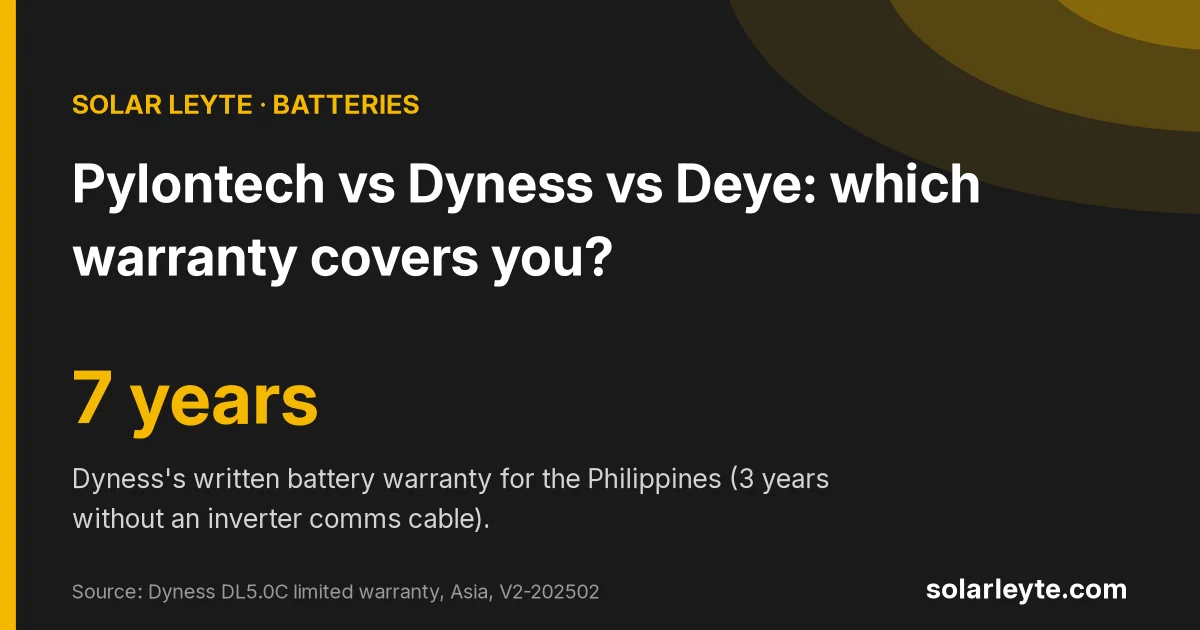
Here's the short version. Dyness publishes an Asia warranty that names the Philippines: 7 years, or 3 years if the battery isn't connected to the inverter by a communication cable. Deye's September 2026 brochure says its warranty is 5 or 10 years depending on where the battery is installed, without saying which applies to the Philippines. Pylontech's download page has warranty documents for seven regions, and the Philippines isn't one of them.
Pylontech vs Dyness, Dyness vs Deye, which one is better? We compared one common model from each maker: the Pylontech US5000, the Dyness DL5.0C (the model Dyness's Philippine distributor lists) and the Deye SE-G5.1 Pro-B. For peso prices, see our solar battery price guide. This post doesn't repeat them.
Specs and warranty terms come from each maker's own datasheet, warranty PDF or compatibility list, checked 24 October 2026. Makers revise these papers often, so match the model and the document date on your quote. This isn't an endorsement of any brand, and Solar Leyte earns nothing from these links. Nothing here is a MACC price, package or warranty.
Last checked: 24 October 2026
If you want a battery-backed system priced for a Leyte or Biliran roof, request a quote.
Pylontech vs Dyness vs Deye: the specs side by side
Spec | Pylontech US5000 | Dyness DL5.0C | Deye SE-G5.1 Pro-B |
|---|---|---|---|
Nominal energy | 4.8 kWh | 5.12 kWh | 5.12 kWh |
Usable energy | 4.56 kWh (95% DoD) | 4.61 kWh in the warranty (90% DoD) | 4.61 kWh in the warranty (90% DoD recommended) |
Max continuous current | 100 A | 100 A discharge, 75 A charge | 100 A |
Cycle rating (at 25 °C) | More than 8,000 (Dec 2025 sheet) | 6,000 or more | 6,000 or more |
Charge temperature | 0 to 50 °C | 0 to 55 °C | 0 to 55 °C on the brochure; the warranty excludes charging above 50 °C |
Modules in one bank | 16 | Up to 50 | Up to 64 (32 without extra setup) |
Inverter communication | CAN, RS485 | CAN, RS485, RS232 | CAN, RS485 |
Weight | 39.7 kg | 49.9 kg | 45 kg |
Enclosure | IP20 (indoor) | IP20 (indoor) | IP20 (indoor) |
Unsa'y buot ipasabot ani? A bit more than 4.5 kWh of usable energy from any of the three, enough to run lights, fans, a ref and Wi-Fi through a typical evening brownout. For sizing, use the brownout worksheet in our battery price guide. The cycle ratings are lab numbers at 25 °C. At one full cycle a day, 6,000 cycles is over 16 years. No warranty here runs that long, so count the warranty, not the cycle rating.
The warranty that applies in the Philippines
This is where the three brands differ most. A warranty PDF usually names a "Territory" or "Region". If the Philippines isn't in it, that document may not cover you.
Pylontech US5000 | Dyness DL5.0C | Deye SE-G5.1 Pro-B | |
|---|---|---|---|
Philippine term in writing | No Philippine document on Pylontech's download page | 7 years ("Category B": Thailand, Philippines, Vietnam, Pakistan) | Brochure: "5 Years / 10 Years… depends on the final installation site" |
Same model elsewhere | EU: 7 years, 10 if registered (Territory = EU and UK, indoor install) | 10 years in "Category A" countries | 10-year warranty document (copy hosted by a seller; doesn't name the Philippines) |
End-of-warranty capacity | EU: 70% minimum capacity (60% after the free 10-year extension) | 70% of usable energy or 10.012 MWh delivered, whichever comes first | 70% of usable energy or 16 MWh delivered |
Without a comms cable | Not stated separately | Drops to 3 years | Must run with a Deye-ESS-certified inverter |
Report a fault within | 48 hours (EU) | 48 hours | 48 hours to Deye after-sales staff (30 days to a Deye ESS partner) |
Three things stand out.
- Dyness is the only one of the three that names the Philippines. Its Asia warranty for the DL5.0C (version V2-202502) puts the Philippines in Category B at 7 years. Some other Asian countries get 10.
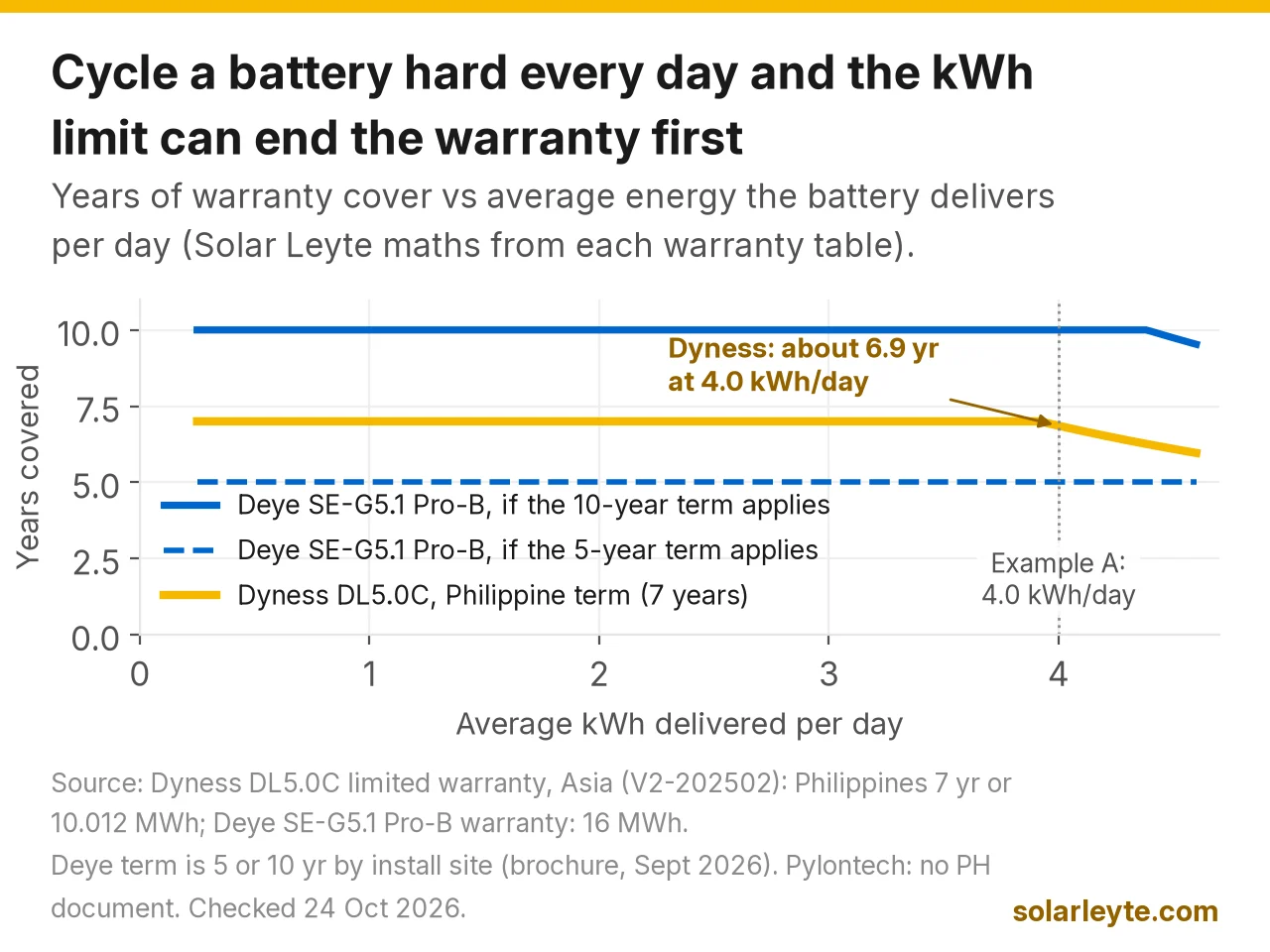
- The Dyness 7 years has a second limit. It ends at 70% of usable energy or after 10.012 MWh of output, whichever comes first. A battery cycled hard every day can reach that before year 7 (see the worked example below).
- Pylontech and Deye leave the Philippine term to your seller. Ask for the warranty document that names the Philippines, or a signed letter from the distributor. A European or Australian PDF printed out isn't enough.
For how calendar, capacity and throughput warranties work in general, see our solar lifespan and warranty explainer.
Worked example: when does a throughput limit matter?
These are Solar Leyte's calculations from the warranty tables above, not figures from the makers.
Example A, daily cycling. Assumption: the battery charges from solar every day and delivers 4.0 kWh each night.
- Output per year: 4.0 kWh × 365 = 1,460 kWh (1.46 MWh).
- Dyness DL5.0C, Philippine term: 10.012 MWh ÷ 1.46 MWh = about 6.9 years. The throughput limit is reached just before the 7-year term.
- Deye SE-G5.1 Pro-B: 16 MWh ÷ 1.46 MWh = about 11 years, so the calendar term (5 or 10 years) ends first.
Example B, brownout backup only. Assumption: the battery sits full and only covers outages, averaging 0.5 kWh a day over the year.
- Output per year: 0.5 × 365 = 182.5 kWh.
- Dyness: 10.012 MWh would take about 55 years, so the 7-year term decides.
The chart below shows the same maths for any daily use.
Which battery works with which inverter?
A battery that can't "talk" to the inverter over CAN or RS485 charges by voltage only. That's less accurate, and with Dyness it cuts the warranty to 3 years. Check the inverter brand on your quote against the makers' own lists:
Inverter on your quote | Pylontech US5000 | Dyness DL5.0C | Deye SE-G5.1 Pro-B |
|---|---|---|---|
Deye hybrid (SG01LP1, SG03LP1, SG04LP1, SG05LP3) | Listed, CAN (Pylontech list v2.46, July 2026) | "DEYE" named on the DL5.0C datasheet | Same maker |
Solis S6-EH1P-L | Listed, CAN (Pylontech list and Solis list) | "Solis" named on the datasheet; Solis lists the Dyness DL LV series | Not on the Solis matching list we read |
SRNE HESP | Listed, RS485 (Pylontech list; SRNE's manual has a "PYL-PYLONTECH" setting) | SRNE isn't named on the datasheet; ask the seller to show it working | Not on SRNE's HESP battery list |
In short: Pylontech is on its own list for all three inverter brands, on Solis's list, and has its own setting in SRNE's manual. Deye batteries are safest with Deye inverters, because Deye's warranty excludes running with an inverter that isn't "DEYE ESS certified". For the inverter side of the decision, see Deye vs Solis vs SRNE hybrid inverters. If you run a Deye inverter, our SOLARMAN app guide shows how to check that the battery is talking (state of charge shown, not just voltage).
Heat: our climate vs the 25 °C test room
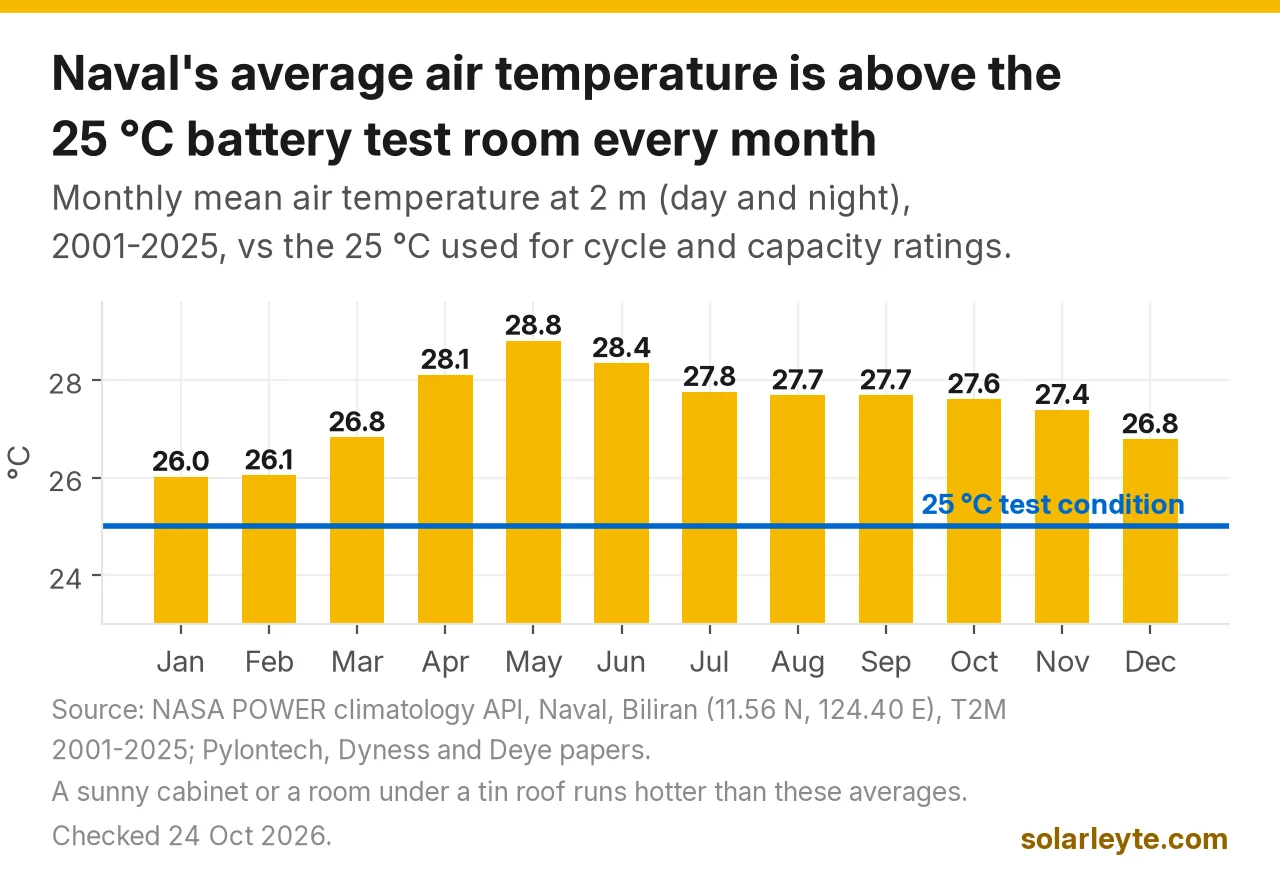
All three makers rate cycles and test capacity at about 25 °C. NASA's 2001–2025 climatology for Naval puts the average outdoor air temperature at 26.0 to 28.8 °C every month (27.4 °C for the year), and that average includes the cooler nights. A cabinet in the sun or under a hot tin roof gets hotter still.
What the papers say:
- Deye's manual: "Do not expose the battery to direct sunlight." Deye's warranty excludes charging above 50 °C.
- Pylontech's datasheet: charging 0 to 50 °C, and its EU warranty requires an indoor install.
- All three modules are IP20, meaning indoor equipment. Keep them out of rain, garages that flood, and kitchens.
Practical rule for Biliran and Leyte: install the battery indoors, shaded, ventilated, and above flood level. Our typhoon preparedness guide covers where to put equipment.
Brownouts, typhoons and lightning: the fine print
- Lightning and floods aren't covered by any of the three warranties (each lists them as force majeure or external causes). A surge arrester and proper grounding protect the inverter and battery, and insurance covers the rest. See lightning and surge protection.
- Don't leave a Deye battery flat. Deye's warranty says "no free warranty" if the battery isn't charged within 48 hours after a full discharge, or if it isn't used for 6 months or more. After a long typhoon brownout, recharge from solar or a generator as soon as you can.
- Register the battery. Dyness registration is through its app or ems.dyness.com, and Pylontech has an online registration page. Keep the invoice and serial numbers.
- Report faults fast. Dyness and Pylontech want claims within 48 hours of finding a defect, and Deye wants its after-sales team told within 48 hours.
Where to buy and claim in the Philippines
Dyness lists Photonergy Inc. (Antipolo City) as its Philippine distributor, and Photonergy's site lists the DL5.0C. For Pylontech and Deye batteries, ask the seller to name the authorised Philippine distributor. Pylontech's warranty, for example, only covers batteries bought from Pylontech or an "Authorized Reseller" in the territory. In practice your claim goes through the installer and the seller, so ask before you pay:
- Which document covers this battery in the Philippines, and how many years?
- Will the battery be connected to the inverter by a CAN or RS485 cable? (For Dyness, that's the difference between 7 and 3 years.)
- Who tests the battery and ships it to Manila if it fails, and who pays?
- Is this inverter on the battery maker's compatibility list, with the right firmware?
Choosing between hybrid and grid-tie in the first place? Start with our grid-tie vs hybrid vs off-grid guide.
FAQ
What is the best solar battery brand in the Philippines? None is best for every home. On paper the Pylontech US5000, Dyness DL5.0C and Deye SE-G5.1 Pro-B are close. Choose the one your inverter is listed with, and whose warranty for the Philippines you can get in writing.
Pylontech vs Dyness: which is better? Pylontech has a higher cycle rating on its latest datasheet (over 8,000) and lists Deye, Solis and SRNE inverters as compatible. Dyness has a written 7-year Philippine warranty and a local distributor. Pylontech doesn't publish a Philippine warranty document.
Is the Deye battery warranty 10 years in the Philippines? Deye's September 2026 brochure says 5 or 10 years, depending on the final installation site, and doesn't list the Philippines. Ask your seller for the term in writing for your serial number.
Can I mix battery brands in one bank? Don't. Pylontech's warranty excludes modules connected to a different battery type or to batteries not made by Pylontech. Ask the seller of any brand for its rule in writing, and add the same model when you expand.
Does the battery need a communication cable to the inverter? Yes. Without it the inverter charges by voltage only, and Dyness cuts its warranty from 7 years to 3.
Solar Leyte is run by MACC Systems & Energy Solutions Inc., a solar installer in Naval, Biliran.
Get a free hybrid solar and battery quote from MACC
Tell us what must keep running in a brownout and send a photo of your last BILECO or LEYECO bill. We'll match the battery and inverter to that list, give you every model number, datasheet and warranty document, and show you the math, with no obligation.
- Call/Text: 0955 723 5093
- Email: official@macc-inc.com or benjie@macc-inc.com
- Website: www.macc-inc.com
- Request a quote online: solarleyte.com/quote
- Office: Brgy. Talustusan, Naval, Biliran 6543
Sources (all checked 24 October 2026)
- Pylontech: US5000/US5000B datasheet, 22 Dec 2025 (4.56 kWh usable, 95% DoD, 100 A, >8,000 cycles, 0–50 °C charge, 16 modules, 39.7 kg, IP20); US-series warranty V1.2, Europe (EU22WUSS100302) (7 years, 10 if registered, indoor, EU/UK territory, exclusions); US5000 downloads page (warranty versions for South Africa, Japan, New Zealand, Europe, SD, Australia, UL); Compatibility List of Pylontech Low Voltage ESS and Inverters v2.46, updated 7 Jul 2026 (distributor-hosted copy); product registration
- Dyness: DL5.0C datasheet, 1 Jul 2025 (5.12 kWh, 90% DoD, 100 A/75 A, ≥6,000 cycles, 0–55 °C charge, 50 in parallel, 49.9 kg, compatible inverter brands); DL5.0C limited warranty, Asia (V2-202502) (Category B incl. Philippines 7 years; 3 years without communication; 4.61 kWh, 10.012 MWh; 48-hour notice); Dyness APAC partners (Philippines distributor Photonergy Inc.); Photonergy Dyness page; Dyness warranty registration
- Deye: SE-G5.1 Pro-B brochure, 7 Sep 2026 (5 or 10 years by installation site, ≥6,000 cycles, 100 A, 64 in parallel, 45 kg, IP20); SE-G5.1 Pro-B user manual (90% DoD, no direct sunlight); Deye ESS limited warranty, SE-G5.1 Pro-B (v3) (seller-hosted copy; 4.61 kWh, 16 MWh, 50 °C charge limit, certified inverter, 48-hour rules, force majeure)
- Inverter makers: Solis battery matching list, global v2.6 (distributor-hosted copy; S6-EH1P-L models); SRNE HESP user manual V2.7 (BMS protocol list)
- Climate: NASA POWER climatology API, Naval, Biliran (11.56° N, 124.40° E), 2001–2025 (monthly mean air temperature at 2 m)
- Worked examples and chart maths: Solar Leyte calculations from the warranty tables above