As of November 2026, you can't really buy a sodium-ion home solar battery in the Philippines yet. When we searched Lazada, every "sodium ion battery" listing was a motorcycle or car starter battery or a loose cell, and none was a 48 V battery for solar storage. Sodium-ion home batteries do exist abroad, but on paper they're heavier than LiFePO4, the cells still cost more to make, and most hybrid inverters sold here don't list them as compatible. For a solar battery in Leyte or Biliran this year, LiFePO4 is still the practical choice.
Daghan nangutana: "Mas barato ba ang sodium battery? Mas safe ba?" The idea is good. Sodium is cheap and plentiful, and there's no lithium or cobalt in it. But "good idea" and "good buy for your house in 2026" aren't the same thing. Here's what we found when we checked the listings, the datasheets and the inverter papers.
Last checked 1 November 2026. Prices are listed prices from online sellers on that date. Battery specs are the makers' own datasheet figures, not our tests.
What's actually for sale in the Philippines
On 1 November 2026 we ran four Lazada Philippines searches ("sodium ion battery", "sodium battery 12v", "sodium ion battery 48v" and "sodium ion battery solar"). That gave 124 unique listings, and 39 of them had "sodium" in the title. Here's what those 39 were:
Type (from listing title) | Listings | Listed price range |
|---|---|---|
Motorcycle starter battery (12 V) | 22 | ₱393 to ₱1,600 |
Car or truck starter battery | 15 | ₱9,885 to ₱24,750 |
Loose 26700 cells (3 V, 3,500 mAh, shipped from Hong Kong) | 2 | ₱294 to ₱322 |
48 V home solar storage battery | 0 | none found |
Two things to watch for:
- Some "sodium" listings may not be sodium. Two listings for a "GD-12V7AH Sodium-ion Lithium Battery" give a 12.8 V output voltage. That's the usual nominal voltage of a 4-cell LiFePO4 battery, not a sodium one. Another title calls the same battery both "Sodium" and "Lithium". If the label and the specs don't match, ask the seller for the cell datasheet before you pay.
- Starter batteries aren't solar batteries. They're built to give a big burst of current for a few seconds to start an engine (that's what the CCA rating means), not to run a ref and fans through a 4-hour brownout. Our car battery for solar post explains why starter batteries do badly when they're cycled every day.
We also didn't find a Philippine listing for the sodium portable power station BLUETTI sells in the US (the Pioneer Na: 900 Wh, 1,500 W, US$799 on BLUETTI's US store). It's marketed mainly for charging and running in freezing weather, which doesn't matter much in Eastern Visayas.
Sodium vs LiFePO4: price per kWh
Since there's no sodium home battery to price here, the closest local comparison is cost per kWh: listed price divided by the energy the battery stores. 13 of the motorcycle listings print their energy in watt-hours (26.4 Wh or 39.6 Wh), so we can work it out for those.
Worked example (listed prices, 1 November 2026):
- A sodium YTX5L-BS motorcycle battery: 12 V, 26.4 Wh, listed at ₱650.
- ₱650 ÷ 0.0264 kWh = about ₱24,600 per kWh.
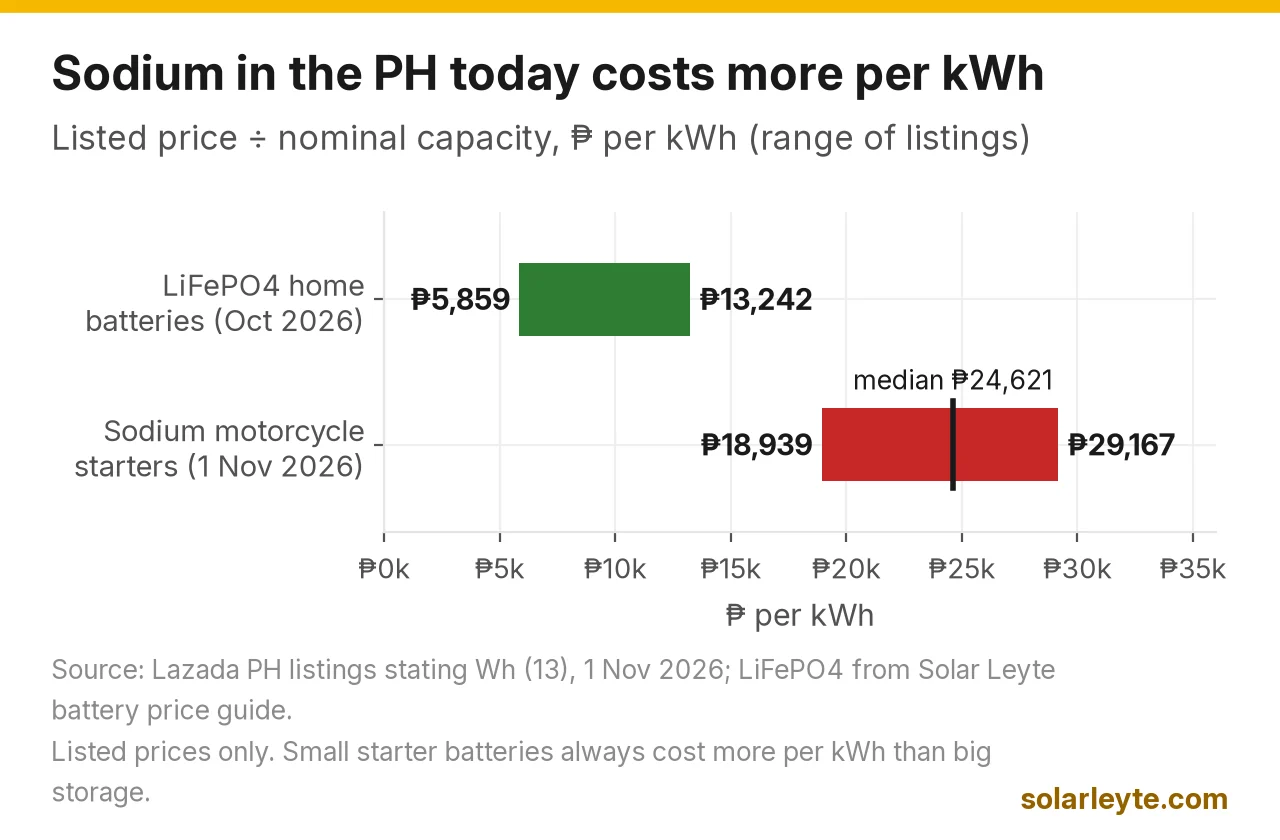
- Across the 13 listings that state Wh: ₱18,900 to ₱29,200 per kWh (median about ₱24,600).
- The LiFePO4 home batteries in our solar battery price guide (October 2026): ₱5,859 to ₱13,242 per kWh for most 51.2 V models.
Assumptions: listed price only, no shipping, nominal capacity as printed. A small starter battery always costs more per kWh than a big storage battery, so this doesn't prove sodium chemistry is expensive. What it does show is that "sodium" in the Philippines today means small batteries at small-battery prices. It isn't a cheap shortcut to home storage.
What about the cells themselves? Wood Mackenzie estimated 2025 average costs of US$59 per kWh for sodium-ion versus US$52 per kWh for LFP (LiFePO4). That's about 13% more for sodium, and it doesn't expect the two to reach parity until around 2035. Sodium-ion was also less than 1% of global battery production for EVs and storage. So if someone tells you in 2026 that sodium is "cheaper than lithium", ask for the price per usable kWh in writing and compare it with the LiFePO4 quotes.
Home sodium batteries on paper: how they compare
Sodium-ion home batteries are sold abroad by makers such as SunArk (China), Freen (Estonia) and Heiwit (Italy). We put their datasheets beside a common LiFePO4 module, the Pylontech US5000, which we also covered in our battery brands comparison.
Spec (maker's datasheet) | SunArk WallArk-Na-48160 (sodium) | Freen BSL (sodium) | Heiwit NA-48V210Ah (sodium) | Pylontech US5000 (LiFePO4) |
|---|---|---|---|---|
Energy | 7.68 kWh | 7.6 kWh usable | 10 kWh | 4.8 kWh (4.56 usable) |
Weight | 113 kg | 120 kg | under 116 kg | 39.7 kg |
Weight per kWh | about 14.7 kg | about 15.8 kg | about 11.6 kg | about 8.3 kg |
Operating voltage | 32–55.2 V (recommended) | 40–60 V | max charge 60 V | 43.5–53.2 V |
Cycle rating | 9,000 at 80% DoD, to 70% health | 10,000, to 60% health | 6,500+ at 90% DoD, to 70% capacity | over 8,000 at 25 °C |
Charging temperature | 0 to 55 °C | 0 to 55 °C | 0 to 60 °C | 0 to 50 °C |
Inverter compatibility (maker's words) | BMS "verified to be compatible with inverters from different brands" | "compatible with most inverters" | Heiwit Virgo and Lybra inverters only | Own compatibility list |
Unsa'y buot ipasabot ani?
- Heavier. Sodium stores less energy per kilo. Worked example, about 15 kWh of storage: three Pylontech US5000 (14.4 kWh) weigh 119 kg. Two SunArk units (15.36 kWh) weigh 226 kg, and two Freen units (15.2 kWh) weigh 240 kg. SunArk's is a wall-mount design, so a 113 kg unit needs a wall and anchors rated for it. A hollow-block wall needs checking by the installer first.
- Cycle ratings aren't measured the same way. Freen counts to 60% health, while SunArk and Heiwit count to 70%. A bigger number measured to a lower finish line isn't automatically better. Count the warranty years, not the cycles.
- Sodium's big selling point is cold weather. Discharging at −40 °C and charging in freezing weather matters in northern Europe or China. NASA's 2001–2025 climatology for Naval puts the average temperature at 26.0 to 28.8 °C in every month. A slightly higher charging limit (55–60 °C vs 50 °C) does help in a hot room. But all of these are lab ratings, and keeping any battery in a shaded, ventilated spot matters more.
- Safety claims are the makers' own. SunArk says "no smoke or fire when punctured". Heiwit is more careful: "reduced, but not zero, thermal risk". LiFePO4 is already the safer lithium chemistry, so the gap for home use is smaller than the headlines suggest.
Will a sodium battery work with my Deye inverter?
This is the real catch. A sodium cell's voltage moves over a wider range than a LiFePO4 cell's, and that range has to fit inside what your inverter will accept.
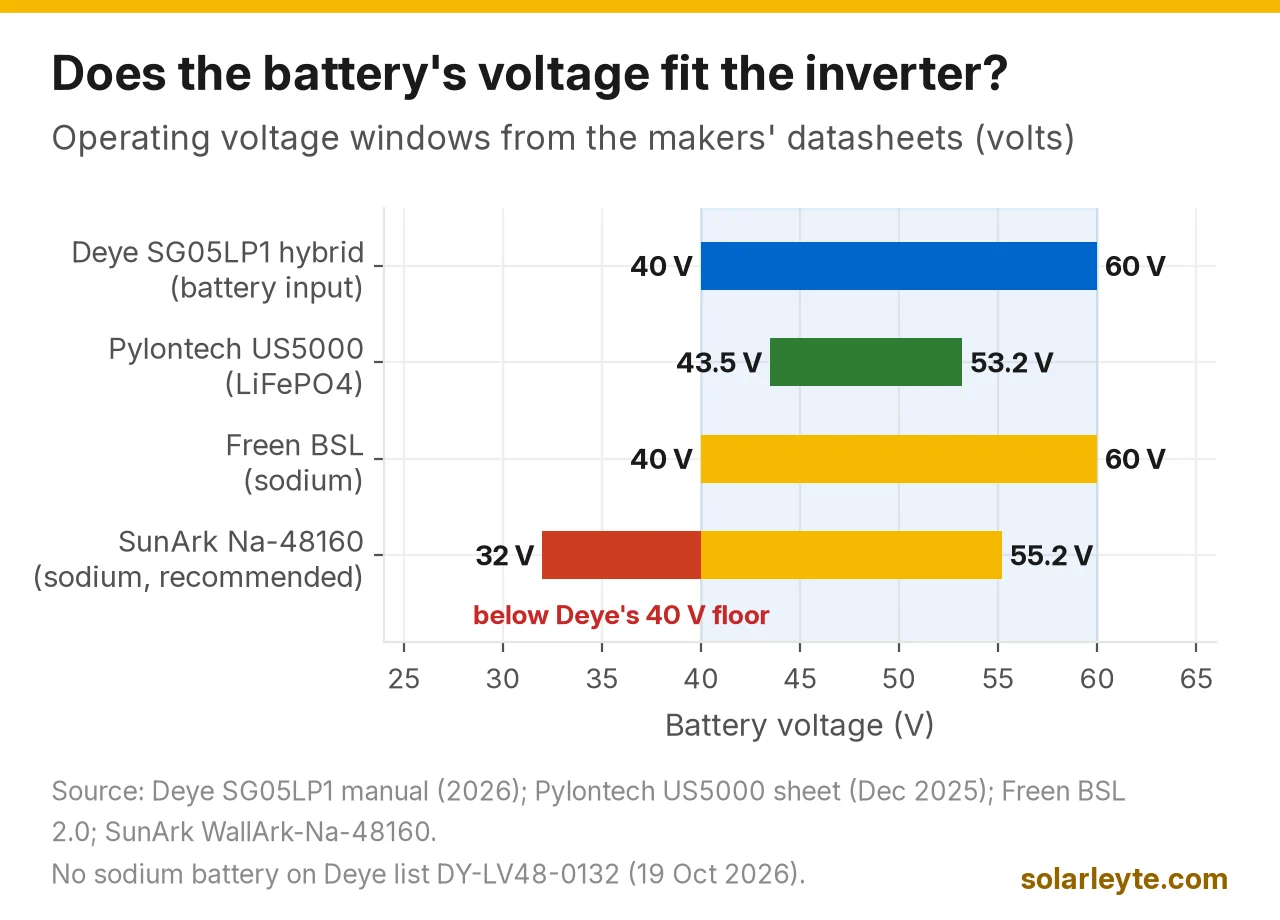
- Deye's SUN-(3.6–8)K-SG05LP1 single-phase hybrids accept 40–60 V on the battery input, and the datasheet lists the battery type as "Lead-acid or Lithium-ion".
- Deye's Approved Battery List (version DY-LV48-0132, issued 19 October 2026) has no sodium-ion battery on it that we could find.
- Heiwit says plainly that "inverters from other brands do not support the voltage range of sodium batteries". That's why it sells its sodium battery only with its own inverters.
Worked example, the voltage window: the SunArk battery has 16 cells in series (16S). SunArk recommends running it from 32 V to 55.2 V, which is 2.0 V to 3.45 V per cell. A Deye inverter stops discharging at 40 V at the latest, which is 2.5 V per cell. Whatever energy sits between 2.0 and 2.5 V per cell stays in the battery. SunArk calls its curve "nearly linear", so that slice probably isn't small, but it doesn't publish the curve, so we can't give you a number. The Freen's 40–60 V window matches Deye's on paper, but Freen isn't on Deye's list either.
What to ask before buying any sodium home battery:
- Is this battery on the inverter maker's compatibility list, by model number? If not, will the battery maker put compatibility in writing?
- What's the usable kWh with my inverter's voltage limits, not the nameplate kWh? Ask for the discharge curve.
- Is there a Philippine distributor and a warranty that names the Philippines? (The same question we ask about LiFePO4 brands.)
For the inverter side, see our hybrid inverter price guide and Deye vs Solis vs SRNE.
Is it worth waiting for sodium?
Big makers are moving. CATL says its Naxtra sodium-ion battery "is set to enter full-scale mass production by the end of 2026". Prices could change quickly once that happens. But a battery that's only just entering mass production in China in late 2026 still has to reach Philippine distributors, get onto inverter lists and come with a local warranty.
If brownouts are costing you now, waiting years for a chemistry that isn't sold here doesn't make sense. A LiFePO4 battery bought today has a warranty of several years, and every month of solar you use yourself is a month you aren't buying from BILECO at ₱18.3407 per kWh (residential, July 2026 rate). If you're fine with your current setup and just curious, keep watching. We'll update this post when a real sodium home battery shows up with a Philippine price.
Not sure where a battery fits in your system? Our grid-tie vs hybrid guide explains when a battery makes sense at all.
FAQ
Is there a sodium-ion solar battery for sale in the Philippines?
Not that we could find on Lazada on 1 November 2026. All 39 "sodium" listings were motorcycle or car starter batteries or loose cells. None was a 48 V home storage battery.
Is sodium-ion cheaper than LiFePO4?
Not yet. Wood Mackenzie's 2025 estimate was US$59 per kWh for sodium-ion cells versus US$52 for LFP, and it expects parity around 2035. In the Philippines, the only sodium batteries listed are small starter batteries at about ₱18,900 to ₱29,200 per kWh.
Sodium-ion vs LiFePO4: which lasts longer?
On paper they're similar. Sodium home batteries are rated at 6,500 to 10,000 cycles and the Pylontech US5000 at over 8,000, but each maker counts to a different end point. In practice, the warranty and how hot the battery gets matter more than the cycle rating.
Can I use a sodium motorcycle battery for a small solar setup?
It isn't designed for that. Starter batteries are made for short bursts of current, and they cost far more per kWh than a LiFePO4 battery built for daily cycling. For small setups, see our car battery for solar post.
Will my Deye hybrid inverter work with a sodium battery?
Deye's October 2026 approved battery list has no sodium battery on it, and its SG05LP1 datasheet lists only lead-acid or lithium-ion. Unless the battery maker puts compatibility in writing, assume it isn't supported.
Solar Leyte is run by MACC Systems & Energy Solutions Inc., a solar installer in Naval, Biliran.
Get a free solar quote from MACC
Thinking about adding a battery? Send us your latest BILECO or LEYECO bill and tell us how long your brownouts usually last. We'll talk through the options with you, with no obligation.
- Call/Text: 0955 723 5093
- Email: official@macc-inc.com
- Website: www.macc-inc.com
Sources (all checked 1 November 2026)
- Lazada Philippines search results for "sodium ion battery", "sodium battery 12v", "sodium ion battery 48v" and "sodium ion battery solar" (example search), read 1 November 2026: 124 unique listings, 39 with "sodium" in the title; listed prices and titles as shown that day.
- Wood Mackenzie, "Sodium-ion batteries enter energy storage market", 24 November 2025: 2025 average cost US$52/kWh LFP vs US$59/kWh sodium-ion, parity around 2035, sodium under 1% of global production.
- CATL, Super Technology Day release, 21 April 2026: Naxtra sodium-ion "set to enter full-scale mass production by the end of 2026".
- SunArk WallArk-Na-48160 datasheet (PDF, ENF-hosted): 48 V 16S, 160 Ah, 7,680 Wh, 9,000 cycles at 80% DoD to 70% SOH, 32–55.2 V recommended, charge 0–55 °C, 113 kg, compatibility and safety wording.
- Freen BSL datasheet (PDF): 40–60 V, 158 Ah, 7.6 kWh usable, 10,000 cycles to 60% SOH, charge 0–55 °C, 120 kg, "compatible with most inverters".
- Heiwit NA-48V210Ah product page: 10 kWh, max charge 60 V, 6,500+ cycles at 90% DoD to 70%, charge 0–60 °C, under 116 kg, Virgo/Lybra inverters only, "inverters from other brands do not support the voltage range of sodium batteries", "reduced, but not zero, thermal risk".
- Pylontech US5000/US5000B datasheet, 22 December 2025 (PDF): 4,800 Wh (4,560 usable), 43.5–53.2 V, over 8,000 cycles at 25 °C, charge 0–50 °C, 39.7 kg.
- Deye SUN-(3.6–8)K-SG05LP1-EU user manual, datasheet section (PDF): battery type "Lead-acid or Lithium-ion", battery voltage range 40–60 V.
- Deye Approved Battery List DY-LV48-0132, 19 October 2026 (PDF): no sodium-ion battery listed.
- BLUETTI Pioneer Na product page (US store): 900 Wh, 1,500 W, US$799.
- NASA POWER climatology, Naval, Biliran, 2001–2025: monthly mean air temperature 26.0–28.8 °C.
- BILECO, July 2026 effective rates: residential ₱18.3407/kWh, VAT inclusive (still the latest on BILECO's power-rate page on 1 November 2026).
- LiFePO4 price per kWh: Solar Leyte, solar battery price guide (listings checked October 2026).
- Per-kWh, weight-per-kWh and per-cell voltage figures: Solar Leyte calculations from the sources above.