Yes, you can put solar panels on a house near the sea, but how close you are changes the rules. The big panel makers all draw lines at about 50 m and 500 m from the shore. LONGi voids its warranty within 50 m. Trina requires glass-glass panels between 50 m and 500 m. Canadian Solar requires anti-corrosion modules within 100 m. Huawei says not to put its SUN2000-50K-MC0 inverter outdoors within 500 m, and Sungrow asks you to consult it first. Measure your distance, then pick panels, hardware and an inverter spot to match.
Taga-baybayon ka? Salt doesn't rule out solar, but it attacks the places where metals meet: clamps, bolts, grounding lugs and connector pins. This post is for homeowners. For resorts, see our solar for beach resorts in Biliran post.
Last checked 28 October 2026 against each maker's current manual. Manuals change, and the rules are model-specific, so confirm yours with the seller in writing. Brands are named only because their documents are public. This isn't an endorsement, and none of this is a MACC price or a quote.
Quick answer: what makers say at each distance
Maker and document | Within 50 m of the sea | 50 m to 500 m | Beyond 500 m |
|---|---|---|---|
LONGi panels (seaside quality statement) | Prohibited; warranty void | Allowed with corrosion protection and extra maintenance; still under warranty | Normal installation |
Trina panels (Vertex user manual, Rev N) | Consult Trina so the warranty stays valid | Glass-glass panels required; connector caps; stainless, aluminium or coated contact parts | Glass-glass recommended up to 5 km |
JinkoSolar panels (global manual, Jan 2026) | Offshore-type modules recommended; consult Jinko before ordering | Protect connectors (dust plugs, connect right away, anti-rust measures) | General rules |
Canadian Solar panels (manual v3.3, US edition, Jul 2026) | Type II anti-corrosion modules within 20 m; Type I from 20 to 100 m | Type I recommended from 100 to 500 m | General rules |
Huawei SUN2000-50K-MC0 inverter (user manual) | Don't install outdoors | Don't install outdoors within 500 m or where sea breeze reaches | Normal |
Sungrow inverters (micro and commercial manuals) | Consult Sungrow (micro); not in salt areas (commercial) | Same, within 500 m | Normal |
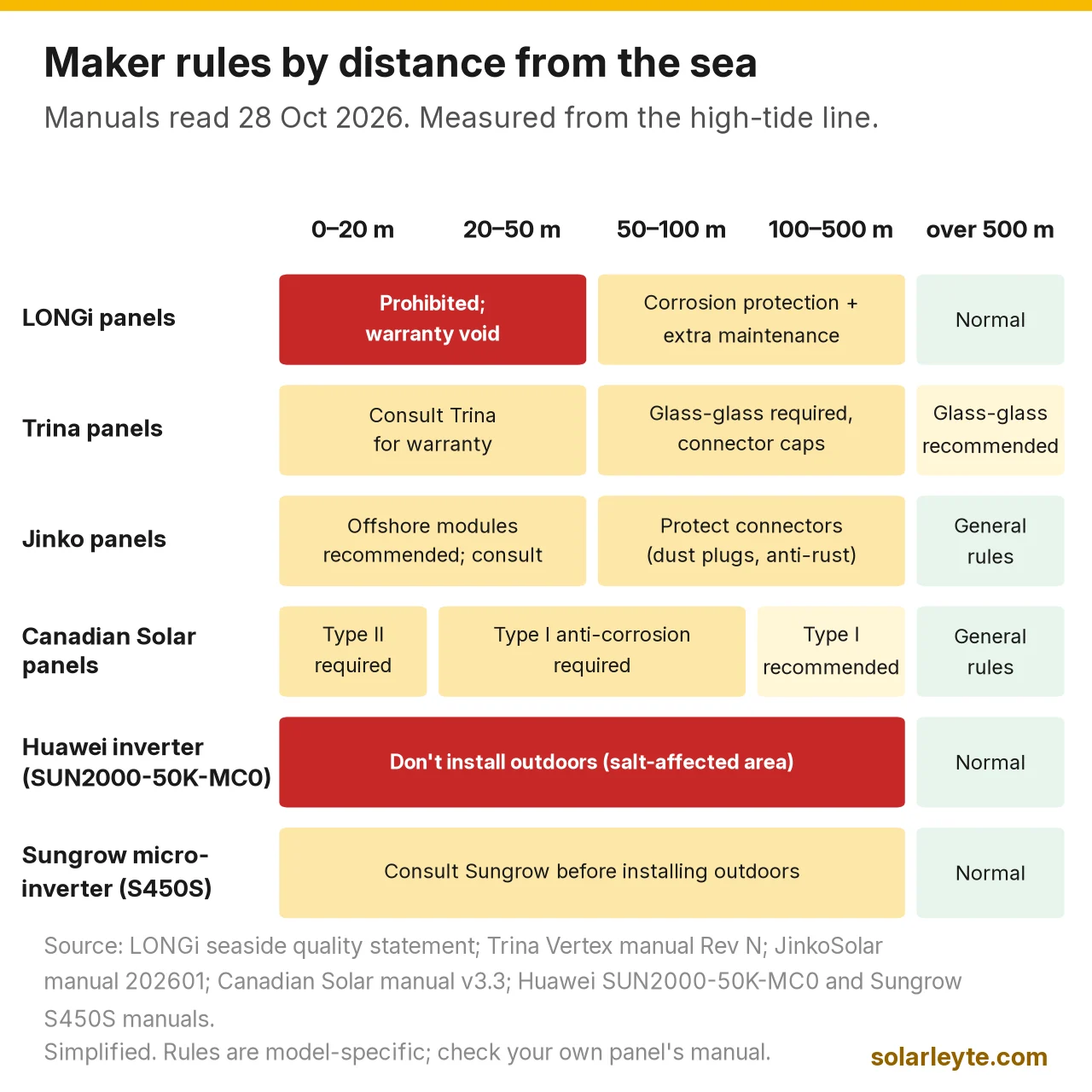
Sources: the maker documents linked in Sources below. Distances are measured from the shoreline: Trina uses the mean high water springs line and Canadian Solar the high-tide line.
Two more rules: panels must never be soaked by seawater or left permanently wet, and salt reach isn't fixed. Huawei says it varies with typhoons, monsoons and terrain, so an exposed point 600 m out can get more salt than a sheltered spot closer in. When in doubt, treat yourself as closer.
Step 1: measure your distance to the sea
Before you ask for quotes, open Google Maps, right-click your roof, choose Measure distance and click the nearest high-tide shoreline (dry sand line or seawall, not the low-tide flats). Give that figure to every installer and ask which maker zone it puts you in. Within about 50 m, the panel brand matters a lot. Within 500 m, where the inverter goes matters as much as the panels.
What "IEC 61701" on a datasheet actually tells you
IEC 61701 is the international salt-mist corrosion test for PV modules. The standard says marine air "could eventually degrade some of the PV module components", through corrosion of metal parts and salt getting into coatings and plastics. Sample modules are sprayed with salt mist in cycles under one of the test methods in IEC 60068-2-52. They're then cleaned and re-tested for power, insulation, wet leakage and bypass diodes. To pass, they must show no corrosion that "would significantly impair their function".
What it doesn't tell you:
- Which test method was used. IEC 60068-2-52 has several, and they aren't equally harsh. Jinko says its modules passed "method 6". Stäubli's MC4 datasheet lists salt mist at "degree of severity 6". If a datasheet only says "IEC 61701", ask for the certificate that names the method.
- Anything about your racking. Canadian Solar's manual says its modules passed IEC 61701, "but the corrosion may still occur where the modules frame is connected to the bracket or where the grounding is connected."
So a passed test is a minimum, not a free pass.
How fast salty air eats metal
ISO 9223 sorts outdoor air into corrosivity categories, C1 (very low) to CX (extreme), by how much bare steel or zinc a test plate loses in its first year. A Kingfield Galvanizing note lists coastal examples from C3 (low salt deposition) through C4 to C5 (sheltered spots on the coastline). Zinc matters because galvanised steel is steel with a zinc coat:
ISO 9223 category | Corrosivity | Zinc lost in year 1 (µm) | Carbon steel lost in year 1 (µm) |
|---|---|---|---|
C2 | Low | 0.1 to 0.7 | 1.3 to 25 |
C3 | Medium | 0.7 to 2.1 | 25 to 50 |
C4 | High | 2.1 to 4.2 | 50 to 80 |
C5 | Very high | 4.2 to 8.4 | 80 to 200 |
CX | Extreme | 8.4 to 25 | 200 to 700 |
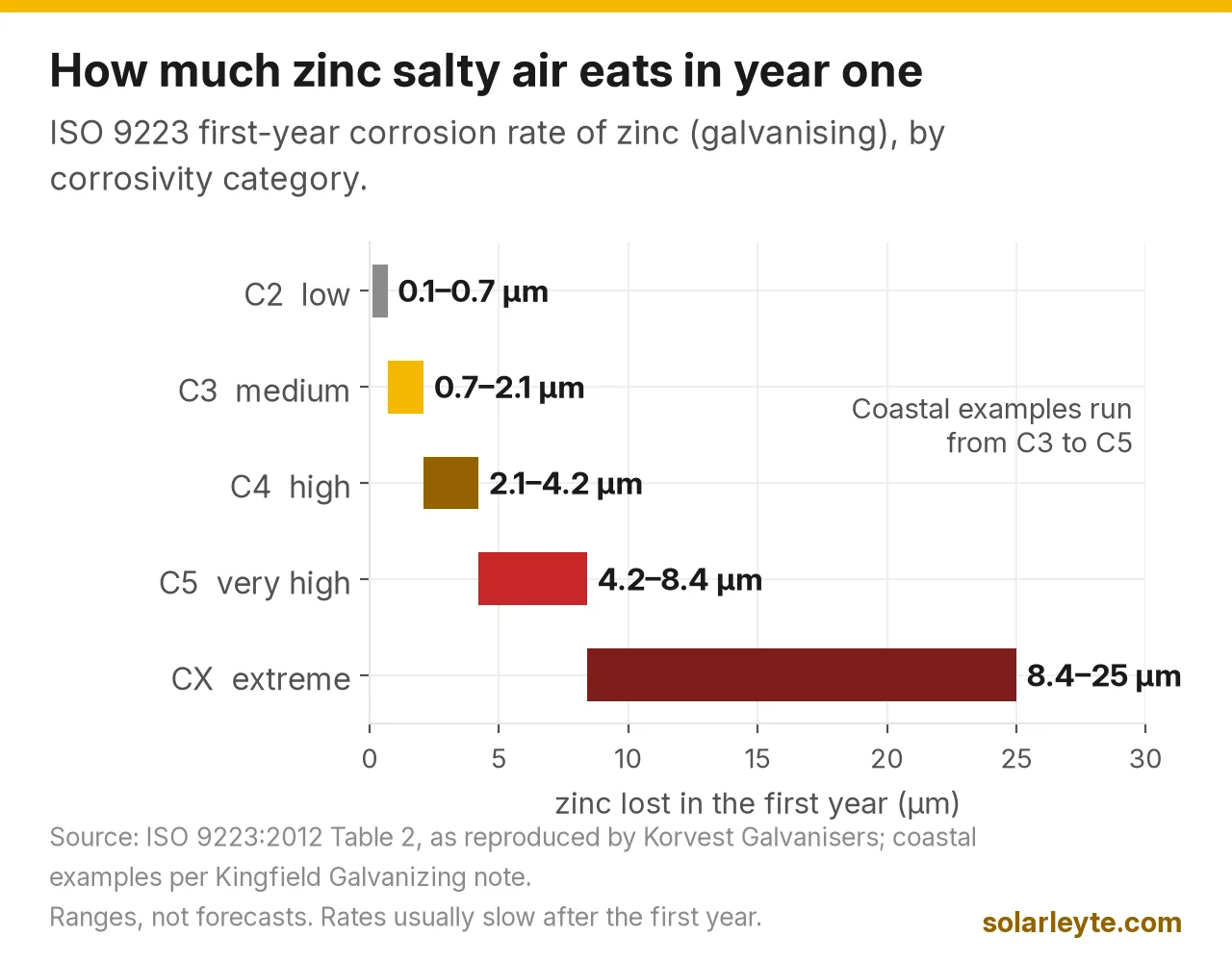
Source: ISO 9223:2012 Table 2, as reproduced by Korvest Galvanisers. First-year rates usually slow afterwards and can't simply be multiplied out over 25 years.
The top of the C5 band (8.4 µm) is 12 times the top of C2 (0.7 µm). Korvest also notes that in coastal air, rain helps by washing salt off, while sheltered surfaces that still get salty air can corrode much faster. On a solar roof, that means rail undersides, clamp backs and an inverter bracket under the eaves. Clenergy's rail datasheet, quoted in our roof installation post, spaces roof feet 5% closer at C4 sites and 25% closer at C5.
Bolts, clamps and grounding: the parts that rust first
Aluminium panel frames corrode by galvanic action where they touch a different metal in salty, wet air. LONGi says this happens "especially in the places with gaps". Here's what the manuals ask for:
Part | What the makers say | Source |
|---|---|---|
Rails, clamps, bolts | Aluminium alloys (5052, 5056, 5086, 6061, 6063, 5356), SUS316 stainless, galvanised steel or non-metals like fibreglass | LONGi seaside statement |
Where frame meets other metal | Rubber gaskets, mica plates or anti-corrosion paint between them | LONGi |
Mixed metals in general | Keep the potential difference under 0.6 V (UL 2703); otherwise add insulating gaskets (mica, silicone resin, fluoropolymer) or Dacromet/OTC-type coatings | Canadian Solar Annex C |
Grounding | Stainless grounding terminals, not copper; coat grounding parts (Canadian Solar: one-coat method maintained every 3 months, or three-coat every 5 years) | LONGi; Canadian Solar |
Frame | Don't drill extra holes or scratch the anti-corrosion coating | Canadian Solar; LONGi |
Tilt | At least 10° so water runs off | LONGi |
When an installer says "stainless", ask which grade: LONGi names SUS316. Earthing rods and SPDs from our lightning and surge protection post need the same corrosion care.
Connectors: small parts, big failures
Stäubli's MC4 is rated IP65/IP68 when mated but only IP2X when unmated, so it's sealed only when plugged in. The coastal rules:
- Keep the factory dust caps on until the moment of connection, then connect immediately (Jinko, Canadian Solar). Trina's manual says connectors "are not designed to be dustproof or waterproof when unmated".
- Trina requires connector protection boxes or dust caps from 50 to 500 m.
- Canadian Solar recommends heat-shrink tubing over connectors after installation.
Where the inverter and battery go
An IP rating isn't a salt rating: IEC 60529 covers how well an enclosure keeps out dust and water, not corrosion. A Deye hybrid like the SG05LP1 series is IP65 and built for outdoor use, but its manual still says to avoid direct sun and rain. Huawei's SUN2000-50K-MC0 manual goes further and says not to install that inverter outdoors within 500 m of the coast or where sea breeze reaches. Sungrow's microinverter manual says to consult Sungrow before installing outdoors within 500 m.
Our suggested default for coastal homes: indoors, or under a solid roof on the side away from the sea, out of rain and sun, with airflow, and above the highest flood or storm-surge level you've seen. Deye's GB-SL Pro manual says its battery "cannot be exposed to corrosive environments". Read each maker's installation-environment section before you buy; our hybrid inverter price and microinverter posts list models sold in the Philippines.
Worked example: three coastal homes
Example only. These houses are made up to show how the maker rules apply. They aren't real sites, and they don't replace a site check.
Example house | Distance to sea | What the rules point to |
|---|---|---|
Seawall house, coastal barangay in Naval | 30 m | LONGi: prohibited, warranty void. Canadian Solar: Type I anti-corrosion modules required. Trina: consult first. Jinko: offshore-type modules recommended. Inverter and battery indoors on the landward side. |
Two streets back from the shore | 200 m | LONGi: allowed with corrosion protection. Trina: glass-glass required, connector caps. Canadian Solar: Type I recommended. Huawei/Sungrow inverters: not outdoors. |
On the national road, behind rice fields | 800 m | General rules for LONGi, Jinko and Canadian Solar; Trina still recommends glass-glass. Inverter outdoors in shade only if its manual allows; treat an exposed site as coastal. |
The pattern: within 50 m, the brand list shrinks. From 50 to 500 m, it's about materials, connectors and inverter placement. Glass-glass panels are explained in our bifacial solar panel post.
Rinsing and inspection by the sea
Salt film is covered in our solar panel cleaning guide. For the metal, LONGi's seaside statement adds two steps: check the frame, mounting, grounding block and joints for corrosion, and clean salt and dust off them.
Our suggested routine for a coastal home (not a maker rule): look over the array and rail undersides after every typhoon or strong amihan spell; rinse with fresh, soft water when you see a white film, following the cleaning post's limits; check the inverter heatsink and cable glands for white crust; and photograph clamps and grounding lugs once a year to spot change. After a storm, start with the safety steps in our typhoon checklist.
Questions to ask a coastal installer
- Which zone does my distance put me in for this panel's manual, and is the warranty confirmed in writing?
- Which stainless grade are the bolts, and how are aluminium and steel kept apart?
- Where will the inverter and battery go, and what does the inverter manual say about coastal sites?
Our installer checklist has the general questions, and the typhoon preparedness guide covers wind and storm planning.
FAQ
Can I install solar panels near the beach in the Philippines?
Usually, yes, with conditions. Most makers allow installs from about 50 m upwards with corrosion protection. Within 50 m, LONGi prohibits it, Canadian Solar requires anti-corrosion modules and Jinko and Trina ask you to consult them first.
Does living near the sea void my solar panel warranty?
It can. LONGi's warranty is void within 50 m of the sea, or if panels are soaked by seawater at any distance. Trina and Canadian Solar tie their warranties to following their coastal rules. Check the manual for your exact panel.
Are glass-glass panels better near the sea?
Trina requires glass-glass (dual-glass) panels from 50 to 500 m and recommends them up to 5 km. Other makers focus on anti-corrosion module types, connectors and racking, so follow your maker's own rule.
Can my inverter go outside if I live near the sea?
Check its manual. Huawei's SUN2000-50K-MC0 manual says not to install it outdoors within 500 m of the coast, and Sungrow's microinverter manual asks you to consult it first. An IP65 rating keeps out dust and water jets, but it isn't a salt-corrosion rating.
How often should I rinse solar panels near the sea?
There's no single interval. Rinse when you see a salt film or your inverter app shows output dropping on sunny days, and check after typhoons. Our cleaning guide lists the maker ranges.
Solar Leyte is run by MACC Systems & Energy Solutions Inc., a solar installer in Naval, Biliran.
Get a free solar quote from MACC
Live near the sea in Leyte or Biliran? Send us your address or a map pin and a recent BILECO or LEYECO bill. We'll check your distance to the shore against the panel and inverter makers' coastal rules and size the system, with no obligation.
- Call/Text: 0955 723 5093
- Email: official@macc-inc.com or benjie@macc-inc.com
- Website: www.macc-inc.com
- Request a quote online: solarleyte.com/quote
- Office: Brgy. Talustusan, Naval, Biliran 6543
Sources (all checked 28 October 2026)
- LONGi, Quality Statement for Modules Installed at Seaside (copy hosted by distributor OSW): 50 m / 500 m zones, materials, gaskets, stainless grounding, 10° tilt, maintenance
- Trina Solar, Vertex Series User Manual, Rev N, section 3.2 Coastal installation environment requirements
- JinkoSolar, Global Installation Manual 202601-EN (IEC 61701 method 6; 50–500 m connector protection; offshore modules within 50 m)
- Canadian Solar, Installation Manual PV Modules, US v3.3 (July 2026), Annex C Coastal area anti-corrosion installation guidelines
- Huawei, SUN2000-50K-MC0 user manual (salt-affected areas within 500 m of the coast)
- Sungrow, Instructions for Installation of Inverters in Different Scenarios V15 (commercial inverters, within 500 m) and S450S/S800S/S1600S microinverter manual Ver11
- Deye, SUN-3.6–8K-SG05LP1 user manual (19 Mar 2026) (IP65, no direct sun or rain, humidity limit); Deye, GB-SL Pro battery manual
- Stäubli, Original MC4 datasheet (IP65/IP68 mated, IP2X unmated, salt mist severity 6)
- IEC, IEC 61701:2020 PV modules – salt mist corrosion testing and the public preview (scope, test sequence, pass criteria); IEC, IEC 60529 IP Code
- Kingfield Galvanizing, Atmospheric corrosion resistance of hot dip galvanized coatings (coastal examples for C3–C5)
- ISO 9223:2012 corrosivity categories and first-year rates, via Korvest Galvanisers, Atmospheric corrosion resistance (Table 2; rain washing and sheltered micro-environments)
- Clenergy rail spacing at C4/C5 sites, as cited in our roof installation post