A small beach resort mostly uses its power after dark. In our 12-room example (8 aircon rooms, 4 fan rooms, a kitchen and a water pump), the resort uses about 42 kWh a day, or roughly 1,280 kWh a month. That's around ₱21,600 at BILECO's July 2026 commercial rate. Room aircons running overnight are 54% of it. Solar panels make almost nothing at those hours. In an hour-by-hour model for Naval, 8 kWp of zero-export solar covered only about 12% of that resort's kWh. Pumping water to the tank at midday raised that to about 19%, and a pool raised it to about 25–30%. To get much further, the resort needs net metering (daytime surplus credited against night use) or a battery.
Brownout na sad? BILECO's general manager said in July 2026 that Biliran's power supply "remains unstable" (PIA). For a resort, an outage means warm freezers, dry taps and guests in the dark. This post works out what a small Biliran or Leyte beach resort uses, what it pays, what solar can cover, what a battery should carry in a brownout, and what panel and inverter makers say about installing near the sea.
Equipment watts come from Philippine product listings and maker figures (Midea, Panasonic, Emaux), Meralco's appliance tests and DOE energy labels, as used in our appliance kWh post. Room counts, occupancy and hours are our assumptions, stated in each table. Rates come from BILECO's own posts and PRESYO-PH, checked 14 October 2026. Every kWh, bill, solar and battery figure below is a Solar Leyte calculation. Measure your own resort before you buy anything. Nothing here is a MACC price or quote.
What uses the power at a small beach resort
Most small resorts on Biliran's coast and the Leyte side are a mix of aircon rooms, fan rooms or cottages, a kitchen or bar, a water pump and outdoor lights. Some have a pool. These are the ratings we used:
Load | Rating we used | Basis |
|---|---|---|
1 HP inverter aircon (room) | 113 kWh a month at 8 h a day, about 0.47 kW on average | Midea Philippines estimate for a standard inverter unit; a 1 HP non-inverter is 180 kWh |
16-inch stand fan, medium | 0.0476 kWh an hour | Meralco test |
Instant shower heater | 3.5 kW | Panasonic DH-3VL1PW, listed ₱6,400 on sale at Robinsons Appliances |
Inverter chest freezer | 0.61 kWh a day (median of 14 models) | Meralco Power Lab tests, from our sari-sari store post |
Glass-door chiller (drinks) | 2.48 kWh a day (median of 14 models) | Meralco Power Lab tests |
Frost-free ref, 7–10 cu ft | about 27 kWh a month | DOE energy labels, from our appliance post |
Water pump, 1 HP | about 0.96 kW drawn | 0.75 kW motor at 77.4% efficiency, from our water refilling station post |
Pool pump, 1 HP (Emaux SS100) | 900 W | Lazada listing, ₱12,363 on 14 October 2026 |
9 W LED bulb | 0.009 kWh an hour | Meralco test |
Wi-Fi router | 0.006 kWh an hour | Meralco test (one model) |
Sources: Midea Philippines, How much electricity does an aircon use in the Philippines; Robinsons Appliances listing for the Panasonic DH-3VL1PW; Lazada listing for the Emaux SS100; Meralco appliance and Power Lab test lists and DOE energy labels as summarised in our appliance and sari-sari posts.
Three things stand out before you add up your own resort:
- The aircon is the resort. One 1 HP inverter aircon running 10 hours a night uses about 4.7 kWh. That's more than all the freezers, chillers and the ref in our kitchen put together (4.6 kWh a day). A non-inverter unit uses about 59% more than an inverter of the same size, going by Midea's figures (180 vs 113 kWh). Our solar aircon post compares inverter, hybrid and DC units.
- Shower heaters are short but huge. A 3.5 kW heater is about seven times a 1 HP aircon's average draw. Ten minutes of shower uses about 0.58 kWh. Three guests showering at once pull over 10 kW, which matters for a battery inverter (see the brownout section).
- Pumps and pools can move. A pump filling an overhead tank, or a pool pump, doesn't care what time it runs. Running them at midday is the cheapest solar trick a resort has.
A 12-room resort, load by load
This is a scenario, not an industry average. We picked a size and hours that look like a small Biliran beach resort, so you can swap in your own. Occupancy is 60% on average (our assumption). Aircons run 9 pm to 7 am in occupied rooms.
Load (Scenario A: 8 aircon rooms, 4 fan rooms, no pool) | Assumption | kWh a day |
|---|---|---|
Room aircons, 8 × 1 HP inverter | 60% occupied, 10 hours a night | 22.6 |
Shower heaters, 3.5 kW | 2 showers of 10 minutes per occupied aircon room | 5.6 |
Kitchen and bar cold storage | 2 inverter chest freezers, 1 chiller, 1 ref, 24 hours | 4.6 |
Water pump to the overhead tank, 1 HP | 3 hours (6–7 am and 5–7 pm) | 2.9 |
Lights | 2 LEDs per occupied room 6–11 pm; 20 path and security LEDs dusk to dawn | 2.8 |
Restaurant fans | 4 stand fans, 9 am to 9 pm | 2.3 |
Fan rooms, 4 × stand fan | 60% occupied, 10 hours a night | 1.1 |
Wi-Fi | 24 hours | 0.1 |
Total | 42.0 a day, about 1,279 a month | |
Scenario B: the same resort with a pool pump | Emaux SS100, 900 W, 8 am to 4 pm | +7.2, so 49.2 a day, about 1,498 a month |
Scenario C: 6 fan cottages, no aircon | fans, lights, 1 chest freezer, 1 ref, pump 1.5 h, Wi-Fi | 6.2 a day, about 188 a month |
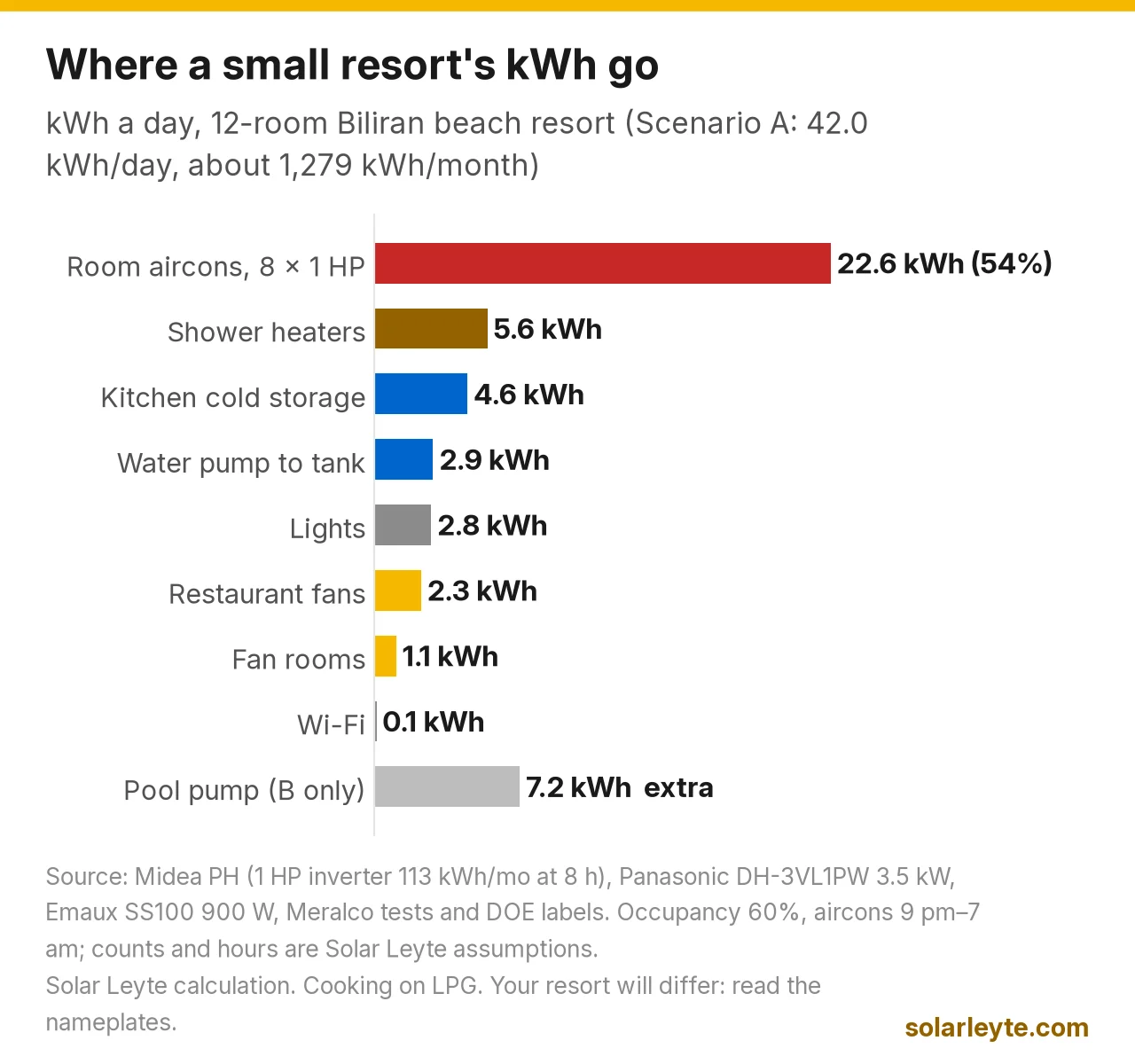
Solar Leyte calculation from the ratings above. A month is 365 ÷ 12 days. Cooking is on LPG in all three scenarios. An electric stove, rice cookers for a restaurant or an ice maker would add a lot.
Only about 12% of Scenario A's kWh falls between 7 am and 5 pm. The pool in Scenario B lifts that to about 25%. That one number drives everything else in this post.
What it costs at BILECO rates
A resort with its own business meter is usually billed at the commercial rate. A homestay on the family's house meter may be on the residential rate. Read the rate class printed on your bill. The rates we used, checked 14 October 2026:
- BILECO commercial: ₱16.8353/kWh, VAT included, from BILECO's July 2026 rate post, plus ₱71.94 a month in fixed charges (₱42.82 + ₱29.12 on the July unbundled sheet). It's still BILECO's latest posted commercial rate. For residential, BILECO's own July 2026 rate post gives ₱18.3407/kWh. A separate source, the PRESYO-PH tracker (from ICSC, compiled from co-op disclosures), shows ₱18.93 for September 2026. The two figures come from different sources, but both point up, so commercial may have moved too.
- BILECO residential: ₱18.93/kWh in September 2026, the PRESYO-PH tracker figure from ICSC, compiled from co-op disclosures. On PRESYO-PH, BILECO was the highest of the 107 utilities with a September figure.
- For Leyte resorts: LEYECO IV low voltage ₱15.6838/kWh plus ₱68.87, and LEYECO V commercial ₱15.4753/kWh plus ₱78.86, both September 2026. LEYECO V's ₱15.4753 is before distribution VAT, so it isn't on the same basis as LEYECO IV's figure (our LEYECO IV and V tracker).
Scenario | kWh a month | BILECO commercial | BILECO residential | LEYECO IV LV | LEYECO V commercial |
|---|---|---|---|---|---|
A. 12 rooms, no pool | 1,279 | ₱21,598 | ₱24,209 | ₱20,122 | ₱19,866 |
B. 12 rooms with pool | 1,498 | ₱25,284 | ₱28,355 | ₱23,557 | ₱23,255 |
C. 6 fan cottages | 188 | ₱3,244 | ₱3,571 | ₱3,024 | ₱2,994 |
Solar Leyte calculation: kWh × rate + the monthly fixed charge shown above. The rates aren't all on the same VAT basis, and they move every month: track them on our BILECO rate tracker. Rates jump around, too. BILECO's commercial rate was ₱11.4404 in May 2026 and ₱16.8353 in July.
How much solar actually covers
We ran an hour-by-hour model with PVGIS hourly data for Naval, Biliran (2023 weather, panels tilted 11° facing south, 14% system losses; 1 kWp made 1,479 kWh that year). Loads follow the hours in the scenario table.
Setup | Solar size | Solar used a month | Share of resort kWh | Solar not used (zero export) |
|---|---|---|---|---|
A, grid-tie, zero export | 5 kWp | 140 kWh | 11% | 477 kWh |
A, grid-tie, zero export | 8 kWp | 158 kWh | 12% | 829 kWh |
A, pump moved to 10 am–1 pm | 8 kWp | 244 kWh | 19% | 742 kWh |
B (pool), grid-tie, zero export | 8 kWp | 370 kWh | 25% | 616 kWh |
B, pump moved to 10 am–1 pm | 8 kWp | 454 kWh | 30% | 532 kWh |
A, pump at midday, hybrid + ~9.2 kWh usable battery | 10 kWp | 511 kWh | 40% | 693 kWh |
A, pump at midday, hybrid + ~18.4 kWh usable battery | 10 kWp | 759 kWh | 59% | 418 kWh |
B, pump at midday, hybrid + ~9.2 kWh usable battery | 10 kWp | 717 kWh | 48% | 488 kWh |
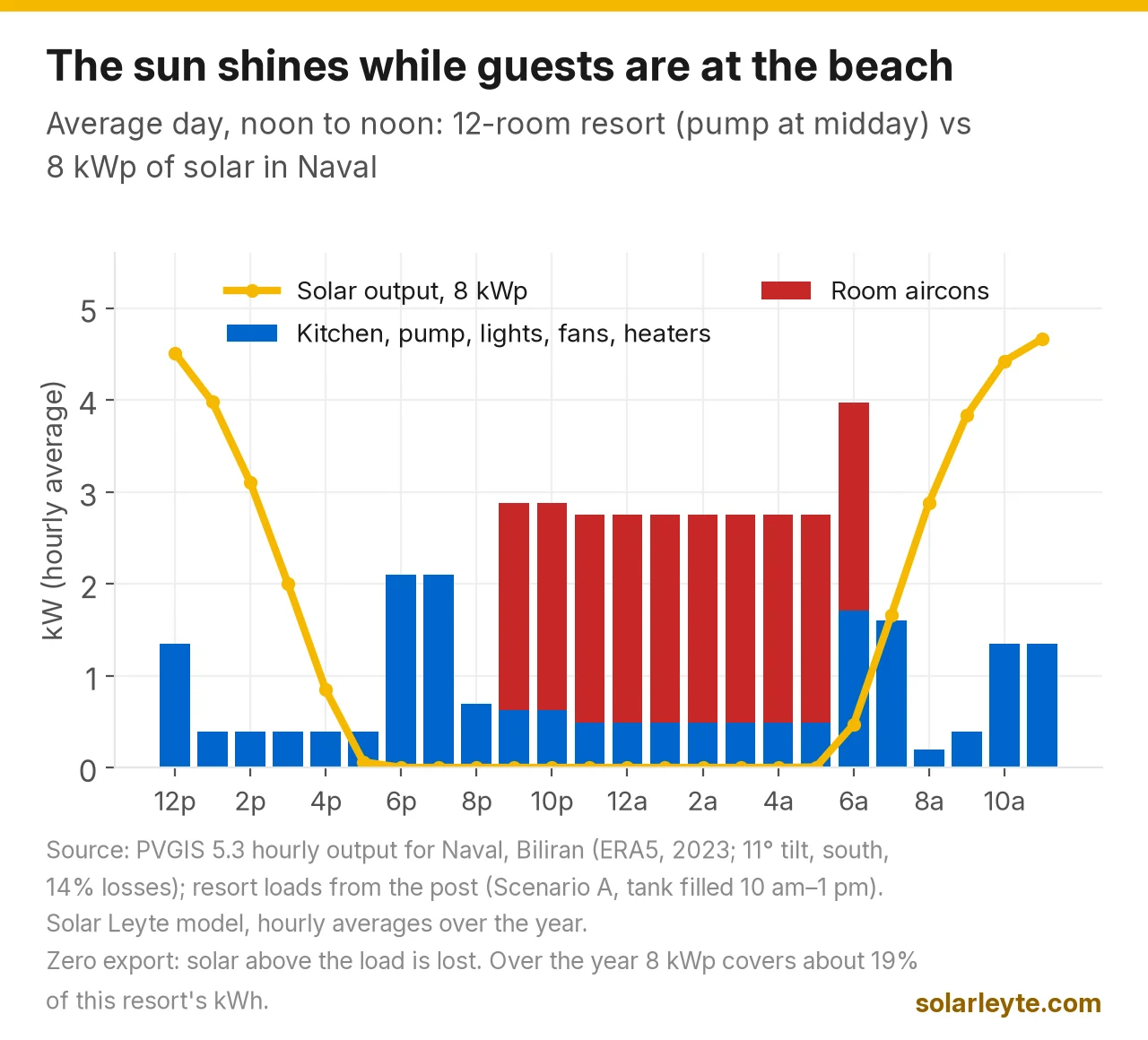
Solar Leyte model: PVGIS 5.3 hourly output for Naval (ERA5, 2023) against our scenario loads, hour by hour. The battery rows assume the battery charges only from surplus solar, with 90% round-trip efficiency, and empties into the evening and night load every day. 9.2 kWh usable is about two 5.12 kWh LiFePO4 modules at 90% depth of discharge.
What this means:
- Zero-export grid-tie barely dents a night-heavy resort. Going from 5 to 8 kWp only raised the share from 11% to 12%, because the extra power arrives while guests are at the beach. Most of it would be thrown away.
- Move every flexible load into the sun first. Filling the tank from 10 am to 1 pm instead of early morning and evening added about 86 kWh a month of solar use on the same 8 kWp. Pool filtration fits the solar day well. Pre-cooling rooms in the late afternoon before guests check in also helps, as our solar for aircon post explains.
- To cover the night, you need net metering or a battery. Under net metering, daytime surplus is exported and credited against what you buy at night. Credit is at roughly BILECO's blended generation charge (about ₱9.50/kWh in September 2026 on PRESYO-PH), not the full rate. A battery keeps the solar for the evening, and it's the only one of the two that works in a brownout.
Leyte sites get a little less sun than Naval in PVGIS. In our 600 W panel post, 1 kWp made about 1,413 kWh a year in Tacloban and 1,481 in Ormoc, against 1,487 in Naval (multi-year averages).
Brownouts: what to keep on
The Visayas grid has had repeated yellow and red alerts in 2026. On 26 August 2026, NGCP flagged possible rotating brownouts from 5 pm to 9 pm across BILECO, LEYECO II to V and the Samar co-ops (GMA News). That's check-in, dinner and shower time. BILECO's GM told PIA in July that when NGCP declares a yellow alert, diesel plants are tapped, which pushes up the price BILECO pays on the spot market.
Grid-tie solar won't help in a brownout. It shuts off when the co-op line goes dead. Only a hybrid inverter with a battery, or a generator, keeps anything running (grid-tie vs hybrid). Some island resorts never had the grid to begin with: a July 2026 travel guide to Sambawan Island, off Maripipi, says the island's generator runs from 6 pm to 5 am. Our off-grid solar post covers that kind of site.
Battery for a four-hour evening brownout (Scenario A)
What stays on, 5 pm to 9 pm | kWh | With 1.5× margin |
|---|---|---|
Freezers, chiller and ref | 0.76 | – |
Lights (rooms and paths, from 6 pm) | 0.93 | – |
Restaurant fans | 0.76 | – |
Water pump, 1 hour to top up the tank | 0.96 | – |
Wi-Fi | 0.02 | – |
Critical loads, no room aircons | 3.43 | 5.2 |
Add every occupied room's aircon for 4 hours | +9.04 | – |
Critical loads plus room aircons | 12.47 | 18.7 |
Whole night, 6 pm to 6 am, everything except heaters and pool | 28.1 | 42.1 |
Whole night without room aircons | 7.7 | 11.6 |
Solar Leyte calculation at the ratings in the first table. Philippine sellers we checked in October 2026 listed 5–6 kWh LiFePO4 batteries at ₱42,000 to ₱67,800 and 11–16 kWh units at ₱70,000 to ₱147,000 (solar battery prices).
What that means in practice:
- One 5 kWh-class battery covers the essentials for an evening outage: cold storage, lights, fans, Wi-Fi and an hour of pumping. That keeps the kitchen safe and the taps running.
- Room aircons are a different size of problem. Adding them takes a four-hour outage from about 3.4 to 12.5 kWh: three 5 kWh-class batteries, or four with margin. An overnight outage with aircons on (28 kWh) is generator territory.
- Keep shower heaters and the pool pump off the backup circuit. A few 3.5 kW heaters at once would overload a 5 kW hybrid inverter. The 5 kW Deye and Solis hybrids in our Deye vs Solis vs SRNE comparison are rated for 2× output for 10 seconds, which is meant for motor starts, not for heaters.
- Fill the tank before the alert window. A full overhead tank is cheaper storage than a battery. On yellow-alert days, run the pump in the early afternoon so the tank is full by 5 pm.
- Daily cycling vs brownout reserve. If the battery also shifts solar to the night every day, set a reserve (for example 30–50%) on alert days, or it may be empty when the grid trips at 7 pm. Check the battery's warranty for cycle and throughput limits (lifespan and warranties).
A smaller fan-cottage resort (Scenario C) needs much less. Its four-hour evening essentials (freezer, ref, lights, Wi-Fi, a little pumping) fit easily in one 5 kWh battery. For a handful of lights and phones only, a portable power station can do the job (solar generator prices).
Salt air: what panel and inverter makers say about the beach
This is the part most quotes skip. A beachfront resort sits inside the band that several makers single out:
Maker and document | What it says about distance from the sea |
|---|---|
LONGi, Quality Statement for Modules Installed at Seaside | 500 m or more: normal installation. Over 50 m and under 500 m: allowed with corrosion protection and extra maintenance, still under warranty. 50 m or less: prohibited, warranty void. Modules soaked by seawater lose the warranty even beyond 50 m. |
JinkoSolar global installation manual (January 2026) | Passed the IEC 61701 salt mist corrosion test. From 50 m to 500 m: protect connectors (dust plugs, connect right after removing them, other anti-rust measures). Within 50 m: offshore modules recommended; consult Jinko before ordering. |
Huawei SUN2000 inverter manual (SUN2000-50K-MC0, 2025) | Don't install outdoors in salt-affected areas: within 500 m of the coast or prone to sea breeze, which varies with typhoons, monsoons and terrain. Consult Huawei first. |
Sungrow microinverter manual (S450S/S800S/S1600S, 2025) | Consult Sungrow before installing outdoors within 500 m of the coast; salt deposition varies with sea winds, rain, humidity and terrain. |
Deye all-in-one ESS manual (GB-SL Pro) | The battery "cannot be exposed to corrosive environments"; in a flood area, install it high enough to stay out of the water. |
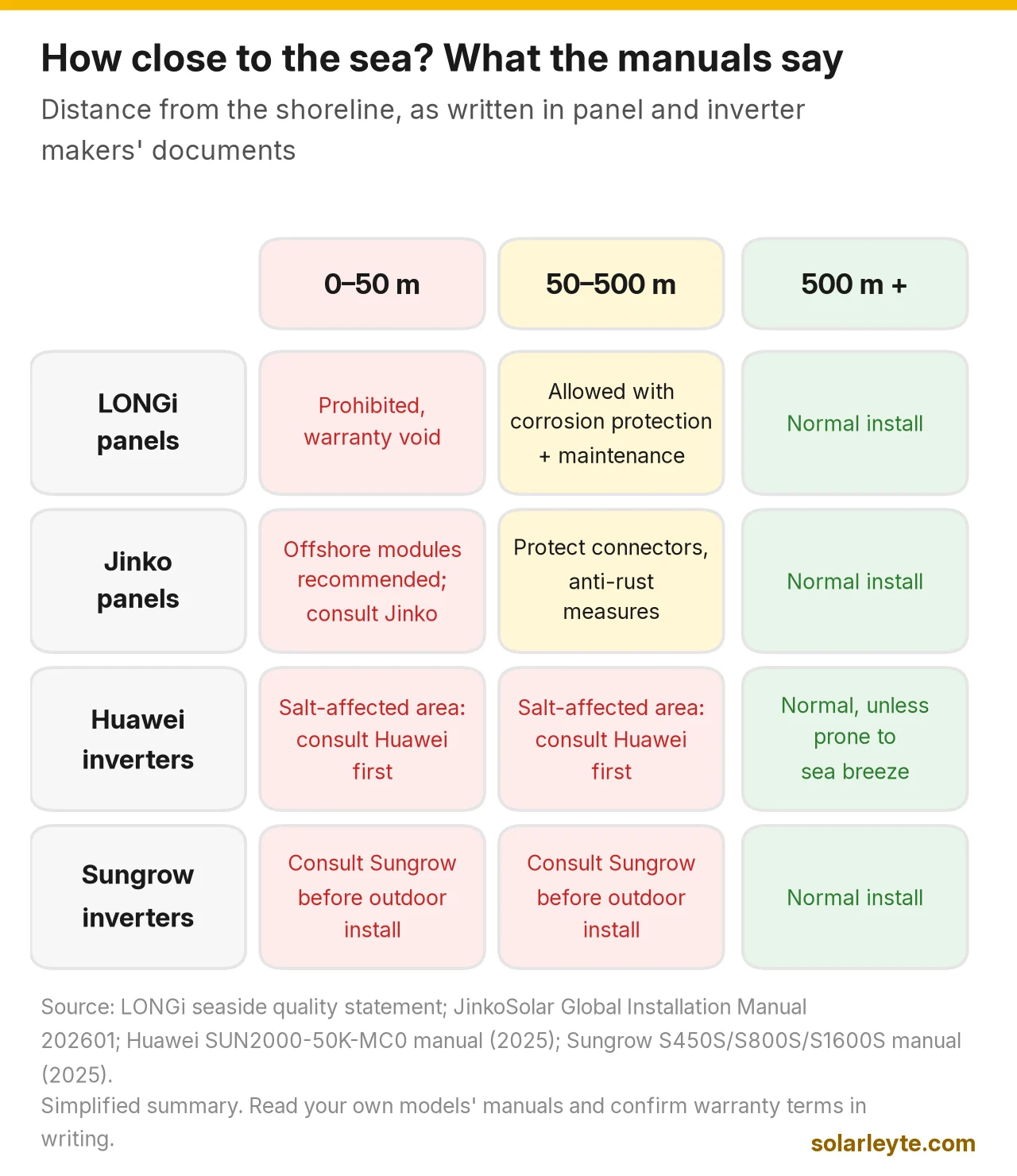
Sources: LONGi seaside statement (copy hosted by distributor OSW); JinkoSolar Global Installation Manual 202601-EN; Huawei SUN2000-50K-MC0 user manual, issue 01 (30 Aug 2025); Sungrow S450S/S800S/S1600S user manual Ver11 (Jan 2025); Deye GB-SL Pro user manual.
LONGi's statement also explains why it's not just about the panel. Its aluminium frames corrode electrochemically where they touch other metals in sea salt fog, "especially in the places with gaps". Its rules for seaside installs:
- Mounting materials that resist salt: aluminium alloys, SUS316 stainless steel, galvanised steel or non-metals such as fibreglass.
- Insulate dissimilar metals: rubber gaskets, mica plates or anticorrosive paint where steel racking, clamps or bolts meet the aluminium frame.
- Stainless grounding terminals, not copper.
- At least 10° of tilt so water runs off (our PVGIS model used 11°).
- Inspect and clean frames, mounting and grounding points for salt and corrosion.
What to ask an installer for a resort within 500 m of the beach:
- Which panel, inverter and battery models, and what each maker's manual says about coastal sites. Get it in writing.
- Whether the maker has been told about the site, as LONGi and Jinko ask, and whether the warranty will stand at your distance from the shoreline.
- Rail, clamp and bolt materials (aluminium, SUS316, galvanised) and how dissimilar metals are insulated.
- Where the inverter and battery go: indoors or under cover on the side away from the sea, out of direct sun and rain (Deye's hybrid manuals ask for no direct sunlight or rain exposure), and above flood and storm-surge level.
- A cleaning and inspection schedule. Salt film is one of the soiling types in our panel cleaning post, and LONGi's seaside rules add frame and grounding checks.
Typhoons at the shoreline
A resort roof by the beach takes the full force of the wind and, in the worst storms, the sea. Panels are tested to set loads in pascals, not to a wind speed. Our typhoon checklist explains what the 2,400 Pa and 5,400 Pa ratings mean and what to do before, during and after a storm. The typhoon guide covers mounting and roof choices.
Two resort-specific points:
- Flooding voids warranties. LONGi's installation manual says not to install modules where they could be flooded, and its seaside statement voids the warranty on panels soaked by seawater. Keep inverters and batteries above any past flood or surge line.
- Insure the system with the building. A fire-only policy won't pay for typhoon damage, and in the policy wording we read, storm surge was excluded from the typhoon endorsement, so ask how the flood endorsement treats it. Our solar panel insurance post lists what to ask.
Rough payback
Monthly value is solar used × ₱16.8353 (BILECO commercial), plus exports × about ₱9.50 where the system is net-metered. Cost bases are Philippine listings from our 10kW solar system price check on 14 October 2026: grid-tie packages at ₱37.50 to ₱43.75 per watt (Phsolar 9.35–11 kWp and ABC Solar Electronics 8 kW), and ABC Solar Electronics' 10.5 kW hybrid packages at ₱505,000 with a 10.24 kWh battery or ₱575,000 with 20.48 kWh (VAT exclusive).
Setup | Value a month | Cost basis | Simple payback |
|---|---|---|---|
A, 8 kWp grid-tie, zero export | ₱2,655 | ₱300,000–₱350,000 | about 9.4 to 11 years |
A with midday pumping, 8 kWp grid-tie, zero export | ₱4,108 | ₱300,000–₱350,000 | about 6.1 to 7.1 years |
A with midday pumping, 8 kWp grid-tie, net-metered | ₱11,160 | ₱300,000–₱350,000 | about 2.2 to 2.6 years |
B (pool) with midday pumping, 8 kWp grid-tie, zero export | ₱7,647 | ₱300,000–₱350,000 | about 3.3 to 3.8 years |
B with midday pumping, 8 kWp grid-tie, net-metered | ₱12,702 | ₱300,000–₱350,000 | about 2.0 to 2.3 years |
A with midday pumping, ~10 kWp hybrid + 10.24 kWh, zero export | ₱8,609 | ₱505,000 package | about 4.9 years |
A with midday pumping, ~10 kWp hybrid + 20.48 kWh, zero export | ₱12,784 | ₱575,000 package | about 3.7 years |
B with midday pumping, ~10 kWp hybrid + 10.24 kWh, zero export | ₱12,078 | ₱505,000 package | about 3.5 years |
Solar Leyte calculation from the model above. Package prices are sellers' listed prices in Cebu and Cavite, not Biliran installed prices, and the ABC prices exclude VAT.
Be careful with these numbers:
- Net metering looks best on paper, because a night-heavy resort exports most of its solar. It needs BILECO's approval and a meter swap first, the credit can only bring a bill down to zero (any excess is carried over), and fixed charges stay. The steps are in our BILECO net metering guide.
- The battery rows assume a full cycle every day with surplus solar to fill it. Cloudy weeks and low occupancy cut the savings, and daily cycling uses up the battery's warranty throughput.
- Occupancy is the big unknown. At 30% occupancy instead of 60%, the aircon kWh halves, and so does what a battery can save at night.
- Coastal extras cost money: stainless or galvanised hardware, insulation between metals, a sheltered inverter spot and more cleaning. They aren't in the package prices.
- Simple payback leaves out permits, an inverter replacement over the system's life, panel ageing and the cost of money. Our is solar worth it post walks through those.
Cut the load before you size the solar
- Replace old non-inverter room aircons first. By Midea's figures, a 1 HP non-inverter uses about 67 kWh a month more than an inverter at 8 hours a day.
- Pump and filter in the sun. Tank filling and pool pumps at midday, timers on both.
- Key-card or timer switches for room aircons, so empty rooms don't cool all day.
- Buy freezers and chillers on the energy label. In Meralco's tests, conventional chest freezers had a median of 1.01 kWh a day against 0.61 for inverter models.
- Solar for the paths. Standalone solar street and path lights take that load off the grid and keep paths lit in a brownout (solar street light prices).
Permits for a resort system
- Zero export (own use only): under DOE Department Circular DC2026-08-0017, the Certificate of Compliance (COC) exemption covers only households, clinics, hospitals and other medical facilities, so a resort business still needs an ERC COC. You also need a building permit, unless your LGU accepts the existing one, and for a grid-connected system a notice to BILECO or your co-op (Annex A). Details are in our plug-and-play and zero-export rules post.
- Net metering (up to 100 kW): surplus is exported and credited at about the generation charge. Steps: BILECO and LEYECO II net metering guides.
- Electrical permit and CFEI: for net metering, the co-op needs the CFEI from your town hall, and you can't get one without the electrical permit. Steps and fees: our electrical permit and CFEI guide.
Before you ask for a quote
- Your last 12 BILECO or LEYECO bills (or at least three), with the rate class.
- A list of aircons (HP, inverter or not), shower heaters, freezers, chillers, pumps and any pool pump, with nameplate watts.
- Your average occupancy by month, and when rooms usually use aircon.
- What must stay on in a brownout, and whether you already have a generator.
- Roof material, roof size and direction, and the distance from the roof to the high-tide line.
- Where an inverter and battery could go: under cover, away from the sea side, above flood level.
Licences and paperwork checks are in how to choose a solar installer in Leyte and Biliran. For a separate well or irrigation pump, see our solar water pump price guide. For hybrid inverter models and prices, see hybrid inverter prices.
FAQ
How much electricity does a small beach resort use? In our 12-room example (8 aircon rooms at 60% occupancy, 4 fan rooms, a kitchen and a pump), about 42 kWh a day or 1,280 kWh a month, and about 1,500 kWh with a pool pump. Room aircons at night are over half of it (Solar Leyte estimate).
How much is a resort's electric bill in Biliran? About ₱21,600 a month for that example at BILECO's July 2026 commercial rate of ₱16.8353/kWh plus fixed charges, or about ₱25,300 with a pool. A six-cottage fan resort uses about 188 kWh, or roughly ₱3,200 to ₱3,600.
Can solar run a resort's aircons at night? Not directly. Panels make power in the day, while guests mostly use aircons at night. To cover night aircon, you need net metering (daytime credits) or a battery. In our model, 10 kWp with about 9.2 kWh of usable battery covered about 40% of the resort's kWh, against 19% for 8 kWp of grid-tie without export.
What size battery does a resort need for a brownout? For a four-hour evening outage, about 3.4 kWh keeps the freezers, chiller, ref, lights, fans, Wi-Fi and an hour of pumping going, so one 5 kWh-class battery. Adding room aircons takes it to about 12.5 kWh. Overnight outages with aircons need a generator.
Can I install solar panels near the beach? Usually, with care. LONGi allows installs more than 50 m from the sea with corrosion protection and prohibits them within 50 m. Jinko recommends offshore modules within 50 m. Huawei and Sungrow ask you to consult them before installing inverters outdoors within 500 m of the coast. Tell the installer, and the maker, how far your roof is from the sea.
Solar Leyte is run by MACC Systems & Energy Solutions Inc., a solar installer in Naval, Biliran.
Get a free solar quote for your resort from MACC
Send us a photo of your last BILECO or LEYECO bill, a list of your aircons, heaters, freezers and pumps, and what must stay on in a brownout. We'll size the panels, inverter and any battery around your occupancy and pump hours, give you every model number and datasheet, and show you the math, with no obligation.
- Call/Text: 0955 723 5093
- Email: official@macc-inc.com or benjie@macc-inc.com
- Website: www.macc-inc.com
- Request a quote online: solarleyte.com/quote
- Office: Brgy. Talustusan, Naval, Biliran 6543
Sources (all checked 14 October 2026)
- Loads: Midea Philippines, How much electricity does an aircon use in the Philippines; Robinsons Appliances, Panasonic DH3VL1PW 3.5 kW water heater; Lazada, Emaux SS100 pool pump listing; Meralco test lists and DOE energy labels as cited in our appliance kWh post and sari-sari store post; pump efficiency from our water refilling station post
- Coastal installation: LONGi, Quality Statement for Modules Installed at Seaside (copy hosted by OSW) and installation manual (DGBG) V2.0, 2025; JinkoSolar, Global Installation Manual 202601; Huawei, SUN2000-50K-MC0 user manual; Sungrow, S450S/S800S/S1600S microinverter user manual; Deye, GB-SL Pro user manual and SUN-5-12K-SG02LP1 installation manual
- Rates: BILECO, power rate posts (July 2026 latest); ICSC, PRESYO-PH (September 2026: BILECO residential ₱18.93, blended generation ₱9.50); Solar Leyte, BILECO rate tracker and LEYECO IV and V tracker
- Brownouts and supply: Philippine Information Agency, BILECO urges consumers to conserve electricity amid expected power rate hikes (16 July 2026); GMA News, Rotating brownouts may hit Visayas consumers on Aug. 26, 2026; Lakbay Pinas, Sambawan Island 2026 guide (10 July 2026); Solar Leyte, Visayas grid alerts
- Solar output: European Commission JRC, PVGIS 5.3 hourly series for Naval (ERA5, 2023)
- Rules: DOE, Department Circular DC2026-08-0017, as summarised in our plug-and-play post
- Prices and equipment: Solar Leyte, 10kW solar system price, solar battery price, hybrid inverter price and Deye vs Solis vs SRNE