In everyday Filipino talk, a "brownout" means the power is completely off. In engineering terms, that's a blackout or power interruption. A true brownout is when the power stays on but the voltage drops, so lights go dim and motors struggle. "Power interruption" is the official word your co-op, NGCP and the ERC use for any outage, planned or not. A "rotational brownout" is a short outage that's moved from area to area on purpose when the Visayas grid runs short of supply.
The words matter less than knowing which one you have, because each needs a different response:
- Lights dim, fan slows, ref hums (low voltage): unplug motors and compressors, or put them behind a voltage protector or AVR.
- Everything goes dark (interruption): check whether it's just your house, your street or the whole town, then ride it out with backup power.
- Scheduled interruption: you should get at least two days' notice, so charge up and plan.
Last checked: 11 November 2026.
The terms side by side
Term | What it technically means | What most Filipinos mean | Example |
|---|---|---|---|
Brownout | Voltage drops but power stays on | Power is completely out | Dim bulbs at 6 pm on a long feeder |
Blackout | Total loss of power, often over a wide area | A big or long outage | Panay and Guimaras, 2 to 5 January 2024 |
Power interruption | Official term for any outage, scheduled or unscheduled | The co-op's advisory word | BILECO-wide NGCP shutdown, 8 August 2026 |
Rotational brownout (manual load dropping) | Planned, area-by-area outages ordered when supply is short | "Rotational" or "red alert" brownout | NGCP red alert, Eastern Visayas co-ops, 7 September 2026 |
Voltage sag / dip | A short voltage drop of under a minute | A flicker, or "kumurap" | Lights blink when a big motor starts nearby |
Even Meralco labels its outage pages "Brownouts" ("check, report and receive outage alerts") on its website, so the everyday meaning is here to stay (Meralco). Elsewhere, Wikipedia notes, "brownout" means a drop in voltage, and in some countries the two words are interchangeable (Wikipedia: Brownout (electricity)).
A true brownout: when the voltage drops
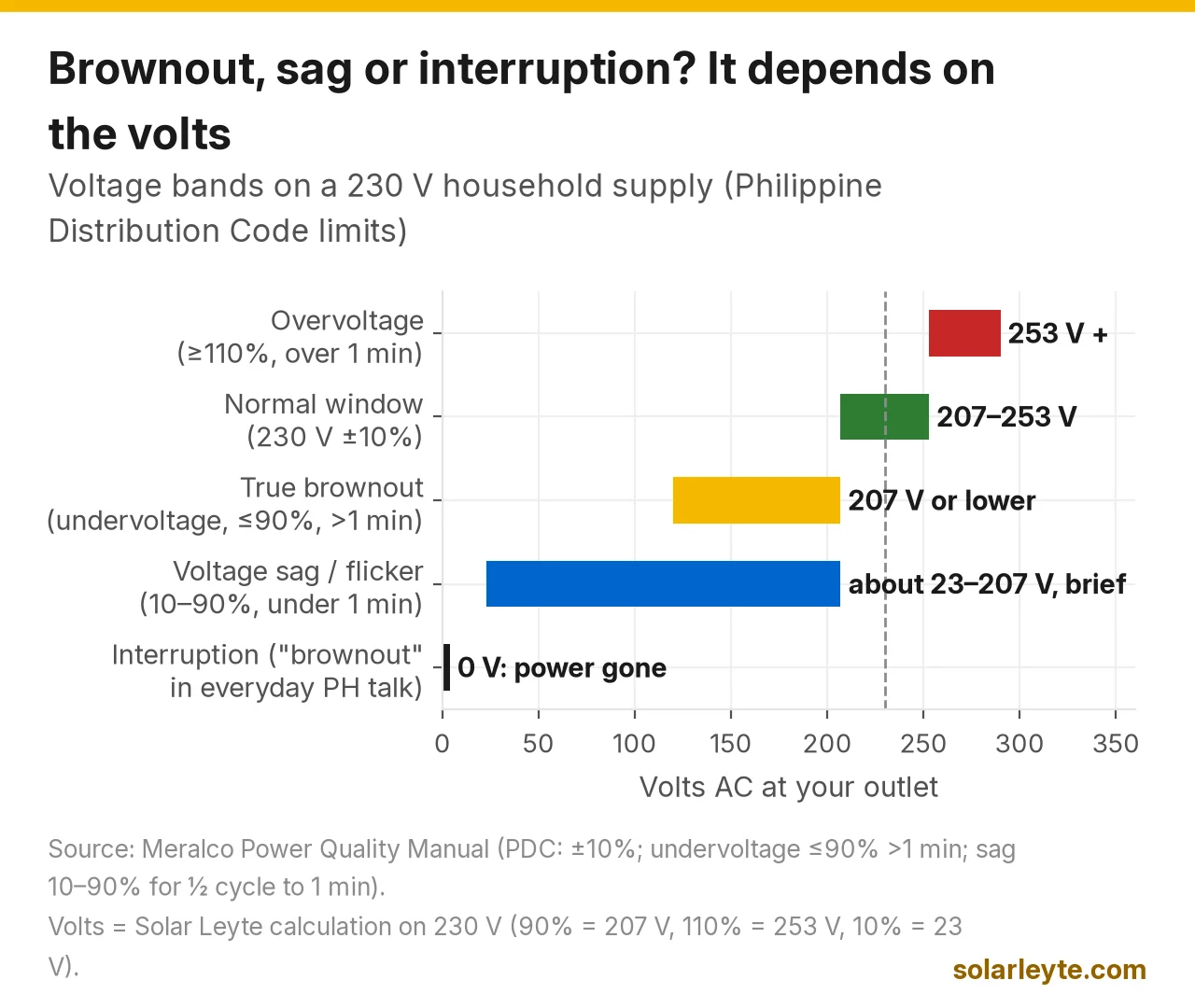
Meralco's power quality manual lists 230 V as its low-voltage (household) supply and, quoting the Philippine Distribution Code, says long-lasting voltage should stay within ±10% of nominal. Voltage at or below 90% for more than one minute is "undervoltage". A voltage sag is a shorter drop to 10% to 90% of nominal, lasting from half a cycle up to one minute (Meralco Power Quality Manual).
On a 230 V supply, that works out to:
Condition | Rule (Distribution Code via Meralco) | On a 230 V supply (our calculation) |
|---|---|---|
Normal | Above 90% and below 110% of nominal | Above 207 V and below 253 V |
Undervoltage (a true brownout) | 90% of nominal or less, for over 1 minute | 207 V or lower, for over a minute |
Voltage sag | 10% to 90% of nominal, for half a cycle up to 1 minute | About 23 V to 207 V, for under a minute |
Overvoltage | 110% of nominal or more, for over 1 minute | 253 V or higher |
Interruption | Power gone | 0 V |
What low voltage does to your appliances
Bulbs dim and electric fans slow down, which is harmless. Motors are the worry: an induction motor (the kind in your ref compressor, water pump and older aircon) draws more current when the voltage drops, which can make it overheat and burn out (Wikipedia: Brownout (electricity)). Meralco's manual lists undervoltage effects such as motor controllers dropping out and extra heating losses (Meralco Power Quality Manual).
What to do:
- Switch off the aircon and unplug the ref until the lights look normal again.
- If this happens often, get a voltage protector or an AVR with a power-on delay. Our AVR guide for refs, aircons and TVs shows which one to buy and how to size it.
- Measure your outlet voltage at the same time each evening with a multimeter (our multimeter guide shows the safe AC setting). Write the readings down. They're your evidence if you report the problem to the co-op.
A blackout: the power is completely gone
A blackout is the full loss of power. The size of the area tells you a lot about the cause:
- Just your house: check your main breaker and your neighbours' lights before calling anyone.
- Your street or barangay: it can be a line fault, a blown transformer fuse, a fallen tree or line repairs.
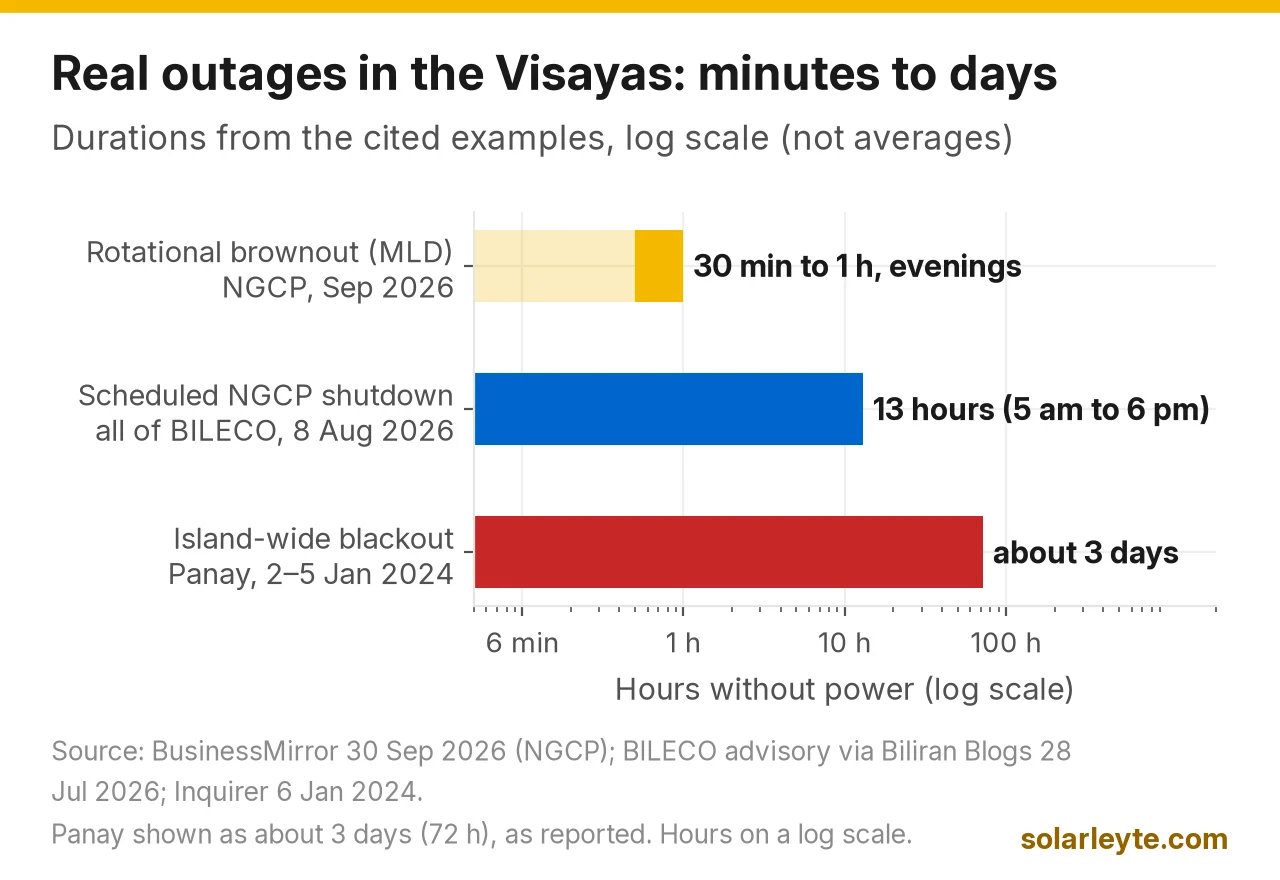
- Your whole co-op area: often a problem upstream, on the NGCP transmission side. On 8 August 2026, an NGCP shutdown was scheduled to cut power to BILECO's entire franchise area from 5:00 am to 6:00 pm, 13 hours; the advisory said power might return earlier (BILECO advisory via Biliran Blogs).
- A whole island: the worst case. On 2 January 2024, several power plants tripped and Panay, Guimaras and parts of Negros went dark. Power came back on 5 January, about three days later, after an outage that affected at least 4.5 million people (Inquirer, 6 January 2024).
Power interruption: the official term, and your right to notice
Co-ops and the ERC say "power interruption" and split them into two kinds:
- Scheduled: maintenance, line upgrades, NGCP work.
- Unscheduled: faults, typhoon damage, trips and grid-ordered load dropping.
For scheduled ones, the ERC's Magna Carta for Electricity Consumers (ERC Resolution No. 25, Series of 2026, in effect since September 2026; it replaced the 2004 Magna Carta for Residential Electricity Consumers), Article 16.D, says a distribution utility must issue an advisory at least two (2) days before a scheduled interruption, through its official communications channels, with preference for mass/interactive media or online platforms, including its official website and social media. Where that media can't reach people, the utility must coordinate with the LGU and barangays and use at least two community methods, such as barangay or community sound systems, postings at barangay or municipal halls, health centers, schools, chapels or public markets, local community radio, LGU or DRRMO SMS alerts, or its own bulletin boards. Under Article 16.A, and subject to the telecom facilities available in its area, every distribution utility must keep at least one of these channels running: mass/interactive or online media, a 24/7 consumer hotline, or SMS, and should offer more than one where feasible (ERC Resolution No. 25, s. 2026, checked 11 November 2026).
The 8 August BILECO shutdown above is a good example: the rescheduled date was posted on 28 July, well over two days ahead (Biliran Blogs). Unscheduled interruptions can't be announced in advance, so for those you rely on the co-op's page and hotline.
Where to look in Biliran: BILECO's website links to its Facebook page (facebook.com/bilecoofficial) and lists main office numbers in Brgy. Caraycaray, Naval: (053) 500-9042, (053) 500-9040 / (053) 507-8069, and 0905 255 9119 / 0948 674 9991 (bileco.com.ph contact page, checked 11 November 2026). LEYECO customers should use their own co-op's official page and hotline.
Rotational brownouts and red alerts
This is the kind Eastern Visayas has had most of in 2026. When NGCP puts the Visayas grid on red alert, supply isn't enough to cover demand plus the reserve the grid needs to stay stable. NGCP can then order manual load dropping (MLD): co-ops switch feeders off one after another so the whole grid doesn't collapse.
- On 7 September 2026, NGCP said MLD might be carried out from 4 pm to 9 pm in areas served by LEYECO II, III, IV and V, SOLECO, DORELCO, BILECO, ESAMELCO, NORSAMELCO and SAMELCO I and II, which serve about one million member-consumers (Inquirer, 7 September 2026).
- An NGCP Visayas operations supervisor said the longer rotational outages, 30 minutes to an hour, happened in the evening when supply ran short. Solar farms stop producing after sunset, and daytime interruptions tend to be shorter repair or maintenance jobs. He also warned that the Visayas might keep having these for the next year, maybe two (BusinessMirror, 30 September 2026).
For what yellow and red alerts mean day to day, see our Visayas grid yellow and red alert guide.
How long each one lasts, and what backup covers it
The durations below are the real examples cited above, not averages for every outage.
Event | Real example (source above) | Backup that covers it |
|---|---|---|
Voltage sag / flicker | Under 1 minute (by definition) | Power-on delay or AVR; a UPS for computers |
Rotational brownout (MLD) | 30 minutes to 1 hour, evenings (NGCP, Sep 2026) | Power bank, mini UPS for WiFi, small power station |
Scheduled co-op or NGCP work | 13 hours scheduled, BILECO area, 8 Aug 2026 (power might return earlier) | Big power station or home battery, or a generator |
Island-wide blackout | About 3 days, Panay, Jan 2024 | Solar with a battery, or a generator with fuel stocked |
For sizing:
- Short outages: see UPS for WiFi and Starlink and inverter and battery backup.
- Long outages: generator vs solar runs the fuel maths. If you plug a generator into the house wiring, use a transfer switch, never a "suicide cord".
What happens to solar panels in each case
- Grid-tie solar with no battery stops during an interruption, even at noon. This is the anti-islanding safety feature, which protects linemen working on the lines (Meralco net-metering FAQ, question 19).
- Hybrid solar with a battery keeps your backup circuits running through a blackout, as long as the battery has charge.
- In a true brownout (low voltage), a hybrid inverter judges the grid against a set voltage window. Deye's SG05LP1 manual, for example, lists a grid voltage range of 0.85 to 1.1 times the rated voltage, about 196 V to 253 V on 230 V. It also has settings for the grid voltage it will accept when connecting and when reconnecting after a trip (Deye SG05LP1 manual, 19 March 2026).
Our grid-tie vs hybrid vs off-grid guide explains which setup fits a home where brownouts are common.
When the power comes back
Interruptions often end with a surge of everything restarting at once. A simple habit protects your appliances:
- Switch off the aircon, ref, water pump and computer at the outlet while the power's out, and leave one light on so you know when it's back.
- Wait a few minutes after it returns, in case it drops again.
- Turn things back on one at a time, starting with the ref.
A power-on delay does steps 2 and 3 for the ref automatically. Lightning is a different problem, covered in our lightning and surge protection guide.
If your area gets interruptions or low voltage all the time
- Report each one to the co-op, and keep your reference number and your voltage readings.
- Ask for a written answer. Article 13 of the Magna Carta for Electricity Consumers says a distribution utility must record and promptly investigate complaints and give you a written report of what it did. That's within the timeline in its Customer Service Standards under the Philippine Distribution Code, or 15 working days from receipt of your complaint if no timeline applies. If the co-op doesn't resolve it to your satisfaction, it must give you a Certification saying so. Under Article 31, first raise the issue with the co-op's Consumer Welfare Desk Officer (CWDO) or representative. If it's still unresolved, you can file a complaint with the ERC by email, letter or the ERC's online CCTS complaints ticketing system (ERC Resolution No. 25, s. 2026).
Bisaya quick take
Kung mangitngit ra gamay ang suga ug hinay ang electric fan, ubos ang boltahe, dili pa brownout sa tinuod nga pasabot. I-unplug una ang ref ug aircon. Kung walay suga tanan, susiha una ang breaker ug ang silingan, unya tan-awa ang advisory sa BILECO o LEYECO.
FAQ
Is a brownout the same as a blackout in the Philippines?
In daily use, yes. Most Filipinos say "brownout" for any outage. Technically a brownout is low voltage with the power still on, and a blackout is a total loss. The official term the co-ops use is "power interruption".
How many days' notice should BILECO or LEYECO give before a scheduled power interruption?
At least two days, through the co-op's official channels, preferably mass/interactive media or online platforms such as its website and social media, under Article 16.D of the ERC's Magna Carta for Electricity Consumers (Resolution No. 25, Series of 2026). Where that media can't reach people, the co-op works with the LGU and barangays and uses at least two community methods, such as barangay sound systems, postings at halls, schools or markets, or community radio.
Ano ang rotational brownout?
Ito ay sadyang pagpatay ng kuryente nang paikot-ikot, isang lugar bawat oras, kapag kulang ang supply sa Visayas grid (red alert). Tinatawag itong manual load dropping ng NGCP. Noong 2026, karaniwang 30 minuto hanggang isang oras ito, at kadalasan sa gabi.
Does my solar system work during a brownout?
A grid-tie system with no battery switches off during an interruption for lineman safety. A hybrid system with a battery keeps your backup circuits running. In low-voltage brownouts, a hybrid inverter may stop using the grid if the voltage falls outside its allowed window.
Related guides
- Solar in typhoon country: protecting your system
- Visayas grid yellow and red alerts
- Do you need an AVR? Ref, aircon and TV guide
- Generator vs solar for brownouts
- Inverter and battery backup for brownouts
- UPS for WiFi and Starlink in a brownout
Solar Leyte is run by MACC Systems & Energy Solutions Inc., a solar installer in Naval, Biliran.
Get a free solar quote from MACC
Tired of evening brownouts? Send us your latest BILECO or LEYECO bill and a list of what you want running during an outage, and we'll talk you through the options, with no obligation.
- Call/Text: 0955 723 5093
- Email: official@macc-inc.com or benjie@macc-inc.com
- Website: www.macc-inc.com
- Request a quote online: solarleyte.com/quote
- Office: Brgy. Talustusan, Naval, Biliran 6543
Sources (all checked 11 November 2026)
- Energy Regulatory Commission, Resolution No. 25, Series of 2026: Magna Carta for Electricity Consumers (dated 18 August 2026; published 26 August 2026; in effect 15 days after publication; consolidates and supersedes earlier issuances): Article 13 (complaint investigation; written report within the Customer Service Standards timeline or 15 working days; Certification if unresolved), Article 16.A (at least one of mass/online media, a 24/7 hotline or SMS), Article 16.D (at least two days' notice of scheduled interruptions; community methods where media can't reach), Article 31 (complaints to the ERC by email, letter or CCTS after first raising them with the DU's CWDO). Signed copy posted by Visayan Electric: PDF scan. It replaced the Magna Carta for Residential Electricity Consumers (promulgated 25 June 2004; in effect 17 July 2004).
- Meralco, Power Quality Manual: Philippine Distribution Code ±10% voltage variation; undervoltage ≤90% and overvoltage ≥110% for more than 1 minute; sag 10–90% for half a cycle to 1 minute; undervoltage effects; low-voltage supply 230 V.
- Meralco, Solar and Net-Metering FAQ: question 19 (systems without a battery stop supplying power during an outage through anti-islanding). The site menu labels outage pages "Brownouts".
- Wikipedia, Brownout (electricity): brownout as a voltage drop; usage differs by country; induction motors draw more current at low voltage.
- Biliran Blogs, 13-hour power outage to affect entire BILECO coverage area (28 July 2026; NGCP scheduled interruption moved from 1 August to 8 August 2026, 5:00 am to 6:00 pm).
- Inquirer, Eastern Visayas power coops warn of outages amid grid alert (7 September 2026; possible MLD 4 pm to 9 pm; the co-ops listed; about one million member-consumers).
- BusinessMirror, 2 more years of outages for Visayas (30 September 2026; evening rotational outages of 30 minutes to an hour; MLD explained; outlook).
- Inquirer, Power finally back in Panay after 3 days (6 January 2024; blackout from 2 January; at least 4.5 million people affected).
- BILECO, bileco.com.ph contact page (main office address and contact numbers; Facebook link).
- Deye, SUN-3.6–8K-SG05LP1-EU user manual, 19 March 2026 (grid voltage range 0.85–1.1 × rated; grid connect and reconnect settings).
- Voltage figures for a 230 V supply (207 V, 253 V, 23 V, 196 V): Solar Leyte calculations from the rules above.