You need an AVR (automatic voltage regulator) if the voltage at your outlet often goes outside what your appliance can handle, and that appliance has a compressor or a circuit board you'd hate to replace. For most homes in Leyte and Biliran, the thing that does the most good is cheaper than a full AVR: a power-on delay that holds power back for about 3 to 5 minutes after a brownout. Many new inverter aircons and freezers also list a wide voltage range on their spec sheets, so check that first before buying anything.
In short:
- Ref or freezer: an AVR with a built-in power-on delay, or at least a power-on delay or voltage protector.
- Aircon: check the spec sheet first. Some makers say their inverter units don't need one.
- TV, computer or sound system: a small relay AVR, no delay needed.
- Electric fan, rice cooker, flat iron: no AVR.
Last checked 11 November 2026. Prices are from the brands' own online stores on that date. The sizing examples are Solar Leyte calculations using the makers' rules of thumb, not a MACC quote.
What an AVR actually does (and what it doesn't)
An AVR sits between the wall outlet and your appliance. When the incoming voltage drops (say 190 V on a busy evening) or rises, it steps the voltage back toward 220 V. Some models also add a power-on delay: after a brownout, they wait a few minutes before passing power through, so the ref's compressor doesn't restart into the unsteady voltage you often get when power first comes back.
There are three kinds of device you'll see in hardware stores, and they're easy to mix up:
Device | What it does | Example (maker's spec) | Price, 11 Nov 2026 |
|---|---|---|---|
AVR, relay type | Switches taps to keep output near 220 V; responds within 1 second | Panther PVE 1001 D: 1,000 W, input 180–250 V, output 220 V ±7%, 3–5 min delay | ₱3,650 |
AVR, servo type | A small motor turns the voltage up or down more precisely | Panther PVS 5001 D: 5,000 W, input 190–250 V, output ±2%, 3–5 min delay | ₱39,300 |
Voltage protector | Doesn't regulate. Cuts power below 160 V or above 250 V, reconnects after a delay | Panther PVP 2500: 2,500 W, delay 15 s / 30 s / 3 min | ₱1,220 |
Power-on delay only | Waits 3–5 minutes after power returns, nothing else | Panther PPD 1000: 10 A (2,500 W) | ₱1,220 |
Sources: Panther product pages (PVE 1001 D, PVS 5001 D, PVP 2500, PPD 1000) and Panther's guides to servo vs relay AVRs and AVR vs voltage protector.
What an AVR won't do:
- It won't stop lightning. Panther's own support team says its AVRs and voltage protectors "do NOT provide lightning surge protection". For that you need a proper surge protective device in the panel. Our lightning and surge protection guide covers it.
- It won't keep anything running in a brownout. No power in, no power out. For backup you need a UPS, an inverter with a battery or a generator with a transfer switch.
How much should your voltage move?
The Philippine Distribution Code says the co-op has to keep long-lasting voltage (more than one minute) within ±10% of nominal at your connection point under normal conditions. Below 90% counts as undervoltage, above 110% as overvoltage. Meralco's power quality manual, which quotes the Code, lists 230 V as its low-voltage supply, so the normal window works out to about 207 V to 253 V (Meralco Power Quality Manual). The same manual tells customers to buy equipment that works across that ±10% range.
Short dips (sags) and spikes (swells) lasting under a minute are a separate category in the Code. They're common when a big motor starts nearby, when a line fault is cleared, or when power comes back after an outage. A power-on delay is meant for that last case.
How to see your own voltage: plug a cheap plug-in voltmeter into an outlet, or use a multimeter on AC volts. Check at 6 to 9 PM, when the line is busiest. Our multimeter how-to shows the basics, but keep the probes away from each other and from your fingers. If it often reads below about 200 V, or your lights dim every evening, take a photo of the readings and report it to BILECO or your LEYECO. A long rural line or an overloaded transformer is their job to fix.
Your appliance may already handle it
Before you buy an AVR, read the spec sheet or the label on the back. Many newer inverter appliances list a working voltage range much wider than an AVR's own input range:
Appliance or device | Working voltage range (maker's figure) |
|---|---|
Normal grid window (230 V ±10%) | 207–253 V |
"Typical" aircon, as Midea describes it | 198–264 V |
Midea DC inverter aircons sold in the PH | 80–265 V |
Condura Negosyo Pro inverter upright freezer | 145–270 V |
Panther PVE relay AVR (500–2,000 W) input | 180–250 V |
Panther PVS servo AVR (1,000–1,500 W) input | 160–240 V |
Panther PVP voltage protector (passes power through) | 160–250 V |
Deye SG05LP1 hybrid inverter, grid side | 0.85–1.1 × 230 V (about 196–253 V) |
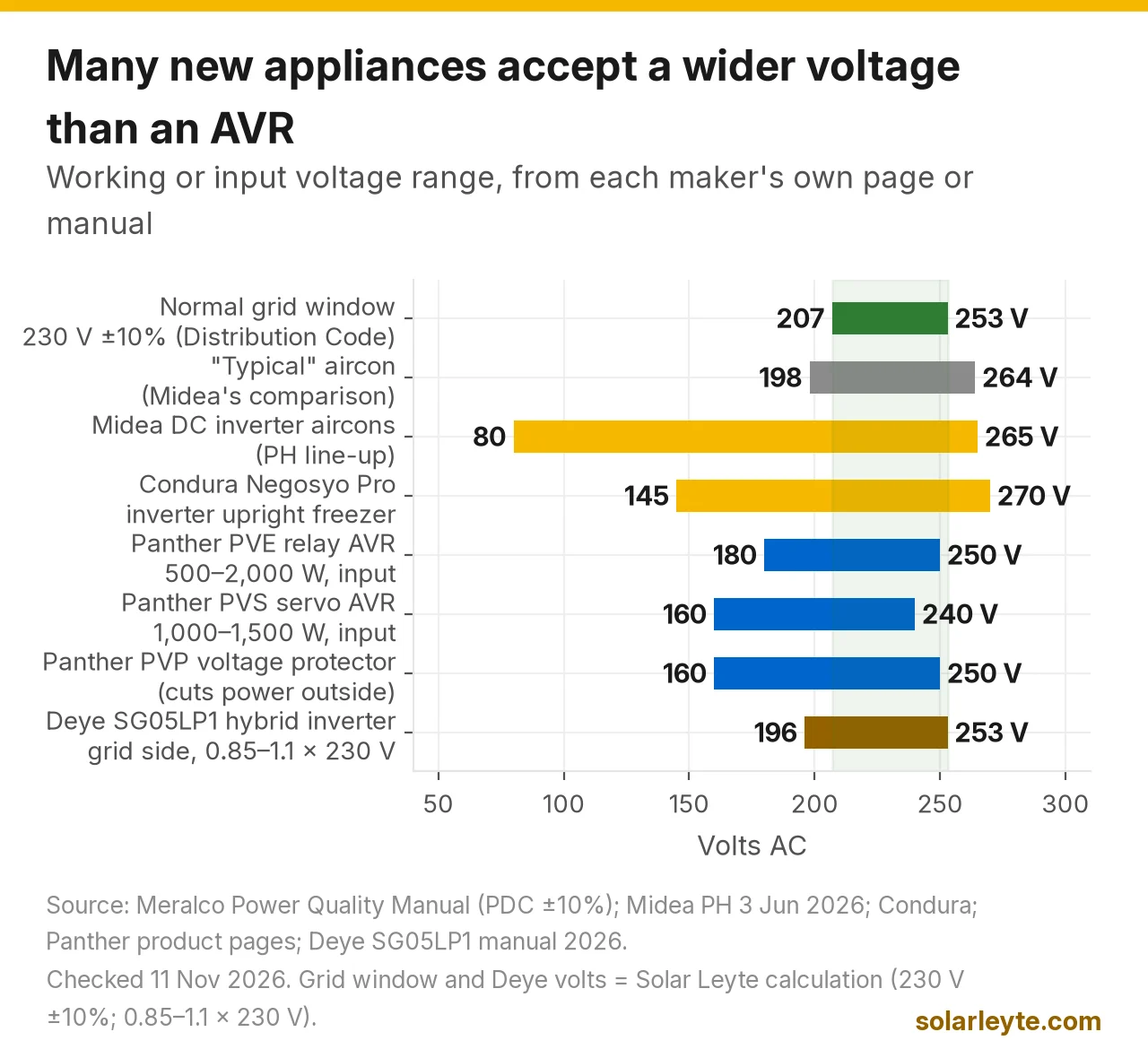
Sources: Midea Philippines, 3 June 2026; Condura Negosyo Pro freezer page; Panther PVE 1501 D, PVS 1000 and PVP 3500 pages; Deye SUN-3.6–8K-SG05LP1-EU manual, March 2026, p. 47. The 196–253 V figure is our calculation.
Two makers say it plainly:
- Midea says its full DC inverter line in the Philippines runs from 80 V to 265 V, so "no external AVR required".
- Samsung Philippines says its aircons are "stabilizer-free", and adds that stabilizers may still be needed where power problems are frequent (Samsung PH support).
Notice something odd in the table? A common relay AVR accepts a narrower range (180–250 V) than some of the appliances it's meant to protect. If your appliance's own range is wider than the AVR's, the AVR adds little for voltage. Its delay feature may still be worth having.
If your label or spec sheet lists no wide range, don't assume it has one. That's the appliance that benefits most from an AVR or a voltage protector.
Which appliances need what
Appliance | What to use | Why |
|---|---|---|
Inverter ref | AVR with power-on delay | On 24/7 and restarts by itself; Panther recommends its "D" (delay) series for inverter refs |
Non-inverter ref, chest freezer, beverage cooler | Power-on delay or voltage protector is OK | Panther says these can get by with a power-on delay or a PVP |
Inverter aircon | Check the spec sheet; if no wide range is listed, a voltage protector or AVR | Some makers say no AVR needed; others don't say |
Window or non-inverter aircon | Voltage protector or AVR | Compressor restarts are the risk |
Smart TV, desktop PC, sound system | Relay AVR, no delay | Sensitive electronics; TVs don't switch back on by themselves |
Electric fan, rice cooker, kettle, flat iron | Nothing | Simple heaters and motors without sensitive boards |
Source: Panther AVR buyer's guide, 2024 update and AVR vs voltage protector. Panther says a ref or aircon can sit out a few minutes of cut-off without trouble: "even if your refrigerator is turned off for 10 minutes during the voltage surge, it will remain cool."
How to size an AVR
The rule from Panther, a Philippine AVR maker:
- Find the rated current (amps) on the nameplate. It's more reliable than the watts.
- Multiply by the voltage on the label (230 V) to get watts.
- For anything with a motor or compressor (ref, aircon, pump), multiply by 3 for the startup surge. For a TV, add 20%.
- Pick an AVR rated at or above that number. One appliance per AVR if you can.
For big aircons, Panther's support replies keep adding one line: ask the aircon maker first, because the startup surge of some designs is lower and a smaller AVR may work.
Worked example A: a two-door inverter ref
Assumption: the nameplate says 230 V, 1.2 A.
- 1.2 A × 230 V = 276 W
- 276 W × 3 = 828 W, so a 1,000 W AVR with delay
- Panther PVE 1001 D (relay, 3–5 min delay) costs ₱3,650. Akari's AVR-SVC 1000 (servo, no delay listed) costs ₱4,599.
Worked example B: a 1 HP inverter split aircon
Assumption: the nameplate says 3.6 A outdoor plus 0.25 A indoor at 230 V, and the spec sheet lists no wide voltage range.
- 3.85 A × 230 V = about 886 W
- 886 W × 3 = about 2,657 W, so a 3,000 W AVR
- A 3,000 W AVR costs ₱9,800 (Panther PVE 3001 D) or ₱9,999 (Akari AVR-SVC 3000). Panther's PVP 3500 voltage protector is ₱1,360. It has an aircon outlet and cuts power outside 160–250 V instead of regulating.
- If your unit is one that lists 80–265 V, the maker says you can skip the AVR.
Worked example C: a 120 W smart TV
- 120 W × 1.2 = 144 W, so the smallest 500 W relay AVR is enough
- Panther PVE 500 (no delay) costs ₱2,400.
AVR prices in the Philippines (November 2026)
List prices on the brands' own online stores, 11 November 2026:
Capacity | Panther PVE "D" relay AVR with delay | Akari AVR-SVC servo AVR | Notes |
|---|---|---|---|
500 W | ₱2,850 | ₱3,499 | Panther PVE 500 (no delay) ₱2,400 |
1,000 W | ₱3,650 | ₱4,599 | |
1,500 W | ₱5,350 | ₱5,499 | |
2,000 W | ₱6,600 | ₱7,999 | Goldsource SVC-2000TD (160–240 V, delay) ₱4,795 at Suraj |
3,000 W | ₱9,800 | ₱9,999 | |
5,000 W | ₱13,500 | ₱17,999 | Panther PVS 5001 D servo ₱39,300 |
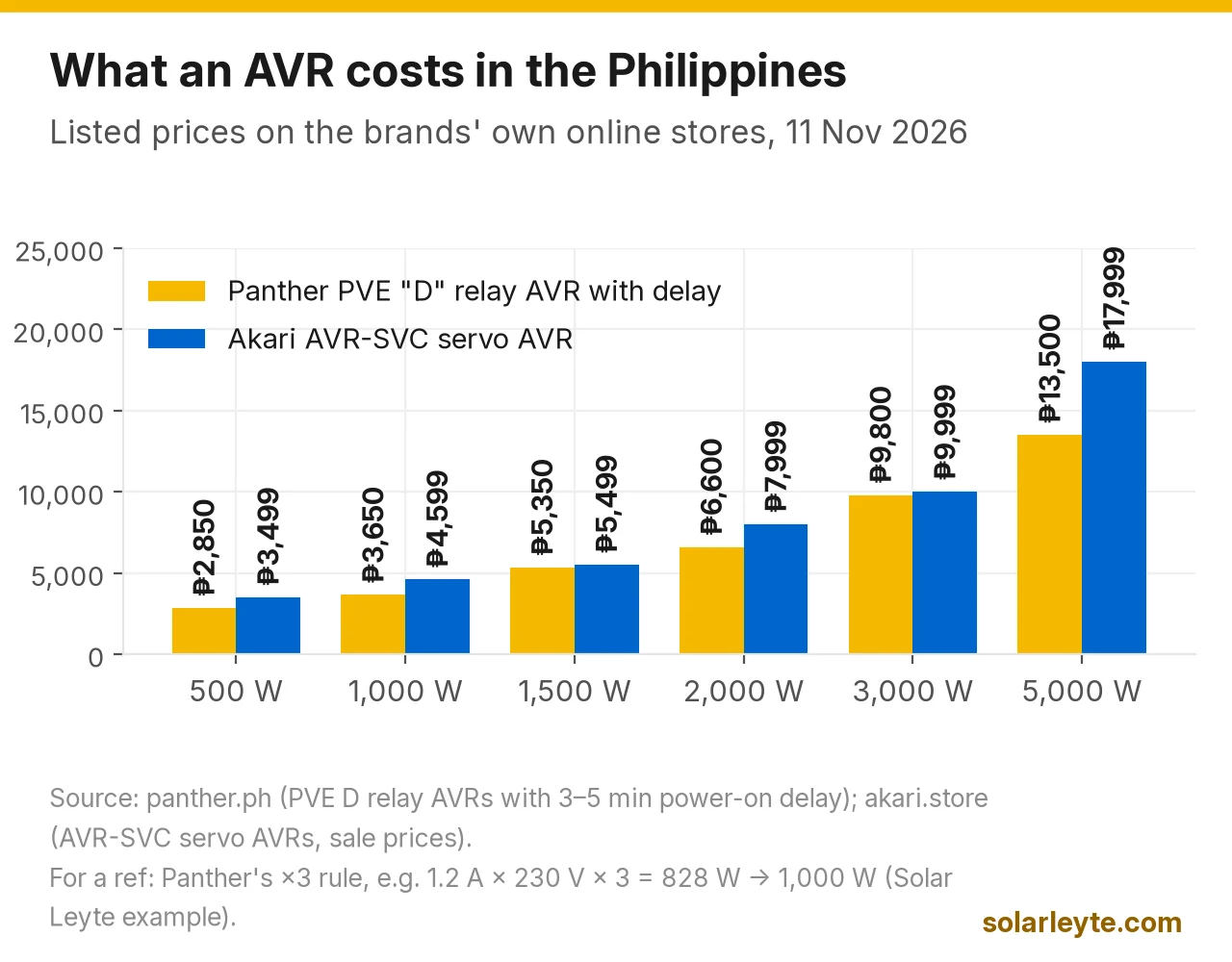
Sources: panther.ph product pages; Akari Store product pages (sale prices; the 10,000 W model and the 500D were sold out); Suraj, Goldsource SVC-2000TD. Akari's listings give watts and outlets but not the input voltage range or a delay feature, so ask the seller before buying one for a ref.
Relay or servo? Panther, which sells both, recommends relay AVRs for normal home appliances and says servo models are for very sensitive equipment like medical and lab devices. Servo units respond within milliseconds to a 1% change. Relay units respond within 1 second to a 7% change. Both wear out with heavy use: servo models need carbon brush replacement, and relay models may need new relays.
AVRs, solar and generators
- Hybrid solar inverter: when your hybrid inverter runs the house from the battery in a brownout, it makes its own 230 V. In grid mode, the Deye SG05LP1 is rated for grid voltage between 0.85 and 1.1 times nominal. When the grid goes outside its settings it shows a fault such as F42, "AC line low voltage" (see our Deye error codes post). Don't put an AVR between the co-op and a hybrid inverter unless the installer and the inverter maker agree. Plug-in AVRs for single appliances on the backup side are a separate, small decision.
- Generator: Panther's support says an AVR on a generator is fine if the generator can carry the load, but generator voltage can swing a lot and may go outside the AVR's input range. Size the generator first. Our generator vs solar post covers that.
Mga tip para sa brownout
- When the power goes out, switch off the ref and aircon at the wall or the AVR if they have no delay. Wait a few minutes after power returns before turning them back on.
- Don't plug the ref and aircon into one AVR. Panther advises one AVR per big appliance.
- Keep the AVR dry, off the floor if your area floods, and away from direct sun.
- If the AVR's fuse keeps blowing, it's too small for the appliance.
Bisaya quick take: Kung kanunay mo-ubos ang boltahe sa inyong lugar, AVR nga naay delay para sa ref. Pero basaha una ang label sa imong aircon. Basin dili na kinahanglan.
FAQ
Does an inverter ref need an AVR?
Not always. Check its label or spec sheet for a working voltage range. If it isn't listed and your voltage swings, Panther recommends an AVR with a power-on delay for inverter refs (about ₱2,850 to ₱5,350 for 500 to 1,500 W). If your power is steady, a ₱1,220 power-on delay covers the restart-after-brownout risk.
Kailangan ba ng AVR ang inverter aircon?
Depende sa brand. Midea says its DC inverter aircons in the Philippines run from 80 V to 265 V and don't need one. Samsung PH calls its aircons "stabilizer-free". If your spec sheet doesn't list a wide range, a voltage protector (from ₱1,360) or a 3,000 W AVR for a 1 HP unit is the usual choice.
What size AVR for a refrigerator?
Rated amps × 230 V × 3. A 1.2 A ref needs about 828 W, so buy a 1,000 W AVR. A 1.6 A ref works out to 1,104 W, so buy 1,500 W (Panther's own example).
Does an AVR use electricity?
A little, while it's working. Panther's support says the power-on delay and surge protector are "pass-through" with negligible use of their own, and that a switched-off AVR uses nothing. We found no published standby watt figure for these models, so we can't give a peso number.
Related guides
- Solar in typhoon country: protecting your system
- Lightning and surge protection for solar homes
- Inverter and battery backup for brownouts
- Solar panel for a refrigerator: size and cost
- Visayas grid yellow and red alerts
- How many kWh do your appliances use?
Solar Leyte is run by MACC Systems & Energy Solutions Inc., a solar installer in Naval, Biliran.
Get a free solar quote from MACC
Tired of brownouts and low evening voltage? Send us your latest BILECO or LEYECO bill and a list of what you want running during an outage, and we'll talk you through the options, with no obligation.
- Call/Text: 0955 723 5093
- Email: official@macc-inc.com or benjie@macc-inc.com
- Website: www.macc-inc.com
- Request a quote online: solarleyte.com/quote
- Office: Brgy. Talustusan, Naval, Biliran 6543
Sources (all checked 11 November 2026)
- Meralco, Power Quality Manual (Philippine Distribution Code limits: voltage variation ±10% of supply voltage, PDC Section 3.2.3; undervoltage ≤90% and overvoltage ≥110% of nominal for more than 1 minute; Meralco low-voltage supply 230 V; buy equipment with the same ±10% tolerance)
- Panther Products Philippines, product pages (prices and specs, 11 Nov 2026): PVE 500 ₱2,400; PVE 500 D ₱2,850; PVE 1001 D ₱3,650 (180–250 V in, 220 V ±7% out, 3–5 min delay); PVE 1501 D ₱5,350; PVE 2001 D ₱6,600; PVE 3001 D ₱9,800 (95–275 V in); PVE 5001 D ₱13,500; PVS 1000 (160–240 V in); PVS 5001 D ₱39,300 (190–250 V in, ±2%); PVP 2500 ₱1,220; PVP 3500 ₱1,360 (cut-off 160/250 V; delay 15 s / 30 s / 3 min); PPD 1000 ₱1,220 (10 A, 3–5 min)
- Panther guides: Buyer's guide to AVRs, 2024 update (×3 startup buffer for motors, +20% for TVs, amps × 230 V method, 1.6 A → 1,104 W → 1,500 W example, D series for inverter refs, PPD/PVP for basic refs, one AVR per appliance; support replies on aircon sizing and generators); Servo vs relay (servo within milliseconds of ±1%; relay within 1 second of ±7%; carbon brush and relay wear); AVR vs voltage protector (cut-off below 160 V / above 250 V; 3–5 min delay; "do NOT provide lightning surge protection"; ref still cool after 10 minutes off)
- Akari Store, product pages (sale prices, 11 Nov 2026): AVR-SVC 500 ₱3,499; AVR-SVC 1000 ₱4,599; AVR-SVC 1500 ₱5,499; AVR-SVC 2000 ₱7,999; AVR-SVC 3000 ₱9,999; AVR-SVC 5000 ₱17,999
- Suraj, Goldsource SVC-2000TD (₱4,795; 2,000 W; 160–240 V in; time delay)
- Midea Philippines, "Do You Need an AVR for Air Conditioner in the Philippines?", 3 June 2026 (80–265 V across its DC inverter line; "typical" aircon 198–264 V)
- Samsung Philippines, "Is a voltage stabilizer required for my air conditioner?" ("stabilizer-free"; may vary with local supply)
- Condura, Negosyo Pro single-door inverter upright freezer (145–270 V wide voltage operation)
- Deye, SUN-3.6–8K-SG05LP1-EU user manual, 19 March 2026 (rated input/output 220/230 V, range 0.85–1.1 Un)
- Grid window (207–253 V), the 196–253 V Deye window, and the three sizing examples: Solar Leyte calculations from the figures above