Yes, solar can run your ref, and it's one of the easiest home appliances to put on solar. A typical 7 to 8 cu ft ref uses 13.5 to 29.4 kWh a month on its DOE energy label, or about 0.45 to 1 kWh a day. For a no-frost model, plan on roughly 500 W of panels in December, a battery of about 1.5 kWh to carry it through the night, and an inverter rated about five times the ref's nameplate watts. That last part is where most small setups fail: the ref may only use 40 to 50 W on average, but its compressor needs a big kick to start.
So kaya, pero don't size it by the average watts alone. The surge, the night hours and a hot Leyte kitchen all matter.
Last checked 10 November 2026. Ref figures come from the DOE's energy label list and Mabces' listings; rates are the latest BILECO and LEYECO IV residential rates posted as of today (October 2026; neither co-op had posted November rates). The worked examples are Solar Leyte calculations with the assumptions stated, not a MACC quote.
The three numbers that matter
- kWh a month (the yellow DOE label). This is the ref's energy. Your panels and battery must supply it. Divide by 30 to get kWh a day.
- Rated watts (the nameplate sticker). This is how hard the ref pulls when the compressor runs. Your inverter or power station must handle it, plus the start-up surge.
- Hours without sun. A ref runs day and night. Whatever it uses after sunset has to come from a battery.
A ref is the opposite of a washing machine. A washer pulls a lot for an hour and stops. A ref pulls a little, but never stops. (Our washing machine post covers the other case.)
How much a ref uses: the DOE label medians
Refrigerators sold in the Philippines must carry a DOE energy label, and the DOE publishes the full list. Its list of active labels as of 31 December 2025 has 873 refrigerating appliances. We could read the size, type and monthly kWh for 859 of them and grouped them by size (1 cu ft = 28.3 litres):
Type and size | Models | Median kWh a month | Lowest to highest | Median kWh a day |
|---|---|---|---|---|
Direct cool (manual defrost), up to 5 cu ft | 24 | 18.9 | 12.6 to 21.9 | 0.63 |
Direct cool, 5 to 8 cu ft | 165 | 21.0 | 12.3 to 36.0 | 0.70 |
Direct cool, 8 to 11 cu ft | 61 | 22.8 | 17.1 to 41.1 | 0.76 |
No frost, 5 to 8 cu ft | 97 | 24.6 | 16.8 to 30.6 | 0.82 |
No frost, 8 to 11 cu ft | 180 | 27.9 | 19.2 to 36.0 | 0.93 |
No frost, over 11 cu ft | 325 | 39.0 | 20.4 to 62.7 | 1.30 |
Medians and ranges: Solar Leyte calculation from the DOE list. "Direct cool" is the list's "Cooling / Manual Defrost" type.
Two things jump out. First, size and type matter less than the model: in the 5 to 8 cu ft direct-cool group, the best label is 12.3 kWh and the worst 36.0, almost three times more for the same size. Second, no-frost refs use a bit more than direct-cool ones of the same size. On solar, every kWh you don't use is a smaller battery and fewer panels, so check the label before you buy.
Seven refs you can buy now, and what they'd cost to run
Here are seven 5 to 8 cu ft refs listed on Mabces on 10 November 2026, matched to their DOE label:
Model (type, size) | Rated watts | Label kWh a month | kWh a day | BILECO Oct (₱19.3628) | LEYECO IV Oct (₱17.0099) | Inverter to look for (× 5) | Listed price |
|---|---|---|---|---|---|---|---|
Condura CSD53MNi (1-door direct cool, inverter, 5.1 cu ft) | 55 W | 13.5 | 0.45 | ₱261 a month | ₱230 a month | 275 W | ₱10,150 |
Panasonic NR-AQ211VS (2-door direct cool, inverter, 7.6 cu ft) | 60 W | 15.6 | 0.52 | ₱302 | ₱265 | 300 W | ₱15,800 |
Haier HRF-IVD280H (2-door direct cool, inverter, 8.2 cu ft) | 130 W | 18.3 | 0.61 | ₱354 | ₱311 | 650 W | ₱17,423 |
Haier HRF-D280H (2-door direct cool, non-inverter, 8.2 cu ft) | 100 W | 21.9 | 0.73 | ₱424 | ₱373 | 500 W | ₱15,298 |
Whirlpool WF2T203 (no frost, inverter, 7.9 cu ft) | 130 W | 19.8 | 0.66 | ₱383 | ₱337 | 650 W | ₱22,798 |
Haier HRF-IV220VNF (no frost, inverter, 7.5 cu ft) | 77 W | 23.4 | 0.78 | ₱453 | ₱398 | 385 W | ₱18,698 |
Samsung RT20FARVDSA (no frost, inverter, 7.4 cu ft) | 100 W | 29.4 | 0.98 | ₱569 | ₱500 | 500 W | ₱18,995 |
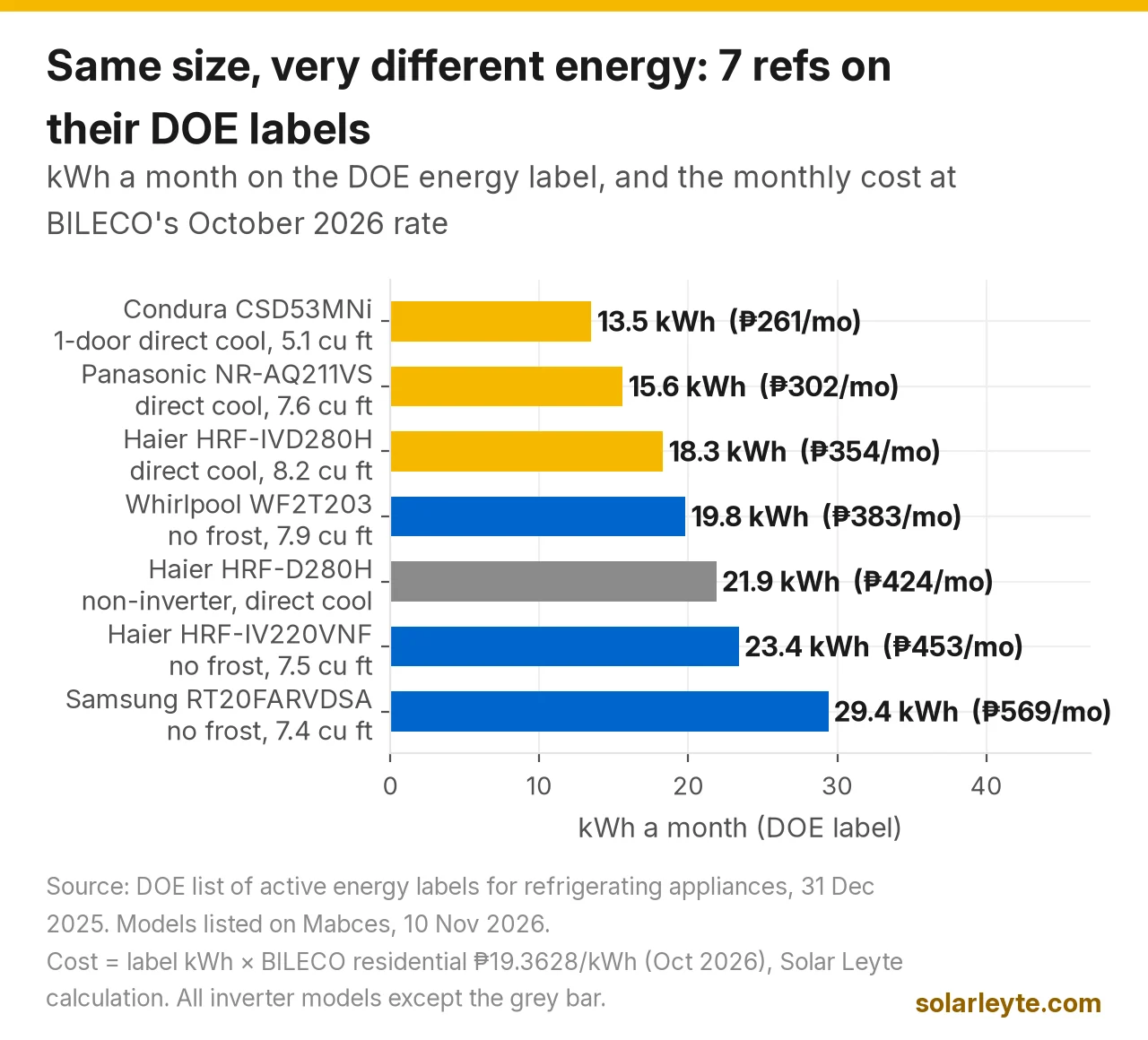
Rated watts and kWh: DOE label list. Prices: Mabces, 10 November 2026. Monthly cost = label kWh × the co-op's October 2026 residential rate (Solar Leyte calculation). Inverter column: rated watts × 5, Samlex's sizing factor for compressor appliances.
The cheapest ref to run here, the little Condura, costs about ₱261 a month at BILECO's rate. The Samsung costs about ₱569, more than double, even though it's only slightly bigger. On solar that gap means roughly twice the battery and panels.
Notice that the rated watts don't track the kWh. The Haier inverter model is rated 130 W but uses less energy than the 100 W non-inverter one. The nameplate tells your inverter what to expect; the label tells your battery.
Surge: why a 100 W ref needs a 500 W inverter
When a compressor starts, it pulls a burst of current for a moment. Danfoss, a compressor maker, says a fixed-speed compressor started straight on the line draws 5 to 6 times its normal current until it gets up to speed. That's why Samlex's inverter manual gives a sizing factor of 5 for compressor-based refrigerators, freezers and aircons: multiply the ref's running watts by 5 to get the continuous rating your inverter should have.
- A 100 W ref → look for a 500 W inverter or bigger.
- A 130 W ref → 650 W. A 1,000 W unit is comfortable.
Inverter refs are gentler. Embraco, which makes ref compressors, says variable-speed compressors "soft start": they start at a lower speed and ramp up. That's easier on a small inverter or power station than an old non-inverter ref slamming on at full speed. The ×5 rule is still a safe starting point, but an inverter ref is less likely to trip a small unit.
Two more rules from the inverter makers:
- Use a pure sine wave inverter. Motors such as ref compressors run "faster, quieter and cooler" on pure sine wave, according to Samlex. Our inverter and battery backup guide explains the difference.
- Check the power station's rated AC output, not just its Wh. A big battery with a small 300 W output can still fail to start a ref.
How long will a battery or power station keep the ref running?
The USDA's food-safety guidance says a ref keeps food safe for up to 4 hours with the door closed, and a full freezer holds for about 48 hours (24 if half full). So for a short evening brownout, just keep the door shut. For anything longer, here is what a battery buys you.
Assumptions: label kWh plus 25% for a hot kitchen and door openings (our assumption, since the label comes from a standard test); 85% of the battery's rated Wh reaches the ref after inverter losses and the battery's usable range (our assumption). Samsung RT20FARVDSA: 29.4 × 1.25 = 36.75 kWh a month, about 51 W on average. Panasonic NR-AQ211VS: 15.6 × 1.25 = 19.5 kWh, about 27 W on average.
Battery or power station size | Samsung no-frost (≈51 W average) | Panasonic direct cool (≈27 W average) |
|---|---|---|
256 Wh | about 4 hours | about 8 hours |
512 Wh | about 9 hours | about 16 hours |
1,024 Wh | about 17 hours | about 32 hours |
1,536 Wh | about 26 hours | about 48 hours |
2,048 Wh | about 34 hours | about 64 hours |
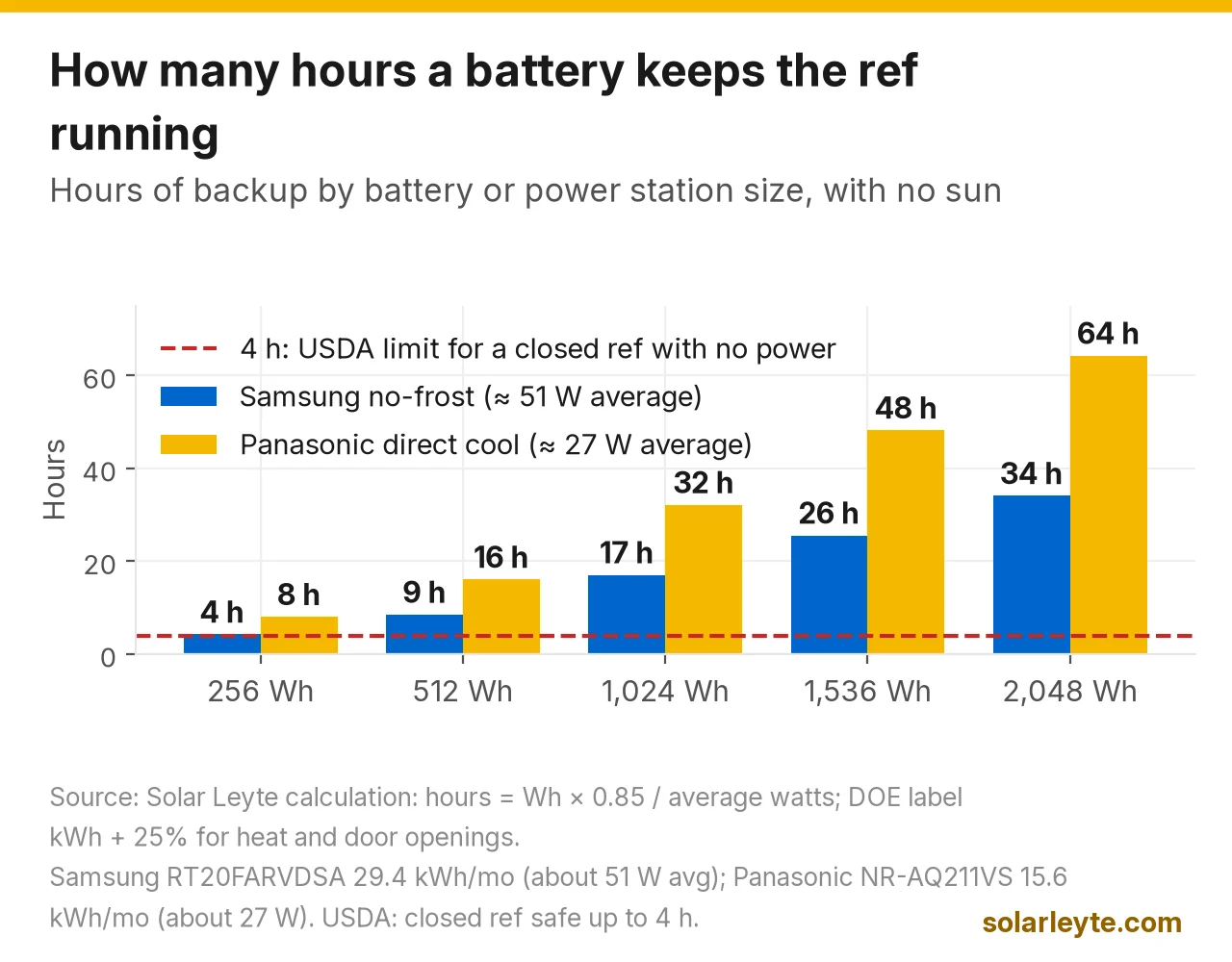
Hours = Wh × 0.85 ÷ average watts (Solar Leyte calculation).
A 1 kWh power station keeps a mid-size ref going overnight, as long as its AC output can start it. Our EcoFlow and power station price list has current prices by Wh and output.
Worked examples
Example A: an evening brownout, with no panels at all
Assumptions: Samsung RT20FARVDSA at about 51 W average (label + 25%), a 4-hour evening outage, 90% inverter efficiency (our assumption).
- Energy: 51 W × 4 h = about 204 Wh. From the battery at 90%: about 227 Wh.
- Inverter: 100 W × 5 = 500 W.
A 300 Wh power station or a small inverter and battery with 500 W+ output covers it. For a long scheduled maintenance shutdown, say 13 hours, it's about 51 × 13 ÷ 0.9 ≈ 737 Wh, so a 1 kWh unit. Our Wi-Fi and Starlink backup post shows how to add the router to the same box.
Example B: a small solar setup just for the ref
Assumptions: same Samsung at 1.225 kWh a day (36.75 ÷ 30); 85% overall system efficiency (our assumption); NASA POWER's December average of 3.86 kWh/m² a day for Naval, with a 0.75 allowance for heat, wiring and dust, so 1 kW of panels makes about 2.9 kWh a day in December; half the ref's energy used at night (our assumption).
- From the panels: 1.225 ÷ 0.85 ≈ 1.44 kWh a day.
- Panel size: 1.44 ÷ 2.9 ≈ 0.5 kW. Three 200 W panels (600 W) give a little margin for cloudy days.
- Night energy: 1.225 ÷ 2 ÷ 0.9 ≈ 0.68 kWh. A 12.8 V 120 Ah LiFePO4 battery (about 1.54 kWh) covers the night with room for a cloudy morning.
- Inverter: 500 W minimum for this ref. A 1,200 W 12 V unit with a built-in solar charger has plenty of headroom.
Here's what those parts list for (Beyond Power, 10 November 2026):
Part | Listed price |
|---|---|
Higee 12.8 V 120 Ah LiFePO4 battery (about 1.54 kWh) | ₱13,400 |
One Solar 12 V 1,200 W hybrid off-grid inverter, pure sine wave, 40 A MPPT | ₱10,100 |
3 × Solar Home 200 W monocrystalline panels (₱3,400 each) | ₱10,200 |
Parts total | ₱33,700 |
That's parts only. Mounting, cables, breakers and an electrician's labour come on top, and the battery will need replacing one day. One check before you buy: a 40 A charger on a 12 V battery tops out around 510 to 560 W of charging (40 A × 12.8 to 14 V, our calculation), and the panels' open-circuit voltage must stay under the charger's limit. Ask the seller for the full spec sheet.
Does it pay off? At 36.75 kWh a month, the ref costs about ₱712 a month at BILECO's October rate, or ₱625 at LEYECO IV's. ₱33,700 ÷ ₱712 ≈ 47 months, so roughly four years on parts alone, longer at LEYECO IV (about 54 months). Honestly, a ref-only kit is mainly a brownout solution. If saving on the bill is the goal, a rooftop system that covers the whole house usually does better per peso.
Example C: the ref on a whole-house rooftop system
Assumptions: a 3 kW rooftop system at 2.9 kWh per kW a day in December (from Example B).
- 3 × 2.9 ≈ 8.7 kWh a day in December.
- The Samsung's 1.225 kWh a day is about 14% of that.
On a grid-tied system, the ref runs off the panels in the daytime and off the grid at night, but it stops in a brownout because a grid-tied inverter shuts down. A hybrid with a battery keeps it running. Our grid-tie vs hybrid guide explains why.
Inverter or non-inverter ref, if you're buying new for solar?
Compare the two Haier 8.2 cu ft direct-cool models in the table:
- The inverter model uses 18.3 kWh a month, the non-inverter 21.9. That's 3.6 kWh less, about ₱70 a month at BILECO's rate (₱61 at LEYECO IV).
- It lists for ₱2,125 more (₱17,423 vs ₱15,298), so it pays back in about 30 months at BILECO's rate (about 35 months at LEYECO IV) on the bill alone.
On solar it also means a smaller battery for the night and a softer start for your inverter. But the label matters more than the word "inverter": even the non-inverter Haier (21.9 kWh) uses less than two of the no-frost inverter refs in our table (23.4 and 29.4 kWh).
What about "solar refrigerators"?
Most refs sold as "solar refrigerators" online are 12 or 24 V DC fridges or chest freezers that run straight from a battery, with no inverter. They make sense on a boat, a small island store or an off-grid farm hut. Our solar freezer and ice maker post covers the DC chest freezers and portable fridge-freezers. For a normal kitchen, an efficient AC ref plus a battery and inverter is usually easier to buy, repair and resell.
Tips that cut the battery you need
- Pick the lowest label kWh you can afford. In our table, the Condura uses less than half the Samsung's energy.
- Keep it out of the sun and away from the stove, with a gap at the back for air.
- Keep the door seal tight and don't overfill. Our appliance kWh guide lists Meralco's test results for these habits.
- In a brownout, keep the door shut. USDA says the ref holds food safely for up to 4 hours that way.
- Don't run the ref and a pump off a small inverter at the same time. Two motors starting together can trip it.
Bisaya quick take
Kaya ra sa solar ang ref. Ang kasagaran nga 7 hangtod 8 cu ft nga ref mogamit og 13.5 hangtod 29.4 kWh matag bulan sumala sa DOE label, mga 0.45 hangtod 1 kWh matag adlaw. Ang importante kay ang inverter: mga lima ka pilo sa watts sa ref, ug pure sine wave. Kung brownout, ayaw ablihi ang ref; luwas ang pagkaon hangtod 4 ka oras.
FAQ
How many solar panels do I need to run a refrigerator?
For a typical 7 to 8 cu ft ref, about 250 to 500 W of panels, depending on the model. In our Example B, a no-frost Samsung at 1.225 kWh a day (label + 25%) needs about 500 W in December in Naval. An efficient direct-cool ref like the Panasonic NR-AQ211VS (19.5 kWh a month with the same margin) needs about 260 W, roughly half.
Can a 1,000 W inverter run a ref?
Yes, for most home refs. By Samlex's ×5 rule, 1,000 W covers a ref rated up to 200 W. Every ref in our table is 130 W or less. Use pure sine wave, and don't start a pump or aircon on the same small inverter at the same time.
How long can a power station run a refrigerator?
Roughly Wh × 0.85 ÷ the ref's average watts. A 1,024 Wh unit runs a mid-size no-frost ref (about 51 W average) for about 17 hours, or an efficient direct-cool ref (about 27 W) for about 32 hours, if its AC output can start the compressor.
Inverter ref ba ang dapat sa solar?
Mas maganda, pero tingnan pa rin ang DOE label. Inverter compressors start softly and usually use less, like the Haier 18.3 vs 21.9 kWh pair above. But some non-inverter or direct-cool refs beat some inverter no-frost ones, so compare the kWh on the yellow label.
Related guides
- Solar generators and portable power stations
- How many kWh your appliances use
- Inverter + battery backup without solar
- EcoFlow and power station prices
- Solar for sari-sari stores (freezer + home ref)
- 12V vs 24V vs 48V systems
- BILECO rate per kWh in 2026
Solar Leyte is run by MACC Systems & Energy Solutions Inc., a solar installer in Naval, Biliran.
Get a free solar quote from MACC
Want your ref, fans and Wi-Fi to keep running in a brownout? Send us a photo of your ref's DOE label (or the watts on its sticker) and your latest BILECO or LEYECO bill, and we'll suggest a system, with no obligation.
- Call/Text: 0955 723 5093
- Email: official@macc-inc.com or benjie@macc-inc.com
- Website: www.macc-inc.com
- Request a quote online: solarleyte.com/quote
- Office: Brgy. Talustusan, Naval, Biliran 6543
Sources (all checked 10 November 2026)
- DOE, List of active energy labels for refrigerating appliances as of 31 December 2025 (PDF): 873 labels; volume, rated watts and monthly kWh for Condura CSD53MNi (144 L, 55 W, 13.5), Panasonic NR-AQ211VS (214 L, 60 W, 15.6), Haier HRF-IVD280H (206 L, 130 W, 18.3), HRF-D280H (206 L, 100 W, 21.9), HRF-IV220VNF (211 L, 77 W, 23.4), Whirlpool WF2T203 (205 L, 130 W, 19.8), Samsung RT20FARVDSA (208 L, 100 W, 29.4). Medians by size: Solar Leyte calculation.
- DOE, Energy Efficiency and Conservation page: where the DOE posts the label lists.
- Mabces, Condura CSD53MNi: ₱10,150.
- Mabces, Panasonic NR-AQ211VS: ₱15,800.
- Mabces, Haier HRF-IVD280H: ₱17,423.
- Mabces, Haier HRF-D280H: ₱15,298.
- Mabces, Whirlpool WF2T203: ₱22,798.
- Mabces, Haier HRF-IV220VNF: ₱18,698.
- Mabces, Samsung RT20FARVDSA: ₱18,995.
- Samlex SWI series inverter manual (PDF), Table 2.1: inverter sizing factor 5 for compressor-based air conditioners, refrigerators and freezers.
- Samlex, Advantages of pure over modified sine wave inverters (PDF): motors run "faster, quieter and cooler" on pure sine wave.
- Danfoss, Variable-speed compressors: direct-on-line start draws 5 to 6 times nominal current.
- Embraco, Variable speed compressors: soft start, starting at a lower speed and ramping up.
- USDA FSIS, Keep your food safe during emergencies: ref keeps food safe up to 4 hours; full freezer about 48 hours (24 if half full).
- BILECO, October 2026 effective rate: residential ₱19.3628/kWh.
- LEYECO IV, October 2026 rates: residential ₱17.0099/kWh.
- Beyond Power, Higee 12.8 V 120 Ah LiFePO4: about 1.54 kWh; ₱13,400.
- Beyond Power, One Solar 12 V 1,200 W hybrid off-grid inverter, 40 A MPPT: pure sine wave; ₱10,100.
- Beyond Power, Solar Home 200 W mono panel: ₱3,400.
- NASA POWER monthly API, Naval (11.56° N, 124.40° E), 2001–2025: December mean 3.86 kWh/m² a day (our average of the monthly values).