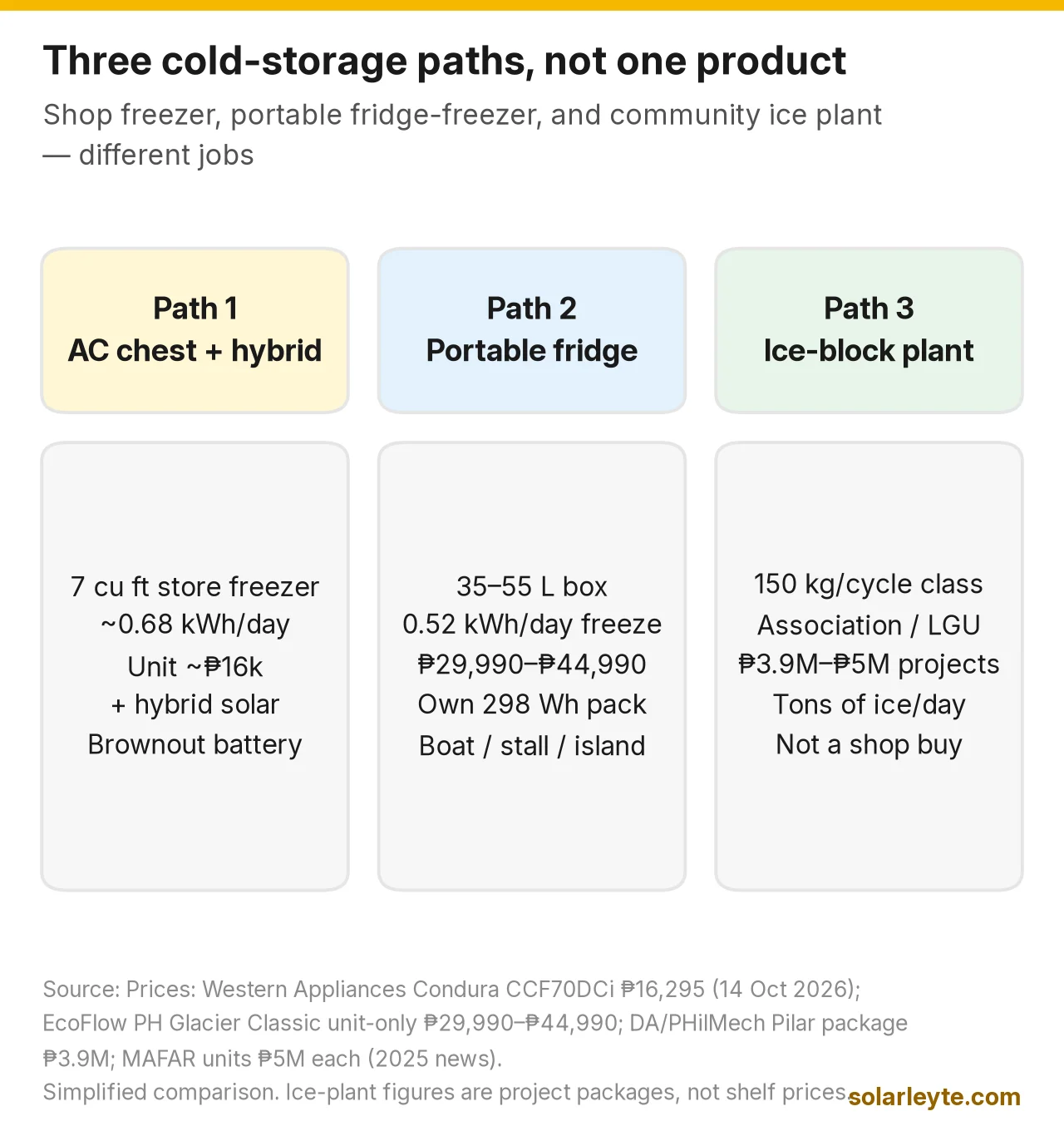
Keeping fish, ice candy or frozen goods cold in Eastern Visayas is really three different problems. A sari-sari or fish vendor usually needs a regular chest freezer that survives brownouts. A boat, island stall or weekend catch may only need a portable fridge-freezer with its own battery. A barangay association that sells ice by the block is looking at a solar ice plant, not a shop appliance. The kWh, the peso prices and the solar size are not interchangeable.
This post sizes each path with numbers you can check: Condura Negosyo Pro labels and Western Appliances list prices (14 October 2026), EcoFlow PH Glacier Classic specs and prices, Department of Agriculture / PHilMech and MAFAR project figures for ice plants, PRESYO-PH September 2026 co-op rates, and PVGIS output for Naval, Biliran. Bill and brownout figures are Solar Leyte calculations. Nothing here is a MACC installed price or quote — and we do not claim MACC sells ice plants or DC freezers.
If you already run a store freezer, start with our sari-sari solar guide for the full store load (fans and lights included). Battery pesos are in the solar battery price post. Portable power stations are compared in the EcoFlow and solar generator price guide.
Path 1: A normal chest freezer on hybrid solar
Most Leyte and Biliran fish vendors and sari-sari stores already own (or will buy) a 230 V AC chest freezer. You do not need a special "solar freezer" for this path. You need panels, a hybrid inverter and a battery so the compressor keeps running when BILECO or LEYECO is dark.
Condura's Negosyo Pro inverter line is aimed at stores. Label figures from Condura's product page, and Western Appliances list prices checked 14 October 2026:
Model | Size | Label kWh/day | About kWh/month | Western list price | BILECO Sep (₱18.93) | LEYECO II Sep (₱14.05) |
|---|---|---|---|---|---|---|
CCF35DCi | 3.5 cu ft | 0.58 | 18 | ₱13,300 | ₱334 | ₱248 |
CCF50DCi | 5.0 cu ft | 0.59 | 18 | ₱14,295 | ₱340 | ₱252 |
CCF70DCi | 7.0 cu ft | 0.68 | 21 | ₱16,295 | ₱392 | ₱291 |
CCF86DCi | 8.6 cu ft | 0.86 | 26 | ₱17,495 | ₱495 | ₱367 |
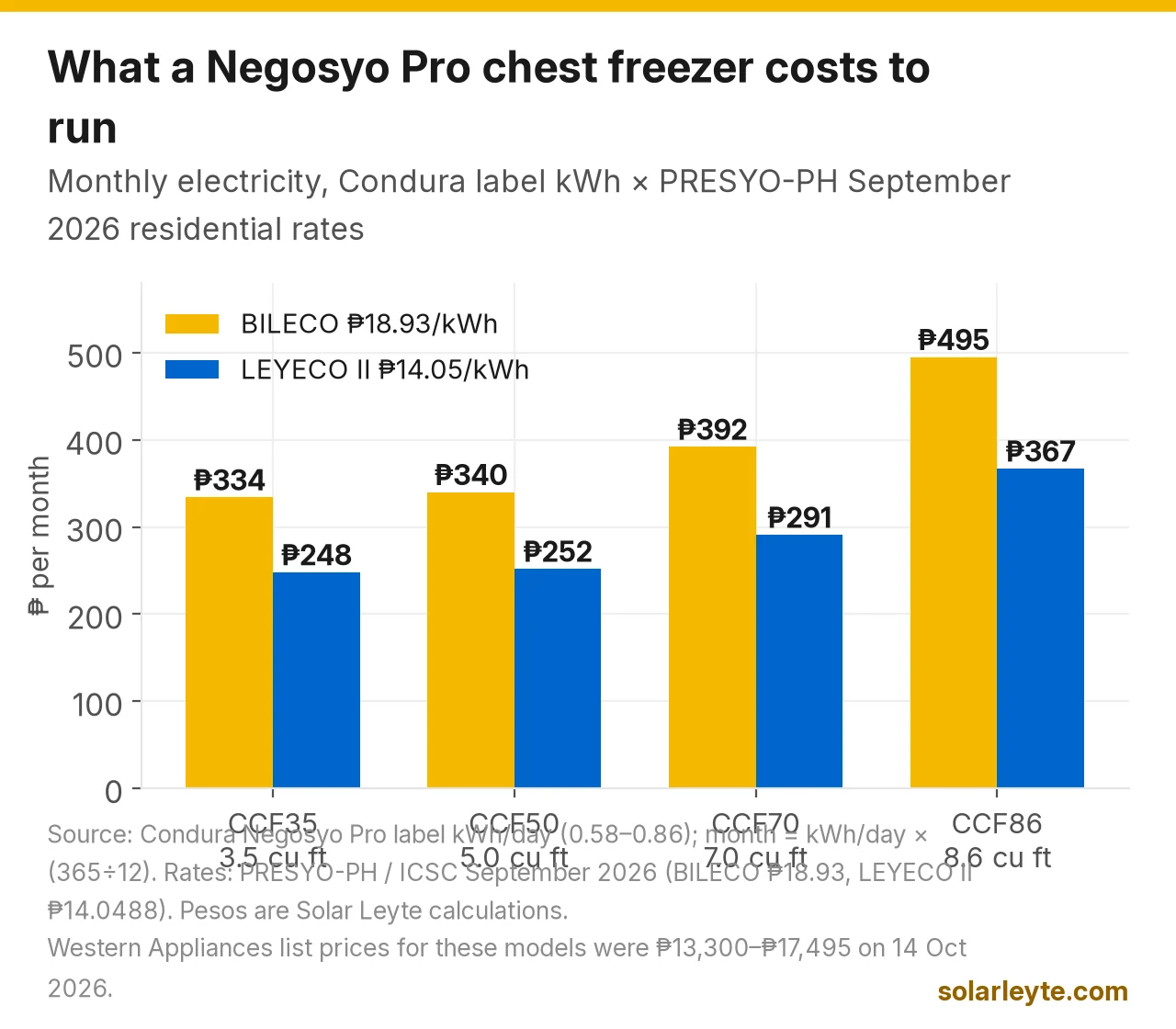
Sources: Condura Negosyo Pro Inverter Chest Freezer specs (wattage 75 W on the 3.5–7.0 models, 120 W on the 8.6; kWh/24hr as published); Western Appliances product pages for CCF35DCi, CCF50DCi, CCF70DCi and CCF86DCi (14 Oct 2026). Month = kWh/day × (365÷12). Pesos are Solar Leyte calculations at PRESYO-PH September 2026 residential rates (BILECO ₱18.93, LEYECO II ₱14.0488). Condura's own "cost per day" uses an older Meralco average (₱11.44), so we re-priced at Eastern Visayas rates.
A few practical notes:
- The freezer is on 24 hours. Fans and lights only run while the stall is open. Hybrid solar with a battery is what protects the stock during Visayas yellow or red alerts (see our Visayas grid alerts post).
- Inverter chests use less than older conventional ones. In our sari-sari post, Meralco's Power Lab median for inverter solid-lid chests was 0.61 kWh/day versus 1.01 for conventional. If you're replacing a worn-out unit, the inverter premium often pays for itself in electricity alone.
- Compressor start needs surge headroom. The running watts on the Condura labels are 75–120 W, but the starting surge is higher. A 3–5 kW hybrid inverter is the usual fit for one freezer plus lights and fans — see hybrid inverter prices.
What size solar for Path 1
PVGIS 5.3 for Naval, Biliran, puts a 1 kWp array at about 124 kWh a month on average (1,487 kWh/year ÷ 12; ERA5, 11° tilt, south, 14% losses — same basis as our earlier posts). A 7 cu ft freezer alone is only about 21 kWh a month, so even 1.5 to 2 kWp overshoots the freezer's monthly energy. The real limits are coincidence (when the sun shines vs when the compressor runs) and how many brownout hours you want covered.
Piece | Rough size | Notes |
|---|---|---|
Panels | 1.5 to 3 kWp | Covers the freezer with margin for fans/lights; see 550–620 W panel prices |
Hybrid inverter | about 3 to 5 kW | Surge headroom for the compressor |
Battery | 3 to 5 kWh LiFePO4 usable target | Four-hour evening brownout for freezer + lights |
Critical-load panel | freezer first, then lights/fan | Don't put the whole house on backup unless you size for it |
A 5–6 kWh LiFePO4 wall battery was listed at ₱42,000 to ₱67,800 by PH sellers in our October 2026 battery check. Parts for a small hybrid (panels + inverter + one battery) often land in the mid-₱100,000s before labour and permits — get real quotes; we are not publishing a MACC package price.
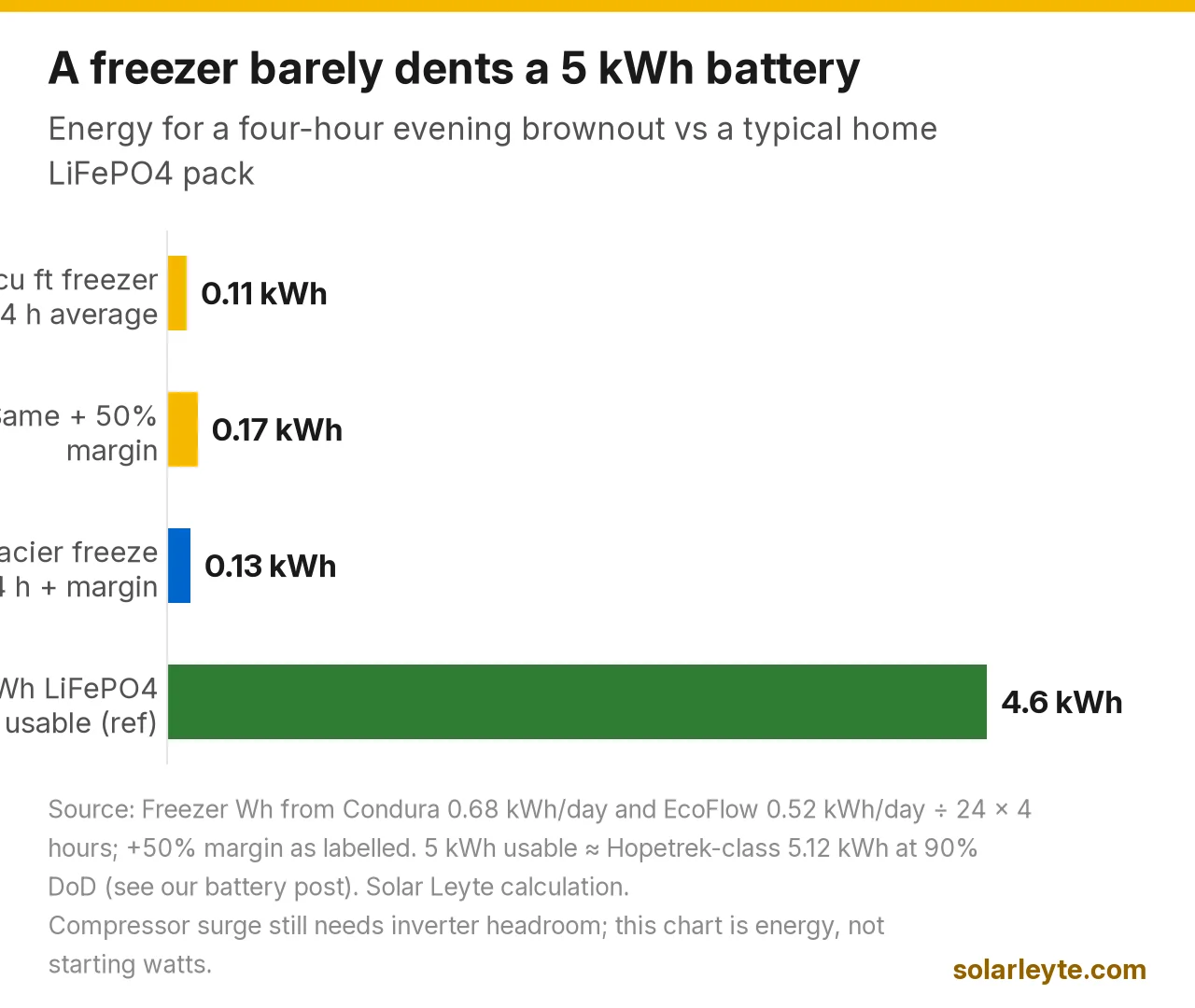
Four-hour brownout math (Solar Leyte): the Condura 7 cu ft label averages 0.68 kWh over 24 hours, so four hours at that average is about 0.11 kWh, or about 0.17 kWh with a 50% margin for door openings and a hot afternoon. That is tiny compared with a 5 kWh battery. The battery is sized for hours of backup and other loads, not because the freezer alone needs 5 kWh. Plain grid-tie with no battery still cuts the daytime bill but shuts off in a brownout.
Path 2: A portable fridge-freezer with its own battery
If you need cold storage on a boat, in a temporary stall, or on an island with weak grid, a 12/24 V portable fridge-freezer can be simpler than a rooftop hybrid. It runs on its own pack, a car outlet, or a small solar input — no house inverter required for the fridge itself.
On EcoFlow's official Philippine store (14 October 2026), the GLACIER Classic portable fridge freezer listed as:
Size | Unit only | With add-on battery | Notes from EcoFlow PH specs |
|---|---|---|---|
35 L | ₱29,990 | ₱42,590 | Up to 58 cans (330 ml); built-in 298 Wh pack |
45 L | ₱39,990 | ₱52,590 | Dual-zone; up to 72 cans |
55 L | ₱44,990 | ₱57,590 | Dual-zone; up to 90 cans |
Rated power 55 W. EcoFlow's Eco-mode test at 25 °C ambient: 165 Wh/24 h in fridge mode (4 °C) and 520 Wh/24 h in freezer mode (−18 °C). Solar charging input 11–30 V, 110 W max. Built-in battery 298 Wh; the maker claims up to about 39–43 hours at fridge temperature on the pack alone (Eco mode, 25 °C). Those are maker figures, not our field test in Biliran heat.
Re-priced at Eastern Visayas rates (Solar Leyte calculation from the 520 / 165 Wh/day figures):
Mode | kWh/day | kWh/month | BILECO Sep ₱18.93 | LEYECO II Sep ₱14.05 |
|---|---|---|---|---|
Freezer (−18 °C) | 0.52 | 16 | ₱299 | ₱222 |
Fridge (4 °C) | 0.165 | 5 | ₱95 | ₱70 |
What this path is good for: a day's catch, drinks, a market weekend, or a backup cooler when the shop freezer is full. What it is not: a substitute for a 7 cu ft store chest. 35–55 litres is roughly 1.2–1.9 cu ft — fine for a boat box, tight for a sari-sari's ice cream stock.
A folding panel on the 110 W input tops up slowly; for multi-day off-grid use, pair it with a small power station from the EcoFlow price guide or the maker's add-on battery. For a permanent island home with no grid, compare a real off-grid solar build instead of stacking portables.
DC "solar chest freezers" (the 12/24 V shop units)
Exporters sell 108–300 L DC chest freezers rated around 50–90 W and about 0.5 kWh/day, meant to wire straight to a battery bank with no inverter. We looked for a clear Philippine retail peso price on 14 October 2026 and did not find a trustworthy public listing (several China wholesale pages, and a distributor page with no published price). A MAFAR "solar-powered chest freezer with complete accessories" tender carried an ABC of ₱149,865 (closes 14 October 2026 on the notices we saw) — that is a government budget ceiling for a packaged unit, not a shelf price in Tacloban. If a seller quotes you a DC chest, ask for the datasheet (12 vs 24 V, Wh/day at 32 °C, starting current) and a local warranty contact before you pay.
Path 3: A community solar ice-block plant
Fisherfolk associations that sell ice by the block are in a different league from a shop freezer. Recent Philippine projects:
- PHilMech / DA in Pilar, Cebu (February 2025): a solar-powered ice-block machine handed over at a project cost of ₱3.9 million. Capacity: up to 30 blocks per cycle at 5 kg each (150 kg per cycle), up to four cycles a day, with solar panels, hybrid inverter, batteries, water filtration, crusher, chest freezer and crates included (DA press release; PHilMech story).
- MAFAR in Maguindanao del Norte and Lanao del Sur (June 2025): three solar-powered ice-block makers, ₱5 million each, rated at 45 blocks a day (BARMM / MAFAR news).
- AASC "Sahaya" commercial plants: marketed at 1–10 tons of ice per day; the company quotes on request and does not publish a fixed peso price on its page.
These are association or LGU-scale investments, usually tied to a grant or cooperative budget — not a sari-sari purchase. If your barangay in Biliran or Leyte is exploring one, the useful questions are daily ice demand (kg), whether you need block or crushed ice, who owns the land and the power system, and who pays for battery replacement in year 8–10. MACC installs rooftop and hybrid solar; we are not quoting ice-plant turnkey packages here.
A smaller public-procurement data point: a MAFAR RFQ for 16 × 14 cu ft inverter chest freezers (support to solar ice-block installs) set an ABC of ₱40,500 per unit (₱648,000 total) — that is the freezer accessory only, not the ice machine or the solar plant.
Which path fits you?
Your situation | Better path | Why |
|---|---|---|
Sari-sari or fish stall with a chest freezer already | Path 1 (hybrid rooftop) | Protects existing stock in brownouts; bill savings on top |
Boat, temporary stall, or small catch box | Path 2 (portable) | Moves with you; no roof work |
Barangay / cooperative selling ice by the block | Path 3 (ice plant) | Tons of ice, not litres of freezer space |
Island house with no grid at all | Off-grid rooftop + Path 1 freezer | See off-grid solar; portables alone get expensive fast |
Running cost at BILECO and LEYECO rates
PRESYO-PH (ICSC's tracker, compiled from co-op rate disclosures) for September 2026 residential:
Co-op | ₱/kWh (Sep 2026) |
|---|---|
BILECO (Biliran) | ₱18.93 |
LEYECO IV | ₱16.97 |
LEYECO V | ₱16.38 |
LEYECO II | ₱14.05 |
So the same Condura 7 cu ft freezer (≈21 kWh/month) costs roughly ₱392 on BILECO and ₱291 on LEYECO II before fixed charges. A Glacier Classic left in freezer mode (≈16 kWh/month) is about ₱299 / ₱222. Your bill's rate class (residential vs commercial) matters — many home-based stalls stay residential; a separate store meter may not. Read the class printed on the bill.
Honest payback notes
- Path 1: bill savings on 21 kWh/month alone are modest (a few hundred pesos). The stronger case in Eastern Visayas is not losing a freezer of fish or ice cream during rotating brownouts. Spoilage losses often dwarf the kWh savings — count those before you decide.
- Path 2: you are buying mobility and a built-in pack, not the cheapest ₱/litre of cold storage. Compare it to a cheap chest freezer + power station only if you truly need to move the box.
- Path 3: payback is a cooperative business plan (ice sold per day × margin − O&M), usually under a grant. Do not mix it into a household solar quote.
For systems that export nothing, DOE Department Circular DC2026-08-0017 (August 2026) simplifies some paperwork, but its plug-and-play allowance is only for tiny systems (up to 1 kW of panels with a micro-inverter of 0.8 kW AC or less), which is far too small for an ice-business freezer; details are in our plug-and-play and zero-export post. Licence and paperwork checks for installers are in how to choose a solar installer in Leyte and Biliran.
Before you ask for a quote
- Photograph the yellow energy label (or nameplate watts) on every freezer or cooler you run.
- Note your bill's rate class and ₱/kWh.
- Decide what must stay cold in a brownout (one chest? lights too?).
- Estimate outage length in your barangay (1 hour, 4 hours, overnight).
- For Path 2: measure the box you need in litres, not "solar freezer" marketing watts.
- For Path 3: write down daily ice demand in kilograms and who will own the plant.
FAQ
How much power does a solar freezer use? It depends which path you mean. A Condura 7 cu ft Negosyo Pro inverter chest uses 0.68 kWh a day on the maker's label (~21 kWh/month). An EcoFlow Glacier Classic in freezer mode uses 0.52 kWh a day on the maker's Eco-mode test. A community ice plant is sized in tons of ice per day, not household kWh.
Can solar keep my freezer running during a brownout? Only with a battery (hybrid rooftop, off-grid, or a portable unit's own pack). Plain grid-tie shuts off when the co-op line is dead.
Is a DC solar chest freezer cheaper than hybrid + AC freezer? Sometimes on paper, but we could not verify a clear PH retail peso price on 14 October 2026. Factor in local warranty, spare compressors, and whether anyone near Naval or Tacloban will service it.
How much is a solar ice plant? Recent public projects: about ₱3.9 million (PHilMech Pilar package) and ₱5 million per MAFAR unit. Commercial plants (1–10 tons/day) are quoted case by case.
Should a fish vendor buy an ice plant or a chest freezer? If you sell fish and buy ice from someone else, Path 1 (or Path 2 for mobile) is usually enough. An ice plant makes sense when your group sells ice as a product.
Solar Leyte is run by MACC Systems & Energy Solutions Inc., a solar installer in Naval, Biliran.
Get a free solar quote for your freezer or stall from MACC
Send us a photo of your last BILECO or LEYECO bill, your freezer's energy label, and what must stay on in a brownout. We'll size panels, hybrid inverter and battery around that list — or tell you honestly if a portable cooler is the better first step. No obligation. We do not sell ice-block plants.
- Call/Text: 0955 723 5093
- Email: official@macc-inc.com or benjie@macc-inc.com
- Website: www.macc-inc.com
- Request a quote online: solarleyte.com/quote
- Office: Brgy. Talustusan, Naval, Biliran 6543
Sources (all checked 14 October 2026)
- Condura, Negosyo Pro Inverter Chest Freezer (CCF35DCi–CCF86DCi label kWh/day and watts)
- Western Appliances list prices: CCF35DCi, CCF50DCi, CCF70DCi, CCF86DCi (₱13,300 / ₱14,295 / ₱16,295 / ₱17,495 on 14 Oct 2026)
- EcoFlow PH, GLACIER Classic Portable Fridge Freezer and Glacier Series (size prices, 55 W, 165/520 Wh/24h, 110 W solar input, 298 Wh pack)
- Department of Agriculture, PHilMech taps power of the sun to produce ice in fishing town (₱3.9M, 150 kg/cycle); PHilMech story mirror
- Bangsamoro Information Office / MAFAR, Fisherfolk receive solar-powered ice block makers (₱5M, 45 blocks/day)
- AASC, Sahaya solar-powered ice plant (1–10 tons/day, quote on request)
- MAFAR RFQ notices summarised on tender aggregators: 16 × 14 cu ft inverter chest freezers ABC ₱40,500 each; solar-powered chest freezer with accessories ABC ₱149,865 (TDIF 2025)
- Rates: PRESYO-PH / ICSC, national tracker (September 2026: BILECO ₱18.93, LEYECO II ₱14.05, LEYECO IV ₱16.97, LEYECO V ₱16.38)
- Solar output: European Commission JRC, PVGIS 5.3 Naval, Biliran
- DOE, DC2026-08-0017
- Related Solar Leyte posts: sari-sari, battery price, EcoFlow / power stations, off-grid, Visayas alerts