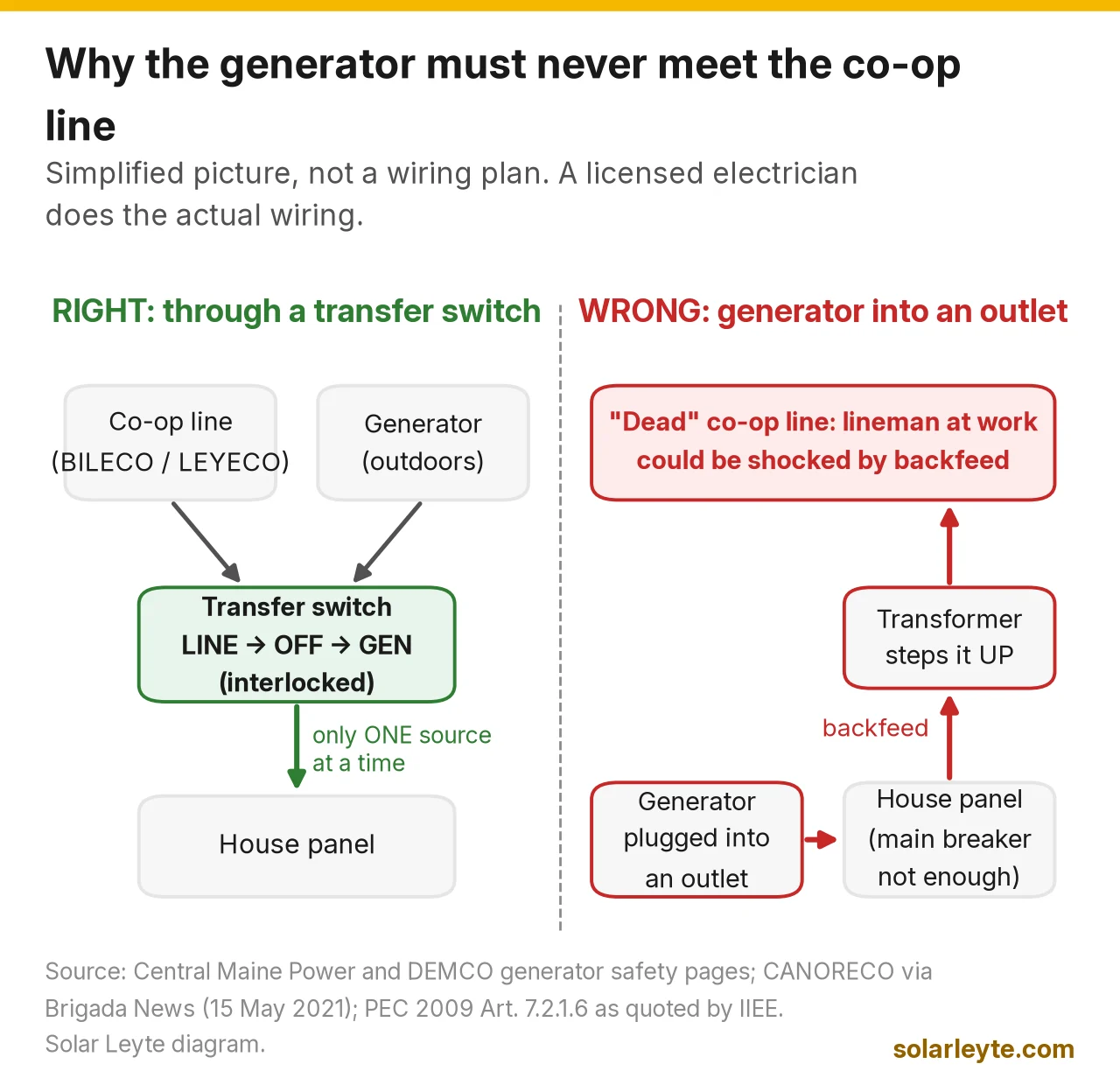
If you want your generator to power your house wiring, not just a few appliances on extension cords, you need a transfer switch. It connects your house to either the co-op line or the generator, never both at once. Without one, your generator can feed power back into the BILECO or LEYECO line while linemen are working on it. The switch is cheap. On 27 October 2026 we found 2-pole manual transfer switches from ₱700 to ₱3,000 at Philippine electrical suppliers, and small automatic ones (ATS) on Lazada from about ₱570 to ₱1,480. Budget too for a registered master electrician to wire it in.
Still choosing between a generator and a battery? Start with our generator vs solar comparison.
Last checked: 27 October 2026. Prices change often. This is general information, not a wiring guide. Any connection to your house wiring is a job for a licensed electrician.
What "backfeed" is, and why co-ops warn about it
Co-op crews switch off the line they're repairing and treat it as dead. If your generator is connected to your house wiring with nothing separating it from the co-op line, its power can flow out onto that line. That's backfeed.
Central Maine Power, a US utility, puts it plainly: transformers can "step up this backfeed to thousands of volts", and that's a hazard to a lineworker repairing the line. Philippine co-ops give the same warning. CANORECO in Camarines Norte reminded generator owners that a transfer switch must be installed, because without one, power can feed back into the main line. They said that's dangerous for the people in the house and for their linemen.
CMP also notes that the generator itself can be damaged if co-op power returns while it's still connected.
What the Philippine Electrical Code says
The Philippine Electrical Code (PEC) treats a home generator as an optional standby system. An IIEE presentation on the most common errors found before the distribution utility's final inspection quotes the 2009 edition, Article 7.2.1.6. It says transfer equipment "shall be designed and installed so as to prevent the inadvertent interconnection of normal and alternate sources of supply in any operation of the transfer equipment", and that it is required for every standby system where the utility is the normal or standby source. The same slides say a manual (non-automatic) transfer switch "shall be provided with mechanical and/or electrical interlock". "No interlock for transfer switch" is listed as one of the common errors.
The PEC in force now is the 2017 edition. We couldn't read its full text online for free, so ask your electrician to confirm the current article numbers. The rule itself hasn't gone away.
Who may do the work: under RA 7920 (the Electrical Engineering Law), Section 31, a registered master electrician's field of practice covers the "installation, wiring, operation, maintenance and repair" of electrical equipment in homes and other buildings. Bigger jobs (over 500 kVA or 600 V) need an electrical engineer's supervision. A home transfer switch is well under both limits. Ask your LGU's building official whether you need an electrical permit (see our permit and CFEI guide).
The types of switch, and what they cost
These are the switches you'll actually see for sale in the Philippines. Prices are listed prices checked on 27 October 2026, before shipping and installation.
Type | How it works | Example listings (27 Oct 2026) | Good to know |
|---|---|---|---|
Knife switch, 2-pole double-throw | A lever with bare metal blades moves between "line" and "generator" | 7 Lazada listings, ₱104 to ₱746 | Exposed live parts. Must sit inside a closed box. Many electricians won't use one for a house |
Manual transfer switch (MTS), DIN rail | Two breaker-style handles joined by a mechanical interlock, so only one side can be on | Royu MTS 2P, 32 A or 63 A: ₱700 to ₱790 (two PH stores) | Fits in a standard breaker box. Royu lists 4.5 kAIC and an on/off indicator |
Manual transfer switch in its own enclosure | Same idea, larger, with an enclosure | Koten MTS 60 A 2-pole: ₱2,640. ARC MTS060: ₱1,300 "enclosure only", ₱3,000 "2-pole" | Koten lists 10 kAIC, 220 V, DPDT |
Automatic transfer switch (ATS), DIN rail "dual power" | A motor flips to the second source when the first one fails, then flips back | 38 Lazada listings for 2-pole units, ₱569 to ₱1,479 (median about ₱1,192) | Most say 63 A. None of the 40 results shipped from the Visayas. We can't check the markings in the titles |
Built into a hybrid solar inverter | The inverter switches between grid, battery and a generator input | Part of the inverter | See the hybrid section below |
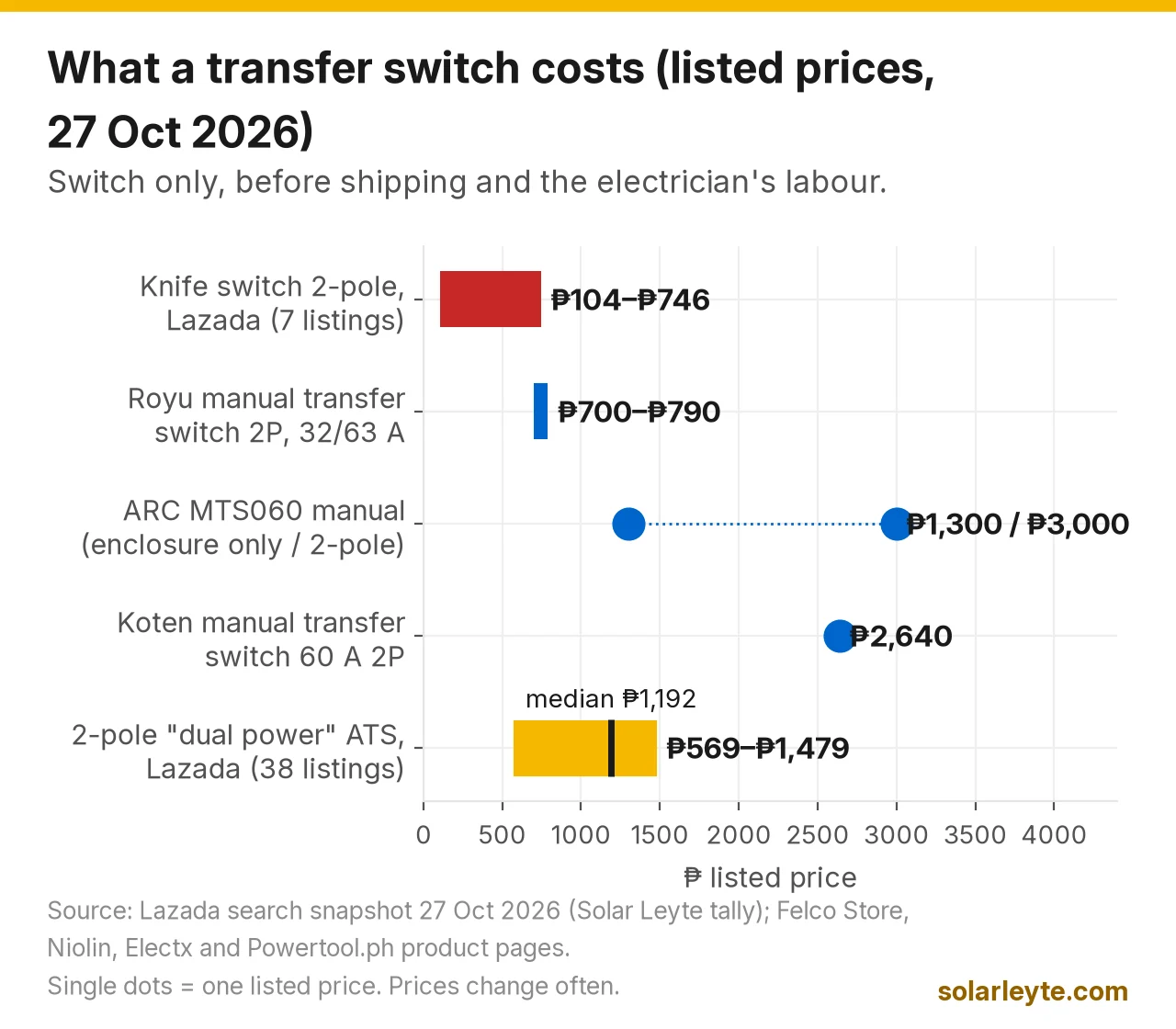
The Lazada figures come from two searches on the morning of 27 October 2026 ("changeover switch 2 pole" and "ATS dual power", 40 results each). We used selling prices, not the crossed-out "original" prices. Other searches hit a captcha, so they're not included.
Manual or automatic?
A manual switch suits most homes with a portable generator. You start the generator yourself anyway, so automatic adds little. They also have fewer parts to fail in a humid, salty coastal house.
An automatic switch makes sense when something else starts the power source for you. That could be a generator with an auto-start controller, or an inverter and battery that's always on. Two things to know before you buy one:
- A basic ATS won't start your generator. CHINT's datasheet for its NXZBN 63 A series shows three controller types. Only the "standard" and "intelligent" ones have a generator function. The basic one just watches the main supply and switches over.
- It isn't instant. The same datasheet lists a contact conversion time of up to 0.9 seconds and a conversion action time of up to 1.5 seconds. Lights will blink and a desktop computer will restart. Keep a small UPS on the PC and the WiFi modem (see our WiFi and Starlink backup guide).
CHINT's datasheet also lists switching over when the main supply drops below 184 V and switch back at 199 V, so a deep voltage dip on a weak line can trigger a switch too.
How to size the switch
The switch carries the current on both sides, so size it to the circuit it controls, not just the generator.
Worked example 1 (assumptions: Honda EU22i S, a small "generator circuit" for the fridge, lights, fans and WiFi). Honda rates the EU22i S at 1.8 kW. At 230 V that's about 1,800 ÷ 230 = 7.8 A. That's far too small to run a whole house. Your electrician moves the essential circuits to a small sub-panel fed through a 2-pole 32 A manual transfer switch, about ₱700 to ₱735 for the switch itself (Royu, 27 October listings).
Worked example 2 (assumptions: Honda EZ3000CX, whole-house transfer, a 60 A main breaker; check the rating printed on yours). Honda rates the generator at 2.6 kW at 60 Hz, about 11.3 A at 230 V. But in the "line" position, the whole house load from BILECO or LEYECO flows through the switch. So it must be rated at least as high as the 60 A main breaker, for example a 60 A or 63 A 2-pole unit. You'd also have to keep the aircon and water heater off while on generator, because the generator can only supply about a fifth of what the switch can pass.
Generator (maker's rated output) | Current at 230 V (our calculation) | Fits a 32 A sub-panel switch? |
|---|---|---|
Honda EU22i S, 1.8 kW | 7.8 A | Yes |
Ingco GEI25006-5P, 2.2 kW | 9.6 A | Yes |
Honda EZ3000CX, 2.6 kW (60 Hz) | 11.3 A | Yes |
Use a 2-pole switch. It disconnects both wires of your 230 V supply at once, which is the double-pole, double-throw (DPDT) arrangement utilities ask for. A 1-pole switch leaves one wire connected.
If you have solar: grid-tie, standalone inverter or hybrid
Grid-tie solar (no battery): a grid-tie inverter shuts down by itself when the co-op line goes dead, so it doesn't backfeed. That's also why it gives you no power in a brownout (see our grid-tie vs hybrid guide). Don't use a transfer switch to try to keep it running.
A standalone inverter with batteries: this is where "ATS for solar and grid" comes in. If the inverter feeds house circuits, those circuits need a changeover or transfer switch so the inverter output and the co-op line can never meet. Our inverter and battery backup guide covers sizing.
A hybrid inverter: many already do the switching inside. Deye's SUN-3.6–8K-SG05LP1 manual, for example, shows three separate AC terminal blocks marked Grid, Load and GEN. It tells you to fit a separate AC breaker for each (40 A for the 3.6–6 kW models, 50 A for 7–8 kW). A generator goes into the GEN port, and a dry contact (GV/GS) can start a generator that has auto-start. So you usually don't add an ATS between the grid and a hybrid. Follow the manual for your exact model, and get your installer to set the generator settings. For brand comparisons see our hybrid inverter price guide.
Using a manual switch during a brownout
- Confirm it's a real outage, not just your own breaker.
- Switch off the big loads (aircon, water heater, pump).
- Start the generator outdoors, away from windows. The exhaust can kill.
- Move the switch from LINE to OFF to GEN.
- Turn your appliances back on one at a time.
- When co-op power returns, switch your appliances off, move the switch back to LINE, then stop the generator.
After a typhoon, don't touch the switch, the panel or the generator if they're wet or you're standing in water. Get anything that flooded checked by an electrician first. Our typhoon checklist covers the rest of the system.
Frequently asked questions
Pwede bang i-off na lang ang main breaker tapos isaksak ang generator sa outlet?
No. To do that you need a cord with a plug on both ends, and the pins of the loose plug are live once the generator is running. If someone turns the main breaker back on, you're connected to the co-op line. Seattle City Light, a US utility, also says a household breaker "does not provide a sufficient gap" to isolate a home safely, and it may have been damaged in the outage. The PEC wants transfer equipment designed so the two sources can't be connected in any operation.
Do I need a transfer switch for a portable power station like an EcoFlow?
Not if you plug appliances straight into it. You only need a switch if it will feed your house wiring. Our EcoFlow price guide compares sizes.
Kinahanglan pa ba og ATS kung hybrid inverter ang akong solar?
Kasagaran dili, kay ang hybrid na mismo ang mo-switch tali sa grid ug battery (Deye's SG05LP1 has separate Grid, Load and GEN ports). A generator normally goes into the GEN input. Check your model's manual and ask your installer.
Is a cheap Lazada ATS safe?
We can't test them, and the listing titles make claims we can't check. Choose a switch rated for the circuit it controls (see the sizing section). Prefer a brand that publishes a datasheet, and let the electrician who installs it choose or approve it.
Solar Leyte is run by MACC Systems & Energy Solutions Inc., a solar installer in Naval, Biliran.
Get a free solar quote from MACC
Tired of running a generator every brownout? Send us a photo of your last BILECO or LEYECO bill and tell us what you need running when the power goes out. We'll size a hybrid system and give you every model number and datasheet, with no obligation.
- Call/Text: 0955 723 5093
- Email: official@macc-inc.com or benjie@macc-inc.com
- Website: www.macc-inc.com
- Request a quote online: solarleyte.com/quote
- Office: Brgy. Talustusan, Naval, Biliran 6543
Sources (all checked 27 October 2026)
- IIEE, Most Common Errors in Service Entrance Installations Prior to Final DU Inspection (PDF, archived copy) (RME Forum, IIEE Convention; quotes PEC 2009 Arts. 7.1.1.7 and 7.2.1.6; interlock requirement; "no interlock for transfer switch")
- Lawphil, RA 7920, Electrical Engineering Law (Section 31, field of practice of registered master electricians; 500 kVA / 600 V limit)
- Central Maine Power, Generator safety (DPDT transfer switch; transformers "step up this backfeed to thousands of volts"; generator damage when power returns)
- Seattle City Light, Generators (opening the main breaker "does not provide a sufficient gap")
- DEMCO, Backfeeding: when electricity flows backward (solar inverters that shut off in outages)
- Brigada News, CANORECO reminder to home generator users (15 May 2021; transfer switch, feedback to the main line, danger to linemen)
- CHINT, NXZBN and NXZHBN automatic transfer switching equipment catalogue (PDF) (2P 230/240 V up to 63 A; contact conversion ≤0.9 s; conversion action ≤1.5 s; generator function only on B and D controllers; 184 V / 199 V undervoltage settings)
- Deye, SUN-3.6–8K-SG05LP1-EU user manual (PDF) (19 March 2026; Grid, Load and GEN terminals; 40 A / 50 A breakers; GV/GS generator start contact)
- Felco Store, Royu manual transfer switch 2P (32 A ₱735, 63 A ₱790); Niolin Industrial Supply, Royu manual transfer switch (32 A ₱700, 63 A ₱750; 4.5 kAIC, 2-pole, on/off indicator)
- Electx Electrical Supply, Koten MTS 60 A 2-pole (₱2,640; 10 kAIC, 220 V, DPDT)
- Powertool.ph, ARC MTS060 manual transfer switch (₱1,300 "enclosure only"; ₱3,000 "2-pole")
- Lazada Philippines search results, 27 October 2026: "changeover switch 2 pole" (40 listings, 7 knife switches ₱104 to ₱746) and "ATS dual power" (40 listings, 38 two-pole ₱569 to ₱1,479). Solar Leyte tally; sellers not named.
- Generator ratings: Motor Ace, Honda EU22i S (1.8 kW rated); Honda, EZ3000CX owner's manual (PDF) (2.6 kW at 60 Hz); Ingco PH, GEI25006-5P (2.2 kW rated)
- Meralco, Understanding Power Quality (PDF) (230 V nominal under the Philippine Distribution Code)
- Our own guides (each lists its sources): generator vs solar, inverter and battery backup, electrical permit and CFEI, typhoon preparedness guide