Most Sungrow error codes you'll see at home are about the grid or the wiring, not a broken inverter. Sungrow shows a number (an "Alarm ID") in the iSolarCloud app and on the inverter's screen. These are the ones Filipino owners search for most:
- 010 Grid Power Outage: the inverter can't see the grid. Normal during a brownout. If your lights are on, check the solar AC breaker.
- 002, 003, 014, 015 Grid Overvoltage: grid voltage too high, common at midday at the end of long lines. 004, 005 are grid undervoltage.
- 012 Excessive Leakage Current and 039 Low System Insulation Resistance: an insulation problem, often on damp mornings. Often clears when things dry out.
- 038: a relay self-test failure on the MG-RL. Sungrow's checklist starts with earthing and swapped L/N wires, and ends with a failed relay.
- 106 Grounding Cable Fault: check the earth wire and the AC wiring.
- 514 Meter Communication Abnormal: the inverter has lost contact with its energy meter.
- 703 Battery Abnormal / Battery Fault: check the battery cables, then the battery itself.
- 714 BMS Communication Fault: the inverter can't talk to the battery.
- 040, 101 and the other "System Fault" numbers: internal faults. Sungrow's fix is a timed restart (below). If it comes back, call your installer.
Last checked 16 November 2026 against Sungrow's MG5/6/8/10/12RL hybrid user manual (Ver13, April 2026), the SH8.0RS/SH10RS hybrid user manual (Ver16, December 2025), the SG2.0–6.0RS grid-tie user manual (Ver25, September 2025), Sungrow Philippines' warranty terms and the Philippine Distribution Code 2017. Code lists differ a little between models and firmware, so always match the number to the manual for your exact unit.
First, stay safe
Sungrow's manuals are written for professional technicians, and they say the inverter has no parts inside that an owner can repair. Don't open the case. Before any service work, the MG-RL manual says to switch off the grid-side AC breaker first, then the DC switch, and to wait 10 minutes after power-off before measuring anything. It also says not to open or restart a unit that smells burnt, smokes or looks damaged.
What you can safely do as an owner:
- Read the code in iSolarCloud or on the screen, and take a screenshot.
- Check whether there's a brownout, and whether the solar AC breaker has tripped.
- Switch off heavy loads on the backup side.
- Check that nothing is blocking the inverter and that it isn't baking in direct sun.
- Do one restart the way Sungrow describes it (see "System Fault codes" below).
If the same fault comes back, stop and call your installer.
Which Sungrow do you have?
Three Sungrow home ranges show up in the Philippines:
Range | Type | Battery | Where you'll see it |
|---|---|---|---|
MG5RL to MG12RL | Hybrid, 48 V battery | Low-voltage lithium or lead-acid (40–60 V) | Sold by Philippine shops; see our Sungrow price list |
SH3.0RS to SH10RS | Hybrid, high-voltage battery | Sungrow SBR/SBH high-voltage batteries | Also sold by Philippine shops (our price list has an SH5.0RS listing) |
SG2.0RS to SG6.0RS | Grid-tie only | None | Grid-tie systems; our grid-tie inverter price guide mentions the range |
The good news is that all three manuals use the same numbering for the common grid codes: 2, 3, 14 and 15 for overvoltage, 4 and 5 for undervoltage, 10 for grid outage, 12 for leakage current, 39 for low insulation, 106 for grounding and 514 for the meter. The manuals write the numbers with or without leading zeros, so "010" and "10" are the same code. Battery codes (700s and 900s) only appear on the hybrids.
How to read the light: on the SH-RS hybrids, a steady blue light means the inverter is running normally. Flashing blue means standby or start-up, not feeding power yet. Steady red means a system fault. The MG-RL manual describes the same three states (running, standby or recovering from a fault, and fault). To see the code, check iSolarCloud. On models with a touch indicator, touch the LED to scroll through the codes.
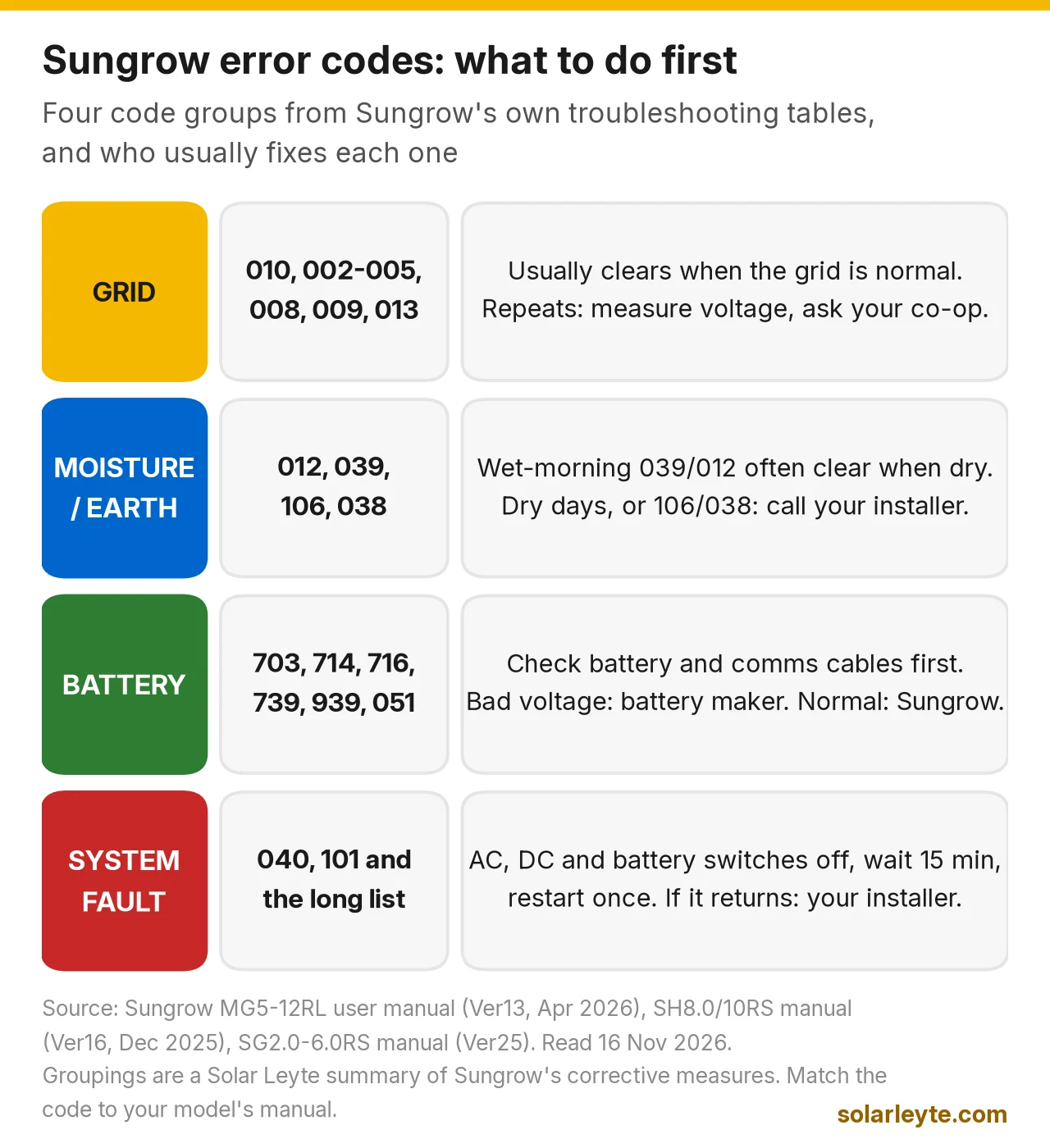
Grid codes: 010, 002–005, 008, 009, 013
These are the codes you'll see most in Leyte and Biliran, and most of them aren't the inverter's fault.
010 Grid Power Outage
This means the inverter can't see the grid. On a grid-tie unit, it shuts down on purpose. This is the anti-islanding safety rule that stops solar from feeding a line that linemen think is dead. On a hybrid, the backup side keeps running from battery and solar while 010 shows.
So during a BILECO or LEYECO brownout, 010 is normal. It clears by itself when power comes back. If you see 010 while your neighbours have power, Sungrow's checklist is:
- Is the solar AC breaker or switch off or tripped?
- Is the AC cable firmly in place?
- Are the live and neutral wires on the correct terminals? (This is installer work.)
- If it keeps happening, contact Sungrow or your installer.
For the difference between a scheduled brownout and a grid blackout, see our brownout vs blackout guide.
002, 003, 014, 015 Grid Overvoltage (and 004, 005 undervoltage)
The inverter has measured grid voltage outside its protection limits and has stopped exporting. Sungrow says it normally reconnects by itself once the grid is back to normal. If it happens often:
- Measure the actual grid voltage (or ask your installer to).
- If the voltage really is higher than the set value, contact the power company.
- Have the installer check the protection settings in the app. Sungrow says to change the overvoltage limits only with the consent of the local electric power operator.
Why it happens at midday: a rooftop system pushes power back into the line, which raises the voltage at your connection. If you're at the end of a long rural feeder that's already running high, the inverter trips. The older SG-RS manual also tells installers to check that the AC cable is thick enough, because a thin cable adds to the voltage rise.
Worked example A: when is the grid "too high"?
Example only, not a real case. The Philippine Distribution Code 2017 calls it an overvoltage when the voltage stays at or above 110% of nominal for more than a minute, and an undervoltage at or below 90%. It also says the distribution utility (your co-op) must make sure neither is present at your connection point in normal conditions. On a 230 V service:
Item | Value | Source |
|---|---|---|
Nominal voltage | 230 V | MG-RL rated AC voltage options: 220/230/240 V |
PDC overvoltage line (110%) | 253 V | Solar Leyte calculation (230 × 1.10) |
PDC undervoltage line (90%) | 207 V | Solar Leyte calculation (230 × 0.90) |
MG-RL AC voltage range (hardware) | 154–276 V | MG-RL user manual, technical data |
So if your multimeter or the app shows a steady 255 V at noon, the grid itself is past the PDC's overvoltage line. That's a supply-quality question for your co-op, not a reason to replace the inverter. The 154–276 V figure is the widest range the hardware supports. The actual trip points depend on the grid standard your installer chose, so ask them what's set.
008, 009, 013 Frequency and "Grid Abnormal"
These mean the grid frequency is out of range (008 too high, 009 too low) or something about the grid is abnormal (013). The Philippine grid runs at 60 Hz, and the PDC's normal band is 59.7–60.3 Hz. These codes usually clear by themselves. If they keep coming back, Sungrow says to check the protection settings and contact the power company.
Insulation and earth codes: 012, 039, 106, 038
These are the codes that worry people most. Two of them are very often about moisture.
039 Low System Insulation Resistance
The inverter checks the insulation resistance between the solar wiring and earth. If it's below the protection value set in the inverter, 039 shows and the inverter won't connect to the grid. Sungrow's steps:
- Wait. It often clears on its own.
- Have the installer check that the insulation-resistance limit in the app isn't set too high for local rules.
- Check the strings and DC cables for damaged insulation or a short to the frame.
- If the cables are fine and it only happens on rainy days, check again when the weather is fine.
- On hybrids, check the battery cables and terminals too.
In Leyte and Biliran, the classic pattern is 039 on wet mornings, then it clears by mid-morning. If it shows on dry, sunny days, a cable or connector is probably damaged. Common causes are rat bites, a cable rubbing on a roof edge, or water in an MC4 connector. That's a job for your installer with an insulation tester. Our multimeter testing guide explains why a basic meter can't do this test.
012 Excessive Leakage Current
This is a close cousin of 039, caught while the inverter is running. Sungrow says it can be caused by poor sunlight or a damp environment, and the inverter reconnects once conditions improve. If conditions are normal and it keeps happening, the AC and DC cables need an insulation check.
106 Grounding Cable Fault
The inverter thinks the earth (PE) connection is wrong. Sungrow's steps are to check that the AC cable is correctly connected and that the insulation between the earth wire and the live wire is normal. A loose or missing earth wire also matters for lightning and surge protection, so don't ignore it.
038 on an MG-RL: Relay Self-Test Failure
Before it connects, the inverter tests its grid relays. On the MG-RL, 038 means that test failed. Sungrow's checklist is installer work:
- Check whether "N-to-ground detection" and "Grounding monitoring" are turned off in the settings, and confirm the system is actually earthed.
- If it's earthed, check whether L and N are swapped on the AC side.
- If 038 appears in off-grid (backup) mode, the earth terminal on the backup port may not be connected.
- If none of that explains it, the relay may be welded shut. Sungrow says the unit then needs replacing: export the logs, note the software version and contact Sungrow.
On the SH8.0/10RS and SG-RS manuals, 38 is grouped with the general "System Fault" codes.
Battery and backup codes: 703, 714, 739, 939, 051
These only appear on the hybrids (MG-RL and SH-RS).
Code | Name in Sungrow's manual | What to check first |
|---|---|---|
703 (and 711, 712, 715, 732–736…) | Battery Abnormal (MG-RL) / Battery Fault (SH8/10RS) | Battery power cables: reversed, loose or damaged. Then the battery's real-time voltage. |
714 | BMS Communication Fault | The communication cable and its plugs between battery and inverter. |
716 | Abnormal Battery Connection (SH8/10RS) | Battery reversed or not connected. |
939 | Low Voltage Alarm (MG-RL) | Battery very low. Let it rest or charge. |
739 | Low Voltage Protection (MG-RL) | Battery protected itself after sitting uncharged. Make sure it can charge. |
932–935, 937 | Battery Alarm | Usually temperature. Improve ventilation. |
051 | Off-grid Load Overpower | Too much load on the backup side. Switch some off. |
For 703, Sungrow's order is: check the battery power cables (reversed or loose) first. If the cables are fine, check the battery's real-time voltage. If the voltage is abnormal, contact the battery maker. If it's normal, contact Sungrow. If the problem is heat, improve the ventilation. This matters if you paired a Sungrow MG-RL with a third-party 51.2 V battery, because 703 or 714 can then be a battery-side issue that the battery seller has to handle. Our solar battery not charging guide covers the battery side.
For 739/939, the MG-RL manual says that if the alarm shows after the system has been idle for more than 2 hours, the battery may have been left uncharged too long. If the inverter can charge it, the forced-charging function will clear the alarm. That can happen after a long night-time brownout drains the battery and the next morning is cloudy.
Worked example B: why 051 trips during a brownout
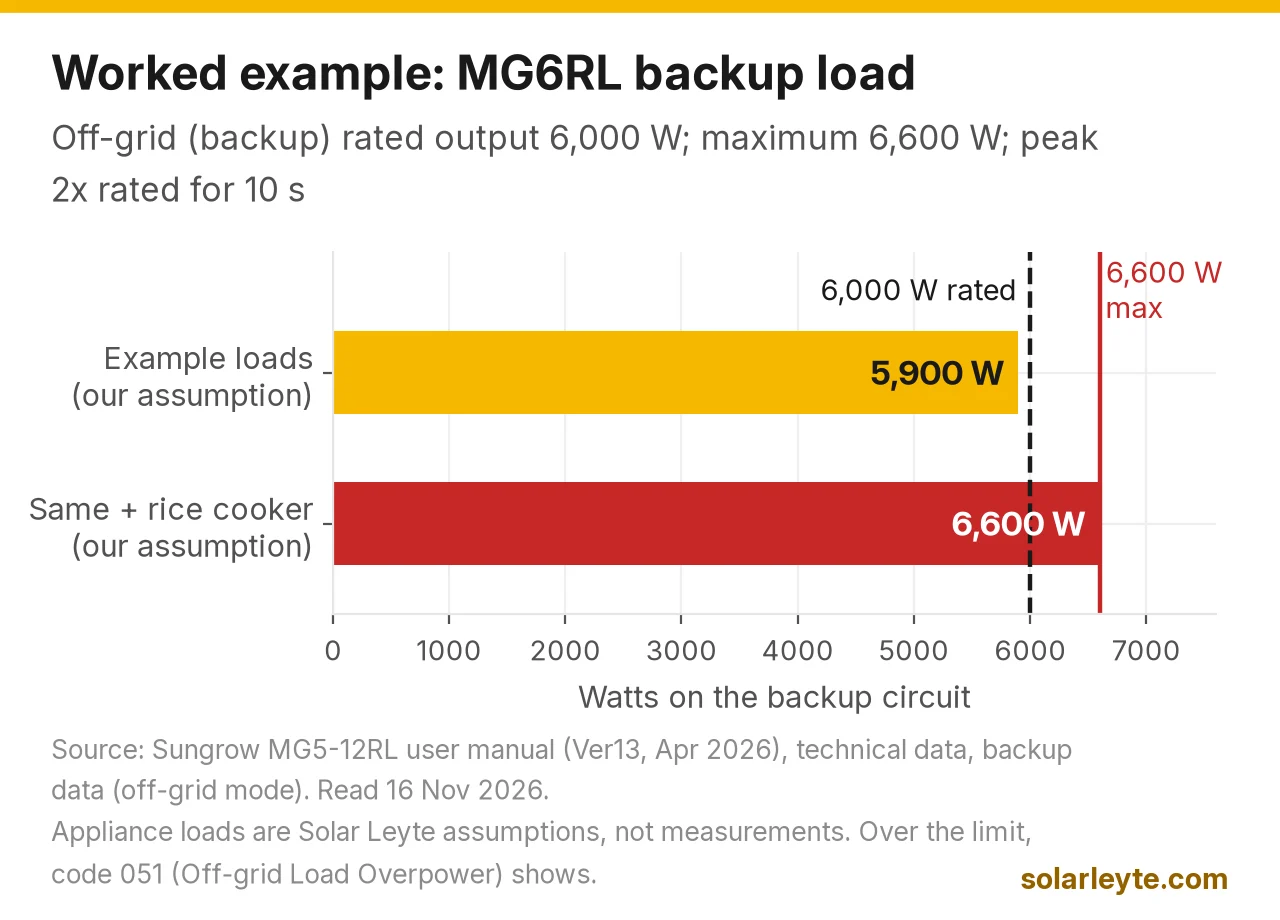
Example only, with assumed loads. The MG6RL's backup output (off-grid mode) is rated 6,000 W, with a maximum of 6,600 W and a peak of 2× rated power for 10 seconds (MG-RL technical data). Say a brownout hits while these are running on the backup circuit:
Load (our assumption) | Watts |
|---|---|
Inverter aircon, running | 1,200 W |
Refrigerator, running | 150 W |
Water pump, running | 750 W |
Electric kettle | 2,000 W |
Flat iron | 1,200 W |
Lights, fans, TV, router | 600 W |
Total | 5,900 W |
That's under 6,000 W, so it runs. But add a rice cooker (about 700 W, our assumption) and that takes the total to 6,600 W, right at the maximum. One more motor start can push it over, and 051 shows. Sungrow's SH8/10RS manual adds that after a backup overload the inverter restarts, and the restart takes longer each time the overload repeats. The fix is to keep high-wattage heating loads (kettle, iron, rice cooker) off the backup circuit. Our guide to how many kWh appliances use has more typical wattages.
Meter and solar-side codes: 514, 084, 028/029, 088, 037
- 514 Meter Communication Abnormal: the inverter has lost contact with its smart meter. This affects export limiting and the home-usage figures in the app. Sungrow says to check the communication cable and terminals, then reconnect the meter cable. The inverter may keep running, but the readings will be wrong until it's fixed.
- 084 Reverse Connection Alarm of the Meter/CT (SH8/10RS): the meter or CT is wired backwards. Installer fix.
- 028, 029 (and 208) PV Reverse Connection: a solar string's + and − are swapped (28 = PV1, 29 = PV2 on the MG-RL). Sungrow says to turn off the DC switch and correct the polarity only once string current is below 0.5 A. Installer job.
- 088 Electric Arc Fault (on units with arc-fault detection): a loose or damaged DC connection is arcing. Disconnect DC and call your installer. The fault is cleared in the app after the repair.
- 037 High Ambient Temperature: the inverter is too hot. Sungrow's checklist is ventilation, direct sun ("shield it if so") and the fan. The MG-RL's rated operating range is −25 °C to 60 °C.
"System Fault" codes: 040, 101 and friends
Sungrow puts a long list of numbers under one heading, System Fault. On the MG-RL that includes 006, 007, 011, 019, 021, 025, 040–042, 048–050, 052–054, 056, 064–067, 100–102, 105, 107, 113, 117, 200–205, 300, 303–305, 308–316 and more. On the SH8/10RS and SG-RS the list includes 38 as well. The corrective steps are the same for all of them:
- Wait for the inverter to recover by itself.
- If it doesn't, turn off the AC and DC switches, and the battery-side switches if there's a battery.
- Wait 15 minutes, then close the AC and DC switches again in turn and restart.
- The MG-RL manual adds: check the inverter's PE (earth) connection.
- If the fault is still there, contact Sungrow or your installer.
A separate group, System Alarm (for example 502–504, 507, 508, 510, 513, 516–518 on the MG-RL), means the inverter can keep running. Check the related wiring for loose terminals or foreign objects, and contact Sungrow if the alarm stays.
Two MG-RL codes installers ask about: 329 and 075/090
- 329 AC Port Wiring Anomaly: usually the grid cable is connected to the backup port, or power is reaching the generator port when generator mode isn't set up. It's an installation error, so call whoever installed it.
- 075 / 090: parallel-system communication and sync codes. These only matter if you have two or more inverters linked together.
When to call your installer, and what to have ready
Call if any System Fault comes back after the 15-minute restart. Also call if 039 shows on dry days, if 106, 038 or 329 appear, or if 703 or 714 won't clear. Have these ready:
- A screenshot of the code in iSolarCloud, with date and time.
- The model and serial number from the side label (for example MG6RL).
- What was running, and the weather (rain, brownout, midday sun).
- Your battery brand and model, if you have one.
- Any recent work on the house wiring.
Warranty notes from Sungrow Philippines' own terms: report a defect to Sungrow (or your dealer or installer) within 24 hours, with proof of purchase, the serial number, a description and photos or video. Sungrow says it responds within 24 hours. The terms exclude damage from typhoons, floods, lightning, water intrusion, corrosion and "input voltage outside the parameters listed in the Product specifications, whether from the grid, generators, or lightning strikes". Fans and fuses count as consumables, and labour to remove and reinstall a unit isn't covered. There are also distance-from-the-sea limits, which our Sungrow price list and solar near the sea guide explain. If brownouts often come back with surges where you live, it's worth asking your installer about surge protection and AVRs.
Choosing an inverter? Compare brands in our hybrid inverter price guide and grid-tie inverter price guide. If you'd like a qualified team to look at your system or design a new one, you can request a free quote. For other brands, see our Solis, Deye, Growatt and Felicity code lists, or solar inverter not turning on if the screen is completely dark.
FAQ
What does error 010 mean on a Sungrow inverter?
It's "Grid Power Outage": the inverter can't see the grid. During a brownout that's normal. A grid-tie unit stops, and a hybrid keeps your backup loads running from battery and solar. If the grid is on and 010 stays, check the solar AC breaker, then call your installer to check the AC wiring.
Ano ang ibig sabihin ng error 039 sa Sungrow?
Ibig sabihin, mababa ang insulation resistance sa pagitan ng solar wiring at ground (mas mababa sa protection value na naka-set sa inverter). Madalas itong lumalabas tuwing basa o maulan ang umaga, at nawawala pag tuyo na. Kung lumalabas pa rin kahit maaraw, baka may sirang cable o connector. Ipa-check sa installer gamit ang insulation tester.
How do I reset a Sungrow inverter?
For System Fault codes, Sungrow's steps are: turn off the AC and DC switches (and the battery switch on a hybrid), wait 15 minutes, then turn them back on in turn. Do this once. If the fault comes back, don't keep cycling it. Call your installer with a screenshot of the code.
Why does my Sungrow show 514?
The inverter has lost communication with its energy meter. Check that the meter's communication cable is plugged in firmly at both ends. Solar production may continue, but export limits and home-usage readings in iSolarCloud won't be right until it's fixed.
Solar Leyte is run by MACC Systems & Energy Solutions Inc., a solar installer in Naval, Biliran.
Get a free solar quote from MACC
Planning a hybrid that rides through brownouts, or not sure if your inverter is set up right for your line? Send us a recent BILECO or LEYECO bill and we'll get back to you with a free, no-obligation written quote.
- Call/Text: 0955 723 5093
- Email: official@macc-inc.com
- Website: www.macc-inc.com
- Or use the site quote form: /quote
Related guides
- Grid-tie vs hybrid vs off-grid solar: which works in a brownout?
- Sungrow inverter price list Philippines
- Solis inverter error codes
- Deye inverter error codes
- Solar battery not charging
- Brownout vs blackout in the Philippines
Sources (all checked 16 November 2026)
- Sungrow, MG5/6/8/10/12RL hybrid inverter user manual, Ver13-202604 (PDF): troubleshooting table (002/003/014/015 grid overvoltage; 004/005 undervoltage; 008/009 frequency; 010 grid power outage; 012 excessive leakage current; 013 grid abnormal; 017; 028/029/208 PV reverse connection, polarity corrected below 0.5 A; 037 high ambient temperature; 039 low system insulation resistance incl. "check again when the weather turns fine"; 106 grounding cable fault; 051 off-grid load overpower; 714 BMS communication; 932–935/937/939 battery alarm; 703 etc. battery abnormal; 502–518 system alarm; 514 meter communication; System Fault list and 15-minute restart with PE check; 090 and 075 parallel; 939 low voltage alarm and forced charging; 739 low voltage protection after 2 hours idle; 038 relay self-test failure checklist; 329 AC port wiring anomaly); operation status indicator states; maintenance safety (AC breaker first, 10 minutes after power-off, no user-serviceable parts, don't open if smoke or odour); technical data (rated AC voltage 220/230/240 V; AC voltage range 154–276 V; MG6RL off-grid rated output 6,000 W, max backup 6,600 W, peak 2× rated for 10 s; MG5RL 5,000/5,500 W; operating temperature −25 °C to 60 °C; battery voltage 40–60 V).
- Sungrow, SH8.0RS/SH10RS hybrid inverter user manual, Ver16-202512 (PDF): troubleshooting table (same grid codes; 38 and 40 in the System Fault list; 84 meter/CT reverse connection; 88 electric arc fault; 716 abnormal battery connection; 703 etc. battery fault); LED colours (blue on = normal, blue flashing = standby or start-up, red on = system fault); backup overload protection (restart time increases if overload repeats).
- Sungrow, SG2.0–6.0RS grid-tie inverter user manual, Ver25-202509 (PDF): fault table with the same numbering (2, 3, 14, 15; 4, 5; 10; 12; 39; 106; 514; 38 and 101 in the System Fault list); AC voltage range 154–276 V.
- Sungrow, SG2.0–6.0RS user manual, Ver11-202106 (PDF, Sungrow Australia): grid overvoltage steps incl. checking the AC cable cross-section.
- Sungrow Philippines, Manufacturer warranty terms and conditions: claim within 24 hours with proof of purchase, serial number, description and photos or video (6.1–6.2); response within 24 hours (6.3); exclusions incl. typhoons, floods, lightning, water intrusion, corrosion and out-of-spec input voltage (5.1 k); fans and fuses as consumables (2.3 remark 5); no labour for removal or reinstallation (7.3).
- Energy Regulatory Commission, Philippine Distribution Code 2017 Edition (PDF copy): 60 Hz nominal, 59.7–60.3 Hz (3.2.2); undervoltage at or below 90% and overvoltage at or above 110% of nominal for more than 1 minute (3.2.3.3); the distribution utility must ensure neither is present at a user's connection point in normal conditions (3.2.3.4).
- Worked examples A and B: Solar Leyte illustrations built from the figures above, not real cases. Our calculations: 230 × 1.10 = 253 V and 230 × 0.90 = 207 V; the appliance wattages in example B are our assumptions (totals 5,900 W and 6,600 W).