On 15 October 2026, Philippine solar shops listed on-grid (string / grid-tie) inverters from about ₱20,000 for a Solis Mini 700 W up to ₱198,000 for a 30 kW Solis three-phase unit. A typical 5 kW single-phase house size sat at ₱40,000 for a Solis 4G on-grid inverter at Solar Hub PH and ₱52,000 for a Huawei SUN2000-5KTL at Sungrid Energy. LakaSolar listed a Deye 3.6 kW grid-tied unit at ₱22,000. Those are inverter-only pesos — no panels, rails, breakers or labour.
This post is on-grid units only: no battery port, no brownout backup. Hybrid inverter prices live in our hybrid inverter price guide. Brand hybrid specs (switch time, surge, warranty) are in Deye vs Solis vs SRNE. Full 5 kW system build-ups are in the 5 kW solar system price post.
Prices checked 15 October 2026 (Philippine time) on each seller's own website. They change often. Confirm the exact model number and stock before you pay. Listing a product isn't an endorsement, and Solar Leyte earns nothing from these links. No MACC installed prices appear below.
What a grid-tie inverter does (and does not do)
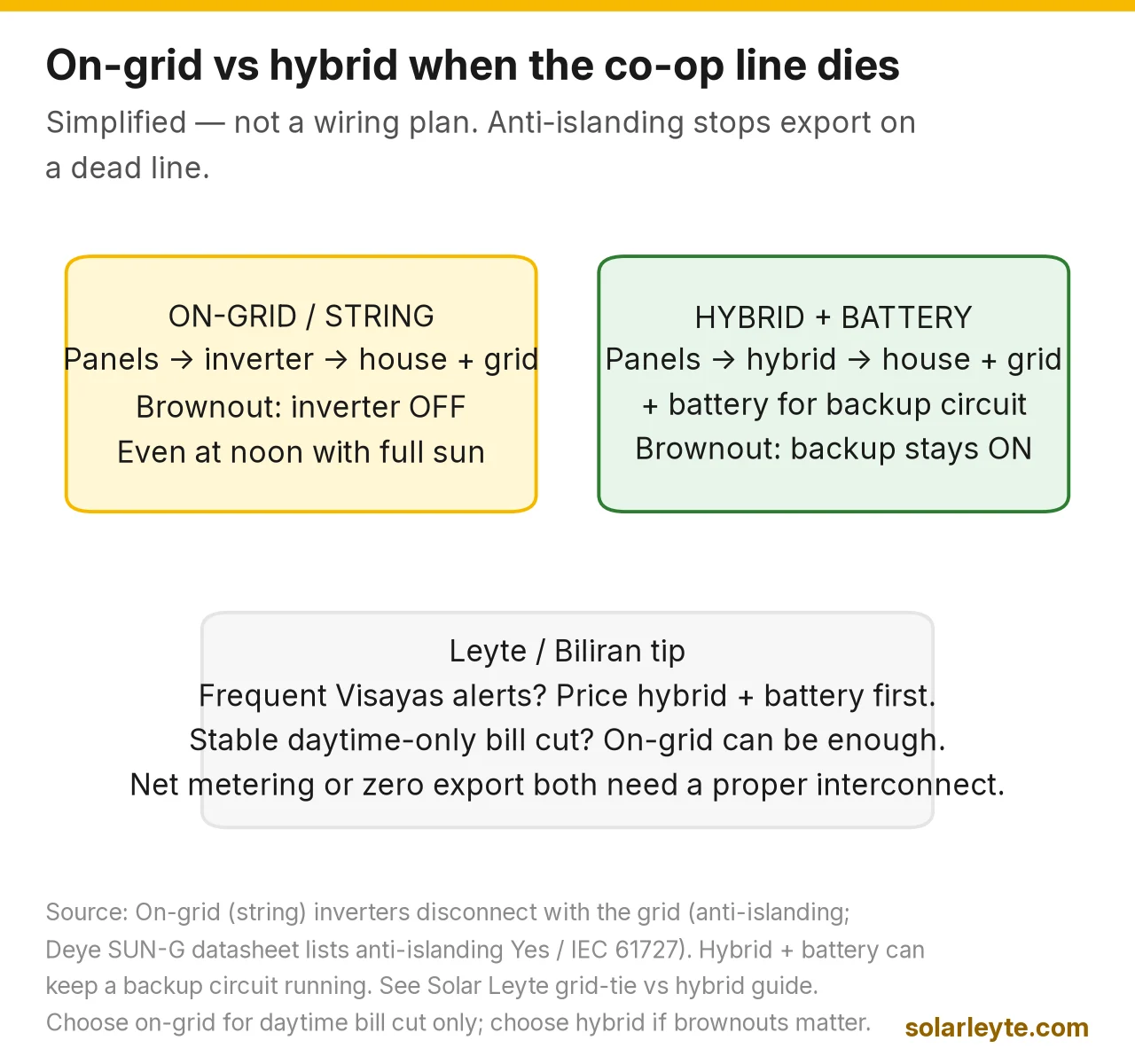
A grid-tie (also called on-grid or string) inverter turns DC from your panels into AC that runs in parallel with BILECO or LEYECO power. In the day it cuts your bill by supplying house loads first; any surplus can export under net metering or be limited to zero export (plug-and-play / zero-export rules).
It shuts down when the co-op line is dead — even at noon with full sun. That is anti-islanding: the inverter must not keep feeding a dead line and endanger lineworkers. Makers list anti-islanding protection and grid standards such as IEC 61727; Deye's SUN-(3.6–6)K-G datasheet also lists anti-islanding as "Yes" and grid connection standards including IEC 61727 (Deye SUN-3.6/5/6K-G datasheet). IEC 62116 is the common test method for islanding prevention on utility-interconnected PV inverters.
If your priority is lights and a freezer through Visayas yellow/red alerts (what the alerts mean), you need a hybrid + battery, not a cheaper string inverter. See grid-tie vs hybrid.
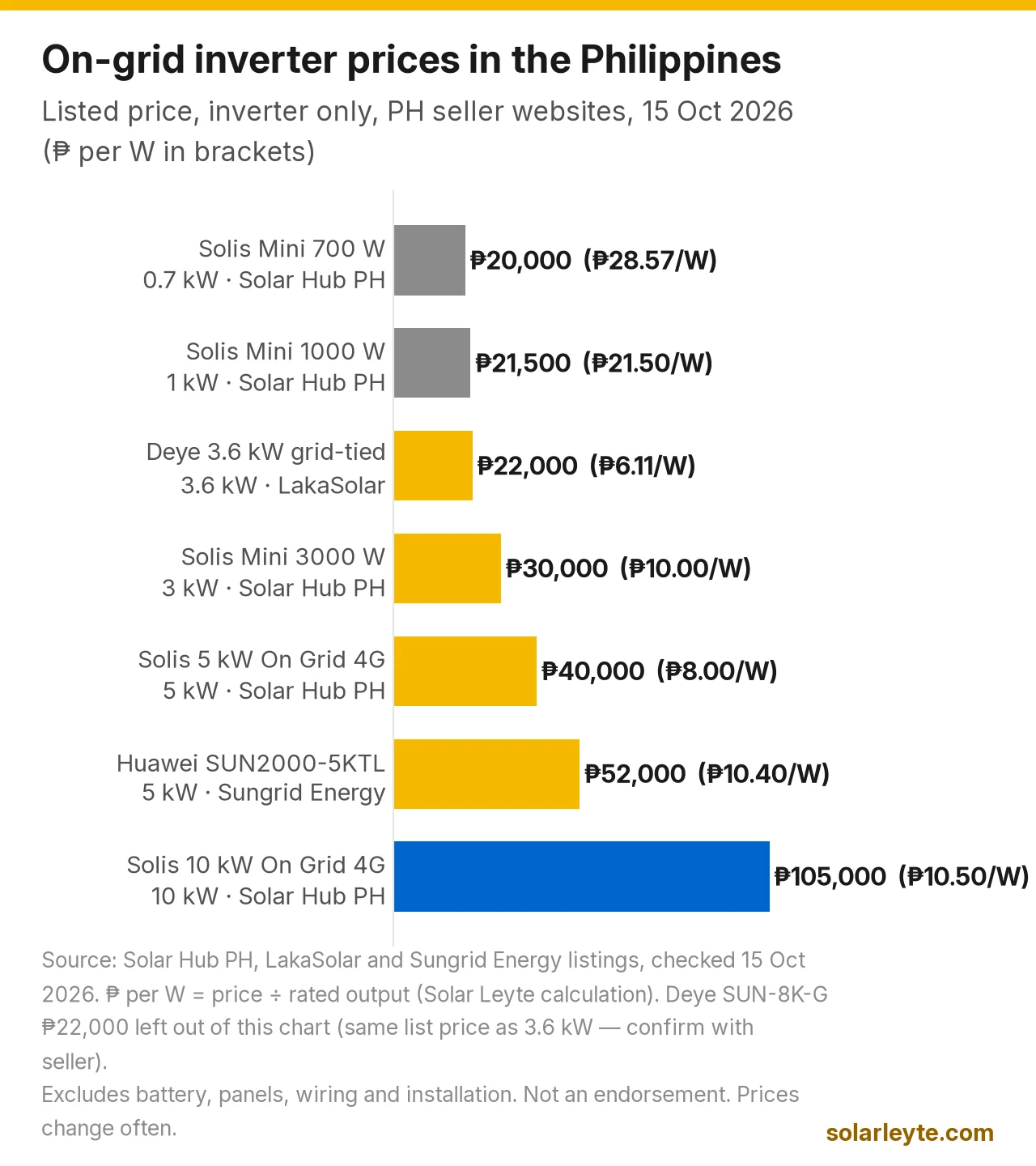
On-grid inverter prices in the Philippines (15 October 2026)
Inverter only. "₱ per W" is listed price ÷ rated output (Solar Leyte calculation). Sale pages that show a struck-through "was" price use the current (lower) figure.
Residential / single-phase sizes
Inverter (as listed) | Rated output | Seller | Listed price | Was (if shown) | ₱ per W |
|---|---|---|---|---|---|
Solis Mini 700 W 4G | 0.7 kW | Solar Hub PH | ₱20,000 | ₱28,700 | ₱28.57 |
Solis Mini 1000 W 4G | 1.0 kW | Solar Hub PH | ₱21,500 | ₱30,000 | ₱21.50 |
Deye 3.6 kW grid-tied (SUN-3.6K class) | 3.6 kW | LakaSolar | ₱22,000 | — | ₱6.11 |
Solis Mini 3000 W 4G | 3.0 kW | Solar Hub PH | ₱30,000 | ₱44,000 | ₱10.00 |
Solis 5000 W 1-phase On Grid 4G | 5.0 kW | Solar Hub PH | ₱40,000 | ₱60,000 | ₱8.00 |
Huawei SUN2000-5KTL | 5.0 kW | Sungrid Energy | ₱52,000 | — | ₱10.40 |
Deye SUN-8K-G grid-tied | 8.0 kW | LakaSolar | ₱22,000 | — | ₱2.75 |
Solis 10000 W 1-phase On Grid 4G | 10.0 kW | Solar Hub PH | ₱105,000 | ₱160,000 | ₱10.50 |
Three-phase / larger (shops, farms, light commercial)
Inverter (as listed) | Rated output | Seller | Listed price | Was (if shown) | ₱ per W |
|---|---|---|---|---|---|
Solis 15000 W 3-phase On Grid 4G | 15 kW | Solar Hub PH | ₱140,000 | ₱215,000 | ₱9.33 |
Solis 20000 W 3-phase On Grid 4G | 20 kW | Solar Hub PH | ₱162,000 | ₱250,000 | ₱8.10 |
Solis 30000 W 3-phase On Grid 4G | 30 kW | Solar Hub PH | ₱198,000 | ₱305,000 | ₱6.60 |
Huawei SUN2000-80K-MGL0 (220 V, 3P) | 80 kW | Letovo PH | ₱364,706 | — | ₱4.56 |
Zero-export accessory (not an inverter): Solis Export Power Manager, 1-phase 2G, ₱20,300 (was ₱31,200) at Solar Hub PH. Used with a Solis on-grid inverter when you want to limit export — relevant under DOE DC2026-08-0017 zero-export paths; details in our plug-and-play / zero-export post.
What stands out:
- Around 5 kW, Solis at ₱40,000 is cheaper per watt than Huawei at ₱52,000 on these two dated listings (₱8.00/W vs ₱10.40/W). That does not decide which is "better" — warranty claim path, AFCI, monitoring and your installer's stock matter as much.
- LakaSolar's Deye SUN-8K-G at ₱22,000 matches their 3.6 kW list price. That is about ₱2.75/W, far below every other 5–10 kW row. Treat it as a possible listing error until the seller confirms the model, box contents and invoice price in writing (we left similarly odd hybrid prices out of earlier posts).
- Alternate LakaSolar URLs for the same Deye SUN-3.6K and SUN-8K-G models showed "Contact for Price" on 15 October, while the product pages above showed ₱22,000. Ask which price is live before you transfer funds.
- Solis Mini units look expensive per watt (₱20,000–₱30,000 for 0.7–3 kW). They fit balcony / small-array use cases under the new micro / zero-export rules more than a full Leyte roof.
- Three-phase Solis units drop toward ₱6.60–₱9.33/W at 15–30 kW — useful for rice mills, cold stores and shops on three-phase service, not for a normal single-phase house meter.
Not in the price table (and why):
- Sungrow SG-series string inverters (for example SG8.0/9.0/10RS on Sungrow's Philippines site: up to 600 V PV input, 8–10 kW rated AC, 97.8% max efficiency). We found no dated Philippine retail peso price for those string models on 15 October. Sungrow hybrid SH prices are in the hybrid inverter post, not here.
- Reflections Solar Solutions "Deye 5 kW Grid Tie" at ₱27,000. The page title says grid-tie, but the bullet list describes battery charging, diesel generator support and 4 ms on-grid to off-grid transfer — that is hybrid language. We left it out of this on-grid table.
- Growatt MIN / MIC string units. Review sites quote wide ranges; we did not find a clean PH shop product page with a clear model and peso price on this check. Ask installers for a written quote.
- Lazada / Shopee listings — prices move by the hour and model numbers are often incomplete.
Grid-tie vs hybrid: what the extra money buys
Type (~5 kW class) | Example from dated PH listings | Inverter only | Brownout backup? |
|---|---|---|---|
On-grid / string | Solis 5 kW 4G (15 Oct) | ₱40,000 | No — shuts down with the grid |
On-grid / string | Huawei SUN2000-5KTL (15 Oct) | ₱52,000 | No |
Hybrid (for comparison only) | Deye / SRNE / Sungrow 5–5.5 kW (7 Oct) | ₱45,000–₱58,000 | Yes, once you add a battery |
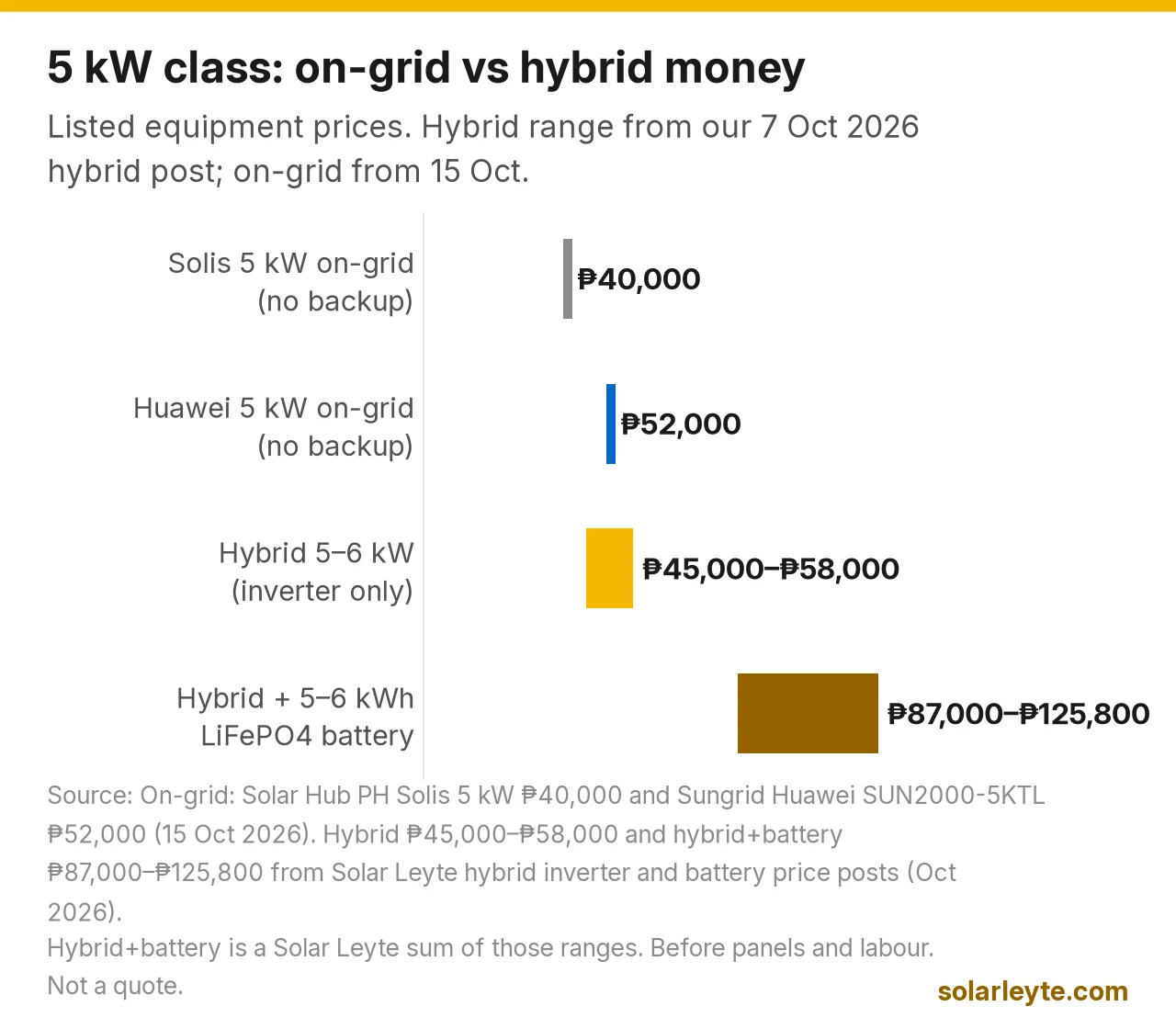
Hybrid figures are from our hybrid inverter price post (checked 7 October 2026) — we are not reprinting that full hybrid table here. The hybrid premium over a Solis 5 kW on-grid unit is often only about ₱5,000–₱18,000 on the inverter alone; the battery (₱42,000–₱67,800 for 5–6 kWh in that earlier check) is the larger jump. See solar battery prices.
Rule of thumb for Leyte and Biliran: if brownouts are rare and you mainly want a lower daytime bill with net metering, on-grid can be enough. If you need the ref and lights through evening outages, price a hybrid + battery first — don't buy a string inverter and hope.
Datasheet numbers that matter for an on-grid unit
Figures below for Deye come from the maker's SUN-3.6/5/6K-G datasheet. Sungrow SG8.0/9.0/10RS highlights are from Sungrow Philippines product page. LakaSolar listing notes for the Deye 3.6 kW and SUN-8K-G are from the seller pages dated 15 October.
Spec | Deye SUN-5K-G (datasheet) | Deye SUN-3.6K-G (datasheet) | Sungrow SG8.0/9.0/10RS (PH page) |
|---|---|---|---|
Rated AC output | 5 kW | 3.6 kW | 8 / 9 / 10 kW |
Max DC input power | 6.5 kW | 4.7 kW | (see datasheet PDF on Sungrow site) |
Max DC voltage | 550 V | 550 V | 600 V |
MPPT operating range | 70–550 V | 70–550 V | Wider / lower startup (marketing claim on page) |
Number of MPPT / strings | 2 / 1 | 2 / 1 | (see datasheet) |
Max efficiency | 97.5% | 97.3% | 97.8% |
Anti-islanding | Yes (listed) | Yes (listed) | Arc-fault (AFCI) listed on PH page |
Ingress protection | IP65 | IP65 | (see datasheet) |
Designed lifetime (datasheet) | >20 years | >20 years | — |
MPPT count and PV input: two trackers let you put panels on two roof faces (east–west) without one string dragging the other down. Max DC input above the AC rating (for example Deye SUN-5K-G at 6.5 kW DC on 5 kW AC) is normal "DC oversizing" — still stay inside the Voc and Imp limits for your panels (550–620 W panel guide; how many panels).
Anti-islanding / IEC 62116: required for grid interconnection. Ask the installer for the unit's test certificates with the model you are buying. Co-op interconnection (BILECO, LEYECO II and others) still needs the usual permits — see electrical permit and CFEI and the installer checklist.
Zero export / CT clamp: LakaSolar's Deye grid-tied listings mention a CT clamp limiter and Wi‑Fi monitoring. Solis sells a separate Export Power Manager (₱20,300 above). Zero export means surplus solar is curtailed instead of earning net-metering credits — trade-offs are in the plug-and-play / zero-export post.
What size on-grid inverter for a Leyte or Biliran roof?
Match the inverter to the array size and your daytime loads, not to your whole-house night load (grid-tie cannot cover nights).
Goal | Rough array | Inverter class often quoted | Notes |
|---|---|---|---|
Small bill cut / trial | ~1–3 kWp | Solis Mini 1–3 kW or Deye 3.6 kW | Check DOE micro / zero-export path if you skip net metering |
Typical house daytime loads | ~5 kWp | 5 kW on-grid (Solis / Huawei / Deye G-series) | Parts build-up in 5 kW price post |
Large house / light shop | ~8–10 kWp | 8–10 kW single-phase | Confirm meter is single-phase; see 10 kW price post |
Three-phase shop / mill | 15 kW+ | Solis 15–30 kW 3P or commercial Huawei | Needs three-phase service; motor surge is a separate design issue |
Panel pesos and count: solar panel price guide. Smaller 3 kW packages: 3 kW system price.
Net metering, zero export and brownouts
- Net metering: an on-grid inverter that meets co-op and ERC interconnection rules can export. Steps for Biliran and Tacloban-area co-ops: BILECO net metering, LEYECO II net metering.
- Zero export: set export to zero with a meter/CT or Export Power Manager. DOE DC2026-08-0017 changed the paperwork path for zero-export systems — read the plug-and-play / zero-export guide before you assume you can skip co-op notice.
- Brownouts: grid-tie alone will not keep your freezer cold when LEYECO or BILECO is out. For stores and resorts that need backup, start from hybrid vs grid-tie and the sari-sari / beach resort load posts.
Before you buy: checklist
- Confirm it is truly on-grid — no battery terminals, no "UPS / off-grid transfer" claims unless you meant to buy a hybrid.
- Get the full model number (for example SUN-5K-G, not just "Deye 5 kW") and match it to the maker datasheet.
- Check MPPT voltage and current against your planned 550–620 W panels.
- Ask who handles warranty claims in Eastern Visayas — many brands' PH service desks sit in Metro Manila or Cebu.
- Plan for heat, salt air and typhoons — IP65 helps outdoors, but shade the unit and follow mounting height rules (typhoon guide).
- Use a licensed electrician / DOE-aware installer — interconnection and CFEI are not DIY (installer guide).
FAQ
How much is a grid-tie inverter in the Philippines? On 15 October 2026, a common 5 kW on-grid unit listed at about ₱40,000 (Solis) to ₱52,000 (Huawei SUN2000-5KTL). Smaller Solis Mini units started near ₱20,000. Three-phase 15–30 kW Solis units listed at ₱140,000–₱198,000. Inverter only.
How much is a Deye 6 kW grid-tie inverter? We did not find a dated Philippine shop listing that clearly named a Deye SUN-6K-G (or "6 kW grid-tie") with a peso price on 15 October. LakaSolar listed a 3.6 kW Deye grid-tied unit at ₱22,000 and an 8 kW SUN-8K-G also at ₱22,000 (confirm that 8 kW price). For 6 kW hybrid pesos, use the hybrid inverter post.
Huawei vs Sungrow vs Solis — which on-grid brand? On price alone in this check, Solis 5 kW undercuts Huawei 5 kW. Sungrow string (SG) models are sold in the PH market but we lacked a public retail peso this run; Sungrow hybrid SH prices are separate. Pick by installer support, warranty paperwork and the exact datasheet — not by brand slogans.
Is a grid-tie inverter enough if we have brownouts? No. It disconnects with the grid. Budget for hybrid + battery if backup matters.
Do I need net metering for a grid-tie system? Not always. Zero-export setups use the panels for self-consumption only. Net metering pays (as credits) for exported kWh when your co-op approves the interconnection.
Solar Leyte is run by MACC Systems & Energy Solutions Inc., a solar installer in Naval, Biliran.
Get a free solar quote from MACC
Tell us your co-op (BILECO or which LEYECO), a photo of your latest bill, and whether you need brownout backup or only daytime bill savings. We'll say honestly if a grid-tie string inverter is enough — or if you should price a hybrid instead. No obligation. The prices above are third-party seller listings, not MACC quotes.
- Call/Text: 0955 723 5093
- Email: official@macc-inc.com or benjie@macc-inc.com
- Website: www.macc-inc.com
- Request a quote online: solarleyte.com/quote
- Office: Brgy. Talustusan, Naval, Biliran 6543
Sources (all checked 15 October 2026)
- Solar Hub PH: Solis Mini 700 W (₱20,000), Mini 1000 W (₱21,500), Mini 3000 W (₱30,000), 5000 W 1P On Grid 4G (₱40,000), 10000 W 1P On Grid 4G (₱105,000; page slug says 5000w, product title 10000W), 15000 W 3P (₱140,000), 20000 W 3P (₱162,000), 30000 W 3P (₱198,000), Export Power Manager 1P (₱20,300); inverters category
- LakaSolar: Deye 3.6 kW grid-tied (₱22,000), Deye SUN-8K-G (₱22,000 — confirm)
- Sungrid Energy: Huawei inverters category (SUN2000-5KTL ₱52,000)
- Letovo PH: Huawei SUN2000-80K-MGL0 (₱364,706)
- Datasheets / maker pages: Deye SUN-3.6/5/6K-G; Sungrow Philippines SG8.0/9.0/10RS
- Excluded with reason: Reflections Solar Solutions page titled Deye 5 kW Grid Tie (hybrid feature bullets)
- Related Solar Leyte: hybrid inverter prices, Deye vs Solis vs SRNE, 5 kW system, 3 kW, 10 kW, plug-and-play / zero-export, grid-tie vs hybrid guide, battery prices