Most Solis alarms you'll see at home are about the grid, not a broken inverter. Solis shows a short name plus a four-digit code (for example "OV-G-V01, 1010"). These are the ones people search for most:
- 1010 OV-G-V01 to 05: grid voltage too high. Very common at midday. The inverter stops exporting, then restarts by itself when the voltage drops.
- 1011 UN-G-V: grid voltage too low.
- 1012 / 1013 OV-G-F / UN-G-F: grid frequency too high or too low. Solis says to check the grid standard setting too.
- 1015 NO-Grid: the inverter can't see the grid. Normal during a brownout. If the lights are on, check the solar AC breaker.
- 1033 PV ISO-PRO: low insulation on the panel side. Often shows on wet mornings.
- 1055 NO-Battery: a hybrid can't see its battery. Check the battery breaker or fuse.
- 2011 MET_Comm_FAIL: the inverter has lost contact with its meter or CT.
- 2012 CAN_Comm_FAIL: the inverter has lost contact with the battery's BMS.
Last checked 15 November 2026 against Solis's complete alarm code list (Solis North America service centre), the S6-GR1P(2.5-6)K-S grid-tie manual, the S6-EH1P(3-8)K-L-PLUS hybrid manual (version 1.3, April 2026), Solis service-centre articles for 1010 and 1015, and the Philippine Distribution Code 2017. Code lists differ a little between models and firmware, so match the code to the manual for your exact unit.
First, safety
Solis itself says only trained electricians should diagnose or repair the inverter and the panels. As a homeowner, you can safely read the alarm, check that breakers are on, note the time it happens, and do one restart. Solis's manuals say to switch the inverter off and wait 5 minutes before restarting it. Don't open the inverter, unplug PV (MC4) connectors under load, or touch battery cables. Panels keep making DC voltage whenever there's daylight.
How Solis shows an alarm
Solis grid-tie units such as the S6-GR1P series have LED lights plus an app (Bluetooth, or a Wi-Fi stick). Hybrids such as the S6-EH1P add their own screen and the SolisCloud app. Either way you get:
- A message name, such as OV-G-V01, NO-Grid or CAN_Comm_FAIL.
- A four-digit code, such as 1010. The "DATA" number after it (0001 to 0005) tells the installer which level of protection tripped.
- A grade, which Solis uses to sort alarms: Tip (shown as "Hint" on some units; often clears by itself), General (may need a check) or Emergency (safety fault, needs attention).
Not every message is a fault. Waiting means the panels haven't reached the start-up voltage yet (100 V on most S6-GR1P models, so it's normal at dawn and dusk). LimByVg means the inverter is cutting power on purpose because grid voltage is high. Surge Alarm on grid-tie units is logged for after-sales analysis and, per Solis, doesn't affect operation.
Grid-side codes (1010 to 1019, 1030)
Code | Name | What it means | What you can do |
|---|---|---|---|
1010 | OV-G-V01 to 05 | Grid voltage above the limit of the selected grid standard | Wait. If it happens daily, call your installer (see below) |
1011 | UN-G-V | Grid voltage below the limit | Wait. If constant, ask your co-op to check supply voltage |
1012 / 1013 | OV-G-F / UN-G-F | Frequency outside limits | Installer checks the grid standard (Philippines is 60 Hz) |
1015 | NO-Grid | No grid voltage at the inverter | Brownout? Normal. Lights on? Check the solar AC breaker |
1016 | G-PHASE | Unbalanced three-phase grid | Installer |
1018 | OV-G-I | Grid output overcurrent | Installer |
1019 | IGFOL-F | Grid current tracking error | One restart, then installer |
1030 | GRID-INTF. | Grid interference or distorted waveform | One restart, then installer |
1010 OV-G-V: why it happens on Philippine roofs
A grid-tie inverter can only push power out if its voltage is slightly higher than the grid's. When lots of rooftops export at noon and few people are using power, the voltage on your street rises. Add the voltage rise in the cable between the inverter and the meter, and the inverter can cross its upper limit. Then it stops exporting for a while and you see 1010.
For context, the Philippine Distribution Code 2017 calls it an overvoltage when the voltage stays at or above 110% of nominal for more than a minute. On a 230 V service that's 253 V. The code says the distribution utility (your co-op) must make sure no overvoltage is present at a customer's connection point in normal conditions, and that small rooftop systems should stay connected within ±10%. The spec table in Solis's S6-EH1P L-PLUS hybrid manual lists a grid voltage range of 187 to 253 V. The exact trip points on your unit depend on the grid standard the installer selected.
Solis's own service steps for 1010 boil down to:
- Count how often it happens. Once or twice a day usually means an unstable grid. Constant alarms mean something to fix.
- Compare voltages. The installer reads the voltage on the inverter display and measures it at the inverter's AC terminals and at the breaker.
- Check for loose connections at the AC connector, the AC distribution board and the meter side.
- Check the grid standard setting. A wrong standard can trip at the wrong voltage or frequency.
- Check cable length and size from inverter to board to meter, because line impedance causes this too.
Solis says the protection limits should only be widened after getting approval from the local power operator. In Leyte and Biliran, that's BILECO or your LEYECO. Don't let anyone just "raise the limit" without asking.
Worked example A (illustration): cable size and voltage rise
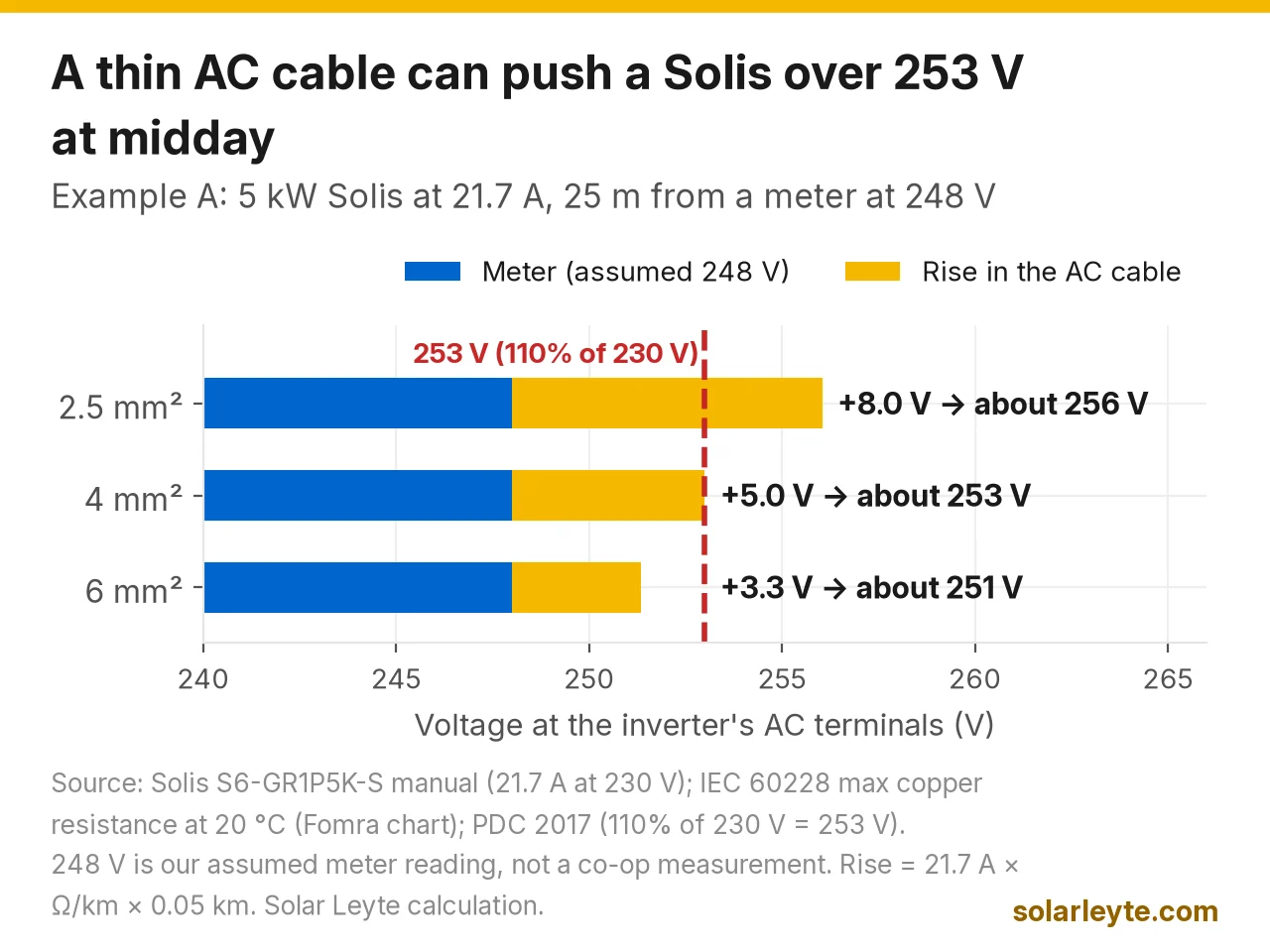
Take a Solis S6-GR1P5K-S (5 kW). Its manual lists a rated output current of 21.7 A at 230 V. Say the inverter is 25 m from the meter, so the current travels 50 m there and back. Using IEC 60228 maximum copper resistance at 20 °C:
AC cable | Resistance (50 m loop) | Voltage rise at 21.7 A | If the meter reads 248 V, the inverter sees |
|---|---|---|---|
2.5 mm² (7.41 Ω/km) | 0.37 Ω | about 8.0 V | about 256 V |
4 mm² (4.61 Ω/km) | 0.23 Ω | about 5.0 V | about 253 V |
6 mm² (3.08 Ω/km) | 0.15 Ω | about 3.3 V | about 251 V |
The 248 V is a figure we picked for the example, not a BILECO or LEYECO measurement. The point: on a high-voltage afternoon, a thin or long AC cable can be the difference between running and tripping on 1010. Solis's grid-tie manual asks for 2.5 to 6 mm² AC cable, total cable resistance under 1 Ω, and 6 mm² if the run is longer than 20 m. Warm cables have a bit more resistance than these 20 °C figures, so real rise is slightly higher.
1015 NO-Grid
During a brownout, 1015 is exactly what should happen. A grid-tie inverter must shut down when the grid is gone (anti-islanding), so linemen aren't hurt by your panels feeding a dead line. It reconnects by itself once power is back. If you have power in the house but the inverter shows NO-Grid, check the solar AC breaker first. Solis's service page for repeated 1015 with a tripping breaker says to check the breaker rating against the recommended size and look for loose connections. The S6-GR1P manual recommends a 30 A breaker for the 5 kW model and 40 A for the 6 kW.
Panel-side (DC) codes
Code | Name | What it means | Who handles it |
|---|---|---|---|
1020 | OV-DC | PV input voltage too high | Installer: too many panels in series |
1021 / 1022 / 1023 | OV-BUS / UNB-BUS / UN-BUS | DC bus voltage problems | Restart once, then installer |
1025 / 1026 | OV-DCA-I / OV-DCB-I | Too much current on MPPT 1 or 2 | Installer: check polarity |
1027 | DC-INTF. | Abnormal DC input current | Installer: damaged or wrong DC wiring |
1028 | Reve-DC | PV wired backwards | Installer |
1033 | PV ISO-PRO01/02 | Low insulation between panels and ground | See below |
1034 | ILeak-PRO01 to 04 | Leakage current | Installer: test strings one by one |
1041 | ARC-FAULT | DC arc detected | Installer, soon: loose or broken MC4, bad junction box |
1033 and 1034 on wet mornings
Solis says if PV ISO-PRO shows only in the early morning, late afternoon or on rainy days, it's usually moisture lowering insulation resistance, and it clears as things dry. If it shows on sunny middays, the installer measures each string's resistance to ground (Solis's guide is above 20 kΩ) and checks for damaged cable, for example where it rubs a roof edge or a rail. Leakage alarms (1034) are tracked down by connecting strings one at a time. Our multimeter testing guide explains the basic checks, but leave live DC testing to a licensed electrician.
Worked example B (illustration): when OV-DC (1020) shows up
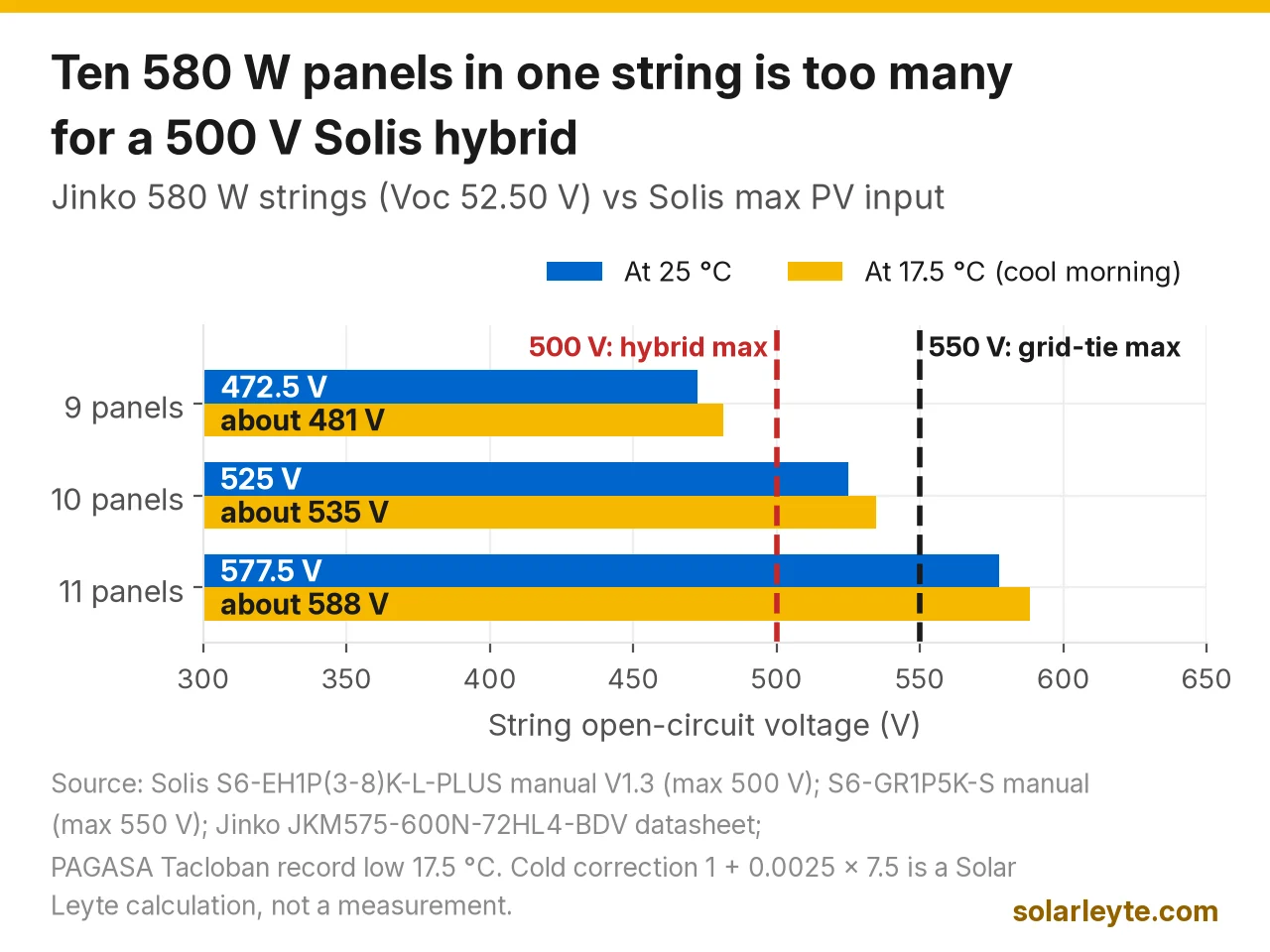
Using the Jinko 580 W panel from our series vs parallel wiring guide (Voc 52.50 V, −0.25% per °C), and PAGASA's 17.5 °C record low for Tacloban for a cool morning:
Panels in one string | Voc at 25 °C | Voc at 17.5 °C | S6-EH1P L-PLUS hybrid (500 V max) | S6-GR1P5K-S grid-tie (550 V max) |
|---|---|---|---|---|
9 | 472.5 V | about 481 V | OK | OK |
10 | 525 V | about 535 V | Over the limit | OK |
11 | 577.5 V | about 588 V | Over the limit | Over the limit |
Those are our calculations. The S6-GR1P manual's fix for OV-DC is to reduce the number of panels in series. Too much DC voltage can damage the inverter, so this one isn't a "wait and see" code.
Inverter-internal codes
- 1032 OV-TEM: too hot inside. Solis's list puts the internal limit near the IGBTs at about 90 °C for single-phase units. Check the inverter isn't in direct afternoon sun or a closed room, then restart after 15 minutes.
- 1031 INI-FAULT, 1035 relay check, 1036 DSP faults, 1037 DC injection, 1038 12 V supply, 1039 leakage sensor, 1048 IGBT overcurrent: restart once. If it comes back, it's for the seller or Solis service. The grid-tie manual lists a 5-year warranty (extendable to 20), so get the serial number and photos ready.
Battery and hybrid codes (S6-EH1P and similar)
Code | Name | What it means | What to check |
|---|---|---|---|
1051 | OV-Vbatt-H / OV-BUS-H | Battery hardware overvoltage | Battery breaker tripped? Battery damaged? |
1053 / 1054 | OV-Vbatt / UN-Vbatt | Battery over or under voltage | Restart once, then installer |
1055 | NO-Battery | Battery not connected | Battery breaker, fuse, battery switched on |
1056 | OV-Vbackup | Backup output voltage too high | Installer checks backup wiring |
1057 | Over-Load | Too much on the backup output | Switch off big loads, restart |
2012 | CAN_Comm_FAIL | No data from the battery BMS | CAN cable, right port, right cable type |
2015 / 2017 | Alarm1-BMS / Alarm2-BMS | The battery's own BMS raised an alarm | Restart the battery |
2016 | BatName-FAIL | Wrong battery brand selected | Installer matches the setting to the battery |
Over-Load (1057) is the one brownout households trigger most. The S6-EH1P manual says the backup load is too large, or a motor load (aircon compressor, water pump) has too big a start-up surge. Turn the big loads off, restart, and add them back one at a time. If it keeps happening, the backup panel needs re-sorting, not a bigger reset button.
For CAN_Comm_FAIL, the hybrid manual says to check the cable, make sure it's in the CAN port on both the battery and the inverter, and use the right cable. Some batteries need a special cable from the battery maker.
Meter codes: 2010 and 2011
2011 MET_Comm_FAIL means the meter communication cable isn't connected, or the wrong meter brand is selected in the inverter. 2010 Failsafe means the inverter lost contact with its export power manager or meter. Both matter if your system is set for zero export or export limits, because without the meter the inverter can't see what your house is using. Our zero-export guide explains why that meter is there.
When to call your installer
Call if the same alarm comes back after one restart, if 1010 happens every sunny day, or for any of these: 1020, 1027, 1028, 1033 on dry days, 1034, 1041, 1051. Have these ready:
- Photos of the alarm, the inverter's serial number label and the breaker board.
- The time of day and weather when it happens.
- For 1010: any voltage readings shown in the app around noon.
If it's a supply problem (voltage high or low most of the day), your co-op is the one to fix it. We've covered what voltage swings do to appliances too. Choosing a new inverter? See Deye vs Solis vs SRNE or our hybrid vs grid-tie guide, or ask us for a quote.
FAQ
Is Solis error 1010 dangerous?
Usually not. It's the inverter protecting itself and the grid by stopping export when voltage is high. It restarts on its own. It's a problem only if it happens every day, because you lose solar output. Then the installer checks wiring, cable size and the grid standard.
Why does my Solis say NO-Grid when there's no brownout?
Check the solar AC breaker and the AC connector first. If both are fine, the installer should measure the voltage at the inverter's AC terminals and check the grid standard setting.
Ano ang ibig sabihin ng 1015 NO-Grid sa Solis?
Wala siyang nakikitang kuryente galing sa grid. Normal ito kapag brownout, kasi kailangan talagang mag-off ang grid-tie inverter para safe ang mga lineman. Babalik siya kusa pag may kuryente na. Kung may ilaw naman sa bahay pero NO-Grid pa rin, i-check ang breaker ng solar.
Can I reset a Solis inverter myself?
You can switch it off, wait 5 minutes and switch it back on once. That's the reset Solis's manuals describe. Don't change grid or protection settings yourself; Solis says those changes need the power operator's approval.
Solar Leyte is run by MACC Systems & Energy Solutions Inc., a solar installer in Naval, Biliran.
Get a free solar quote from MACC
Is your inverter tripping all the time, or are you planning a grid-tie or hybrid system? Send us a recent BILECO or LEYECO bill and we'll get back to you with a free, no-obligation written quote.
- Call/Text: 0955 723 5093
- Email: official@macc-inc.com
- Website: www.macc-inc.com
- Or use the site quote form: /quote
Related guides
- Grid-tie vs hybrid vs off-grid solar: which works in a brownout?
- Deye inverter error codes
- Growatt inverter error codes
- LuxPower error codes
- Solar inverter not turning on
- Grid-tie inverter prices in the Philippines
Sources (all checked 15 November 2026)
- Solis North America service centre, Solis Inverter Alarm Codes (Complete List) (modified 25 Apr 2025): operating and warning messages (Waiting, LimByVg, LimByEPM, Surge Alarm); grid-tie alarm codes 1010–1059 incl. OV-G-V01–05 definitions, 1015 NO-Grid steps, 1029/1033 insulation guide (above 20 kΩ; morning, evening and rainy-day alarms), 1032 OV-TEM (about 90 °C for single-phase), 1034 leakage; energy-storage codes 1051–1057, 2010 Failsafe, 2011 MET_Comm_FAIL, 2012 CAN_Comm_FAIL, 2014–2019; only trained electricians should diagnose and repair.
- Solis, S6-GR1P(2.5-6)K-S single-phase grid inverter user manual, V1.0 (PDF): AC cable 2.5–6 mm², cable resistance under 1 Ω, 6 mm² over 20 m (4.3.2); breaker ratings 30 A for 5 kW and 40 A for 6 kW (Table 4.3); troubleshooting Table 8.1 (1010–1048) and the "turn off and wait 5 minutes" note; S6-GR1P5K-S: max DC input 550 V, start-up 100 V, rated output current 22.7/21.7 A at 220/230 V; 5-year warranty, extendable to 20.
- Solis, S6-EH1P(3-8)K-L-PLUS hybrid inverter user manual, V1.3, April 2026 (PDF): alarm table (OV-G-V, NO-Grid, NO-Battery, Over-Load, CAN Fail, BatName-FAIL, OV-DC, PV ISO-PRO, OV-Vbatt-H); grid voltage range 187–253 V; max PV input 500 V.
- Solis service centre, 1010 – OV-G-V01 to 05 and 1015 – NO-GRID (AC MCB tripping): service steps (frequency of alarms, voltage comparison, loose contacts, grid standard, cable length and size, breaker rating).
- Solis service centre, Full Alarm Code Maintenance Overview: Tip / General / Emergency grades.
- Energy Regulatory Commission, Philippine Distribution Code 2017 Edition (PDF copy): 60 Hz nominal, 59.7–60.3 Hz (3.2.2); overvoltage at or above 110% for more than 1 minute and the utility's duty to prevent it at connection points (3.2.3.3–3.2.3.4); micro plants up to 10 kW (Table 4-1); small and micro plants stay connected within ±10% (4.9.1.2).
- UD Fomra Group, Cable conductor resistance chart (IEC 60228): copper maximum DC resistance at 20 °C, 2.5 mm² 7.41 Ω/km, 4 mm² 4.61 Ω/km, 6 mm² 3.08 Ω/km.
- JinkoSolar JKM575–600N-72HL4-BDV datasheet (PDF): 580 W Voc 52.50 V, Voc temperature coefficient −0.25%/°C.
- PAGASA, Tacloban climatological extremes (PDF): record low 17.5 °C.
- Worked examples A and B: Solar Leyte illustrations built from the figures above, not real cases. Cable loop resistance (7.41 / 4.61 / 3.08 Ω/km × 0.05 km = 0.37 / 0.23 / 0.15 Ω), voltage rise at 21.7 A (about 8.0 / 5.0 / 3.3 V), the 248 V meter reading (our assumption) and string voltages (9 × 52.50 = 472.5 V, about 481 V at 17.5 °C; 10 × 52.50 = 525 V, about 535 V; 11 × 52.50 = 577.5 V, about 588 V) are our calculations.