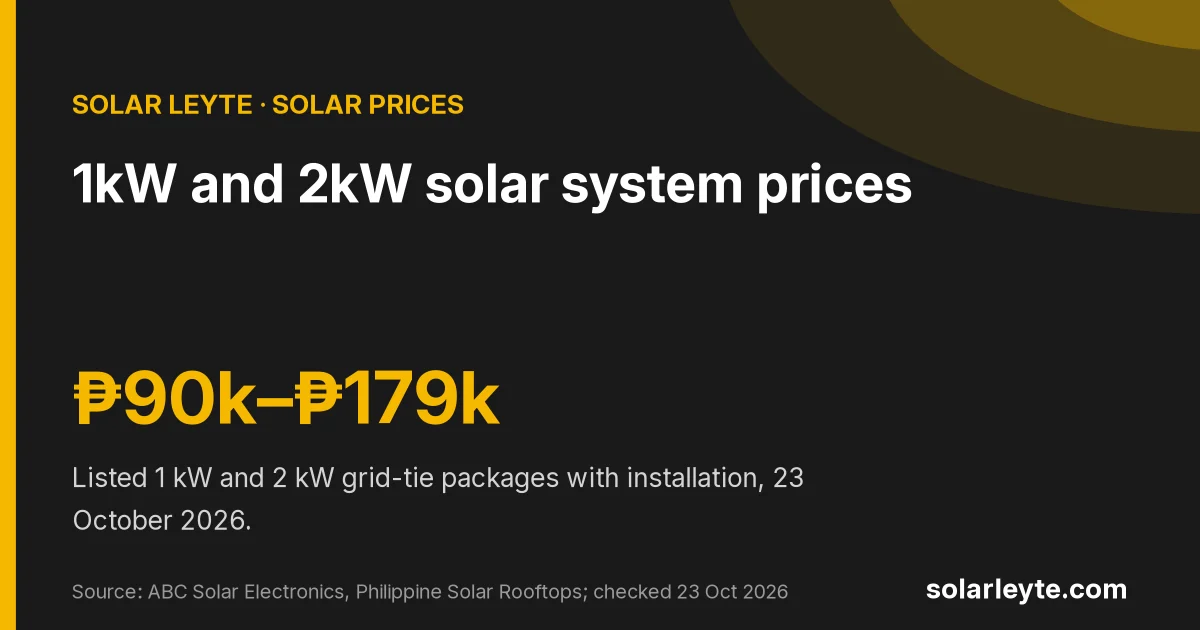
On 23 October 2026, Philippine sellers listed complete 1 kW grid-tie solar packages at about ₱90,000 to ₱117,600, and 2 kW packages at about ₱171,000 to ₱179,200 (with VAT added where the seller lists it separately). The core parts for a 1.1 kWp setup (two 550 W panels and a small grid-tie inverter) came to about ₱29,900, and about ₱38,800 for 2.2 kWp. The catch: small systems cost much more per watt. At Phsolar, a 3.3 kWp package started at ₱168,000, so a 2 kW package can cost about the same as a 3 kW one.
Last checked: 23 October 2026
This post covers normal 230 V rooftop systems for a house. If you want a 12 V panel and battery kit for lights and a fan, read our small solar panels post. If you're thinking of a plug-in setup under 1 kW, the new DOE rules for those are in our plug-and-play and zero-export post.
1kW and 2kW solar system prices: listed packages (October 2026)
These are complete packages with installation, as the sellers list them. ABC Solar Electronics (Cebu) says its prices are VAT exclusive, so we added 12% VAT to compare fairly. Philippine Solar Rooftops lists prices for Metro Manila installs only, and net metering isn't included.
Package (as listed) | Seller | Listed price | With 12% VAT | ₱ per watt |
|---|---|---|---|---|
1 kW grid-tie | Philippine Solar Rooftops (Metro Manila) | ₱90,000 | as listed | ₱90 |
1 kW grid-tie | ABC Solar Electronics | ₱105,000 + VAT | ₱117,600 | ₱118 |
1.6 kW grid-tie | ABC Solar Electronics | ₱125,000 + VAT | ₱140,000 | ₱88 |
2 kW grid-tie | Philippine Solar Rooftops (Metro Manila) | ₱171,000 | as listed | ₱86 |
2 kW grid-tie | ABC Solar Electronics | ₱160,000 + VAT | ₱179,200 | ₱90 |
"3KW Hybrid" (3 × 615 W panels = 1.85 kWp, 24 V 200Ah battery) | CEED Solar (Cagayan de Oro) | ₱135,000 | as listed | ₱73 per panel watt |
For comparison: 3.3 kWp grid-tie (smallest variant) | Phsolar | ₱168,000 | as listed | ₱51 |
For comparison: 3 kW grid-tie | Philippine Solar Rooftops (Metro Manila) | ₱231,500 | as listed | ₱77 |
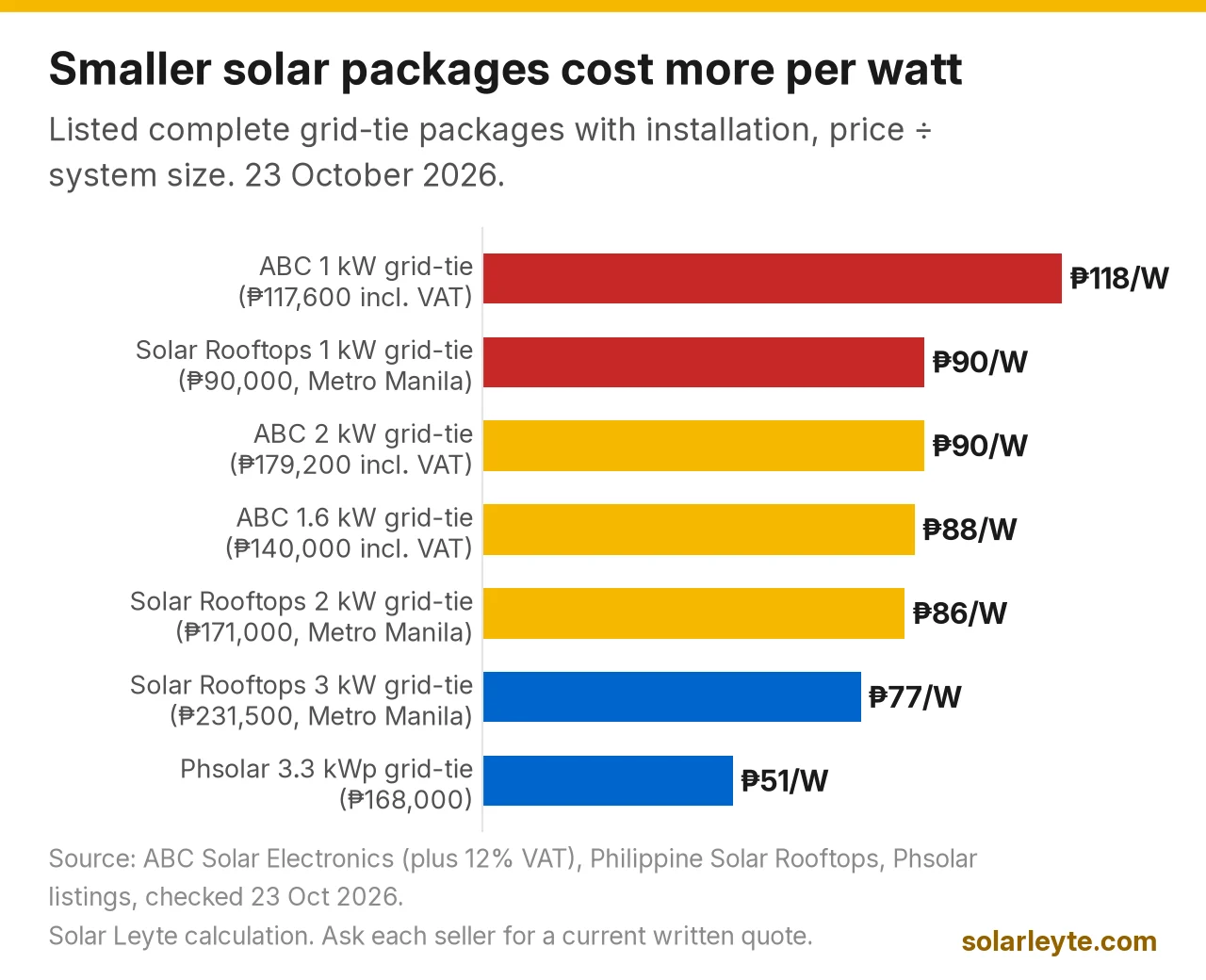
₱ per watt is our math: price ÷ system size. The CEED package is called "3KW" because of its 3 kW inverter, but its three 615 W panels add up to only about 1.85 kWp, so we put it here. CEED says final pricing is confirmed after a site assessment.
A few things to check before you trust any of these:
- ABC's package photos are in a 2017 upload folder on its site, and its savings claims (₱800–₱1,200 a month for 1 kW) look like they come from older electricity rates. Ask for a current, written quote.
- ABC says its 1 kW package makes "an average of 150Kwhr/month." That's more than the PVGIS model below gives for Naval. Plan with the lower number.
- Bigger sellers often start at 3 kW or more. On 23 October, GetSolar's smallest listed package was a 5 kW hybrid at ₱265,000, and Takiyo's smallest was a 3 kW hybrid at ₱270,000.
Why a small solar system costs more per watt
Panels are cheap now. On 23 October, ABC listed a LVTOPSUN 550 W panel at ₱4,200. The expensive part of a small system is everything that doesn't shrink with it: the inverter, the breakers and surge protection, the rails, the electrician's day on your roof, the electrical permit and paperwork, and delivery.
Small inverters show this clearly. Solar Hub PH listed a Solis Mini 1000 W grid-tie inverter at ₱21,500 and a Solis Mini 3000 W at ₱30,000. So you get three times the inverter for 40% more money. LakaSolar listed a Deye 3.6 kW grid-tied inverter at ₱22,000, about the same price as the 1 kW Solis.
Parts build-up for 1.1 kWp and 2.2 kWp
These are the main parts only, at listed prices on 23 October 2026. They don't include rails and clamps, PV cable and connectors, DC and AC breakers, surge protection, grounding, labour, or the electrical permit and CFEI.
Setup | Panels | Inverter | Battery | Main parts total |
|---|---|---|---|---|
1.1 kWp grid-tie | 2 × LVTOPSUN 550 W (ABC), ₱8,400 | Solis Mini 1000 W (Solar Hub PH), ₱21,500 | none | ₱29,900 |
2.2 kWp grid-tie | 4 × LVTOPSUN 550 W (ABC), ₱16,800 | Deye 3.6 kW grid-tied (LakaSolar), ₱22,000 | none | ₱38,800 |
2.2 kWp grid-tie, alternative | 4 × LVTOPSUN 550 W, ₱16,800 | Solis Mini 3000 W (Solar Hub PH), ₱30,000 | none | ₱46,800 |
2.2 kWp with brownout backup | 4 × LVTOPSUN 550 W, ₱16,800 | Axpert VM II 3 kVA 24 V (ABC), ₱35,000 | HIGEE120 25.6 V 120Ah, 3 kWh (LakaSolar), ₱24,000 | ₱75,800 |
The gap between ₱30,000–₱76,000 in parts and ₱90,000–₱180,000 for a package pays for the balance of system, labour, design, permits, warranty handling and the seller's margin. If you're comparing parts against packages, the 3kW price post itemises the rails, cable and breakers too.
Before you buy the backup setup, ask the seller to confirm in writing that the Axpert's PV input can take your 2.2 kWp array. Also note that a grid-tie inverter switches off during a brownout. That's a safety rule so it doesn't push power into the lines while linemen are working. Only the battery setup keeps your fridge running when BILECO is down.
How much a 1.1 kWp and a 2.2 kWp system make in Naval
We ran the EU's PVGIS 5.3 calculator for Naval, Biliran (11.56°N, 124.40°E). Settings: panels tilted 12° facing south, 14% system losses, and PVGIS-ERA5 weather data.
System | PVGIS per year | PVGIS average per month | Lowest month (July) | Highest month (March) | Our planning figure per month |
|---|---|---|---|---|---|
1.1 kWp | 1,636 kWh | 136 kWh | 124 kWh | 161 kWh | 116 kWh |
2.2 kWp | 3,272 kWh | 273 kWh | 248 kWh | 322 kWh | 231 kWh |
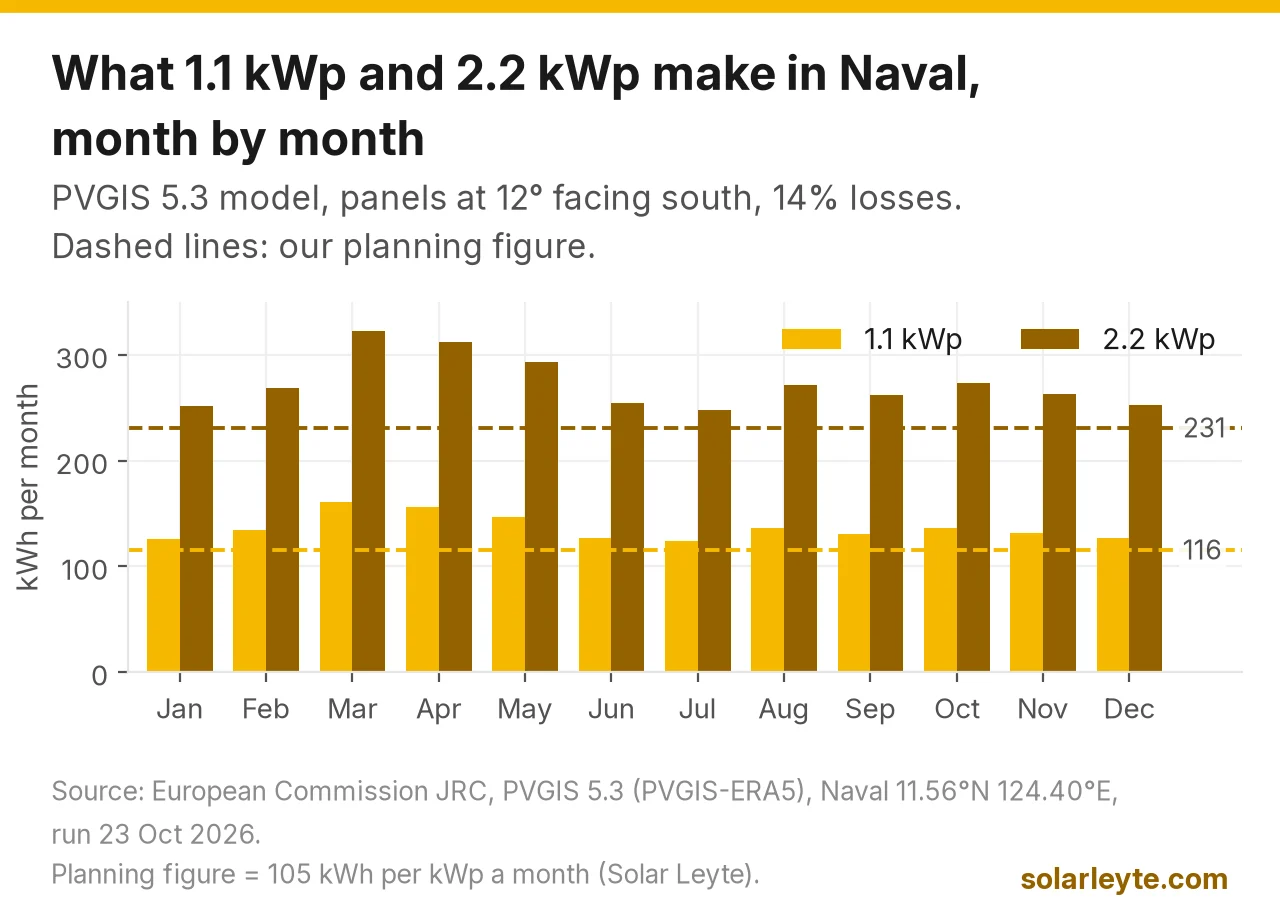
The planning figure uses 105 kWh per kWp a month. That's lower than PVGIS on purpose, to allow for dust, shade, heat and cloudy weeks. We use the same number in how many solar panels do I need.
What 1 kW and 2 kW can run and save at BILECO rates
BILECO's residential rate for September 2026 was ₱18.93 per kWh on ICSC's PRESYO-PH tracker. Every kWh of solar you use at home saves you that.
Worked example 1: a 1.1 kWp grid-tie system on a daytime home (our example). Assumptions: someone is home in the daytime. From 8 AM to 4 PM the house runs a frost-free ref (about half of its 27 kWh a month, so 0.45 kWh a day), three stand fans for 8 hours (1.14 kWh), a 43-inch TV for 4 hours (0.28 kWh), Wi-Fi (0.05 kWh) and one rice cooker cycle (0.34 kWh). That's about 2.3 kWh a day, or 68 kWh a month. Appliance figures are from our appliance kWh guide.
- Solar made: about 116 kWh a month (planning figure)
- Used at home: about 68 kWh a month × ₱18.93 = about ₱1,290 saved a month
- Left over: about 48 kWh a month. With zero export it's wasted. Under net metering it's credited at the blended generation charge, which PRESYO-PH listed at ₱9.50/kWh for BILECO in September 2026. That's worth about ₱456, if you've gone through the net-metering process.
- Simple payback on the ABC 1 kW package (₱117,600 with VAT): about 7.6 years. On the ₱90,000 listing, about 5.8 years. With net-metering credits for the extra 48 kWh, about 5.6 and 4.3 years.
Worked example 2: a 2.2 kWp system on a home that uses it all (our example). Assumptions: a family home with an inverter aircon or a sari-sari store freezer running in the daytime uses all 231 kWh a month of solar on site.
- 231 kWh × ₱18.93 = about ₱4,373 saved a month
- Simple payback on the ₱171,000 Metro Manila listing: about 3.3 years. On ABC's ₱179,200: about 3.4 years.
- The same household on Phsolar's ₱168,000 3.3 kWp package would make about 347 kWh a month (planning figure). If it uses all of that, the saving is about ₱6,560 a month, a payback of about 2.1 years.
Payback here is price ÷ monthly saving, ignoring repairs, panel ageing and rate changes. The big lesson: if your daytime use is low, a 1 kW system pays back slowly. If you use your solar power during the day, 3 kW is often the better buy for almost the same money.
So should you get 1 kW, 2 kW or 3 kW?
- 1 kW makes sense if your daytime use is small and steady (ref, fans, TV, Wi-Fi) and your budget is tight. Get a plug-in setup instead if you only want to start small; see the plug-and-play post.
- 2 kW fits a home that runs one big daytime load, like an aircon for a few afternoon hours or a store freezer. Check our solar aircon guide for that.
- 3 kW is often the sweet spot on price per watt. If a 2 kW quote is within ₱10,000–₱20,000 of a 3 kW quote, ask for both.
Need brownout backup? Budget for a battery and a hybrid or off-grid inverter. Prices for those are in our solar battery price post.
FAQ
How much is a 1kW solar system in the Philippines? On 23 October 2026, complete 1 kW grid-tie packages were listed at ₱90,000 (Metro Manila) and ₱105,000 plus VAT (₱117,600) at ABC Solar Electronics. The main parts alone (two 550 W panels and a 1 kW inverter) came to about ₱29,900.
How much is a 2kW solar system with installation? ₱171,000 at Philippine Solar Rooftops (Metro Manila) and ₱160,000 plus VAT (₱179,200) at ABC Solar Electronics on 23 October 2026. That's close to a 3.3 kWp package at ₱168,000, so compare both sizes.
How many kWh does a 1kW solar system produce per day? In Naval, PVGIS models about 4.5 kWh a day on average for 1.1 kWp. Plan with about 3.9 kWh a day to allow for real-world losses.
Can a 1kW solar system run a ref and electric fans? Yes, in the daytime. In our example, a ref, three fans, a TV and Wi-Fi use about 2.3 kWh between 8 AM and 4 PM, which a 1.1 kWp system covers on most days. At night, or during a brownout, a grid-tie system can't run them. You need a battery for that.
Is 1kW solar worth it? Only if you use the power at home in the daytime. Our example home saves about ₱1,290 a month at BILECO's ₱18.93/kWh, which works out to a payback of about 6 to 8 years on today's 1 kW package prices, or less if you get net-metering credits for the extra.
Solar Leyte is run by MACC Systems & Energy Solutions Inc., a solar installer in Naval, Biliran.
Get a free small solar system quote from MACC
Thinking 1 kW, 2 kW or 3 kW? Send us a photo of your latest BILECO or LEYECO bill and tell us what you run in the daytime and whether you need brownout backup. We'll size the system, list every part by brand and model, and show you the savings math, with no obligation.
- Call/Text: 0955 723 5093
- Email: official@macc-inc.com or benjie@macc-inc.com
- Website: www.macc-inc.com
- Request a quote online: solarleyte.com/quote
- Office: Brgy. Talustusan, Naval, Biliran 6543
Sources (all checked 23 October 2026)
- ABC Solar Electronics: 1 kW grid-tie package (₱105,000, VAT exclusive, "150Kwhr/month"), 1.6 kW grid-tie package (₱125,000), 2.0 kW grid-tie package (₱160,000), LVTOPSUN 550 W panel (₱4,200), Axpert VM II 3 kVA 24 V (₱35,000)
- Philippine Solar Rooftops: package prices (1KW ₱90,000; 2KW ₱171,000; 3KW ₱231,500; Metro Manila installs, net metering not included)
- CEED Solar: packages ("3KW Hybrid Package", ₱135,000, 3 × 615 W panels and a 24 V 200Ah battery)
- Phsolar: Complete Package – Grid Tie (₱168,000–₱477,000; smallest variant 3.3 kWp)
- GetSolar Philippines: store (5 kW hybrid, ₱265,000); Takiyo Japan: Takiyo Essential 3 kW (₱270,000)
- Solar Hub PH: Solis Mini 1000 W (₱21,500) and Solis Mini 3000 W (₱30,000)
- LakaSolar: Deye 3.6 kW grid-tied inverter (₱22,000) and HIGEE120 25.6 V 120Ah battery (₱24,000)
- European Commission JRC: PVGIS 5.3 (Naval 11.56°N, 124.40°E; 1.1 and 2.2 kWp; 12° tilt, south, 14% losses; PVGIS-ERA5)
- ICSC: PRESYO-PH national table (BILECO residential ₱18.93/kWh and blended generation ₱9.50/kWh, September 2026)
- Appliance kWh figures: Solar Leyte appliance kWh guide (DOE energy labels and Meralco tests)